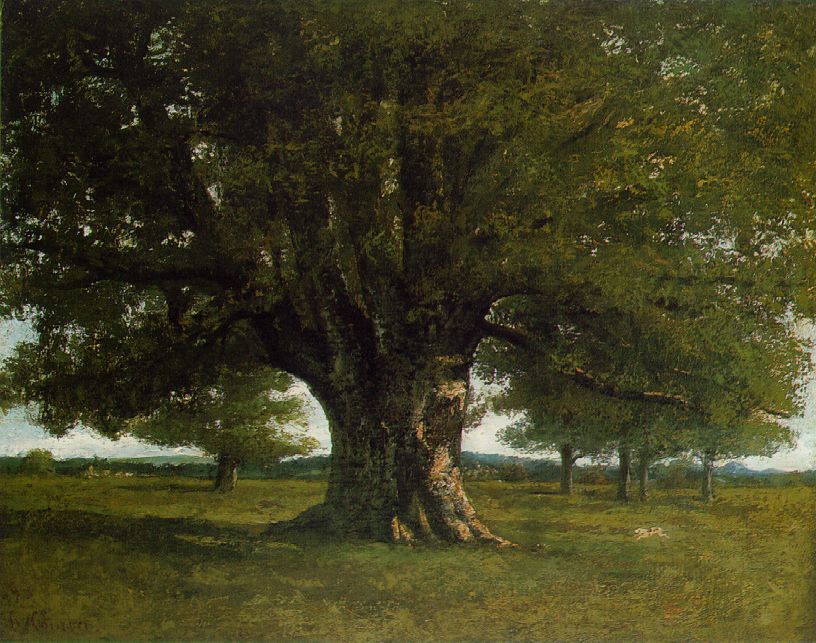
The Oak of Flagey by Gustave Courbet, 2013.1.1 Murauchi Art Museum reproduction, via Wikimedia Commons. Image source. Public domain.
 by Tom Gurney
Tom Gurney BSc (Hons) is an art history expert with over 20 years experience
Email: tomgurney1@gmail.com / Phone: +44 7429 011000
The Oak of Flagey: Introduction
The first thing that catches the light in Gustave Courbet’s The Oak of Flagey is a strip of bark on the right side of the trunk. The ground on the other side is already in shadow. Above, the limbs run sideways into a crown so wide that the upper edge of the canvas cuts it off. It takes a moment to see the small brown hare to the left of the trunk and the pale dog to the right. The eye comes back to the tree with a better sense of how much space it occupies. [1] [2]
Courbet signed and dated the painting at the lower left in 1864. It is oil on canvas mounted on wood, and belongs to the Department of the Doubs. The Musée Gustave Courbet in Ornans holds it under inventory number 2013.1.1. The collection record also gives a longer name that Courbet used when he exhibited it in Paris three years later, which brings the Gaulish leader Vercingétorix and Caesar’s camp near Alésia into the picture. [1] [2] [3]
At a Glance
- Date1864
- MediumOil on canvas
- CollectionMusée Courbet, 2013.1.1
Contents
- How Courbet gives the tree its size
- What changed while Courbet painted
- Flagey before Alésia
- What the title meant in 1867
- From Philadelphia and Japan back to the Doubs
How Courbet gives the tree its size
The trunk rises almost from the centre. At its base the roots spread into the grass, their outlines clearest where sunlight falls on the right. The opposite side darkens into the ground shadow, which stretches towards the left edge. Follow the trunk upwards and its outline becomes harder to hold. One thick limb reaches out almost horizontally on the left. On the right, a lower branch crosses in front of lighter foliage before the two merge. Pale flecks open little intervals in the canopy, though most of the sky is visible underneath it, in the gaps on either side of the trunk. That distribution of light keeps the eye moving between the weight of the limbs and the air around them. [1] [2]
There is a broad view behind the oak. An isolated tree stands to the left, and a small group stands to the right. Their trunks give the eye something to measure against the dark column in front. The ground runs back to a low strip of woods, buildings and distant rises, where the colours cool and the shapes lose their edges. Courbet places the horizon low enough to see the open country beneath the branches. We can take in the distance without the oak ever looking like one tree among many. [1] [2]
The chase is easy to miss because it unfolds close to the ground. The hare’s brown shape almost disappears into the sunlit grass. The dog is lighter, and the open stretch between the two animals lets us register their movement across the field. In a painting organised around a stationary subject, the chase gives the foreground a brief action of its own. It also supplies a scale the background trees can only suggest. The dog and hare run close enough to the oak for the spreading roots alone to look substantial beside them. [1] [2]
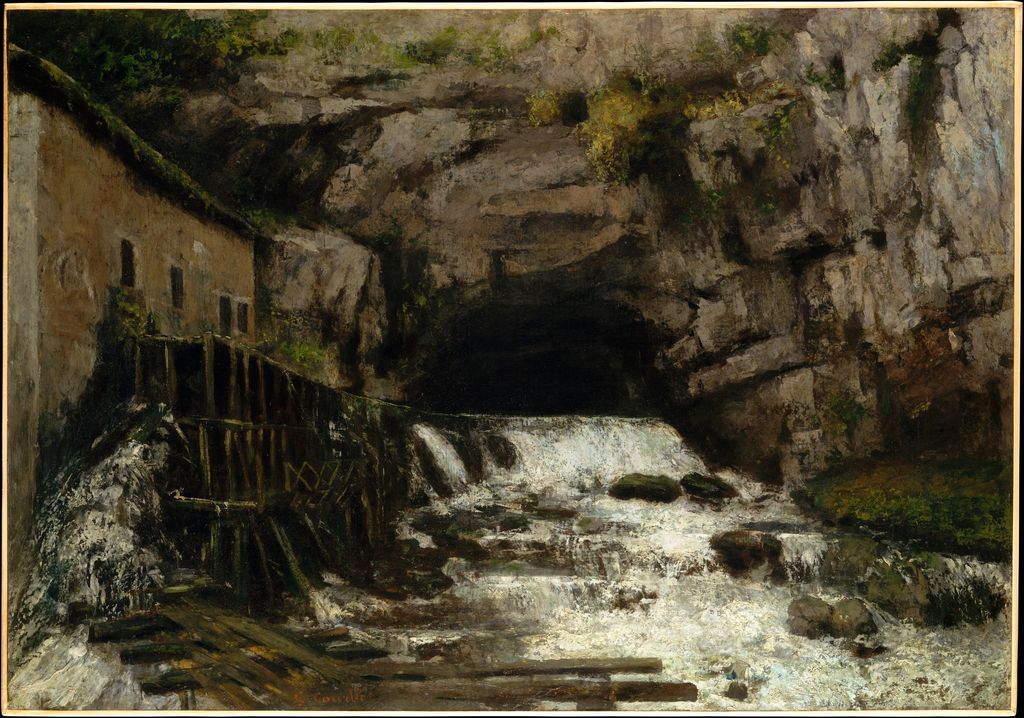
The Source of the Loue, Met 29.100.122. Image source. CC0 / Public domain. Resized from the complete source image.
What changed while Courbet painted
The scale of the tree was partly a decision made on the canvas. The Musée Courbet’s study, drawing on a 2012 examination by the Centre de recherche et de restauration des musées de France, reports that Courbet broadened the left side of the trunk considerably. A small standing figure in a hat was sketched to the right of the tree and left out of the finished painting. The museum suggests that this figure would have given viewers a human measure of the oak’s size. In the finished scene, the animals give a sense of scale while leaving the tree without a person beside it to direct our attention. [2]
The study also describes a reddish-orange preparation and distinguishes two ways Courbet fitted the tree into the landscape. He painted the sky and ground while reserving space for the trunk and main branches, then worked the finer growth and foliage over the sky. The museum identifies thick passages applied by brush and knife. Look at the rough, bright marks on the right of the trunk and the softer border where leaves meet air. The changes in the way paint meets paint help separate the surfaces of bark and leaf. The sharply lit side of the trunk can remain distinct while parts of the crown seem to dissolve into the light. [1] [2]
Flagey before Alésia
Courbet’s family had a home in Flagey. His father’s farm there had belonged to his grandfather, and the village was a place he could stop on the way to his studio in Ornans. In December 1864, writing from Salins to the critic Jules Castagnary, Courbet proposed showing him Poupet, Alaise, Nans and the source of the Lison. The plan was to visit his mother and stay the night in Flagey before continuing to Ornans. That itinerary puts the village amid the places he thought worth showing a friend, with a family visit fitted into the journey. [3] [4]
Courbet had already used the village name in The Peasants of Flagey Returning from the Fair. The earlier painting, held in Besançon, takes its scale and movement from the cattle, riders and people on foot spread across a road. The oak is another way of singling out a feature of this countryside. A viewer of the fair picture can follow a group moving across a landscape made familiar by travel and work. In the oak painting, the viewer comes up close to a single landmark, with the field and the distant settlement left visible around it. The shared place name tells us where Courbet wanted attention to settle in two very different compositions. [1] [2] [5]
What the title meant in 1867
Courbet showed the painting at his independent exhibition at the Rond-Point du Pont de l’Alma in Paris in 1867, held in parallel with the year’s Universal Exhibition. The Musée Courbet gives the title used on that occasion as Chêne de Vercingétorix, camp de César près d’Alésia, Franche-Comté, or Vercingétorix’s Oak, Caesar’s Camp near Alésia, Franche-Comté. The current Joconde record preserves a shorter form without the final regional name and lists the Alma exhibition. The words Franche-Comté in the museum’s account of the historical title matter. They locate the reference in a region then putting forward a rival claim to the site of Caesar’s victory. [2] [3] [6]
In 52 BCE, Vercingétorix led a Gaulish coalition against Julius Caesar and was besieged at Alésia. The nineteenth-century dispute concerned where that fortified settlement had stood. The architect Alphonse Delacroix proposed Alaise, south of Besançon, in a presentation to the Société d’émulation du Doubs in 1855. Others defended the older identification with Alise-Sainte-Reine in the Côte-d’Or. Napoleon III backed excavations at Alise-Sainte-Reine in the 1860s and commissioned Aimé Millet’s statue of Vercingétorix, erected there in 1865. The archaeological commission uncovered siege ditches and weaponry. Further work in the 1990s corroborated the nineteenth-century findings, including the lines of the Roman siege. [7] [8]
Courbet already knew about the dispute in the year he painted the oak. In the letter to Castagnary he describes the planned stop at Alaise with a playful reference to those who called it Alésia, invoking the Druids. The letter shows he was willing to play with the identification in private. The exhibition title makes the association publicly and explicitly gives it a regional setting. The Musée Courbet reads that gesture as a challenge to the imperial preference and an assertion of regional identity. The letter gives that reading some contemporary footing, though its joking register leaves Courbet’s private degree of conviction uncertain. The title gives the landscape a stake in the dispute. It supplies no archaeological evidence for a siege at Flagey or Alaise, and no basis for dating the tree to Caesar’s time. [2] [4] [7] [8]
The title also changes what an exhibition visitor might look for. A conventional battle picture could give the viewer a commander, a surrender or a line of fortifications. Courbet leaves the field to a hare and a dog, and the oak takes the place an imposing figure might occupy. The Musée Courbet has also suggested that the tree can be read as an indirect self-portrait of a painter rooted in his region. The reading gains force from the closeness and individuality with which he paints the tree, and from the importance of Flagey in his life. It remains an interpretation of how the picture works. The title’s clearest intervention is to attach names from national history to a tree in a landscape Courbet knew. [1] [2] [4] [5]
From Philadelphia and Japan back to the Doubs
Courbet entrusted the painting to the dealer Paul Durand-Ruel in April 1872. According to the Musée Courbet’s acquisition history, it sold in August to the Philadelphia businessman Henry C. Gibson for 6,000 francs. After Gibson’s death the picture entered the collection of the Pennsylvania Academy of the Fine Arts. The Academy’s registrar files still list the painting under its English collection titles, Oak at Flagey and The Great Oak of Flagey. Those names kept the village attached to the canvas for an American audience, while leaving the old controversy over Alésia out of the title. [3] [9] [10]
The Academy held the painting for much of the next century. The Musée Courbet traces its next sale to Sotheby’s in New York in 1987, where the Japanese businessman Michimasa Murauchi bought it. It became part of his collection in Japan. In 2000 the painting appeared in Gustave Courbet et la Franche-Comté in Besançon, years before the Department of the Doubs acquired it. That exhibition brought the canvas back to the region temporarily while it was still in private hands. [3] [9]
When Murauchi announced in 2012 that he intended to part with the work, the Department of the Doubs launched a public subscription. The museum records about 1,500 private donors, alongside corporate sponsorship and public grants. Joconde dates the purchase to January 2013 and identifies the department as owner. The museum records the hanging in Ornans on 9 March of that year. The acquisition put a landscape named for Courbet’s family village in a public collection a short distance away. The title that once asked Parisians to imagine Alésia in Franche-Comté now belongs to a painting that is held in the region where Courbet found its subject. [2] [3] [9]
Courbet artworks directory
Browse the paintings covered in this guide. Dates identify the specific versions discussed.
Discussion
Look again at the images and ideas explored in The Oak of Flagey. These editorial prompts invite your observations.
Reader Insights
Which details give the oak its scale?
How does the Vercingétorix title change the way you read the landscape?
What does the painting’s ownership history tell you about its return to Ornans?
Join the Conversation
Share a detail, comparison or question about The Oak of Flagey below.
References
- Musée départemental Gustave Courbet, Devenir Courbet, with Pierre Guenat’s reproduction of Le Chêne de Flagey, 1864, inv. 2013.1.1 View source.
- Musée départemental Gustave Courbet, La nature comme tableau, Les carnets du musée Gustave Courbet, no. 2, pp. 9–10 View source.
- Ministère de la Culture, Joconde, Le Chêne de Flagey dit aussi Chêne de Vercingétorix, camp de César près d’Alésia, M0339000534 View source.
- Gustave Courbet, letter to Jules Castagnary, Salins, 14 December 1864, French text reproduced in the Musée Courbet’s Parcours de la Cuderie View source.
- Musée départemental Gustave Courbet, The Courbet Family and Flagey View source.
- Bibliothèque nationale de France, Exposition des oeuvres de M. G. Courbet. Rond-point du pont de l’Alma, Paris, 1867, catalogue record View source.
- Ministère de la Culture and Musée d’Archéologie nationale, The Alesia Question, with the excavation plans of the Commission de Topographie des Gaules View source.
- Ministère de la Culture and Musée d’Archéologie nationale, L’action de Napoléon III View source.
- Musée départemental Gustave Courbet and Institut Gustave Courbet, Acheter Courbet, acquisition history and reproduction View source.
- Pennsylvania Academy of the Fine Arts Archives, Works No Longer in Collection, registrar finding aid RG.02.03.02, box 3, folder 35 View source.