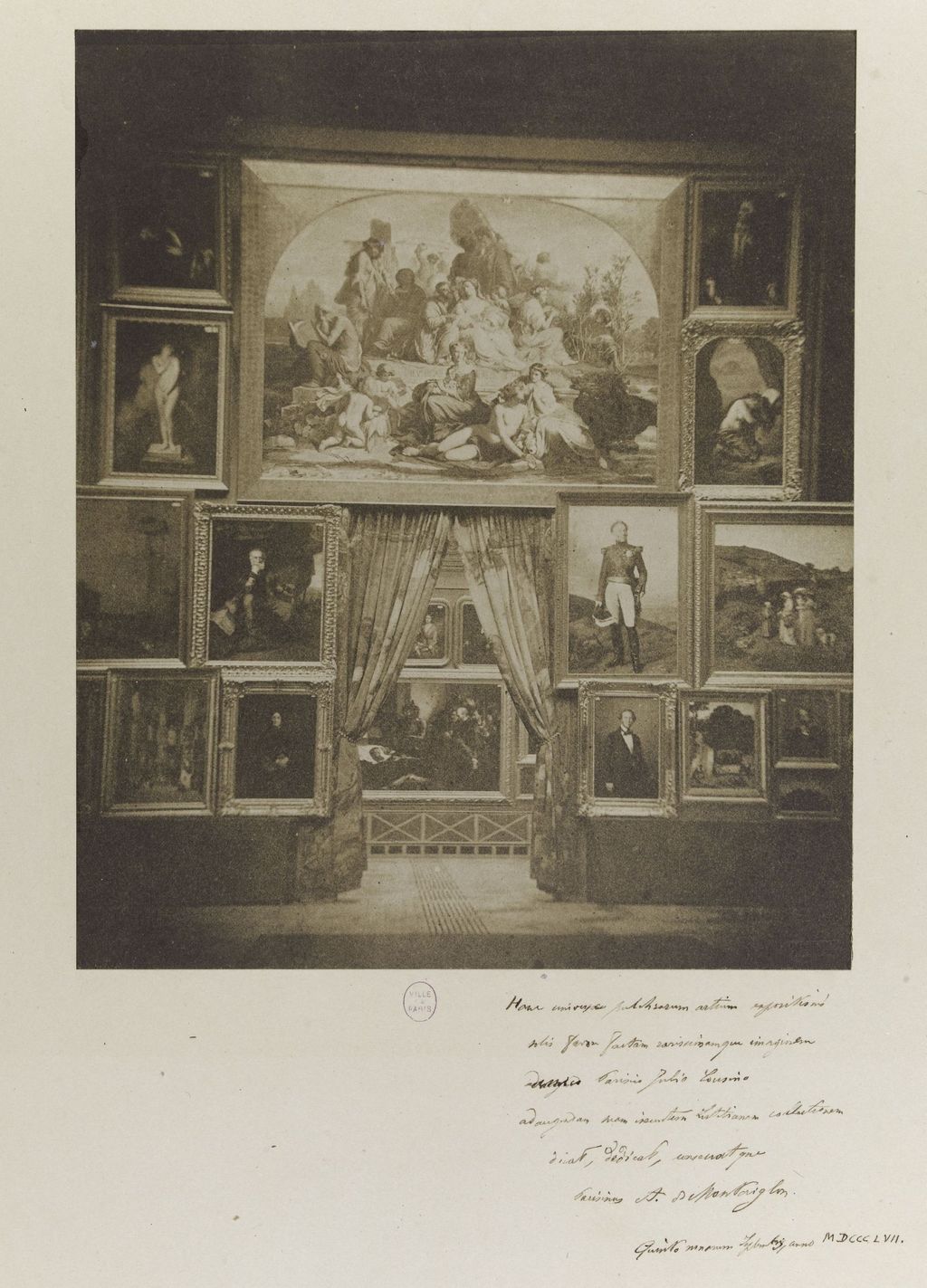
Salon de peintures, 1857, photograph by Gustave Le Gray Paris Musées / Musée Carnavalet. Image source. CC0 / Public domain.
 by Tom Gurney
Tom Gurney BSc (Hons) is an art history expert with over 20 years experience
Email: tomgurney1@gmail.com / Phone: +44 7429 011000
Gustave Courbet’s Salons and Independent Exhibitions: Introduction
In Paris in 1855, visitors to the Universal Exhibition could see Gustave Courbet’s The Meeting at the official fine arts exhibition. To see his enormous Painter’s Studio, they had to go to a separate building on the avenue Montaigne and pay Courbet’s admission charge. One picture showed the artist meeting his collector on a road near Montpellier. In the other, Courbet placed himself at an easel in the middle of a room filled with people. Both pictures made the painter conspicuous, but only one of them had secured a place in the official exhibition. Twelve years later, The Meeting appeared again in Paris, this time in Courbet’s own exhibition near the Pont de l’Alma. Its passage from one venue to another shows how Courbet used both kinds of exhibition over the course of his career. [1] [2] [3]
At a Glance
- Pavilion of RealismParis, 1855
- Second independent exhibitionPont de l’Alma, Paris, 1867
Contents
- From the Louvre to the Tuileries
- The Salon of 1850–51
- The official Universal Exhibition of 1855
- The Pavilion of Realism and its catalogues
- Back at the Salon and out to the Alma
From the Louvre to the Tuileries
Courbet’s first painting accepted at the Salon was his Self-Portrait with a Black Dog, shown in 1844. The Petit Palais dates the picture to 1842–44 and treats the inscribed date of 1842 with caution. The exhibition year is secure. The picture presents a young man in the countryside, seated with a pipe, a walking stick, a book or sketchbook and a black spaniel. It is small enough to have an intimate effect. The close view and low vantage point let the painter meet the spectator’s eye with a confidence that the size of the canvas alone would hardly suggest. Courbet had found a way to give himself a public presence before he started working on the scale of his later group pictures. [4]
The Salon had an institutional identity that outlasted any one of its buildings. The 1848 catalogue names the Musée national du Louvre, where Courbet showed a portrait drawing entered as Portrait de M. C. S. The 1849 catalogue names the Palais des Tuileries. There, the printed guide listed After Dinner at Ornans as no. 455, following two of his landscapes. The title of the first landscape specifies the position of the painter above the Loue and names the village visible from the river. The title of the second identifies a castle, an evening view and the village from which it was taken. The interior makes an equally direct claim on a place. A visitor could encounter the Doubs as a set of identifiable views and then as a place where men sat around a table after a meal. [5] [6] [7] [8]
The gathering won a second-class medal in the genre and landscape category. This affected how Courbet could exhibit again, since the award exempted him from ordinary jury selection at the following Salon. The exemption gave him an opening through the official system just when he was working on canvases that put unusual pressure on its distinctions between types of painting. The later controversy over those pictures is a matter of reception. The medal and exemption are matters of exhibition procedure, and they help explain how the pictures could be shown despite the objections they provoked. [9] [10]
The Salon of 1850–51
The next Salon opened on 30 December 1850 at the building named in the livret as the Palais National and identified by the Musée d’Orsay’s Salon database as the Palais Royal. The late opening accounts for the familiar date 1850–51. The livret listed A Burial at Ornans as no. 661, with Ornans misprinted as Ornus. The Musée d’Orsay dates the canvas itself to 1849–50. Courbet had assembled the villagers across nearly seven metres of canvas, with the open grave at the bottom bringing their line close to the spectator. The catalogue’s short description gives little sense of the physical encounter. The people around the grave stand at the scale of figures in history painting, and the scale requires spectators to look back and forth between individuals in what might otherwise have been taken in as a single picturesque group. [10] [11]
Courbet also showed The Stone Breakers and Peasants of Flagey Returning from the Fair at that Salon. The three paintings brought different forms of ordinary life into a public exhibition. In the burial the villagers have assembled for an event, while the road workers go on with a task. The peasant procession gives attention to people returning from a fair, an activity that connects the villages to one another. What gave the paintings their force in company was the accumulation of such occasions. Viewers had several chances to see what Courbet was doing with figures drawn from his home region and to compare his treatment of work, ceremony and movement across the countryside. [10] [12]
The pattern continued with Young Ladies of the Village, painted in 1851–52 and shown at the Salon of 1852. In the painting, Courbet’s three sisters meet a young cowherd near Ornans. Critics objected to the scale and disposition of the figures and animals, and the title’s use of demoiselles itself became contentious. The word gave the young women a social standing that some reviewers found difficult to reconcile with the village setting. The episode shows how closely the printed title and the painted scene could be read against each other. A work could pass into the exhibition and still leave critics disputing the terms under which it asked to be seen. [13] [14]
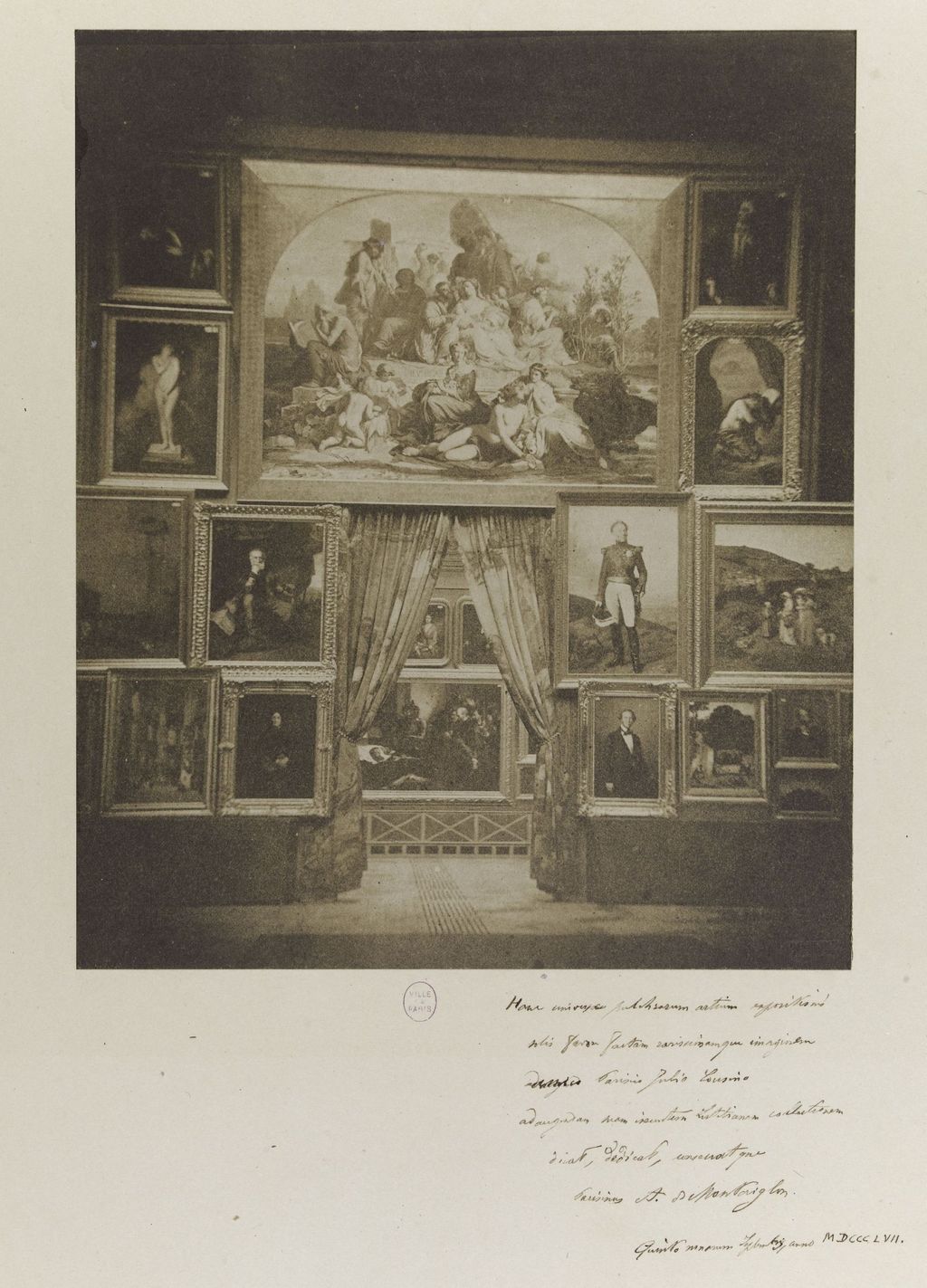
Gustave Le Gray, view of the Salon of 1857. Paris Musées. Image source. CC0 / Public domain. Resized from the complete source image.
The official Universal Exhibition of 1855
The 1855 Exposition Universelle brought an international fine arts exhibition to Paris alongside the industrial displays. Courbet sought a place in the fine arts section at the Palais des Beaux-Arts and prepared The Painter’s Studio with that exhibition in view. Dated 1855, the canvas is almost six metres wide. At its centre, the painter works on a landscape, watched by a boy and a model. Around them are figures drawn from different parts of Courbet’s life and the society he painted. The exhibition jury refused the work. It also refused A Burial at Ornans, a picture that had already been seen at the Salon of 1850–51. A place at the earlier Salon gave the burial its reputation. Its admission to the international show was a new decision. [2] [3] [10]
Courbet wrote to Alfred Bruyas that his Portrait of Champfleury had also been refused. The portrait survives in the Musée d’Orsay, which dates its likely execution to 1854 and records it as no. 7 at the independent exhibition. The official livret lists eleven works under Courbet’s name. Its first two entries are The Stone Breakers and Young Ladies of the Village, each identified by the Salon at which it had previously appeared. Courbet’s contribution included canvases that Paris audiences already knew as well as recent work. Bruyas lent The Meeting to the official exhibition, and the Musée Fabre records it there as no. 2803. Courbet painted it in 1854. His correspondence records opposition to its admission, while the subsequent display establishes that it got through. [1] [3] [15] [16] [17] [18]
There was much at stake in which pictures represented Courbet at the fair. Visitors who knew him by reputation could see The Meeting as a claim about the painter’s dealings with a collector. The painter stands on equal terms with the man who buys his work, and has an identity as recognisable as that of his patron. In the rejected Studio, the painter gives himself a much wider circle and a much bigger room. Setting up his own exhibition allowed Courbet to put that ambitious account of his work before the same public that could see his encounter with Bruyas. [1] [2] [3]
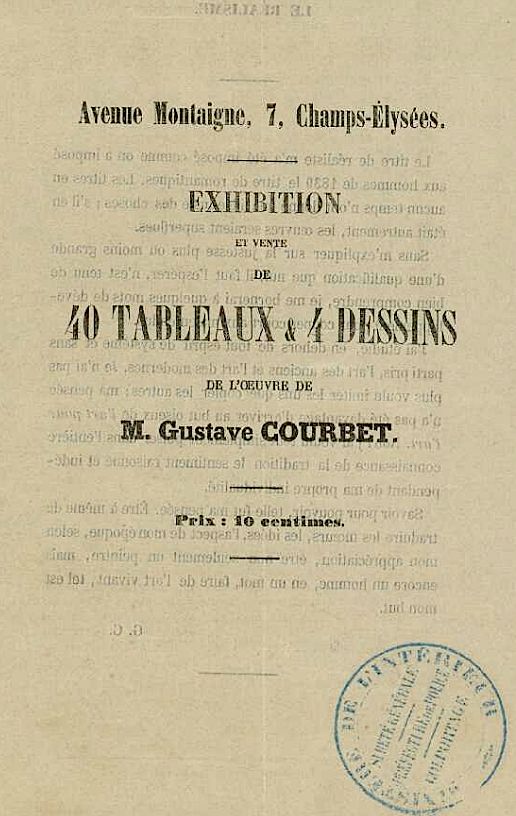
Cover of the catalogue for Courbet’s independent exhibition, 1855. Image source. Public domain. Resized from the complete source image.
The Pavilion of Realism and its catalogues
Courbet set up his Pavilion of Realism at 7 avenue Montaigne, across from the official fine arts building. Alfred Bruyas helped him, and Courbet charged admission and offered work for sale. Location was part of the venture. A visitor drawn to Paris by the fair could see a show whose contents were chosen by a single artist and whose ticket was separate from that of the official event. Courbet could give his large canvases a place of their own and use the accompanying pamphlet to address visitors before or after they saw them. This control also meant responsibility for rent, construction and the proceeds at the door. [3] [16] [19]
Two catalogue titles survive in the Bibliothèque nationale de France’s records. The Morris printing advertises 38 tableaux et 4 dessins, or 38 paintings and four drawings. The BnF records that same wording in a Simon Raçon printing and also lists a Simon Raçon catalogue advertising 40 tableaux et 4 dessins. The change is in the advertised number of paintings. Both titles announce an exhibition and sale. The two figures describe the printings and give a sense of the pavilion’s scale. To use either as an exact count of objects hanging together at a particular moment would require further evidence about how the catalogue related to the display. For individual works, the Musée d’Orsay gives The Painter’s Studio as no. 1 and A Burial at Ornans as no. 2. Those first two entries establish how Courbet introduced his work in print. They place the painting of his present artistic life next to the village burial that had already made his reputation at the Salon. [2] [10] [20] [21] [22]
Courbet called the preface Le Réalisme. Its argument starts from the fact that the label had been attached to him, then turns to what he wanted painting to do. He describes an art grounded in the manners, ideas and appearance of his time as he saw them. In the pavilion, visitors could test that claim against pictures of different kinds. The burial makes the life of a village visible through a public ritual. The Studio assembles people around the painter at work, a gathering that no viewer could take for a straightforward record of a single afternoon. The short preface asks the visitor to consider what those different constructions owe to the artist’s own experience and choices. [2] [12] [20]
The pavilion also gave viewers a setting in which to make their own comparisons with the official show. Eugène Delacroix recorded leaving the industrial exhibition and visiting Courbet on 3 August. Admission had by then fallen to ten sous. He spent nearly an hour alone and found the rejected Studio exceptionally absorbing. The diary captures the sort of visit a separate room could make possible, and its solitude also gives the episode a commercial dimension. One distinguished visitor could have a strong response to the work on the hour in which he had the room to himself. Champfleury, writing publicly to George Sand, treated the exhibition as an appeal to viewers over the heads of the jury. His attention to the variety of subjects shows how a one-person exhibition could let a critic follow the painter’s decisions across several works. [23] [24]
Back at the Salon and out to the Alma
The 1857 Salon livret for the Palais des Champs-Élysées groups six of Courbet’s entries together, including Young Ladies Beside the Seine, The Quarry, a landscape of the Loue and a portrait of the opera singer Louis Gueymard in character. The official catalogue thus registered a range of work by the same painter two years after the Pavilion of Realism. A spectator who had heard of Courbet mainly through the burial controversy could now see him working with a different cast of figures and settings. In 1866 the Salon accepted Woman with a Parrot. The Metropolitan Museum distinguishes it from Courbet’s earlier nude submission rejected in 1864. The reclining woman in the accepted painting has a pose the Salon public could recognise, alongside discarded clothing and loose hair that place her at some distance from the idealised figures with which viewers might have compared her. [25] [26]
During the 1867 Universal Exhibition, Courbet again presented a show of his own, this time at the Rond-Point du Pont de l’Alma. Bätschmann dates its opening to 29 May and records Courbet’s participation in the official fair as well. The Alma catalogue gives the address and calls the event an exhibition of Courbet’s works. The catalogue’s notice, quoted by Bätschmann, explains that the gallery was too small to show all his works at once and offers replicas to order. That combination of limited space and ambitious coverage helps explain why a catalogue entry is stronger evidence for a work’s association with the exhibition than for its precise position or neighbours on any given day. At the official exhibition on the Champ-de-Mars, the Musée d’Orsay identifies Courbet’s The Black Stream as no. 174, under the short title Paysage. The same canvas had appeared at the 1865 Salon under a longer title locating it at the entrance to the Puits-Noir valley at twilight. Here a museum record links two quite different catalogue titles to a single painting. [3] [27] [28]
The Musée Fabre records The Meeting as no. 130 at the Alma. The Institut Gustave Courbet places the newly painted Death of the Stag prominently in the same venture. In one, Courbet is a traveller encountered on foot. In the other, a mounted hunter, a pack of hounds and a stag fill a snowy landscape five metres wide. A visitor to the Alma could encounter this shift in scale and subject within the scope of one painter’s exhibition. The comparison also marks a change from 1855. Then Courbet used his own pavilion to bring the Studio and Burial before viewers after their rejection. In 1867 he could give a recent work such as the stag painting a place alongside work already known to the public, while still taking part in the official fair. [1] [3] [27] [29]
The stag’s later Salon appearance also shows how the exhibitions could work in succession. Its official Paris Salon entry followed in 1869 as no. 571, at the Palais des Champs-Élysées, the venue for the 1857 Salon as well. The livret specifies an episode of hunting with hounds in snowy weather. The very next number is his picture of a midday rest during haymaking in the Doubs. In 1855 Courbet had put a picture from an earlier Salon beside a recent large canvas in a catalogue of his own. In 1869 the Salon put his more recent hunting picture, already shown independently, in a list alongside a scene of rural labour. The same painting could therefore enter a new conversation as it moved between exhibitions. What the visitor could see depended on which works each exhibition brought together. [25] [29] [30]
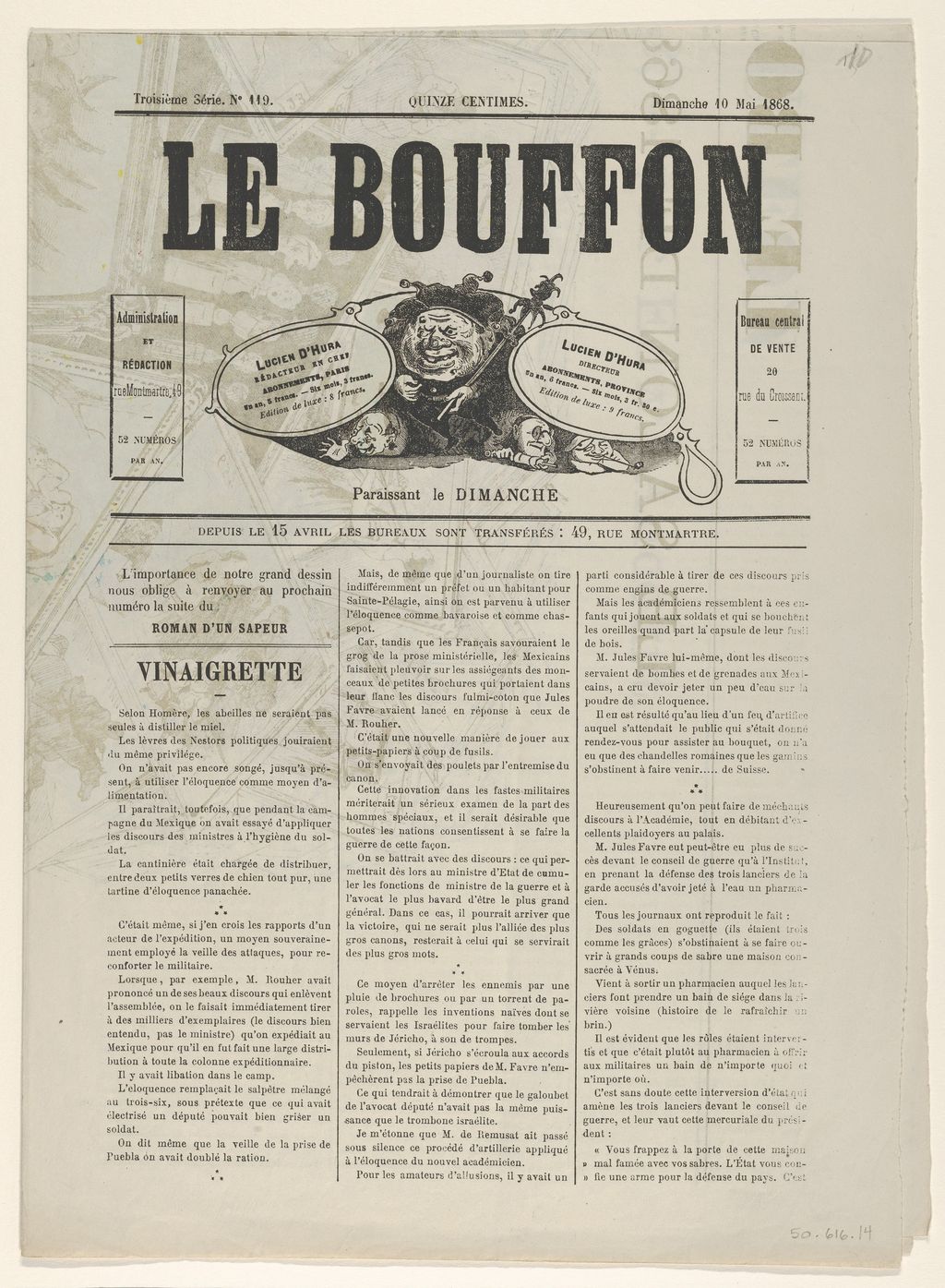
Le Bouffon, illustrated Salon satire, 10 May 1868. Paris Musées. Image source. CC0 / Public domain. Resized from the complete source image.
Courbet artworks directory
Browse the paintings covered in this guide. Dates identify the specific versions discussed.
Discussion
Look again at the images and ideas explored in Gustave Courbet’s Salons and Independent Exhibitions. These editorial prompts invite your observations.
Reader Insights
How might an independent pavilion change the way a visitor sees a large canvas?
What can an exhibition catalogue establish about the works on view?
What changes in the relationship between Courbet and the Salon across these years?
Join the Conversation
Share a detail, comparison or question about Gustave Courbet’s Salons and Independent Exhibitions below.
References
- Musée Fabre, La Rencontre ou Bonjour M. Courbet, collection record 868.1.23, including official exhibition entry 2803 in 1855 and Alma entry 130 in 1867. View source.
- Musée d’Orsay, L’Atelier du peintre, collection record RF 2257. View source.
- Oskar Bätschmann, The Artist On Show: Gustave Courbet, pp. 9–12, 23–25 and notes 24–30, 66–71. View source.
- Paris Musées, Autoportrait dit Courbet au chien noir, Petit Palais PPP731. View source.
- Musée d’Orsay, Base Salons, 1848 livret entry for Courbet’s drawing Portrait de M. C. S. View source.
- Musée d’Orsay, Base Salons, Une après-dînée à Ornans, 1849 livret entry 455. View source.
- Musée d’Orsay, Base Salons, La vallée de la Loue, 1849 livret entry 453. View source.
- Musée d’Orsay, Base Salons, Vue du château de Saint-Denis, le soir, 1849 livret entry 454. View source.
- Musée d’Orsay, Base Salons, Courbet’s 1857 exhibitor record, recording the classification of his 1849 medal. View source.
- Musée d’Orsay, Un enterrement à Ornans, collection record RF 325. View source.
- Musée d’Orsay, Base Salons, Un enterrement à Ornus, 1850 livret entry 661. View source.
- The Metropolitan Museum of Art, Gustave Courbet, retrospective exhibition, sections on the Salon of 1850–51 and the 1855 preface Le Réalisme. View source.
- The Metropolitan Museum of Art, Young Ladies of the Village, collection record 40.175. View source.
- The Metropolitan Museum of Art, Gustave Courbet, illustrated exhibition checklist, entry for Young Ladies of the Village. View source.
- Musée d’Orsay, Portrait de Champfleury, collection record. View source.
- Bibliothèque nationale de France, Expositions-manifestes, sections on the Pavilion of Realism and the Alma exhibitions. View source.
- Musée Fabre, La Rencontre, teaching dossier, with excerpts from Courbet’s letters to Bruyas. View source.
- Exposition Universelle de 1855, Explication des ouvrages de peinture, sculpture, gravure, lithographie et architecture, official fine arts livret, p. 287, entries 2801–11. View source.
- Musée Courbet and Institut Gustave Courbet, Acheter Courbet, section on the 1855 letter to Alfred Tattet. View source.
- Bibliothèque nationale de France, Exhibition et vente de 38 tableaux et 4 dessins, Morris printing, 1855. View source.
- Bibliothèque nationale de France, Exhibition et vente de 38 tableaux et 4 dessins, Simon Raçon printing, 1855. View source.
- Bibliothèque nationale de France, Exhibition et vente de 40 tableaux et 4 dessins, Simon Raçon printing, 1855. View source.
- Eugène Delacroix, Journal, 3 August 1855, edited by Paul Flat and René Piot, vol. 3, pp. 63–65. View source.
- Champfleury, Du réalisme. Lettre à Madame Sand, 1855, transcription hosted by the University of Wuppertal. View source.
- Musée d’Orsay, Base Salons, Portrait de M. Gueymard, 1857 livret entry 624, which gives the venue and the portrait’s full title. View source.
- The Metropolitan Museum of Art, Woman with a Parrot, collection record 29.100.57. View source.
- Bibliothèque nationale de France, Exposition des œuvres de M. G. Courbet. Rond-point du pont de l’Alma, 1867 catalogue record. View source.
- Musée d’Orsay, Le Ruisseau noir, collection record and exhibition history, 1865 Salon no. 521 and 1867 Exposition Universelle no. 174. View source.
- Institut Gustave Courbet, Les chasses de Courbet au Musée, Musée Courbet exhibition overview. View source.
- Paris Salon, Explication des ouvrages de peinture, sculpture, architecture, gravure et lithographie des artistes vivants, 1869, p. 79, entries 571–72. View source.