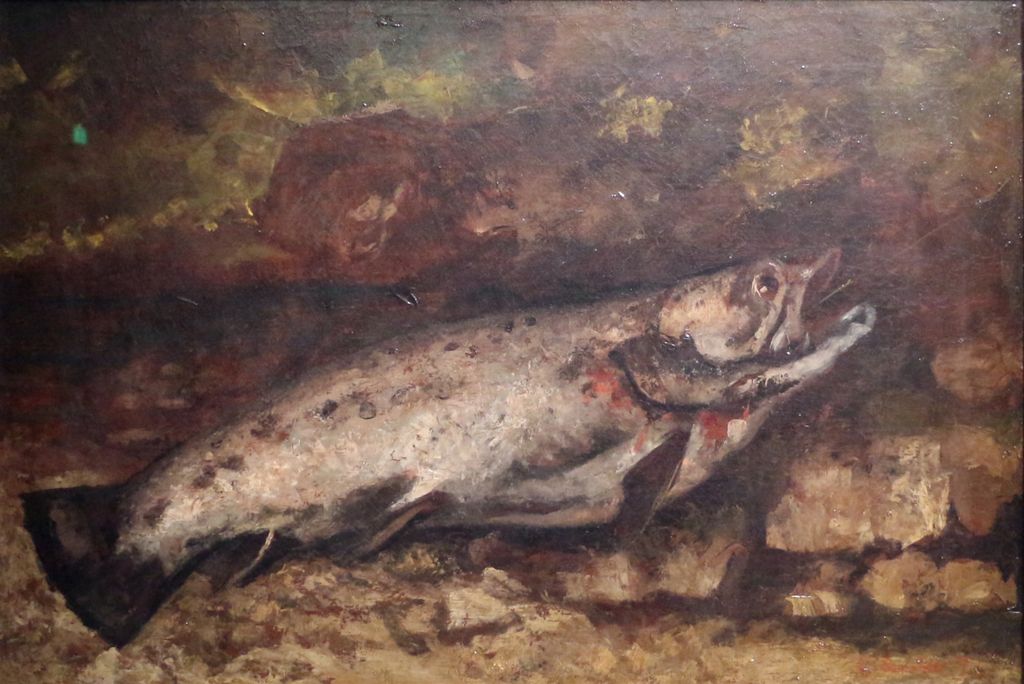
The Trout by Gustave Courbet, Musée d’Orsay, RF 1978 15 Photograph by Sailko. Image source. CC BY 3.0. Cropped to the painted canvas.
 by Tom Gurney
Tom Gurney BSc (Hons) is an art history expert with over 20 years experience
Email: tomgurney1@gmail.com / Phone: +44 7429 011000
The Trout by Gustave Courbet: Introduction
A trout lies on a bank with its tail to the left and its head lifted towards the upper right. A fine line leads from the open mouth into the darkness. Against the bank’s brown and green, the flank has the pale shine of wet skin. The eye, parted jaws and red near the gill draw attention to the animal’s struggle. Gustave Courbet painted this Trout (La Truite) in 1873. The oil on canvas measures 65.5 × 98.5 cm and belongs to the Musée d’Orsay in Paris, where it is catalogued as RF 1978 15. [1]
At a Glance
- Date1873
- MediumOil on canvas
- CollectionMusée d’Orsay, RF 1978 15
Contents
- The line and the open mouth
- Still life on the riverbank
- The Paris and Zurich paintings
- Courbet after the Paris Commune
- How the painting has been seen
The line and the open mouth
The fish occupies most of the width of the picture. Its tail almost touches the left edge, low enough to mingle with a dark patch in the foreground. The body rises from there in a single long diagonal. At the other end, the jaws separate into two shapes, with a sliver of pale paint catching the edge of the lower jaw. The line is easy to overlook beside this broad mass of paint. Once you pick it out, the angle of the head becomes easier to read. A force from outside the picture is pulling at the mouth while the rest of the animal bears down on the bank. The line carries that force without giving us a view of the person holding it. [1]
Courbet gives the eye a small, almost circular highlight, set against a dark socket. The gill area below it is painted in wider, rougher marks. Rust red interrupts the grey of the skin and appears again in small patches just beneath the gill, close to the dark fin. The mouth supplies the clearest sign of what is happening, but the smaller contrasts keep drawing us back to the head. Farther along the flank, scattered dark spots break up a much larger field of grey and cream. The tail loses most of that brightness. Follow the fish from left to right and the quiet, heavy stretch of the body gives way to the concentrated detail around the mouth. [1]
The bank is close enough in colour to the fish for parts of its outline to merge with the setting. The broad underside catches the light intermittently against shadows and ochre stones. Above, patches of green and brown gather against the upper edge, with no horizon to lead the eye into the distance. Much of the setting is hard to resolve into individual forms. The contrast between the mottling on the body and the rough patches on the bank lets us distinguish skin from earth even where the outlines soften. In this shallow space, the fish has room to bend and lift its head, and scarcely any room to go. [1]
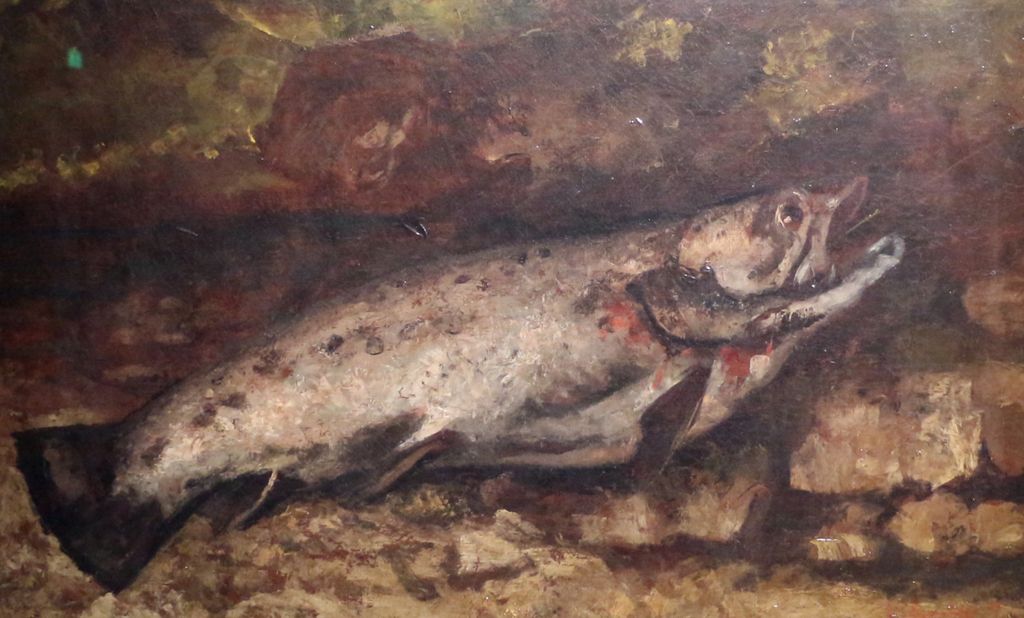
Detail of The Trout, Orsay RF 1978 15, Sailko photograph. Shown here, fish and surrounding painted surface. Photograph by Sailko. Image source. CC BY 3.0. Cropped and resized from the source image.
Still life on the riverbank
The Musée d’Orsay relates Courbet’s fish still lifes to catches on the Loue, the river that passes through his home town of Ornans. In The Source of the Loue, painted in 1864 and now at the Metropolitan Museum of Art, Courbet placed the dark mouth of a cave above the water rushing into the foreground. The site gives the landscape its name. In The Trout, the bank is brought so close that very little of the place can be made out. The Loue provides a regional setting for the subject, while the stones and damp-looking patches in the painting tell us most about where the fish lies in relation to the viewer. [1] [2]
Orsay also places the canvas in the tradition of seventeenth-century Dutch fish still lifes. In Abraham van Beijeren’s Still Life with Fish at the Rijksmuseum, several kinds of fish lie in a basket on a table. A cut of salmon, shellfish, a knife and vessels give the eye a series of textures and shapes to compare. Their arrangement also takes the fish into the world of preparation and eating. Courbet gives nearly the whole width of his canvas to one uncut body. The riverbank and the line keep the subject at the moment of the catch. Both painters use the ability of light to pick wet flesh out of a dark setting, but the line in Courbet’s picture leaves the outcome feeling immediate, as though we have arrived while something is still happening. [1] [3]
The Paris and Zurich paintings
The single-trout canvas at the Kunsthaus Zürich is a separate oil painting, inventory 2383. The Kunsthaus gives its image dimensions as 52.5 × 87 cm. The compositions run in opposite directions. The Zurich trout lifts its head towards the upper left, where the line is easier to pick out against the dark. Its tail points down towards the right and the pale flank occupies much of the middle of the painting. In the larger Paris canvas the head rises to the right and a broad stretch of dark bank remains above the fish. Seeing the two together makes clear how much Courbet can change while keeping the same action. The Zurich fish almost spans the painted field, and its open jaws read immediately. The Paris fish takes longer to separate from the ground around it. [1] [4]
The dates require a similar comparison. On the Paris canvas, Orsay records the signature and date at lower right as “G. Courbet 73”. The Zurich canvas bears “71” and the Latin phrase in vinculis faciebat, meaning “he made it in chains”. The Kunsthaus dates the painting to July 1872, when Courbet was staying with the Ordinaire family at Maisières near Ornans after his imprisonment. The museum dates the addition of the Latin words to 1873, referring to a letter from Courbet to Édouard Pasteur of 20 February. Its provenance records Pasteur buying the work from Courbet that year. The Swiss canvas thus brings together a painted date of 1871, an execution date of 1872 and an inscription added in 1873. The Paris “73” belongs to the second canvas. [1] [4]
The location of the writing matters to the experience of looking. The red lettering in the Zurich picture lies low on the bank below the raised head. The fish leads the eye up to the line, then the words draw it back down towards the ground. The first detail shows the animal held by the hook. The second names the circumstances of a maker. Orsay’s signature records Courbet’s name and year. The connection between the artist and the captured fish in that version has to come from the depicted situation and from what we know of the related painting and Courbet’s life. [1] [4]
Courbet after the Paris Commune
In 1871 Courbet was elected to the Council of the Paris Commune and led the Federation of Artists. Before the Commune was established, he had urged the Government of National Defence to take down the Vendôme Column, a monument to Napoleonic victories. After the Commune fell, he was arrested and convicted by a military court of complicity in the column’s destruction. The six-month sentence included time at Sainte-Pélagie. Illness led to his transfer to a clinic in Neuilly, where he remained in custody on parole. He was released in 1872, returned to Franche-Comté, and went into exile in Switzerland in July 1873 amid continuing legal pressure. That sequence places the painting of the Zurich canvas after his release and before his departure for Switzerland. The Paris canvas and the departure share a year. [1] [4] [5] [6] [7]
The Kunsthaus reads the wording on its canvas as an identification between Courbet and the fish. Orsay likewise reads the Paris trout as a figure for the artist still subject to the courts. The comparison has force because the animal has been caught and is still struggling. A fish arranged on a table might convey the result of a catch. Here the tight line and the raised head extend the moment of capture and keep the agency of the person holding the line outside the frame. That situation can suggest the painter’s predicament, particularly in light of the Zurich words. It can also hold our attention as a study of an animal at the edge of the water, with its gill, eye and mouth painted as closely as Courbet judged necessary to show what a hook does. [1] [4] [5]
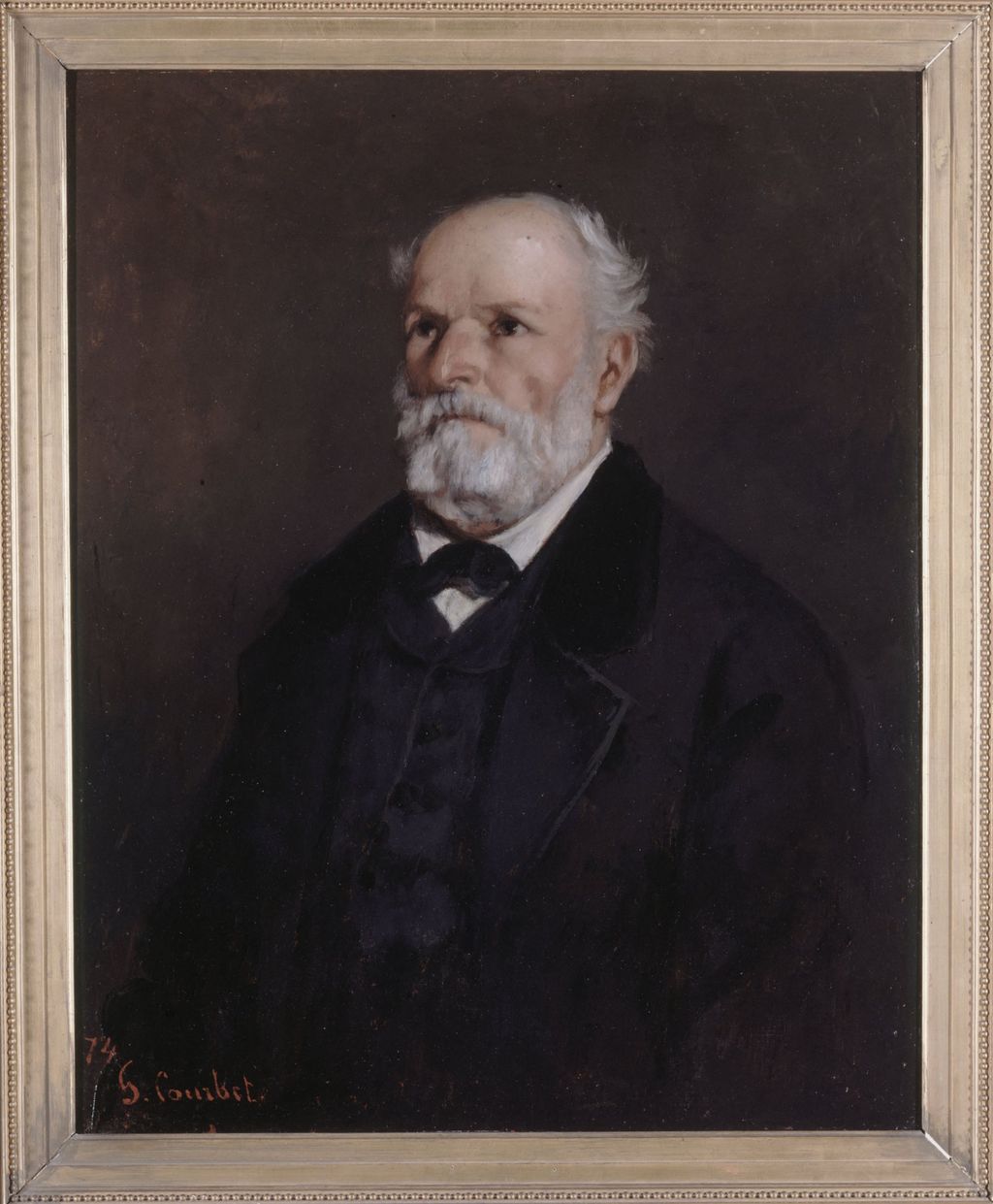
Gustave Courbet, Portrait of Régis Courbet, 1874. Petit Palais. Image source. CC0 / Public domain. Resized from the complete source image.
How the painting has been seen
The Paris canvas has appeared in exhibitions that made different aspects of it visible. The Musée de l’Orangerie included it in a history of still life in 1952. It was in the collection of the painter André Dunoyer de Segonzac in 1974 and entered the French national collections in 1978 through a dation, the acceptance of a work in payment of inheritance tax. Initially assigned to the Louvre, it was allocated to the Musée d’Orsay in 1986. Orsay brought the Paris, Zurich and Bern trout pictures together for its exhibition on Courbet and the Commune in 2000. That exhibition let viewers consider the related paintings side by side and see where the appearance of the fish, the wording and the historical circumstances came together. [1] [5] [8]
In 2025, the Paris picture went to the Musée Courbet in Ornans on loan. The museum set it beside Miroir d’Ornans, a view of the river in the town, in a programme about the health of the Loue and its fish. The companion landscape supplied a view of the water largely kept from sight in The Trout. The pairing gave local residents, fishing guides and people working on river conservation a way to talk about changes in a place Courbet knew. Where the 2000 exhibition placed the trout beside the painter’s political history, the Ornans display brought it back to the valley. The fish’s exposure is legible in either setting. To see how little Courbet needs to convey it, look again at the narrow space between the two jaws and the thin mark continuing into the dark. [1] [5] [9]
Courbet artworks directory
Browse the paintings covered in this guide. Dates identify the specific versions discussed.
Discussion
Look again at the images and ideas explored in The Trout by Gustave Courbet. These editorial prompts invite your observations.
Reader Insights
How does the dark setting affect the visibility of the trout?
Which details distinguish the Orsay painting from the Zürich version?
What can the different inscriptions establish?
Join the Conversation
Share a detail, comparison or question about The Trout by Gustave Courbet below.
References
- Musée d’Orsay, Gustave Courbet, La Truite, collection record RF 1978 15. View source.
- Metropolitan Museum of Art, Gustave Courbet, The Source of the Loue, collection record 29.100.122. View source.
- Rijksmuseum, Abraham van Beijeren, Still Life with Fish, collection record SK-A-25. View source.
- Kunsthaus Zürich, Gustave Courbet, Truite, collection and provenance dossier 2383. Includes the museum’s dating of the Latin addition and its reference to the letter of 20 February 1873. View source.
- Musée d’Orsay, Courbet et la Commune, 2000 exhibition account. View source.
- Metropolitan Museum of Art, Gustave Courbet, 2008 retrospective, section on the Commune and exile. View source.
- Historical Dictionary of Switzerland, “Courbet, Gustave”. View source.
- French Ministry of Culture, Joconde record M5060000042, La truite. View source.
- French Ministry of Culture and Musée d’Orsay, 100 œuvres qui racontent le climat, 2025 exhibition dossier, pp. 56–57. View source.