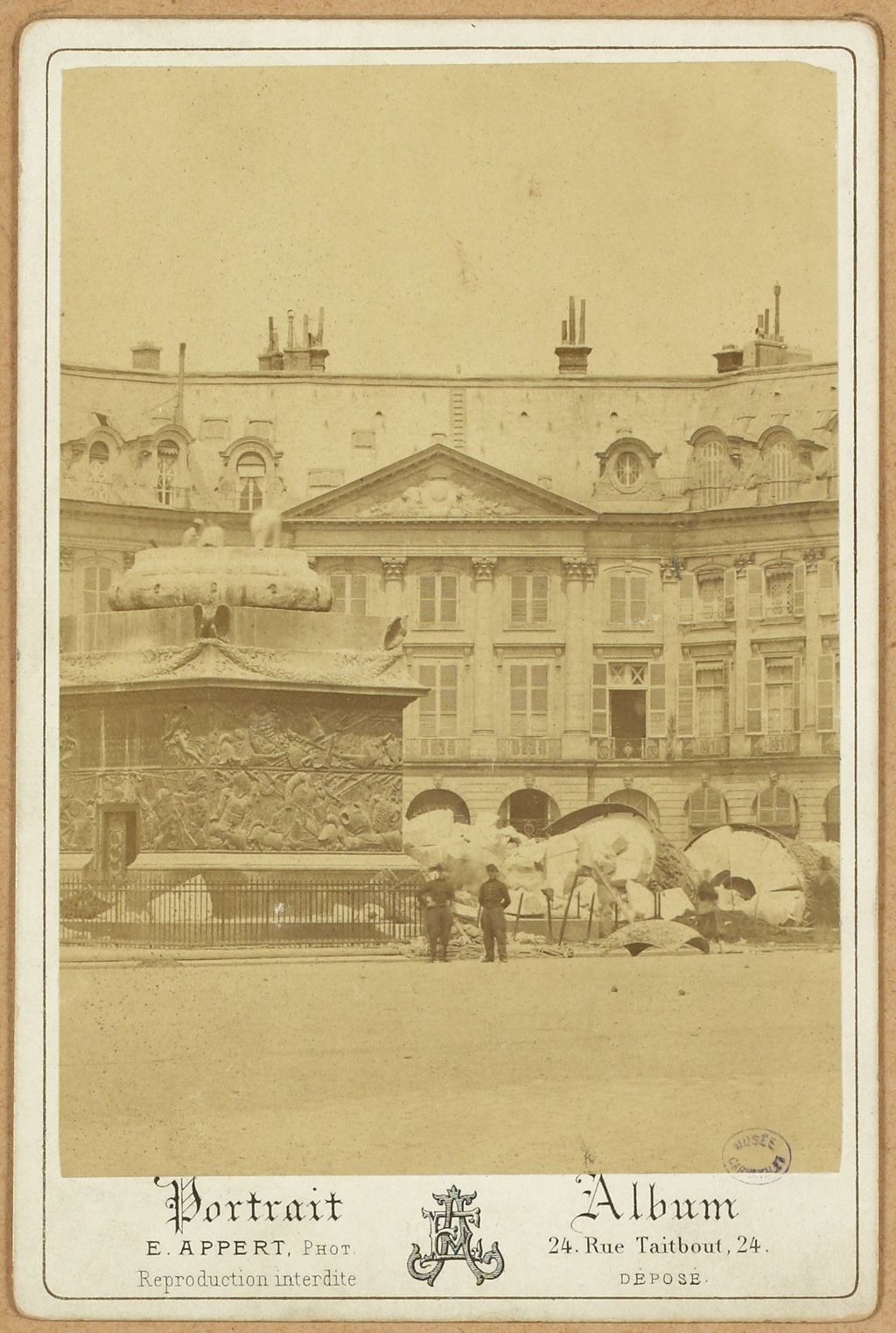
The fallen Vendôme Column, photographed by Ernest Charles Appert in 1871 Paris Musées / Musée Carnavalet. Image source. CC0 / Public domain.
 by Tom Gurney
Tom Gurney BSc (Hons) is an art history expert with over 20 years experience
Email: tomgurney1@gmail.com / Phone: +44 7429 011000
Gustave Courbet and the Paris Commune: Introduction
Ernest Charles Appert’s photograph of the fallen Vendôme Column records a change in the centre of Paris that no passer-by could have missed. A monument erected to glorify Napoleon’s victories had come down under a decree of the Paris Commune. It fell on 16 May 1871, and the painter Gustave Courbet became so closely associated with the event that it followed him from a military courtroom to his exile. His part in it changed over time. He proposed removing the column in 1870, joined the Commune after it voted to demolish the monument and then asked the council to carry out its decision. In the same weeks he led an artists’ federation that wanted to put museums, exhibitions and art education in the hands of artists. Both activities belonged to his public life in Paris, though they left very different records. [1] [2] [3]
At a Glance
- Paris Commune1871
- RoleArtists’ Federation and elected Commune member
Contents
- The monument Courbet wanted removed
- Two decisions on 12 April
- What the Federation of Artists wanted to change
- The 27 April discussion and the fall in May
- The military verdict and the paintings of confinement
- Reconstruction, seizure and exile
The monument Courbet wanted removed
The column made Napoleon’s military victories part of the everyday city. Its spiral reliefs led the eye up to the emperor, borrowing a form associated with Trajan’s Column in Rome. Place Vendôme gave that story a public setting, where a spectator had no need to enter a museum or buy a ticket to see it. When the Second Empire collapsed in September 1870 during the war with Prussia, the column remained in its square. For Courbet, a monument to conquest had acquired a new meaning in a city about to endure a siege. He questioned both its value as art and the political purpose served by keeping it in place. [2] [4]
Courbet was already working with the Commission des arts under the Government of National Defence when he raised the issue in September. He raised the issue on 14 September. He also petitioned the government for permission to take the column down. The French verb he used, déboulonner, can literally mean to unbolt. His proposals contemplated taking the monument apart and moving its bronze elements, with the Invalides among the destinations discussed. The proposal would have deprived the column of its commanding position while allowing the parts to have another use or setting. The government did not act on it. [2] [4] [5]
The proposal mattered later because it established a public position that preceded the Commune. When Courbet defended himself in 1871, he emphasised the difference between taking the structure down for removal and breaking it up. His early petition supports the importance of relocation, while his statements after his arrest show how he chose to describe his intentions once he faced prosecution. The distinction is easiest to see by reading the petition beside the Commune’s decree, which assigned a different fate to the column and came from a different governing body. [3] [4] [5]
Two decisions on 12 April
The Paris Commune took shape after the uprising of 18 March 1871, in the aftermath of the siege and France’s defeat. Its council governed the capital in opposition to the national government based at Versailles. In the night sitting of 12 April, Félix Pyat presented the demolition proposal on behalf of the Executive Commission. The minutes record objections and arguments over whether to retain the reasons given in the draft. The council adopted the text. Published the next day, the decree described the column as a monument to militarism that insulted the defeated and affronted republican fraternity. Its single operative article ordered demolition. It gave no instructions for moving the bronze reliefs to another site. [3] [6]
The supplementary elections took place on 16 April, when Courbet was elected in the sixth arrondissement. The dates answer the question of his vote on demolition. He had no seat in the council on 12 April, and the minutes name Pyat as the person who introduced the measure. The April decree is sometimes told as the inevitable outcome of Courbet’s September petition. At the time, the political situation, the institution making the decision and the stated fate of the object had all changed. [2] [3] [6]
The other decision of 12 April entrusted Courbet with the city’s museums. A printed notice authorises him, as president of the painters’ society, to restore them to their usual condition, open the galleries to the public and enable the work normally carried out in them to resume. It also gave him authority to make arrangements for the annual exhibition at the Champs-Élysées. His standing among painters had given him a mandate before he acquired an electoral one. After the election, his work on public instruction and his presidency of the Federation of Artists gave him further ways to pursue it. The printed museum notice shows what he was empowered to do at that moment, while the Federation’s programme shows what artists hoped to build in the longer term. [2] [7]
What the Federation of Artists wanted to change
In an appeal printed on 6 April, Courbet asked artists to take part in the recovery of Paris and to direct museums and collections themselves. The Federation was formed at a meeting of artists at the School of Medicine later that month. Its programme, published in the Commune’s Journal officiel on 15 April, carried the names of several artists alongside Courbet’s. It set out how an elected committee could represent painters, sculptors, architects, engravers and artists working in the decorative arts. Women and men could vote in the committee election if they could establish their standing as artists, for instance through an exhibitor’s card or the testimony of two colleagues. The programme tried to turn the idea of artists directing their own affairs into a working electoral system. [8] [9]
For museums, the programme specified practical duties. The committee would maintain inventories and catalogues, inspect the condition of buildings, report urgent repairs and appoint staff. It would make catalogues available to visitors and report its work to the Commune. Opening a gallery meant attending to the objects, the people who worked there and the public who came to study them. During the siege the immediate question had been how to safeguard collections. Under the Commune the Federation was also asking who should be trusted to look after them and set the terms of public access. [2] [7] [9]
The exhibition proposals touched institutions that had shaped Courbet’s own career. He had worked within the official Salon and had paid to show his work independently when juries rejected important canvases. The Federation proposed that artists organise exhibitions, give the creator proper credit and dispense with prizes. It would allocate ordinary public commissions using choices made by exhibitors and open exceptional projects to competition. These proposals addressed a difficulty Courbet knew from his Salons and independent exhibitions. Decisions about who could show, receive an award or obtain a commission helped determine whose work the public would see. [9] [10]
The programme extended beyond galleries and commissions. It proposed teaching drawing and modelling in municipal schools and funding further training for promising pupils. Reproductions of major works could travel to communities whose residents might never visit a Paris collection. The phrase luxe communal, used towards the end of the programme, has a concrete meaning alongside those proposals. Access to accomplished work could become part of ordinary civic life through schools, public buildings and reproducible images. The programme sets out intended reforms. The Commune’s short life gave the Federation little time to carry them through. [2] [9]
The 27 April discussion and the fall in May
Once he was a councillor, Courbet did intervene directly on the column. The published account of the 27 April sitting records him asking the Commune to carry out its demolition decree. He suggested retaining the pedestal, whose reliefs he associated in the discussion with the history of the Republic, and placing a figure personifying the revolution of 18 March above it. In the same account, Jean-Baptiste Clément called for complete destruction. When Charles Gambon proposed adding Courbet to the people charged with the work, Paschal Grousset replied that the Executive Commission had already entrusted it to two engineers, who had assumed responsibility. The account records a proposal to involve Courbet and an answer identifying who had the assignment. It establishes his advocacy in the council without giving him technical command. [11] [12]
That intervention is an important part of the record because the September petition alone would leave the impression that Courbet consistently wanted to move the whole structure somewhere else. By late April he was publicly asking for action under the decree and still trying to influence what would stand in the square afterwards. His proposed replacement would have used a surviving piece of the old monument to mark the new revolution. The idea had its own political implications. It would have changed the subject of commemoration while keeping the pedestal as the focus of the square. [4] [11]
The column came down on 16 May. Appert’s photograph belongs to the aftermath. Other period pictures show groups around the wreckage, including a photograph by Auguste Bruno Braquehais in the Musée Carnavalet in which a group stands in front of the debris. Such images show how quickly the site became somewhere to gather and be seen. Attempts to identify Courbet in a photograph of the square have yielded uncertain results. Even a secure identification would establish his presence at the moment of exposure. The account of the council discussion provides better evidence of his role in pressing for implementation, and it answers a different question from who happened to be there after the fall. [1] [6] [12] [13]
Satire offered a more direct answer than the photographs could. In Léonce Schérer’s print, the caption makes the ability to break stones the painter’s preparation for bringing down a column. The joke depends on readers recognising The Stone Breakers, a painting of two men at work on a road that had made Courbet controversial long before 1871. Schérer transfers the labour in that picture to Courbet himself. The caption lets the painter’s earlier work look like a prediction of his public conduct. For the people who encountered the caricature, it furnished a memorable culprit without needing to explain the sequence of the council’s decisions. [10] [14]
Courbet’s council work extended beyond the arts and the column. On 1 May he sided with the minority that opposed replacing the Executive Commission with a Committee of Public Safety. He later claimed at his trial to have left the council on 11 May, but the records place him in council business afterwards. His resignation as mayor of the sixth arrondissement on 17 May was a separate event. The distinction matters for the final days of the Commune, when a statement made in his own defence can be tested against dated records of what he did in office. [12]
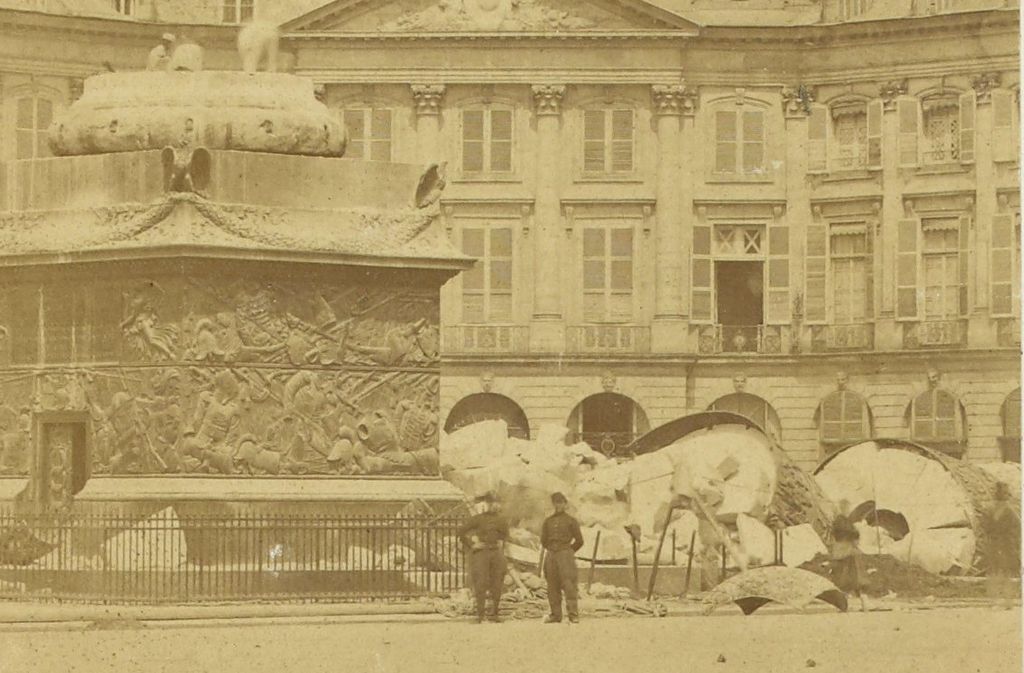
Detail of Ernest Charles Appert, The Fallen Vendôme Column, 1871. Musée Carnavalet, Paris Musées. Shown here, fallen column and pedestal. Image source. CC0 / Public domain. Cropped and resized from the source image.
The military verdict and the paintings of confinement
Versailles troops entered Paris on 21 May and suppressed the Commune in the fighting that ended on 28 May. Courbet was arrested on 7 June. A government report recommended a military trial on several grounds, including the alleged usurpation of civil functions and complicity in the destruction of a public monument. The Third Council of War at Versailles delivered its verdict on 2 September. Only the complicity charge was upheld against Courbet. The sentence was six months in prison and a fine of 500 francs. The case therefore had a narrower outcome than the case presented in the government’s report, even though the conviction made the column the defining charge against him. [2] [6] [15] [16]
Courbet’s account at the hearing stressed his earlier preference for moving the column to the Invalides. The catalogue of the surviving Vendôme dossier also describes a letter from the Conciergerie to Pierre Frédéric Dorian in which he denied responsibility for the fall and offered to raise money through the sale of his paintings to put the column back up. The offer gives a sense of the lengths to which he was prepared to go to answer the accusation. It belongs to his defence and precedes the later action to recover the cost of rebuilding. The military sentence had fixed a term and a fine. The reconstruction bill came through a separate process. [4] [16] [17]
Courbet spent part of his detention at Sainte-Pélagie and was transferred to Dr Duval’s clinic at Neuilly on 30 December 1871. Once permitted to paint, he had the materials for still lifes in the fruit and flowers his sister Zoé brought. The National Gallery in London notes that a number of still lifes made around this period bear the name Sainte-Pélagie, including works probably painted at the clinic. Look at the care with which Courbet renders the marked skin and varying ripeness of fruit in the London gallery’s Still Life with Apples and a Pomegranate. The subject was close to hand, but it gave him a way to resume sustained work with colour, texture and weight. The group of paintings and the inscriptions kept the memory of confinement visible beyond the immediate conditions in which the pictures were made. [2] [18]
In the Self-Portrait at Sainte-Pélagie, dated 1872–73 by the Metropolitan Museum of Art’s exhibition checklist, a window grille identifies the setting, and the pipe recalls a familiar feature of Courbet’s earlier self-portraits. The man at the window is recognisably the painter who had used a pipe to present himself outdoors in the Self-Portrait with a Black Dog. The changed setting makes the familiarity of the gesture striking. The painting looks back to the prison through the carefully composed figure he chose to show, and its dating places the making of the portrait after the events it recalls. [19] [20]
Courbet carried the association with captivity back into the landscape of Ornans and the Franche-Comté. The Kunsthaus Zürich dates its version of The Trout to July 1872, after his imprisonment, although the painting bears the year 1871 and was later inscribed in Latin with a phrase meaning that it was made in chains. The Musée d’Orsay holds a reversed variant dating to 1873. The hooked fish on the bank lends itself to a reading about captivity, especially with that inscription. It also belongs to an established tradition of fish still lifes and to Courbet’s renewed attention to the Loue. The dates allow the prison reference to be understood as something he could carry into a work made after his release. [21] [22]
Reconstruction, seizure and exile
In 1873 the prospect of being made to pay for restoring the column returned. The library in Besançon records Courbet’s reading in January that deputies wanted to charge him with the expense. The Musée d’art et d’histoire in Geneva traces the decision to rebuild and recover the expense from Courbet to a law of 30 May 1873 and dates the sequestration of his property to 19 June. He left for Switzerland in July, while the matter was still unfolding. By 16 April 1874, a bailiff’s notice described in the Vendôme dossier was directed to the dealer Paul Durand-Ruel for seizure of property belonging to Courbet. The dealer’s involvement shows how far the dispute reached into the painter’s working life. Works held by a dealer could be treated as assets in the effort to recover money. [6] [17] [23] [24]
On 26 June 1874 the civil tribunal of the Seine held Courbet liable. A report published in L’Écho saumurois four days later describes an order for damages whose amount was still to be fixed. The Fondation Beyeler’s exhibition chronology records confirmation of the judgment on 6 August 1875 and gives 4 May 1877 as the date on which he was ordered to pay the full reconstruction cost, 323,091 francs and 68 centimes. Those dates explain why accounts can mention a seizure before the June judgment and a sum settled years after it. The process had several stages, from pursuing property through fixing responsibility and finally assessing the cost. [6] [17] [25]
By the time the amount was fixed, Courbet had already spent years in Switzerland. He died at La Tour-de-Peilz on 31 December 1877. The works he produced during his Swiss exile belong to a new phase of his career, but the financial claim that pursued him there grew out of the decisions taken in Paris. The museum notice of 12 April and the column decree from the same day still make a revealing pair. One names Courbet and gives him responsibility for opening galleries. The other sets a demolition in motion before he joins the council. His later request to carry it out, the military finding of complicity and the civil judgments each added a further stage to a story that a single photograph of the ruins could never tell. [3] [6] [7] [24]
Courbet artworks directory
Browse the paintings covered in this guide. Dates identify the specific versions discussed.
Discussion
Look again at the images and ideas explored in Gustave Courbet and the Paris Commune. These editorial prompts invite your observations.
Reader Insights
What can photographs of the fallen column establish about the event?
How did the proposals and decisions change between 1870 and 1871?
What can the Artists’ Federation programme tell you about how its members viewed cultural institutions?
Join the Conversation
Share a detail, comparison or question about Gustave Courbet and the Paris Commune below.
References
- Paris Musées and Musée Carnavalet, Ernest Charles Appert, La Colonne Vendôme renversée, 1871. View source.
- Musée d’Orsay, Courbet et la Commune, exhibition account of Courbet’s public work and imprisonment. View source.
- Procès-verbaux de la Commune de Paris, 12 April 1871, pp. 188–190, discussion and text of the demolition decree. View source.
- Amies et Amis de la Commune de Paris, 12 April chronology and September petition transcription, petition reproduced through Maxime Vuillaume. View source.
- Bibliothèque municipale de Besançon, Courbet, les lettres cachées…, archival exhibition and correspondence excerpts. View source.
- Fondation Beyeler, Gustave Courbet exhibition chronology, entries for 1870–77. View source.
- Paris Musées and Musée Carnavalet, Commune poster no. 128, 12 April 1871, authorisation to reopen museums and galleries and arrange the annual exhibition. View source.
- Assemblée nationale, La Commune de Paris a 130 ans, including Courbet’s 6 April appeal. View source.
- Programme de la Fédération des artistes, published 15 April 1871, Journal officiel text transcribed by the Fondation Gabriel Péri. View source.
- The Metropolitan Museum of Art, Gustave Courbet, retrospective exhibition. View source.
- Grand dictionnaire universel du XIXe siècle, “Commune de Paris de 1871”, reproducing the Journal officiel account of the 27 April sitting. View source.
- Amies et Amis de la Commune de Paris, Le peintre et la photographie, study of the minutes, trial evidence and photographic identifications. View source.
- Paris Musées and Musée Carnavalet, Auguste Bruno Braquehais, Groupe devant les débris de la colonne Vendôme, May 1871. View source.
- Paris Musées and Musée Carnavalet, Léonce Schérer, Souvenirs de la Commune, plate 21. View source.
- Le dossier de la Commune devant les conseils de guerre, Courbet report dated 25 July 1871, contemporary printing of the government report. View source.
- Procès des membres de la Commune, verdict of 2 September 1871, period proceedings excerpted and transcribed by Michèle Audin. View source.
- Bibliothèque nationale de France, CCFr, fol. 124, Vendôme dossier, 1871–74, archival inventory of the Dorian letter, proceedings and Durand-Ruel notice. View source.
- Sarah Herring, National Gallery catalogue, Still Life with Apples and a Pomegranate, NG5983. View source.
- The Metropolitan Museum of Art, Gustave Courbet, illustrated exhibition checklist, Self-Portrait at Sainte-Pélagie. View source.
- Paris Musées and Petit Palais, Autoportrait dit Courbet au chien noir. View source.
- Kunsthaus Zürich, The Trout, collection dossier with inscription and dating. View source.
- Musée d’Orsay, La Truite, RF 1978 15, collection record. View source.
- Musée d’art et d’histoire de Genève, Gustave Courbet. Les années suisses, exhibition chronology. View source.
- Pierre Chessex, Historical Dictionary of Switzerland, “Courbet, Gustave”. View source.
- L’Écho saumurois, 30 June 1874, report on the civil tribunal’s judgment, Archives municipales de Saumur. View source.