by Tom Gurney
Tom Gurney BSc (Hons) is an art history expert with over 20 years experience
Email: tomgurney1@gmail.com / Phone: +44 7429 011000
The Château de Chillon by Gustave Courbet: Introduction
The first bright patch on Courbet’s castle is a wall with only a few small openings. Below it the water holds a blur of the building. To the left, a bank of broken rock leads towards the towers. To the right, Lake Geneva spreads out beneath snow-covered mountains. This is The Château de Chillon (Le Château de Chillon), an oil on canvas dated 1874 in the Musée départemental Gustave Courbet, where it is a deposit from the town of Ornans under inventory number D1976.1.3. Courbet painted Chillon repeatedly. In this version, he gives the building a remarkably precise silhouette while making its reflection difficult to separate from the water around it. [1] [2] [3]
At a Glance
- Date1874
- MediumOil on canvas
- CollectionMusée Courbet, Ornans deposit D1976.1.3
Contents
- The castle from the Montreux side
- What a Braun photograph can show
- A landmark in the Swiss years
- The Lons-le-Saunier and Belfort versions
- From Lake Geneva to Ornans
The castle from the Montreux side
The Musée Courbet identifies the view as looking from the Montreux side of the castle and names the Dent du Midi and the Dent de Morcles among the distant peaks. The angle brings one end of the building into the light while leaving most of the walls facing us in shade. In the middle of the group the tall square tower clears the rooftops, its steep cap dark against pale sky. A sequence of smaller roofs leads down to the bright wall. The little dark openings there are particularly easy to see because so much of the rest of the building blends with foliage and shadow. [1] [3]
The foreground gives you a route into that view. The wooded slope begins at the very edge of the canvas. Below it, ochre and grey marks break up the rocky bank, which runs diagonally towards the building and then disappears into the dark at its base. The castle itself stands on a limestone islet at Veytaux. Its close fit with the shore in this view makes the geology easy to miss. On the near side, rock and masonry seem to carry on into one another. The dark water and the abrupt end of the bright wall are what make the building’s position out in the lake apparent. [3] [4]
Past the castle the picture opens out. Low bands of blue and green extend from the wall to the right edge of the canvas. Under the wall itself, the reflection drops through those bands in a greyer streak. The water breaks the shape into small horizontal marks, so that the brightest stone above has only a wavering counterpart below. The distant slopes also lose definition as they approach the lake. Near the snow there are patches of pink and light grey. Lower down, cooler greens gather into a broad mass with few hard edges. You can move from the near rocks to the far mountains by following a steady loss of detail, even though both are made of stone. [1] [3]
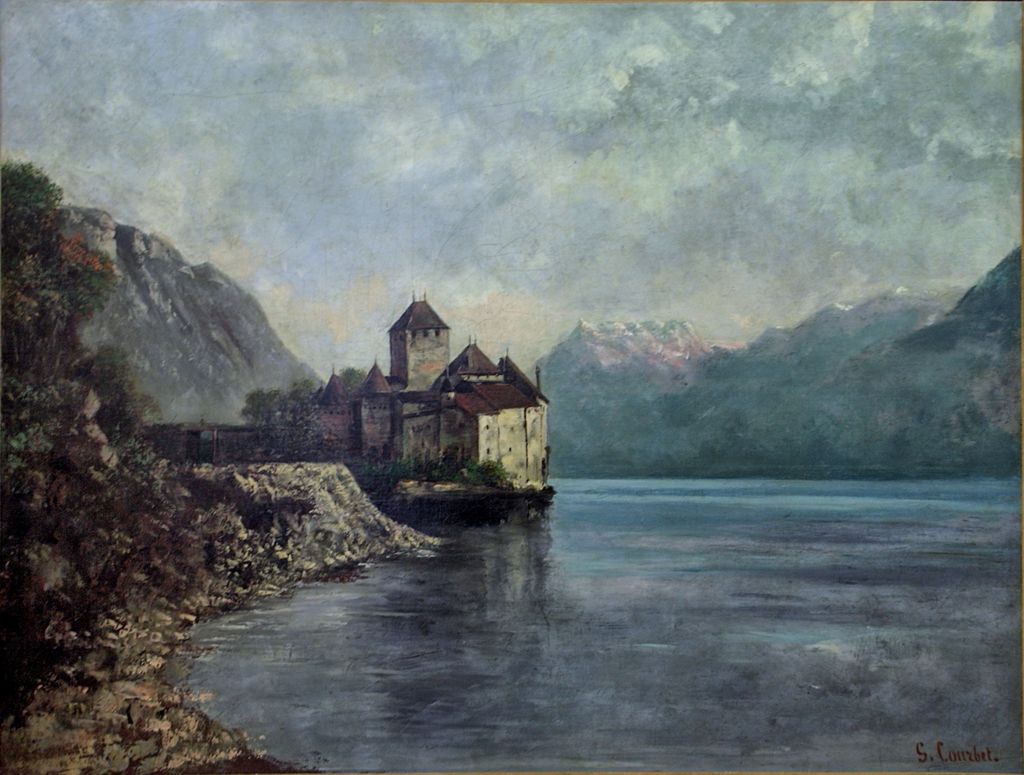
Gustave Courbet, The Château de Chillon. Musée Courbet, D.1976.1.3. Image source. Public domain. Resized from the complete source image.
What a Braun photograph can show
According to the Musée Courbet, Courbet used a photograph marketed by Maison Braun to compose the Ornans picture. A surviving Braun view in the Cleveland Museum of Art makes the relationship easier to understand. Cleveland dates the image to around 1870 and the printing of its particular carbon print to around 1900. The photograph shows a similar view along the shore, with the same turn from the shadowed side of the castle to the light end wall, the steep roofs gathered below the square tower and a reflection extending down into the lake. The late print lets us compare the views while leaving the identity of the print Courbet worked from open. [1] [5]
Try following the shore through both images. In the Braun view, a railway runs diagonally across the foreground and a pole rises into the open water at the lower right. Across the lake, a thin line of buildings sits between the water and the mountains. In the painting, the diagonal route into the scene belongs to the rocky bank. The foreground water extends to the bottom edge across most of the canvas, and the far shore reads as an almost unbroken band. In the photograph the mountains rise close behind the tower and show their ridges distinctly. In the painting the snow line sits lower in the sky and the ridges are less sharply defined. The castle remains easy to recognise even as the balance between it, the mountains and the lake shifts. [3] [5]
The comparison also explains how much the painting depends on colour. The greens at the base of the mountains come close to the blues across the lake, while the warm wall stays separate from both. The warmth recurs in smaller amounts in the foreground stone and on the roofs. Against a grey sky with faint yellow light, the illuminated end of the castle seems to catch that light and hold it. The photograph offers a way to understand the framing and the turn of the building. These relationships of colour are things to look for in the painting itself. [3] [5]
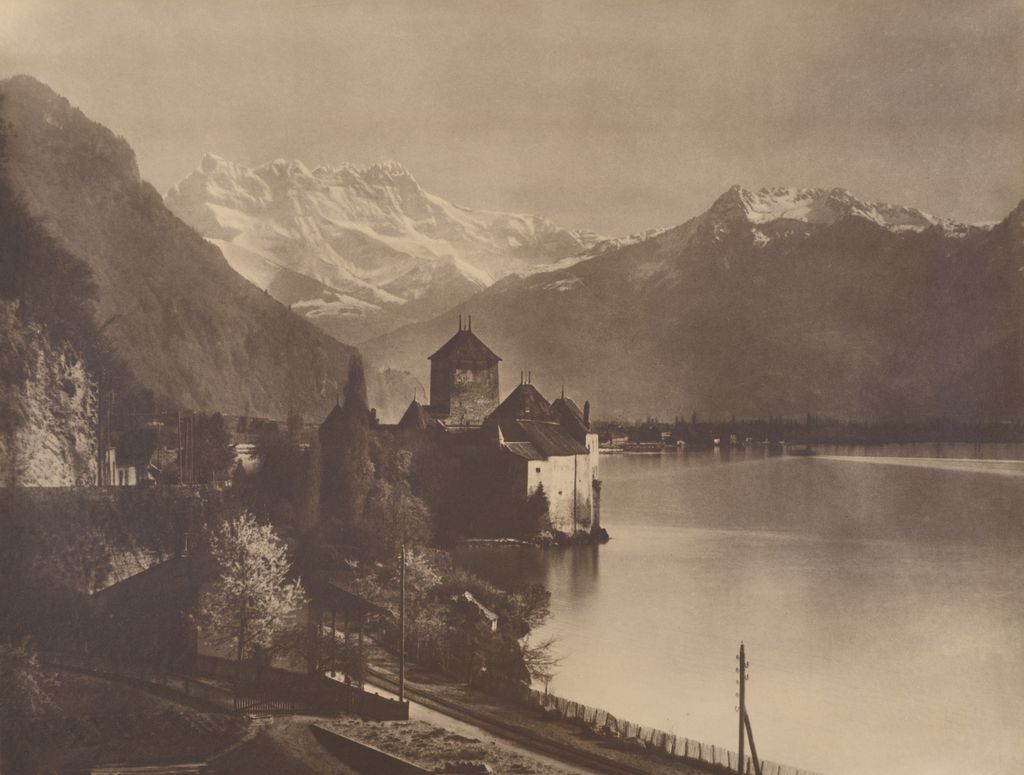
Château de Chillon, carbon print by Adolphe Braun, image c. 1870, printed c. 1900 Cleveland Museum of Art, 2022.353. Image source. CC0 / Public domain.
A landmark in the Swiss years
Courbet moved to Switzerland in July 1873 amid proceedings that followed the Paris Commune and settled at La Tour-de-Peilz on Lake Geneva. He painted the lake in a period when he faced the cost of rebuilding the Vendôme Column, for which he was held financially liable. The Musée Courbet links the Chillon pictures to the market for views of a place travellers already knew by reputation. The curators of Gustave Courbet, les années suisses at the Musée Rath in Geneva likewise connect the series with the need to sell pictures and emphasise the range of viewpoints within it. The castle gave Courbet a subject buyers could recognise across changes in framing and weather. [1] [6] [7]
The building had acquired a literary history well before Courbet painted it. The Savoyard fortress controlled the route past its rocky islet and also served as a prison. François Bonivard was held there from 1530 to 1536. Lord Byron visited in 1816 and made the prisoner the subject of The Prisoner of Chillon, first published that same year. A reader who came to Chillon through Byron might have looked at the walls for signs of the prison or at the lake as the space beyond them. Eugène Delacroix took the story inside the dungeon in his 1834 painting for the Duke of Orléans. Courbet’s exterior leaves the small windows dark, with the open lake in full view. The two paintings offer very different ways to approach a building that was already famous through a poem. [4] [8] [9] [10]
Courbet’s painting of a recognisable landmark in several versions had a precedent a decade earlier. In 1864 he told his dealer that he had made four large landscapes at the source of the Loue. The Metropolitan Museum of Art identifies its Source of the Loue as probably one of those four. That view includes waterworks beside the grotto. At Chillon the lake and the terrain give the castle its setting, while the signs of modern life visible in Braun’s photograph recede from the view. The earlier painting is a reminder that Courbet could use a specific locality repeatedly while making different choices about which of its built features to bring forward. [3] [5] [11]
The Lons-le-Saunier and Belfort versions
The painting reproduced in connection with the Geneva exhibition from the Musée des Beaux-Arts de Lons-le-Saunier is a separate oil on canvas. Robert Fernier catalogues it as no. 992, signed and dated 1875 and measuring 62 × 92 cm. His description notes a boat close to the old walls and places particular emphasis on the surrounding mountains. In the Ornans canvas, where the water beside the castle is empty, it takes longer to judge the distance between the wall and the far shore. The boat in the Lons-le-Saunier work supplies a measure against the height of the walls and gives the eye something to follow out from them. Even where the architecture fixes the subject, such a small difference can change the way the space reads. [3] [12] [13]
A different painting, dated 1874 like the Ornans canvas, belongs to the Musée d’Art et d’Histoire de Belfort. The Leopold Museum’s material for Gustave Courbet: Realist and Rebel reproduces it and gives its dimensions as 64.8 × 80.7 cm. Here the sky is streaked with pink and cream, the left bank has a rusty warmth, and pale sails rise from the lake to the right of the castle. Their thin, leaning shapes bring a sense of movement beside the upright tower. In Ornans the corresponding stretch of water holds nearly horizontal bands and the chief vertical accent below the roofs is the reflection. Date and title alone would bring the Belfort and Ornans paintings together. The sails and the reflection tell them apart at a glance. [3] [14]
The Geneva curators discuss roughly twenty Chillon paintings, with differences in both angle and setting. They also distinguish the question of repetition from the question of who worked on individual canvases. Their dossier points out that the surviving archive only sporadically places Courbet’s pupils at his side. A group of paintings with the same subject can show the range of his choices, but the recurrence of a motif is thin evidence for how any one picture was made. With the Ornans painting, the useful points of comparison are specific to what we can see, from the angle of the sunlit wall to the lengths of open water on either side of its reflection. [3] [5] [7]
From Lake Geneva to Ornans
The Ornans painting came to the town through an 1882 donation from Courbet’s sister Juliette, according to the Historical Dictionary of Switzerland. The town’s deposit at the Musée Courbet keeps the painting distinct in the records from the canvases in Lons-le-Saunier and Belfort. It also brings a view made during Courbet’s Swiss exile back into the town where he grew up. Follow the rocks once more from the lower left to the foot of the walls. They bring the eye close enough to pick out the marks on the masonry. From there the lake stretches away in colour, with hardly an object to interrupt it. The building is the thing you recognise first, and the water gives you the longest look. [2] [3] [4] [6]
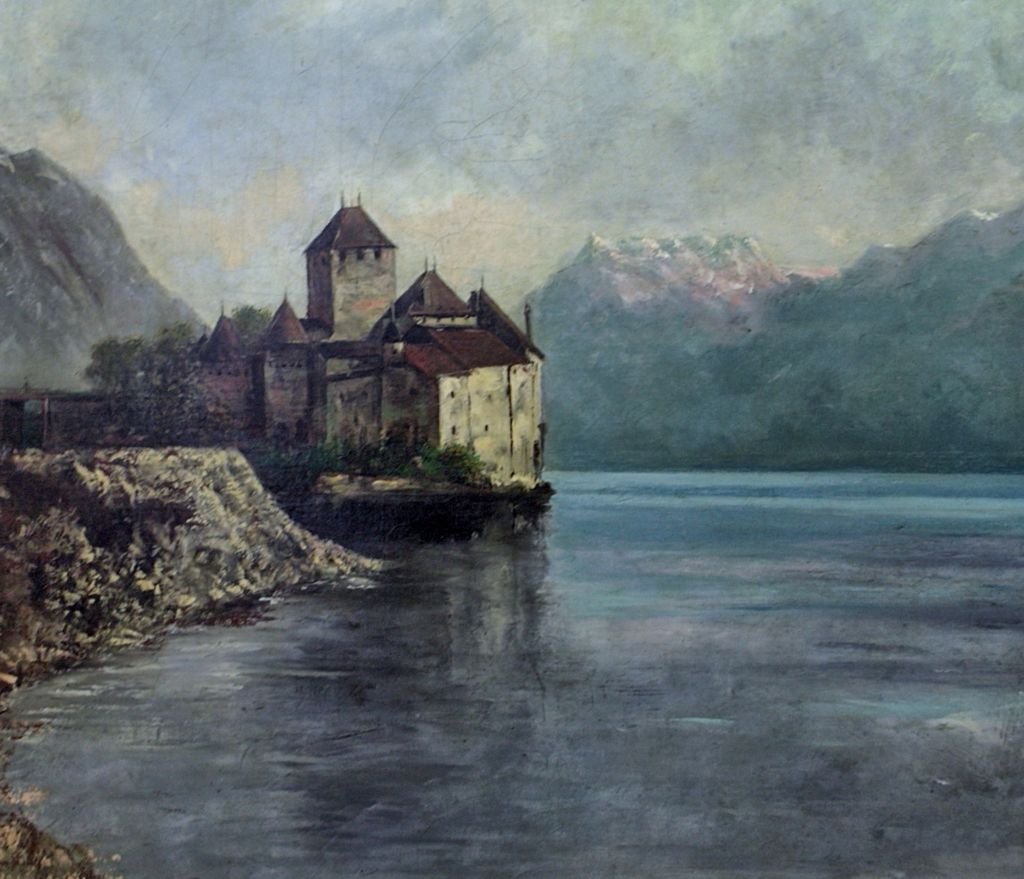
Detail of Gustave Courbet, The Château de Chillon. Musée Courbet, D.1976.1.3. Shown here, castle and its reflection. Image source. Public domain. Cropped and resized from the source image.
Courbet artworks directory
Browse the paintings covered in this guide. Dates identify the specific versions discussed.
Discussion
Look again at the images and ideas explored in The Château de Chillon by Gustave Courbet. These editorial prompts invite your observations.
Reader Insights
What effect does the reflection have on the castle’s mass?
Which details are similar in the painting and the Braun print?
What features distinguish Courbet’s versions of the castle?
Join the Conversation
Share a detail, comparison or question about The Château de Chillon by Gustave Courbet below.
References
- Musée Courbet, La nature comme tableau, “Le château de Chillon,” Les carnets du musée Gustave Courbet, no. 2, PDF page 31. View source.
- Département du Doubs, partnership and loan documentation, inventory D1976.1.3, PDF page 18. View source.
- Musée Courbet, “Qui est Gustave Courbet ?”, reproduction and caption for D1976.1.3 under “L’exil et la maladie”. View source.
- Evelyne Lüthi-Graf, “Chillon (château),” Historical Dictionary of Switzerland, including the D1976.1.3 caption. View source.
- Cleveland Museum of Art, Adolphe Braun, Château de Chillon, collection record 2022.353. View source.
- Pierre Chessex, “Gustave Courbet,” Historical Dictionary of Switzerland. View source.
- Musée d’art et d’histoire, Geneva, Gustave Courbet, les années suisses, 2014 exhibition dossier. View source.
- Fondation du Château de Chillon, history of the castle. View source.
- Morgan Library & Museum, Lord Byron, The Prisoner of Chillon and Other Poems, first edition, 1816. View source.
- Musée du Louvre, Eugène Delacroix, Le Prisonnier de Chillon, collection record RF 1660. View source.
- Metropolitan Museum of Art, Gustave Courbet, The Source of the Loue, collection record 29.100.122. View source.
- Robert Fernier, La vie et l’œuvre de Gustave Courbet, vol. II, 1978, no. 992, digitised by the Wildenstein Plattner Institute. View source.
- Suisse Magazine, no. 303–304, 2014, p. 33, reproduction caption for the Lons-le-Saunier canvas and Geneva exhibition. View source.
- Leopold Museum, Gustave Courbet: Realist and Rebel, 2026 press images, no. 28, Belfort’s Chillon Castle. View source.