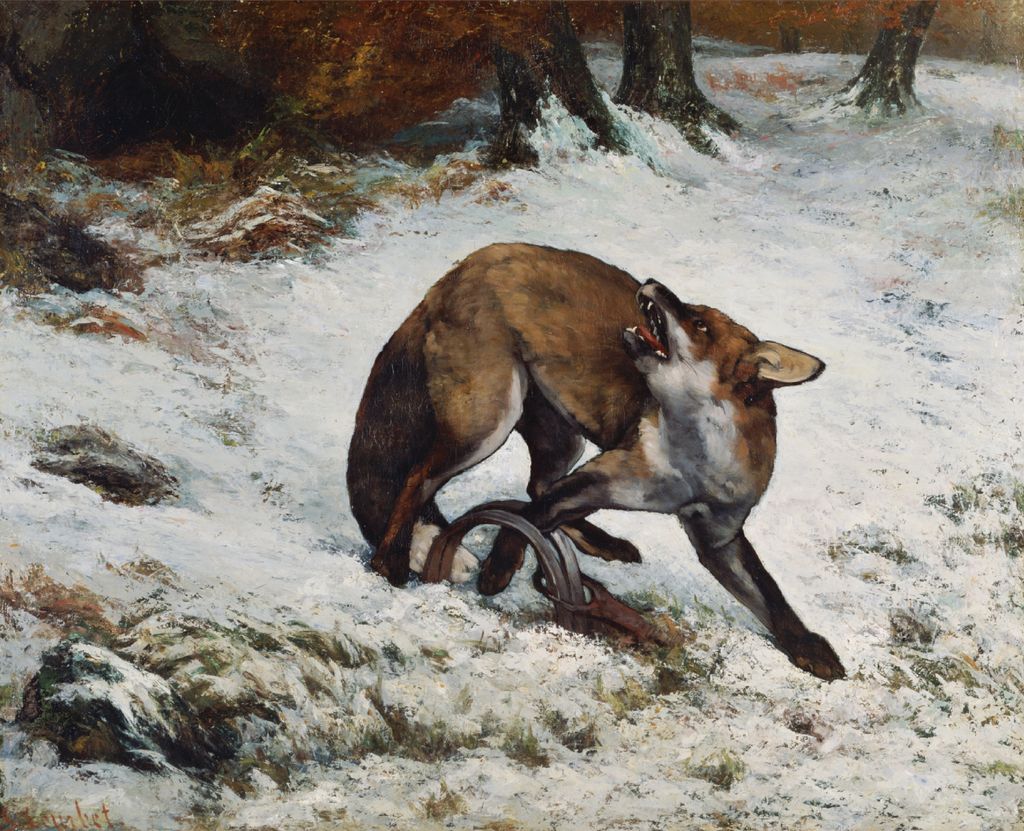
Fox Caught in a Trap by Gustave Courbet, P.1959-0061 National Museum of Western Art reproduction, via Wikimedia Commons. Image source. Public domain.
 by Tom Gurney
Tom Gurney BSc (Hons) is an art history expert with over 20 years experience
Email: tomgurney1@gmail.com / Phone: +44 7429 011000
Fox Caught in a Trap by Gustave Courbet: Introduction
A fox braces one foreleg against the snow and turns its open mouth back over its shoulder. The line of its raised muzzle leads up towards the trees, while the iron arc beneath its body keeps drawing the eye down. Gustave Courbet painted this Fox Caught in a Trap in 1860. The National Museum of Western Art in Tokyo catalogues the oil on canvas as P.1959-0061, with the Japanese title 罠にかかった狐. It measures 81.5 × 100.5 cm and is signed at the lower left. Courbet painted another trapped fox of much the same size, now in Ornans. The Tokyo fox can be recognised by the way it gathers itself over the iron, its back raised above the surrounding snow. [1] [2]
At a Glance
- Date1860
- MediumOil on canvas
- CollectionNational Museum of Western Art, Tokyo, P.1959-0061
Contents
- The fox above the iron
- The snow under the fox
- Two trapped foxes and a Salon picture
- The Matsukata Collection and the move to Tokyo
The fox above the iron
The first part of the fox you might pick out is the pale throat. It curves towards an open jaw, with the white tips of teeth against the darkness of the mouth. The ear extending to the right and the muzzle pointing up and back make a turn that is easy to follow even at a distance. Lower down, the dark foreleg reaches diagonally to the right. It takes the weight of the turn, ending in a paw pressed against a patch of snow and grass. The other limbs are harder to separate where they cross beneath the body. The broad back looks solid, while the tangle below it takes a moment to make sense. [1]
The trap is visible in that tangle. Its curved metal catches a cool streak of light on the right, and the reddish length at its base runs away through the foreground. Snow partly obscures the place where metal and ground meet. The close overlap of the device and the dark limbs makes the eye work back from the iron towards the animal. From there the foreleg reads as an effort to gain purchase. The raised head and extended paw seem to lead in different directions, but neither gesture takes the fox any farther from the centre of the canvas. [1]
The viewer is close enough to see the fox’s eye and the light inside its ear. No person enters the clearing, and there is no sign of a crowd or pack to tell us where to look. The iron supplies the human action that the scene itself leaves outside the frame. The painting gives the fox room on all sides, including a pale stretch beyond its planted forepaw. In that space the pose has the look of an interrupted movement. A single contact with the ground has changed what all four legs can do. [1]
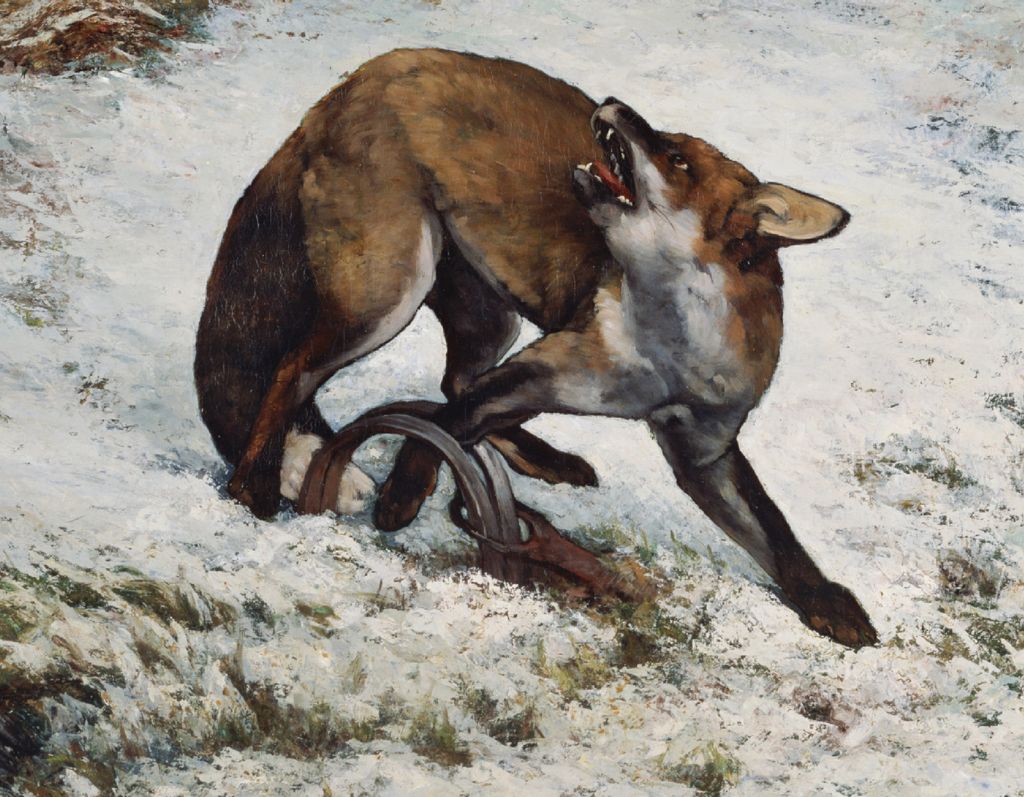
Detail of Fox Caught in a Trap, Tokyo P.1959-0061. Shown here, fox, trap and snow. Image source. Public domain. Cropped and resized from the source image.
The snow under the fox
Behind the animal, snow runs back between dark trunks. It collects in small mounds against their roots, and more of the brown ground shows through beneath the dense cover at the upper left. Near the lower edge, ochre and green patches interrupt the white as it thins over vegetation. Darker stone pushes through at the lower left. These changes make it possible to follow the rise of the ground from the immediate foreground into the wood, even though there is little distant view. Around the fox, broader stretches of pale paint let the animal’s back and planted paw stand out. [1]
The Tokyo museum draws attention to Courbet’s palette knife in the snow. A flat blade can spread paint in a broad stroke and leave a ridge where the stroke ends. Here the broken, sometimes abrupt changes between white, blue-grey and earth colours give the snow a visible depth. In places the white looks spread across the ground. Elsewhere little dabs catch the edges of darker forms and make the snow look patchy or compressed. The fox’s back has gentler transitions between brown and tawny colour, although the fur itself breaks into smaller accents around the face. A similarly pale colour can thus describe the cheek turning into shadow, snow resting on a root or a narrow glint on iron. [1]
The clearing gives the picture a sense of movement in its own right. White slants across the darker ground, breaks up under the fox, and spreads out again behind it. The colour of the throat comes close to that of the snow, especially where both pass into grey. Follow the point at which one becomes distinguishable from the other and you can see how small the margins are around the animal’s struggle. The dark chest and foreleg give it an edge against the clearing. The parts of the trap nearest the ground take on the colours of the ground itself. [1]
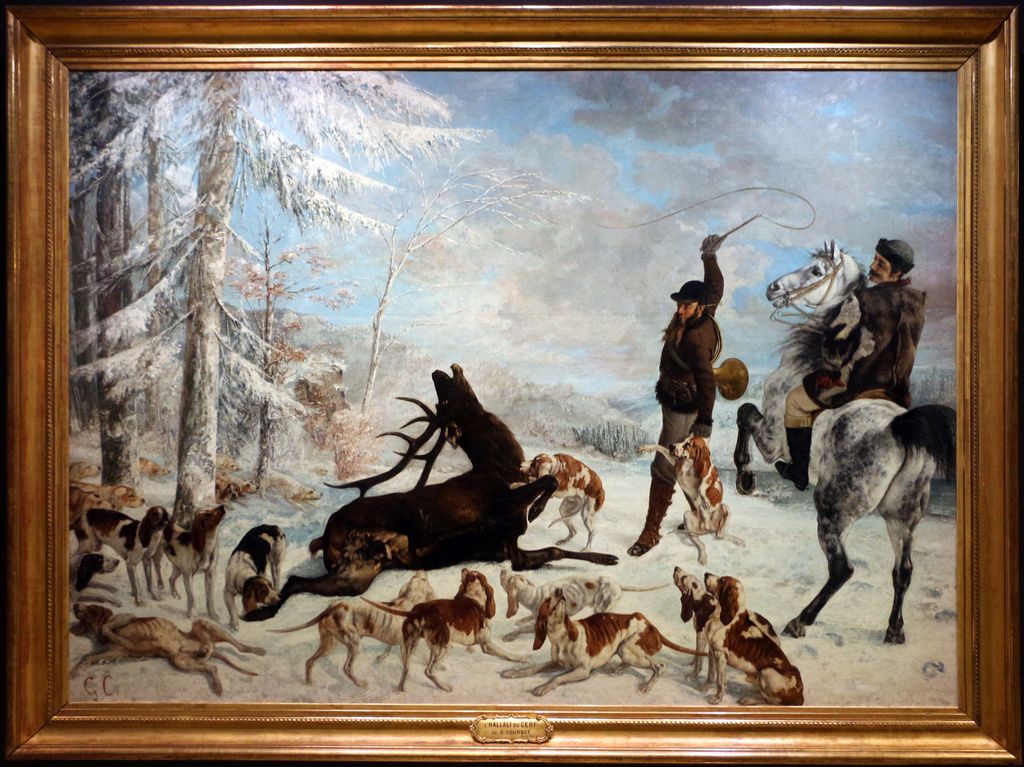
The Death of the Stag, Besançon D.882.2.1 / RF 327, Sailko photograph. Photograph by Sailko. Image source. CC BY 3.0. Resized from the complete source image.
Two trapped foxes and a Salon picture
The Musée Courbet in Ornans holds Le Renard pris au piège, inventory 1990.1.1, which its English gallery guide also calls Fox Caught in a Trap and dates to around 1860. In the museum’s reproduction the fox is thrown much farther onto its side. The head is at the left and the limbs spread across the white ground, with the iron reaching towards the right. The dark patch at lower right gives this version a different balance from Tokyo’s snow-covered foreground. Compare the back in each canvas. In Tokyo it rises above the head and limbs in a strong curve, while in Ornans the body extends more diagonally across the scene. The Ornans guide reads its fox as a suffering animal and uses the idea of martyrdom to convey the intensity of the pose. The shared subject leaves Courbet free to give the same predicament two different shapes, and the two museum records give each composition an identity of its own. [1] [3] [4]
There is a third picture from 1860 with a fox against snow, The Fox in the Snow at the Dallas Museum of Art. In the retrospective at the Metropolitan Museum of Art in 2008, the curators identified the Dallas canvas as the painting exhibited at the Salon of 1861. The Salon catalogue transcribed by the Musée d’Orsay lists Le renard dans la neige as no. 720. The Dallas fox bends over small prey, with the head lowered in the direction of its front paws. The snow gives the crouch a clear outline, as it does for the twist of the Tokyo fox. The resemblance makes the change in the animal’s role especially legible. In Dallas the lowered head is where the fox directs its attention. In Tokyo the raised head is the end of a movement forced by what has happened underfoot. The Salon reference belongs to the Dallas canvas, while the earliest exhibition in the Tokyo museum’s list for its own painting is the Centennale de l’art français in Paris in 1889. [1] [5] [6]
Courbet could make a human presence felt with very little equipment. In The Trout of 1873 at the Musée d’Orsay, the hook and line explain the attitude of a fish already out of water. In the Tokyo fox the iron lies amid the snow through which the animal has been moving. One animal is brought onto ground where it struggles for breath, while the other struggles on ground where it could normally find its footing. The sparse signs of human action in both canvases leave much of the painted surface to the animal and the place where it has been caught. [1] [7]
In The Death of the Stag of 1867, the people and dogs appear in the painting, and the viewer can follow a whole group converging on one animal. The canvas in Besançon is over five metres wide. Snow opens the spaces between the figures and helps the viewer follow the course of the hunt across that breadth. In the metre-wide Tokyo painting the same pale ground brings the signs of a hunt into a small area around the paws. The eye can take in the action almost at once, yet the trap still takes a closer look. [1] [8]
The Matsukata Collection and the move to Tokyo
The Tokyo museum’s ownership record names Klotz in 1900 and then Henri Menier. On 5 March 1914 the picture was lot 1 at a sale at Galerie Georges Petit in Paris, where Galerie Georges Bernheim bought it. The museum dates Kōjirō Matsukata’s purchase from Bernheim to around November 1921 and gives the price as 70,000 francs. It cites a letter from Georges Bernheim to Léonce Bénédite dated 17 November 1921. The letter date helps locate the transaction within the month, while the museum’s purchase date remains approximate. In 1929 the painting appeared in the Courbet exhibition at the Petit Palais in Paris, during the period when a substantial part of Matsukata’s collection was still in France. [1] [9]
Matsukata, a shipbuilding executive, collected European art with a museum in Japan in mind. The National Museum of Western Art’s collection history explains that he left hundreds of works in Paris under the care of Bénédite, who arranged storage at the Musée Rodin. The Tokyo object record dates the French government’s wartime sequestration of the fox to 1944. It gives 1952 as the year the work vested in the French government under the San Francisco Peace Treaty. The treaty was signed in September 1951 and took effect in April 1952. These dates distinguish the wartime taking into custody from the later disposition of the painting under the treaty. [1] [9] [10]
France subsequently agreed to transfer most of the works in the Paris group to Japan. For this canvas the museum records 23 January 1959 as the date of the transfer from the French to the Japanese government and April 1959 as its entry into the National Museum of Western Art. The museum opened to the public that June and included the fox in its exhibition of former Matsukata collection masterpieces the following year. The credit line Matsukata Collection records the painting’s place in the group that formed the basis of the museum. The collection number identifies the particular winter scene whose history ran through that group, the one with the arched back and the iron visible beneath the fox. [1] [9] [11]
Courbet artworks directory
Browse the paintings covered in this guide. Dates identify the specific versions discussed.
Discussion
Look again at the images and ideas explored in Fox Caught in a Trap by Gustave Courbet. These editorial prompts invite your observations.
Reader Insights
How does the fox’s pose change the way you read the landscape?
What kinds of marks make the snow feel uneven?
Which features distinguish the Tokyo canvas from Courbet’s other fox paintings?
Join the Conversation
Share a detail, comparison or question about Fox Caught in a Trap by Gustave Courbet below.
References
- National Museum of Western Art, Tokyo, Fox Caught in a Trap, collection record P.1959-0061. Includes the reproduction, palette-knife discussion, exhibition list and provenance with the Bernheim letter citation. View source.
- National Museum of Western Art, Tokyo, 罠にかかった狐, Japanese collection record P.1959-0061. View source.
- Musée Courbet, La représentation de l’animal chez Courbet, p. 2. Reproduction and inventory number for the Ornans canvas. View source.
- Musée Courbet, Tour Guide: Permanent Collections, room 16. English title, approximate date and curatorial reading for the Ornans painting. View source.
- Metropolitan Museum of Art, Gustave Courbet, 2008 retrospective, The Fox in the Snow. Identifies the Dallas painting and its Salon exhibition. View source.
- Musée d’Orsay, Base Salons, Le renard dans la neige, Salon of 1861, no. 720. View source.
- Musée d’Orsay, La Truite, collection record RF 1978 15. View source.
- Musées d’arts & du temps, Besançon, L’Hallali du cerf, collection record D.882.2.1. View source.
- National Museum of Western Art, Tokyo, history of the Matsukata Collection. View source.
- United Nations Treaty Series, Treaty of Peace with Japan, 1951, entry into force in 1952. View source.
- National Museum of Western Art, Tokyo, museum chronology. View source.