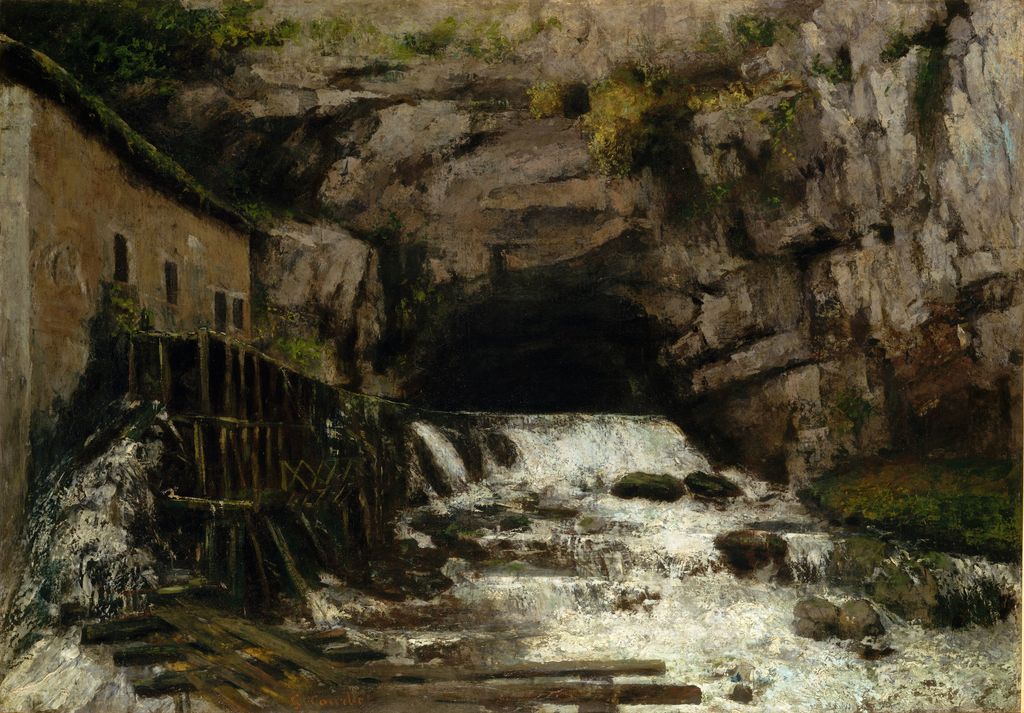
The Source of the Loue by Gustave Courbet The Metropolitan Museum of Art. Image source. CC0 / Public domain.
 by Tom Gurney
Tom Gurney BSc (Hons) is an art history expert with over 20 years experience
Email: tomgurney1@gmail.com / Phone: +44 7429 011000
The Source of the Loue by Gustave Courbet: Introduction
Water spills from a dark opening in the rock and breaks white over a series of ledges. A building crowds the left bank, with a timber structure below it and boards reaching across the foreground. Behind the building and the falling water, the cliff fills the rest of the view. Gustave Courbet painted this Source of the Loue in 1864. The oil on canvas measures 99.7 × 142.2 cm and entered the Metropolitan Museum of Art through the 1929 bequest of Mrs. H. O. Havemeyer. Its accession number, 29.100.122, identifies the broad view of the grotto with the waterworks on the left. [1]
At a Glance
- Date1864
- MediumOil on canvas
- CollectionThe Metropolitan Museum of Art, 29.100.122
Contents
- From the cave to the foreground
- Where the Loue comes to the surface
- What Courbet’s letter tells us
- The palette knife at the cliff and the fall
- The other painting called The Source
From the cave to the foreground
Start with the long, shallow curve of the cave mouth. Courbet puts it just right of centre, underneath courses of stone that have split and shifted into uneven blocks. The roof of the opening seems to dip on the left, where vegetation obscures the boundary between rock and shadow. At the right, a sloping shelf pushes into the dark. The opening looks low in relation to the rock above it. With the top of the cliff cut off, there is no sky by which to judge how much farther the stone rises. [1]
The brightest stretch of water begins almost exactly where the shadow ends. Under the roof the current is hard to separate from the dark around it. Then a pale lip runs across the foot of the cave and widens into a sheet of falling water. Two rounded rocks below the fall interrupt that sheet. Farther forward, patches of brown and green divide the white into smaller runs, each with its own edge and direction. The river comes out of depth that Courbet leaves almost entirely hidden and reaches the bottom of the picture in a succession of visible drops. [1]
The building offers a second way into the scene. Its windows grow smaller towards the cave, while the downward line of the roof takes the eye towards the middle of the canvas. Below the wall, the timbers run across the flow at different angles. Some are upright and bunched together, and others stretch nearly flat across the foreground. Water tumbles down the far left beside this structure as well as down the main channel to the right. Following the building and the timberwork makes it possible to see how much is going on outside the dark centre that first catches the eye. [1]
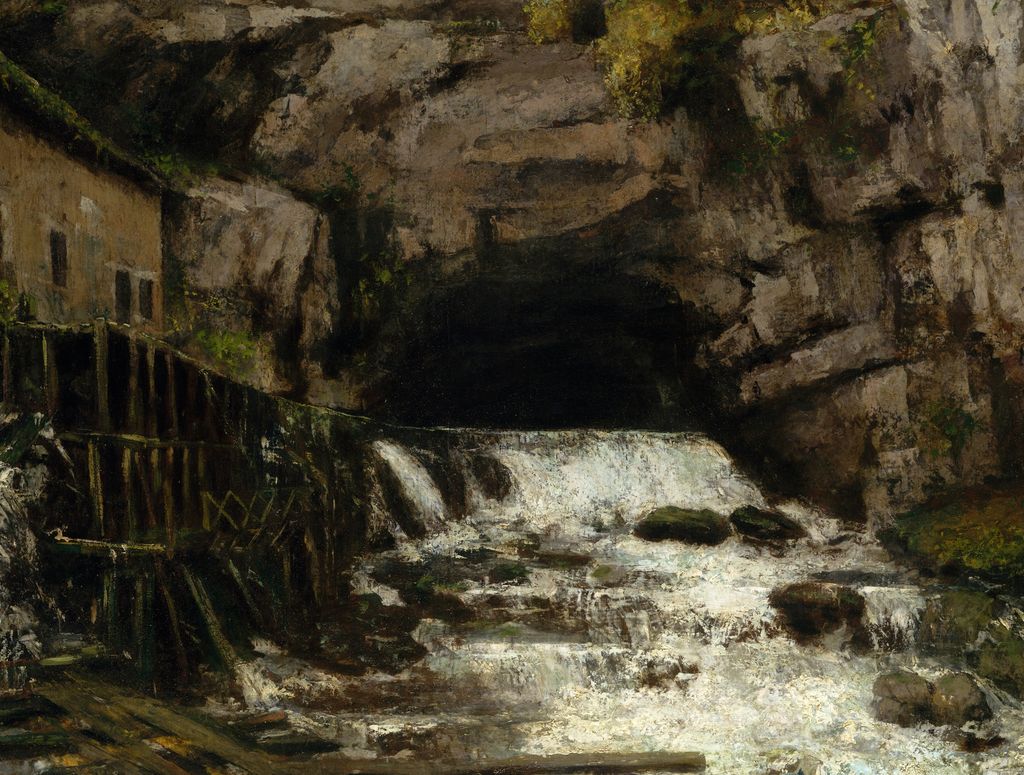
Detail of The Source of the Loue, Met 29.100.122. Shown here, cave mouth, rocks and falling water. Image source. CC0 / Public domain. Cropped and resized from the source image.
Where the Loue comes to the surface
The Loue emerges near Ouhans in the Doubs, in eastern France. From its source it runs through the Noailles Gorge and on through Ornans, Courbet’s birthplace. The Musée Courbet describes a karst system beneath the surface. Water travels through passages in the limestone, supplied in part by water that seeps underground from the Doubs and the Drugeon and in part by rainfall that infiltrates the surrounding country. At the foot of the cliff this underground network has an outlet. The volume of the river coming out of the grotto is part of what made the site remarkable. [1] [2]
The force of that water also made the source a place of work. The Musée Courbet traces local mills back to a record of 1260. By 1857, seven years before the date of the painting, its account lists an oil works, two mills and four sawmills at the source. Forges had also made agricultural tools there. The Met identifies the group at the left of the painting as the site’s waterworks. The receding wall and the structures below it make sense in a place where people had put a powerful current to work for centuries. The painting preserves a view of that activity from before the hydroelectric works of the twentieth century and the demolition of the old forge buildings in 1926. [1] [2]
Courbet already knew what it was to exhibit a landscape from the country around Ornans. His painting of the Puits-Noir stream brought him public success as a landscape painter at the Paris Exposition Universelle in 1855. He continued to paint versions of that stream in the following decade. At the source of the Loue, the enclosing rock gives him a different way to frame moving water. The main current issues from a single shadowed opening, and the buildings gather to one side of it. For an earlier treatment of this part of France, compare The Valley of the Loue in Stormy Weather of 1849, in Strasbourg. It takes in a broad stretch of country beneath a bank of storm clouds. Fifteen years later, in the Met canvas, even the little daylight that catches the stone has its source somewhere outside the frame. [1] [3] [4]
What Courbet’s letter tells us
In 1864 Courbet wrote to the dealer Jules Luquet that he had recently gone to the source of the Loue and made four landscapes roughly 1.40 metres wide, similar to ones Luquet already had. The Met considers its 142.2-centimetre canvas a probable member of that group. The width fits the estimate in the letter, but Courbet’s description gives no individual titles or details that would distinguish the four. His reference to the pictures Luquet already had puts the new canvases in the context of a motif familiar to both painter and dealer. It leaves room for other paintings of the site before and after the visit he describes. [1] [5]
The versions show how much Courbet could change while keeping the grotto recognisable. The National Gallery of Art in Washington holds La Grotte de la Loue, dated 1864 and measuring 98.4 × 130.4 cm (1957.6.1). In it, a small fisherman stands with his back to us and holds a spear beside a much larger expanse of dark, still water. Beyond him the main arch and a smaller opening are both clearly visible, while the current breaks into white at the lower right. A viewer can use the fisherman’s body to gauge the height of the rock. In New York, the mill windows do some of that work. They give a familiar scale to the left edge of a cliff whose upper limit lies beyond the picture. [1] [6]
Buffalo’s La Source de la Loue (Buffalo AKG Art Museum 1959:1) is another oil on canvas of almost the same width. It measures 107.3 × 137.5 cm and the museum dates it to about 1864. The Buffalo painting, which later belonged to Henri Matisse, brings the arch much closer. A block of rock fills the left where we would look for the mill in New York. Beneath the overhang, reflections extend the cave’s dark tones well down into the river. Most of the white water is pushed to the lower edge and the right. In New York, the bright run starts almost at the cave mouth. Across the versions, Courbet gave different amounts of room to the water while it was still dark and while it was catching the light. [1] [7]
The palette knife at the cliff and the fall
The Met describes Courbet varying his work with the palette knife to paint both the rock and the cascade. Look above the cave where a light band of stone seems to slide over the brown below it. Its upper surface is broad and uneven, and its lower edge breaks abruptly into shadow. On the right, small changes of direction and colour mark out blocks that catch the light at different angles. Much of the impression of weight comes from the way a pale patch ends sharply, leaving the adjoining dark to suggest a fissure or an overhang. [1]
Down in the river, the pale paint breaks into much finer marks. Along the main fall, short light streaks descend in parallel before scattering over the rocks. The right foreground is so bright that the dark stones within it seem to stand up through the paint. There are pale browns and greens between the whites, where the current runs shallow or where the face of a rock catches the water. At a distance you can follow one current through all of it. Up close, separate marks give that continuous movement a series of sudden changes of speed and direction. [1]
Courbet took the knife to the sea as well. In its 2008 retrospective, the Met compared the sculpted water of the Berlin Nationalgalerie’s The Wave (1869) with the limestone and grottoes in his Ornans landscapes. The Musée d’Orsay likewise describes thick paint worked with a knife in its own The Wave, also called The Stormy Sea, shown at the Salon of 1870. In the Orsay picture, white gathers along the crest of a single mass of dark green water, with a strip of shore and two boats in front. In the Met’s Loue, the brightest paint is spread out below the cave, where one fall feeds the next. The two works give the knife different tasks. At the shore it helps build the weight of a wave before it breaks. Below the grotto it follows water that keeps breaking as it comes towards us. [1] [4] [8]
The other painting called The Source
The Met also holds Courbet’s The Source of 1862, accession number 29.100.58, from the same Havemeyer bequest. It is an upright canvas, 120 × 74.3 cm, in which a nude woman seen from behind puts her arms around falling water. The Met suggests that the figure may answer Ingres’s idealised personification of a spring, a woman holding a jar from which water pours. Courbet returned to the bather subject in a separate 1868 La Source now at the Musée d’Orsay (RF 2240). These pictures belong with his studies of bodies at the water’s edge, a subject he had taken to the Salon with The Bathers in 1853. [4] [9] [10]
In the wide Loue canvas, the title names a particular place in eastern France. Our bearings come from the wall with its little windows, the lines of the timbers and the bright water descending into the foreground. Follow the current the other way and it takes you to the lip of the fall, then stops giving anything away. Some of that water has already flowed in another river before passing underground and reaching daylight here. Courbet gives the visible part of that journey almost the whole lower half of his canvas and leaves the rest in shadow. [1] [2]
Courbet artworks directory
Browse the paintings covered in this guide. Dates identify the specific versions discussed.
Discussion
Look again at the images and ideas explored in The Source of the Loue by Gustave Courbet. These editorial prompts invite your observations.
Reader Insights
Where does Courbet let you see the cave’s depth?
How does the handling of water differ from the handling of stone?
What can comparisons with the other views tell you about his choices?
Join the Conversation
Share a detail, comparison or question about The Source of the Loue by Gustave Courbet below.
References
- Metropolitan Museum of Art, The Source of the Loue, 1864, collection record and audio transcript, 29.100.122. View source.
- Musée Courbet, The Source of the Loue, site history and hydrology. View source.
- Metropolitan Museum of Art, Gustave Courbet, 2008 retrospective, Landscape. View source.
- Metropolitan Museum of Art, Gustave Courbet, 2008 retrospective checklist, entries for the Strasbourg landscape, The Bathers and the Berlin Wave. View source.
- Robert Fernier, La Vie et l’œuvre de Gustave Courbet, vol. 1, pp. 217–18, Wildenstein Plattner Institute digital copy. Includes the French wording of Courbet’s 1864 letter to Jules Luquet. View source.
- National Gallery of Art, La Grotte de la Loue, 1864, collection record 1957.6.1. View source.
- Buffalo AKG Art Museum, La Source de la Loue, ca. 1864, collection record 1959:1. View source.
- Musée d’Orsay, La Mer orageuse, collection record RF 213. View source.
- Metropolitan Museum of Art, The Source, 1862, collection record 29.100.58. View source.
- Musée d’Orsay, La Source, 1868, collection record RF 2240. View source.