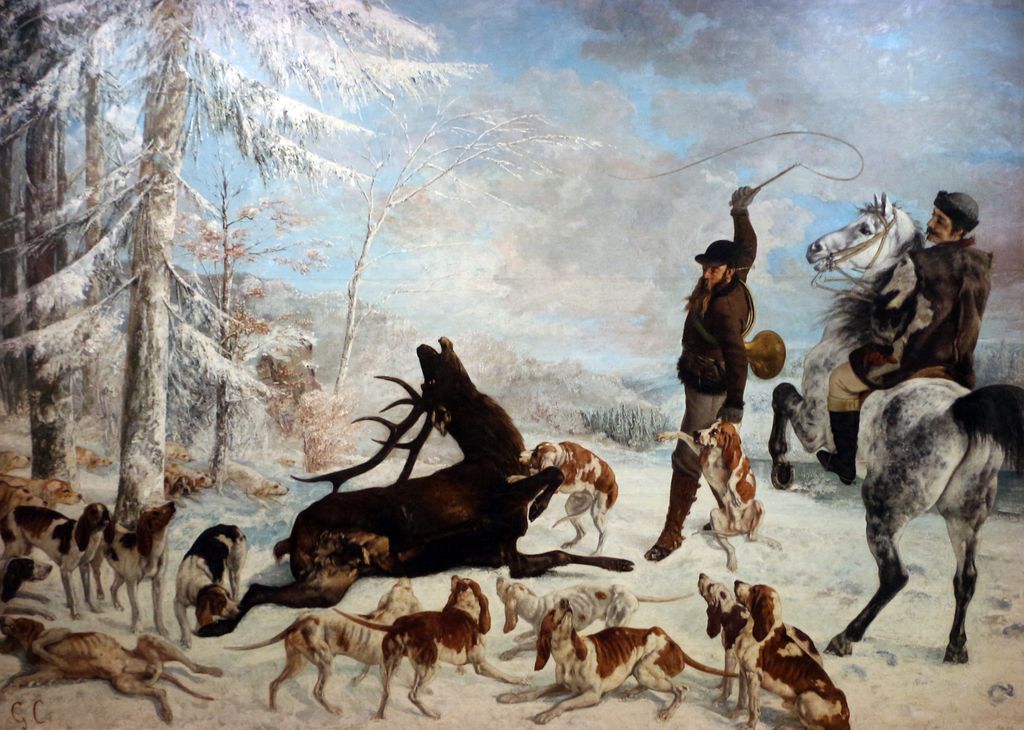
The Death of the Stag by Gustave Courbet, RF 327 Photograph by Sailko. Image source. CC BY 3.0. Cropped to the painted canvas.
 by Tom Gurney
Tom Gurney BSc (Hons) is an art history expert with over 20 years experience
Email: tomgurney1@gmail.com / Phone: +44 7429 011000
The Death of the Stag by Gustave Courbet: Introduction
A stag has gone down in the snow, but its head is still up. Its antlers swing back across its body as hounds press in from both sides. Farther to the right, a man raises a whip and a grey horse lifts a foreleg. Gustave Courbet spreads these movements across more than five metres of canvas. Painted in 1867, The Death of the Stag (L’Hallali du cerf) is an oil on canvas measuring 355 × 505 cm. The Musée des Beaux-Arts et d’Archéologie in Besançon catalogues it as D.882.2.1. The same painting is recorded as RF 327 in the national inventory. [1] [2]
At a Glance
- Date1867
- MediumOil on canvas
- CollectionMusée des Beaux-Arts et d’Archéologie, Besançon, D.882.2.1
Contents
- The stag at bay
- Snow, distance and scale
- Courbet in front of the canvas
- From the Alma pavilion to the Salon
- The painting in Besançon
The stag at bay
In the French of Courbet’s day, the Académie française defined hallali as the hunting cry that announces that the stag is near its end. The French title points to the instant at which the animal can run no farther. The English title gives that instant an outcome. Courbet lets us see how close the two are. The stag’s body lies low and broad across the snow, with a leg stretched out to the right. Its neck makes an abrupt turn upwards and the mouth opens towards the sky. The points of the antlers rake back through a patch of light that separates them from the torso. It takes a moment to follow the antlers to the head and recognise how far the animal has thrown it back. [1] [3]
The hounds take up nearly the whole width of the lower canvas. Some are already on the stag, while others look or move towards it. Near the trees, one lowers its muzzle at the stag’s hindquarters. A brown-and-white dog on the other side presses close to its shoulder. Across the foreground, elongated bodies and low tails pull the eye sideways. At the right, two dogs sit close together, their heads lifted above the animals on the run. Courbet gives their long ears, ribcages and coats enough definition for each change of posture to register separately. From farther away the pack reads as a continuous band, cutting across the foot of the picture and filling the space between the viewer and the fallen animal. [1]
The standing hunter is close enough to intervene. His boot comes down near the end of the stag’s outstretched leg. The brass horn at his hip catches the light, while his raised hand sends a thin loop of whip into the sky. The horn is a reminder of the sound named by the title, and the curve of the whip suggests another sound about to break over the pack. On the far right the horse faces back into the picture, its raised foreleg bent almost double. The rider sits above the hounds and looks left. The height of these figures gives the right side much of its weight. Their gestures carry attention up and out before the turned head of the horse leads it back towards the ground. [1] [3]
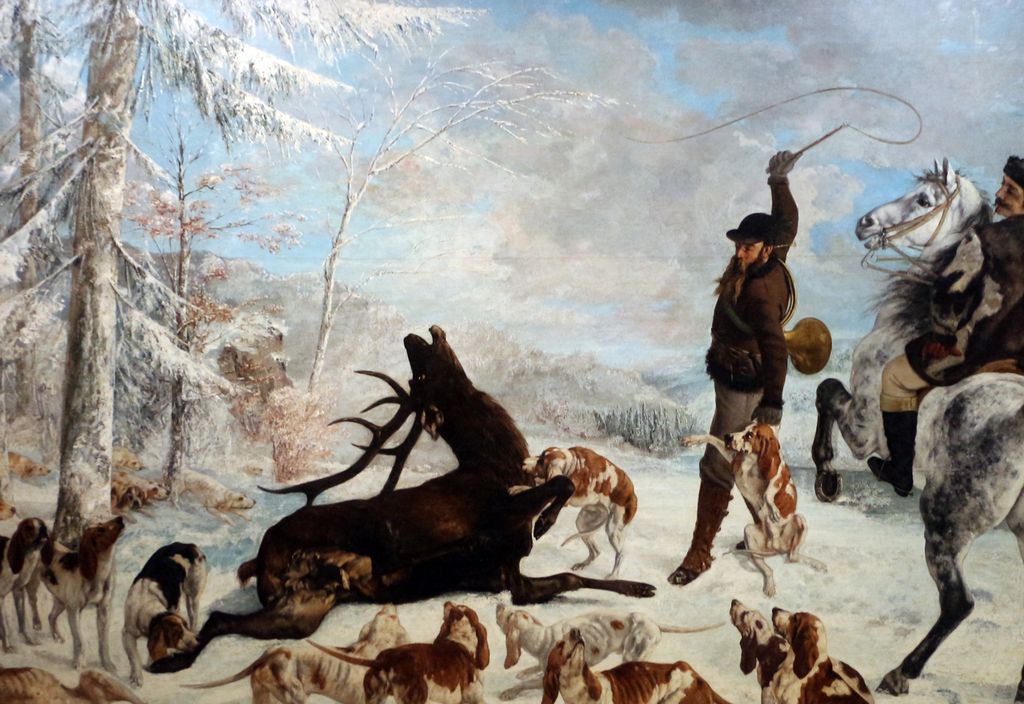
Detail of The Death of the Stag, Besançon D.882.2.1 / RF 327, Sailko photograph. Shown here, stag, dogs and snow. Photograph by Sailko. Image source. CC BY 3.0. Cropped and resized from the source image.
Snow, distance and scale
At the left, snow lies in thick strips along the drooping branches. It breaks up the dark upright trunks and catches in finer lines on the bare twigs near the middle. Between the trees and the hunters there is room to see across a pale valley towards the far slopes. The foreground has much more definition. A boot has an edge and a hound has a shadow. The farther slopes are built out of greys and blues close to the colour of the sky. That opening behind the stag gives the eye a long way to travel into the picture, even as the dogs close off its immediate space. [1]
The colour reproduction in Besançon’s collection record makes it possible to follow different shades of white across the composition. The grey horse’s back is dappled and the snow beside its hooves tends towards blue. Warm patches of hide break up the white on the hounds. Near the stag the snow sets off a mass of dark brown, especially where the body lies beneath the antlers. A spectator can pick out that large dark shape before making sense of the individual dogs. The farther up the picture the eye goes, the more delicately the snow and light are marked. The whip’s line, fine against the clouds, would disappear into the busy lower register. [1]
Courbet had already used a wall-sized canvas to give a provincial gathering public weight in A Burial at Ornans. In the hunt, the width gives the hounds room to separate and puts open country behind them. A viewer who steps back can see how the tall conifers answer the upright hunters and how the two sides bear down on the middle. Up close the stag is too broad, and the interval to the horse too long, to take in with a glance. The scene has an effect that depends on both distances. Its action is concentrated in a few feet of snow around the stag, while the span of the canvas keeps offering the eye places to escape. [1] [4]
The way Courbet spaces the animals becomes clearer beside his 1866 Roe Deer at the Stream of Plaisir-Fontaine. There a standing deer is partly screened by a trunk, a second rests on the near bank and another stands on the far side of the stream. The eye has to find them in the shade, one by one. In the snow the stag’s open mouth and spread antlers catch attention almost at once. Courbet makes the open ground around it an exposed place, even as the valley and the woods suggest how much country lies beyond. [1] [5]
Courbet in front of the canvas
Étienne Carjat photographed Courbet at work on the painting in 1867. The surviving albumen print in the Petit Palais is scarcely eleven centimetres across. It holds the painter and a painting so large that his body gives us a measure of the task. The Petit Palais describes the stag in its death throes as already clearly defined while much of the scene was still sketched. That is one documented stage of the work. The photograph preserves the relative clarity of the stag at that moment. It leaves open when Courbet decided on the position of each hound or worked out the distant slopes. [6]
The photograph also had a subject of its own. Carjat and Courbet had met in Frankfurt in 1859, and the Petit Palais traces more than ten portraits from their friendship in the following decade. Courbet appears in different clothes and roles across them, among them the artist at work. Seen alongside the finished picture, the 1867 portrait changes the scale of the encounter twice. In the photograph, the person beside the canvas makes its height apparent. In the gallery, that same expanse of painted fabric is what allows us to read a lifted hoof, a turn of the head and a dark shape lying on the snow from across a room. [1] [6]
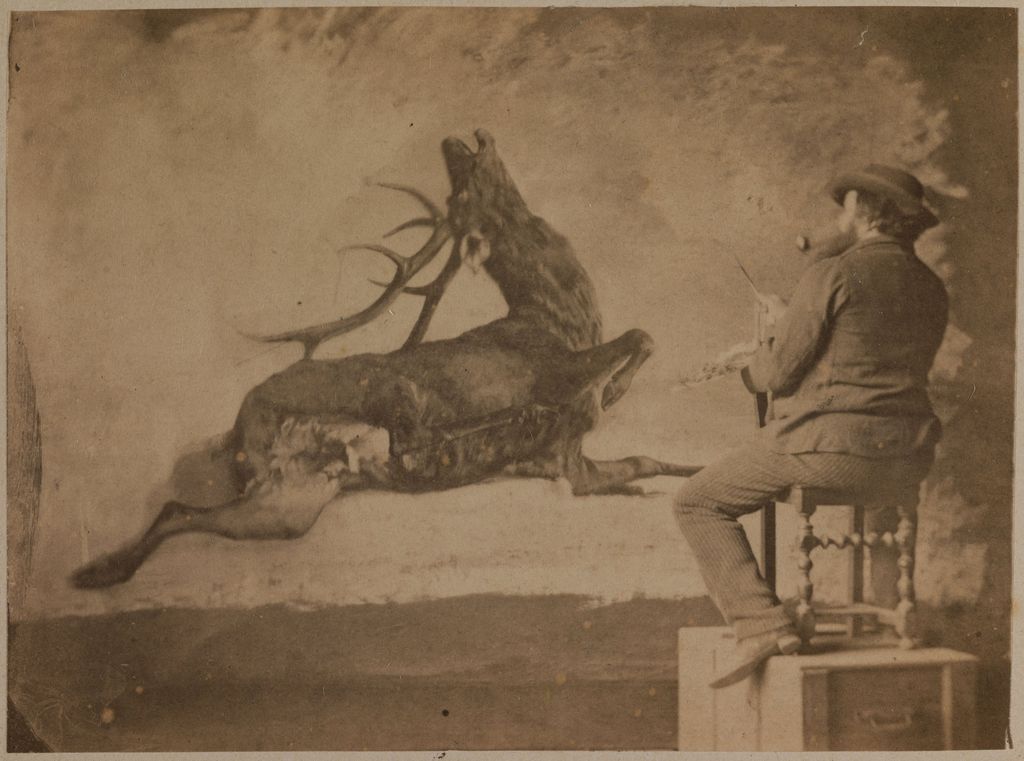
Étienne Carjat, Courbet painting The Death of the Stag, 1867. Paris Musées. Image source. CC0 / Public domain. Resized from the complete source image.
From the Alma pavilion to the Salon
The Institut Gustave Courbet identifies L’Hallali du cerf as a central work in Courbet’s independent Paris exhibition of 1867. The catalogue places his show at the Rond-Point du Pont de l’Alma. Courbet could there set the new painting among works from earlier in his career while the Universal Exhibition was drawing visitors to Paris. The official Paris Salon entry came two years later, in 1869, as number 571. The Salon catalogue describes an episode of hunting with hounds in snowy weather. Its next entry is Courbet’s painting of a rest during haymaking in the Doubs. Viewers could encounter two very different uses of the countryside by the same painter, one a moment of rest in summer and the other a pursuit that ends in snow. The stag picture also travelled to the international exhibition in Munich that year. [4] [7] [8] [9]
Writing about the 1869 Salon, Théophile Gautier argued that the subject called for a smaller canvas. He compared it with Rubens’s large hunting scenes, whose ferocious movement and dramatic manner, he thought, earned their epic proportions. Gautier still admired the movement of the man with the whip and found several of the dogs convincing. He was less persuaded by the rider. He also had a specific complaint about snow. From his own experience of a winter in Russia, he expected the animals and people to stand out more sharply against it. To him, the weaker contrast in parts of Courbet’s scene left the whole effect disjointed. [10]
That criticism draws attention to a choice visible in the picture. The stag is among the strongest dark shapes on the canvas, while the edge of a white hound can be hard to distinguish from the snow. The horse’s pale head reads clearly against the sky, but much of the space behind its legs dissolves into the lighter distance. The differences in contrast matter if we try to follow the event from the human figures down into the pack. They make it possible to lose sight of one dog in the snow and recover the picture’s main action by finding the stag again. What Gautier wanted in the way of more consistent silhouettes would have changed that pattern of attention. [1] [10]
The painting in Besançon
After Courbet’s death, the canvas was shown in the foyer of the Théâtre de la Gaîté in Paris before the first sale from his estate. At the Hôtel Drouot on 9 December 1881, the French state bought it for 33,900 francs. It appeared in the posthumous Courbet exhibition at the École des Beaux-Arts in Paris in 1882, the year Besançon records for its deposit. The 2021 municipal report puts the national and local numbers together and lists the canvas among works eligible for a transfer of ownership to the city. The museum’s object record identifies it by its deposit history. [1] [2] [9] [11] [12]
In 1906 Georges Riat’s book on Courbet reproduced the finished painting on page 251. That archival illustration records the arrangement of the stag, hounds and hunters in print. The earlier Carjat photograph preserves a different sight, a painter beside a work whose surface was still taking shape. In the print, the snowy opening behind the stag remains clear even in monochrome. It is a surprisingly large interval for an episode that has come down to a single spot on the ground. Following the picture back from that opening to the pack brings us again to the head and antlers. The animal that has the least room to move still makes the largest gesture at the centre of the canvas. [1] [6] [13]
Courbet artworks directory
Browse the paintings covered in this guide. Dates identify the specific versions discussed.
Discussion
Look again at the images and ideas explored in The Death of the Stag by Gustave Courbet. These editorial prompts invite your observations.
Reader Insights
How do the dogs and people direct your eye towards the stag?
What effect does the snow have on the figures?
What can Carjat’s studio photograph establish about the painting’s development?
Join the Conversation
Share a detail, comparison or question about The Death of the Stag by Gustave Courbet below.
References
- Musées d’arts & du temps, Besançon, L’Hallali du cerf, collection record D.882.2.1. Includes a colour reproduction. View source.
- Ville de Besançon, Transfert de propriété des dépôts de l’État à la Ville de Besançon, municipal report of 9 December 2021, section II and annex A, Musée d’Orsay. View source.
- Académie française, Dictionnaire de l’Académie française, sixth edition, 1835, hallali. View source.
- Institut Gustave Courbet, Les chasses de Monsieur Courbet, Musée Courbet exhibition overview, section on Le Rut du printemps and L’Hallali du cerf. View source.
- Musée d’Orsay, Remise de chevreuils au ruisseau de Plaisir-Fontaine, 1866, collection record RF 583. View source.
- Paris Musées, Étienne Carjat, Gustave Courbet peignant « L’Hallali du Cerf », 1867, Petit Palais PPPH00701. View source.
- Exposition des œuvres de M. G. Courbet. Rond-point du pont de l’Alma (Champs-Élysées), 1867 catalogue, Bibliothèque nationale de France record. View source.
- Paris Salon, Explication des ouvrages de peinture, sculpture, architecture, gravure et lithographie des artistes vivants, 1869, p. 79, nos. 571–72. View source.
- Robert Fernier, La Vie et l’œuvre de Gustave Courbet, catalogue raisonné, vol. II, no. 612. Records the 1869 Salon entry and the Munich and later exhibition history. View source.
- Théophile Gautier, Salon de 1869, Société Théophile Gautier transcription. View source.
- Musée Courbet and Institut Gustave Courbet, Acheter Courbet, exhibition catalogue, section on the first sale from Courbet’s estate, 9 December 1881. View source.
- Exposition des œuvres de Gustave Courbet à l’École des Beaux-Arts, May 1882, period catalogue. View source.
- Georges Riat, Gustave Courbet, peintre, Paris, H. Floury, 1906, p. 251. Archival monochrome reproduction. View source.