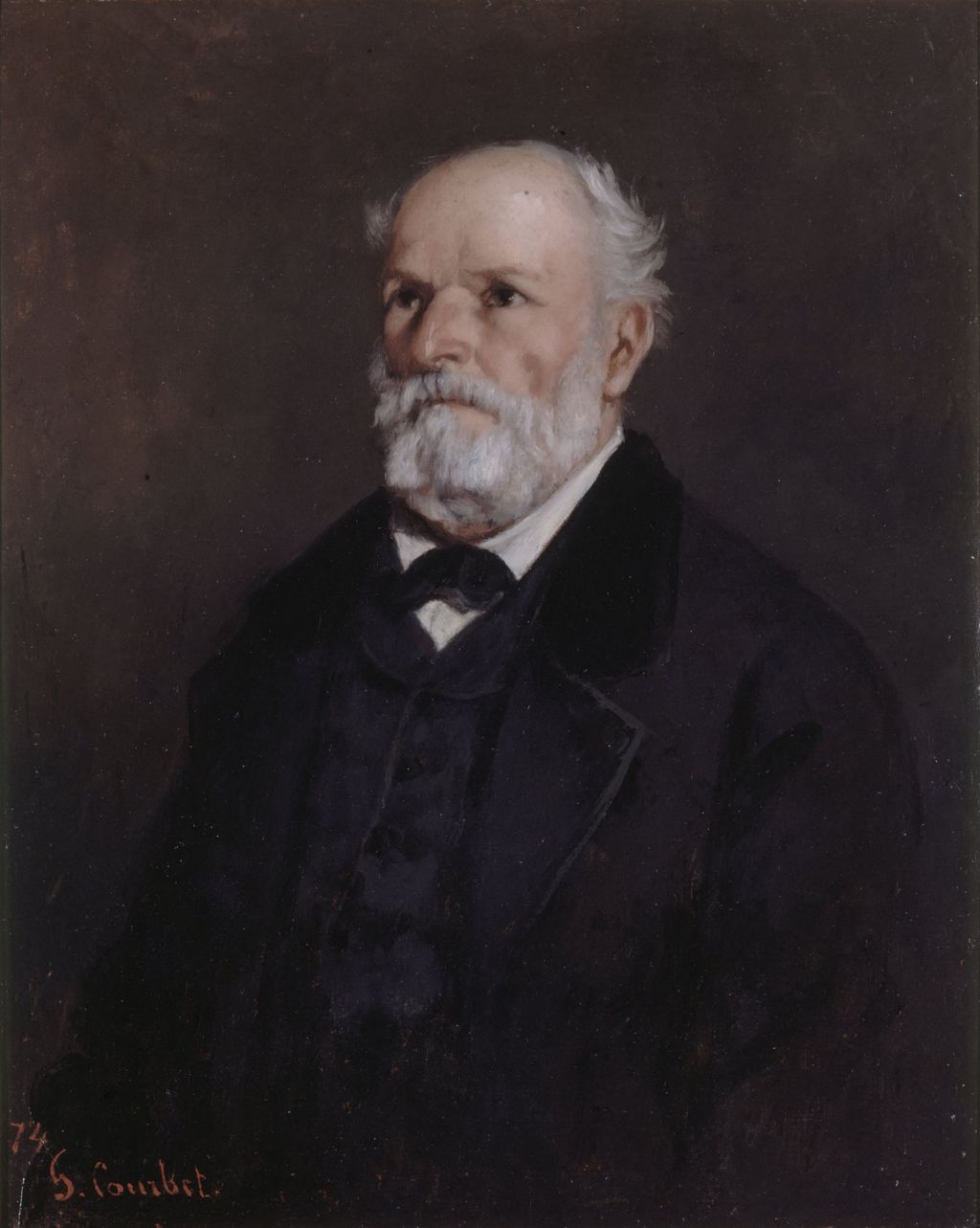
Portrait of Régis Courbet, painted by his son in La Tour-de-Peilz in 1874 Paris Musées / Petit Palais. Image source. CC0 / Public domain.
 by Tom Gurney
Tom Gurney BSc (Hons) is an art history expert with over 20 years experience
Email: tomgurney1@gmail.com / Phone: +44 7429 011000
Gustave Courbet’s Swiss Exile: Introduction
In February 1877, Gustave Courbet wrote to James McNeill Whistler from La Tour-de-Peilz. The two painters had worked on the Normandy coast in 1865, and Courbet had an idea of what might appeal to his old companion about Lake Geneva. In one direction he could see a stretch of water with the horizon of a sea. Elsewhere immense mountains bordered the lake. He thought Whistler would prefer it to Trouville for the landscape. The letter puts two familiar experiences of looking into the same view. The water allowed Courbet to work with distances and weather he knew from Normandy, while the mountains could give the eye a stopping point of a kind he had rarely had on the coast. [1] [2]
Courbet spent the last four and a half years of his life in Switzerland. He had gone there under threat of financial ruin after the Paris Commune. During those years he made pictures for buyers, sent others to exhibitions, gave sculpture to the town where he lived and began a landscape more than two metres wide with a Paris exhibition in mind. The contrast between a sunset commissioned from Ohio and the unfinished canvas for Paris helps explain the range of work possible from a small town on Lake Geneva. [2] [3]
At a Glance
- Period1873–1877
- BaseLa Tour-de-Peilz, Switzerland
Contents
- Settling on the lake
- Showing pictures from Bon-Port
- What a buyer asked for
- Painting Chillon more than once
- A public bust and two mountain paintings
Settling on the lake
Switzerland was familiar to Courbet well before he needed refuge there. He visited his friend Max Buchon in Bern in 1853, while Buchon was in exile following Louis-Napoléon Bonaparte’s coup. A return visit in 1854 also took Courbet to Geneva and brought him into contact with the Bovy family. In 1861 the Genevan painter Barthélemy Menn invited him to show three pictures alongside works by Corot and Delacroix. Courbet painted near Interlaken in 1869 on his way back from Munich. Those visits had already put him in touch with people who made and exhibited art on the Swiss side of the border. [2] [4]
The move on 23 July 1873 came under different circumstances. Courbet had served a prison sentence following the Paris Commune. The National Assembly voted in May 1873 to rebuild the Vendôme Column, and the French state pursued him for the expense. The civil judgment establishing his liability came in June 1874 and was confirmed in August 1875. The exact bill of 323,091 francs and 68 centimes followed in May 1877. The risk of seizure was already pressing when he crossed the border, four years before the final sum was set. [2] [3]
Three days before leaving, Courbet wrote to his sisters Zélie and Juliette that the distance would be short enough for them to visit. He also said their father encouraged the move. The choice kept him close to his family in the Franche-Comté. He spent time in Neuchâtel, Vevey and Geneva during his first months in Switzerland. By autumn 1873 he was staying at La Tour-de-Peilz, on the north shore of Lake Geneva. The town’s archives preserve his residence permit, dated 26 January 1874. In 1875 he moved into Bon-Port, a house at the water’s edge. From there he could look across to the Grammont and the Dents du Midi. The rail and boat routes described in the Geneva exhibition dossier gave him ways to travel to other towns, see exhibitions and meet other refugees. The house offered space to work and receive visitors. The lake linked it to the places where those visitors lived and where paintings could be seen and sold. [2] [3] [5] [6]
The people in that circle can be traced through some of the work Courbet made. In 1874 he drew Marc-Louis Baud-Bovy in pencil and charcoal. Marc-Louis was a medallist and the grandfather of Auguste Baud-Bovy, a painter Courbet saw between Geneva and La Tour-de-Peilz. The Musée Jenisch also records his friendship with the painter François Bocion and his continued contact with fellow exiles from the Commune. Courbet showed work in Geneva and at the travelling Swiss exhibitions known as the Turnus, with appearances at Berne, Aarau and Lausanne between 1874 and 1877. His years on the lake can be followed through the making of individual pictures and through the occasions on which they entered public view. [2] [4] [5]
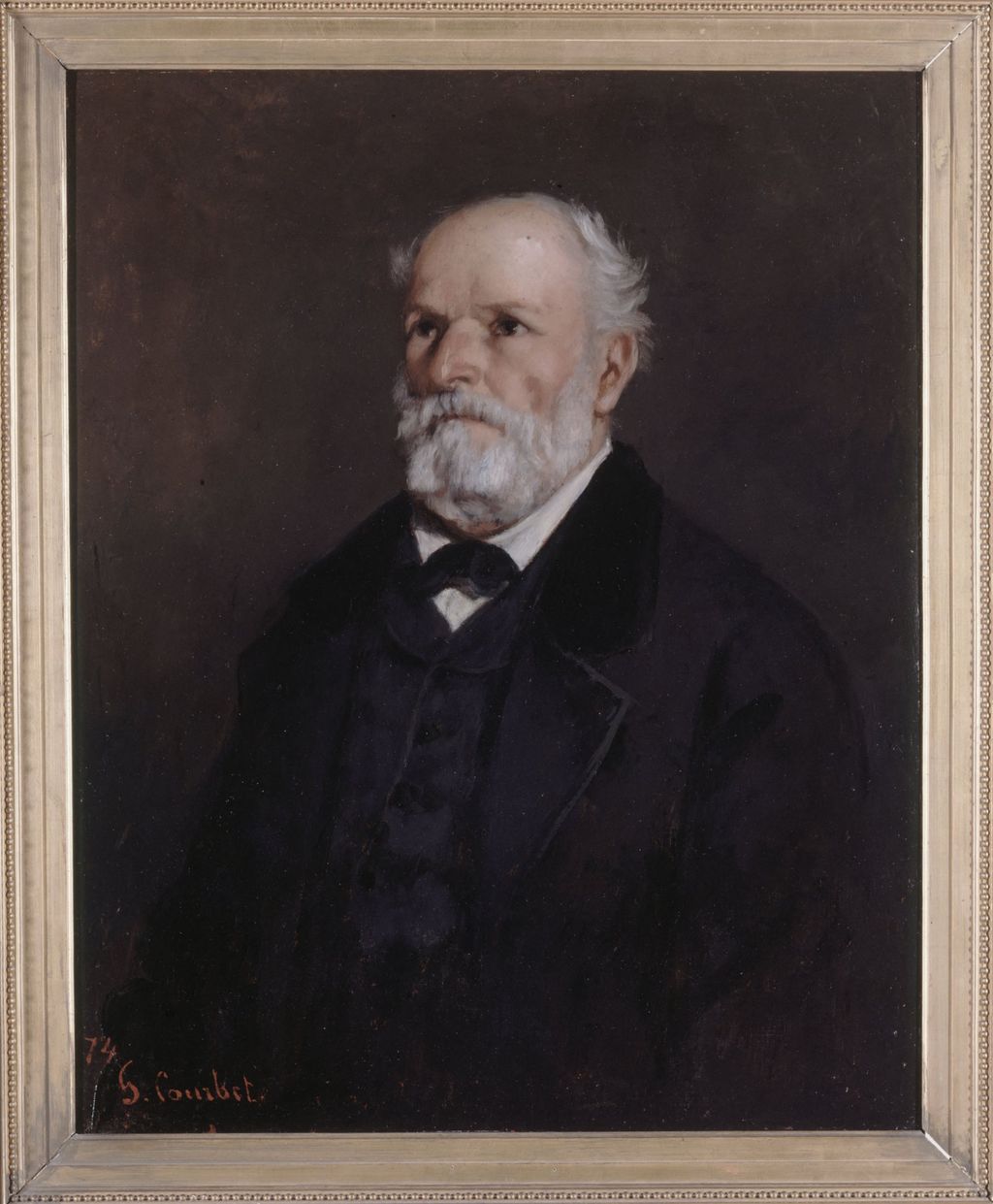
Gustave Courbet, Portrait of Régis Courbet, 1874. Petit Palais. Image source. CC0 / Public domain. Resized from the complete source image.
Showing pictures from Bon-Port
Courbet opened the Galerie Courbet at Bon-Port on 15 August 1875. Geneva’s exhibition dossier uses his estate inventory to corroborate accounts of a display that brought his own pictures together with older paintings he had acquired in France. Some of the works he had taken for originals were copies. For visitors, a display in the painter’s home was a chance to see earlier work that he still held, including the portrait of Joanna Hiffernan now in Stockholm. Courbet also exhibited that picture in Switzerland in 1876. In his letter to Whistler he mentioned the admiration the portrait drew and said he meant to keep it. A picture could help sustain his reputation even when he had no intention of selling it. [1] [2] [7]
The same correspondence points to pictures Courbet did want to sell. Courbet asked Whistler to look into the sale in London of a still life of apples and a picture of veal. He believed the two works were with the dealer Charles Deschamps. In the same letter he worried about the fate of four other canvases entrusted to a dealer for the Philadelphia exhibition. The editors give a possible identification for the veal painting, which, if correct, would put its making before the flight to Switzerland. The distinction is worth keeping in view. Work seen or offered during the Swiss years could include pictures brought from France, paintings made on the lake and older subjects that Courbet was prepared to take up again. Even the works circulating from a single address could have quite different histories. [1] [2] [8]
Pia, himself a former Communard living in Switzerland, ran a gallery and art supplies business in Geneva. A letter Courbet sent him from La Tour-de-Peilz on 7 December 1874 records the dispatch of two landscapes in the dimensions requested. One was a waterfall near Hauteville in France, and the other showed Lake Geneva disturbed by the regional wind known as the Vaudaire. Courbet stated the price he wanted to receive and said he would try to make two more pictures. The description links the lake to a particular sort of weather and shows how easily a French motif and a Swiss one could share a shipment. It provides evidence of an order and a dispatch. Identifying the canvases today would require evidence beyond their subjects and the size specification. [8] [9]
What a buyer asked for
The American judge George Hoadly wanted to support Courbet. Correspondence from September 1873 records his request for a picture in which the sea was the principal subject. Daniel Conway acquired a painting for him in March 1874. It is now in the Cincinnati Art Museum as Sunset, Vevey, Switzerland, dated 1874 in the Geneva exhibition dossier. Water occupies much of the view, with the rocky shoreline guiding the eye toward a broad expanse of pink and orange light. A distant suggestion of mountains gives a geographical clue that the water and sky alone might leave open. Geneva’s curators relate the composition to Courbet’s Normandy seascapes. He could answer the request through the structure of a seascape and still include a feature of the place where he now lived. [2] [10]
The Musée Jenisch’s Sunset on Lac Léman, also dated 1874 in the Getty exhibition catalogue, is a separate and smaller canvas. The title, date and subject overlap with the Cincinnati picture. The correspondence about Hoadly’s request and his gift credit belong to the Cincinnati canvas. The two records show what the word sunset leaves unspecified. A buyer could order a picture with water as its principal feature. A museum identifying a particular picture needs the details that belong to the object, including its measurements, collection history and the way the scene is arranged. [2] [10] [11]
A figure painting shows how differently a Swiss subject could travel. In La Vigneronne de Montreux of 1874, now in the Musée cantonal des Beaux-Arts in Lausanne, a young woman carries a hoe, a basket on her back and a copper container. The mountain outlines behind her include the Dent de Jaman and the Rochers de Naye. The museum singles out her tall hat as the distinctively Vaudois element of the costume. Courbet hoped the picture would interest buyers in Paris, but his friend Étienne Baudry sent it back and suggested looking for a buyer in Switzerland. Set beside Hoadly’s commission, the exchange shows two ways a subject could meet a market. The sunset could cross the Atlantic as a variation on a seascape. The winegrower depended more on curiosity about a particular place and its dress. [2] [10] [12]
Painting Chillon more than once
The Château de Chillon gave Courbet a subject visitors already knew from travel and from Byron’s poem. He returned to it from different viewpoints, altering the balance of walls, mountains, water and weather. The Musée Courbet’s Le Château de Chillon is dated 1874 and carries inventory number D 1976.1.3. The Philadelphia Museum of Art holds a separate Château Chillon, dated about 1874. The Geneva exhibition dossier identifies a third canvas, now at the Wallraf-Richartz-Museum in Cologne, as a painting made in 1873 and exhibited in Lausanne in 1874. That exhibition history belongs to the Cologne painting. Glasgow’s editors also record two Chillon pictures offered for sale at the 1876 International Exhibition in Philadelphia. The city name in that exhibition history gives a venue. The city name in the Philadelphia Museum of Art record gives the location of its collection. Identifying either exhibit with the museum’s painting would require evidence connecting the records. [1] [2] [13] [14]
The repetition has also prompted questions about the part played by Cherubino Patà and Marcel Ordinaire. The Geneva curators point to archival evidence that the two painters spent only intermittent periods with Courbet during the Swiss years. That complicates the idea of a continuously staffed workshop turning out Chillon paintings. It still leaves individual canvases open to study. A documented meeting with a fellow painter, a repeated outline of the castle and an attribution in a collection record each answer a different question. The surviving records support Courbet’s sustained interest in a saleable subject and a careful approach to identifying the hand responsible for any particular version. [2]
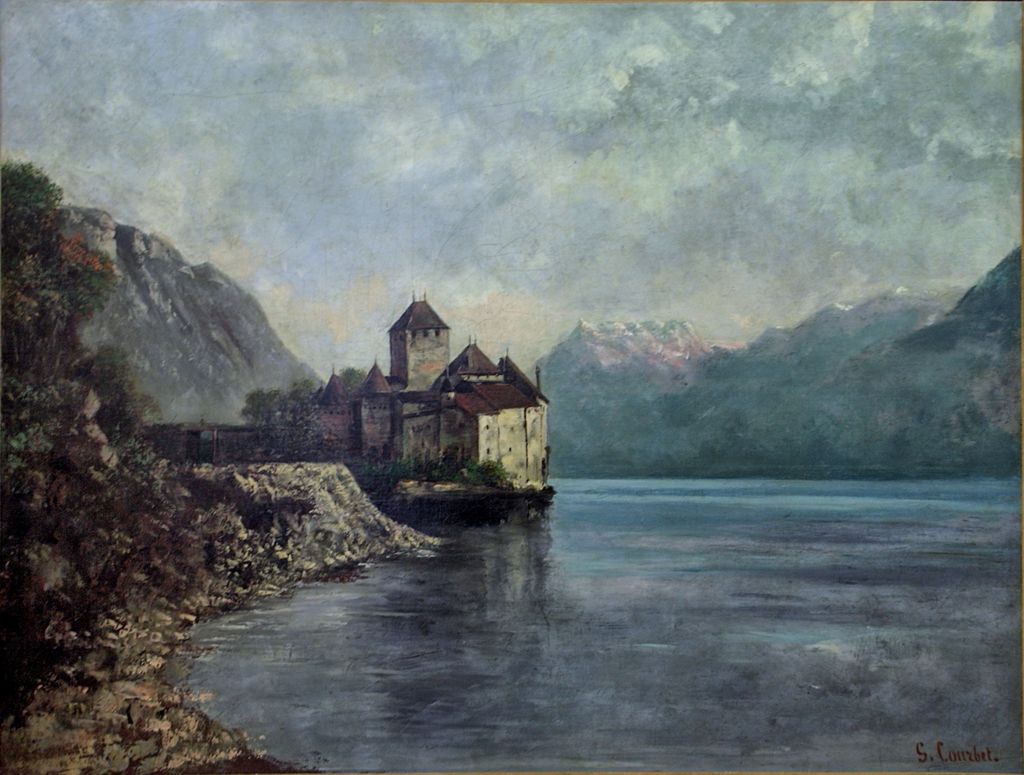
Gustave Courbet, The Château de Chillon. Musée Courbet, D.1976.1.3. Image source. Public domain. Resized from the complete source image.
A public bust and two mountain paintings
In 1875 Courbet modelled an allegorical bust of Switzerland, Helvetia, and offered casts to Swiss towns. At La Tour-de-Peilz he adapted the figure at the authorities’ request and the bust was installed under the name Liberté on a fountain in the Place du Temple. It was inaugurated on 15 August 1875, the same day he opened his gallery. A year later he made La Mouette du lac Léman, poésie, a medallion associated with a building façade in Vevey. The Musée Jenisch preserves a plaster and a bronze example. The two sculptures belong to places where people would encounter them in the street, apart from the rooms and exhibitions in which his canvases were shown. [2] [5] [6]
The lake and mountains also gave Courbet a project for a much larger exhibition. The approximately 1876 Panorama des Alpes in Geneva is 64 centimetres high and 140 wide. The museum relates the view of the Grammont and Dents du Midi to the terrace at Bon-Port. Its length lets the eye follow the mountain forms sideways. Courbet left the work unfinished. The other unfinished landscape, Cleveland’s Panoramic View of the Alps, Les Dents du Midi of 1877, is more than twice as high and extends the view into a substantial foreground. A figure with animals sits on a grassy prominence. A lake separates that ground from mountains rising high into the canvas. Geneva’s curators describe the larger work as a view constructed from above the town, with signs of settlement removed. [2] [15]
Courbet’s letters to the critic Jules Castagnary show what it cost him to keep working. In December 1876 he complained that the prolonged case made work impossible and worried that he would lose the studio in Ornans that he could never afford to rebuild. The letter captures his anxiety about the future. Within a year he was working on the largest canvas of his exile. [2] [15]
On Castagnary’s advice, Courbet intended the large canvas for the 1878 Paris Universal Exposition, according to the Geneva dossier. In the Cleveland painting, dense paint and varied strokes distinguish snow from cloud near the summits, while the lower right remains visibly less worked. A painting that might have presented the Swiss view to an international audience now also lets a viewer compare areas Courbet had developed to different degrees. He died at La Tour-de-Peilz on 31 December 1877, before the exposition opened. [2] [3] [15] [16]
From Bon-Port, Courbet could revisit the same stretch of water under different conditions, or move the viewpoint uphill and give the mountains another scale. His correspondence shows what changed when a picture had a destination. For Hoadly, the lake could carry the weight of a seascape. For the exhibition in Paris, the shore and its mountains could be arranged into a view that filled a large canvas. Courbet described to Whistler a place he wanted his friend to see. Across the paintings he gave viewers several ways to see it, each shaped by where he stood, what he chose to include and where he hoped the picture would go. [1] [2] [10] [15]
Courbet artworks directory
Browse the paintings covered in this guide. Dates identify the specific versions discussed.
Discussion
Look again at the images and ideas explored in Gustave Courbet’s Swiss Exile. These editorial prompts invite your observations.
Reader Insights
Which features recur in different Chillon views?
How does the position of the lake change the sense of distance?
What can correspondence and exhibition records tell you about the practical work of painting in exile?
Join the Conversation
Share a detail, comparison or question about Gustave Courbet’s Swiss Exile below.
References
- University of Glasgow, The Correspondence of James McNeill Whistler, Gustave Courbet to James McNeill Whistler, 14 February 1877, Glasgow University Library MS Whistler C196, record 00695, transcription and editorial notes. Read the letter. View source.
- Musées d’art et d’histoire de Genève, Gustave Courbet. Les années suisses, 2014 press and teaching dossiers, with the exhibition’s object captions. Read the press dossier, read the teaching dossier and view the object captions. View source 1. View source 2. View source 3.
- Fondation Beyeler, Gustave Courbet, exhibition chronology, especially 1871–1877. View the chronology. View source.
- Historical Dictionary of Switzerland, Pierre Chessex, Courbet, Gustave, on the earlier Swiss visits and later exhibitions. View the entry. View source.
- Musée Jenisch Vevey, Courbet dessinateur, 2019 press dossier, section Courbet et la Suisse, and exhibition record. Read the dossier and view the exhibition record. View source 1. View source 2.
- La Tour-de-Peilz, Gustave Courbet, an open-air museum, Exile and the Liberty, with the municipal archives’ reproduction of the 1874 residence permit and documentation on the bust. View the municipal record. View source.
- La Tour-de-Peilz, Gustave Courbet, un musée à ciel ouvert, Bon Port, including the house, selected works shown there and the quotation from Courbet’s letter to Whistler. View the site account. View source.
- University of Glasgow, The Correspondence of James McNeill Whistler, biographical and documentary notes on Paul Pia. View the archive’s notes. View source.
- Gustave Courbet, autograph letter to Paul Pia, La Tour-de-Peilz, 7 December 1874, transcription excerpt in the manuscript description. Read the excerpt. View source.
- Cincinnati Art Museum, Gustave Courbet, Sunset, Vevey, Switzerland, 1887.5, gift of George Hoadly, collection listing and reproduction. View the museum listing. View source.
- J. Paul Getty Museum, Courbet and the Modern Landscape, exhibition catalogue, entry for Sunset on Lac Léman, 1874, Musée Jenisch Vevey. Read the catalogue. View source.
- Musée cantonal des Beaux-Arts de Lausanne, Gustave Courbet, La Vigneronne de Montreux, 1874, inventory 664, with an excerpt from Étienne Baudry’s letter. View the collection record. View source.
- Musée Courbet, Qui est Gustave Courbet ?, including Le Château de Chillon, 1874, inventory D 1976.1.3. View the museum record. View source.
- Philadelphia Museum of Art, Gustave Courbet, Château Chillon, c. 1874, collection record 102785. View the collection record. View source.
- Cleveland Museum of Art, Gustave Courbet, Panoramic View of the Alps, Les Dents du Midi, 1877, accession 1964.420. View the collection record. View source.
- Bureau International des Expositions, Expo 1878 Paris, official title and dates. View the exhibition record. View source.