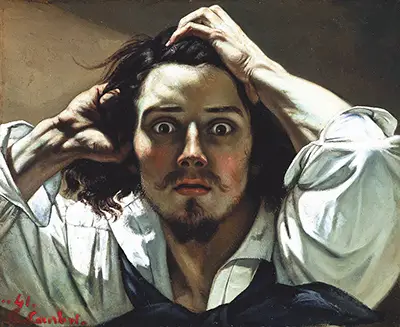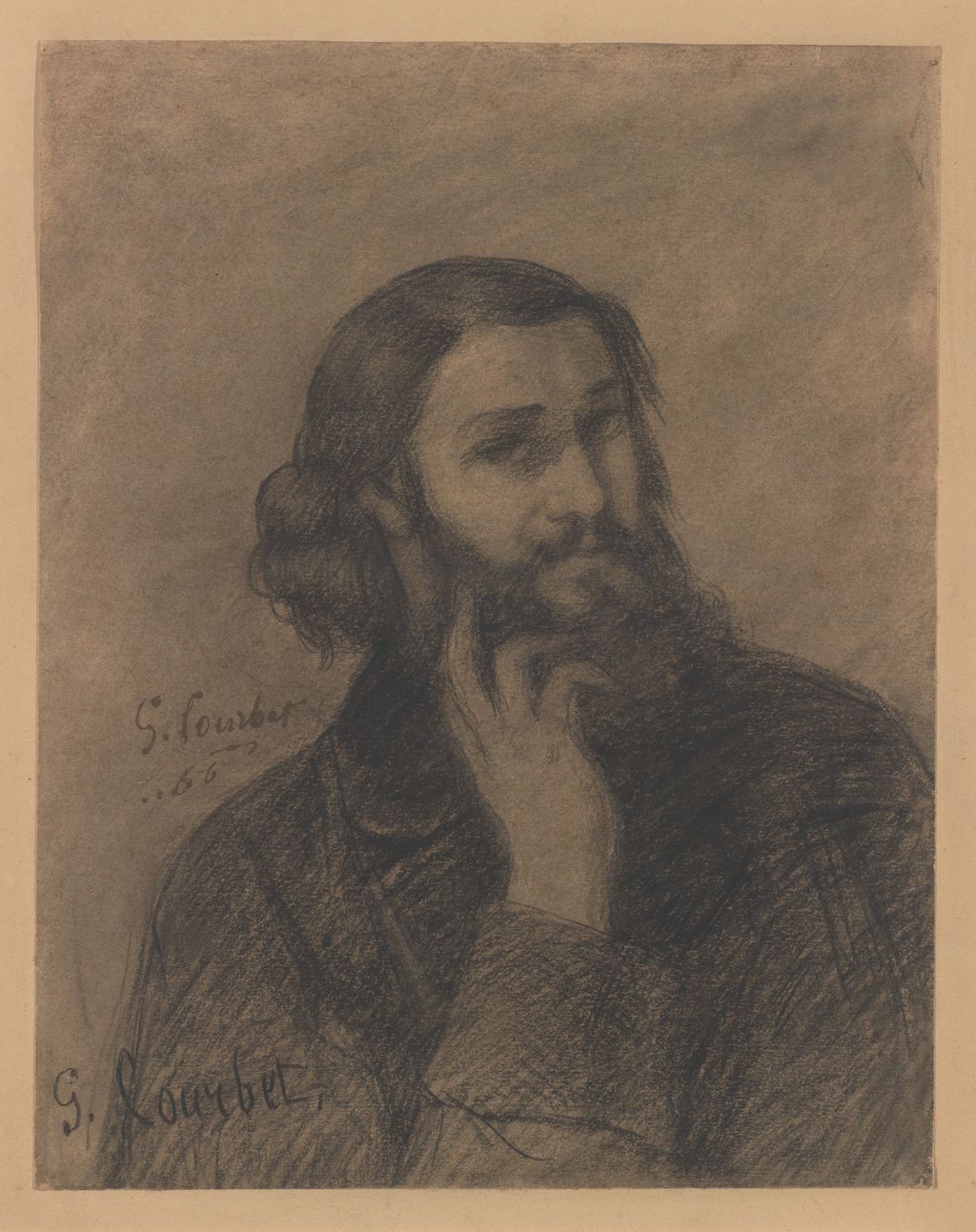
Self-Portrait, c. 1866, a Conté crayon drawing by Gustave Courbet The Metropolitan Museum of Art. Image source. CC0 / Public domain.
 by Tom Gurney
Tom Gurney BSc (Hons) is an art history expert with over 20 years experience
Email: tomgurney1@gmail.com / Phone: +44 7429 011000
Gustave Courbet’s Self-Portraits: Introduction
In one painting Gustave Courbet sits beneath a rock with a black dog and looks down at us. In another he pulls at his hair with both hands, his eyes wide and his face so near that his elbows run out of the picture. The two canvases are close in size and date. They give the viewer strikingly different places to stand. The walker has a dog beside him, a valley behind him and a ledge on which he can settle. The face in The Desperate Man takes up so much room that we can scarcely tell where the figure is. One encounter starts with the question of who is looking up at whom. The other begins at a distance usually reserved for a face we know well. [1] [2]
The Metropolitan Museum of Art estimates that Courbet made about twenty painted and drawn self-portraits between 1842 and 1855. He compared the undertaking to writing his autobiography. The comparison makes sense across a group of pictures that show him at different ages and in different circumstances, but the situations he gives his likeness range well beyond what a chronology can explain. A cellist performs, a wounded man lies alone and a figure on a cliff seems about to lose his footing. Museum Folkwang emphasises the part these roles played in winning attention in an art world where the young painter still had to establish himself. Some entered public exhibitions. Others are known from their later histories. The distinction matters when asking what kind of encounter Courbet made available to his first viewers. [3] [4]
At a Glance
- Media discussedOil on canvas and Conté crayon
- ExamplesSelf-Portrait with a Black Dog, The Desperate Man, The Wounded Man
Contents
- Two ways to meet a stare
- Where the fear is placed
- Hands at work and at rest
- From the Salon wall to a sheet of paper
Two ways to meet a stare
In Self-Portrait with a Black Dog, the rock cuts off much of the sky on the left. To the right, the ground falls away and the lighter distance opens behind the dog’s head. Courbet sits with one knee raised, and his hand with the pipe has a place to rest. The stick behind him and the dog make sense as the equipment and company of a walk. A rectangular object beside the stick could be a book or sketchbook. Courbet gives it less light and space than the pipe and collar, so a viewer can register the man as a walker before wondering whether he has come out to draw. The setting draws on the country near Ornans. A Paris viewer could encounter the young painter as someone with a place of his own, whose position above the viewer makes him look at ease on his chosen ground. [1] [3]
The Petit Palais catalogues the painting to 1842–44. The public date is more precise. The picture appeared at the Paris Salon in 1844, the first time a painting by Courbet was accepted there, according to the Met. That distinction leaves room for the work it took to arrive at a public image. The face is easy to pick out under the wide hat, but details that make the figure interesting take longer to see. The pipe hand is small. The dog’s dark coat meets the painter’s dark clothes. The little bit of white at the throat matters because so much else is low in tone. From across a gallery these elements form one broad silhouette. Closer up, the walker begins to look quite deliberately dressed and posed. [1] [3]
In The Desperate Man, which the Met dates to 1844–45, there is room for hardly anything besides the head and the movements of the hands. They enter from opposite sides to grasp the hair. The bent arms narrow the opening through which we see the face, and the bright shirt below brings the light back towards the cheeks and eyes. The painting supplies no equivalent to the dog or the valley that might tell us how the figure came to be there. The pressure belongs to the encounter itself. Even the things a viewer might look at to get some distance from the expression, such as the fingers or the folds of the shirt, lead back to it. [2]
The Met’s exhibition caption records that The Desperate Man remained with Courbet until his death. It also sets out several readings of the work, including a study in how to paint expression and a version of the Romantic idea of artistic genius under extreme strain. The first directs attention to how widely the eyes open and what the hands add to their effect. The second asks what a nineteenth-century viewer might have made of an artist claiming such an expression as his own. Neither reading settles what Courbet was doing on a particular day. The contrast with the Black Dog portrait is sharper when both are allowed their own circumstances. The first put Courbet’s composed likeness in public view in 1844. The second offers much closer access to the face, and its long stay with the artist gives it a different exhibition history. [1] [2] [3]
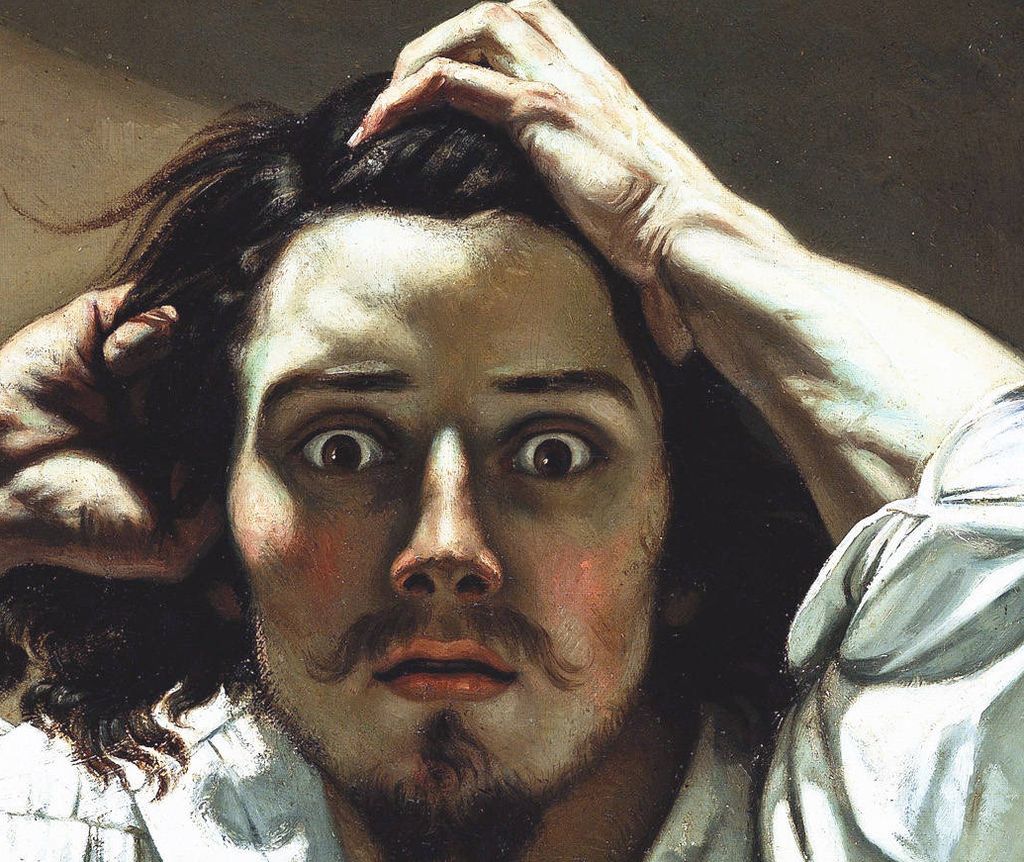
Detail of Gustave Courbet, The Desperate Man, about 1844–45. Qatar Museums, on loan to the Musée d’Orsay. Shown here, face and hands. Image source. Public domain. Cropped and resized from the source image.
Where the fear is placed
Oslo’s The Man Made Mad by Fear is the picture in which Courbet puts the precariousness of the encounter into the landscape itself. Nasjonalmuseet dates the canvas to about 1844 and records the Norwegian title På kanten av stupet, meaning At the Edge of the Cliff. The Louvre gave it a wider date range of about 1844–48 and used Portrait de l’artiste dit Le Fou de peur in its 2024 exhibition material. The Norwegian title sends the eye to the ground. The French one calls attention to the face and gesture. The titles describe different ways into the same Oslo painting, which has its own support, proportions and inventory number, NG.M.02169. [5] [6]
One hand goes to the hair as it does in The Desperate Man. The other reaches towards the foreground, where loosely defined patches of paint make it hard to tell how far the ground drops. The low viewpoint in the Black Dog portrait made the resting walker appear self-possessed. Here a similarly low vantage gives a clear view of the figure against the sky but scarcely any ground from which to see him. The clothes and pale cuff are specific enough for us to follow the arm into space. The nearer rock gives much less information just where the outstretched hand might need something solid. Folkwang’s guide locates the force of the scene in that shift from the figure to the roughly painted foreground. [1] [2] [4] [5]
The fear pictures differ most in what the hands have available to them. In The Desperate Man both hands find purchase in the hair and keep the eye inside the frame. In the Oslo canvas, one hand reaches into open space with its fingers spread. The bent figure makes sense as someone in danger even before the title names the feeling. A viewer who concentrates on the face alone will miss the amount of work done by the sloping body and uncertain foreground. Courbet can make the audience feel peril by changing its position in the picture, just as he makes the stare in The Desperate Man harder to escape by giving the audience so little space around it. [2] [4] [5]
Hands at work and at rest
In The Cellist, the hands belong to a task. One curves over the strings, its wrist lit against the dark coat. The other moves the bow across the lower part of the picture. The angled neck of the instrument gives us a line to follow from the scroll to the fingers and down towards the bow, while Courbet tilts his head away. Stockholm’s Nationalmuseum dates the painting to 1847 and records its appearance at the Salon of 1848. According to the museum, critics at that exhibition compared the treatment of light and shade with Rembrandt’s self-portraits. Look at how the painter picks out the forehead and one cheek and leaves the eyes difficult to read. The cello gives the visitor a way into the action even where the gaze withholds an obvious point of contact. [7]
The contrast with The Desperate Man goes beyond a change of mood. Both paintings select certain bright features against dark surroundings. In the close-up, light makes the open eyes and the tension of the fingers immediately apparent. In The Cellist, it separates the two activities of hands and face, so that we have to hold the action of playing in mind while studying a man who appears absorbed elsewhere. The larger canvas leaves room for the instrument to establish that action. Its body extends out of sight, yet there is enough of it to carry the sense of playing beyond the instant the painter depicts. The comparison with Rembrandt concerns how a face and figure emerge from shadow. The arrangement of hands, instrument and gaze makes that handling serve a role specific to this picture. [2] [7]
The figure in The Wounded Man has almost ceased to act. A hand emerges low in the picture and rests loosely against the dark covering. The eyes are closed. A sword leans against the tree and a small red stain interrupts the pale shirt. There is little motion to show how the injury came about. The hand could belong to someone asleep, and the evidence of a wound is in a place we might look only after studying the face. Courbet asks the viewer to work back from the signs of what may have happened to the quiet figure in front of us. The Musée d’Orsay dates the canvas to 1844–54, a span that includes substantial repainting. [2] [8]
An X-ray shows an earlier scene in which a companion rests beside Courbet. The Met compared the buried arrangement to Country Siesta, a drawing in Besançon in which two people recline together under a tree. The resemblance gives the present pose a history within the work. The shoulder and closed eyes could once be read in relation to another person’s weight and nearness. Once Courbet covered the companion and supplied the sword and stain, much of that bodily quiet could remain while the story changed. The material record makes the revision visible. It also gives a concrete reason to be careful about treating a self-portrait as a report of an episode in the artist’s life. Here the same pose could serve two stories because the painter changed what he put around it. [2] [8]
From the Salon wall to a sheet of paper
In 1855, Courbet included a group of self-portraits in his independent Pavilion of Realism. The Met’s survey records the irritation of the critic Maxime Du Camp, who complained about encountering Courbet over and over. His response catches something a single visit to one picture can obscure. Repeated across a room, a familiar face asks the viewer to notice how often its relations to costume, gesture and setting have changed. Courbet could also set himself within a much larger company. In The Painter’s Studio, which he showed at the pavilion, he sits at an easel working on a landscape. The brush specifies his occupation as clearly as the bow had specified the cellist’s. A child and a model stand nearby, and the surrounding figures broaden the question from what kind of man the painter is to what world he puts around his work. [3] [9]
The Met’s Self-Portrait, a Conté crayon drawing dated about 1866, brings the problem back to the scale of a page. The sheet measures 26.7 by 21 centimetres and is catalogued as 2010.232. Courbet turns his head to one side and raises a hand to his beard. There is a large interval of softly toned paper above the head. The shoulders, by contrast, are cut by the sides and bottom of the image, and the darker strokes of the coat give the hand an especially clear outline. Marks that run close together under the chin thin out on the cheek, so the face takes shape through different degrees of shading. On this small sheet the eye can move between the gesture and the strokes that form it without having to step away from either. [10]
The raised hand recalls the early paintings while changing what there is to see in it. Its fingers rest along the beard and cheek, and the head has room to turn without losing its place on the sheet. The pose suggests a pause sustained long enough for someone to look closely. In the Oslo painting the nearest hand tests the space beyond the figure. In The Cellist the fingers and the bow direct attention to different parts of the same action. In the drawing a single hand takes the eye up from the sleeve to the face. The likeness may be what links the works at first glance. Look again at where each hand comes to rest, and how much room Courbet gives us to follow it. [5] [7] [10]
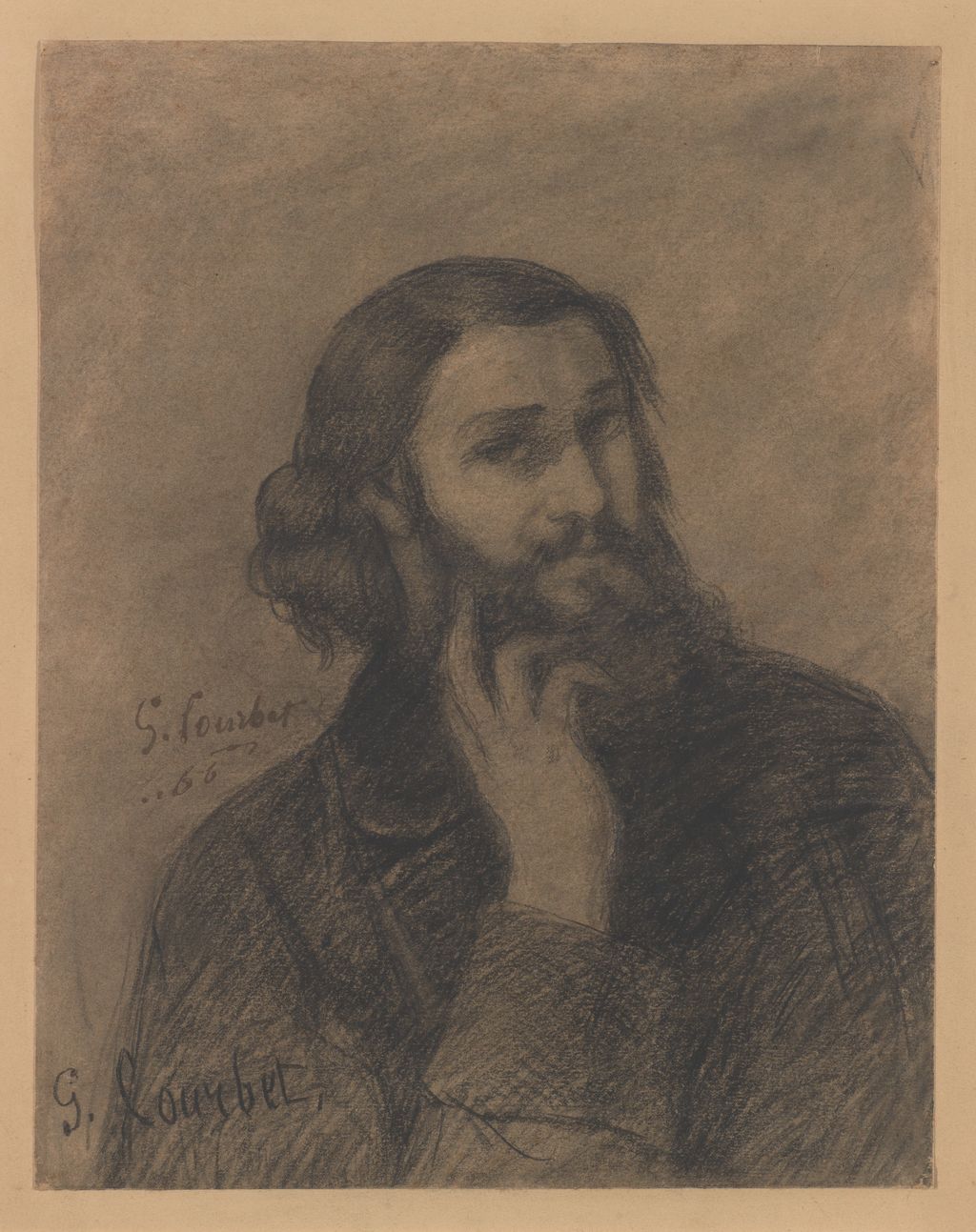
Gustave Courbet, Self-Portrait, about 1866. The Metropolitan Museum of Art. Image source. CC0 / Public domain. Resized from the complete source image.
Courbet artworks directory
Browse the paintings covered in this guide. Dates identify the specific versions discussed.
Discussion
Look again at the images and ideas explored in Gustave Courbet’s Self-Portraits. These editorial prompts invite your observations.
Reader Insights
How does the viewpoint change the role Courbet plays in each portrait?
What can the altered Wounded Man tell you about the choices available to a painter?
How does the raised hand work differently in the Conté drawing and The Desperate Man?
Join the Conversation
Share a detail, comparison or question about Gustave Courbet’s Self-Portraits below.
References
- Paris Musées, Petit Palais, Gustave Courbet, Autoportrait dit Courbet au chien noir, collection record PPP731. View source.
- The Metropolitan Museum of Art, Gustave Courbet, 2008 retrospective gallery, entries for The Desperate Man and The Wounded Man. View source.
- The Metropolitan Museum of Art, Gustave Courbet, 2008 exhibition overview, especially “Self-Reflections” and “Ornans: The Emergence of Realism”. View source.
- Museum Folkwang, I, Gustave Courbet. Painter and Rebel, digital exhibition guide, part one. View source.
- Nasjonalmuseet, Gustave Courbet, The Man Mad with Fear, collection record NG.M.02169. View source.
- Musée du Louvre, Figures of the Fool, 2024–25 exhibition press dossier, work 35. View source.
- Nationalmuseum, Gustave Courbet, The Cellist (Self-portrait), collection record NM 3105. View source.
- Musée d’Orsay, Gustave Courbet, L’Homme blessé, collection record RF 338. View source.
- Musée d’Orsay, Gustave Courbet, L’Atelier du peintre, collection record RF 2257. View source.
- The Metropolitan Museum of Art, Gustave Courbet, Self-Portrait, collection record 2010.232. View source.