The Source of the Loue by Gustave Courbet The Metropolitan Museum of Art. Image source. CC0 / Public domain.
 by Tom Gurney
Tom Gurney BSc (Hons) is an art history expert with over 20 years experience
Email: tomgurney1@gmail.com / Phone: +44 7429 011000
Gustave Courbet’s Ornans and Franche-Comté: Introduction
The church steeple in Gustave Courbet’s View of Ornans rises just above the roofs along the Loue. Behind the town is the Roche du Mont, a broad face of limestone. A bridge crosses the foreground. The Metropolitan Museum of Art identifies the cliff and uses the steeple to place the town, but it describes the bridge more cautiously. Tradition associates it with Scey-en-Varais, several miles downstream. The distinction matters. You can recognise Ornans in the picture without assuming that every feature stood together in a view you could retrace from a single spot. [1]
Ornans was where Courbet went to school, where his mother’s family lived and where he made some of his largest pictures. Flagey, on the plateau above the valley, was the site of his father’s farm. Within the wider Franche-Comté landscape, the wooded ravine of the Puits Noir and the spring from which the Loue emerges offered quite different kinds of terrain. These places furnished Courbet with people, working spaces and recurring subjects. Putting a town, a funeral and a cave entrance side by side shows how differently he could use what he knew about the region. [2] [3]
At a Glance
- RegionFranche-Comté, eastern France
- Places discussedOrnans, Flagey and the Loue valley
Contents
- Ornans and Flagey
- The people who appear in the paintings
- From the town to the ravine
- A river’s source as a working place
- Places with more than one history
Ornans and Flagey
The Musée Courbet’s biography gives Ornans as the painter’s birthplace in 1819. Its territorial study leaves the actual house open and records a local uncertainty that also involves the farm at Flagey. The Hôtel Hébert, long associated with the painter’s birth and now part of the museum, has a documented connection of a different kind. After a fire at the Flagey farm in 1828, the Hébert family took in the Courbets. Gustave spent about six years there during his childhood. The house belongs to his story through those years of residence. [2] [3]
Courbet’s mother, Sylvie Oudot, came from a family of winegrowers in Ornans. His father, Régis, ran the agricultural holding at Flagey, which had been acquired by Gustave’s paternal grandfather. The farm occupied a position in a working village on the Amancey plateau, with living quarters and space for agricultural use under one roof. The museum’s history follows the holding through Régis’s expansion of it and records that the Bourgon family worked as sharecroppers for him. Their presence gives a sense of the arrangements behind a family property. When Courbet put riders and people on foot on the same road in his fair painting, he was working with distinctions that would have been familiar in that setting. [2] [4]
Local connections helped give him the room to paint. Régis had an attic at the Oudot grandparents’ house fitted out as a studio. The Musée Courbet records Gustave’s complaint about the size and position of the window, a difficulty that mattered when he needed to light a large canvas. He nevertheless made A Burial at Ornans there. In 1860 he took up a larger working space in a former foundry by the Loue, which he had adapted for use as a studio. The old attic and converted foundry tell two parts of the same story. The first depended on what the family could make available. The second gave him space he had chosen and could arrange for himself. [3] [5]
Peasants of Flagey, Besançon RF 1959 9 / D.959.1.1. Image source. Public domain. Resized from the complete source image.
The people who appear in the paintings
In A Burial at Ornans, the people are spread across almost seven metres of canvas. Townspeople sat for the figures. The mourners form a long row with intervals between bodies, while the edge of the grave cuts into the foreground. Their faces and clothes repay attention at a distance closer than the one needed to see the group. The landscape works on a different scale. A low ridge sits beyond the gathering and leaves open sky above most of the heads. It situates the ceremony without competing with the people for the foreground. The museum’s account of the sitters gives the figures a connection to Ornans that the outline of a hill alone could never establish. [6]
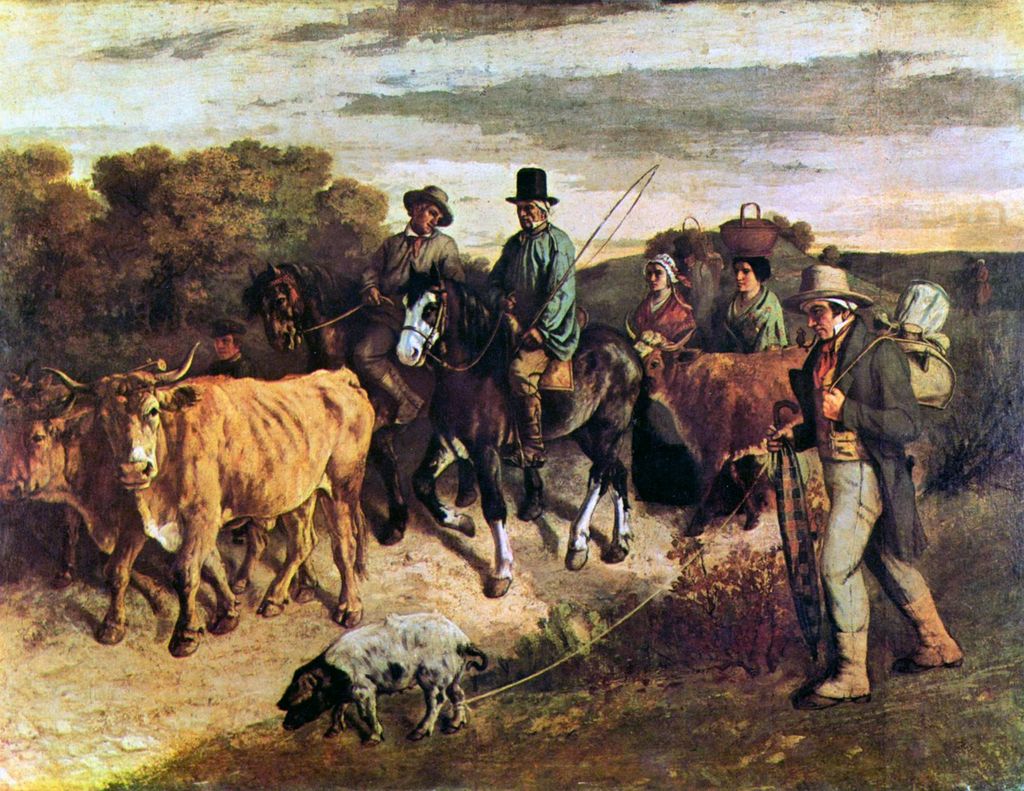
The Peasants of Flagey Returning from the Fair gives a gathering a different shape. The travellers take up different parts of the road. A basket carried at head height picks out one walker behind the mounted figures, and the man with a pig occupies his own stretch of verge. At the left, animals and people crowd the edge as if the journey continues beyond what the canvas can show. The funeral holds people in one place and gives the viewer time to look from face to face. The fair picture keeps its group together through a shared destination, even as the size and pace of its animals spread it across the road. [6] [7]
The title anchors the fair scene in Flagey. The proposed identification of the central rider as Régis Courbet belongs to tradition, as the Met’s retrospective catalogue material makes clear. There is a separate question about which painting a viewer is looking at. Courbet exhibited the subject at the Salon of 1850–51. Besançon’s collection labels its surviving canvas 1850, while the national Joconde inventory allows a range from 1850 to 1855 and the Met describes the extant canvas as a later replica. The Met notes traces of the woman’s basket near the right, consistent with a revision that moved her toward the centre. That change bears on how the group reads today. It brings the raised basket closer to the other travellers and leaves more room around the man and pig. [7] [8] [9] The C2RMF identifies it as the original Salon canvas, which Courbet cut down on the right and subsequently enlarged again. [17]
The family connection is firmer in Young Ladies of the Village. The Met identifies the three women as Courbet’s sisters Zélie, Juliette and Zoé, and locates them in the Communal, a small valley near Ornans. A girl tending cattle meets the three women and receives alms. The figures occupy a strip of ground below a pale, broken slope. Dresses, hats and the outstretched hand make the encounter easy to follow, even before the viewer starts to make sense of the distance from the foreground group to the cattle. The place and the sitters can be named, while the arrangement through which we encounter them is Courbet’s. X-rays discussed by the Met show that he enlarged the cattle during painting. Their apparent smallness still drew complaints at the 1852 Salon. [10]
The three pictures make different kinds of public life visible. The mourners assemble for a ceremony, the travellers return from an occasion of trade and the sisters encounter someone working close to home. Look at the different routes through the foreground. At the burial the grave makes a break that people stand around. At the fair the road supplies a direction and allows the party to stretch out. In the valley the small space between the girl and the women is enough to stage an exchange. Courbet could give local activity the prominence of a large painting while leaving the habits of a place visible in how people move, stand and attend to one another. [6] [7] [10]
From the town to the ravine
Seen against those figure paintings, View of Ornans makes the town legible through roofs, the steeple and its position on the river. The foreground bridge offers a way for the eye to cross the water before the scene opens out toward the cliff. In The Stream, shown at the 1855 Universal Exhibition, Courbet named his location as the Puits Noir in the Loue valley. The National Gallery of Art in Washington identifies the gorge with the Brême, a tributary of the Loue. The water leads the eye inward, but the rocks and trees hold it in the gorge. There is little room for the broad distance that allows the town and the cliff to sit apart in View of Ornans. [1] [11]
The valley gave Courbet a choice of viewpoints within a relatively small area. A river town could be read through its buildings and landmarks. In the ravine, a change in the bank or the amount of light on the rock could alter how far into the picture a viewer seemed able to go. The Musée Courbet’s landscape study describes an especially enclosed composition in Grotte de la source enneigée, a view associated with the Grotte Sarrazine near Nans-sous-Sainte-Anne. The rock wall fills the upper part of that painting, while snow and bushes pick out the edge of the water in front. This is a different place from the Loue spring. The comparison makes it possible to see a compositional interest recurring across sites, as Courbet brings the mass of stone close enough to dictate the viewer’s field of vision. [11] [12]
A river’s source as a working place
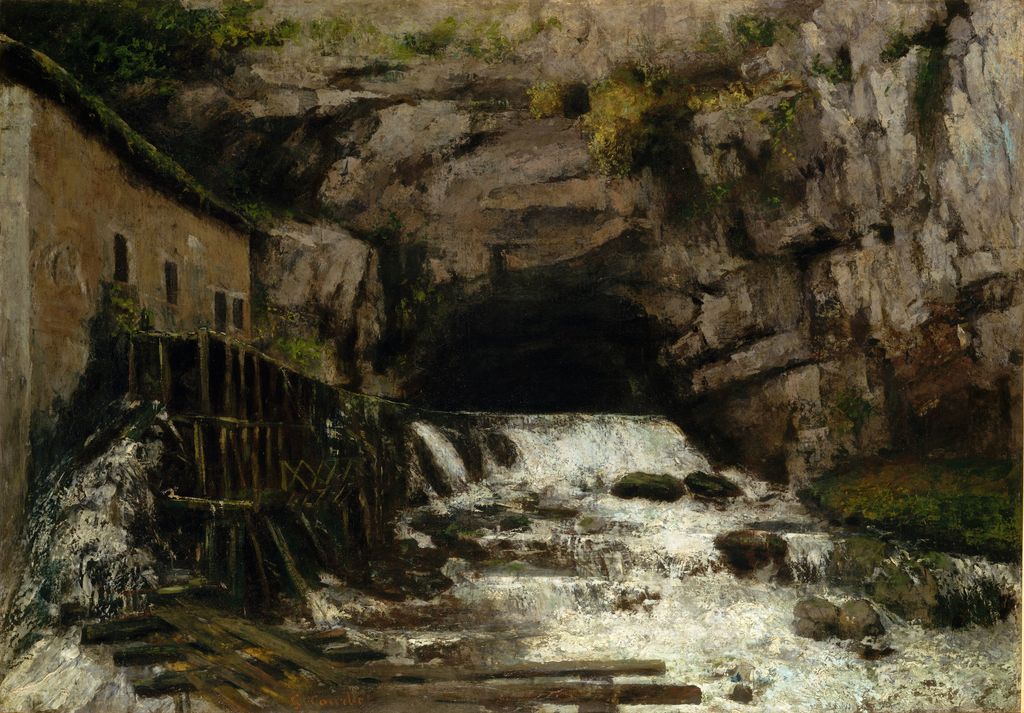
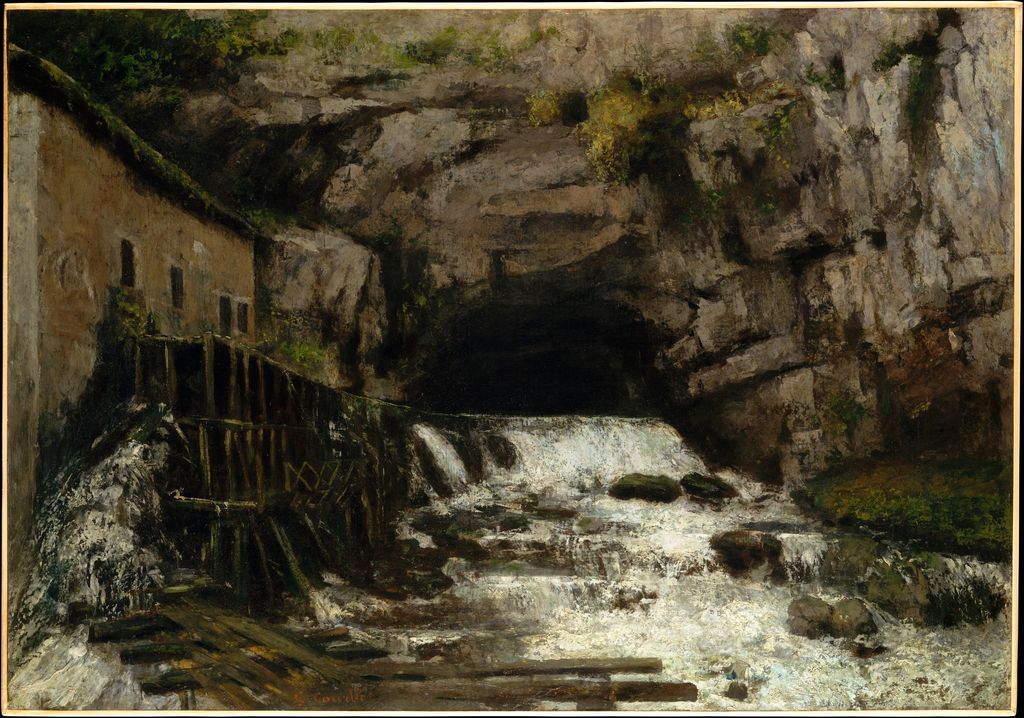
The Loue emerges at the foot of a limestone cliff near Ouhans. The Musée Courbet’s site account points to the history of work around the spring. The river’s force was available to the people who built and worked beside it, and Courbet included buildings or figures in some views. In the Metropolitan Museum of Art’s 1864 The Source of the Loue, the waterworks at the left give a measure of the cave’s size. Water spreads out below the opening, with white strokes where the current is broken. Looking up from the water, the eye has little distance to travel before it meets the face of the cliff. The scene’s human scale comes chiefly from the structure at the edge. [13] [14]
The Met relates the canvas to a letter Courbet wrote to the dealer Jules Luquet in 1864. He reported making four views about 1.4 metres across. The museum considers its painting likely to be one of that group. The letter documents repeated work on the subject in a particular format. The museum’s qualification keeps the surviving canvas distinct from an unnamed item in the letter. The cave’s aperture and the flow at its base provide a common problem for the series. Changing the width of the dark opening or the amount of water in view could give one canvas a different sense of depth and movement from another, even within the same dimensions. [14]
There is a material difference between the water and the rock in the Met canvas. Light breaks into small, irregular patches across the current, while the cave mouth gathers darkness into one area. The Met relates the use of palette knife and brush to the rendering of rock and foam. The marks make a natural feature felt at the level of the painted surface. They also separate the place Courbet knew from the particular experience he offers a viewer. At the spring you could turn and look downstream or move away from the cave. In front of this picture the dark opening and the water issuing from it continue to set the terms of the view. [13] [14]
The Source of the Loue, Met 29.100.122. Image source. CC0 / Public domain. Resized from the complete source image.
Places with more than one history
The family farm at Flagey passed to Juliette after Régis died and later to the Bourgon family, who had worked the holding. It opened as a cultural site in 2009. The Musée Courbet explains that the garden was recreated with the earlier property in mind. It also identifies a plan from 1842 that helps establish the historic layout. That gives the garden two dates worth keeping in mind. There is the nineteenth-century evidence of how the property was arranged and there is the later work that allows visitors to see what part of that arrangement might have looked like. The same distinction applies at the Hôtel Hébert, where the surviving building holds a period of the family’s life and the museum reflects the work of later collectors, organisers and the Département du Doubs. [3] [4] [15] [16]
The farm, studio and spring each show a different part of the relationship between Courbet and the region. The farm connects the fair picture and the portraits of his sisters to the circumstances of a landowning family. The attic helps explain how a large public painting took shape in a room made available by relatives. The spring shows what prolonged attention to one place could yield across several paintings. Back in View of Ornans, the steeple fixes the town for the eye and the bridge leaves a question about the viewpoint. That combination is one reason to begin with the picture. It lets us see how much a known place could give Courbet and how much of the view was still his to decide. [1] [4] [5] [14]
Courbet artworks directory
Browse the paintings covered in this guide. Dates identify the specific versions discussed.
Discussion
Look again at the images and ideas explored in Gustave Courbet’s Ornans and Franche-Comté. These editorial prompts invite your observations.
Reader Insights
How does the scale of the funeral change the way you look at the people of Ornans?
What distinguishes the open landscape of Flagey from the opening of the Loue cave?
How does Courbet make everyday movement through the region visible?
Join the Conversation
Share a detail, comparison or question about Gustave Courbet’s Ornans and Franche-Comté below.
References
- The Metropolitan Museum of Art, Gustave Courbet, View of Ornans, collection record 1995.537. View source.
- Musée Courbet, Qui est Gustave Courbet ?, biography and family background. View source.
- Musée départemental Gustave Courbet, Courbet en son territoire, Les carnets du musée Gustave Courbet, no. 1, especially the introduction and the sections on the museum and the artist’s studios. Read the study. View source.
- Musée Courbet, Histoire de la Ferme Courbet, history of the property, family and sharecroppers. View source.
- Musée Courbet, Histoire de l’atelier, the two Ornans studios and Courbet’s account of the attic. View source.
- Musée d’Orsay, Gustave Courbet, Un enterrement à Ornans, collection record RF 325. View source.
- Musée des Beaux-Arts et d’Archéologie de Besançon, Gustave Courbet, Les Paysans de Flagey revenant de la foire, collection record D.959.1.1. View source.
- Ministère de la Culture, Joconde, Les Paysans de Flagey revenant de la foire, record M0332000887. View source.
- The Metropolitan Museum of Art, Gustave Courbet, 2008 retrospective gallery entry for The Peasants of Flagey Returning from the Fair. View source.
- The Metropolitan Museum of Art, Gustave Courbet, Young Ladies of the Village, collection record 40.175 and audio transcript with Charlotte Hale and Keith Christiansen. View source.
- National Gallery of Art, Gustave Courbet, The Stream (Le Ruisseau du Puits-Noir; vallée de la Loue), collection record 1943.15.2 and education resource Picturing France, 1830–1900. View the collection record and read the resource. View source 1. View source 2.
- Musée départemental Gustave Courbet, La nature comme tableau, Les carnets du musée Gustave Courbet, no. 2, especially the analysis of Grotte de la source enneigée. Read the study. View source.
- Musée Courbet, Maison de la source de la Loue, on the site and its working history. View the site account and read the guide to the spring at Ouhans. View source 1. View source 2.
- The Metropolitan Museum of Art, Gustave Courbet, The Source of the Loue, collection record 29.100.122 and the museum’s account of Courbet’s landscape painting. View the collection record and read the essay. View source 1. View source 2.
- Musée Courbet, Jardin, history of the garden and its recreation at Flagey. View source.
- Musée Courbet, Aujourd’hui, un lieu culturel and Histoire du musée. Read the farm’s history as a cultural venue and the museum’s history. View source 1. View source 2.
- Bruno Mottin, C2RMF, Gustave Courbet étudié et restauré au C2RMF : un travail au long cours View source.