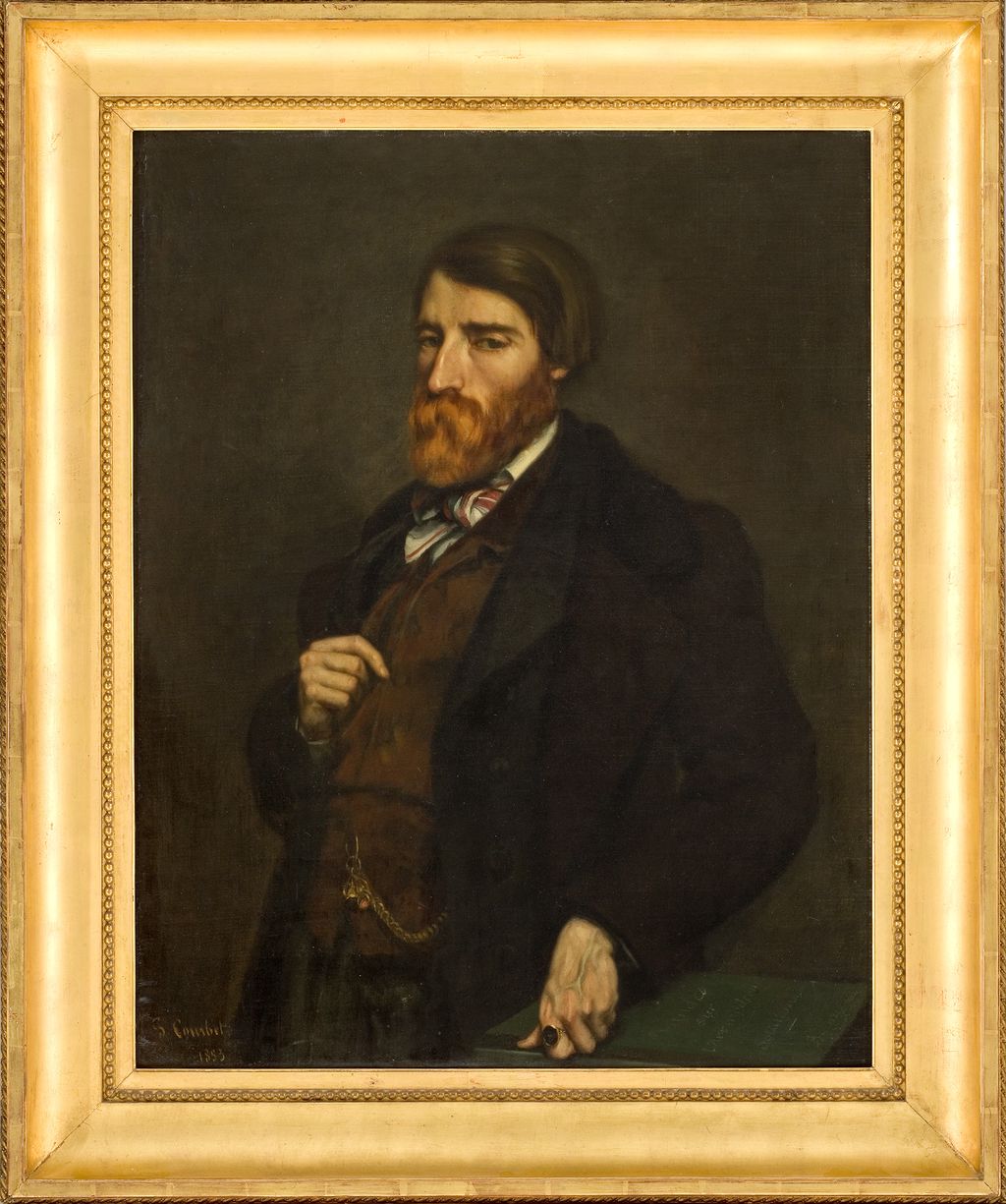
Portrait of Alfred Bruyas, known as Tableau-Solution, 1853, by Gustave Courbet Musée Fabre, Montpellier, 868.1.21. Image source. Public domain.
 by Tom Gurney
Tom Gurney BSc (Hons) is an art history expert with over 20 years experience
Email: tomgurney1@gmail.com / Phone: +44 7429 011000
Alfred Bruyas and Gustave Courbet: Introduction
On 14 September 1868, Alfred Bruyas wrote to the mayor of Montpellier to offer the city his gallery of paintings. He argued that works by great artists belonged to posterity and should pass out of private hands into public view. Among the pictures the city received were two that had already had very public lives. Bruyas bought Gustave Courbet’s The Bathers at the 1853 Salon, where it caused a scandal. The following year Courbet painted The Meeting for him, putting his patron into a scene that would be caricatured after its appearance at the 1855 Universal Exhibition. By giving them to the city, Bruyas could decide where those pictures would find their next public. [1]
Bruyas had been buying work by living artists long before he met Courbet. He was also a sitter, a commissioner, a publisher of catalogues and, when Courbet needed paintings for exhibitions, a lender. The dated records tell you what each of those roles involved. The 1853 Salon was where Bruyas acquired two paintings already made for public display. An invitation to Montpellier led to new work in 1854. Loans put selected pictures back in front of audiences in Paris. The gift of 1868, supplemented by a bequest at Bruyas’s death in 1877, gave the city a collection through which visitors could see several stages of the relationship. [1] [2]
At a Glance
- CollectorAlfred Bruyas (1821–1877)
- Key worksThe Bathers, The Meeting, The Seaside at Palavas
- CollectionMusée Fabre, Montpellier
Contents
- What Bruyas was collecting
- Two purchases and a commission in 1853
- What the Montpellier invitation made possible
- Letters, loans and the exhibitions
- The gallery becomes public
What Bruyas was collecting
Bruyas grew up in Montpellier, the son of a banker. By 1845 he was involved in the city’s Société des amis des arts. In Rome in the 1840s he spent time among artists at the Villa Medici, where his fellow Montpelliérain Alexandre Cabanel was a pensioner after winning the Prix de Rome. Bruyas commissioned work from Cabanel and from another local painter, Auguste Barthélemy Glaize, who depicted scenes from the collector’s private life. Both relationships preceded Courbet’s arrival in his circle. Bruyas already knew what a commission could bring him that a purchase could only supply by chance. He could ask a painter to make a picture with a particular place in his collection or a particular connection to his own life. [1] [2]
On repeated stays in Paris between 1849 and 1853, Bruyas moved among the Salon, museums, dealers and artists’ studios. His purchases included work by Théodore Rousseau and Jean-François Millet, as well as several paintings by Eugène Delacroix, including the Musée Fabre version of Women of Algiers in Their Apartment. Delacroix painted Bruyas himself in 1853. Looked at alongside Courbet’s portrait from the same year, that commission shows how readily the collector turned to painters with quite different reputations and ways of working. He could admire Delacroix and make a public commitment to Courbet within the same season. [1] [2]
The catalogues Bruyas began publishing in 1851 also gave him a way of making a case for his choices. One of his recurring words was solution. The Musée Fabre traces the term to the vocabulary of social reform and shows how Bruyas applied it to different painters over a few years. In 1852 he associated it with Octave Tassaert’s depictions of poverty. The following year he used it in connection with close observation of the real in painters such as Corot and Troyon. By 1854 he had applied it to Courbet’s The Bathers. The changing examples give a better idea of what the word meant to him than a single definition could. Bruyas was looking for an art that could do something for the society it depicted, and he kept revising his account of where that promise lay. [3]
Two purchases and a commission in 1853
At the Salon of 1853, Bruyas bought The Bathers and The Sleeping Spinner. The former drew hostile attention with its large nude figure and difficult-to-read exchange of gestures. The latter, a picture of a woman asleep at her spinning wheel, drew more admirers according to Courbet’s 13 May letter to his parents. He reports those differing reactions in the same letter, adding that he had introduced a cloth over the bather’s buttocks and that the landscape had been well received. Bruyas’s decision to take both paintings gave the collection two different examples of what Courbet could do with figures whose actions were as ordinary as bathing or working at home. [1] [4] [5] [6]
The purchase of The Bathers was a public commitment in a particular sense. Bruyas chose a painting while it was being argued over, and he would later give Courbet access to it again for exhibition. It also mattered that he chose The Sleeping Spinner. To reduce the transaction to the rescue of a scandalous painting would miss the breadth of the purchase. The two works could be put beside one another in a private gallery and could travel independently when a new occasion to show them came up. That flexibility would matter two years later, when the pair was divided between different exhibitions in the same city. [1] [4] [5]
The portrait called Tableau-Solution was a further transaction. Bruyas asked Courbet to paint him, and a message dated 18 June places the sittings in progress. In the finished canvas, the sitter rests his clenched hand on a book whose cover associates the study of modern art with the word solution. His hand gives the book the prominence that another portrait might give to a family emblem or an attribute of office. Here Bruyas is pictured as someone who has a position on art and intends to put it into practice. The book also gives Courbet a way to suggest what the painter and collector hoped to do together. The portrait is dated 1853, even though the Fabre traces further uses of the term by Bruyas in 1854. [3] [7]
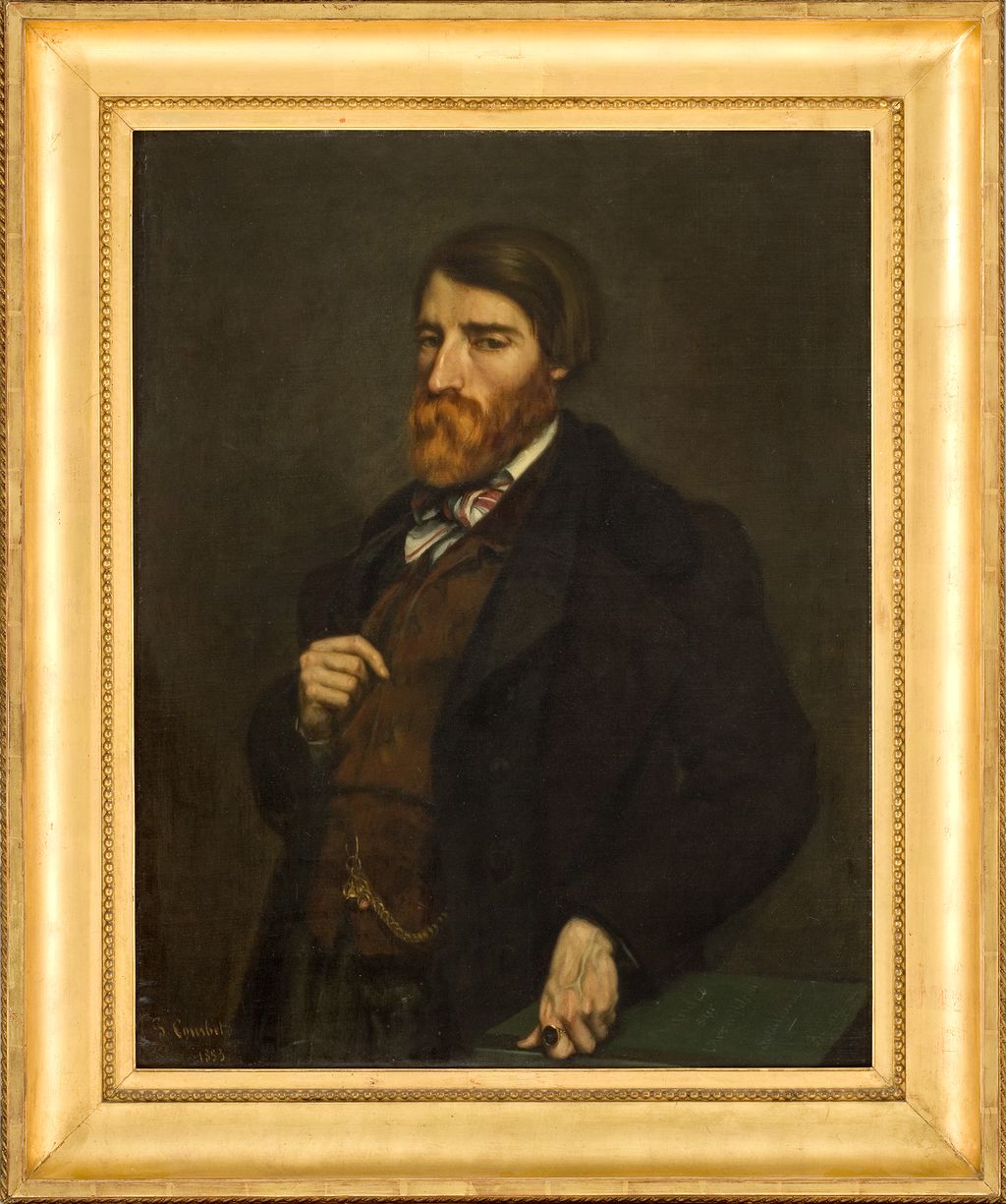
Portrait of Alfred Bruyas, Tableau-Solution, Musée Fabre 868.1.21. Image source. Public domain. Resized from the complete source image.
What the Montpellier invitation made possible
Courbet arrived in Languedoc in May 1854 at Bruyas’s invitation and remained until September. The stay put the painter in a landscape he had never worked in before and gave Bruyas new pictures made for him, among them The Meeting and The Seaside at Palavas. Both put Courbet into the landscape. In the first he encounters the collector and his companion on a road. In the second a small figure raises his hat to the sea. Bruyas could commission two pictures in which the painter was recognisable while allowing Courbet to give the figure entirely different things to do. [1] [8] [9]
The roadside scene makes the relationship visible by giving the two men room to face each other. Courbet appears with his travelling equipment and stands clear of the figures who greet him. The Fabre points out that Courbet travelled by rail and treats the painted greeting as a scene composed for the picture. The distinction matters to the history of the commission. Bruyas had made a visit possible, while Courbet determined how that visit would be remembered in paint. The resulting canvas gives the patron a place in the artist’s story while leaving the artist free to decide how both of them appear. [8] [10]
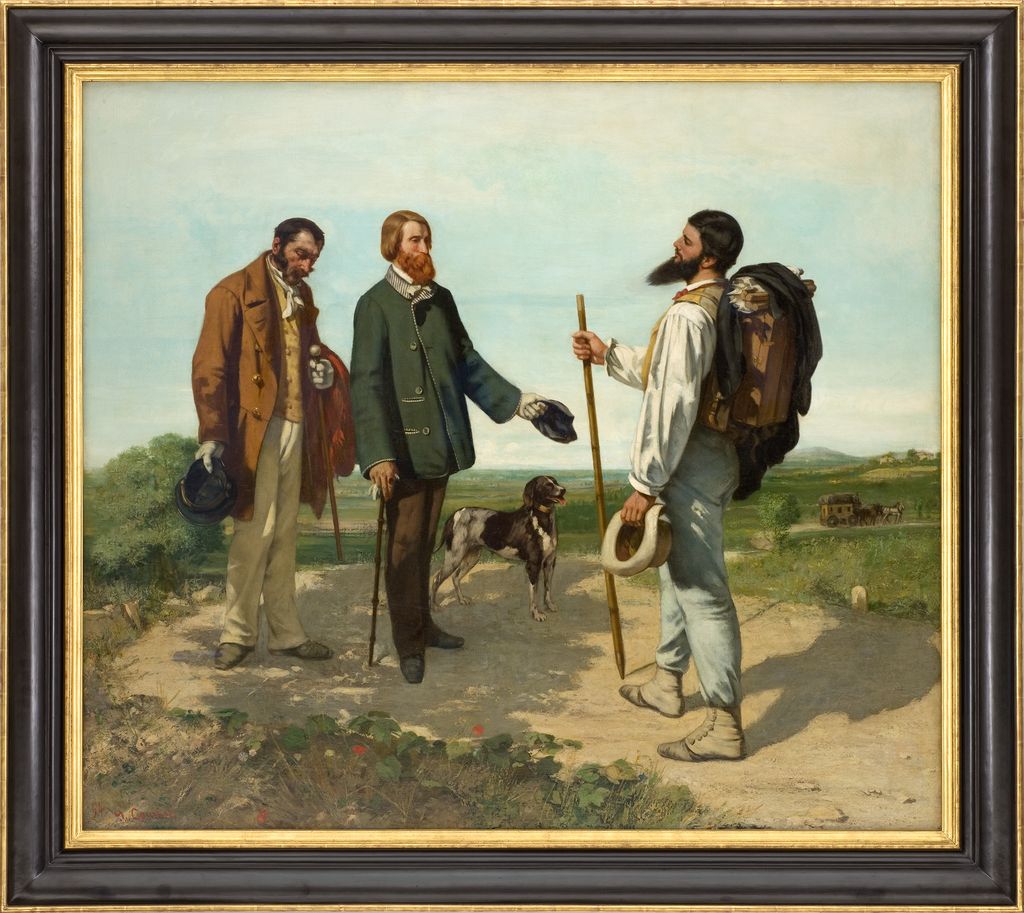
The Meeting, Musée Fabre 868.1.23. Image source. Public domain. Resized from the complete source image.
Letters, loans and the exhibitions
Courbet also depended on Bruyas’s willingness to discuss works while they were in progress. In a letter from late 1854, Courbet reported that he had transferred the outline of The Painter’s Studio to the large canvas. In February 1855 he asked Bruyas to look into an extension of the exhibition deadline, explaining that illness had cost him three months. By March he could tell Bruyas that he had obtained another fifteen days through the painter Louis Français. Read together, the letters show both the confidence with which Courbet talked to Bruyas about his work and the practical limits of what he could ask him to do. The news that the extension had been secured came with a different name attached. [11] [12]
By then Courbet had already discussed with Bruyas how a personal exhibition might work. In January 1854 he imagined a large tent with a central support, a ticket desk and attendants. The proposed title paired his own name with Bruyas’s gallery. The letter comes before the Montpellier stay and well before the official 1855 jury decisions. It shows that Courbet was thinking about the space, the staff and the paintings for a show of his own while the partnership was still new. In February 1855 Courbet told Français that the joint project had fallen through. By April, he was writing to Bruyas about the rent and projected building costs for a show of his own. Bruyas’s role in the pavilion that opened was as a lender. The distinction between the proposal and the exhibition matters because the plan to share billing can so easily be mistaken for an agreement to share costs. [13]
In 1855 the pictures were spread across two Paris venues. The division shows how the same owner’s pictures could serve both the official selection and Courbet’s independent exhibition. Bruyas lent The Meeting to the official Universal Exhibition, where it was listed as no. 2803. The Sleeping Spinner was in the same exhibition as no. 2805. The Bathers appeared as no. 4 in Courbet’s own pavilion. In a letter dated 9 December, Courbet wrote of returning the borrowed works and asked Bruyas to count the shipping against money owed to him. The letter gives the exhibition a material aftermath. Pictures had to be packed, transported and accounted for once the public had gone home. [1] [4] [5] [8] [14]
The loans also had consequences for Bruyas as a sitter. Caricaturists took up The Meeting after its official exhibition, and the Fabre describes Bruyas’s distress at the response. There were further occasions for display. The Fabre’s exhibition histories list The Meeting, The Bathers, The Sleeping Spinner and Tableau-Solution in Courbet’s independent 1867 show near the Pont de l’Alma. This time a visitor could encounter both purchases from the 1853 Salon, the portrait that followed them and the roadside picture within the same exhibition. Bruyas still owned the works. Putting them together for a temporary show was a different decision from making them part of a city museum. [4] [5] [7] [8] [10] [11]
The gallery becomes public
When Bruyas offered the gallery to Montpellier, he followed the local example of earlier collectors François-Xavier Fabre and Antoine Valedau. The council accepted the gift on 22 October 1868. Bruyas continued to fill gaps in the collection with help from the critic Théophile Silvestre and the painter and lithographer Jules Laurens, bringing in work by artists such as Géricault and Ingres while retaining his enthusiasm for Delacroix. La Galerie Bruyas, published in 1876, continued the work of presenting the collection in print. The further bequest took effect at his death on 1 January 1877. The two 1853 Salon purchases, the Tableau-Solution and the two better-known Montpellier pictures already belonged to the city through the 1868 gift. [1] [2] [4] [5] [7] [8] [9]
In December 1888 Vincent van Gogh visited the museum with Paul Gauguin. Writing to his brother Theo, he singled out the portraits of Bruyas and compared the red-haired sitter in Delacroix’s portrait to the two brothers. He admired Courbet’s painting of the spinner and discussed the collection in the same letter in which he described his arguments about painting with Gauguin. Bruyas had wanted people to see works together and think about what they offered to the art of their own time. Here were two painters travelling to Montpellier to do just that, following lines of interest through the gallery that its collector could never have predicted. [2] [15]
Courbet artworks directory
Browse the paintings covered in this guide. Dates identify the specific versions discussed.
Discussion
Look again at the images and ideas explored in Alfred Bruyas and Gustave Courbet. These editorial prompts invite your observations.
Reader Insights
What roles does Courbet give himself and Bruyas in The Meeting?
How does the portrait compare with the way Bruyas appears outdoors in The Meeting?
How did lending and donating paintings change their audience?
Join the Conversation
Share a detail, comparison or question about Alfred Bruyas and Gustave Courbet below.
References
- Musée Fabre, “La ‘Solution’ d’Alfred Bruyas,” collector history and transcript of Bruyas’s letter of 14 September 1868 to Jules Pagézy. View source.
- Musée Fabre, “Alfred Bruyas,” collector profile and links to the 1854 and 1876 catalogues and manuscript collections. View source.
- Musée Fabre, Portrait d’Alfred Bruyas dit Tableau-Solution, interpretation and account of the June 1853 sittings. View source.
- Musée Fabre, Les Baigneuses, inventory 868.1.19 and exhibition history. View source.
- Musée Fabre, La Fileuse endormie, inventory 868.1.20 and exhibition history. View source.
- Musée Fabre, Les Baigneuses, dossier with Courbet’s letter of 13 May 1853 to his parents, as edited by Petra ten-Doesschate Chu. View source.
- Musée Fabre, Portrait d’Alfred Bruyas dit Tableau-Solution, inventory 868.1.21 and exhibition history. View source.
- Musée Fabre, La Rencontre, inventory 868.1.23 and exhibition history. View source.
- Musée Fabre, Le Bord de mer à Palavas, inventory 868.1.24. View source.
- Musée Fabre, “La Rencontre ou Bonjour Monsieur Courbet,” account of the composition and the 1855 reception. View source.
- Institut national d’histoire de l’art, “Lettres de Gustave Courbet,” 1854–1868, pièces 94–111, archival inventory via FranceArchives. View source.
- Noël Barbe, “L’Atelier de Courbet : une énonciation du travail du peintre,” notes 1–3, extracts from Courbet’s letters to Bruyas with references to Chu’s edition, pp. 119, 124 and 126–127. View source.
- “Les pavillons Courbet, 1855, 1867 et 1868,” transcriptions of Courbet’s letters 54-1, 55-1 and 55-4. View source.
- Institut Gustave Courbet, Acheter Courbet, exhibition catalogue, extract from Courbet’s letter of 9 December 1855 to Bruyas. View source.
- Vincent van Gogh to Theo van Gogh, Arles, December 1888, letter 564 in the Van Gogh-Bonger translation. View source.