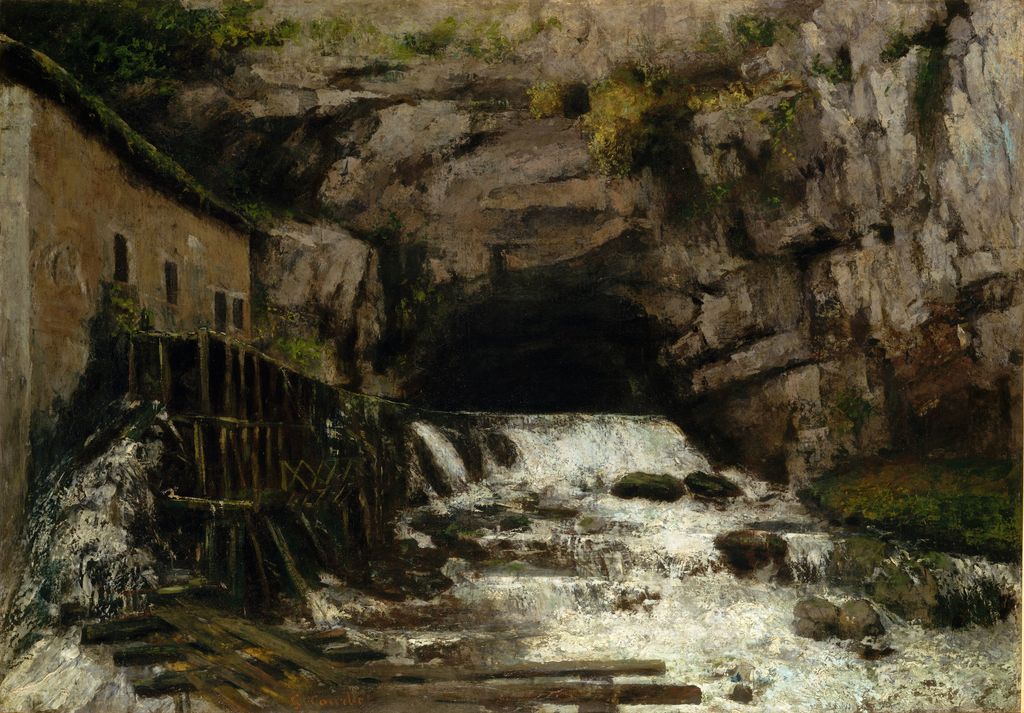
The Source of the Loue by Gustave Courbet The Metropolitan Museum of Art. Image source. CC0 / Public domain.
 by Tom Gurney
Tom Gurney BSc (Hons) is an art history expert with over 20 years experience
Email: tomgurney1@gmail.com / Phone: +44 7429 011000
Gustave Courbet’s Style and Technique: Introduction
At the mouth of the Loue, a cliff fills almost the entire upper part of Gustave Courbet’s painting. Light catches patches of stone around the dark opening. Below, a pale band of water spills over a ledge and breaks into small, bright marks around the boulders. The rock seems to hold its weight while the water scatters. The Metropolitan Museum of Art credits Courbet’s palette knife with both effects in its 1864 canvas of The Source of the Loue. The distinction between solid rock and moving water depends on how he handled the paint within a few inches of canvas. [1]
That surface offers one kind of evidence about Courbet’s work. Other paintings preserve decisions that the artist covered over, or that later treatments made harder to see. In The Wounded Man, a companion survives beneath the painted surface. In The Peasants of Flagey Returning from the Fair, Courbet altered the width of the canvas itself. The restoration of A Burial at Ornans exposed a painted edge that had been folded out of sight. Each case asks a different question about how the picture we see came to look as it does. [2] [3]
At a Glance
- MaterialsOil paint, canvas and drawing media
- EvidenceSurface observation, restoration and technical imaging
Contents
- Rock and running water at the Loue
- A kitchen knife at Étretat
- The companion beneath The Wounded Man
- A different subject beneath the deer
- How Courbet changed the canvas at Flagey
- What restoration changed at A Burial at Ornans
Rock and running water at the Loue
The Met’s Source of the Loue, accession 29.100.122, measures 99.7 × 142.2 cm. A letter Courbet wrote to the dealer Luquet in spring 1864 mentions four landscapes about 1.40 metres wide made during a recent visit to the site. The Met thinks its canvas probably belongs to that group. Its version includes the waterworks to the left of the grotto. The building’s square window openings and the uprights of the waterworks give the eye a measure for the uneven face of the cliff and the turbulence below. [1]
A palette knife has a flat blade for mixing or moving paint. On the canvas, the broad face can spread a patch of colour, while an edge can draw it out or leave a sharper boundary. A loaded blade can leave a raised deposit. That physical buildup is called impasto. A brush can also make impasto, and a knife can spread paint thinly. One term names an implement and the other describes the thickness of the painted surface. Where the paint stands in relief, light striking it from the side can pick out a ridge or cast a little shadow behind it. [1] [4]
At the Loue, look from the upper lip of the grotto to the bright water beneath it. On the rock, the lighter patches sit against one another in irregular planes. Some end abruptly in shadow, so the breaks can read as ledges or changes of angle. Across the first drop, small pale marks crowd into a bright sheet. Farther forward, a pair of dark, rounded rocks interrupt the white, and the light breaks into separate runs as the water falls again. The shifting intervals give the eye a route down the slope and into the foreground. Courbet used the knife to vary the size and spacing of his marks. The rock gathers them into a mass, while the water divides them into glints. [1]
The art historian and conservator David Bomford proposed a longer history for Courbet’s interest in rough surfaces. In a Getty symposium paper he compared the low relief of Courbet’s landscapes with the broken handling of earlier painters such as Rembrandt and Velázquez. The comparison concerns an effect paint can produce when its physical texture stays visible within the illusion. In The Diligence in the Snow, Bomford describes pale slabs applied with a knife in the distance, thick swirls of paint for foreground rocks and snow, and a very dark underlying colour. That is a specific account of the snow painting. At the Loue, where the cave’s darkness makes the falling water seem brighter, we can see a tonal contrast without assigning the same underlying materials to both canvases. [1] [5]
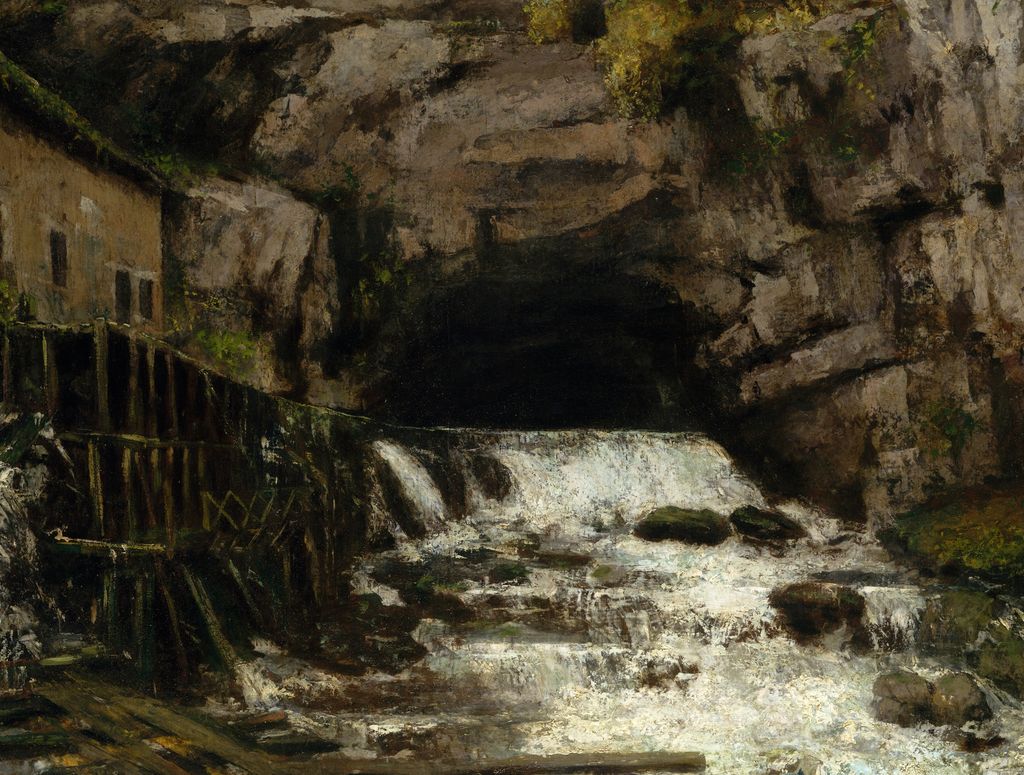
Detail of The Source of the Loue, Met 29.100.122. Shown here, cave mouth, rocks and falling water. Image source. CC0 / Public domain. Cropped and resized from the source image.
A kitchen knife at Étretat
The Musée d’Orsay’s The Wave, also called La Mer orageuse, offers a different comparison between thick paint and moving water. In this canvas, dated 1870 and catalogued as RF 213, two fishing boats sit on the shore. The dark green water rises behind them in a band that crowds the sky. White foam breaks the band’s upper edge, so the eye reads the weight of the wave and the moment it starts to turn in the same sweep. The museum describes Courbet applying thick paint with a kitchen knife. Where the Loue’s light marks pick out a cascade spilling down, the white at Étretat shows a mass of water lifting and beginning to break. [1] [6]
Guy de Maupassant’s La Vie d’un paysagiste, published in Gil Blas on 28 September 1886, evokes a visit to Courbet at Étretat. Courbet applies patches of white with a kitchen knife, interrupts himself to look at the storm, and returns to the canvas. Maupassant also gives him a glass of cider and makes the sea seem about to engulf the room. The episode takes the form of a landscape painter’s letter and appeared sixteen years after the 1870 Salon. Its details make a story of the encounter, down to the rhythm of looking out and working again. The picture at Orsay supplies a different kind of evidence. The shore, sea and sky occupy distinct horizontal bands, and the foam is placed where it can interrupt their order. The account brings the act of applying paint to life. The surface lets us examine what the finished arrangement does with that white. [6] [7]
The companion beneath The Wounded Man
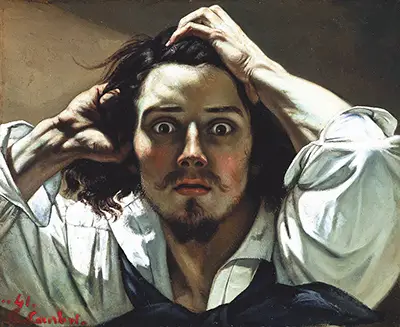
In the Musée d’Orsay’s The Wounded Man, dated 1844–54, Courbet’s closed eyes and resting hand could belong to a sleeper. A sword beside the shoulder and a red stain near the heart make the posture more troubling. The Centre de recherche et de restauration des musées de France, or C2RMF, publishes a radiograph of this canvas, RF 338. It records traces of earlier painting, including a composition in which a woman rested against Courbet. A figure once gave the slope of his shoulder a different purpose. The visible sword and red mark change what a viewer makes of a pose that already existed. [2] [8]
In radiography, X-rays pass through the painting and some of the materials impede them more strongly than others. Paint containing elements such as lead can produce a light mark in a conventional positive radiograph. Materials from the canvas, paint layers and mounting can all contribute to the resulting image. Features from different stages of a picture may appear on top of one another. That is what makes a radiograph useful for finding a buried figure and difficult to read where successive features occupy the same place. An outline can survive in the radiograph even where its colour and the relation to its surroundings are hard to recover. [2] [9]
The Orsay portrait actually preserves three compositions. There was first a portrait of a woman, then the scene of the couple beneath a tree, and finally the wounded figure alone. Ina Reiche and colleagues combined maps of chemical elements with measurements at selected depths to establish the order of the paint. A map can pick out a shape made in a paint containing a particular element. At points where signals from the three pictures overlapped, measurements at different depths helped the researchers separate the earlier marks from the later ones. Their study could distinguish at least eight paint layers. The process gave the team a way to test the sequence suggested by the earlier images. [2] [8] [10]
The C2RMF identifies the companion as Virginie Binet, and Orsay links the change to a separation. That reading gives the final image a biographical resonance. The material study answers a narrower question with greater precision. It places the couple between the portrait of a woman and the wounded self-portrait. With that sequence in mind, the white shirt becomes a particularly economical change. A small spot of colour can recast the meaning of the body around it without requiring Courbet to invent a new pose. [2] [8] [10]
A different subject beneath the deer
The C2RMF reports another earlier composition beneath Orsay’s 1866 Roe Deer at the Stream of Plaisir-Fontaine, RF 583. It identifies the surviving traces with La Source d’Hippocrène, a composition known from written sources. In the visible painting, four deer share a stretch of water below a pale cliff. One lies beside a tree at the left, while another lowers its head in the darker space at the far right. Their separate turns and pauses organise the near ground, while the wall of rock gives the clearing its height. A viewer can follow the arrangement of the animals across the bank. The earlier subject enters our understanding of the painting through the conservation centre’s identification. Its public account leaves the method of examination and the extent of the surviving image unspecified. [2] [11]
The two cases show what the reuse of a canvas can encompass. In the Orsay self-portrait, part of an arrangement survives visibly from one stage to the next. Courbet’s reclining figure carries a new story when the companion disappears. For the deer, the published finding establishes that traces of an earlier subject lie beneath the one on display. It leaves open whether Courbet adapted anything from the earlier arrangement when he painted the animals. The association with La Source d’Hippocrène brings written evidence into the reading of the material traces, much as the different depth readings in The Wounded Man bring one kind of physical evidence to bear on another. [2] [10] [11]
How Courbet changed the canvas at Flagey
The right side of The Peasants of Flagey Returning from the Fair presented a question about the support, the fabric on which the picture is painted. The canvas in Besançon, D.959.1.1, is 275 centimetres wide. Horsemen rise above the press of cattle, while a man on foot follows a pig along the darker ground at the right. The space around the walker lets the eye follow his extended stride and the thin lead down to the animal. The group’s spacing depends on how much painted ground Courbet gave it at that end. [12] [13]
A partial radiograph of the right side made in 1959 once led researchers to treat the Besançon painting as a later repetition. The C2RMF now identifies the work as the original canvas, cut on its right side and subsequently enlarged again by Courbet. The national collections record gives the first public showing as the Salon of 1850–51 and places alterations to the right side in 1855. The physical change is therefore part of the history of the picture shown at the Salon. Cutting and extending the fabric gave Courbet a different area in which to arrange the procession. [2] [13] The Metropolitan Museum of Art’s 2008 retrospective catalogue describes the same Besançon canvas as a later replica. [15]
This is a different problem from separating paint layers on the wounded self-portrait. A partial image of the right side may show evidence of a change there, while the question of the painting’s identity involves the whole object and its exhibition history. A change of fabric can make the finished picture look different enough to prompt a theory about another version. At Flagey, the revised reading of the evidence keeps that difference within the history of one canvas. [2] [13]
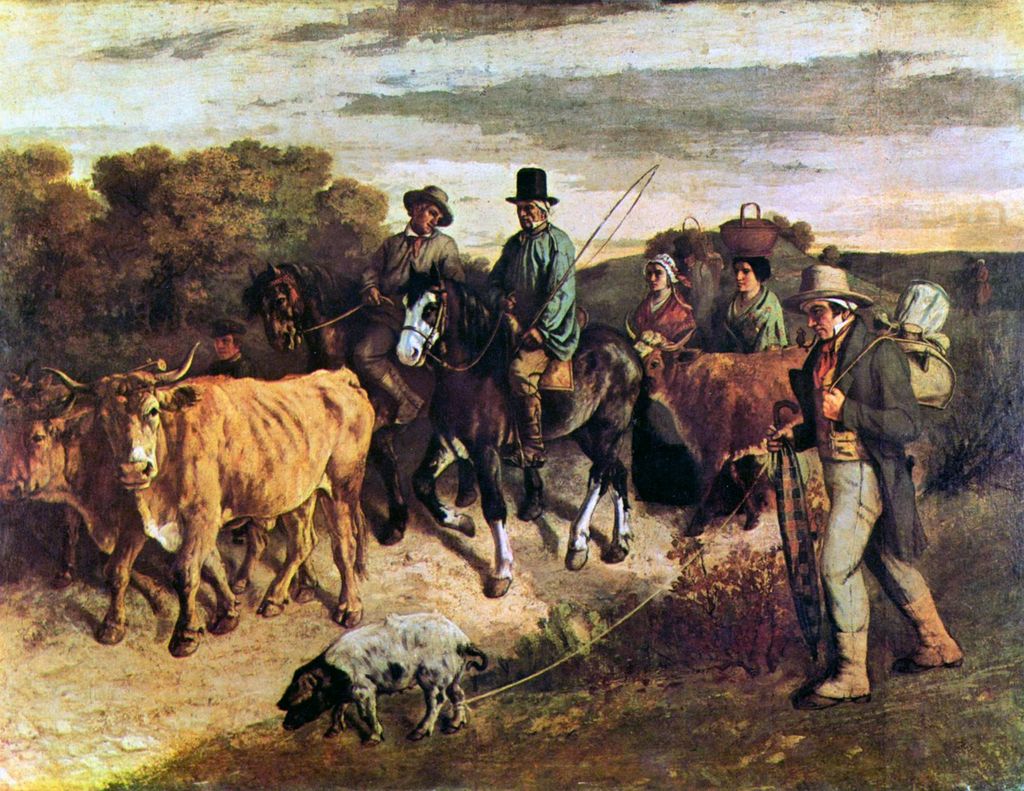
Peasants of Flagey, Besançon RF 1959 9 / D.959.1.1. Image source. Public domain. Resized from the complete source image.
What restoration changed at A Burial at Ornans
In A Burial at Ornans, the open grave interrupts a long line of people at the very bottom of the painting. There are faces, hats and patches of colour to follow across a canvas more than six metres wide, but the pit brings the eye down to the viewer’s side of the gathering. Orsay’s account of the restoration completed in 2026 describes two separate conditions that had changed what a visitor could see. Old coats of varnish had yellowed and become opaque, and painted canvas had been folded away at the edges. A preliminary scientific imaging campaign by the C2RMF between 2018 and 2020 informed the treatment. [3] [14]
Varnish sits over the paint. Its change in colour and clarity can alter how easily nearby colours can be distinguished. The restorers reduced the aged coatings, recovering differences in colour and light that had become harder to see. They also took the fabric off a defective stretcher dating to 1884, unfolded its edges and consolidated the support. A stretcher holds the canvas under tension, and the new one uses adjustable springs. The physical work on the fabric addressed how the painting was held as well as how much of it could be displayed. [3]
Unfolding the canvas revealed a narrow painted strip along the lower edge. The museum and its scientific committee chose to show it again. A few centimetres here have a greater effect than the dimensions alone suggest. They let the open grave extend farther down and bring the gravedigger’s shovel handle back into view. The change at Flagey reflects Courbet’s decision to reshape a picture he had exhibited. At Orsay, the visible area increased because restorers could present paint already on the folded edge. Both cases bring the boundary of the canvas into the interpretation of the scene. [2] [3]
Orsay also reports that some faces Courbet covered during painting had become visible as the materials aged. The committee decided to leave these pentimenti visible. A pentimento is a trace of a change the painter made while working, and its appearance now can depend on what happened to the paint later. At the Loue, the marks Courbet left exposed are enough to distinguish a fall of water from a wall of stone. At the burial, the present surface also carries traces that he deliberately hid. The lower strip, the reappearing faces and the clearer colour each have a different history. Knowing which is which helps explain how one painting can show Courbet’s decisions alongside the effects of the years since he made them. [1] [3]
Courbet artworks directory
Browse the paintings covered in this guide. Dates identify the specific versions discussed.
Discussion
Look again at the images and ideas explored in Gustave Courbet’s Style and Technique. These editorial prompts invite your observations.
Reader Insights
Where does the thickness of the paint become visible in the Loue landscape?
What can an earlier composition beneath the surface tell you about Courbet’s working choices?
How can a restoration change the details you notice?
Join the Conversation
Share a detail, comparison or question about Gustave Courbet’s Style and Technique below.
References
- Metropolitan Museum of Art, The Source of the Loue, 29.100.122, collection record and audio transcript View source.
- Bruno Mottin, C2RMF, Gustave Courbet étudié et restauré au C2RMF : un travail au long cours View source.
- Musée d’Orsay, Gustave Courbet’s A Burial at Ornans: completion of a remarkable restoration, 7 September 2026 View source.
- National Gallery, London, Impasto, glossary View source.
- David Bomford, Rough Manners: Reflections on Courbet and Seventeenth-Century Painting, Getty symposium paper, especially pp. 10–12 View source.
- Musée d’Orsay, La Mer orageuse, RF 213 View source.
- Guy de Maupassant, La Vie d’un paysagiste, Gil Blas, 28 September 1886, French transcription View source.
- Musée d’Orsay, L’Homme blessé, RF 338 View source.
- National Gallery, London, X-rays, glossary View source.
- Ina Reiche and colleagues, New insights into the painting stratigraphy of L’Homme blessé by Gustave Courbet combining scanning macro-XRF and confocal micro-XRF, Applied Physics A 122, article 947, 2016 View source.
- Musée d’Orsay, Remise de chevreuils au ruisseau de Plaisir-Fontaine, RF 583 View source.
- Musée des Beaux-Arts et d’Archéologie, Besançon, Les Paysans de Flagey revenant de la foire, D.959.1.1 View source.
- French Ministry of Culture, Joconde, Les Paysans de Flagey revenant de la foire, M0332000887 View source.
- Musée d’Orsay, Un enterrement à Ornans, RF 325 View source.
- The Metropolitan Museum of Art, Gustave Courbet, 2008 retrospective gallery entry for The Peasants of Flagey Returning from the Fair. View source.