 by Tom Gurney
Tom Gurney BSc (Hons) is an art history expert with over 20 years experience
Page Created on August 31, 2026 / Page Updated on November 6, 2026
Email: tomgurney1@gmail.com / Phone: +44 7429 011000
Paul Nash: Introduction
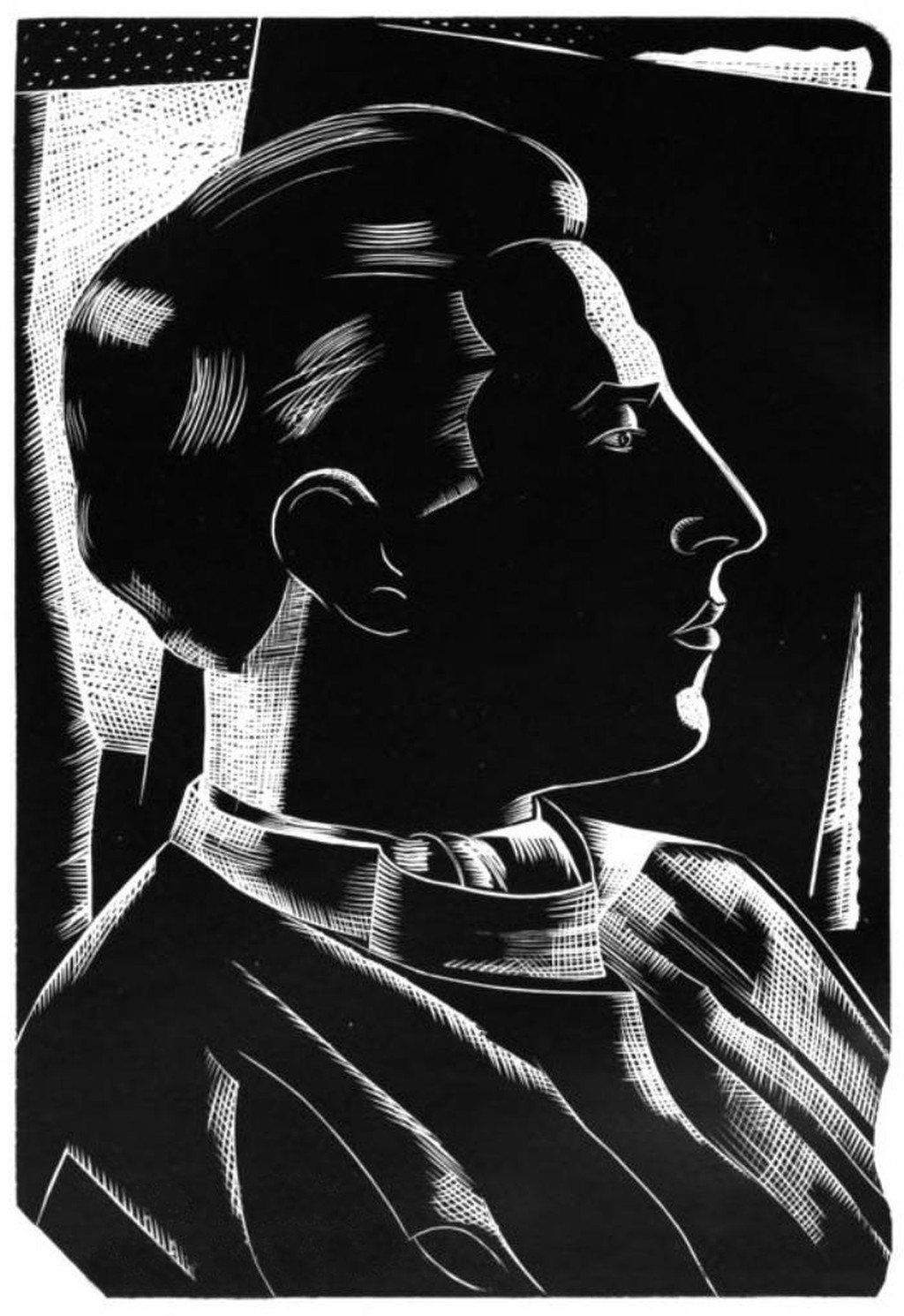
Paul Nash (1889–1946) made landscapes in which places do more than provide a background. Trees, stones, coastlines, aircraft wreckage and ruined earth become active presences, carrying the pressures of memory, conflict and change. His work ranges across painting, drawing, printmaking, photography, books and design, yet a sustained attention to the character of place holds those activities together.[1]
The two world wars transformed Nash’s subjects and public role, but they do not contain his achievement. Early drawings, interwar experiments, ancient sites and late symbolic paintings reveal an artist continually testing how the visible world might suggest something beyond immediate appearances.
At a Glance
- IdentityBritish artist, born in London on 11 May 1889 and died on 11 July 1946.[1]
- TrainingStudied at Chelsea Polytechnic and the Slade School of Fine Art; his Slade period fell in 1910–11.[1][2]
- MediaPainting, watercolour, drawing, lithography, wood engraving, photography, book illustration and applied design.[1][3]
- AffiliationsServed with the Artists Rifles, became an official war artist and founded the modern-art group Unit One in 1933.[1][3]
- Signature concernsCharged landscapes, damaged nature, ancient places, unexpected objects, dream imagery and the meeting of natural and mechanical forms.
- Major collectionsImportant works and archival material are held by Imperial War Museums, Tate, the British Council Collection and other public collections.[1][3]
Paul Nash in context
British landscape traditions
c. 1880–1940Cubism and geometrical modernism
c. 1907–1930Surrealism
c. 1924–1950Unit One
1933–35Paul Nash
1889–1946John Nash
1893–1977Ben Nicholson
1894–1982Henry Moore
1898–1986Eileen Agar
1899–1991Graham Sutherland
1903–1980Contents
- A Landscape Artist Beyond a Single Label
- From the Slade to the Western Front
- Places after the Armistice
- Modernism, Avebury and the Unseen Landscape
- Photography, Books and Design
- A Second War Seen from the Ground
- Five Works to Begin With
- Collections, Archives and the Works Census
A Landscape Artist Beyond a Single Label
Nash is often introduced through his war paintings, and with good reason: his images of the Western Front and aerial warfare have become central to British accounts of both conflicts. Yet landscape mattered before his military service and remained the organising force of his art afterwards. His subjects could be observed places, remembered places or invented spaces built from real fragments.
That continuity makes the Paul Nash biography more revealing than a division into disconnected phases. It also explains why the Paintings and Artworks guide includes photographs, prints and design alongside oils and watercolours. Nash changed media and absorbed modern movements, but he repeatedly returned to the question of how a place acquires presence.
From the Slade to the Western Front
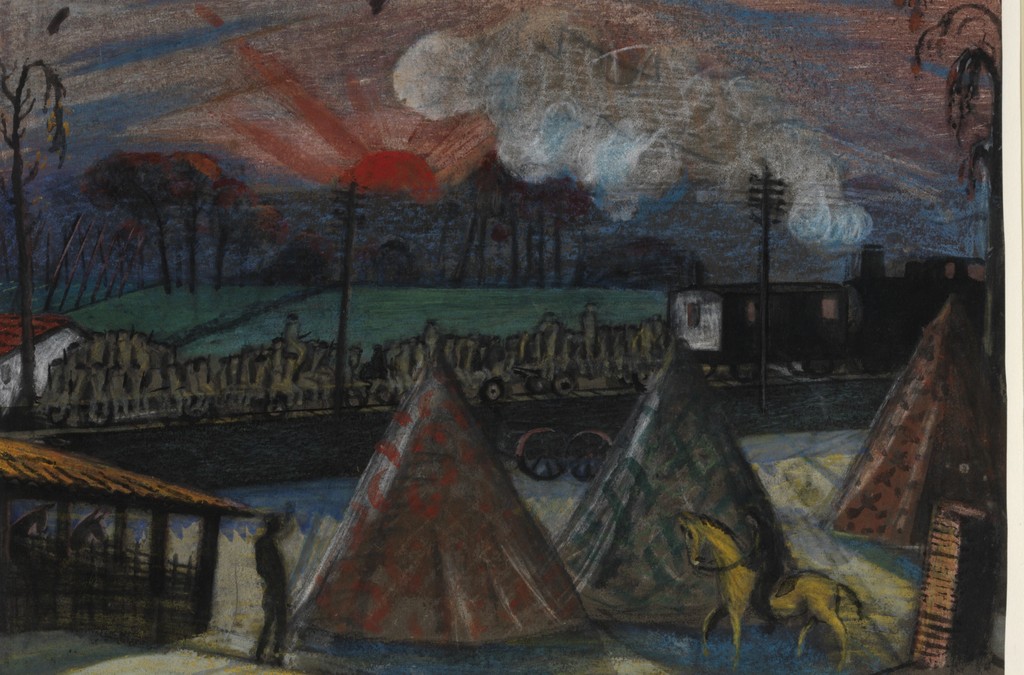
Nash studied at the Slade in 1910–11 and held his first London exhibition in 1912. His early reputation grew from drawings of landscape rather than academic figure painting. He enlisted in the Artists Rifles in 1914, received a commission in the Hampshire Regiment in 1916 and served near Ypres in 1917. His return from the front followed an accidental injury, not an enemy wound. An exhibition of his front-line drawings in London helped lead to his return to France as an official war artist.[1][2]
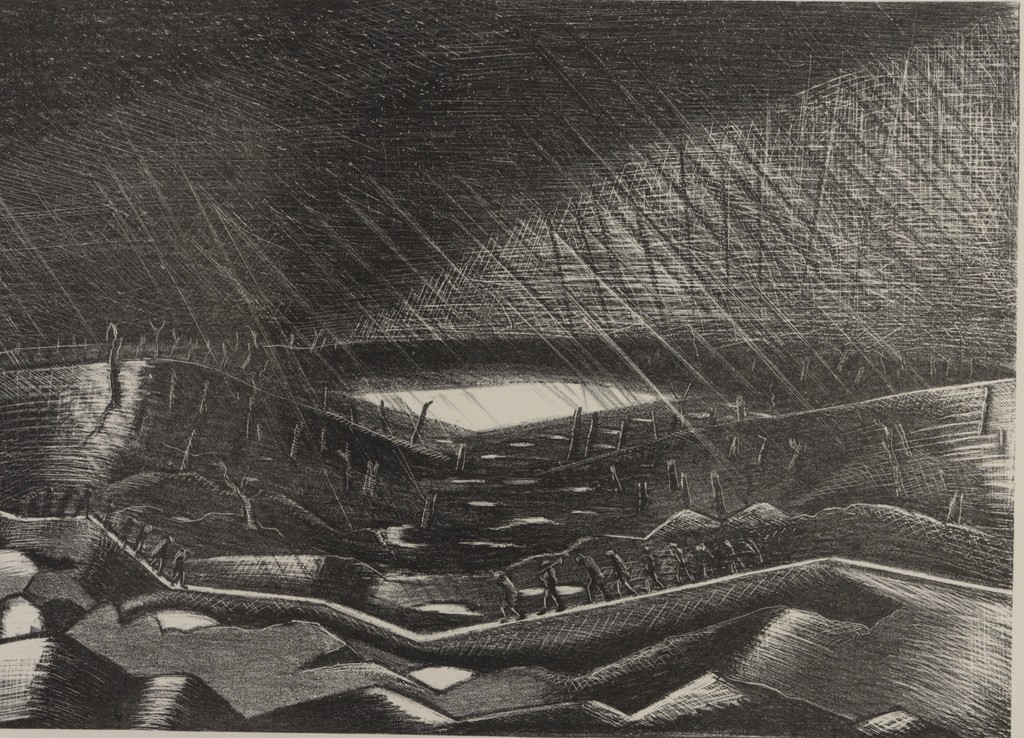
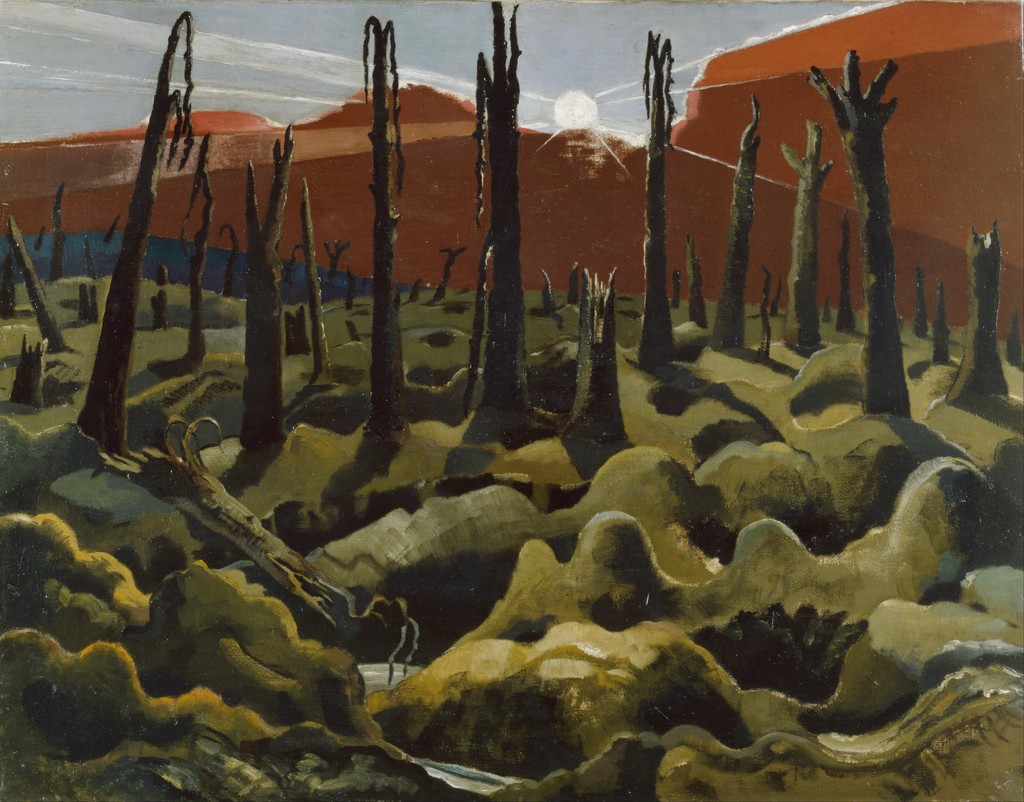
The First World War art that followed treats the battlefield as a violated environment. In We Are Making a New World, a pale sunrise illuminates churned earth and broken trees, turning the optimistic title into bitter irony.[4] The Menin Road expands destruction to monumental scale. Commissioned in 1918 for a proposed Hall of Remembrance, it draws on a landscape near Gheluvelt and shares its imposing proportions with Paolo Uccello’s Battle of San Romano.[5][6] The Mule Track instead catches figures and pack animals moving through the force of a bombardment.[7]
Watch: Paul Nash, War, Surrealism and British Landscapes
Places after the Armistice
In the 1920s, Nash’s attention shifted towards coasts, fields, woods and buildings. Dymchurch, Romney Marsh, Whiteleaf and the Dorset coast offered boundaries between land and water, enclosure and exposure, natural growth and human construction. The landscape and place guide follows these environments from the early importance of Wittenham Clumps to Nash’s later Oxford years.[8]
These pictures are not simply topographical records. A line of trees can behave like a wall; a pool or window can open one space inside another; a familiar path can feel strangely staged. Lessons of compression, disrupted perspective and expressive terrain remained available after the war, but Nash used them to explore more than wartime memory. Landscape became a structure through which ordinary observation could meet association and surprise.
Modernism, Avebury and the Unseen Landscape
Nash engaged directly with European modernism while retaining recognisable places and objects. He founded Unit One in 1933 to bring progressive British artists together around abstraction and Surrealism.[3] That same year, an encounter with the stones at Avebury gave ancient landscape a new importance. Landscape of the Megaliths, made from memory and shown in the Unit One exhibition under an earlier title, sets monumental forms within a modern geometrical space.[9]
The megaliths and ancient landscape story connects Avebury with aerial archaeology, geology and ideas of deep time. Scholarly research shows that Nash’s interest was not only mystical: books, maps, fossils and geological knowledge helped him imagine forces hidden beneath a site’s surface.[10] Landscape of the Megaliths, Equivalents for the Megaliths and Druid Landscape are related but distinct works and should not be treated as interchangeable.
Nash exhibited paintings and found objects with Surrealist groups in the later 1930s, although he never confined himself to a single programme.[11] The modernism and Surrealism guide explores how geometry, dreamlike shifts of scale and unexpected encounters intensified rather than displaced his attachment to the material world.
Photography, Books and Design
Photography became a substantial part of Nash’s practice. Tate preserves 1,267 negatives made between 1930 and 1946, a body of work that records landscapes, objects and chance arrangements through his own framing.[12] The camera could preserve a discovery, test a composition or make a familiar object newly strange. It belongs beside his painting rather than outside it.
Nash also designed book jackets, illustrated texts and worked in wood engraving, textiles, ceramics, theatre and other applied fields. The V&A’s study of his book work traces a graphic language altered by war and by new artistic ideas.[13] These activities are brought together in Photography, Design and Prints, where repeated motifs show how ideas travelled between a photograph, a printed page and a painting.
A Second War Seen from the Ground
Nash returned to official service through the Air Ministry in 1940 and the Ministry of Information in 1941.[1] His Second World War art often imagines aerial conflict without adopting the straightforward viewpoint of a pilot. Totes Meer (Dead Sea) turns a dump of wrecked German aircraft near Oxford into a metallic sea, its jagged wings appearing to rise and fall like waves.[14]
Battle of Britain constructs a broad panorama of aircraft, trails, coast and water rather than documenting one observed instant.[15] Nash did not fly, and institutional accounts emphasise that his aerial visions were imaginative constructions.[16] In Battle of Germany, completed in 1944, moon, smoke, fire and a waiting city form a compressed image of bombardment seen across multiple spaces.[17]
Late works returned to natural cycles. Eclipse of the Sunflower, one of Nash’s final oils, combines a sinking flower and celestial event in an image of decline, recurrence and transformation.[18] The sunflower paintings do not resolve the tensions of the war pictures; they redirect them towards time, mortality and renewal.
Five Works to Begin With
The five detailed studies provide different entrances into Nash’s art:
- We Are Making a New World turns sunrise and devastated terrain into an indictment of wartime promises.[4]
- The Menin Road uses monumental scale, fractured routes and modernist planes to make movement through destruction almost impossible.[5][6]
- The Mule Track places human and animal vulnerability inside the momentum of shellfire.[7]
- Battle of Britain builds an imagined aerial theatre from coast, cloud, vapour trails and combat.[15][16]
- Battle of Germany joins night landscape and bombardment in a late meditation on mechanised war.[17]
Together, they show why Nash cannot be reduced either to factual reportage or private symbolism. He began with observed objects and places, then reorganised them until the structure of the image carried an argument.
Collections, Archives and the Works Census
Nash’s institutional afterlife is unusually rich. Tate’s archive contains writings, correspondence, photographs, artworks and ephemera dating from 1907 to 1960, while Imperial War Museums preserves the major official commissions discussed here.[1] The British Council Collection documents his international representation, and Art UK brings together records from public collections across Britain.[3][19]
The Paintings and Artworks section includes a researched online works census. It is a navigational record assembled from accessible collection data, not a claim to completeness. Collection records remain the authority for an individual work’s title, date, medium and accession.
Follow Paul Nash’s career through four stages
The Slade, drawing and an early art of place
Nash’s brief Slade training mattered less as a fixed style than as a professional beginning. Wittenham Clumps, trees and paths soon became recurring structures through which observed places could carry memory and mood.
Service, field drawings and official commissions
Service near Ypres, an accidental injury and the success of his 1917 drawings led to Nash’s return as an official war artist. Drawings, lithographs and major oils transformed damaged ground into a central actor without erasing its human cost.
Dymchurch, design, Unit One and Avebury
Coastal walls, book pages, found objects and ancient stones expanded Nash’s practice. Unit One and Surrealist circles sharpened his geometrical and associative language, while real places continued to anchor the work.
Imagined skies, wreckage and late natural forms
Working from the ground, Nash built aerial war images from research, photography and invention. Battle of Britain and Battle of Germany led into late works where moons, sunflowers and seasonal change set destruction within larger natural cycles.
Essential works
We Are Making a New World
1918 · A devastated landscape whose title turns progress into bitter irony.
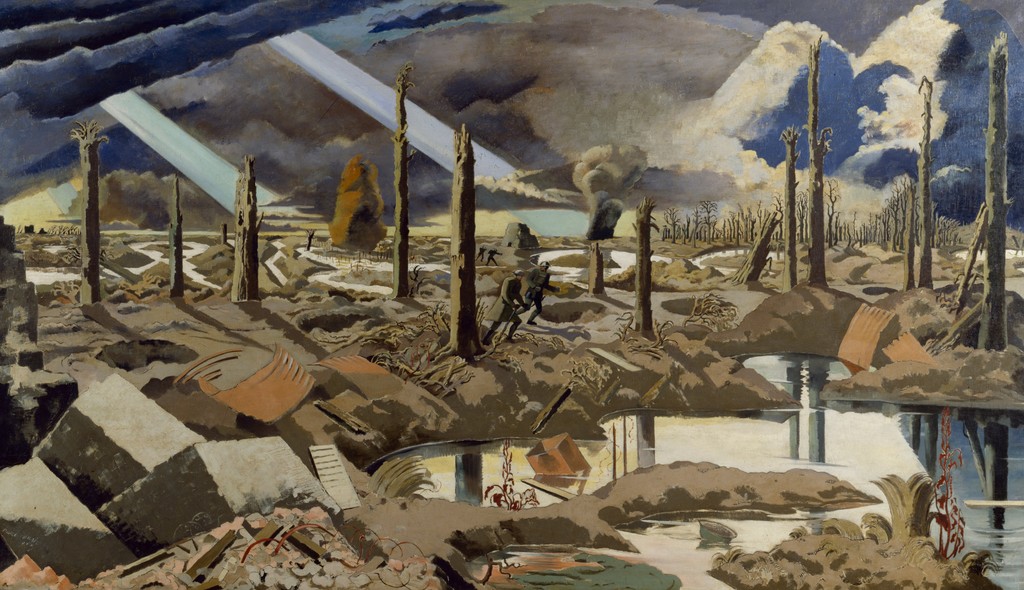
The Menin Road
1918–19 · A vast Hall of Remembrance commission in which the route seems to trap its travellers.
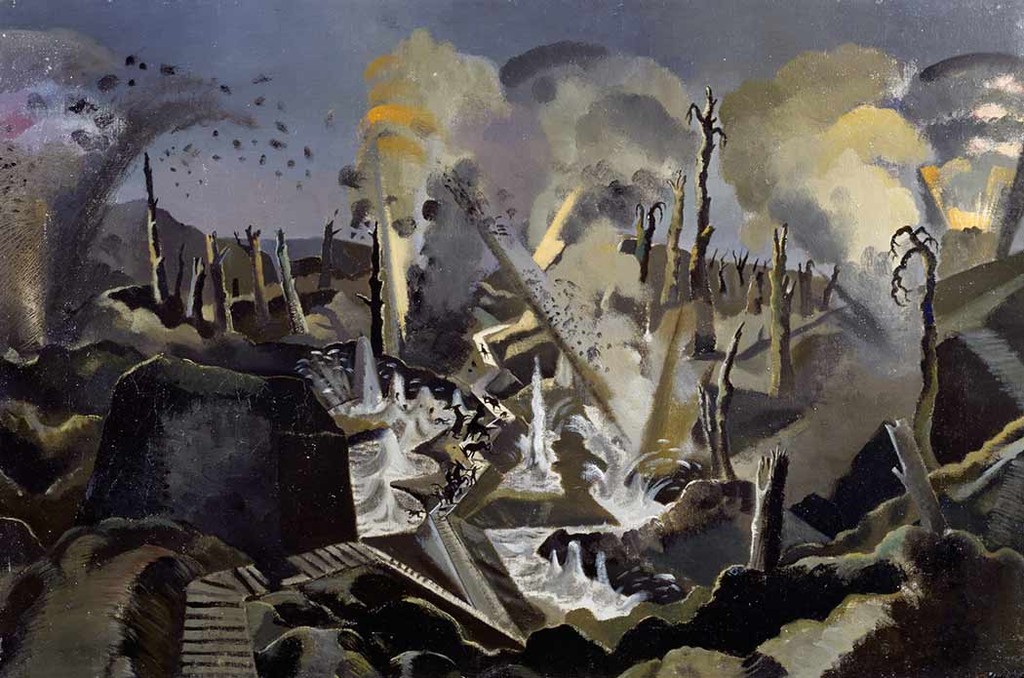
The Mule Track
1918 · Men and animals move through a landscape broken by bombardment.
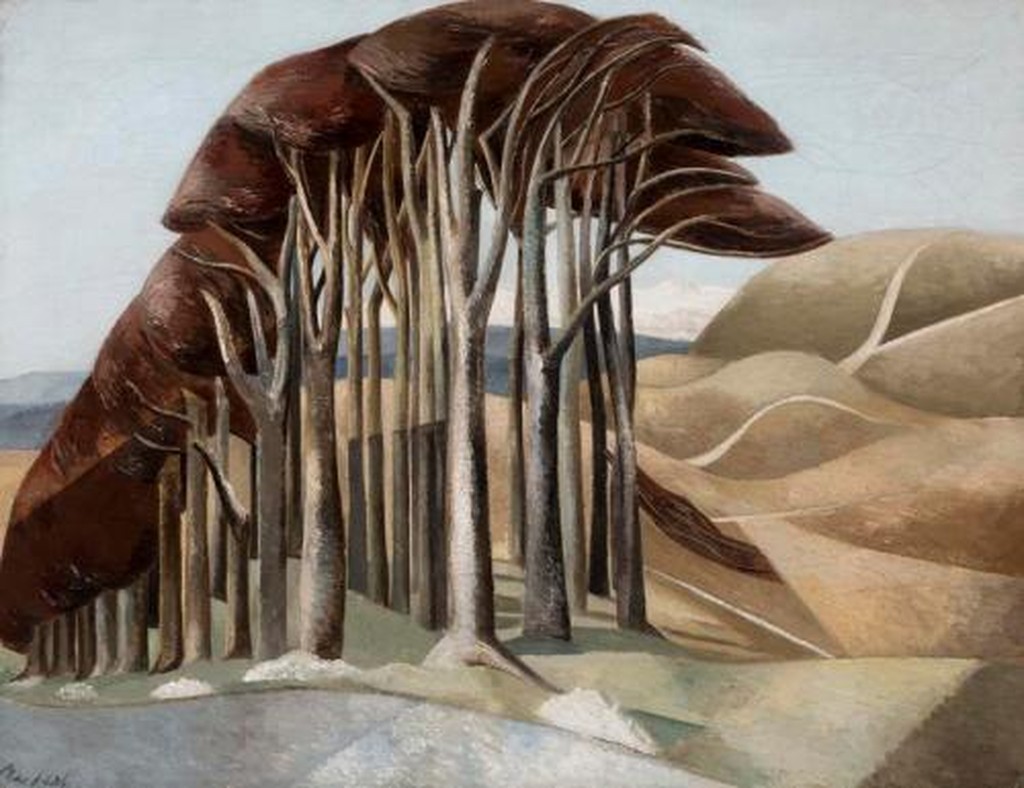
Wood on the Downs
1929 · A wood and rolling ground become interlocking organic and geometrical forms.
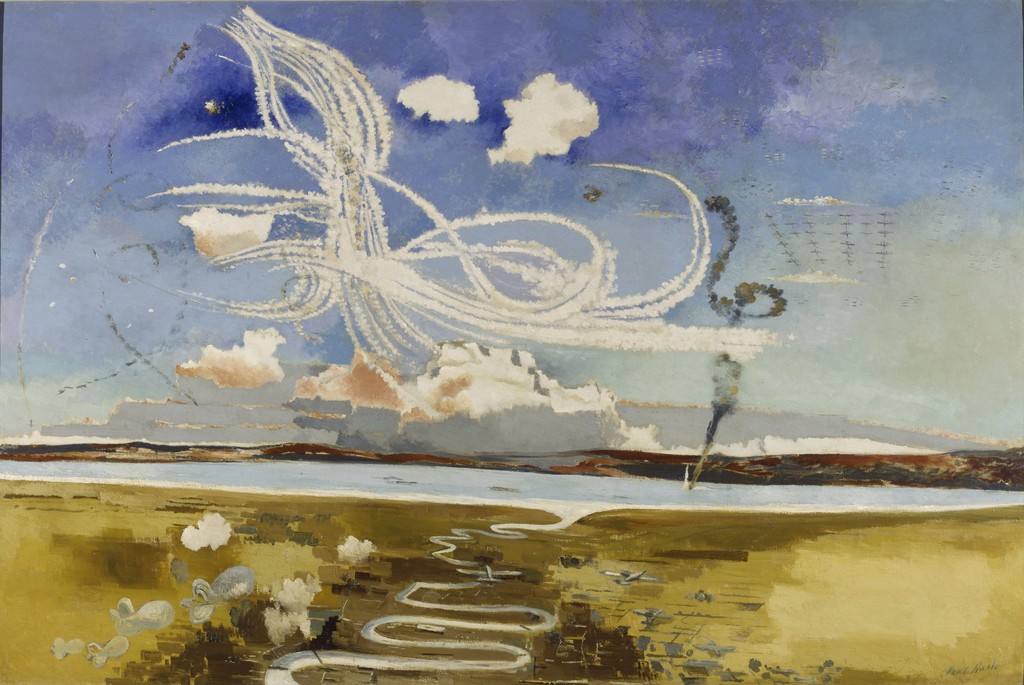
Battle of Britain
1941 · An imagined aerial panorama turns aircraft trails into a vast pattern across sea and sky.
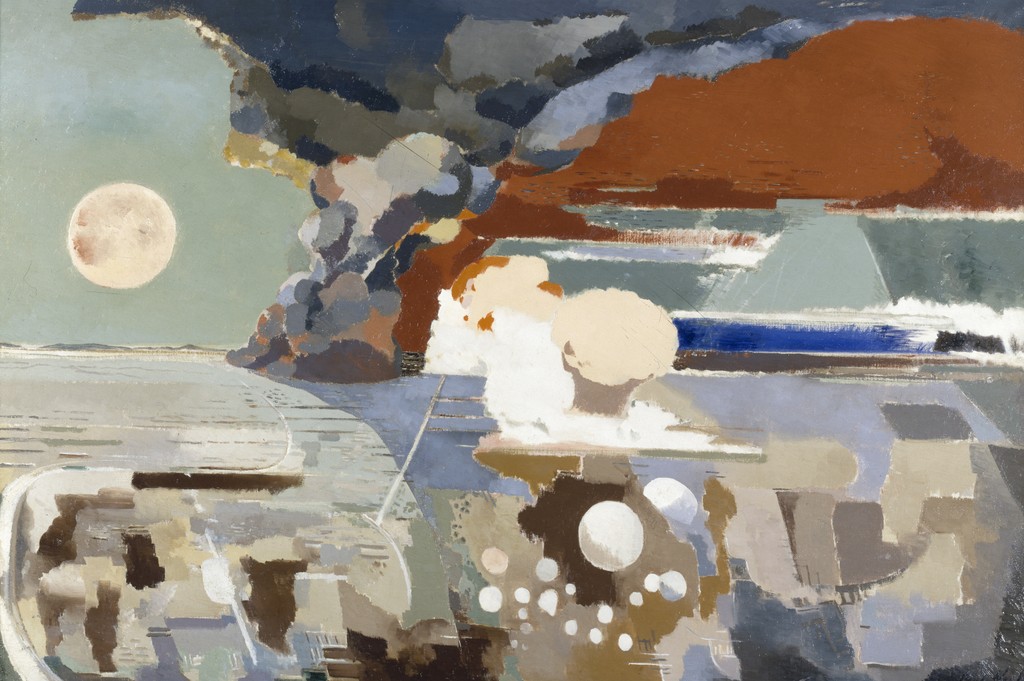
Battle of Germany
1944 · Moonlit stillness and chromatic bombardment divide a late wartime canvas.
About this directory: These 129 entries form a reproducible researched online works census assembled from current public records. It is not a catalogue raisonné and does not claim absolute completeness.
Artworks directory
| Name | Date | Medium |
|---|---|---|
| A Christmas Card to Arthur and Madeline Clifton, 1926 | 1926 | |
| A German Double Pill Box | 1918 | |
| A Howitzer Firing | 1914 | Painting |
| A Night Bombardment | 1919 | Painting |
| A Shell Crater | 1918 | Drawing |
| Battle of Britain | 1941 | Painting |
| Battle of Germany | 1944 | Painting |
| Beeches in the Wind by Paul Nash - Paul Nash | 1918 | Artwork |
| Behind the Inn | 1920 | Painting |
| Berkshire Downs | 1922 | Painting |
| Blue House on the Shore | 1930 | Painting |
| Bouquet | Date unknown | Painting |
| Bouquet - Paul Nash | 1927 | Artwork |
| Buckinghamshire Landscape | 1927 | Painting |
| Cactus | 1928 | Painting |
| Chestnut Waters | Date unknown | Painting |
| Circle of the Monoliths | 1937 | Painting |
| Cliffs | Date unknown | Drawing |
| Cloudscape (recto) | 1939 | Painting |
| Composition (Design for Today) | 1934 | Painting |
| Coronilla | 1929 | Painting |
| Cotswold Hills | 1920 | Painting |
| Day Fighter | 1940 | Painting |
| Dead Spring | 1929 | Painting |
| Defence of Albion | 1942 | Painting |
| Design for a bookplate for Kenneth Fitzpatrick Mackenzie | 1909 | Drawing |
| Division of the Light from the Darkness | 1924 | |
| Druid Landscape | 1938 | Painting |
| Dunbarton Lakes | 1910 | Drawing |
| Dymchurch, Kent | Date unknown | Painting |
| Dymchurch Steps | Date unknown | Painting |
| Dymchurch - The Strange Coast | 1920 | |
| Eclipse of the Sunflower | 1945 | Painting |
| Edge of the marsh | 1925 | Painting |
| Equivalents for the Megaliths | 1935 | Painting |
| Event on the Downs | 1934 | Painting |
| Flight of the Magnolia | 1944 | Painting |
| Footballers Prefer Shell | 1935 | Painting |
| Fruits and Vegetables | 1930 | |
| Granary | 1922 | Painting |
| Graveyard in a Ruined Orchard near Vimy | 1917 | Drawing |
| Grotto in the Snow | 1939 | Painting |
| Harbour and Room | 1934 | Painting |
| Iver Heath, Buckinghamshire, Snow | 1927 | Painting |
| Kinetic Feature | 1931 | Painting |
| Landscape | 1926 | Painting |
| Landscape at Iden | 1929 | Painting |
| Landscape Composition (Objects in Relation) | 1934 | Painting |
| Landscape from a Dream | 1937 | Painting |
| Landscape of Bleached Objects | 1934 | Painting |
| Landscape of the Bagley Woods | 1943 | Painting |
| Landscape of the Brown Fungus | 1943 | Painting |
| Landscape of the Malvern Distance | 1943 | Painting |
| Landscape of the Megaliths | 1934 | Painting |
| Landscape of the Moon's First Quarter | 1943 | Painting |
| Landscape of the Moon's Last Phase | 1944 | Painting |
| Landscape of the summer solstice | Date unknown | Painting |
| Landscape of the Vernal Equinox (III) | 1944 | Painting |
| Landscape (verso) | 1939 | Painting |
| Landscape with Megaliths - Paul Nash | 1936 | |
| Landscape - Year of Our Lord, 1917 | 1910 | Drawing |
| Lares | 1929 | Painting |
| March Landscape | 1944 | Painting |
| Men Marching at Night | 1918 | |
| Metamorphosis | 1938 | Painting |
| Michaelmas Landscape | 1943 | Painting |
| Mimosa Wood | 1926 | Painting |
| Mineral Object | 1935 | Painting |
| 'Modern Textiles' (shop sign board) | 1926 | Painting |
| Monument to Fallen Canadians on Vimy Ridge | 1917 | Drawing |
| Nest of the Siren | 1930 | Painting |
| Night Fighter | 1940 | Painting |
| Nocturnal Landscape | 1938 | Painting |
| Northern Adventure | 1929 | Painting |
| Nostalgic Landscape | 1930 | Painting |
| November Moon | 1942 | Painting |
| Oxenbridge Pond | 1927 | Painting |
| Oxford During the War | 1942 | Painting |
| Pillar and Moon | 1937 | Painting |
| Pink Hyacinth | 1921 | Painting |
| Plage | 1928 | Painting |
| Riviera Landscape | 1926 | Painting |
| Riviera Window, Cros-de-Cagnes | 1926 | Painting |
| Sandling Park, Kent | 1924 | Painting |
| Sluice | 1920 | |
| Solstice of the Sunflower | 1945 | Painting |
| Souvenir of Florence | 1929 | Painting |
| Spring in the Trenches, Ridge Wood, 1917 | 1918 | Painting |
| St Pancras Lilies | 1927 | Painting |
| St Pancras, London | 1927 | Painting |
| Still Life I - Paul Nash | 1924 | Artwork |
| Still Life with Bog Cotton | 1927 | Painting |
| Strange Coast | 1920 | |
| Study of Mrs. Nash | 1916 | Drawing |
| Sunflower and sun | 1942 | Painting |
| Sunrise, Inverness Copse | 1918 | Painting |
| Telecommunications | 1934 | Painting |
| The Archer | Date unknown | Painting |
| The Diving Stage | 1928 | Painting |
| The Edge of the Wood | 1919 | Painting |
| The Menin Road | 1919 | Painting |
| The Mule Track | 1918 | Painting |
| The Pond at Souldern | 1926 | Painting |
| The Raider on the Moors | 1940 | |
| The Rye Marshes, East Sussex | 1932 | Painting |
| The Sea | 1923 | Painting |
| The Sea Wall | 1920 | |
| The Shore | 1923 | Painting |
| The Stackyard | 1925 | Painting |
| The Window, Iver Heath | Date unknown | Painting |
| The Ypres Salient at Night | 1918 | Painting |
| Through a Window, Riviera | 1927 | Painting |
| Tide at Dymchurch | 1920 | |
| Token [verso: Tree in a Landscape (unfinished)] | 1929 | Painting |
| Totes Meer (Dead Sea) | 1940 | Painting |
| Vale of the White Blackbird | 1942 | Painting |
| View from a Window, Nice | 1934 | Painting |
| View R | 1940 | Painting |
| Void | 1918 | Painting |
| Voyages of the Moon | 1935 | Painting |
| We Are Making a New World | 1918 | Painting |
| Whiteleaf Cross | 1931 | Painting |
| Winter, Hampden | Date unknown | |
| Winter Sea | 1931 | Painting |
| Wittenham Clumps | 1943 | Painting |
| Wood on the Downs | 1929 | Painting |
| Wooded Landscape | 1942 | Painting |
| Worth Matravers, Dorset | 1936 | Drawing |
| Wounded, Passchendaele | Date unknown | Painting |
Frequently Asked Questions
Nash is especially known for First World War landscapes such as We Are Making a New World and The Menin Road, and for Second World War paintings including Totes Meer and Battle of Britain. His wider importance also rests on interwar landscape, modernism, photography, printmaking and design.
Nash participated in British Surrealist exhibitions and used found objects, dreamlike conjunctions and altered scale. He was not exclusively a Surrealist, however. Unit One, abstraction, landscape tradition and close observation all contributed to his visual language.[3][11]
Landscape was central before his wartime service and gave him a way to join observation with memory, history and hidden structure. Ancient sites such as Avebury added archaeology, geology and deep time to that inquiry.[9][10]
No. Nash served in the British Army during the First World War and later returned to France as an official artist. During the Second World War he worked under official commissions rather than as a combatant, and he did not fly while developing his aerial battle imagery.[1][16]
Discussion
What should readers notice when looking closely at Paul Nash?
Reader Insights
Trace how trees, stones, aircraft and coastlines change when Nash repeats them.
Keep war art, landscape, photography and design in one career rather than separate boxes.
Which recurring object best connects Nash’s early and late work?
Join the Conversation
Share your reading below, keeping observations specific and evidence clear.
References
- Paul Nash fonds TGA 769 — Tate Archive, accessed 31 August 2026.
- Paul Nash portrait biography — National Portrait Gallery, accessed 31 August 2026.
- Paul Nash artist record — British Council Collection, accessed 31 August 2026.
- We Are Making a New World, ART 1146 — Imperial War Museums, accessed 31 August 2026.
- The Menin Road, ART 2242 — Imperial War Museums, accessed 31 August 2026.
- The Menin Road memorial record — Imperial War Museums, accessed 31 August 2026.
- The Mule Track, ART 1153 — Imperial War Museums, accessed 31 August 2026.
- Paul Nash chronology — Oxfordshire Blue Plaques Board, accessed 31 August 2026.
- Landscape of the Megaliths — British Council Collection, accessed 31 August 2026.
- Paul Nash’s Geological Enigma — British Art Studies, accessed 31 August 2026.
- Paul Nash person record — National Portrait Gallery, accessed 31 August 2026.
- Negatives of 1,267 photographs taken by Paul Nash — Tate Archive, accessed 31 August 2026.
- Paul Nash and the Art of the Book — Victoria and Albert Museum, accessed 31 August 2026.
- Totes Meer (Dead Sea), N05717 — Tate, accessed 31 August 2026.
- Battle of Britain, ART LD 1550 — Imperial War Museums, accessed 31 August 2026.
- Visions of War Above and Below — Imperial War Museums, accessed 31 August 2026.
- Battle of Germany, ART LD 4526 — Imperial War Museums, accessed 31 August 2026.
- Eclipse of the Sunflower — British Council Collection, accessed 31 August 2026.
- Paul Nash national holdings — Art UK, accessed 31 August 2026.