 by Tom Gurney
Tom Gurney BSc (Hons) is an art history expert with over 20 years experience
Page Created on August 31, 2026 / Page Updated on November 6, 2026
Email: tomgurney1@gmail.com / Phone: +44 7429 011000
The Menin Road: Introduction
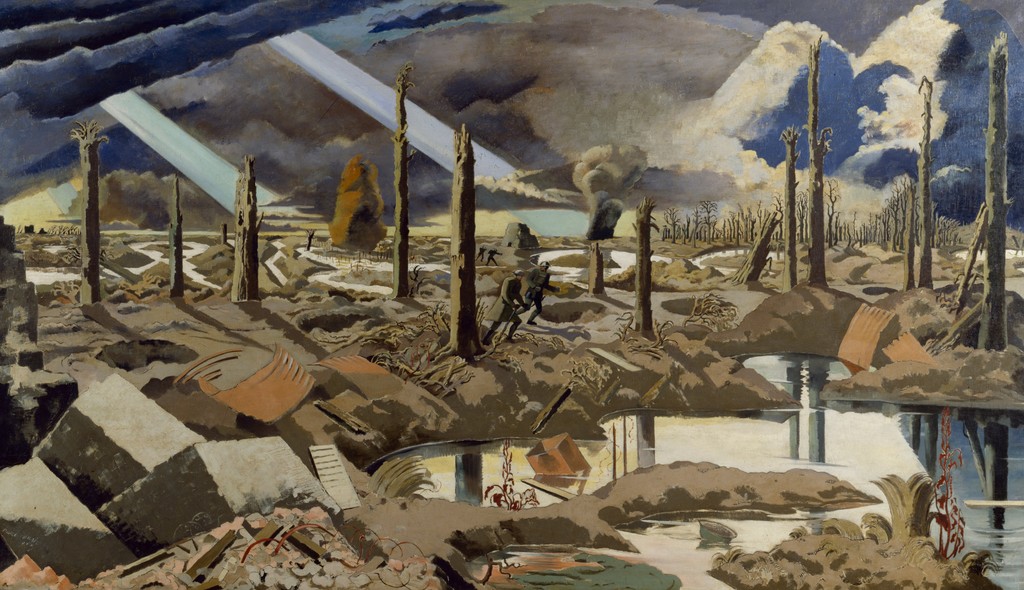
Paul Nash’s The Menin Road turns a route through the Ypres Salient into a monumental image of obstruction. Two soldiers advance among water-filled craters, severed trees, mud and broken materials, but the road offers no dependable way out. At 3.175 metres wide, the painting surrounds a small human action with a landscape whose structure has been violently remade.[1]
Commissioned for a memorial hall that was never built, the canvas joins modernist simplification to the scale of European history painting. Its flat planes and hard lines impose visual order, yet that order does not repair the battlefield. It makes the destruction legible.
At a Glance
- ArtistPaul Nash (1889–1946).
- Date1918–19; Imperial War Museums catalogues the work as 1919.
- MediumOil on canvas.
- Dimensions1,828 × 3,175 mm at the support.
- CollectionImperial War Museums, London; ART 2242.
- CommissionMinistry of Information, April 1918, for the proposed Hall of Remembrance.[1][2]
Paul Nash in context
Contents
- From Field Experience to a Major Commission
- The Hall of Remembrance That Was Never Built
- Gheluvelt, Tower Hamlets and a Named Battlefield
- Two Soldiers and a Road That Fails
- Water, Mud, Poles, Beams and Broken Trees
- Monumental Scale and the Viewer’s Position
- Uccello’s Battle of San Romano as a Model
- A Modern Memorial through Landscape
From Field Experience to a Major Commission
Nash knew the Ypres landscape first through military service and then through his return as an official war artist. Tate Archive traces that transition from the front-line drawings shown in London in 1917 to commissioned work made from his renewed observation of France.[3] The distinction matters: The Menin Road is grounded in places and conditions he had encountered, but it is a large studio painting rather than a document completed in front of the scene.
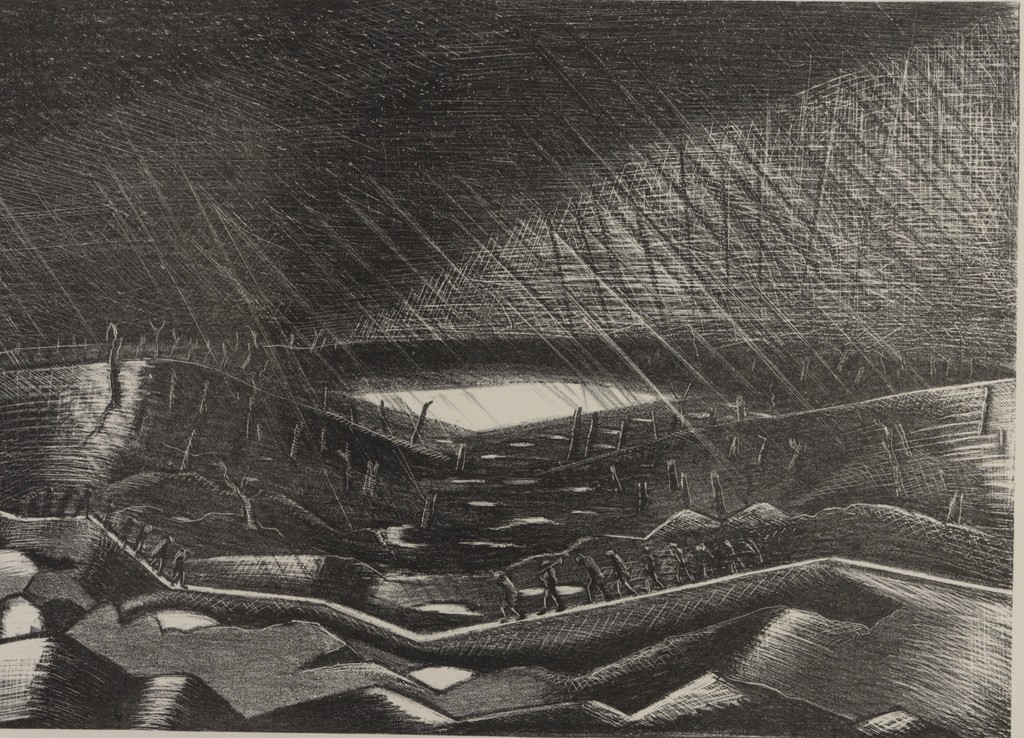
The British Council’s German Double Pill Box, Gheluvelt shows how Nash had already compressed this district into emphatic lithographic forms. Its institutional record highlights shell holes, shell bursts, sharply angled causeways, damaged trees and resistant masonry as components of his selective wartime vocabulary.[4] Those motifs reappear on a far larger and more complex field in The Menin Road.
The Ministry of Information awarded the commission in April 1918. Its first intended title was A Flanders Battlefield. Nash began the canvas in June and continued until February 1919, crossing the Armistice rather than ending with it.[1][2] The date 1918–19 describes that working history; the museum’s object record gives the production date as 1919.
The Hall of Remembrance That Was Never Built
The painting was intended for a projected Hall of Remembrance overseen through the British War Memorials Committee. The scheme would have assembled large works on fighting, the home front, war at sea and war in the air. Its advisers looked backwards as well as forwards: modern British artists were to work within a tradition of ambitious European public commissions.[2]
Heroism and sacrifice were stated ideals for both the art and its architectural setting. Yet the hall did not materialise. The Menin Road entered the Imperial War Museum instead, where the painting survived without the building that was meant to organise its meaning.[2] That history leaves a productive tension. The canvas belongs to an official commemorative programme, but its principal subject is not victory, command or ceremonial unity. It is a damaged environment through which two ordinary figures struggle to move.
IWM’s Truth and Memory material places the Hall among early attempts to turn wartime experience into collective remembrance.[6] Nash’s contribution answers that purpose by preserving neither a parade nor a decisive instant. It gives duration to the state of the ground.
Gheluvelt, Tower Hamlets and a Named Battlefield
Nash located the scene near Gheluvelt, in the area known to British forces as Tower Hamlets. IWM associates the object with Gheluvelt, Tower Hamlets Ridge and the Menin Road in the Ypres Salient.[1] These names prevent the picture from becoming an unspecified vision of devastation.
The title refers to the important route running east from Ypres towards the front. A road ordinarily promises connection and direction. Here, its line has been interrupted by artillery damage, flooding and churned earth. The route survives just strongly enough to be followed, but not strongly enough to provide confidence.
Gheluvelt also links the monumental oil to Nash’s earlier work on paper. The 1918 lithograph of the German pill box preserves a particular fortification within the same broader locality.[4] Different media serve different purposes: the lithograph isolates a hard military object, while the later canvas spreads the consequences of bombardment across an entire visual field.
Two Soldiers and a Road That Fails
The two soldiers stand near the centre, leaning forward as they pick their way between tree trunks. They are visible, but they do not control the composition. Their scale is small beside the canvas, and their movement is hesitant beside the broad lateral sweep of ground and sky.[1]
The road does not form a clear corridor towards safety. It divides, disappears behind stumps and mounds, and is repeatedly confused with pale water and mud. The eye tries to extend its course into depth, only to encounter another crater, obstruction or abrupt change of direction. Nash converts the basic device of perspective—a path narrowing towards the distance—into an unreliable promise.
This trapped movement distinguishes the painting from a static emblem. The figures introduce time: they have arrived from somewhere and must continue. But the terrain gives no assurance that progress is possible. Human vulnerability is conveyed through the effort of crossing rather than through a close view of injury.
Water, Mud, Poles, Beams and Broken Trees
The foreground is crowded with concrete blocks, corrugated iron, wire, splintered boards and flooded cavities. Mud forms irregular banks around reflective water. Farther back, artillery throws up vertical columns, while smoke marks impacts across the horizon.[1]
Broken trees repeat from front to distance like damaged poles. Some stand rigidly upright; others lean or end in torn points. Their rhythm gives the wide scene a rough internal measure, but no stable avenue. Pale beams descend diagonally from the dark sky, cutting across the verticals and the largely horizontal spread of land. IWM describes these shafts as uncanny light; within the picture they can also resemble gigantic structural members or projected weapons.[1]
Nash keeps these materials recognisable while simplifying them into hard-edged shapes. Water becomes a sequence of light planes, mud a set of brown-grey masses, and sheets of debris curved or angled blocks. The result is not decorative abstraction. Each formal decision clarifies how war has altered the behaviour of the landscape.
Monumental Scale and the Viewer’s Position
The support measures 1,828 × 3,175 mm, or six feet by ten feet five inches.[1][2] That breadth matters because the battlefield cannot be absorbed in one quick glance. The viewer must scan from the piled wreckage at the lower edge through the soldiers and trunks to explosions and cloud.
Near-life-size verticals confront the body, while the two painted figures recede into the middle distance. This change of scale places viewers imaginatively at the margin of the devastated ground rather than above it. The panorama supplies breadth without offering mastery.
The IWM gallery guide notes that the dimensions evoke historic painting while the image remains modernist through strong lines and flat colour planes.[5] Monumentality therefore has two effects at once: it honours the seriousness expected of a memorial commission and makes the physical extent of destruction difficult to evade.
Uccello’s Battle of San Romano as a Model
The Hall’s large canvases were planned around the dimensions of Paolo Uccello’s The Battle of San Romano in the National Gallery. Uccello’s panel is 182 × 320 cm, almost the same imposing rectangle as Nash’s work.[2][7] The relationship begins with format and the established prestige of a Renaissance battle painting, not with a claim that Nash copied its scene.
There is nevertheless a revealing formal comparison. In Uccello’s cavalry battle, broken lances create a grid that explores linear perspective and imposes a pattern upon confusion. The National Gallery describes a courtly, triumphal construction centred on the Florentine commander Niccolò da Tolentino.[7] Weapons, horses and armour form a brilliant pageant of organised combat.
Nash also uses repeated uprights and forceful diagonals, but his order produces a different historical meaning. Tree stumps replace lances, beams cross an empty sky, and two trudging soldiers replace the commanding horseman. Where Uccello’s grid supports civic victory, Nash’s broken route exposes the damage left by industrial war. The comparison is strongest when both continuity and reversal remain visible.
A Modern Memorial through Landscape
IWM’s description of The Menin Road stresses both the apocalyptic weather and the devastated ground.[1] The gallery guide adds the language of modernist line and plane.[5] Visible evidence supports both accounts: the picture is recognisably a battlefield, but its meaning is carried by the controlled collision of vertical trunks, diagonal light, shallow colour zones and interrupted recession.
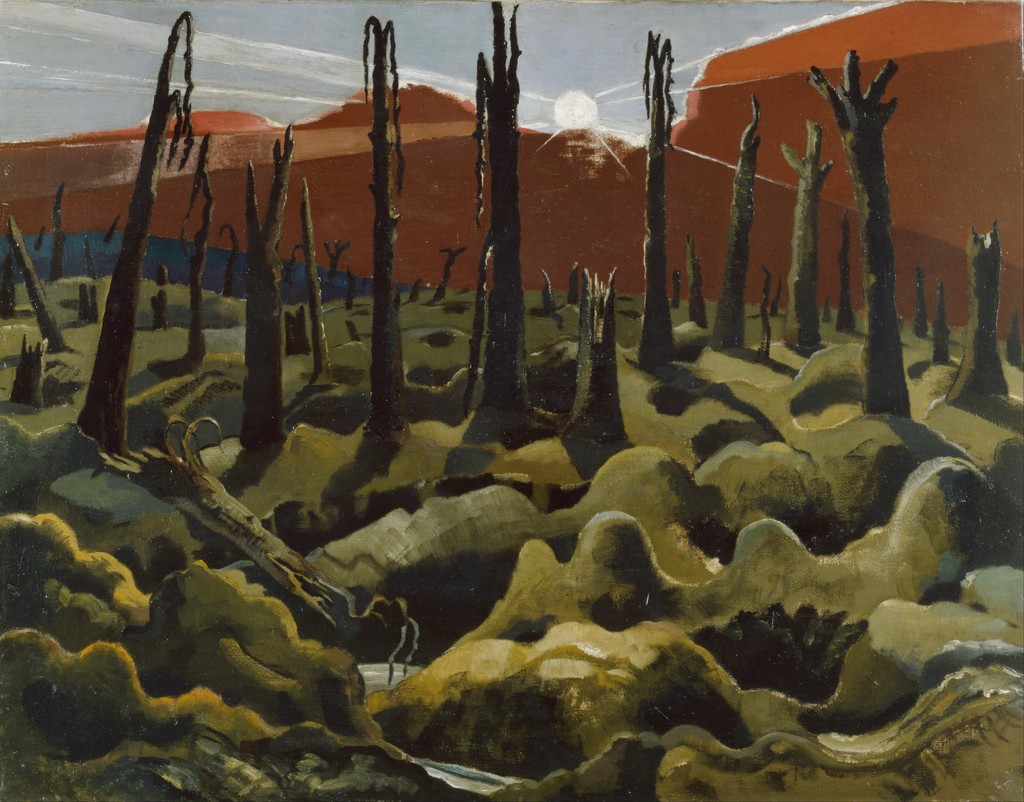
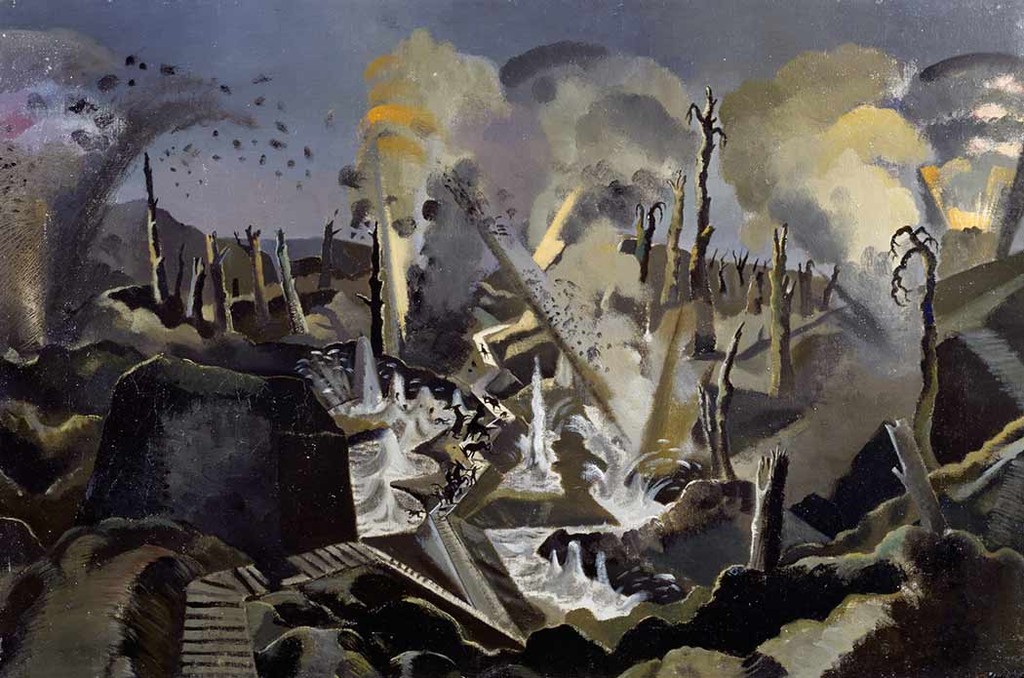
Within Nash’s First World War art, the work occupies a distinct position. We Are Making a New World condenses ruined terrain into a frontal, bitter emblem. The Mule Track places a convoy inside the immediate force of shellfire. The Menin Road gives the viewer a wider, slower ordeal of attempted passage. The paintings overview sets these different spatial solutions within his larger practice.
The memorial purpose does not require a heroic protagonist. Here, damaged landscape and place carry the burden of remembrance. The commission sought public commemoration; Nash supplied an environment in which survival is measured by two people still moving through what war has made.
About this directory: These 129 entries form a reproducible researched online works census assembled from current public records. It is not a catalogue raisonné and does not claim absolute completeness.
Artworks directory
| Name | Date | Medium |
|---|---|---|
| A Christmas Card to Arthur and Madeline Clifton, 1926 | 1926 | |
| A German Double Pill Box | 1918 | |
| A Howitzer Firing | 1914 | Painting |
| A Night Bombardment | 1919 | Painting |
| A Shell Crater | 1918 | Drawing |
| Battle of Britain | 1941 | Painting |
| Battle of Germany | 1944 | Painting |
| Beeches in the Wind by Paul Nash - Paul Nash | 1918 | Artwork |
| Behind the Inn | 1920 | Painting |
| Berkshire Downs | 1922 | Painting |
| Blue House on the Shore | 1930 | Painting |
| Bouquet | Date unknown | Painting |
| Bouquet - Paul Nash | 1927 | Artwork |
| Buckinghamshire Landscape | 1927 | Painting |
| Cactus | 1928 | Painting |
| Chestnut Waters | Date unknown | Painting |
| Circle of the Monoliths | 1937 | Painting |
| Cliffs | Date unknown | Drawing |
| Cloudscape (recto) | 1939 | Painting |
| Composition (Design for Today) | 1934 | Painting |
| Coronilla | 1929 | Painting |
| Cotswold Hills | 1920 | Painting |
| Day Fighter | 1940 | Painting |
| Dead Spring | 1929 | Painting |
| Defence of Albion | 1942 | Painting |
| Design for a bookplate for Kenneth Fitzpatrick Mackenzie | 1909 | Drawing |
| Division of the Light from the Darkness | 1924 | |
| Druid Landscape | 1938 | Painting |
| Dunbarton Lakes | 1910 | Drawing |
| Dymchurch, Kent | Date unknown | Painting |
| Dymchurch Steps | Date unknown | Painting |
| Dymchurch - The Strange Coast | 1920 | |
| Eclipse of the Sunflower | 1945 | Painting |
| Edge of the marsh | 1925 | Painting |
| Equivalents for the Megaliths | 1935 | Painting |
| Event on the Downs | 1934 | Painting |
| Flight of the Magnolia | 1944 | Painting |
| Footballers Prefer Shell | 1935 | Painting |
| Fruits and Vegetables | 1930 | |
| Granary | 1922 | Painting |
| Graveyard in a Ruined Orchard near Vimy | 1917 | Drawing |
| Grotto in the Snow | 1939 | Painting |
| Harbour and Room | 1934 | Painting |
| Iver Heath, Buckinghamshire, Snow | 1927 | Painting |
| Kinetic Feature | 1931 | Painting |
| Landscape | 1926 | Painting |
| Landscape at Iden | 1929 | Painting |
| Landscape Composition (Objects in Relation) | 1934 | Painting |
| Landscape from a Dream | 1937 | Painting |
| Landscape of Bleached Objects | 1934 | Painting |
| Landscape of the Bagley Woods | 1943 | Painting |
| Landscape of the Brown Fungus | 1943 | Painting |
| Landscape of the Malvern Distance | 1943 | Painting |
| Landscape of the Megaliths | 1934 | Painting |
| Landscape of the Moon's First Quarter | 1943 | Painting |
| Landscape of the Moon's Last Phase | 1944 | Painting |
| Landscape of the summer solstice | Date unknown | Painting |
| Landscape of the Vernal Equinox (III) | 1944 | Painting |
| Landscape (verso) | 1939 | Painting |
| Landscape with Megaliths - Paul Nash | 1936 | |
| Landscape - Year of Our Lord, 1917 | 1910 | Drawing |
| Lares | 1929 | Painting |
| March Landscape | 1944 | Painting |
| Men Marching at Night | 1918 | |
| Metamorphosis | 1938 | Painting |
| Michaelmas Landscape | 1943 | Painting |
| Mimosa Wood | 1926 | Painting |
| Mineral Object | 1935 | Painting |
| 'Modern Textiles' (shop sign board) | 1926 | Painting |
| Monument to Fallen Canadians on Vimy Ridge | 1917 | Drawing |
| Nest of the Siren | 1930 | Painting |
| Night Fighter | 1940 | Painting |
| Nocturnal Landscape | 1938 | Painting |
| Northern Adventure | 1929 | Painting |
| Nostalgic Landscape | 1930 | Painting |
| November Moon | 1942 | Painting |
| Oxenbridge Pond | 1927 | Painting |
| Oxford During the War | 1942 | Painting |
| Pillar and Moon | 1937 | Painting |
| Pink Hyacinth | 1921 | Painting |
| Plage | 1928 | Painting |
| Riviera Landscape | 1926 | Painting |
| Riviera Window, Cros-de-Cagnes | 1926 | Painting |
| Sandling Park, Kent | 1924 | Painting |
| Sluice | 1920 | |
| Solstice of the Sunflower | 1945 | Painting |
| Souvenir of Florence | 1929 | Painting |
| Spring in the Trenches, Ridge Wood, 1917 | 1918 | Painting |
| St Pancras Lilies | 1927 | Painting |
| St Pancras, London | 1927 | Painting |
| Still Life I - Paul Nash | 1924 | Artwork |
| Still Life with Bog Cotton | 1927 | Painting |
| Strange Coast | 1920 | |
| Study of Mrs. Nash | 1916 | Drawing |
| Sunflower and sun | 1942 | Painting |
| Sunrise, Inverness Copse | 1918 | Painting |
| Telecommunications | 1934 | Painting |
| The Archer | Date unknown | Painting |
| The Diving Stage | 1928 | Painting |
| The Edge of the Wood | 1919 | Painting |
| The Menin Road | 1919 | Painting |
| The Mule Track | 1918 | Painting |
| The Pond at Souldern | 1926 | Painting |
| The Raider on the Moors | 1940 | |
| The Rye Marshes, East Sussex | 1932 | Painting |
| The Sea | 1923 | Painting |
| The Sea Wall | 1920 | |
| The Shore | 1923 | Painting |
| The Stackyard | 1925 | Painting |
| The Window, Iver Heath | Date unknown | Painting |
| The Ypres Salient at Night | 1918 | Painting |
| Through a Window, Riviera | 1927 | Painting |
| Tide at Dymchurch | 1920 | |
| Token [verso: Tree in a Landscape (unfinished)] | 1929 | Painting |
| Totes Meer (Dead Sea) | 1940 | Painting |
| Vale of the White Blackbird | 1942 | Painting |
| View from a Window, Nice | 1934 | Painting |
| View R | 1940 | Painting |
| Void | 1918 | Painting |
| Voyages of the Moon | 1935 | Painting |
| We Are Making a New World | 1918 | Painting |
| Whiteleaf Cross | 1931 | Painting |
| Winter, Hampden | Date unknown | |
| Winter Sea | 1931 | Painting |
| Wittenham Clumps | 1943 | Painting |
| Wood on the Downs | 1929 | Painting |
| Wooded Landscape | 1942 | Painting |
| Worth Matravers, Dorset | 1936 | Drawing |
| Wounded, Passchendaele | Date unknown | Painting |
Frequently Asked Questions
Nash identified a tract near Gheluvelt in the Tower Hamlets area of the Ypres Salient, Belgium. IWM also associates the work with Tower Hamlets Ridge and the Menin Road itself.[1][2]
The principal human figures are two soldiers negotiating the damaged road. They are not identified portraits or victorious commanders. Their small scale and difficult progress establish a human measure for the surrounding destruction.[1]
The canvas support is 1,828 mm high and 3,175 mm wide—approximately six feet by ten feet five inches. Its dimensions were suited to the Hall of Remembrance’s ambition for monumental commemorative paintings.[1][2]
The Hall’s canvases took their size from Uccello’s Battle of San Romano. Both works also use lines to organise crowded battle imagery, but Nash replaces Uccello’s cavalry pageant and commanding hero with broken trees, flooded ground and two struggling soldiers.[2][7]
Discussion
What should readers notice when looking closely at The Menin Road?
Reader Insights
Follow the road, poles and shafts of light and note where each route is blocked.
Read the monumental commission beside both battlefield evidence and Uccello’s ordered battle space.
What makes this road feel less like passage than enclosure?
Join the Conversation
Share your reading below, keeping observations specific and evidence clear.
References
- The Menin Road, ART 2242 — Imperial War Museums, accessed 31 August 2026.
- The Menin Road memorial record — Imperial War Museums, accessed 31 August 2026.
- Paul Nash fonds TGA 769 — Tate Archive, accessed 31 August 2026.
- German Double Pill Box, Gheluvelt — British Council, accessed 31 August 2026.
- Blavatnik Art, Film and Photography Galleries large-print guide — Imperial War Museums, accessed 31 August 2026.
- Truth and Memory: First World War art material — Imperial War Museums, accessed 31 August 2026.
- The Battle of San Romano — National Gallery, accessed 31 August 2026.