 by Tom Gurney
Tom Gurney BSc (Hons) is an art history expert with over 20 years experience
Page Created on August 31, 2026 / Page Updated on November 6, 2026
Email: tomgurney1@gmail.com / Phone: +44 7429 011000
Paul Nash: First World War Art: Introduction
Paul Nash's First World War art began with direct observation but did not end there. He served near Ypres, drew the damaged terrain around him, returned to Britain after an accidental injury and later went back to the Western Front as an official war artist. The resulting drawings, lithographs and paintings transformed particular places into forceful images of industrialised war. They are central to his career, yet they also belong within the longer biography of an artist who repeatedly found meaning in landscape.[1][2]
At a Glance
- Service datesArtists Rifles from September 1914; Hampshire Regiment commission in 1916; service near Ypres in 1917
- Wartime roleSoldier and infantry officer who recorded the battlefield through landscape
- Principal mediaPencil, ink, watercolour, lithography and oil painting
- Official appointmentReturned to the Western Front later in 1917 as an official war artist
- Signature landscapesBlasted trees, flooded ground, broken roads, trenches and shell craters
- Key worksWe Are Making a New World, The Mule Track and The Menin Road
Contents
- From the Artists Rifles to Ypres
- Accident, Recovery and the Goupil Exhibition
- Drawing, Lithography and the Work of Translation
- When the Battlefield Becomes the Subject
- We Are Making a New World: Dawn without Renewal
- The Mule Track: Movement under Fire
- The Menin Road and the Hall of Remembrance
- After the Armistice
From the Artists Rifles to Ypres
Nash enlisted in the Artists Rifles in September 1914. The unit drew many recruits from artistic and professional circles, but its cultural associations did not remove the routines or obligations of military life. In 1916 he received a commission in the Hampshire Regiment, and in 1917 he went to the Western Front near Ypres.[1]
This chronology matters because Nash was neither a detached visitor nor simply an illustrator sent to record a campaign. He encountered the front first as a serving officer. At the same time, his surviving work should not be treated as a complete account of infantry experience. One individual's drawings cannot stand for every soldier, unit or phase of the war. What Nash brought to the subject was a landscape artist's close attention to ground, weather, trees and distance. Those elements became his means of registering what mechanised conflict had done to a place.
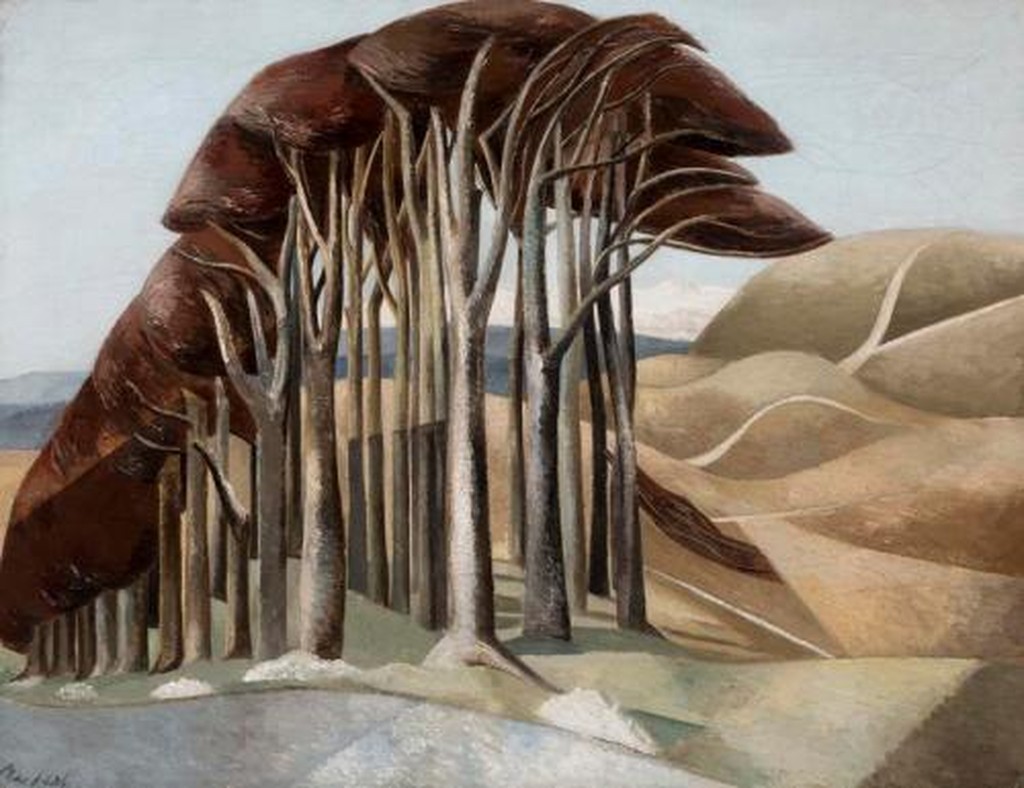
The war therefore intensified an existing concern rather than creating it from nothing. Before 1914, Nash had already been drawn to places that seemed charged with presence. The Western Front confronted him with a radically altered version of that problem: land reorganised by trenches, transport, artillery and ruin. His wartime pictures are most revealing when viewed alongside his broader exploration of landscape and place, not as an isolated episode.[2]
Accident, Recovery and the Goupil Exhibition
Nash's first period near Ypres was short. An accidental injury, recorded in the archive as a broken rib received in the trenches, led to his return to Britain. It was not an enemy-inflicted wound. While recovering, he developed drawings based on what he had seen, and a selection was exhibited at the Goupil Gallery in London in June 1917.[1]
That exhibition was a decisive bridge between service and official employment. The drawings established that Nash could communicate the front through sharply observed landscapes rather than conventional scenes of heroic action. Their damaged trees, unstable roads and flooded earth made the environment itself into evidence. Later in 1917, he returned to France in an official capacity, able to gather further material for works intended for a public audience.[1]
The distinction between these stages is important. Some images originated in immediate field observation; major oils were constructed later, away from the front, through selection, enlargement and reorganisation. This does not make the paintings less truthful. It identifies the kind of truth they pursue: not an untouched visual transcript, but a considered arrangement of remembered and recorded facts.
Drawing, Lithography and the Work of Translation
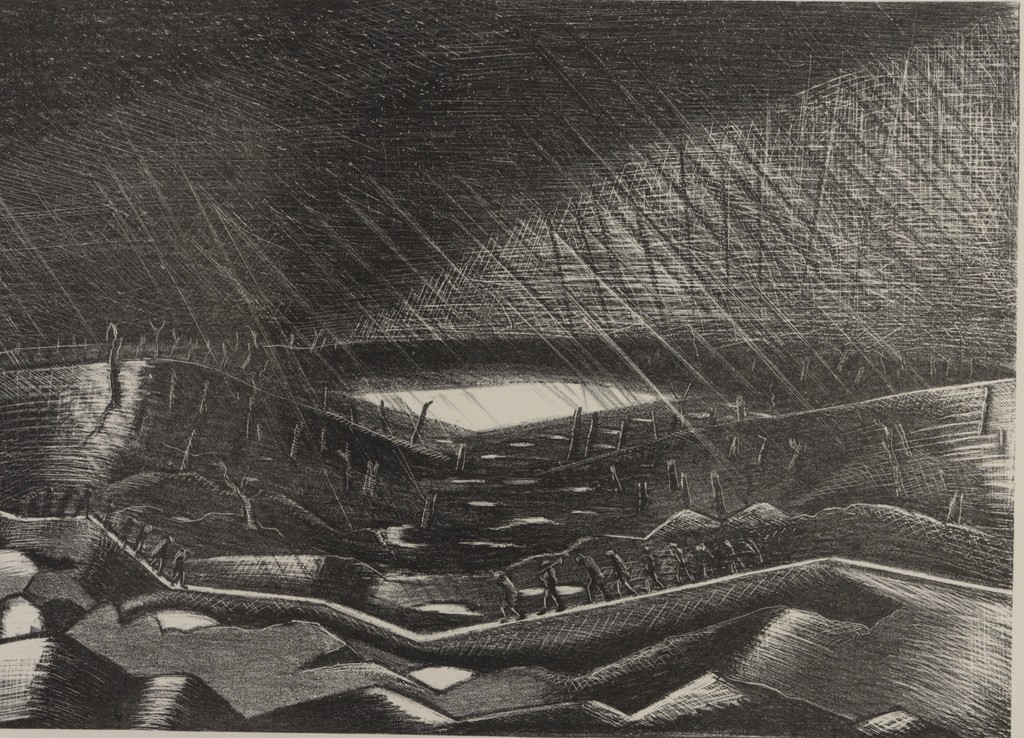
Drawing was the practical foundation of Nash's wartime art. Portable materials allowed him to note the profile of a shattered tree, the angle of a dugout, the spread of water or the way a road disappeared into bombardment. Such records could then be reworked in watercolour, print or oil. The British Council's German Double Pill-Box, Gheluvelt, for example, preserves a named location and military structure within a lithographic image made for circulation beyond the original sheet.[3]
Moving between media changed more than scale. Lithography could simplify tonal masses and make black forms unusually emphatic. Oil allowed Nash to build denser surfaces, stronger colour relationships and larger compositional rhythms. Repetition across formats was therefore not mechanical copying. It was a process of testing how a particular motif could carry knowledge of the front to viewers who had not been there.
This translation also explains why his pictures can appear both specific and strange. Place names, military objects and observed conditions anchor them in history, while compression and pattern prevent them from behaving like neutral reports. Nash retained the authority of witness but used composition to make devastation intelligible.
When the Battlefield Becomes the Subject
Human figures are often small in Nash's First World War work, but human action is everywhere. Roads exist because troops and supplies must move. Trenches cut the ground because armies occupy it. Flooded shell holes record artillery fire; splintered trees register blast; corrugated iron, concrete and wire reveal systems of defence. The apparent emptiness of a landscape is therefore not an absence of history.
Nash repeatedly organised this material through routes and barriers. A track may draw the eye forward only to become obscured. Rows of trees resemble an avenue, yet their trunks are stripped and broken. Pools reflect the sky but also interrupt movement. These visual contradictions turn landscape from backdrop into the principal bearer of experience.
The result is neither straightforward topography nor fantasy. Nash condenses separate observations into structures that a viewer can read: advance and obstruction, distance and enclosure, natural growth and mechanical destruction. His approach helps explain why the wartime works remain connected to later paintings and artworks, even when their subjects and colours change.
We Are Making a New World: Dawn without Renewal
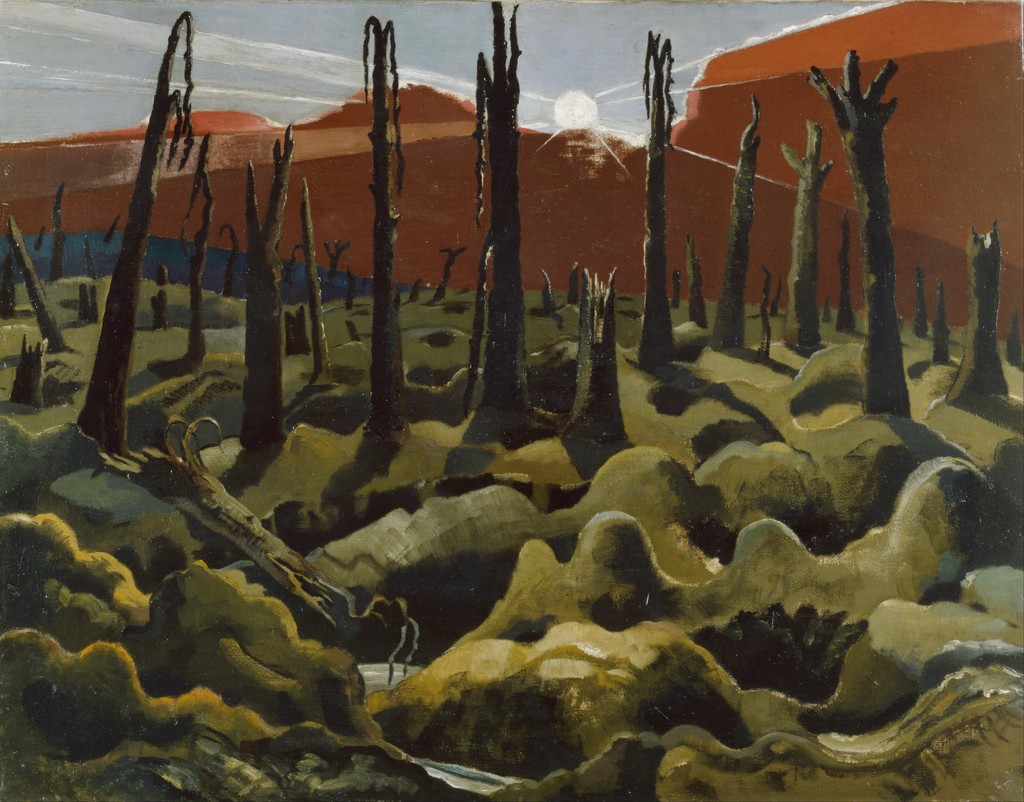
In We Are Making a New World, painted in 1918, a pale sun rises above a field of churned earth and blackened tree trunks. The oil painting measures 711 by 914 millimetres and is catalogued by Imperial War Museums as ART 1146.[4] Its title sounds constructive, but the landscape makes the phrase bitterly unstable. What has been made is a world stripped of shelter, cultivation and ordinary movement.
The composition is severe. Repeated trunks form a dark screen, while ridges of earth lead towards a horizon illuminated by red, orange and cold white. Sunrise traditionally promises renewal; here, light exposes devastation rather than repairing it. The picture's force comes from that unresolved opposition. Beauty has not disappeared, but it has become ethically uncomfortable.[4][5]
No single incident is narrated, and no soldier dominates the scene. Instead, the land bears cumulative damage. Nash turns a familiar landscape convention into an indictment without relying on a theatrical climax. The work asks viewers to confront creation as a destructive human act.
The Mule Track: Movement under Fire
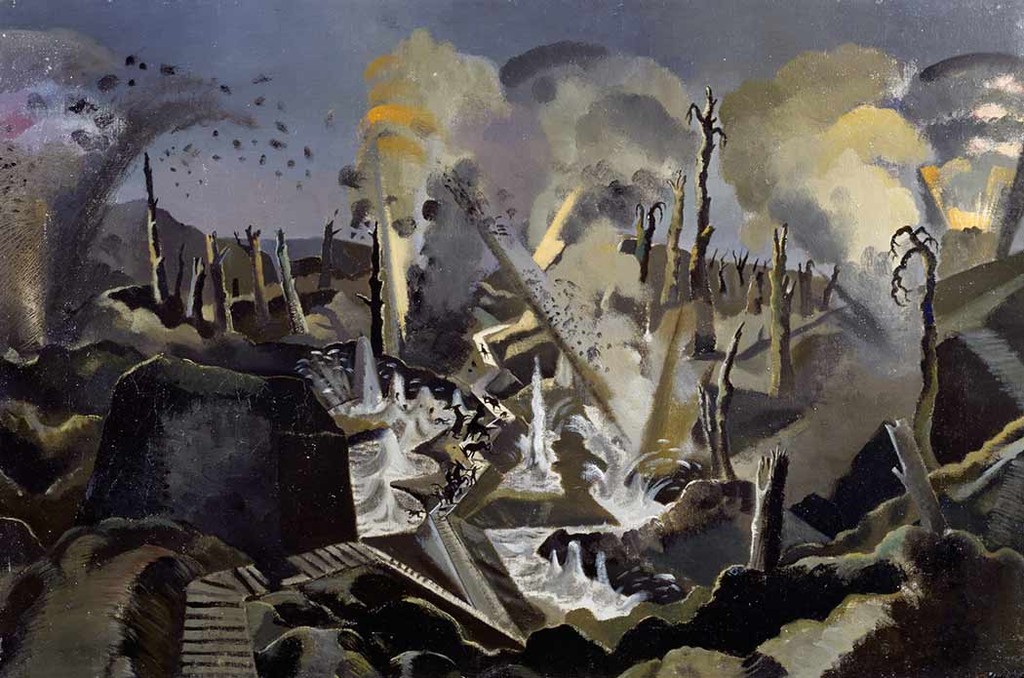
The Mule Track presents a different problem. Painted in 1918, the 609-by-914-millimetre oil is IWM ART 1153.[6] Here the battlefield is not held at the still distance of We Are Making a New World. The route, transport and surrounding debris are compressed into a scene of hazardous movement.
Dark, block-like forms crowd the foreground and middle distance. Broken trees and waterlogged ground fracture the track, while smoke and bursts of shellfire disrupt the sky. The title identifies the military function of the route, yet the convoy is difficult to separate from the environment. Figures and animals are reduced by scale and engulfed by the damaged terrain.[5][6]
That compression conveys vulnerability without turning the mule train into an anecdotal centrepiece. The eye searches for a clear passage and repeatedly loses it among diagonals, smoke and wreckage. Compared with the stark, emblematic stillness of We Are Making a New World, The Mule Track makes danger feel immediate and unstable. The two works share motifs, but they do not make the same argument.
The Menin Road and the Hall of Remembrance
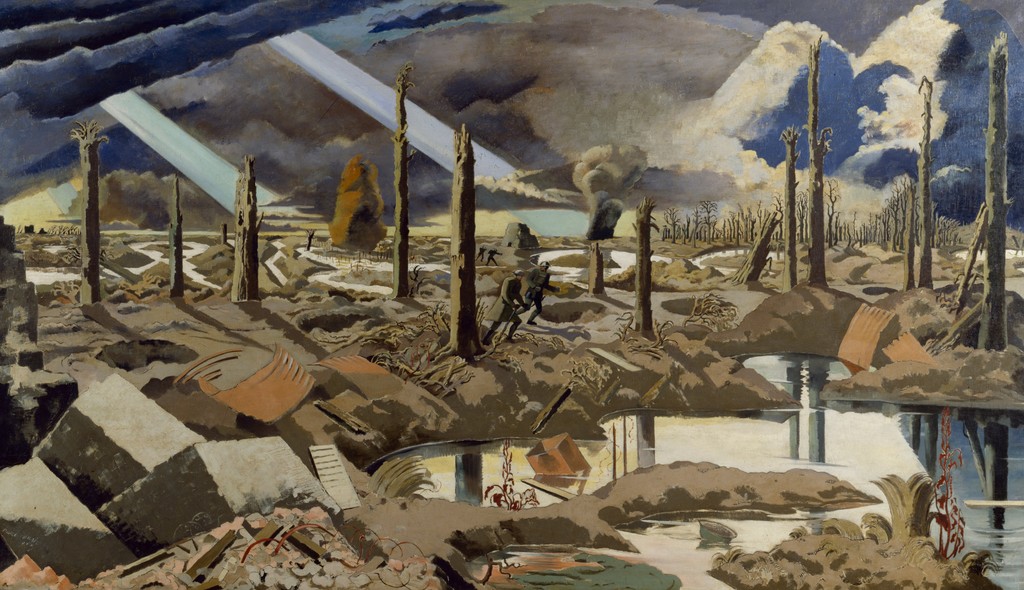
The Menin Road is Nash's largest and most complex First World War painting. Imperial War Museums records it as ART 2242, an oil on canvas of 1828 by 3175 millimetres, made in 1918–19 and catalogued as 1919.[7][8] Across its wide field, flooded shell holes, shattered trees, concrete blocks, corrugated iron and barbed wire obstruct a route towards distant artillery smoke. Two small figures negotiate the foreground, making human scale painfully clear.[7]
The Ministry of Information commissioned the painting in April 1918 for a proposed Hall of Remembrance. Nash worked on it from June 1918 until February 1919, after his official return from the front. The hall was never built, but the commission's ambition survives in the painting's panoramic scale.[7]
Its proportions were connected to Paolo Uccello's The Battle of San Romano. In Uccello's fifteenth-century battle scene, broken lances help impose a perspectival grid upon confusion. Nash borrowed the organising challenge, not the older painting's courtly splendour: his avenues, diagonals and wreckage lead the eye into a battlefield where order continually collapses.[7][9]
This is a studio construction grounded in first-hand evidence. The broad canvas combines observed materials and conditions within a deliberately controlled design. Official commissions required war artists to turn immediate records into durable public objects, and the surviving IWM displays and documentation place The Menin Road within that larger history of British war art.[10] Its monumentality does not glorify a charge. It gives lasting form to a landscape made almost impassable.
After the Armistice
The Armistice did not make Nash's wartime images self-explanatory or close their meanings. They continued to participate in remembrance, museum display and debate about how war should be represented. Studies of Nash's wider conception of landscape place the wartime work within a sustained engagement with land and material change.[11] Scholarship on Paul and his brother John Nash has also considered how artists worked through the conflict's aftermath and how their images entered cultures of commemoration.[12]
It is tempting to read every later bare tree, stone or strange horizon as a direct consequence of wartime experience. That goes beyond what the pictures can prove. A more careful view recognises continuity as well as rupture. Nash remained concerned with the material character and imaginative charge of land, a subject that later studies have explored far beyond the trenches.[2][11] His First World War art changed the terms of that engagement, but it did not define the whole of his career.
The wartime pictures endure because they hold witness and transformation together. Their military details are precise enough to locate them in a historical world, while their formal structures prevent easy consumption. Roads lead nowhere securely, dawn offers no simple redemption and monumental scale records obstruction rather than victory.
About this directory: These 129 entries form a reproducible researched online works census assembled from current public records. It is not a catalogue raisonné and does not claim absolute completeness.
Artworks directory
| Name | Date | Medium |
|---|---|---|
| A Christmas Card to Arthur and Madeline Clifton, 1926 | 1926 | |
| A German Double Pill Box | 1918 | |
| A Howitzer Firing | 1914 | Painting |
| A Night Bombardment | 1919 | Painting |
| A Shell Crater | 1918 | Drawing |
| Battle of Britain | 1941 | Painting |
| Battle of Germany | 1944 | Painting |
| Beeches in the Wind by Paul Nash - Paul Nash | 1918 | Artwork |
| Behind the Inn | 1920 | Painting |
| Berkshire Downs | 1922 | Painting |
| Blue House on the Shore | 1930 | Painting |
| Bouquet | Date unknown | Painting |
| Bouquet - Paul Nash | 1927 | Artwork |
| Buckinghamshire Landscape | 1927 | Painting |
| Cactus | 1928 | Painting |
| Chestnut Waters | Date unknown | Painting |
| Circle of the Monoliths | 1937 | Painting |
| Cliffs | Date unknown | Drawing |
| Cloudscape (recto) | 1939 | Painting |
| Composition (Design for Today) | 1934 | Painting |
| Coronilla | 1929 | Painting |
| Cotswold Hills | 1920 | Painting |
| Day Fighter | 1940 | Painting |
| Dead Spring | 1929 | Painting |
| Defence of Albion | 1942 | Painting |
| Design for a bookplate for Kenneth Fitzpatrick Mackenzie | 1909 | Drawing |
| Division of the Light from the Darkness | 1924 | |
| Druid Landscape | 1938 | Painting |
| Dunbarton Lakes | 1910 | Drawing |
| Dymchurch, Kent | Date unknown | Painting |
| Dymchurch Steps | Date unknown | Painting |
| Dymchurch - The Strange Coast | 1920 | |
| Eclipse of the Sunflower | 1945 | Painting |
| Edge of the marsh | 1925 | Painting |
| Equivalents for the Megaliths | 1935 | Painting |
| Event on the Downs | 1934 | Painting |
| Flight of the Magnolia | 1944 | Painting |
| Footballers Prefer Shell | 1935 | Painting |
| Fruits and Vegetables | 1930 | |
| Granary | 1922 | Painting |
| Graveyard in a Ruined Orchard near Vimy | 1917 | Drawing |
| Grotto in the Snow | 1939 | Painting |
| Harbour and Room | 1934 | Painting |
| Iver Heath, Buckinghamshire, Snow | 1927 | Painting |
| Kinetic Feature | 1931 | Painting |
| Landscape | 1926 | Painting |
| Landscape at Iden | 1929 | Painting |
| Landscape Composition (Objects in Relation) | 1934 | Painting |
| Landscape from a Dream | 1937 | Painting |
| Landscape of Bleached Objects | 1934 | Painting |
| Landscape of the Bagley Woods | 1943 | Painting |
| Landscape of the Brown Fungus | 1943 | Painting |
| Landscape of the Malvern Distance | 1943 | Painting |
| Landscape of the Megaliths | 1934 | Painting |
| Landscape of the Moon's First Quarter | 1943 | Painting |
| Landscape of the Moon's Last Phase | 1944 | Painting |
| Landscape of the summer solstice | Date unknown | Painting |
| Landscape of the Vernal Equinox (III) | 1944 | Painting |
| Landscape (verso) | 1939 | Painting |
| Landscape with Megaliths - Paul Nash | 1936 | |
| Landscape - Year of Our Lord, 1917 | 1910 | Drawing |
| Lares | 1929 | Painting |
| March Landscape | 1944 | Painting |
| Men Marching at Night | 1918 | |
| Metamorphosis | 1938 | Painting |
| Michaelmas Landscape | 1943 | Painting |
| Mimosa Wood | 1926 | Painting |
| Mineral Object | 1935 | Painting |
| 'Modern Textiles' (shop sign board) | 1926 | Painting |
| Monument to Fallen Canadians on Vimy Ridge | 1917 | Drawing |
| Nest of the Siren | 1930 | Painting |
| Night Fighter | 1940 | Painting |
| Nocturnal Landscape | 1938 | Painting |
| Northern Adventure | 1929 | Painting |
| Nostalgic Landscape | 1930 | Painting |
| November Moon | 1942 | Painting |
| Oxenbridge Pond | 1927 | Painting |
| Oxford During the War | 1942 | Painting |
| Pillar and Moon | 1937 | Painting |
| Pink Hyacinth | 1921 | Painting |
| Plage | 1928 | Painting |
| Riviera Landscape | 1926 | Painting |
| Riviera Window, Cros-de-Cagnes | 1926 | Painting |
| Sandling Park, Kent | 1924 | Painting |
| Sluice | 1920 | |
| Solstice of the Sunflower | 1945 | Painting |
| Souvenir of Florence | 1929 | Painting |
| Spring in the Trenches, Ridge Wood, 1917 | 1918 | Painting |
| St Pancras Lilies | 1927 | Painting |
| St Pancras, London | 1927 | Painting |
| Still Life I - Paul Nash | 1924 | Artwork |
| Still Life with Bog Cotton | 1927 | Painting |
| Strange Coast | 1920 | |
| Study of Mrs. Nash | 1916 | Drawing |
| Sunflower and sun | 1942 | Painting |
| Sunrise, Inverness Copse | 1918 | Painting |
| Telecommunications | 1934 | Painting |
| The Archer | Date unknown | Painting |
| The Diving Stage | 1928 | Painting |
| The Edge of the Wood | 1919 | Painting |
| The Menin Road | 1919 | Painting |
| The Mule Track | 1918 | Painting |
| The Pond at Souldern | 1926 | Painting |
| The Raider on the Moors | 1940 | |
| The Rye Marshes, East Sussex | 1932 | Painting |
| The Sea | 1923 | Painting |
| The Sea Wall | 1920 | |
| The Shore | 1923 | Painting |
| The Stackyard | 1925 | Painting |
| The Window, Iver Heath | Date unknown | Painting |
| The Ypres Salient at Night | 1918 | Painting |
| Through a Window, Riviera | 1927 | Painting |
| Tide at Dymchurch | 1920 | |
| Token [verso: Tree in a Landscape (unfinished)] | 1929 | Painting |
| Totes Meer (Dead Sea) | 1940 | Painting |
| Vale of the White Blackbird | 1942 | Painting |
| View from a Window, Nice | 1934 | Painting |
| View R | 1940 | Painting |
| Void | 1918 | Painting |
| Voyages of the Moon | 1935 | Painting |
| We Are Making a New World | 1918 | Painting |
| Whiteleaf Cross | 1931 | Painting |
| Winter, Hampden | Date unknown | |
| Winter Sea | 1931 | Painting |
| Wittenham Clumps | 1943 | Painting |
| Wood on the Downs | 1929 | Painting |
| Wooded Landscape | 1942 | Painting |
| Worth Matravers, Dorset | 1936 | Drawing |
| Wounded, Passchendaele | Date unknown | Painting |
Frequently Asked Questions
Nash enlisted in the Artists Rifles in September 1914, was commissioned into the Hampshire Regiment in 1916 and served near Ypres in 1917.[1] He therefore knew the Western Front as a serving officer before returning as an official war artist. His pictures remain an individual record, not a universal account of combat.
No. His first return from the Ypres sector followed an accidental injury, recorded as a broken rib received in the trenches.[1] Describing it as an enemy-inflicted wound would distort the chronology. During his recovery, he prepared the drawings shown at the Goupil Gallery in June 1917.
Not generally. Nash made and gathered drawings from direct observation, both during service and on his official return. He then developed major oils such as The Menin Road in Britain through deliberate studio construction; that painting occupied him from June 1918 to February 1919.[7]
Nash often made damaged terrain carry the human meaning. Trenches, routes, shell holes, wire and broken trees show what military activity has done even when figures are small. People are not entirely absent: The Menin Road includes two foreground figures, while The Mule Track subordinates a vulnerable convoy to smoke, debris and disrupted ground.[6][7]
Discussion
What should readers notice when looking closely at Paul Nash: First World War Art?
Reader Insights
Follow paths, flooded ground and damaged trees before looking for figures.
Distinguish field observation from the later construction of exhibition and memorial works.
How can a landscape register human cost when people are small or absent?
Join the Conversation
Share your reading below, keeping observations specific and evidence clear.
References
- Paul Nash Archive (TGA 769) — Tate Archive, accessed 31 August 2026.
- Paul Nash — British Council Collection, accessed 31 August 2026.
- German Double Pill-Box, Gheluvelt — British Council Collection, accessed 31 August 2026.
- We Are Making a New World — Imperial War Museums, accessed 31 August 2026.
- Truth and Memory: British Art of the First World War — Imperial War Museums, accessed 31 August 2026.
- The Mule Track — Imperial War Museums, accessed 31 August 2026.
- The Menin Road memorial record — Imperial War Museums, accessed 31 August 2026.
- The Menin Road — Imperial War Museums, accessed 31 August 2026.
- The Battle of San Romano — The National Gallery, accessed 31 August 2026.
- Blavatnik Art, Film and Photography Galleries: Large Print Guide — Imperial War Museums, accessed 31 August 2026.
- Paul Nash and the Geological Enigma — British Art Studies, accessed 31 August 2026.
- Brothers in Arms: John and Paul Nash and the Aftermath of the First World War — Arts University Bournemouth, accessed 31 August 2026.