 by Tom Gurney
Tom Gurney BSc (Hons) is an art history expert with over 20 years experience
Page Created on August 31, 2026 / Page Updated on November 6, 2026
Email: tomgurney1@gmail.com / Phone: +44 7429 011000
Paul Nash: Modernism and Surrealism: Introduction
Paul Nash brought British landscape into conversation with abstraction and Surrealism without surrendering the visible world. Hills became planes, stones behaved like figures, and found objects entered relationships that were improbable but materially precise. His modernism depended on transformation: close observation supplied the forms, while geometry, scale, framing and juxtaposition changed how they could be understood.[1][2]
This position makes the label “Surrealist” useful but incomplete. Nash exhibited within Surrealist circles and explored irrational encounters, dreams and animated objects. Yet his strangeness usually begins in a named place—a Dorset shore, an Oxford garden or the prehistoric landscape at Avebury—rather than in an invented realm detached from nature.
At a Glance
- AffiliationsFounder of Unit One in 1933; participant in British Surrealist exhibitions during the later 1930s.
- Key datesFirst encounter with Avebury in 1933; International Surrealist Exhibition in London in 1936.
- MethodsGeometrical simplification, shifts of scale, unexpected juxtaposition, photography and collage.
- Recurring objectsStones, trees, birds, mirrors, moons, rooms, driftwood and weathered fragments.
- Key worksLandscape of the Megaliths, Equivalents for the Megaliths, Landscape from a Dream and Pillar and Moon.
- Essential qualificationNash remained a representational, place-based artist even at his most Surreal.
Contents
- Geometry without Leaving the Landscape
- Unit One and a European Conversation
- Found Objects and Object Personae
- Photography, Collage and the Art of Selection
- Avebury and Four Distinct Megalith Pictures
- Pillar and Moon: Relationship across Distance
- Landscape from a Dream: Framing the Uncanny
- Exhibitions, War and the Persistence of Transformation
Geometry without Leaving the Landscape
Nash’s route into modernism was not a clean break with natural appearances. Tate Archive describes a progression from simplified nature through geometrical form to Surreal imagery while stressing the continuity of his attitude to nature.[1] This account is borne out by the paintings: recognisable hills, fields, stones and trees persist, but contours become firmer, spaces flatten and repeated shapes acquire an independent rhythm.
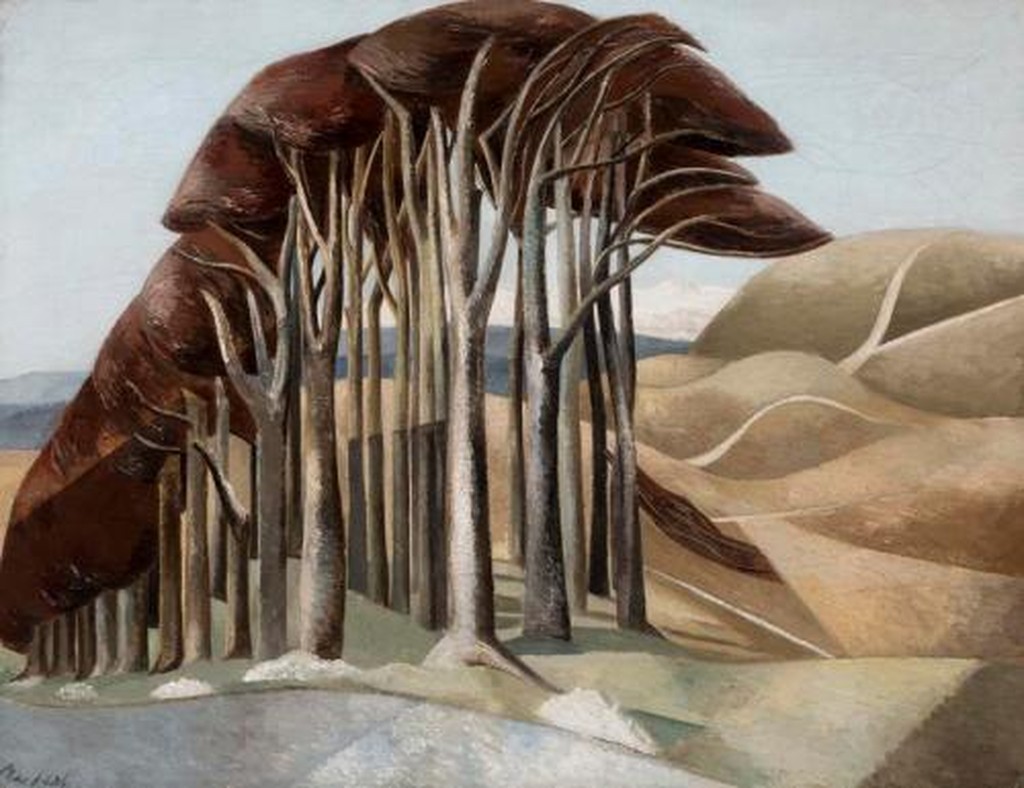
Wood on the Downs offers a useful example from 1929. The trees remain trees, yet their rounded masses, dark openings and measured spacing make the wood read as a constructed arrangement. Such simplification differs from total abstraction. Nash selects and intensifies relations already present in a site, allowing an observed landscape to function as a pattern without dissolving its identity.
His wider landscapes and places therefore provide the ground of his modernism. Horizon, enclosure, threshold and silhouette became tools with which he could organise a picture. When unfamiliar objects later entered those spaces, the underlying structure still gave them weight and location.
Unit One and a European Conversation
In 1933 Nash founded Unit One, bringing painters, sculptors and architects together around the need for contemporary British art. The Tate record defines its aim broadly as expressing a modern spirit, while the British Council presents the group as a meeting point for abstraction and Surrealism.[1][2] Unit One was not a uniform style. It was an argument that British artists could respond to international experiment without treating local subjects as provincial remnants.
European modernism offered several ways to rethink the ordinary. Geometric abstraction gave simple masses and intervals new authority. Metaphysical painting and Surrealism demonstrated how familiar things could become disquieting through altered scale or unexplained proximity. Tate’s scholarly account of Nash at Avebury places Equivalents for the Megaliths near the improbable object-worlds associated with Giorgio de Chirico, René Magritte and the Surrealist movement, while also locating it in an older British response to antiquity.[5]
Nash’s applied work widened that conversation. In the 1930s he designed a bathroom for Tilly Losch in Edward James’s London house using sharp lines, mirrors and neon lighting.[9] Design was not separate from his experiments in painting: reflective surfaces, framed views and surprising material combinations also recur within his pictorial spaces.
Found Objects and Object Personae
Stones, flints and pieces of driftwood mattered to Nash as encountered things before they became motifs. In Dorset he collected, handled, positioned and photographed such fragments. British Art Studies emphasises their geological origin and argues that his found objects do not simply illustrate a private unconscious; they carry the deep processes of the land into the work.[6]
The phrase “object personae” helps describe what happens next. An object is not painted as a literal human figure, but it gains a role through posture, placement and relation. Two stones may appear to meet; a branch can loom, shelter or threaten; a sphere may confront the moon. Personhood is suggested by pictorial behaviour rather than by adding a face or supplying a story.
This approach differs from treating found material as a novelty. Nash attended to surface, balance, erosion and resemblance, then created situations in which those physical qualities could act. The object remains stone or wood even as it becomes a participant. That double status—material fact and imaginative presence—is one reason his Surrealism stays tethered to the world.
Photography, Collage and the Art of Selection
Nash began using a camera regularly in 1930. Tate preserves a group titled Negatives of 1267 photographs taken by Paul Nash, spanning 1930–46; its subjects range from archaeological sites, rocks, roads and trees to aerodromes and aircraft parts.[7] The camera isolated patterns that ordinary looking might pass over: a wall’s rhythm, a shadow’s interruption or the resemblance between a fragment and a creature.
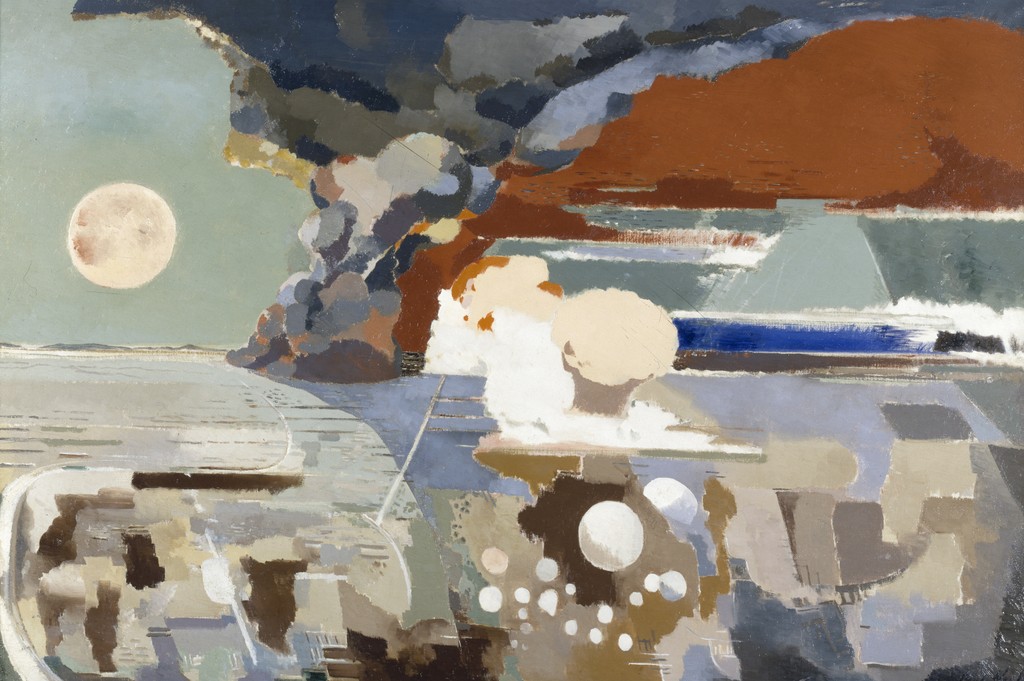
Photography also supplied material for later paintings. Tate directly connects Nash’s Cowley aircraft-dump negatives with Totes Meer (Dead Sea).[7] More generally, the photographic frame encouraged cropping, enlargement and comparison. These are close relatives of Surrealist displacement: a commonplace thing becomes unfamiliar when removed from its usual scale or surroundings.
Collage made that process physical. An album annotated by Paul and Margaret Nash records Landscape at Large of 1936 and Portrait of the Lunar Hornet of 1937 as collages, alongside oils and watercolours concerned with objects, megaliths and metamorphosis.[8] The album is a catalogue description, not access to every missing image, but it establishes that cutting and recombination formed part of his practice. The relationship between camera, collage and painting is explored further through Nash’s photography, design and prints.
Avebury and Four Distinct Megalith Pictures
Nash first encountered Avebury in 1933. The stones offered both actual masses in a cultivated landscape and remnants of a past that could not be fully recovered. His megaliths and ancient landscapes use modern form to approach that tension rather than to produce archaeological diagrams.
Titles must remain precise. Landscape of the Megaliths is the British Council oil of 1934, first exhibited as Landscape Composition in Unit One’s exhibition.[3] Equivalents for the Megaliths is a separate Tate oil of 1935, measuring 457 × 660 mm.[4] Druid Landscape and Landscape with Megaliths are different works again. Shared stones and fields do not make these names interchangeable.
In Landscape of the Megaliths, outlined stones, sweeping ground and an elevated perspective loosen ordinary scale while retaining Avebury as the stimulus.[3] In Equivalents for the Megaliths, blocks, cylinders and a sphere act as formal counterparts to standing and fallen stones. Tate reads these geometric elements as simultaneously related to contemporary abstract sculpture and to prehistoric monuments.[4] The painting is not a map of Avebury; its “equivalents” translate the stones into a designed relation of masses, directions and intervals.
That translation is modernist because it insists on the picture’s independent construction. It is also Surreal in the calm incompatibility of its forms. Yet Tate Papers stresses that the imaginative composition still begins with the real site and with Nash’s resistance to reducing antiquity to restored certainty.[5]
Pillar and Moon: Relationship across Distance
Pillar and Moon, dated 1932–42, is an oil on canvas in Tate’s collection. A pale sphere rests on a ruined pillar and faces the moon across an unoccupied landscape. Tate describes the work through the association of objects belonging to different elements: stone and celestial body become counterparts without losing their separate identities.[10]
The picture shows how little is required for Nash to make a scene psychologically charged. Ruin, sphere, moon, horizon and cold light are all recognisable. Their spacing, however, creates the impression of an encounter. No event is narrated and no human witness appears. The meaning resides in the act of comparison—near against far, built fragment against sky, solid stone against an apparently solid moon.
This is neither conventional symbolism nor pure abstraction. The forms carry associations, but the painting does not assign them a single code. It asks the viewer to experience relation itself as mysterious.
Landscape from a Dream: Framing the Uncanny
Landscape from a Dream, painted in 1936–8, combines a hawk, a reflecting or screening plane, a sphere and a coastal setting. Tate catalogues the work as oil on canvas, 679 × 1,016 mm, and identifies subjects including the hawk, mirror, reflection, Dorset, sea, dreaming and mystery.[11] Those elements are visible anchors rather than a complete explanation.
The picture contains several kinds of looking. The bird appears alert; the mirror or screen interrupts the landscape; framed and open spaces compete. A familiar coast becomes difficult to locate because foreground object, reflection and distant view do not settle into one continuous depth. The title invites a dream reading, but the scene is assembled from sharply described things.
Nash did not offer a fixed narrative by which every object can be decoded. A cautious reading is that the work tests perception: is the hawk confronting an image, watching another space or serving as a concentrated emblem of sight? The unresolved alternatives are part of the composition. Surrealism here is a method for sustaining relationships that realistic description alone would close too quickly.
Exhibitions, War and the Persistence of Transformation
Nash’s participation in Surrealism was concrete as well as stylistic. He showed Found Object Interpreted at the International Surrealist Exhibition in London in 1936.[6] Tate also records his role in selecting the Surrealist section of an Artists’ International Association exhibition in 1937 and his later display of Metamorphosis with the association in 1939.[11] These activities place him inside organised exhibition networks, even though his work retained a distinct basis in British places and natural objects.
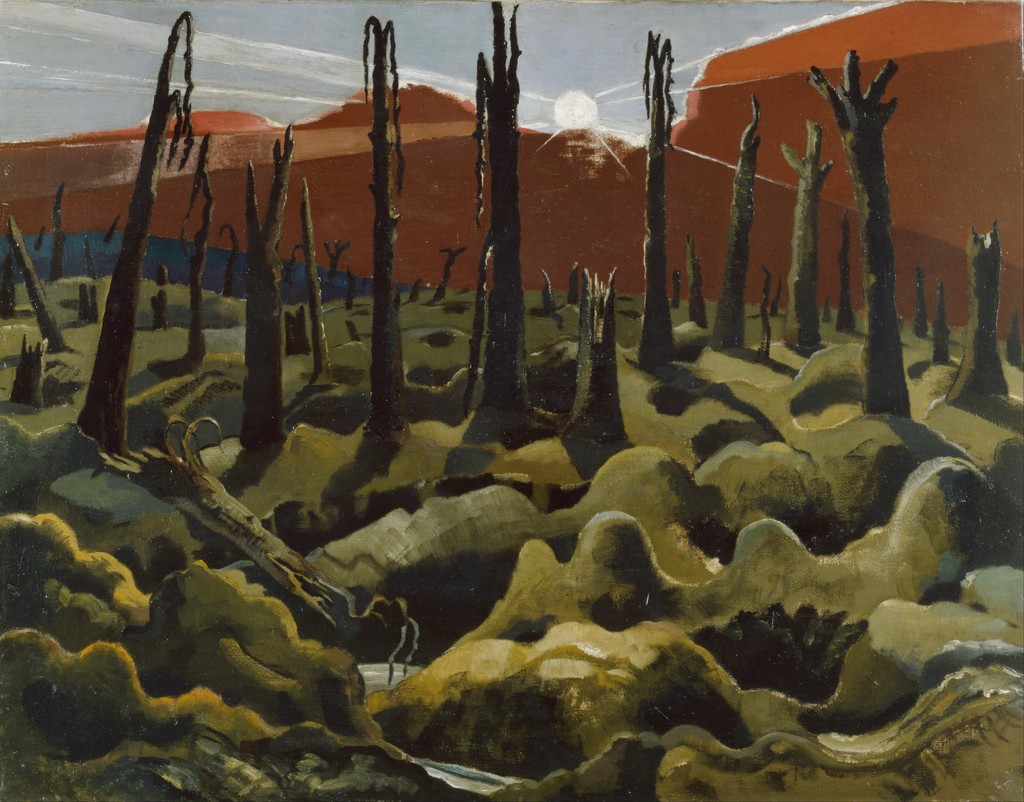
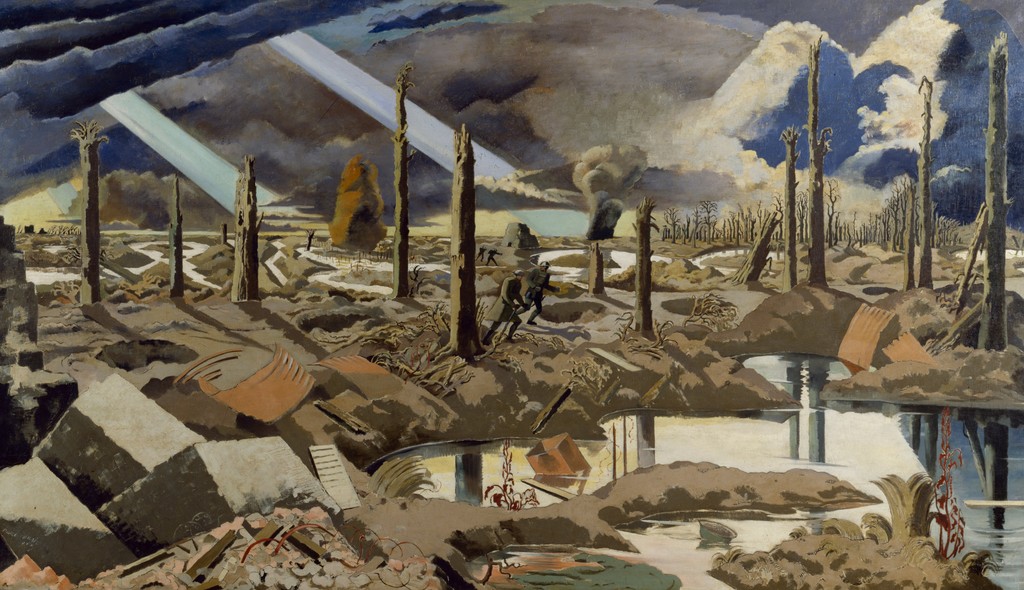
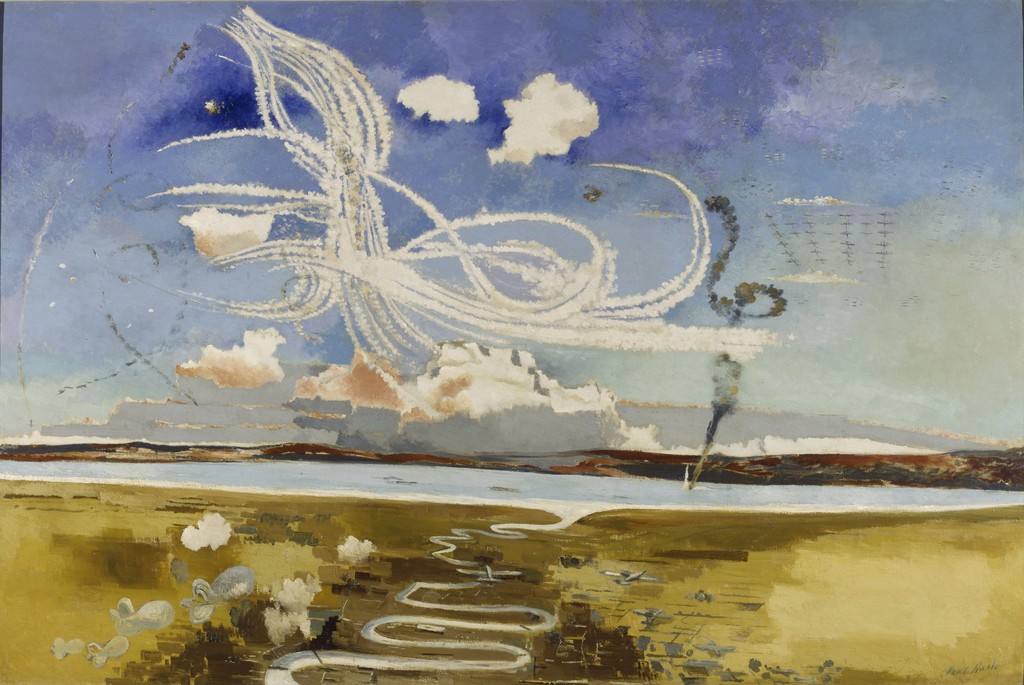
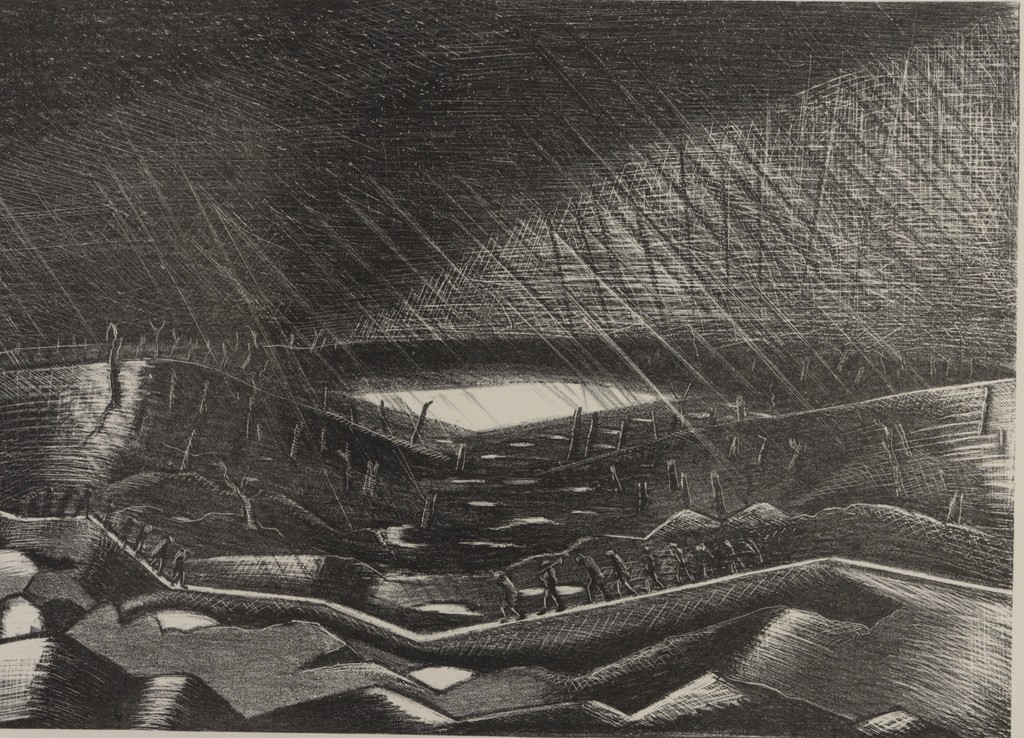
War did not end that method. In his First World War art, We Are Making a New World had already turned blasted trees and furrows into an ordered, bitter landscape. His Second World War art transformed machines more radically: wrecked aircraft became the dead metallic sea of Totes Meer, whose Cowley source Tate records,[12] while Battle of Britain and Battle of Germany convert trails, clouds, parachutes and explosions into vast aerial patterns.
Late sunflower paintings continued the exchange between observed nature and symbolic structure. The British Council identifies Eclipse of the Sunflower of 1945 as one of Nash’s final two oils and interprets its flower, dark disc and stormy setting through death and renewal.[13] Across modernism, Surrealism and war, transformation remained a way of making material reality more—not less—present.
About this directory: These 129 entries form a reproducible researched online works census assembled from current public records. It is not a catalogue raisonné and does not claim absolute completeness.
Artworks directory
| Name | Date | Medium |
|---|---|---|
| A Christmas Card to Arthur and Madeline Clifton, 1926 | 1926 | |
| A German Double Pill Box | 1918 | |
| A Howitzer Firing | 1914 | Painting |
| A Night Bombardment | 1919 | Painting |
| A Shell Crater | 1918 | Drawing |
| Battle of Britain | 1941 | Painting |
| Battle of Germany | 1944 | Painting |
| Beeches in the Wind by Paul Nash - Paul Nash | 1918 | Artwork |
| Behind the Inn | 1920 | Painting |
| Berkshire Downs | 1922 | Painting |
| Blue House on the Shore | 1930 | Painting |
| Bouquet | Date unknown | Painting |
| Bouquet - Paul Nash | 1927 | Artwork |
| Buckinghamshire Landscape | 1927 | Painting |
| Cactus | 1928 | Painting |
| Chestnut Waters | Date unknown | Painting |
| Circle of the Monoliths | 1937 | Painting |
| Cliffs | Date unknown | Drawing |
| Cloudscape (recto) | 1939 | Painting |
| Composition (Design for Today) | 1934 | Painting |
| Coronilla | 1929 | Painting |
| Cotswold Hills | 1920 | Painting |
| Day Fighter | 1940 | Painting |
| Dead Spring | 1929 | Painting |
| Defence of Albion | 1942 | Painting |
| Design for a bookplate for Kenneth Fitzpatrick Mackenzie | 1909 | Drawing |
| Division of the Light from the Darkness | 1924 | |
| Druid Landscape | 1938 | Painting |
| Dunbarton Lakes | 1910 | Drawing |
| Dymchurch, Kent | Date unknown | Painting |
| Dymchurch Steps | Date unknown | Painting |
| Dymchurch - The Strange Coast | 1920 | |
| Eclipse of the Sunflower | 1945 | Painting |
| Edge of the marsh | 1925 | Painting |
| Equivalents for the Megaliths | 1935 | Painting |
| Event on the Downs | 1934 | Painting |
| Flight of the Magnolia | 1944 | Painting |
| Footballers Prefer Shell | 1935 | Painting |
| Fruits and Vegetables | 1930 | |
| Granary | 1922 | Painting |
| Graveyard in a Ruined Orchard near Vimy | 1917 | Drawing |
| Grotto in the Snow | 1939 | Painting |
| Harbour and Room | 1934 | Painting |
| Iver Heath, Buckinghamshire, Snow | 1927 | Painting |
| Kinetic Feature | 1931 | Painting |
| Landscape | 1926 | Painting |
| Landscape at Iden | 1929 | Painting |
| Landscape Composition (Objects in Relation) | 1934 | Painting |
| Landscape from a Dream | 1937 | Painting |
| Landscape of Bleached Objects | 1934 | Painting |
| Landscape of the Bagley Woods | 1943 | Painting |
| Landscape of the Brown Fungus | 1943 | Painting |
| Landscape of the Malvern Distance | 1943 | Painting |
| Landscape of the Megaliths | 1934 | Painting |
| Landscape of the Moon's First Quarter | 1943 | Painting |
| Landscape of the Moon's Last Phase | 1944 | Painting |
| Landscape of the summer solstice | Date unknown | Painting |
| Landscape of the Vernal Equinox (III) | 1944 | Painting |
| Landscape (verso) | 1939 | Painting |
| Landscape with Megaliths - Paul Nash | 1936 | |
| Landscape - Year of Our Lord, 1917 | 1910 | Drawing |
| Lares | 1929 | Painting |
| March Landscape | 1944 | Painting |
| Men Marching at Night | 1918 | |
| Metamorphosis | 1938 | Painting |
| Michaelmas Landscape | 1943 | Painting |
| Mimosa Wood | 1926 | Painting |
| Mineral Object | 1935 | Painting |
| 'Modern Textiles' (shop sign board) | 1926 | Painting |
| Monument to Fallen Canadians on Vimy Ridge | 1917 | Drawing |
| Nest of the Siren | 1930 | Painting |
| Night Fighter | 1940 | Painting |
| Nocturnal Landscape | 1938 | Painting |
| Northern Adventure | 1929 | Painting |
| Nostalgic Landscape | 1930 | Painting |
| November Moon | 1942 | Painting |
| Oxenbridge Pond | 1927 | Painting |
| Oxford During the War | 1942 | Painting |
| Pillar and Moon | 1937 | Painting |
| Pink Hyacinth | 1921 | Painting |
| Plage | 1928 | Painting |
| Riviera Landscape | 1926 | Painting |
| Riviera Window, Cros-de-Cagnes | 1926 | Painting |
| Sandling Park, Kent | 1924 | Painting |
| Sluice | 1920 | |
| Solstice of the Sunflower | 1945 | Painting |
| Souvenir of Florence | 1929 | Painting |
| Spring in the Trenches, Ridge Wood, 1917 | 1918 | Painting |
| St Pancras Lilies | 1927 | Painting |
| St Pancras, London | 1927 | Painting |
| Still Life I - Paul Nash | 1924 | Artwork |
| Still Life with Bog Cotton | 1927 | Painting |
| Strange Coast | 1920 | |
| Study of Mrs. Nash | 1916 | Drawing |
| Sunflower and sun | 1942 | Painting |
| Sunrise, Inverness Copse | 1918 | Painting |
| Telecommunications | 1934 | Painting |
| The Archer | Date unknown | Painting |
| The Diving Stage | 1928 | Painting |
| The Edge of the Wood | 1919 | Painting |
| The Menin Road | 1919 | Painting |
| The Mule Track | 1918 | Painting |
| The Pond at Souldern | 1926 | Painting |
| The Raider on the Moors | 1940 | |
| The Rye Marshes, East Sussex | 1932 | Painting |
| The Sea | 1923 | Painting |
| The Sea Wall | 1920 | |
| The Shore | 1923 | Painting |
| The Stackyard | 1925 | Painting |
| The Window, Iver Heath | Date unknown | Painting |
| The Ypres Salient at Night | 1918 | Painting |
| Through a Window, Riviera | 1927 | Painting |
| Tide at Dymchurch | 1920 | |
| Token [verso: Tree in a Landscape (unfinished)] | 1929 | Painting |
| Totes Meer (Dead Sea) | 1940 | Painting |
| Vale of the White Blackbird | 1942 | Painting |
| View from a Window, Nice | 1934 | Painting |
| View R | 1940 | Painting |
| Void | 1918 | Painting |
| Voyages of the Moon | 1935 | Painting |
| We Are Making a New World | 1918 | Painting |
| Whiteleaf Cross | 1931 | Painting |
| Winter, Hampden | Date unknown | |
| Winter Sea | 1931 | Painting |
| Wittenham Clumps | 1943 | Painting |
| Wood on the Downs | 1929 | Painting |
| Wooded Landscape | 1942 | Painting |
| Worth Matravers, Dorset | 1936 | Drawing |
| Wounded, Passchendaele | Date unknown | Painting |
Frequently Asked Questions
Yes, but the term needs qualification. Nash exhibited with Surrealists, worked with found objects and used dreamlike juxtaposition.[6][11] Unlike approaches centred primarily on fantasy or the unconscious, his images usually begin with actual landscapes and collected things. “British Surrealist” describes an affiliation and a method, not the whole of his practice.
Unit One was the group Nash founded in 1933 to promote contemporary art in Britain. It joined painters, sculptors and architects and created a forum in which abstraction and Surrealism could be discussed together.[1][2] Its importance lies less in a shared appearance than in its outward-looking case for modern art.
He worked between those categories. Even highly simplified pictures retain identifiable fields, stones, trees, birds or moons. Geometric design controls their arrangement, but it rarely removes reference to the material world. Equivalents for the Megaliths demonstrates this balance particularly clearly.[4]
They included stones, flints, driftwood and other weathered fragments encountered in the landscape. Nash collected, arranged and photographed them, attending to their shapes and geological histories.[6] In paintings and constructions they could acquire the presence of characters while remaining recognisably inanimate things.
There is no single authorised decoding. The hawk, reflective screen, sphere and coast create an encounter between alert vision, reflection and an unsettled landscape.[11] The title licenses a dreamlike reading, but the work’s tension comes from the precision of its real objects and from the uncertainty of how their spaces connect.
Discussion
What should readers notice when looking closely at Paul Nash: Modernism and Surrealism?
Reader Insights
Identify where geometry sharpens an object without dissolving it into abstraction.
Place Nash near Surrealism while preserving his attachment to real places and things.
What makes an ordinary object strange without making it unrecognisable?
Join the Conversation
Share your reading below, keeping observations specific and evidence clear.
References
- Paul Nash fonds TGA 769 — Tate Archive, accessed 31 August 2026.
- Paul Nash artist record — British Council, accessed 31 August 2026.
- Landscape of the Megaliths — British Council, accessed 31 August 2026.
- Equivalents for the Megaliths, T01251 — Tate, accessed 31 August 2026.
- Thomas Guest and Paul Nash in Wiltshire — Tate Papers, accessed 31 August 2026.
- Paul Nash’s Geological Enigma — British Art Studies, accessed 31 August 2026.
- Negatives of 1267 photographs taken by Paul Nash — Tate Archive, accessed 31 August 2026.
- Album annotated by Paul and Margaret Nash — Tate Archive, accessed 31 August 2026.
- Edward James’s Surrealist world — Victoria and Albert Museum, accessed 31 August 2026.
- Pillar and Moon, N05392 — Tate, accessed 31 August 2026.
- Landscape from a Dream, N05667 — Tate, accessed 31 August 2026.
- Totes Meer (Dead Sea), N05717 — Tate, accessed 31 August 2026.
- Eclipse of the Sunflower — British Council, accessed 31 August 2026.