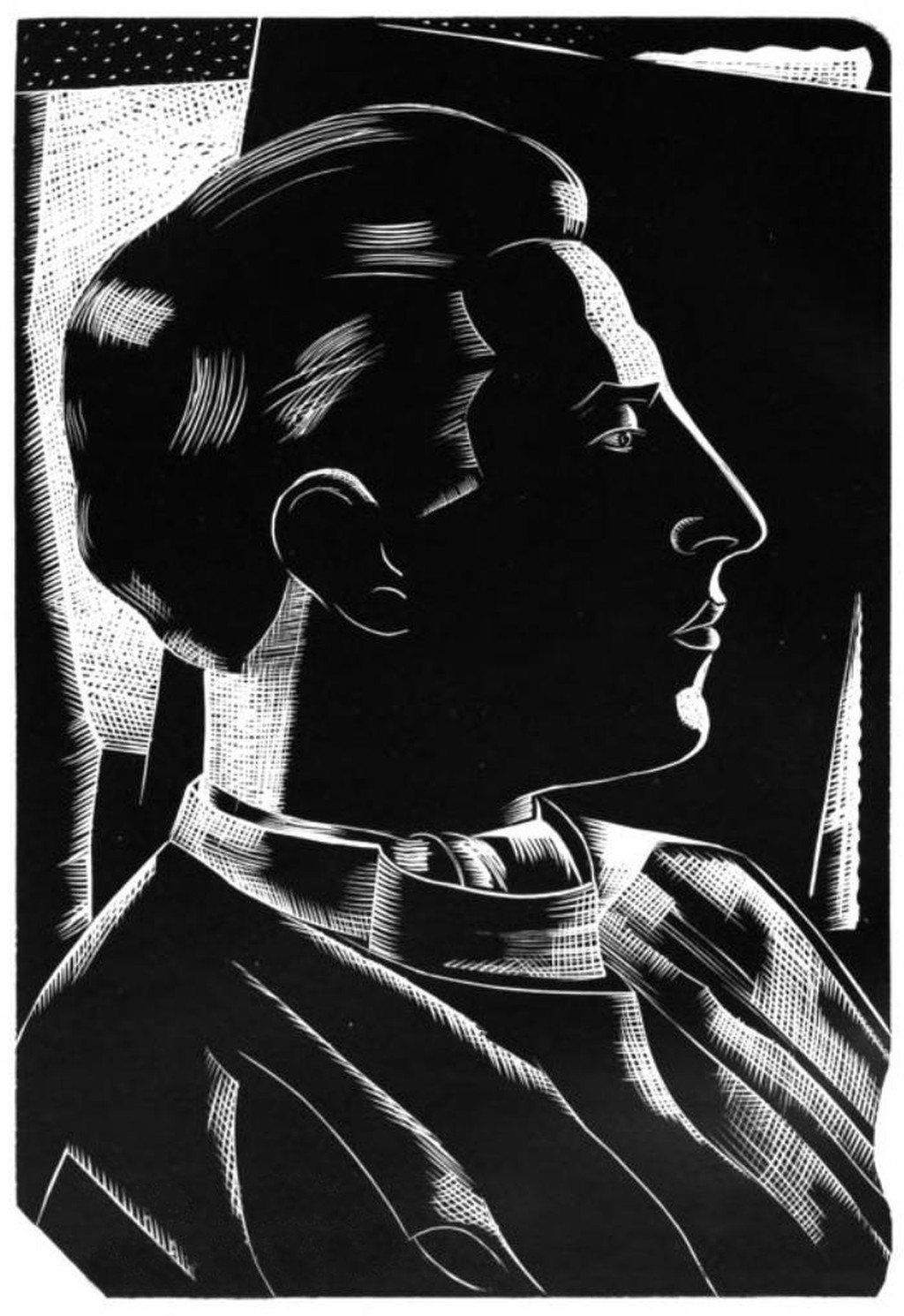
 by Tom Gurney
Tom Gurney BSc (Hons) is an art history expert with over 20 years experience
Page Created on August 31, 2026 / Page Updated on November 6, 2026
Email: tomgurney1@gmail.com / Phone: +44 7429 011000
Paul Nash Biography: Introduction
Paul Nash (1889–1946) made landscape the thread connecting a remarkably varied career. He drew the Western Front, designed books and stage scenery, photographed found objects, helped organise British modernism and returned to official war work in the 1940s. Across those changes, places and things remained active presences in his art rather than passive backgrounds.[1]
At a Glance
- LifeBorn in London on 11 May 1889; died on 11 July 1946.
- UpbringingEducated at St Paul’s School before studying art in London.
- TrainingChelsea Polytechnic, an LCC school and the Slade School of Fine Art, 1910–11.
- War serviceArtists Rifles volunteer, Hampshire Regiment officer and official war artist in both world wars.
- Principal mediaOil, watercolour, drawing, printmaking, photography, illustration and applied design.
- Key affiliationsLondon Group, Society of Industrial Artists, Unit One and British Surrealist circles.
Paul Nash in context
British landscape traditions
c. 1880–1940Cubism and geometrical modernism
c. 1907–1930Surrealism
c. 1924–1950Unit One
1933–35Paul Nash
1889–1946John Nash
1893–1977Ben Nicholson
1894–1982Henry Moore
1898–1986Eileen Agar
1899–1991Graham Sutherland
1903–1980Contents
- London Childhood and the Slade, 1889–1911
- Wittenham Clumps and an Art of Place
- Soldier, Witness and Official War Artist, 1914–19
- Dymchurch, Print and Design in the 1920s
- Industrial Art, Avebury and Unit One, 1932–34
- Surrealism, Found Objects and Photography
- Oxford and a Second World War, 1939–44
- Last Works and Death, 1944–46
London Childhood and the Slade, 1889–1911
Nash was born in London, the son of William Harry Nash, a barrister who became Recorder of Abingdon. He attended St Paul’s School and initially considered a naval career. After that course closed, he trained at Chelsea Polytechnic and an LCC school before entering the Slade School of Fine Art in 1910. His stay at the Slade lasted into 1911, placing him among a generation that included Mark Gertler and C. R. W. Nevinson.[1]
The Slade supplied a setting and contemporaries, but Nash’s strongest early subject was nature. A National Portrait Gallery account records that he turned to landscape after leaving and held his first London exhibition in 1912.[2] This was not a retreat from modern life. Trees, hills, water and weather gave him a vocabulary through which form, memory and atmosphere could be tested. That commitment would survive his encounters with war, geometric abstraction and Surrealism.
Wittenham Clumps and an Art of Place
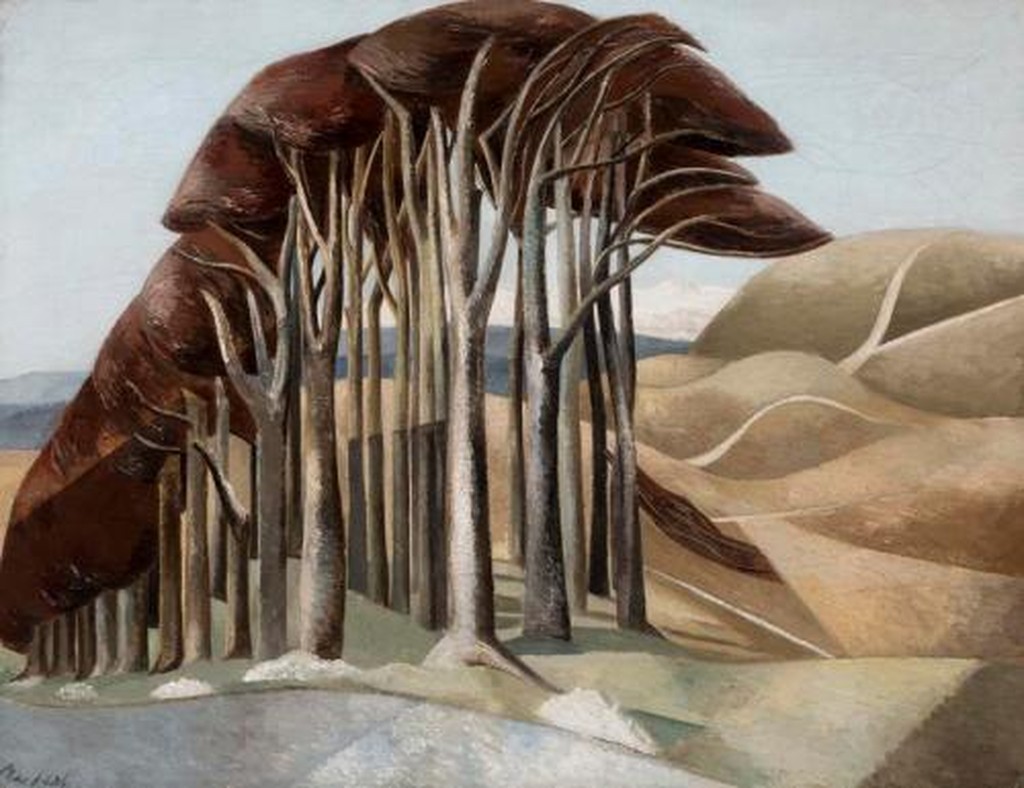
In 1912 Nash worked around Wittenham Clumps, the paired Oxfordshire hills above the Thames. The site joined strong silhouettes and long views to visible layers of human history. An Oxfordshire chronology describes its mixture of landscape, history, form and a less tangible sense of mystery as a compelling stimulus for him.[3] These early drawings established a career-long habit: returning to particular places until their shapes acquired the force of signs.
This approach helps explain why Nash’s landscapes and places cannot be treated as straightforward topography. A hill, a stand of trees or a coastal wall might be observed precisely, yet it could also organise a picture’s emotional temperature. Wittenham remained important enough for him to revisit the subject decades later. The continuity matters: even his most radical images grew from sustained looking rather than a rejection of nature.
Soldier, Witness and Official War Artist, 1914–19
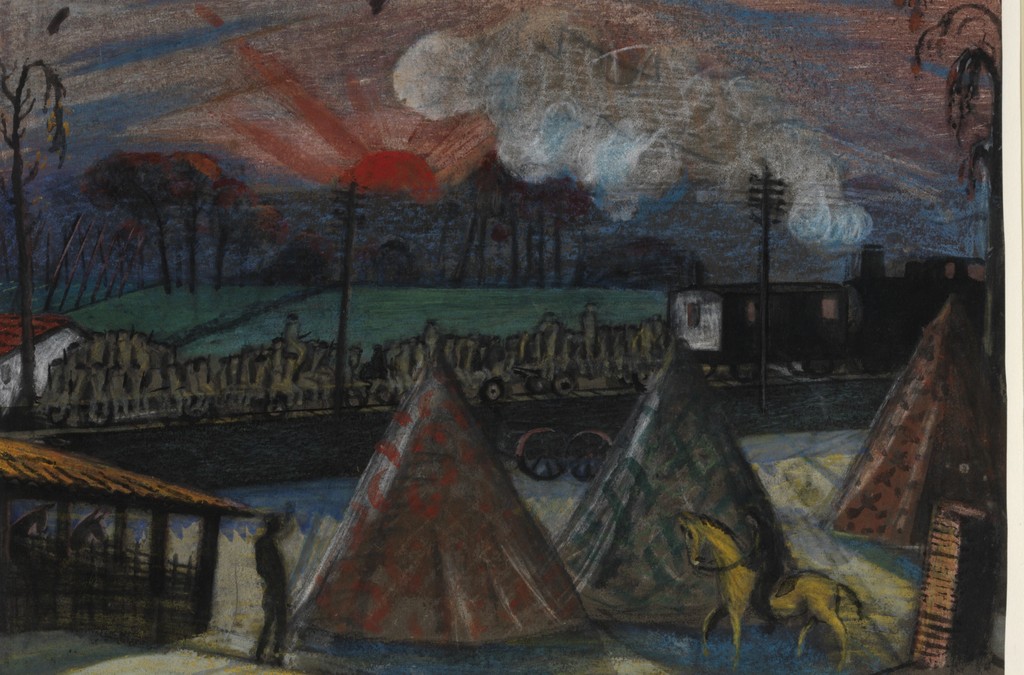
Nash married Margaret Theodosia Odeh in 1914 and enlisted in the Artists Rifles after the outbreak of the First World War. He received a commission in the Hampshire Regiment in 1916 and served in the Ypres Salient in 1917. An accidental injury, rather than an enemy-inflicted wound, caused his return to Britain. While recovering from a broken rib, he developed drawings based on the landscapes he had seen at Ypres.[1]
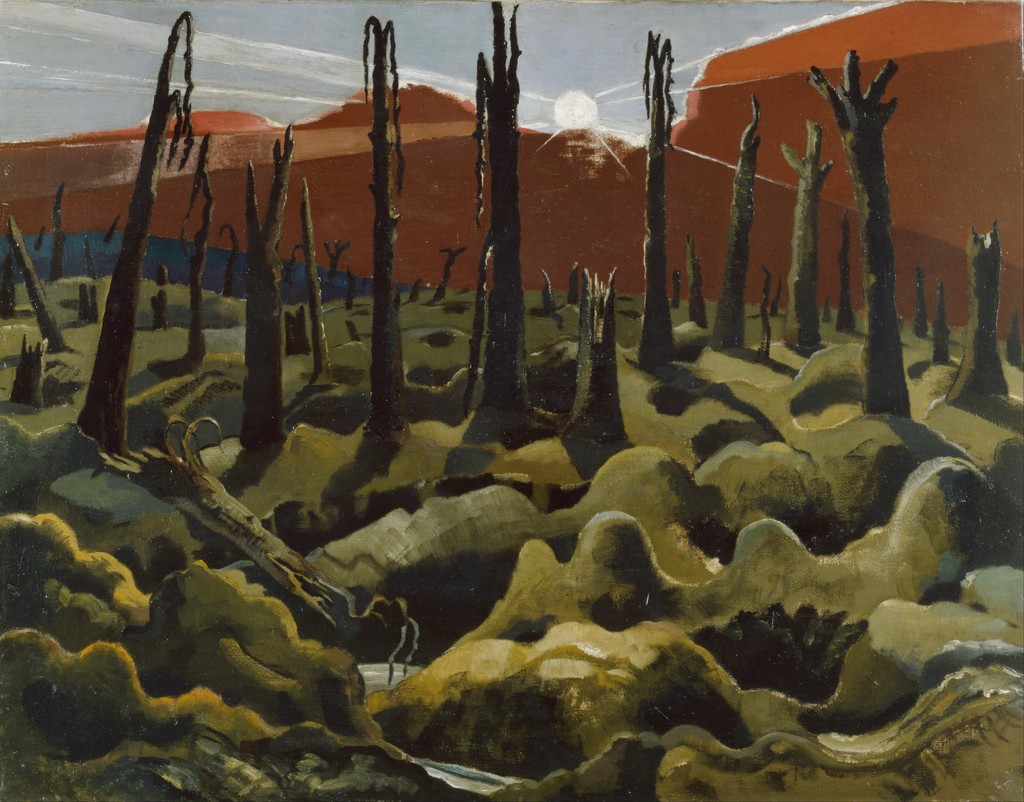
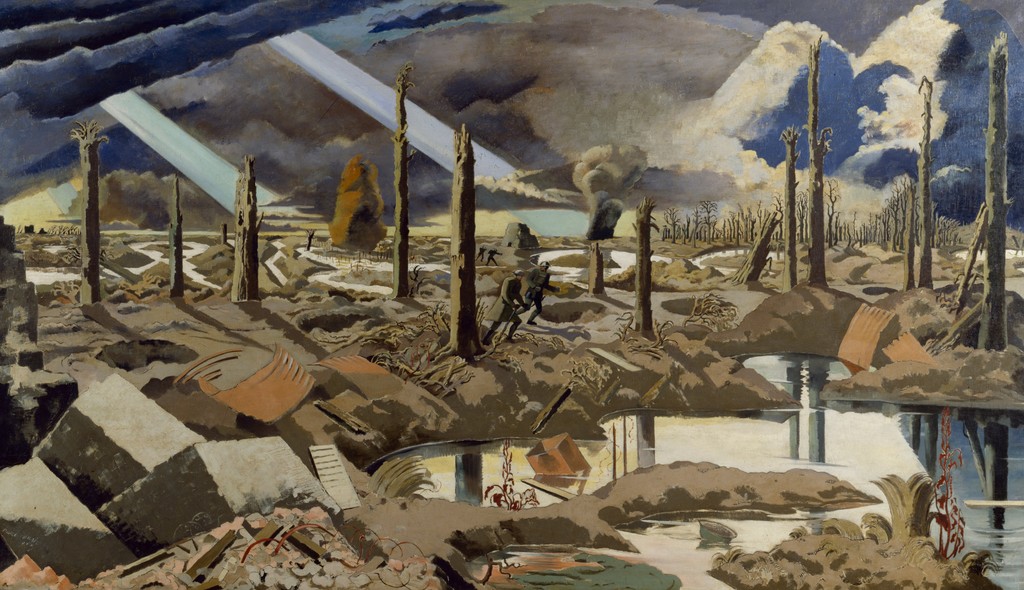
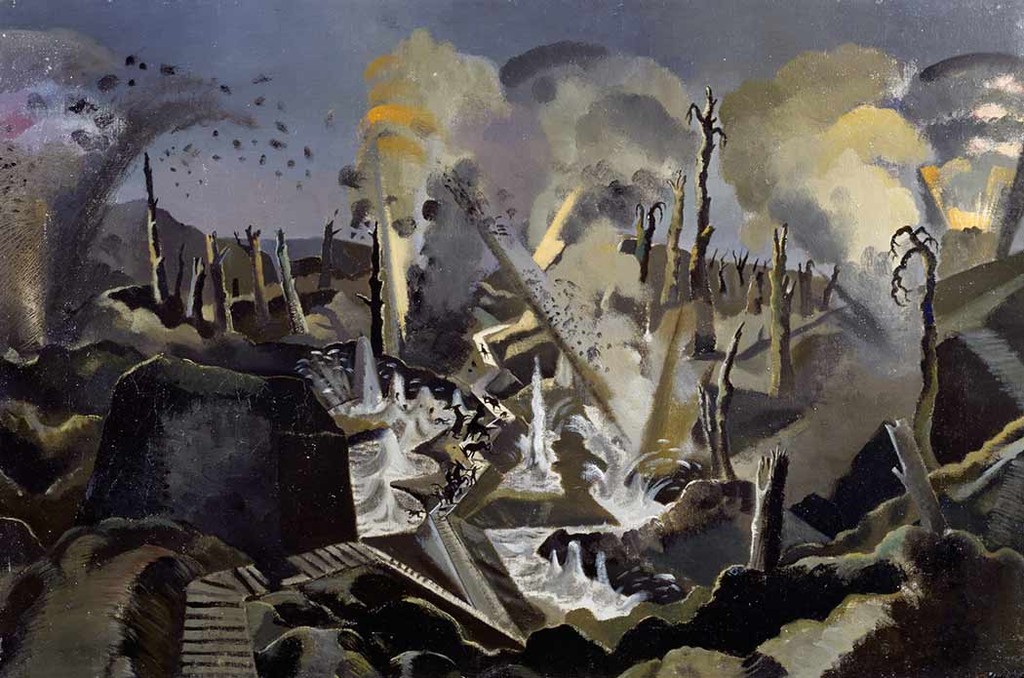
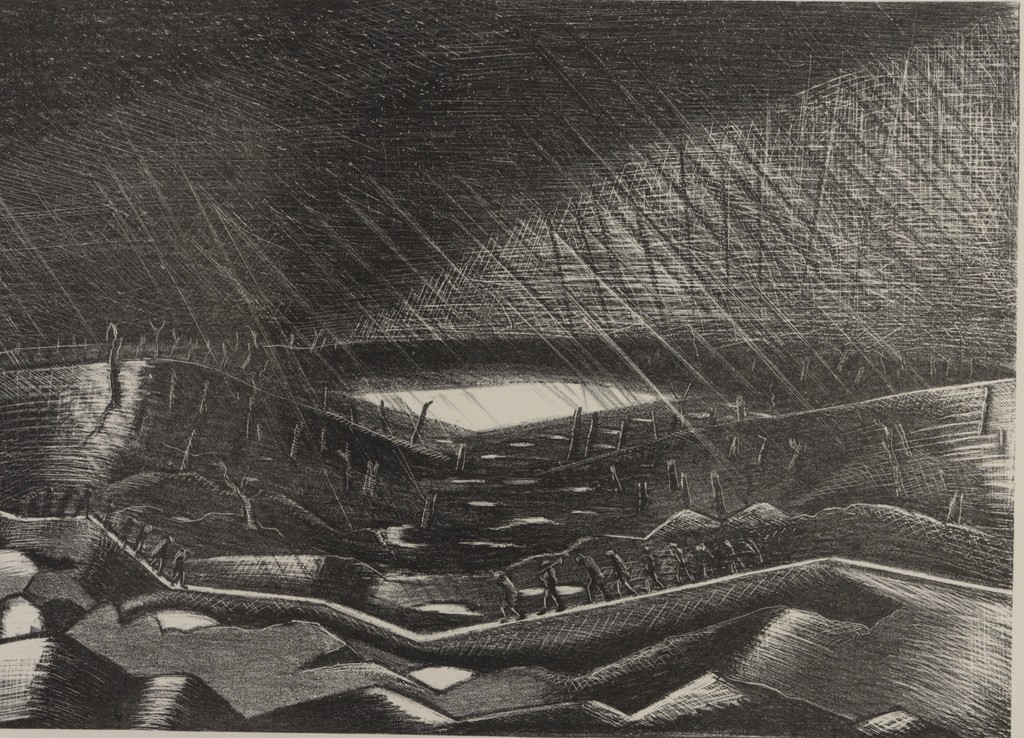
Those drawings were shown at the Goupil Gallery in London in June 1917. Their reception helped secure his return to France as an official war artist.[1] The sequence is crucial: military service gave him direct experience of the front, but the later official appointment created a different role, centred on observation and representation. His First World War art converted violated ground into broken rhythms of tree stumps, waterlogged trenches, roads and shell holes without turning destruction into spectacle.
Works such as The Mule Track and We Are Making a New World place damaged terrain at the centre of the account. The latter’s bitterly expansive title works against its view of a scarred landscape, while its repeated trunks and furrows impose order without offering consolation. Nash’s war imagery was therefore continuous with his earlier feeling for place, but the meaning of the land had changed.
In April 1918 the Ministry of Information commissioned The Menin Road for a proposed Hall of Remembrance. Nash worked on the vast canvas from June 1918 to February 1919. The unbuilt scheme took the dimensions of Uccello’s Battle of San Romano as a model, joining a modern battlefield to the tradition of European public painting. The finished work, IWM ART 2242, replaces a heroic charge with two small figures negotiating flooded craters, shattered trees and unstable ground.[4]
Dymchurch, Print and Design in the 1920s
After the war, Nash did not abandon bleak or exposed terrain. At Dymchurch on the Kent coast, sea walls, steps and the horizontal pressure of water gave him a new structural language. Prints including Dymchurch – The Strange Coast and Tide at Dymchurch, both associated with 1920, reduce the coast to emphatic bands and angles. The setting belongs within his wider art of landscape and place, but its engineered defences also drew nature and construction into the same design.
His 1920s practice extended well beyond easel painting. He made wood engravings, illustrations, book jackets, textiles, ceramics, posters, theatre scenery and costume designs.[5] The Victoria and Albert Museum preserves a design connected with J. M. Barrie’s The Truth about the Russian Dancers, around 1922, evidence that stage work was part of this multidisciplinary practice rather than a diversion from it.[6]
A Bodleian holdings guide also records book jackets, cards, broadsides and publicity material by Paul and John Nash, although that small folder is neither catalogued in detail nor digitised.[7] Its catalogue description should not be mistaken for direct access to every object, but it confirms the breadth of the brothers’ graphic activity. Nash’s photography, design and prints allowed the compressed shapes of his landscape art to circulate through books, interiors and performance.
Industrial Art, Avebury and Unit One, 1932–34
Nash’s applied work was matched by organisational activity. He served as president of the Society of Industrial Artists in 1932, joined the Council for Art and Industry in 1933 and taught as a visiting instructor at the Royal College of Art.[1] These roles linked modern form to the things and spaces of everyday life. A sharp division between “fine” and “applied” art does not describe his career well.
In 1933 he established Unit One, bringing painters, sculptors and architects together around contemporary art. The British Council identifies Henry Moore, Edward Wadsworth, Edward Burra and Ben Nicholson among the group’s members and describes its programme as a meeting of abstraction and Surrealism.[5] Unit One was brief, but it made an argument: British modernism could engage international experiment without severing its relation to local landscape and objects.
Avebury and the Wiltshire monuments sharpened that argument. Ancient stones could be read as archaeological remains, upright forms in space and agents within a living landscape. The dated entries in an album annotated by Paul and Margaret Nash keep Landscape of the Megaliths of 1934 distinct from Equivalents for the Megaliths of 1935.[8] His megaliths and ancient landscapes joined deep history to the formal tensions of modern painting; they were neither picturesque ruins nor generic abstractions.
Surrealism, Found Objects and Photography
During the later 1930s Nash’s landscapes acquired improbable meetings: stones, rooms, trees, moons and fragments appear in charged relationships. The National Portrait Gallery records that he exhibited paintings and found objects with Surrealist groups in 1936, 1937 and 1938.[9] Yet his modernism and Surrealism remained anchored in things encountered outdoors. The unfamiliar often entered through a shift of scale, placement or association rather than through fantasy alone.
Photography strengthened this way of seeing. Tate’s archive records 1,267 negatives of photographs taken by Nash.[10] The camera enabled him to isolate weathered wood, stone, shadows and unexpected arrangements, building a visual store that could feed painting, collage and design. The annotated album likewise records related versions in different media, including Harbour and Room, Voyages of the Moon, Landscape from a Dream and several megalith pictures.[8] Photography was therefore an active component of his practice, not merely a record of finished paintings.
Oxford and a Second World War, 1939–44
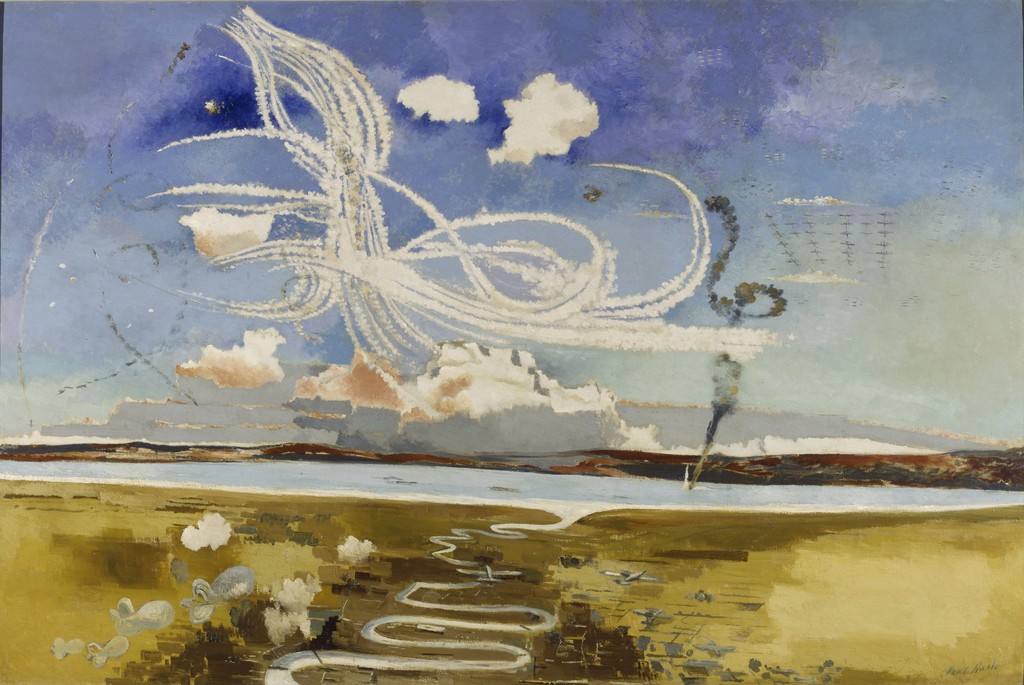
Nash moved to Oxford in 1939 and helped establish the Arts Bureau for War Service. In 1940 he became an official war artist to the Air Ministry, followed by an appointment to the Ministry of Information in 1941.[3][1] The second appointment did not repeat the trench viewpoint of 1917. Aircraft, vapour trails, wreckage and the imagined breadth of aerial combat demanded a different visual language.
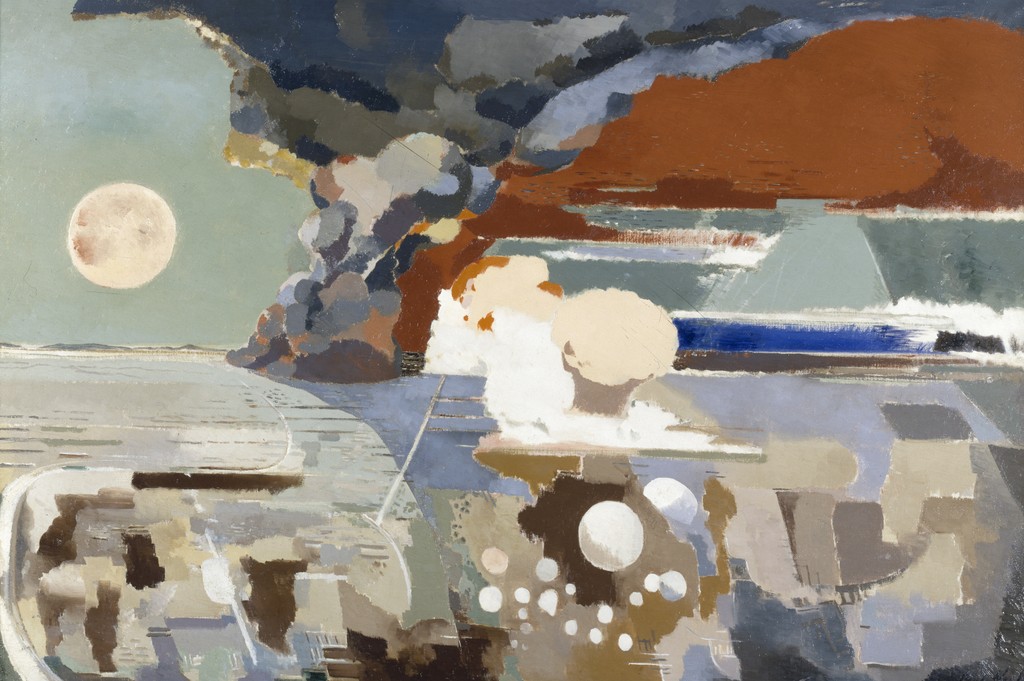
Battle of Britain, IWM ART LD 1550, organises the conflict across sky, cloud and distant ground.[11] Nash was not recording a single witnessed dogfight; he constructed an encompassing image from observed and gathered material. In Totes Meer, wrecked aircraft become a metallic sea, bringing the coastal imagination of the 1920s into a landscape made from machines. His Second World War art thus returned to familiar structures—sea, horizon, weather and transformed objects—under new historical conditions.
Battle of Germany, IWM ART LD 4526, followed in 1944.[12] Its divided field of combustion, cloud and darkness pushes wartime description towards symbolic structure. The change from mud to air did not erase the earlier career; it revealed how adaptable Nash’s landscape thinking had become.
Last Works and Death, 1944–46
Poor health narrowed Nash’s movement during the 1940s, while the Oxford garden around 106 Banbury Road became increasingly important. Magnolia, moon and sunflower supplied forms for late paintings in which growth and seasonal change meet eclipse, flight and transformation. Flight of the Magnolia dates from 1944, while Eclipse of the Sunflower belongs to 1945.[13] These works should not be reduced to a coded diagnosis. Their force lies in how recognisable natural forms are placed within expansive cycles of light and time.
Nash died on 11 July 1946 while on a short visit to Boscombe, near Bournemouth, and was buried at Langley in Buckinghamshire.[1][3] His career had moved through war service, public commissions, coastal landscapes, industrial design, ancient sites, photography and Surrealism, but none of those phases stands alone. The persistent question was how the visible world could carry histories and relationships larger than any single view.
Follow Paul Nash’s career through four stages
The Slade, drawing and an early art of place
Nash’s brief Slade training mattered less as a fixed style than as a professional beginning. Wittenham Clumps, trees and paths soon became recurring structures through which observed places could carry memory and mood.
Service, field drawings and official commissions
Service near Ypres, an accidental injury and the success of his 1917 drawings led to Nash’s return as an official war artist. Drawings, lithographs and major oils transformed damaged ground into a central actor without erasing its human cost.
Dymchurch, design, Unit One and Avebury
Coastal walls, book pages, found objects and ancient stones expanded Nash’s practice. Unit One and Surrealist circles sharpened his geometrical and associative language, while real places continued to anchor the work.
Imagined skies, wreckage and late natural forms
Working from the ground, Nash built aerial war images from research, photography and invention. Battle of Britain and Battle of Germany led into late works where moons, sunflowers and seasonal change set destruction within larger natural cycles.
About this directory: These 129 entries form a reproducible researched online works census assembled from current public records. It is not a catalogue raisonné and does not claim absolute completeness.
Artworks directory
| Name | Date | Medium |
|---|---|---|
| A Christmas Card to Arthur and Madeline Clifton, 1926 | 1926 | |
| A German Double Pill Box | 1918 | |
| A Howitzer Firing | 1914 | Painting |
| A Night Bombardment | 1919 | Painting |
| A Shell Crater | 1918 | Drawing |
| Battle of Britain | 1941 | Painting |
| Battle of Germany | 1944 | Painting |
| Beeches in the Wind by Paul Nash - Paul Nash | 1918 | Artwork |
| Behind the Inn | 1920 | Painting |
| Berkshire Downs | 1922 | Painting |
| Blue House on the Shore | 1930 | Painting |
| Bouquet | Date unknown | Painting |
| Bouquet - Paul Nash | 1927 | Artwork |
| Buckinghamshire Landscape | 1927 | Painting |
| Cactus | 1928 | Painting |
| Chestnut Waters | Date unknown | Painting |
| Circle of the Monoliths | 1937 | Painting |
| Cliffs | Date unknown | Drawing |
| Cloudscape (recto) | 1939 | Painting |
| Composition (Design for Today) | 1934 | Painting |
| Coronilla | 1929 | Painting |
| Cotswold Hills | 1920 | Painting |
| Day Fighter | 1940 | Painting |
| Dead Spring | 1929 | Painting |
| Defence of Albion | 1942 | Painting |
| Design for a bookplate for Kenneth Fitzpatrick Mackenzie | 1909 | Drawing |
| Division of the Light from the Darkness | 1924 | |
| Druid Landscape | 1938 | Painting |
| Dunbarton Lakes | 1910 | Drawing |
| Dymchurch, Kent | Date unknown | Painting |
| Dymchurch Steps | Date unknown | Painting |
| Dymchurch - The Strange Coast | 1920 | |
| Eclipse of the Sunflower | 1945 | Painting |
| Edge of the marsh | 1925 | Painting |
| Equivalents for the Megaliths | 1935 | Painting |
| Event on the Downs | 1934 | Painting |
| Flight of the Magnolia | 1944 | Painting |
| Footballers Prefer Shell | 1935 | Painting |
| Fruits and Vegetables | 1930 | |
| Granary | 1922 | Painting |
| Graveyard in a Ruined Orchard near Vimy | 1917 | Drawing |
| Grotto in the Snow | 1939 | Painting |
| Harbour and Room | 1934 | Painting |
| Iver Heath, Buckinghamshire, Snow | 1927 | Painting |
| Kinetic Feature | 1931 | Painting |
| Landscape | 1926 | Painting |
| Landscape at Iden | 1929 | Painting |
| Landscape Composition (Objects in Relation) | 1934 | Painting |
| Landscape from a Dream | 1937 | Painting |
| Landscape of Bleached Objects | 1934 | Painting |
| Landscape of the Bagley Woods | 1943 | Painting |
| Landscape of the Brown Fungus | 1943 | Painting |
| Landscape of the Malvern Distance | 1943 | Painting |
| Landscape of the Megaliths | 1934 | Painting |
| Landscape of the Moon's First Quarter | 1943 | Painting |
| Landscape of the Moon's Last Phase | 1944 | Painting |
| Landscape of the summer solstice | Date unknown | Painting |
| Landscape of the Vernal Equinox (III) | 1944 | Painting |
| Landscape (verso) | 1939 | Painting |
| Landscape with Megaliths - Paul Nash | 1936 | |
| Landscape - Year of Our Lord, 1917 | 1910 | Drawing |
| Lares | 1929 | Painting |
| March Landscape | 1944 | Painting |
| Men Marching at Night | 1918 | |
| Metamorphosis | 1938 | Painting |
| Michaelmas Landscape | 1943 | Painting |
| Mimosa Wood | 1926 | Painting |
| Mineral Object | 1935 | Painting |
| 'Modern Textiles' (shop sign board) | 1926 | Painting |
| Monument to Fallen Canadians on Vimy Ridge | 1917 | Drawing |
| Nest of the Siren | 1930 | Painting |
| Night Fighter | 1940 | Painting |
| Nocturnal Landscape | 1938 | Painting |
| Northern Adventure | 1929 | Painting |
| Nostalgic Landscape | 1930 | Painting |
| November Moon | 1942 | Painting |
| Oxenbridge Pond | 1927 | Painting |
| Oxford During the War | 1942 | Painting |
| Pillar and Moon | 1937 | Painting |
| Pink Hyacinth | 1921 | Painting |
| Plage | 1928 | Painting |
| Riviera Landscape | 1926 | Painting |
| Riviera Window, Cros-de-Cagnes | 1926 | Painting |
| Sandling Park, Kent | 1924 | Painting |
| Sluice | 1920 | |
| Solstice of the Sunflower | 1945 | Painting |
| Souvenir of Florence | 1929 | Painting |
| Spring in the Trenches, Ridge Wood, 1917 | 1918 | Painting |
| St Pancras Lilies | 1927 | Painting |
| St Pancras, London | 1927 | Painting |
| Still Life I - Paul Nash | 1924 | Artwork |
| Still Life with Bog Cotton | 1927 | Painting |
| Strange Coast | 1920 | |
| Study of Mrs. Nash | 1916 | Drawing |
| Sunflower and sun | 1942 | Painting |
| Sunrise, Inverness Copse | 1918 | Painting |
| Telecommunications | 1934 | Painting |
| The Archer | Date unknown | Painting |
| The Diving Stage | 1928 | Painting |
| The Edge of the Wood | 1919 | Painting |
| The Menin Road | 1919 | Painting |
| The Mule Track | 1918 | Painting |
| The Pond at Souldern | 1926 | Painting |
| The Raider on the Moors | 1940 | |
| The Rye Marshes, East Sussex | 1932 | Painting |
| The Sea | 1923 | Painting |
| The Sea Wall | 1920 | |
| The Shore | 1923 | Painting |
| The Stackyard | 1925 | Painting |
| The Window, Iver Heath | Date unknown | Painting |
| The Ypres Salient at Night | 1918 | Painting |
| Through a Window, Riviera | 1927 | Painting |
| Tide at Dymchurch | 1920 | |
| Token [verso: Tree in a Landscape (unfinished)] | 1929 | Painting |
| Totes Meer (Dead Sea) | 1940 | Painting |
| Vale of the White Blackbird | 1942 | Painting |
| View from a Window, Nice | 1934 | Painting |
| View R | 1940 | Painting |
| Void | 1918 | Painting |
| Voyages of the Moon | 1935 | Painting |
| We Are Making a New World | 1918 | Painting |
| Whiteleaf Cross | 1931 | Painting |
| Winter, Hampden | Date unknown | |
| Winter Sea | 1931 | Painting |
| Wittenham Clumps | 1943 | Painting |
| Wood on the Downs | 1929 | Painting |
| Wooded Landscape | 1942 | Painting |
| Worth Matravers, Dorset | 1936 | Drawing |
| Wounded, Passchendaele | Date unknown | Painting |
Frequently Asked Questions
Nash was born in London on 11 May 1889 and attended St Paul’s School. He studied at Chelsea Polytechnic and an LCC school before joining the Slade School of Fine Art in 1910–11. After leaving the Slade, landscape became his central subject, and he held his first London exhibition in 1912.[1][2]
Yes. John Northcote Nash was Paul’s younger brother and also became an artist, working as a painter, wood engraver and illustrator. Records connect both brothers with graphic projects, while research on their careers examines how each responded to the First World War and its aftermath.[7][14]
He enlisted in the Artists Rifles in 1914, received a Hampshire Regiment commission in 1916 and served at Ypres in 1917. An accidental injury led to his return home. After his Goupil Gallery exhibition, he went back to France as an official war artist and later completed major commissions including The Menin Road.[1][4]
Unit One was the modern-art group Nash established in 1933. It brought together painters, sculptors and architects, including Henry Moore, Edward Wadsworth, Edward Burra and Ben Nicholson, to promote contemporary British work shaped by abstraction and Surrealism.[5]
Discussion
What should readers notice when looking closely at Paul Nash Biography?
Reader Insights
Notice where a change of place coincides with a change of material or scale.
Treat public commissions as circumstances that shaped choices, not complete explanations of them.
Where does continuity matter more than a chronological break?
Join the Conversation
Share your reading below, keeping observations specific and evidence clear.
References
- Paul Nash fonds TGA 769 — Tate Archive, accessed 31 August 2026.
- Paul Nash portrait biography — National Portrait Gallery, accessed 31 August 2026.
- Paul Nash chronology — Oxfordshire Blue Plaques Board, accessed 31 August 2026.
- The Menin Road memorial record — Imperial War Museums, accessed 31 August 2026.
- Paul Nash artist record — British Council, accessed 31 August 2026.
- Stage Design and Beyond — Victoria and Albert Museum, accessed 31 August 2026.
- John Johnson Collection Nash ephemera guide — Bodleian Libraries, accessed 31 August 2026.
- Album annotated by Paul and Margaret Nash — Tate Archive, accessed 31 August 2026.
- Paul Nash person record — National Portrait Gallery, accessed 31 August 2026.
- Negatives of 1,267 photographs taken by Paul Nash — Tate Archive, accessed 31 August 2026.
- Battle of Britain, ART LD 1550 — Imperial War Museums, accessed 31 August 2026.
- Battle of Germany, ART LD 4526 — Imperial War Museums, accessed 31 August 2026.
- Eclipse of the Sunflower — British Council, accessed 31 August 2026.
- Brothers in Arms: John and Paul Nash and the Aftermath of the Great War — Arts University Bournemouth, accessed 31 August 2026.