 by Tom Gurney
Tom Gurney BSc (Hons) is an art history expert with over 20 years experience
Page Created on August 31, 2026 / Page Updated on November 6, 2026
Email: tomgurney1@gmail.com / Phone: +44 7429 011000
Paul Nash: Megaliths and Ancient Landscape: Introduction
Paul Nash encountered Avebury in 1933 and found a landscape where standing stones, buried remains, cultivated fields and modern archaeological inquiry occupied the same ground. He did not simply copy the monument. Memory, photography, elevated viewpoints and geometrical simplification enabled him to test how ancient objects might belong to a modern picture.[1]
These paintings are rooted in an actual place without serving as measured plans. Their mystery comes from constructed relationships between forms and times, separating material evidence from invented ritual.
At a Glance
- Key site and dateAvebury, Wiltshire, first encountered by Nash in the summer of 1933.[1]
- Earlier ancient placeWhiteleaf Cross had already drawn his attention to a human mark embedded in a hillside.[2]
- MethodsField observation, photography, memory, aerial suggestion and shifts of scale or viewpoint.[3][4]
- Principal worksLandscape of the Megaliths (1934), Equivalents for the Megaliths (1935) and the separate Druid Landscape; Pillar and Moon shares related concerns without depicting the same subject.[1][5][6]
- Archaeological contextAlexander Keiller’s protection of Avebury and use of aerial archaeology made ancient alignments newly visible.[1]
- Interpretive cautionThe paintings invite ideas of deep time and ritual, but they do not establish a precise ceremony or a definite occult creed.[7]
Contents
- Before Avebury: Whiteleaf and Marked Ground
- The Avebury Encounter of 1933
- Archaeology at Ground Level and from the Air
- Landscape of the Megaliths and Its Unit One Title
- Equivalents for the Megaliths: Objects as Relations
- Druid Landscape Is Not a Ritual Diagram
- Pillar and Moon: A Related but Separate Painting
- Geology, Deep Time and the Material Unseen
- Ancient Forms across a Modern Career
Before Avebury: Whiteleaf and Marked Ground
Avebury was a turning point, not the beginning of Nash’s interest in antiquity. In 1922 he made Whiteleaf Cross, a crayon and watercolour on paper showing the ancient cross cut into a Chiltern hillside near Princes Risborough. The British Council record notes the site’s special significance for him and identifies a further painting of the subject.[2]
Whiteleaf offered a useful early problem: a recognisable hill carries a sign whose age and purpose are not immediately legible. Shape, place and historical association cannot be separated. Nash’s response belonged to an established landscape practice, yet the cross also behaves as a bold graphic form. It can be read at once as topography, object and mark.
At Avebury, physical masses with known positions could also act as silhouettes and intervals. Modern form did not erase history; it made ancient matter’s meeting with present perception the subject.
The Avebury Encounter of 1933
Nash first saw the Avebury megaliths while recovering from bronchitis in the summer of 1933. The stones appeared in varied states: some stood among crops or vegetation, others were partly covered, and still others survived below the turf. The British Council’s account stresses the unsettled impression this dispersed survival made upon him.[1]
It was not a tidy, single view. The stones survived as fragments across working land, encouraging Nash to think through relationships rather than isolated portraits.
Photography helped retain arrangements and profiles, while drawing and recollection allowed him to change their emphasis. The Tate Archive catalogue describes an album annotated by Paul and Margaret Nash from 1933 onwards. Its record lists photographs of works, titles, media and provenance, including the 1934 Landscape of the Megaliths and the 1935 Equivalents for the Megaliths.[3] It separates versions without making every photograph a preparatory study. The wider movement between camera and artwork belongs to Nash’s photography, design and print practice.
Archaeology at Ground Level and from the Air
Avebury was also changing through archaeology. Alexander Keiller had bought the site in 1924 to protect it from a proposed Marconi wireless installation. The British Council relates the elevated, unsettled perspective of Landscape of the Megaliths to Keiller’s pioneering adoption of aerial archaeology.[1] Seen from above, earthworks and stone avenues could become patterns whose full order was difficult to grasp while standing among them.
An aerial viewpoint did not turn the picture into an overhead survey. Fields become planes, a circular feature becomes diagrammatic and distant contours approach outlined stones. Walking experience meets maps and aerial photographs.
Tate scholarship places Nash within a longer history of artists responding to British antiquity.[4] In the 1930s, that inheritance could coexist with archaeology’s modern instruments and with the formal economy of abstraction. The connection is central to Nash’s modernism and Surrealism: the landscape remains identifiable, while viewpoint and scale make it unfamiliar.
Landscape of the Megaliths and Its Unit One Title
The British Council’s Landscape of the Megaliths is a 1934 oil on canvas measuring 49.5 by 73.2 centimetres, accession P3.[1] Nash developed it from memory while away from Wiltshire. This distance helps explain why the painting acts less like a site record than an arrangement of remembered relationships.
Two large outlined stone forms dominate the composition. One contains a circular sign, while hills, shadows and clouds seem to circulate around it. Lichen-like passages evoke physical surfaces, but broad, even areas of colour weaken ordinary depth. Near and far no longer behave consistently. The viewpoint recalls archaeological vision without pretending to reproduce an excavation plan.[1]
The painting first appeared as Landscape Composition in Unit One’s only exhibition. Its later name, Landscape of the Megaliths, shifts attention from a general formal exercise to relationships among stones, terrain and historical time.[1] Both titles matter. The first announces construction; the second restores the ancient objects that prompted it.
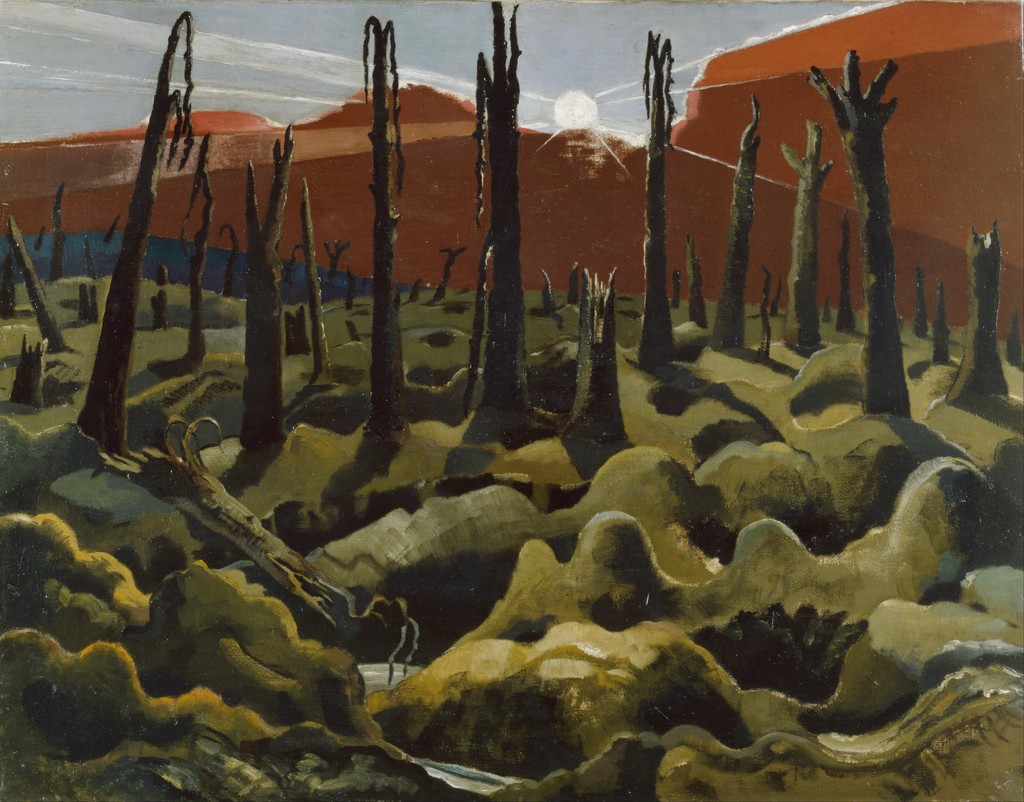
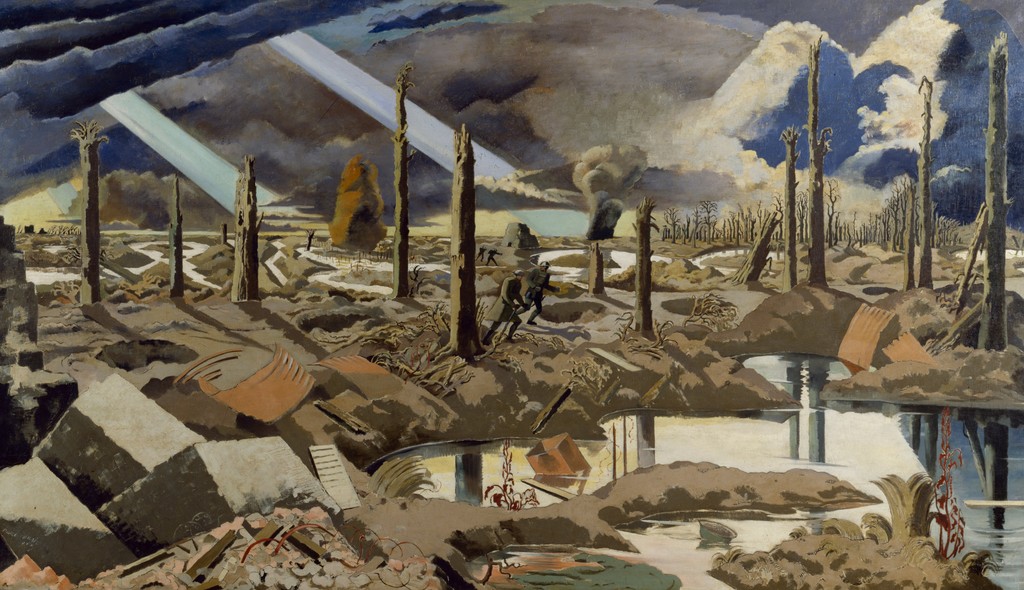
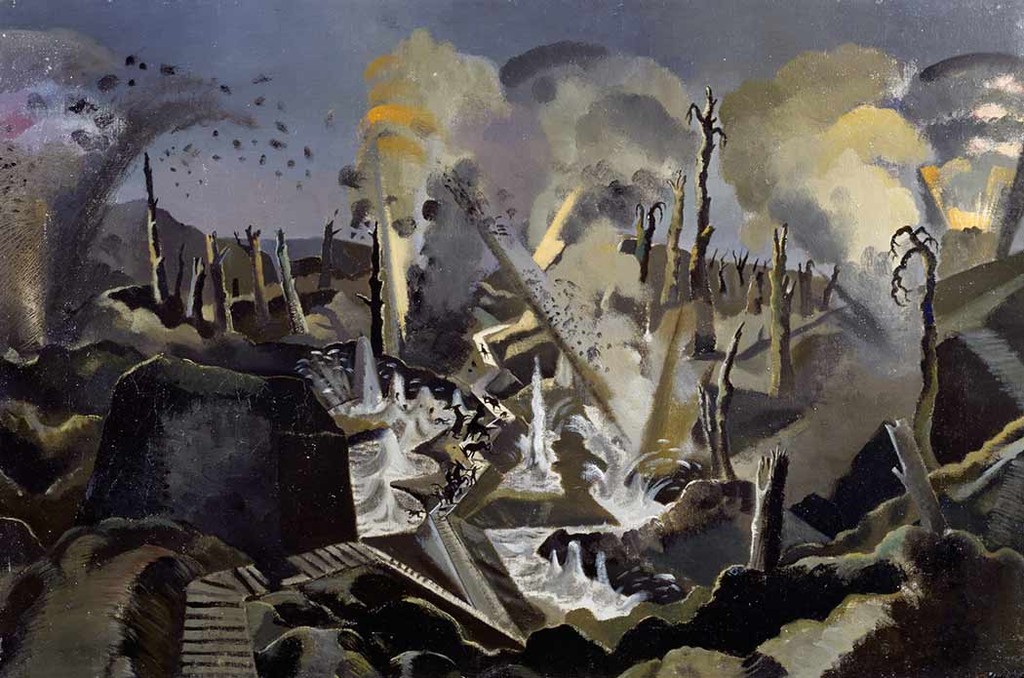
Unit One sought a place for progressive art in Britain, and Nash used this work to bring abstraction into contact with a particular English field. His previous First World War landscapes had already shown that terrain could carry history without serving merely as background. At Avebury, ordered planes and interrupted routes address survival and antiquity rather than destruction.
Equivalents for the Megaliths: Objects as Relations
Tate’s Equivalents for the Megaliths dates from 1935. It is an oil painting measuring 45.7 by 66 centimetres, accession T01251.[5] The title is exact and important: it does not call the simplified forms megaliths, but proposes visual equivalents for them.
Compared with the more topographical cues of Landscape of the Megaliths, the later picture gives geometrical objects greater independence. Rounded and rectilinear masses occupy a high, compressed terrain. Their placement establishes weight, interval and balance, as if ancient stones had prompted a new family of modern forms. A viewer may recognise a field and horizon, yet the objects resist being decoded as a single archaeological layout.[5]
This is why the two paintings cannot be treated as versions of one object. One reorganises remembered Avebury through outlined stones and an aerially inflected landscape; the other asks what modern forms might perform an equivalent pictorial role. The paintings and artworks guide records each separately within its researched online works census.
Druid Landscape Is Not a Ritual Diagram
Druid Landscape is another distinct title. It must not be substituted for either of the two megalith paintings already discussed, nor confused with Landscape with Megaliths. The word “Druid” introduces ritual association, but a title is not documentary proof of an ancient ceremony.[4]
Nash’s images can encourage imaginative narratives because stones appear to face, guard or answer one another. Those effects arise from position, scale, lighting and the animation of objects. They tell us how the painting works; they do not demonstrate what rites occurred at Avebury or precisely what Nash believed.
Real archaeological remains leave gaps that invite conjecture. Nash held material presence and imagination together without turning conjecture into fact.
Pillar and Moon: A Related but Separate Painting
Tate dates Pillar and Moon to 1932–42 and records it as an oil on canvas, 50.8 by 76.2 centimetres, accession N05392.[6] Its architectural vertical, moon and tree belong to Nash’s broader interest in objects that acquire force through placement. The painting shares a language of alignment and encounter with the Avebury works, but it is not an alternative title for any of them.
The moon sets a circular body against the pillar’s upright geometry. Built form, natural growth and celestial cycle occupy one compressed setting. That relationship extends the problem of ancient landscape beyond stones: how can unlike objects become active partners within a picture?
Related shapes need not indicate the same site: Nash’s recurring forms make a network, not a chain in which every pillar becomes a standing stone.
Geology, Deep Time and the Material Unseen
Archaeology addresses human activity across long periods; geology opens a far greater scale. Anna Reid’s study of Nash places his landscapes beside early twentieth-century developments in geophysics and public discussion of radiometric dating. She argues that his interest in equations, patterns and apparently inert matter can be read materially, not only spiritually.[7]
This interpretation is especially useful for Equivalents for the Megaliths. A standing stone has an archaeological history as a positioned object, but its rock also belongs to processes older than that human act. Simplified masses and balanced intervals can therefore suggest more than invented ritual. They can make duration, transformation and hidden structure pictorial problems.[7]
Reid also distinguishes the “unseen” from an automatically psychic realm. Nash’s hidden landscapes can refer to structures and forces present in the visible world but unavailable to an unaided glance.[7] Aerial photographs disclose alignments; geological knowledge discloses processes within matter; an artist’s rearrangement discloses formal relations. None supplies a final meaning, but each changes what seeing a field can involve.
Deep time should not be used as a vague synonym for magic. It names a material temporal scale. Nash could respond imaginatively to that scale without committing himself to a fixed occult system.
Ancient Forms across a Modern Career
The megalith pictures sit at a productive crossing of Nash’s interests. Observation provides stones, vegetation and contours. Photography and archaeological vision alter the available viewpoints. Abstraction clarifies masses and intervals. Surrealist association permits objects to appear strangely animate. Geology extends the land backwards beyond recorded human history.
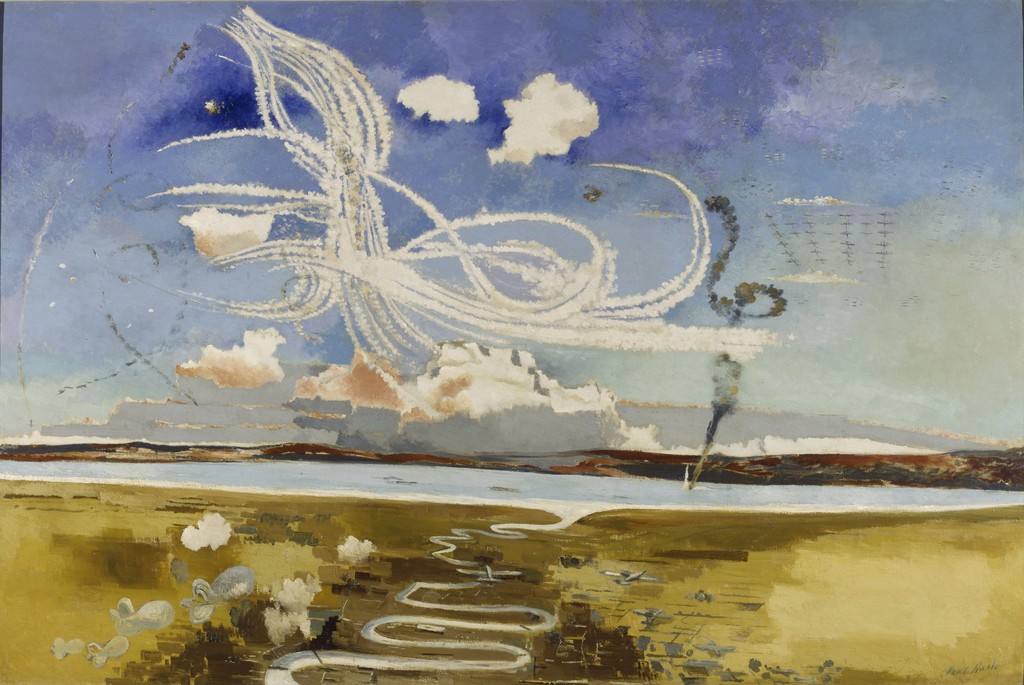
These methods also connect periods that are often separated. The organisation of terrain in his war work, the unusual encounters of the 1930s and the elevated structures of his Second World War art all ask how a landscape can contain events beyond one stable view. Their subjects and historical responsibilities differ, so continuity should not become equivalence.
Avebury mattered because it made several modes of knowledge operate together. Nash neither reproduced the monument as a survey nor abandoned it for free fantasy. He treated ancient stones as stubborn material objects and as prompts for a new modern order.
About this directory: These 129 entries form a reproducible researched online works census assembled from current public records. It is not a catalogue raisonné and does not claim absolute completeness.
Artworks directory
| Name | Date | Medium |
|---|---|---|
| A Christmas Card to Arthur and Madeline Clifton, 1926 | 1926 | |
| A German Double Pill Box | 1918 | |
| A Howitzer Firing | 1914 | Painting |
| A Night Bombardment | 1919 | Painting |
| A Shell Crater | 1918 | Drawing |
| Battle of Britain | 1941 | Painting |
| Battle of Germany | 1944 | Painting |
| Beeches in the Wind by Paul Nash - Paul Nash | 1918 | Artwork |
| Behind the Inn | 1920 | Painting |
| Berkshire Downs | 1922 | Painting |
| Blue House on the Shore | 1930 | Painting |
| Bouquet | Date unknown | Painting |
| Bouquet - Paul Nash | 1927 | Artwork |
| Buckinghamshire Landscape | 1927 | Painting |
| Cactus | 1928 | Painting |
| Chestnut Waters | Date unknown | Painting |
| Circle of the Monoliths | 1937 | Painting |
| Cliffs | Date unknown | Drawing |
| Cloudscape (recto) | 1939 | Painting |
| Composition (Design for Today) | 1934 | Painting |
| Coronilla | 1929 | Painting |
| Cotswold Hills | 1920 | Painting |
| Day Fighter | 1940 | Painting |
| Dead Spring | 1929 | Painting |
| Defence of Albion | 1942 | Painting |
| Design for a bookplate for Kenneth Fitzpatrick Mackenzie | 1909 | Drawing |
| Division of the Light from the Darkness | 1924 | |
| Druid Landscape | 1938 | Painting |
| Dunbarton Lakes | 1910 | Drawing |
| Dymchurch, Kent | Date unknown | Painting |
| Dymchurch Steps | Date unknown | Painting |
| Dymchurch - The Strange Coast | 1920 | |
| Eclipse of the Sunflower | 1945 | Painting |
| Edge of the marsh | 1925 | Painting |
| Equivalents for the Megaliths | 1935 | Painting |
| Event on the Downs | 1934 | Painting |
| Flight of the Magnolia | 1944 | Painting |
| Footballers Prefer Shell | 1935 | Painting |
| Fruits and Vegetables | 1930 | |
| Granary | 1922 | Painting |
| Graveyard in a Ruined Orchard near Vimy | 1917 | Drawing |
| Grotto in the Snow | 1939 | Painting |
| Harbour and Room | 1934 | Painting |
| Iver Heath, Buckinghamshire, Snow | 1927 | Painting |
| Kinetic Feature | 1931 | Painting |
| Landscape | 1926 | Painting |
| Landscape at Iden | 1929 | Painting |
| Landscape Composition (Objects in Relation) | 1934 | Painting |
| Landscape from a Dream | 1937 | Painting |
| Landscape of Bleached Objects | 1934 | Painting |
| Landscape of the Bagley Woods | 1943 | Painting |
| Landscape of the Brown Fungus | 1943 | Painting |
| Landscape of the Malvern Distance | 1943 | Painting |
| Landscape of the Megaliths | 1934 | Painting |
| Landscape of the Moon's First Quarter | 1943 | Painting |
| Landscape of the Moon's Last Phase | 1944 | Painting |
| Landscape of the summer solstice | Date unknown | Painting |
| Landscape of the Vernal Equinox (III) | 1944 | Painting |
| Landscape (verso) | 1939 | Painting |
| Landscape with Megaliths - Paul Nash | 1936 | |
| Landscape - Year of Our Lord, 1917 | 1910 | Drawing |
| Lares | 1929 | Painting |
| March Landscape | 1944 | Painting |
| Men Marching at Night | 1918 | |
| Metamorphosis | 1938 | Painting |
| Michaelmas Landscape | 1943 | Painting |
| Mimosa Wood | 1926 | Painting |
| Mineral Object | 1935 | Painting |
| 'Modern Textiles' (shop sign board) | 1926 | Painting |
| Monument to Fallen Canadians on Vimy Ridge | 1917 | Drawing |
| Nest of the Siren | 1930 | Painting |
| Night Fighter | 1940 | Painting |
| Nocturnal Landscape | 1938 | Painting |
| Northern Adventure | 1929 | Painting |
| Nostalgic Landscape | 1930 | Painting |
| November Moon | 1942 | Painting |
| Oxenbridge Pond | 1927 | Painting |
| Oxford During the War | 1942 | Painting |
| Pillar and Moon | 1937 | Painting |
| Pink Hyacinth | 1921 | Painting |
| Plage | 1928 | Painting |
| Riviera Landscape | 1926 | Painting |
| Riviera Window, Cros-de-Cagnes | 1926 | Painting |
| Sandling Park, Kent | 1924 | Painting |
| Sluice | 1920 | |
| Solstice of the Sunflower | 1945 | Painting |
| Souvenir of Florence | 1929 | Painting |
| Spring in the Trenches, Ridge Wood, 1917 | 1918 | Painting |
| St Pancras Lilies | 1927 | Painting |
| St Pancras, London | 1927 | Painting |
| Still Life I - Paul Nash | 1924 | Artwork |
| Still Life with Bog Cotton | 1927 | Painting |
| Strange Coast | 1920 | |
| Study of Mrs. Nash | 1916 | Drawing |
| Sunflower and sun | 1942 | Painting |
| Sunrise, Inverness Copse | 1918 | Painting |
| Telecommunications | 1934 | Painting |
| The Archer | Date unknown | Painting |
| The Diving Stage | 1928 | Painting |
| The Edge of the Wood | 1919 | Painting |
| The Menin Road | 1919 | Painting |
| The Mule Track | 1918 | Painting |
| The Pond at Souldern | 1926 | Painting |
| The Raider on the Moors | 1940 | |
| The Rye Marshes, East Sussex | 1932 | Painting |
| The Sea | 1923 | Painting |
| The Sea Wall | 1920 | |
| The Shore | 1923 | Painting |
| The Stackyard | 1925 | Painting |
| The Window, Iver Heath | Date unknown | Painting |
| The Ypres Salient at Night | 1918 | Painting |
| Through a Window, Riviera | 1927 | Painting |
| Tide at Dymchurch | 1920 | |
| Token [verso: Tree in a Landscape (unfinished)] | 1929 | Painting |
| Totes Meer (Dead Sea) | 1940 | Painting |
| Vale of the White Blackbird | 1942 | Painting |
| View from a Window, Nice | 1934 | Painting |
| View R | 1940 | Painting |
| Void | 1918 | Painting |
| Voyages of the Moon | 1935 | Painting |
| We Are Making a New World | 1918 | Painting |
| Whiteleaf Cross | 1931 | Painting |
| Winter, Hampden | Date unknown | |
| Winter Sea | 1931 | Painting |
| Wittenham Clumps | 1943 | Painting |
| Wood on the Downs | 1929 | Painting |
| Wooded Landscape | 1942 | Painting |
| Worth Matravers, Dorset | 1936 | Drawing |
| Wounded, Passchendaele | Date unknown | Painting |
Frequently Asked Questions
Standing stones joined several long-term concerns: distinct objects, expressive silhouettes, landscape history and relationships across space. Avebury also offered the stimulus of contemporary archaeological inquiry. Nash could begin with actual stones and then use memory, geometry and altered viewpoint to explore how they occupied both a field and the imagination.[1][4]
He encountered the Avebury megaliths in the summer of 1933 while recovering from bronchitis.[1] The experience fed paintings and photographs over subsequent years, rather than a single immediate transcription.
They draw upon a real archaeological landscape, but they are not reliable maps. Landscape of the Megaliths was developed from memory and combines ground-level impressions with an elevated, diagrammatic perspective.[1] Equivalents for the Megaliths goes further by giving simplified modern objects an analogous role.[5]
The British Council painting of 1934 uses outlined stones, fields and aerial suggestion; it first appeared under the Unit One title Landscape Composition.[1] Tate’s 1935 work emphasises geometrical substitutes and balance.[5] They have different dates, compositions, collections and titles.
The consulted institutional records do not establish a definite occult belief. Nash found the stones mysterious and used ritual associations, but scholarship also identifies archaeological, photographic and geological foundations for his imagery.[4][7] It is safer to describe how the works create strangeness than to assign him a doctrine.
Discussion
What should readers notice when looking closely at Paul Nash: Megaliths and Ancient Landscape?
Reader Insights
Compare the scale and alignment of stones with paths, horizons and imagined structures.
Keep archaeology, geology and artistic invention distinct but in conversation.
Do Nash’s megaliths feel ancient, modern, or deliberately both?
Join the Conversation
Share your reading below, keeping observations specific and evidence clear.
References
- Landscape of the Megaliths — British Council Collection, accessed 31 August 2026.
- Whiteleaf Cross — British Council Collection, accessed 31 August 2026.
- Album annotated by Paul and Margaret Nash, 1933 onwards — Tate Archive, accessed 31 August 2026.
- Thomas Guest and Paul Nash in Wiltshire: Two Episodes in the Artistic Approach to British Antiquity — Tate Papers, accessed 31 August 2026.
- Equivalents for the Megaliths, T01251 — Tate, accessed 31 August 2026.
- Pillar and Moon, N05392 — Tate, accessed 31 August 2026.
- Paul Nash’s Geological Enigma — British Art Studies, accessed 31 August 2026.