 by Tom Gurney
Tom Gurney BSc (Hons) is an art history expert with over 20 years experience
Page Created on August 31, 2026 / Page Updated on November 6, 2026
Email: tomgurney1@gmail.com / Phone: +44 7429 011000
Paul Nash: Second World War Art: Introduction
Paul Nash’s Second World War art turns aircraft, vapour trails, wreckage and bombardment into a new kind of landscape. Working from Oxford and serving under two official appointments, he did not paint aerial combat as an eyewitness in the sky. He assembled researched details into imaginative structures that could convey the scale and pressure of modern air war.[1][2]
The resulting pictures are neither simple reports nor unqualified propaganda. Totes Meer (Dead Sea) makes a grounded aircraft dump resemble a frozen sea; Battle of Britain opens combat across a vast horizon; and Battle of Germany divides a city and its sky between suspense and detonation. Each transforms machines through a visual language Nash had already developed in landscape, photography and Surrealism.
At a Glance
- AppointmentsAir Ministry commission, 1940; Ministry of Information commission, 1941.
- Working baseOxford from 1939; he lived at 106 Banbury Road from 1940.
- Media and researchOil painting informed by drawings, photographs, aerial material and close study of aircraft wreckage.
- Vantage pointsNash never flew; his views from above were constructed imaginatively rather than witnessed in flight.
- Three key worksTotes Meer (Dead Sea), 1940–1; Battle of Britain, 1941; Battle of Germany, 1944.
- Major collectionImperial War Museums holds both large battle paintings; Tate holds Totes Meer.
Contents
- Oxford and Two Official Appointments
- An Air War Seen Without Flying
- Photography, Visual Research and Assembly
- Totes Meer: A Dead Sea at Cowley
- Battle of Britain: A Theatre of the Whole Sky
- Battle of Germany: Suspense and Bombardment
- Beyond the Propaganda Label
- Natural Cycles in the Late War Years
Oxford and Two Official Appointments
In 1939 Nash settled in Oxford and joined the creation of the Arts Bureau for War Service. The city remained his wartime base, initially in temporary rooms and then at 106 Banbury Road. He became an official war artist for the Air Ministry in 1940 and for the Ministry of Information in 1941.[2] These roles renewed the public commission he had held during the First World War, but the problem of representation had changed.
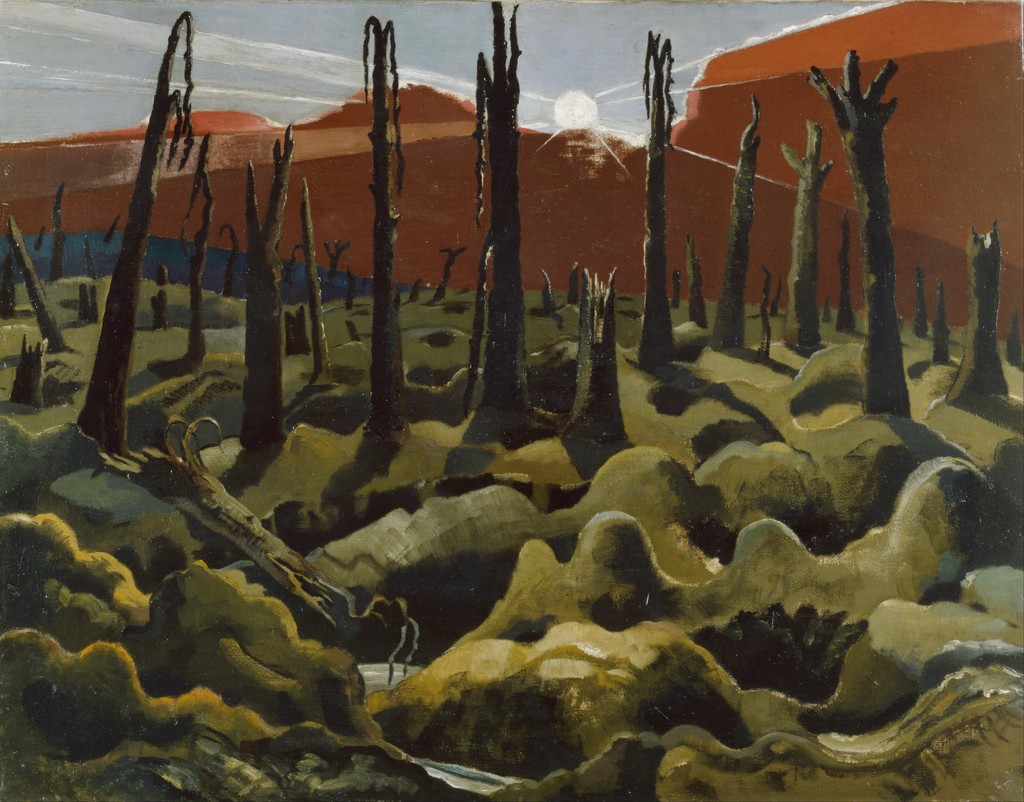
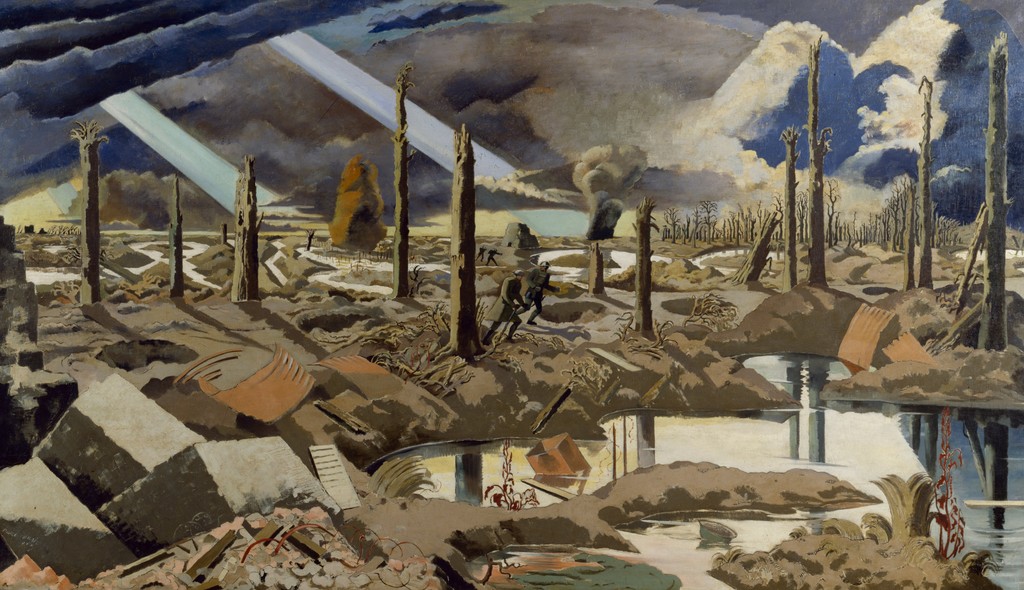
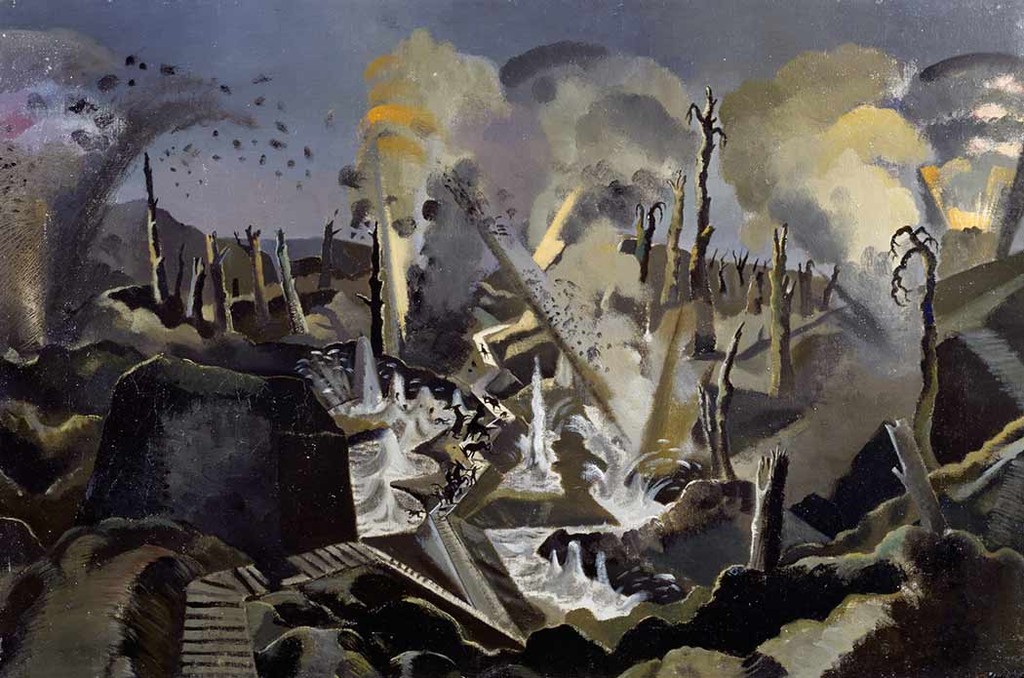
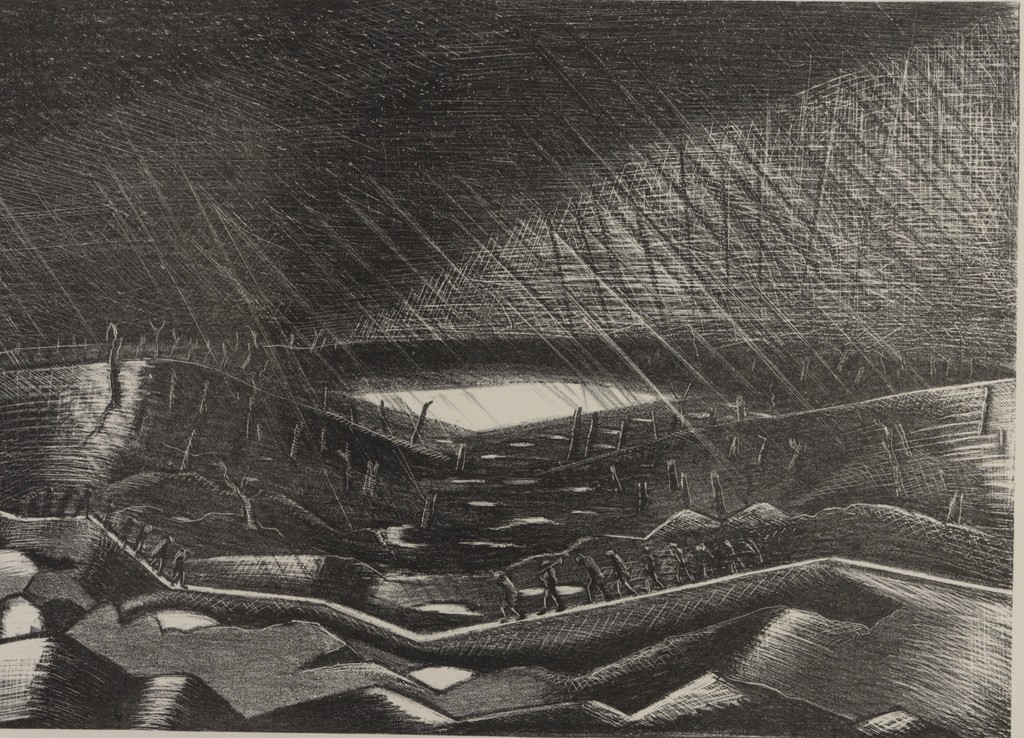
The earlier conflict had confronted Nash with trenches, flooded craters and splintered trees. Air power demanded a language for events distributed across great distances: machines passed through cloud, trails crossed the sky, and attacks connected airfields, factories, cities and coastlines. His biography shows that this was a return to official war work, not a return to the same viewpoint.
Nash’s Oxford setting mattered in practical and imaginative ways. The aircraft salvage ground at Cowley supplied the starting point for Totes Meer, while the garden at Banbury Road later fed his sunflower pictures.[2] A single local environment therefore connected industrial wreckage, domestic observation and natural cycles. That connection helps explain why his wartime art repeatedly moves between mechanical fact and landscape metaphor.
An Air War Seen Without Flying
Nash never flew in an aeroplane. Imperial War Museums makes that qualification explicit when discussing his aerial imagery and describes Battle of Germany as an imaginative, poetic approach to a bomber’s target.[4] His elevated viewpoints should therefore not be read as memories of looking down from a cockpit. They are pictorial constructions made by an artist considering what flight meant and how an airborne conflict might be comprehended from the ground.
This distinction does not make the pictures detached from evidence. It changes the kind of evidence they offer. Nash could study aircraft, maps, photographs, reports, cloud effects and the marks that machines left in the sky, then bring separate observations together. A witnessed dogfight would reveal one position at one moment. A constructed panorama could suggest several simultaneous movements and a much wider field of danger.
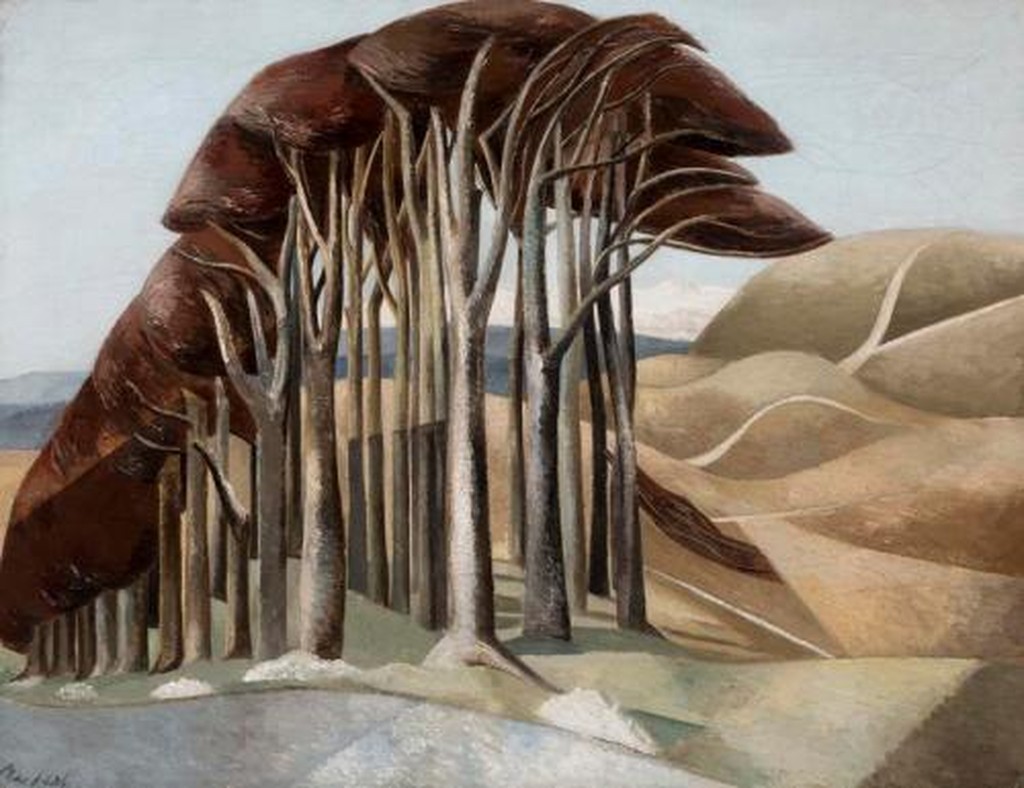
The method also belongs to Nash’s longer art of landscape and place. Long before 1939, he had treated hills, roads, trees, walls and horizons as active forms. In the air-war paintings, cloud banks behave like terrain, vapour trails score routes through space, and aircraft formations become temporary patterns within weather. The sky is not an empty backdrop. It is the contested environment in which the action is organised.
Photography, Visual Research and Assembly
Photography had taught Nash to isolate an object, alter its scale and notice accidental resemblances. His broader work in photography, design and prints also encouraged selection and compression: a found fragment could become a strong sign, while separate motifs could be arranged into a persuasive whole. That experience was especially useful when the subject itself could not be observed from a stable vantage point.
The surviving accounts do not imply that every painted feature came from one photograph or that Nash merely copied documentary material. The IWM record for Battle of Germany says he drew upon aerial photographs as well as imagination.[7] In Battle of Britain, recognisable elements—coast, estuary, clouds, balloons, parachutes, aircraft and smoke trails—are coordinated across a view no individual observer could possess. Research provides the parts; composition determines their relationship.
This is close to montage in principle, although the finished works remain oil paintings. Their credibility depends less on a literal match to one scene than on the accumulation of telling details. Nash’s modernism and Surrealism gave him ways to make those details strange without making them arbitrary. Machine, bird, flower, wave and cloud can resemble one another because their outlines and movements have been deliberately brought into contact.
Totes Meer: A Dead Sea at Cowley
Totes Meer (Dead Sea), painted in 1940–1, began with the wrecked Luftwaffe aircraft dump at Cowley in Oxfordshire. Tate identifies the work as oil on canvas and records Nash’s perception of the piled metal as a static inundation: broken wings and fuselages appeared like breakers across a plain.[5] The German title sharpens the reversal. Machines made for the air have become a sea that cannot move.
The painting is grounded in a particular site, yet its organisation exceeds description of a salvage yard. Repeated jagged planes build a hard, pale surface under a distant moon. Wreckage takes on the rhythm of water while remaining unmistakably metallic. The metaphor does not conceal the objects; it makes their defeat legible through another of Nash’s persistent subjects, the sea.
That double recognition is central to the picture’s force. A viewer sees aircraft parts and waves at once, so technological destruction is recast as a landscape without becoming natural. Tate’s record anchors the Cowley source, while the passage from dump to dead sea is visible in the painted arrangement.[5] The image can support a wartime message about destroyed enemy aircraft, but its stillness and estrangement are more unsettling than a straightforward emblem of victory.
Battle of Britain: A Theatre of the Whole Sky
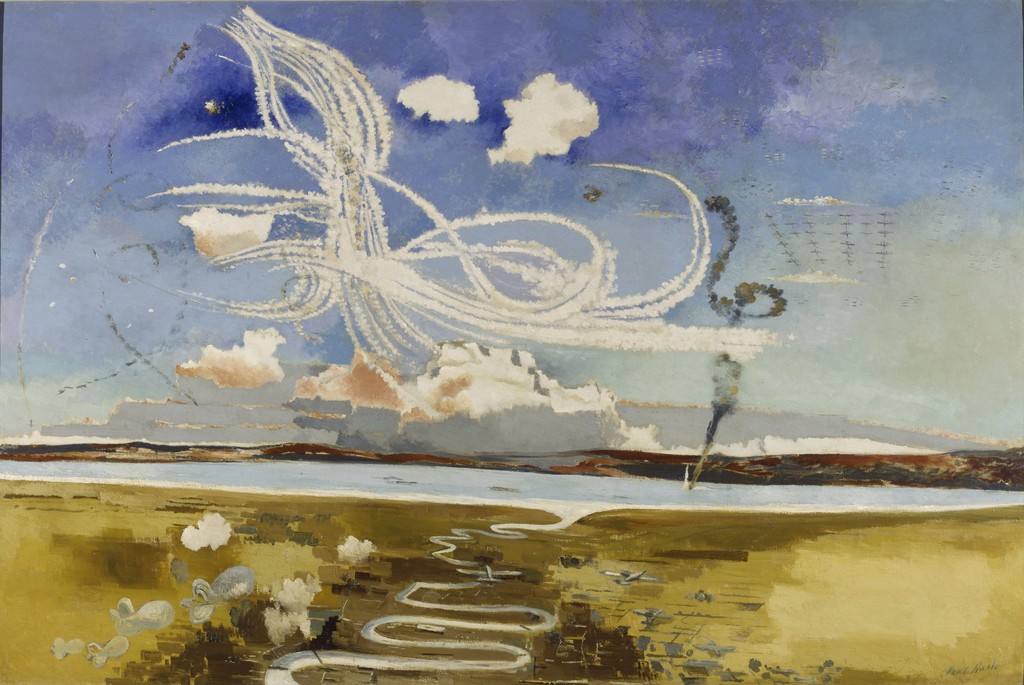
Battle of Britain was completed in 1941. The large oil on canvas, now at Imperial War Museums, is catalogued as ART LD 1550 and measures 1,226 × 1,835 × 23 mm at the support.[6] Its viewpoint encompasses a winding river, parched land, coast, Channel and the distant continent beneath an immense sky.
Aircraft formations occupy only part of that space. Vapour and smoke trails curve and plunge; balloons and parachutes punctuate the air; cloud masses gather towards sunset. IWM describes the painting as an imaginative summary rather than a factually exact record.[6] It therefore does not reconstruct one engagement at a named hour. The geography suggests the Thames Estuary, but scale and proportion yield to the need to show a campaign unfolding over a broad area.
The distinction is important. A title naming the Battle of Britain may invite the expectation of illustrated military history, yet Nash offers an overall impression of systems in conflict. Ordered enemy formations meet more fluid arcs, while vulnerable ground lies below. The painting’s public function and its symbolic organisation coexist: it communicates resistance and victory, but does so through rhythm, weather, distance and an invented aerial command of the scene.
Battle of Germany: Suspense and Bombardment
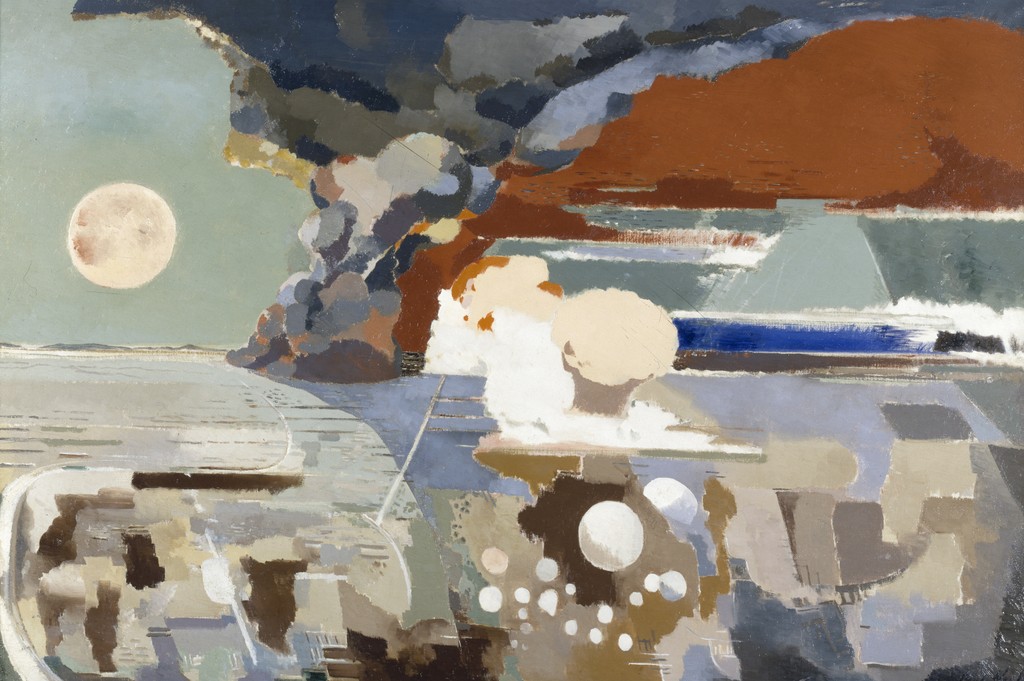
Battle of Germany, delivered in 1944, is the last major war painting Nash completed. IWM catalogues it as ART LD 4526, an oil on canvas measuring 1,219 × 1,828 mm.[7] The picture again takes an aerial subject without claiming an eyewitness view. This time the imagined space is split between a city waiting under the moon and an area convulsed by bombardment.
The two halves do not form a neat before-and-after sequence. Smoke, red sky, descending discs, flashes and unstable forms create competing states within one field. IWM’s account notes that Nash used colour and deliberately arbitrary forms to suggest explosion and detonation; it also records the ambiguity of the floating discs, which may evoke parachutes or aircrew escaping damaged aircraft.[7] Meaning remains active because the forms are not reduced to technical labels.
The painting gathers several strands of Nash’s wartime vision. Aerial photographs contribute information, the high viewpoint supplies scope, and moon, smoke pillar and fungal shapes carry associations beyond reportage. Bombardment becomes both an event and a disturbance of the whole environment. Compared with Battle of Britain, the composition offers less geographic clarity and more violent internal division.
Beyond the Propaganda Label
Official commissions had public purposes. The IWM interpretation of Battle of Britain places it within a wartime argument about RAF resistance and the defeat of Nazi Germany.[6] Calling the picture propaganda is therefore not wrong, but it is incomplete. The label identifies an intended civic function; it does not explain why the aircraft resemble organic forms, why weather occupies so much of the canvas, or why spatial inconsistencies are essential to the effect.
The British Council describes Nash’s Second World War pictures as both sinister and lyrical, Surreal in their transformations yet rooted in English landscape painting.[3] That tension limits any one-dimensional reading. Totes Meer can register enemy losses and still make victory look cold and uncanny. Battle of Britain can celebrate defence while refusing the viewpoint of a single heroic pilot. Battle of Germany can accompany an official campaign while presenting bombardment as unstable, difficult to contain and imaginatively troubling.
Nash’s war art is most revealing when commission and invention are considered together. Institutions supplied subjects, audiences and historical urgency. His own visual habits—metaphor, analogy, compressed design and attention to landscape—determined how those demands became pictures.
Natural Cycles in the Late War Years
Nature did not disappear when Nash turned to aircraft. It became one of the means by which machinery and destruction could be reconsidered. Waves organise the wreckage in Totes Meer; cloud and flower-like aerial patterns animate Battle of Britain; moon, smoke and fungal forms complicate Battle of Germany. These analogies can carry opposing meanings, since growth and extinction, beauty and violence may share a shape.
The late sunflower paintings make that ambiguity especially clear. Eclipse of the Sunflower of 1945 is one of Nash’s final two oil paintings. The British Council relates its detached flower head, darkened disc and stormy setting to a larger meditation on seasonal death and renewal.[8] This institutional interpretation provides context, but it does not turn every wartime motif into a fixed code. The continuity lies in Nash’s sustained interest in cycles, correspondences and transformed natural forms.
Seen from this later perspective, the Second World War paintings do more than replace the trenches of 1917 with aeroplanes. They test whether landscape painting can address a war conducted through altitude, speed and mechanical distance. Nash answered by making the sky a landscape, wreckage a sea and bombardment a field of unstable signs.
About this directory: These 129 entries form a reproducible researched online works census assembled from current public records. It is not a catalogue raisonné and does not claim absolute completeness.
Artworks directory
| Name | Date | Medium |
|---|---|---|
| A Christmas Card to Arthur and Madeline Clifton, 1926 | 1926 | |
| A German Double Pill Box | 1918 | |
| A Howitzer Firing | 1914 | Painting |
| A Night Bombardment | 1919 | Painting |
| A Shell Crater | 1918 | Drawing |
| Battle of Britain | 1941 | Painting |
| Battle of Germany | 1944 | Painting |
| Beeches in the Wind by Paul Nash - Paul Nash | 1918 | Artwork |
| Behind the Inn | 1920 | Painting |
| Berkshire Downs | 1922 | Painting |
| Blue House on the Shore | 1930 | Painting |
| Bouquet | Date unknown | Painting |
| Bouquet - Paul Nash | 1927 | Artwork |
| Buckinghamshire Landscape | 1927 | Painting |
| Cactus | 1928 | Painting |
| Chestnut Waters | Date unknown | Painting |
| Circle of the Monoliths | 1937 | Painting |
| Cliffs | Date unknown | Drawing |
| Cloudscape (recto) | 1939 | Painting |
| Composition (Design for Today) | 1934 | Painting |
| Coronilla | 1929 | Painting |
| Cotswold Hills | 1920 | Painting |
| Day Fighter | 1940 | Painting |
| Dead Spring | 1929 | Painting |
| Defence of Albion | 1942 | Painting |
| Design for a bookplate for Kenneth Fitzpatrick Mackenzie | 1909 | Drawing |
| Division of the Light from the Darkness | 1924 | |
| Druid Landscape | 1938 | Painting |
| Dunbarton Lakes | 1910 | Drawing |
| Dymchurch, Kent | Date unknown | Painting |
| Dymchurch Steps | Date unknown | Painting |
| Dymchurch - The Strange Coast | 1920 | |
| Eclipse of the Sunflower | 1945 | Painting |
| Edge of the marsh | 1925 | Painting |
| Equivalents for the Megaliths | 1935 | Painting |
| Event on the Downs | 1934 | Painting |
| Flight of the Magnolia | 1944 | Painting |
| Footballers Prefer Shell | 1935 | Painting |
| Fruits and Vegetables | 1930 | |
| Granary | 1922 | Painting |
| Graveyard in a Ruined Orchard near Vimy | 1917 | Drawing |
| Grotto in the Snow | 1939 | Painting |
| Harbour and Room | 1934 | Painting |
| Iver Heath, Buckinghamshire, Snow | 1927 | Painting |
| Kinetic Feature | 1931 | Painting |
| Landscape | 1926 | Painting |
| Landscape at Iden | 1929 | Painting |
| Landscape Composition (Objects in Relation) | 1934 | Painting |
| Landscape from a Dream | 1937 | Painting |
| Landscape of Bleached Objects | 1934 | Painting |
| Landscape of the Bagley Woods | 1943 | Painting |
| Landscape of the Brown Fungus | 1943 | Painting |
| Landscape of the Malvern Distance | 1943 | Painting |
| Landscape of the Megaliths | 1934 | Painting |
| Landscape of the Moon's First Quarter | 1943 | Painting |
| Landscape of the Moon's Last Phase | 1944 | Painting |
| Landscape of the summer solstice | Date unknown | Painting |
| Landscape of the Vernal Equinox (III) | 1944 | Painting |
| Landscape (verso) | 1939 | Painting |
| Landscape with Megaliths - Paul Nash | 1936 | |
| Landscape - Year of Our Lord, 1917 | 1910 | Drawing |
| Lares | 1929 | Painting |
| March Landscape | 1944 | Painting |
| Men Marching at Night | 1918 | |
| Metamorphosis | 1938 | Painting |
| Michaelmas Landscape | 1943 | Painting |
| Mimosa Wood | 1926 | Painting |
| Mineral Object | 1935 | Painting |
| 'Modern Textiles' (shop sign board) | 1926 | Painting |
| Monument to Fallen Canadians on Vimy Ridge | 1917 | Drawing |
| Nest of the Siren | 1930 | Painting |
| Night Fighter | 1940 | Painting |
| Nocturnal Landscape | 1938 | Painting |
| Northern Adventure | 1929 | Painting |
| Nostalgic Landscape | 1930 | Painting |
| November Moon | 1942 | Painting |
| Oxenbridge Pond | 1927 | Painting |
| Oxford During the War | 1942 | Painting |
| Pillar and Moon | 1937 | Painting |
| Pink Hyacinth | 1921 | Painting |
| Plage | 1928 | Painting |
| Riviera Landscape | 1926 | Painting |
| Riviera Window, Cros-de-Cagnes | 1926 | Painting |
| Sandling Park, Kent | 1924 | Painting |
| Sluice | 1920 | |
| Solstice of the Sunflower | 1945 | Painting |
| Souvenir of Florence | 1929 | Painting |
| Spring in the Trenches, Ridge Wood, 1917 | 1918 | Painting |
| St Pancras Lilies | 1927 | Painting |
| St Pancras, London | 1927 | Painting |
| Still Life I - Paul Nash | 1924 | Artwork |
| Still Life with Bog Cotton | 1927 | Painting |
| Strange Coast | 1920 | |
| Study of Mrs. Nash | 1916 | Drawing |
| Sunflower and sun | 1942 | Painting |
| Sunrise, Inverness Copse | 1918 | Painting |
| Telecommunications | 1934 | Painting |
| The Archer | Date unknown | Painting |
| The Diving Stage | 1928 | Painting |
| The Edge of the Wood | 1919 | Painting |
| The Menin Road | 1919 | Painting |
| The Mule Track | 1918 | Painting |
| The Pond at Souldern | 1926 | Painting |
| The Raider on the Moors | 1940 | |
| The Rye Marshes, East Sussex | 1932 | Painting |
| The Sea | 1923 | Painting |
| The Sea Wall | 1920 | |
| The Shore | 1923 | Painting |
| The Stackyard | 1925 | Painting |
| The Window, Iver Heath | Date unknown | Painting |
| The Ypres Salient at Night | 1918 | Painting |
| Through a Window, Riviera | 1927 | Painting |
| Tide at Dymchurch | 1920 | |
| Token [verso: Tree in a Landscape (unfinished)] | 1929 | Painting |
| Totes Meer (Dead Sea) | 1940 | Painting |
| Vale of the White Blackbird | 1942 | Painting |
| View from a Window, Nice | 1934 | Painting |
| View R | 1940 | Painting |
| Void | 1918 | Painting |
| Voyages of the Moon | 1935 | Painting |
| We Are Making a New World | 1918 | Painting |
| Whiteleaf Cross | 1931 | Painting |
| Winter, Hampden | Date unknown | |
| Winter Sea | 1931 | Painting |
| Wittenham Clumps | 1943 | Painting |
| Wood on the Downs | 1929 | Painting |
| Wooded Landscape | 1942 | Painting |
| Worth Matravers, Dorset | 1936 | Drawing |
| Wounded, Passchendaele | Date unknown | Painting |
Frequently Asked Questions
No. Imperial War Museums states that Nash had never flown and that his aerial views were imaginative constructions.[4] He used research, including aerial photographs, to build perspectives that could suggest the breadth of air warfare without presenting them as personal memories of flight.[7]
Nash had long found visual correspondences between objects, landscape and living forms. In the war pictures, aircraft can resemble birds, wrecked wings can behave like waves, and trails can open like flowers. These are composed analogies, not claims that machines are natural. They allow mechanical war to enter his established language of landscape and transformation.[3]
The German title means “Dead Sea”. It refers to the way Nash transformed a dump of wrecked German aircraft at Cowley into an apparently frozen expanse of metal. The work remains tied to that real Oxfordshire site, but its sea-like rhythm turns salvage into an uncanny landscape.[5]
No. IWM treats it as an imaginative summary of the campaign rather than a literal record of one combat.[6] Nash combines geography, weather, aircraft formations, smoke trails, balloons and parachutes to convey action occurring over a wide area.
Battle of Germany was his last major completed war painting. Nash delivered it in 1944. The work presents an imagined bombing raid through a divided composition of moonlit suspense, smoke, descending forms and violent colour rather than through a single witnessed incident.[7]
Discussion
What should readers notice when looking closely at Paul Nash: Second World War Art?
Reader Insights
Watch how clouds, trails, wreckage and natural forms exchange visual roles.
Remember that Nash imagined aerial views from the ground and from gathered evidence.
Does distance clarify war or make its violence more unsettling?
Join the Conversation
Share your reading below, keeping observations specific and evidence clear.
References
- Paul Nash fonds TGA 769 — Tate Archive, accessed 31 August 2026.
- Paul Nash chronology — Oxfordshire Blue Plaques Board, accessed 31 August 2026.
- Paul Nash artist record — British Council, accessed 31 August 2026.
- Visions of War Above and Below — Imperial War Museums, accessed 31 August 2026.
- Totes Meer (Dead Sea), N05717 — Tate, accessed 31 August 2026.
- Battle of Britain, ART LD 1550 — Imperial War Museums, accessed 31 August 2026.
- Battle of Germany, ART LD 4526 — Imperial War Museums, accessed 31 August 2026.
- Eclipse of the Sunflower — British Council, accessed 31 August 2026.