


 by Tom Gurney
Tom Gurney BSc (Hons) is an art history expert with over 20 years experience
Page Created on August 31, 2026 / Page Updated on November 6, 2026
Email: tomgurney1@gmail.com / Phone: +44 7429 011000
Paul Nash Paintings and Artworks: Introduction
Paul Nash worked across painting, watercolour, drawing, printmaking, photography and design. These were not isolated careers. A shape first noticed in a field might reappear in a photograph, become more abstract in a print and acquire a new setting on canvas. Looking across media reveals a practice held together by landscape, transformed objects and the pressure of historical events.[1][2]
At a Glance
- Active yearsFrom early drawings before the First World War to paintings completed shortly before his death in 1946.[1]
- Principal mediaOils, watercolours, drawings, lithographs, wood engravings, photographs, book work and applied design.[1][2]
- Major subjectsEnglish landscape, two world wars, coastlines, ancient stones, found objects, dreams and natural cycles.
- AffiliationsOfficial war artist, president of the Society of Industrial Artists and founder of Unit One.[1][2]
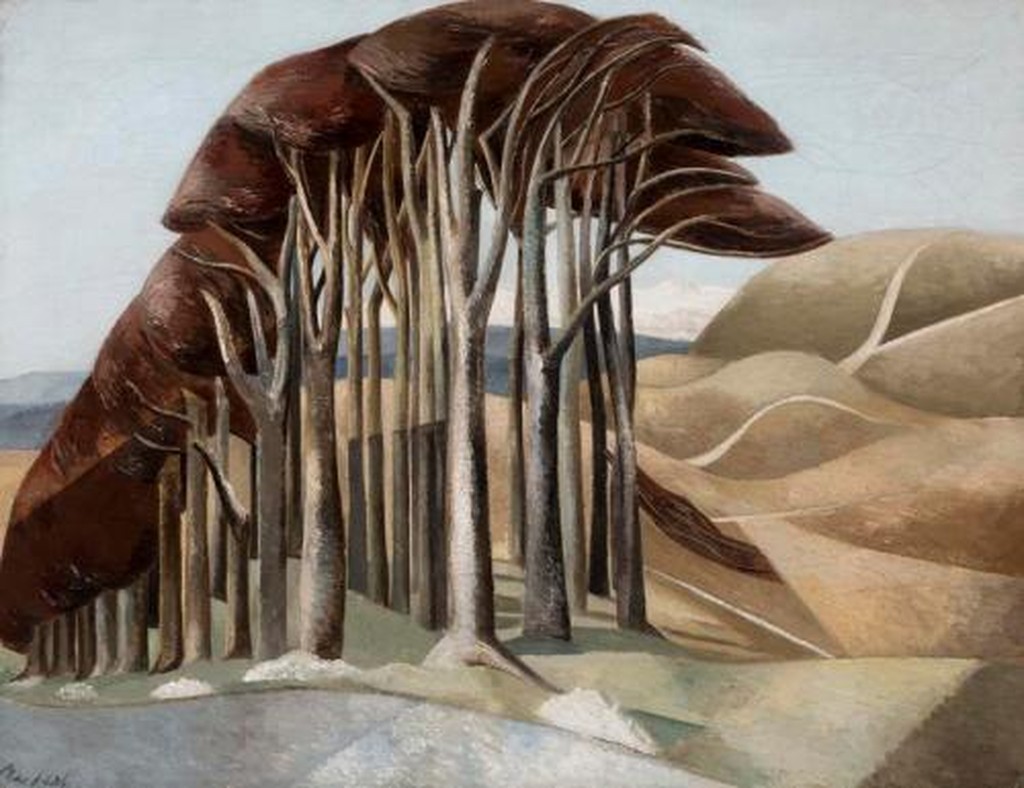
- Six studiesThree First World War paintings, two Second World War paintings and the 1929 landscape Wood on the Downs.
- Census scope129 distinct visual records drawn from a dated online dataset; useful for discovery, but not a total of Nash’s surviving output.[3]
Contents
- One Practice across Many Materials
- Drawing, Watercolour and Early Landscape
- War on Paper, Stone and Canvas
- Dymchurch, Books and Designed Surfaces
- Unit One, Ancient Stones and Surrealism
- Photographs and Object Poems
- Air War and Late Natural Cycles
- Six Works for Closer Viewing
- How to Read the 129-Work Census
- Collections and Continuing Research
One Practice across Many Materials
Nash’s paintings become clearer when seen beside his work on paper and behind the camera. Drawing trained his attention on silhouettes and intervals. Print processes encouraged firm contrasts and economical shapes. Photography isolated objects and chance arrangements, while commercial and book design tested how an image worked at a smaller scale or for a particular use. Oil paint offered different possibilities of colour, texture and revision, but it did not replace those other ways of thinking.[1][2]
The medium attached to an individual object still matters. A watercolour wash, an incised wood engraving and a layered oil produce different kinds of space. The aim is therefore not to treat everything as painting, but to follow motifs as they move through the wider body of work.
Selected Paul Nash Artworks
Drawing, Watercolour and Early Landscape
Landscape established Nash’s direction before either world war. His Slade training in 1910–11 was followed by a first London exhibition in 1912, with drawing central to his emerging reputation.[1] In early work, trees, pools, hills and paths are both observed features and strong organising forms. Watercolour allowed atmosphere and weather to remain mobile; pencil and ink could make a tree line or ridge more emphatic.
The Ashmolean’s British Drawings research places Nash within the movement from academic draughtsmanship towards British modernism and confirms the importance of works on paper within public collections.[4] The Landscape and Place guide traces the changing environments behind this practice. Yale’s Landscape of 1926 offers one institutional point of reference for the interwar phase, when recognisable terrain could be arranged through increasingly concise planes.[5]
War on Paper, Stone and Canvas
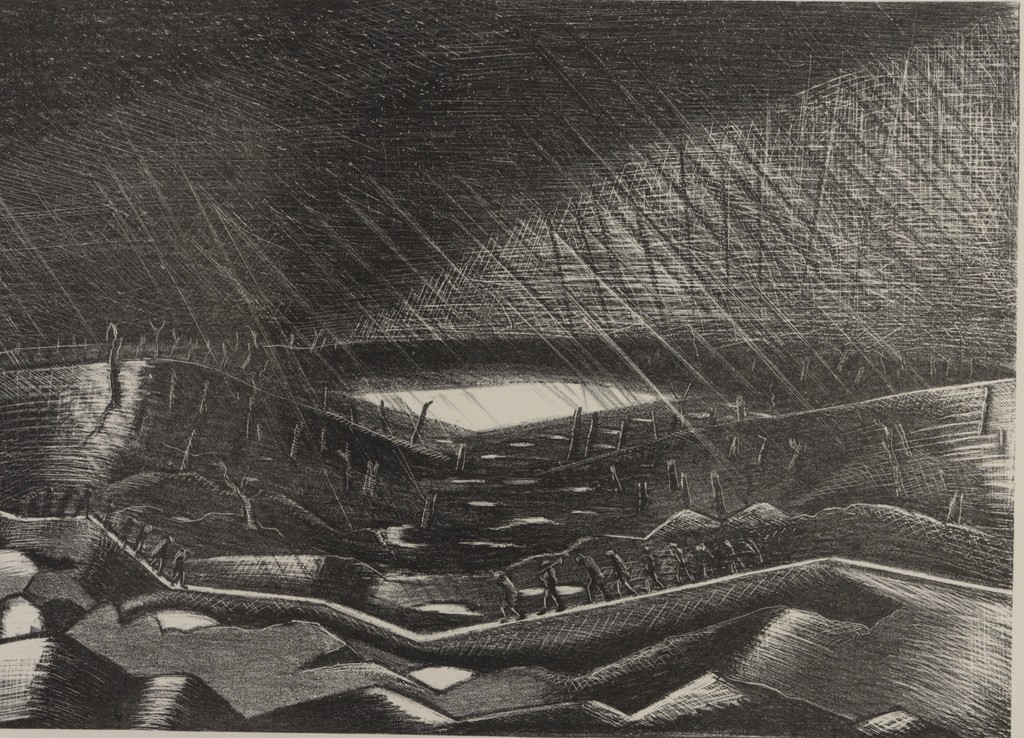
Nash first recorded the Western Front in drawings. After an accidental injury brought him back from active service in 1917, his London exhibition of front-line work preceded his return to France as an official war artist.[1] The resulting First World War art moved between immediate notation, lithographic translation and ambitious oils.
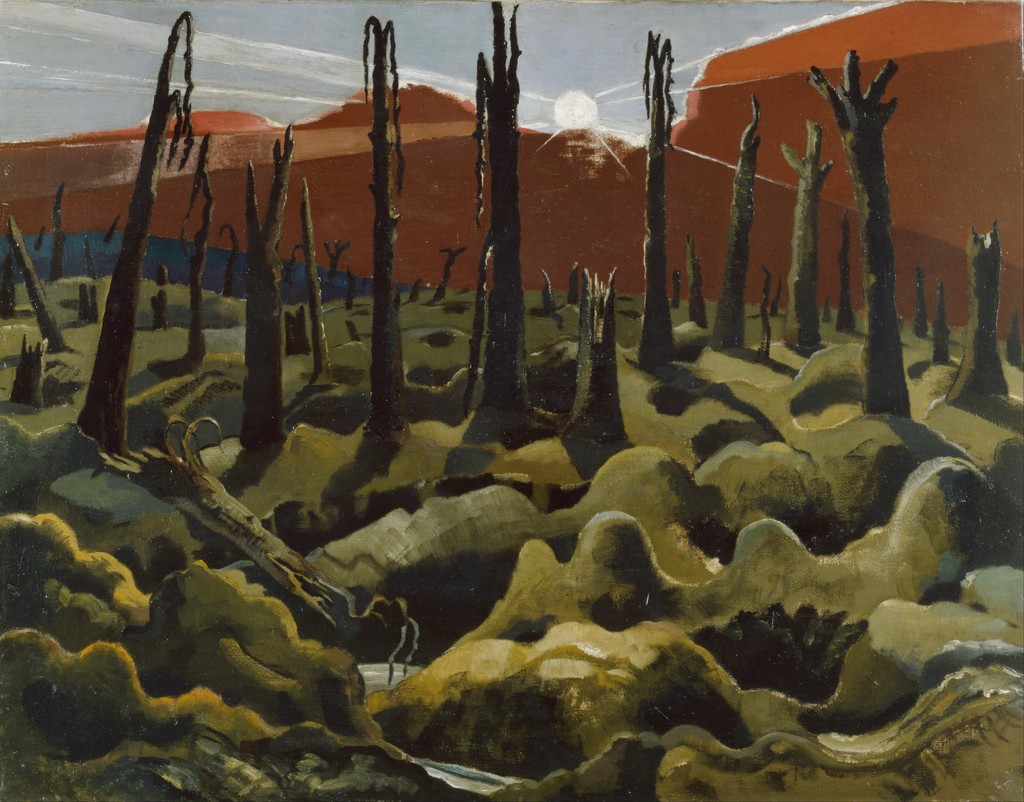
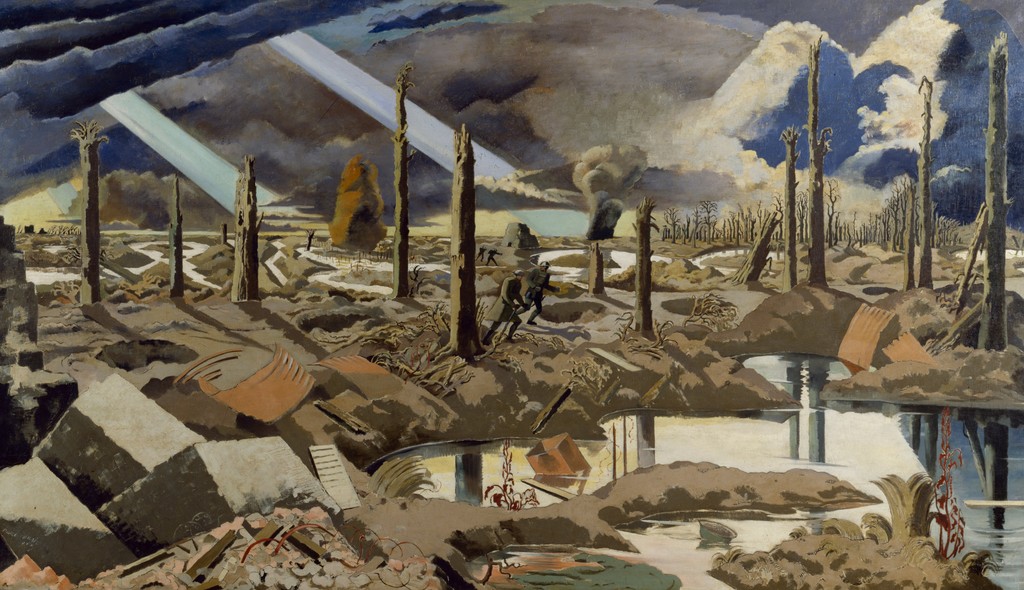
The British Council’s record for German Double Pill Box, Gheluvelt connects the 1917 experience with the wartime lithographs shown in 1918.[6] Repetition and hard black-white contrast made damaged trees, blockhouses and broken ground legible in print. Oil permitted a different scale and density. We Are Making a New World concentrates the battlefield into parallel furrows and splintered trunks; The Menin Road spreads unstable routes and flooded craters across a canvas more than three metres wide; The Mule Track sets human and animal movement against the sweep of bombardment.[7][8][9]
These oils are not enlarged field sketches. Each reorganises witnessed terrain in order to control pace, emphasis and the viewer’s relation to destruction.
Dymchurch, Books and Designed Surfaces
In the 1920s, Dymchurch gave Nash a landscape structured by sea walls, steps, water and horizon. The coast joined natural force to engineered defence, encouraging images built from long bands, abrupt angles and exposed intervals. Works associated with Dymchurch exist in different media and under distinct titles; Dymchurch – The Strange Coast must not be confused with Dymchurch Steps.[2][3]
At the same time, Nash made illustrations, jackets, wood engravings and applied designs. The V&A’s study of his book work shows graphic form responding both to war and to newer artistic ideas.[10] Its stage-design material also documents his contribution to J. M. Barrie’s The Truth about the Russian Dancers, around 1922.[11] The Photography, Design and Prints guide follows this traffic between private observation, printed circulation and commissioned objects.
Unit One, Ancient Stones and Surrealism
Nash founded Unit One in 1933 as an alliance of progressive painters, sculptors and architects. Abstraction and Surrealism supplied new strategies, but his art remained tied to encountered things and specific places.[2] Avebury was especially productive. Landscape of the Megaliths presents ancient stones through modern geometrical relationships, connecting archaeological interest with the design of a contemporary picture.[12]
The Megaliths and Ancient Landscape guide distinguishes that 1934 painting from Equivalents for the Megaliths, Druid Landscape and Landscape with Megaliths. An album annotated by Paul and Margaret Nash provides useful evidence for the dating and cross-media life of several works from this period.[13]
Within Modernism and Surrealism, rooms open into landscapes, moons align with architectural forms and found objects take on unexpected agency. The strangeness often begins with a real discovery, then grows through placement, scale and association.
Photographs and Object Poems
Tate holds 1,267 negatives made by Nash between 1930 and 1946.[14] Their scale alone makes photography an important part of his work rather than incidental documentation. He framed stones, weathered wood, shadows and accidental groupings so that ordinary things could appear newly animate. These encounters fed what are often described as object poems: suggestive relationships among found forms rather than conventional still-life arrangements.
Photographs could record a discovery, test an angle or preserve a fleeting conjunction for later transformation. They also expose a limit in medium-based counts. The 129-record researched online works census contains paintings, drawings, prints and generically classified artworks, but it is not a census of those 1,267 negatives.[3][14]
Air War and Late Natural Cycles
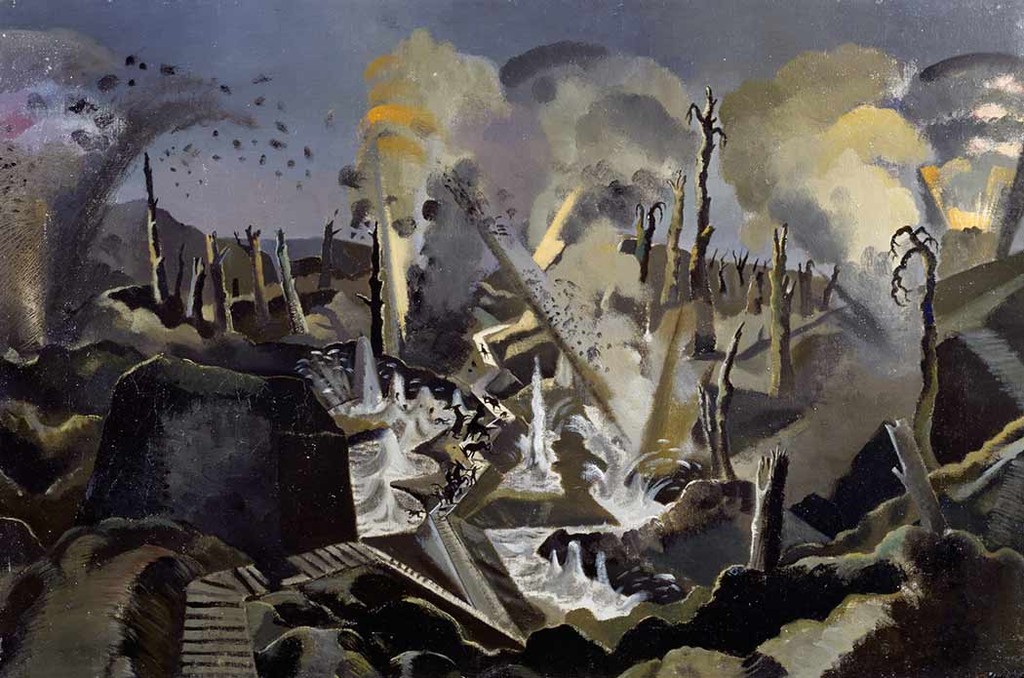
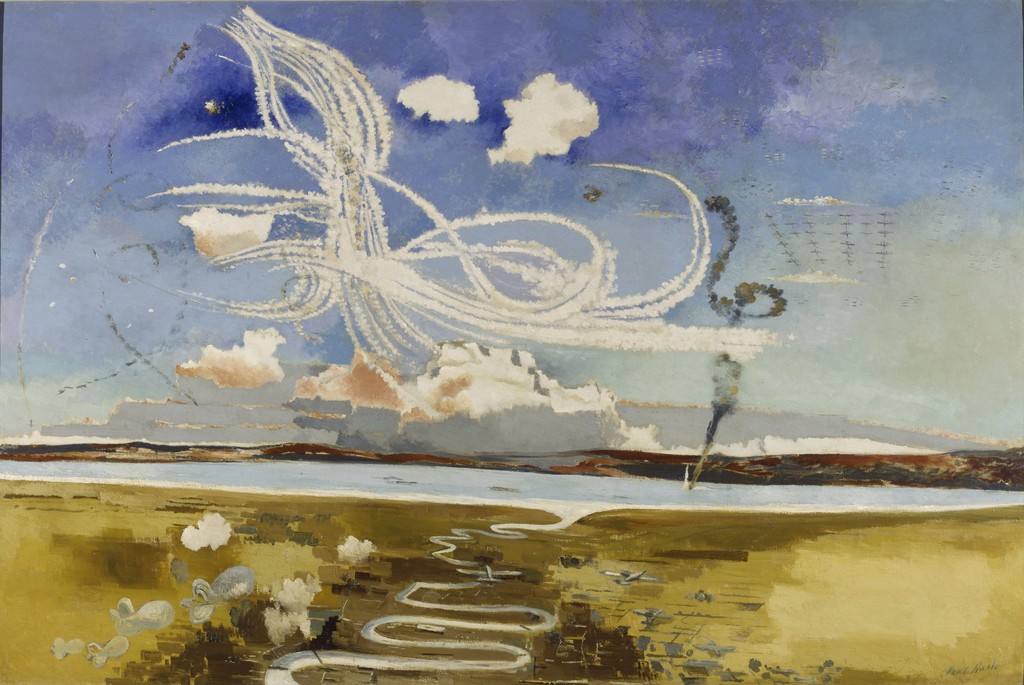
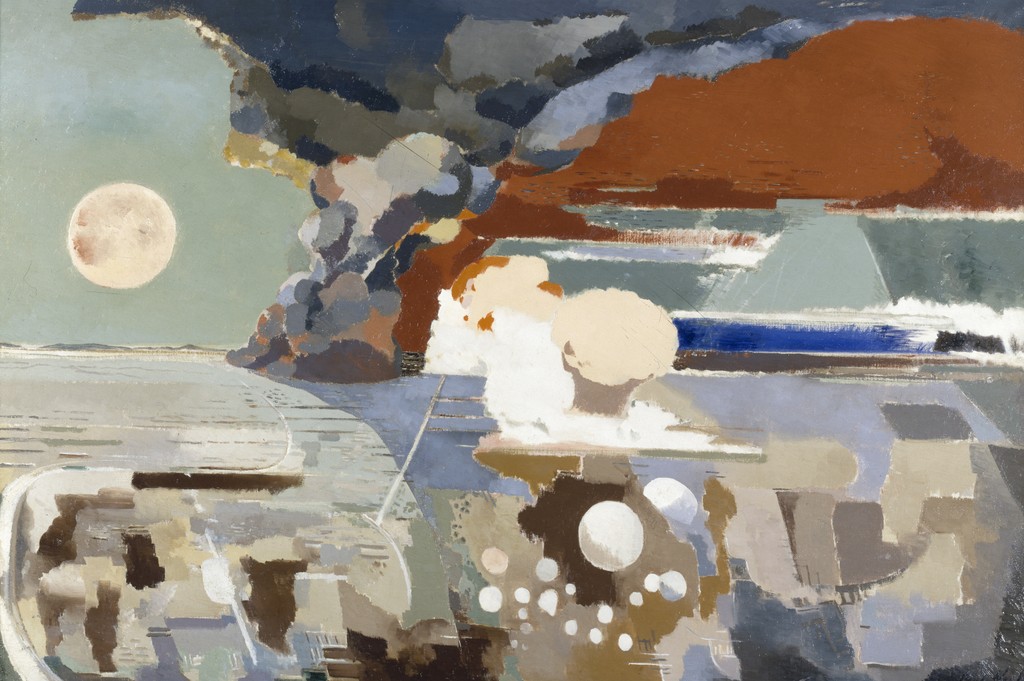
The Second World War art changes the dominant machinery and viewpoint. Battle of Britain organises aircraft, vapour trails, cloud, land and sea into a constructed panorama.[15] Battle of Germany compresses moonlight, smoke, fire and urban space into a 1944 image of bombardment.[16] Both are oils, yet their spatial logic owes something to Nash’s practice of gathering, selecting and combining visual material.
His late work also turned towards magnolia, moon, equinox and sunflower. Eclipse of the Sunflower belongs to a 1945 cycle in which a recognisable plant enters a larger pattern of decline, recurrence and celestial change.[17] The movement from machine wreckage to plant and moon is not a retreat from history; it broadens the question of transformation.
Six Works for Closer Viewing
Six detailed studies show the range contained within the works directory:
- We Are Making a New World (1918), IWM ART 1146, turns devastated ground and a pale sunrise into a charged contradiction.[7]
- The Menin Road (1918–19; catalogued 1919), IWM ART 2242, uses monumental oil painting to make the battlefield an obstructed environment.[8]
- The Mule Track (1918), IWM ART 1153, concentrates on bodies moving through shellfire.[9]
- Battle of Britain (1941), IWM ART LD 1550, constructs combat across an expansive aerial field.[15]
- Battle of Germany (1944), IWM ART LD 4526, joins separate zones of night, smoke and destruction.[16]
- Wood on the Downs (1929), Aberdeen Art Gallery ABDAG002949, offers a non-war comparison grounded in topography, structure and living form.[18]
How to Read the 129-Work Census
The researched online works census begins with a dated Wikidata search for records naming Paul Nash as creator. Repeated records were reconciled into 129 distinct entries: 104 paintings, 13 prints, nine drawings and three objects carrying only the broader classification “artwork”.[3] Six exact titles lead to the detailed studies above.
The census is a discovery tool, not an assertion that 129 works survive. Public databases are uneven: some collections publish rich object records, others expose only basic metadata, and many works have not entered the dataset. Unknown dates remain labelled as unknown rather than guessed. Photographs, book designs and other applied objects are especially under-represented. For any individual artwork, its holding institution’s record takes precedence over the aggregate entry.
Collections and Continuing Research
Imperial War Museums holds the five official-war paintings highlighted in the conflict studies, while Tate preserves both paintings and extensive archival material.[1][7][8][9][15][16] The British Council Collection, Yale Center for British Art, Aberdeen Art Gallery and many other museums add different periods and media. Art UK provides a national discovery layer across British public collections, while individual museum records remain the better source for exact object facts.[19]
The distribution matters because no single collection represents Nash’s whole practice. Moving between institutional records makes it possible to reconnect a war oil with drawings, a printed design with a photograph, or a landscape with later variations.
About this directory: These 129 entries form a reproducible researched online works census assembled from current public records. It is not a catalogue raisonné and does not claim absolute completeness.
Artworks directory
| Name | Date | Medium |
|---|---|---|
| A Christmas Card to Arthur and Madeline Clifton, 1926 | 1926 | |
| A German Double Pill Box | 1918 | |
| A Howitzer Firing | 1914 | Painting |
| A Night Bombardment | 1919 | Painting |
| A Shell Crater | 1918 | Drawing |
| Battle of Britain | 1941 | Painting |
| Battle of Germany | 1944 | Painting |
| Beeches in the Wind by Paul Nash - Paul Nash | 1918 | Artwork |
| Behind the Inn | 1920 | Painting |
| Berkshire Downs | 1922 | Painting |
| Blue House on the Shore | 1930 | Painting |
| Bouquet | Date unknown | Painting |
| Bouquet - Paul Nash | 1927 | Artwork |
| Buckinghamshire Landscape | 1927 | Painting |
| Cactus | 1928 | Painting |
| Chestnut Waters | Date unknown | Painting |
| Circle of the Monoliths | 1937 | Painting |
| Cliffs | Date unknown | Drawing |
| Cloudscape (recto) | 1939 | Painting |
| Composition (Design for Today) | 1934 | Painting |
| Coronilla | 1929 | Painting |
| Cotswold Hills | 1920 | Painting |
| Day Fighter | 1940 | Painting |
| Dead Spring | 1929 | Painting |
| Defence of Albion | 1942 | Painting |
| Design for a bookplate for Kenneth Fitzpatrick Mackenzie | 1909 | Drawing |
| Division of the Light from the Darkness | 1924 | |
| Druid Landscape | 1938 | Painting |
| Dunbarton Lakes | 1910 | Drawing |
| Dymchurch, Kent | Date unknown | Painting |
| Dymchurch Steps | Date unknown | Painting |
| Dymchurch - The Strange Coast | 1920 | |
| Eclipse of the Sunflower | 1945 | Painting |
| Edge of the marsh | 1925 | Painting |
| Equivalents for the Megaliths | 1935 | Painting |
| Event on the Downs | 1934 | Painting |
| Flight of the Magnolia | 1944 | Painting |
| Footballers Prefer Shell | 1935 | Painting |
| Fruits and Vegetables | 1930 | |
| Granary | 1922 | Painting |
| Graveyard in a Ruined Orchard near Vimy | 1917 | Drawing |
| Grotto in the Snow | 1939 | Painting |
| Harbour and Room | 1934 | Painting |
| Iver Heath, Buckinghamshire, Snow | 1927 | Painting |
| Kinetic Feature | 1931 | Painting |
| Landscape | 1926 | Painting |
| Landscape at Iden | 1929 | Painting |
| Landscape Composition (Objects in Relation) | 1934 | Painting |
| Landscape from a Dream | 1937 | Painting |
| Landscape of Bleached Objects | 1934 | Painting |
| Landscape of the Bagley Woods | 1943 | Painting |
| Landscape of the Brown Fungus | 1943 | Painting |
| Landscape of the Malvern Distance | 1943 | Painting |
| Landscape of the Megaliths | 1934 | Painting |
| Landscape of the Moon's First Quarter | 1943 | Painting |
| Landscape of the Moon's Last Phase | 1944 | Painting |
| Landscape of the summer solstice | Date unknown | Painting |
| Landscape of the Vernal Equinox (III) | 1944 | Painting |
| Landscape (verso) | 1939 | Painting |
| Landscape with Megaliths - Paul Nash | 1936 | |
| Landscape - Year of Our Lord, 1917 | 1910 | Drawing |
| Lares | 1929 | Painting |
| March Landscape | 1944 | Painting |
| Men Marching at Night | 1918 | |
| Metamorphosis | 1938 | Painting |
| Michaelmas Landscape | 1943 | Painting |
| Mimosa Wood | 1926 | Painting |
| Mineral Object | 1935 | Painting |
| 'Modern Textiles' (shop sign board) | 1926 | Painting |
| Monument to Fallen Canadians on Vimy Ridge | 1917 | Drawing |
| Nest of the Siren | 1930 | Painting |
| Night Fighter | 1940 | Painting |
| Nocturnal Landscape | 1938 | Painting |
| Northern Adventure | 1929 | Painting |
| Nostalgic Landscape | 1930 | Painting |
| November Moon | 1942 | Painting |
| Oxenbridge Pond | 1927 | Painting |
| Oxford During the War | 1942 | Painting |
| Pillar and Moon | 1937 | Painting |
| Pink Hyacinth | 1921 | Painting |
| Plage | 1928 | Painting |
| Riviera Landscape | 1926 | Painting |
| Riviera Window, Cros-de-Cagnes | 1926 | Painting |
| Sandling Park, Kent | 1924 | Painting |
| Sluice | 1920 | |
| Solstice of the Sunflower | 1945 | Painting |
| Souvenir of Florence | 1929 | Painting |
| Spring in the Trenches, Ridge Wood, 1917 | 1918 | Painting |
| St Pancras Lilies | 1927 | Painting |
| St Pancras, London | 1927 | Painting |
| Still Life I - Paul Nash | 1924 | Artwork |
| Still Life with Bog Cotton | 1927 | Painting |
| Strange Coast | 1920 | |
| Study of Mrs. Nash | 1916 | Drawing |
| Sunflower and sun | 1942 | Painting |
| Sunrise, Inverness Copse | 1918 | Painting |
| Telecommunications | 1934 | Painting |
| The Archer | Date unknown | Painting |
| The Diving Stage | 1928 | Painting |
| The Edge of the Wood | 1919 | Painting |
| The Menin Road | 1919 | Painting |
| The Mule Track | 1918 | Painting |
| The Pond at Souldern | 1926 | Painting |
| The Raider on the Moors | 1940 | |
| The Rye Marshes, East Sussex | 1932 | Painting |
| The Sea | 1923 | Painting |
| The Sea Wall | 1920 | |
| The Shore | 1923 | Painting |
| The Stackyard | 1925 | Painting |
| The Window, Iver Heath | Date unknown | Painting |
| The Ypres Salient at Night | 1918 | Painting |
| Through a Window, Riviera | 1927 | Painting |
| Tide at Dymchurch | 1920 | |
| Token [verso: Tree in a Landscape (unfinished)] | 1929 | Painting |
| Totes Meer (Dead Sea) | 1940 | Painting |
| Vale of the White Blackbird | 1942 | Painting |
| View from a Window, Nice | 1934 | Painting |
| View R | 1940 | Painting |
| Void | 1918 | Painting |
| Voyages of the Moon | 1935 | Painting |
| We Are Making a New World | 1918 | Painting |
| Whiteleaf Cross | 1931 | Painting |
| Winter, Hampden | Date unknown | |
| Winter Sea | 1931 | Painting |
| Wittenham Clumps | 1943 | Painting |
| Wood on the Downs | 1929 | Painting |
| Wooded Landscape | 1942 | Painting |
| Worth Matravers, Dorset | 1936 | Drawing |
| Wounded, Passchendaele | Date unknown | Painting |
Frequently Asked Questions
There is no secure single total. The researched online works census contains 129 distinct visual records from one dated dataset, but it does not capture every collection or medium. Tate’s separate holding of 1,267 photographic negatives demonstrates why the directory figure cannot be treated as Nash’s complete output.[3][14]
There is no institutional ranking. We Are Making a New World, The Menin Road and Battle of Britain are useful starting points because each has a substantial museum record and represents a different problem of wartime landscape.[7][8][15]
He worked in oil and watercolour, drew in several media, produced lithographs and wood engravings, took photographs, illustrated books and designed for textiles, ceramics and the stage.[1][2][10][11]
They belong to any serious account of his artistic practice. Some photographs documented places or objects, while others shaped framing and relationships that informed later images. Museums may classify negatives separately from paintings and prints, so their absence from the 129-record census does not make them artistically marginal.[3][14]
Discussion
What should readers notice when looking closely at Paul Nash Paintings and Artworks?
Reader Insights
Compare how a motif behaves in drawing, print, photograph and oil paint.
Use the works census as a discovery tool whose limits remain visible.
Which medium most clearly alters Nash’s way of organising space?
Join the Conversation
Share your reading below, keeping observations specific and evidence clear.
References
- Paul Nash fonds TGA 769 — Tate Archive, accessed 31 August 2026.
- Paul Nash artist record — British Council Collection, accessed 31 August 2026.
- Paul Nash creator-statement works snapshot — Wikidata Query Service, accessed 31 August 2026.
- British Drawings project: Paul Nash context — Ashmolean Museum, accessed 31 August 2026.
- Landscape, B1992.13.9 — Yale Center for British Art, accessed 31 August 2026.
- German Double Pill Box, Gheluvelt — British Council Collection, accessed 31 August 2026.
- We Are Making a New World, ART 1146 — Imperial War Museums, accessed 31 August 2026.
- The Menin Road, ART 2242 — Imperial War Museums, accessed 31 August 2026.
- The Mule Track, ART 1153 — Imperial War Museums, accessed 31 August 2026.
- Paul Nash and the Art of the Book — Victoria and Albert Museum, accessed 31 August 2026.
- Assistant Curator Talk on Nash stage design — Victoria and Albert Museum, accessed 31 August 2026.
- Landscape of the Megaliths — British Council Collection, accessed 31 August 2026.
- Album annotated by Paul and Margaret Nash, 1933 onward — Tate Archive, accessed 31 August 2026.
- Negatives of 1,267 photographs taken by Paul Nash — Tate Archive, accessed 31 August 2026.
- Battle of Britain, ART LD 1550 — Imperial War Museums, accessed 31 August 2026.
- Battle of Germany, ART LD 4526 — Imperial War Museums, accessed 31 August 2026.
- Eclipse of the Sunflower — British Council Collection, accessed 31 August 2026.
- Wood on the Downs, ABDAG002949 — Aberdeen Archives, Gallery and Museums, accessed 31 August 2026.
- Paul Nash national holdings — Art UK, accessed 31 August 2026.