 by Tom Gurney
Tom Gurney BSc (Hons) is an art history expert with over 20 years experience
Page Created on August 31, 2026 / Page Updated on November 6, 2026
Email: tomgurney1@gmail.com / Phone: +44 7429 011000
The Mule Track: Introduction
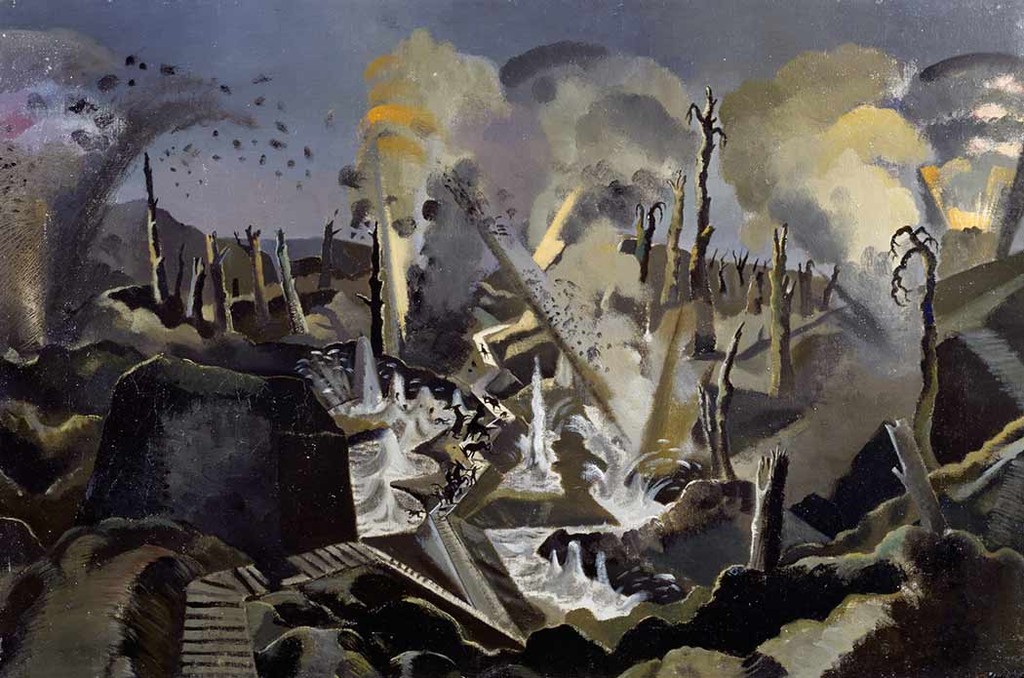
Paul Nash’s The Mule Track traps a military supply train inside an erupting landscape. Mules and handlers try to follow a duckboard route while shell bursts throw water, earth and smoke across their path. The figures are present, but hard to hold apart from the shattered ground. Movement, rather than a single heroic action, becomes the painting’s subject.[1]
At a Glance
- ArtistPaul Nash (1889–1946)
- Date1918
- Medium and sizeOil on canvas; support 609 × 914 mm
- CollectionImperial War Museums, London; accession ART 1153
- SubjectPack animals and their handlers caught under bombardment on a Western Front supply route
- War contextDeveloped after Nash’s 1917 service and return to France as an official war artist.[1][2]
Paul Nash in context
Contents
- The Exact IWM Object
- Finding the Mule Train
- Duckboards and Diagonal Movement
- Explosion, Smoke and Colour
- Mules, Handlers and Military Labour
- From Service to Official War Art
- Drawing, Memory and Studio Construction
- Movement beside Emptiness
- Collection Context and Continuing Value
The Exact IWM Object
Imperial War Museums identifies the painting as The Mule Track, 1918, ART 1153. Its support measures 609 by 914 millimetres.[1] The horizontal canvas is substantially wider than it is high, allowing the route and surrounding blasts to pull vision laterally as well as into depth.
The object is an oil, an important fact for a painter who had relied heavily on drawing and watercolour at the front. Oil enabled opaque dark masses, luminous bursts and layered greys to coexist on one surface. Yet the painting retains a draughtsman’s insistence on directional lines: planks, broken trees, smoke and projectiles all steer the eye.
Within the Paintings and Artworks survey, it shows how a new medium could transform field evidence rather than simply enlarge it.
Finding the Mule Train
The title tells viewers what to seek, but recognition takes time. Near the centre-left, pale and dark fragments resolve into pack animals and small handlers. Their bodies overlap with the track, thrown-up earth and the sharp white shapes of explosions. Nash does not give the group a clean outline or a calm profile.
That difficulty is meaningful. On a conventional animal painting, the mules would occupy an open field and their movement would be easy to follow. Here, they are one vulnerable current within a much larger disturbance. A handler’s effort to restrain or redirect a frightened animal is compressed into a knot of angled limbs and harness-like lines.[1]
The viewer’s initial uncertainty mirrors the convoy’s loss of control without pretending to reproduce what any one participant saw. Human and animal forms keep slipping back into the environment that threatens them.
Duckboards and Diagonal Movement
A boarded track enters from the lower left. Its repeated slats establish a rhythm before the route bends inward and becomes harder to distinguish. Rather than leading smoothly to a destination, it meets dark banks, broken timber and the central eruption. The track promises passage but cannot guarantee it.
Diagonals multiply around that route. A pale beam or plank points down towards the centre; columns of smoke lean and overlap; fragments cut across the sky. Even upright tree remnants appear unstable because they stand among sloping banks and bursts. The eye is urged forward, deflected and urged again.
This zig-zag organisation gives the composition speed while keeping it compressed. There is no broad, empty foreground from which to observe safely. Viewers begin close to the duckboards and enter the same obstructed system used by the convoy. The First World War Art context shows how often Nash made roads and tracks into contested structures rather than neutral lines through scenery.
Explosion, Smoke and Colour
Bombardment occupies almost every zone. At the left, a dark arc sprays debris across the blue-grey sky. Near the middle, white jets rise from the ground among angular fragments. Behind them, thick smoke forms columns and rounded clouds in grey, cream, mustard and yellow. Further flashes appear between the trees towards the right.
The colour does not merely decorate violence. Bright yellow and pale smoke interrupt an otherwise restricted field of black, olive, brown and slate. Those warm notes make explosions visible at a distance, while white ground bursts pull attention back towards the animals. The canvas continually exchanges foreground and background danger.
Nash also varies the apparent density of matter. Earth is heavy and dark; smoke swells but remains permeable; splashes turn briefly white; the sky is comparatively flat. Oil paint lets these material differences occupy the same compressed space. Institutional interpretation of First World War art describes violated landscape as a means of conveying both destructive force and human cost.[3] Here that force is still in motion.
Mules, Handlers and Military Labour
Mules were vital to moving supplies where mud, shell damage and narrow tracks limited vehicles. They could carry loads along precarious routes, but they were living animals exposed to noise, blast and panic. Nash’s subject brings logistical labour—often absent from conventional battle imagery—into view.[1]
The handlers face a double danger. They must survive the bombardment while preventing frightened animals from bolting off the duckboards. A misstep could send animal, person and load into broken or flooded ground. Their task is practical rather than theatrical, and the painting withholds any clear moment of mastery.
Animals therefore sharpen the work’s account of modern war. Industrial weapons have transformed the setting, yet movement still depends upon bodies, balance, training and touch. The convoy joins organic vulnerability to a mechanical system of supply. Neither mules nor handlers control the landscape through which that system requires them to pass.
From Service to Official War Art
Nash enlisted in the Artists Rifles in September 1914, gained a Hampshire Regiment commission in 1916 and served near Ypres in 1917. An accidental injury returned him to Britain. His front-line drawings were exhibited at the Goupil Gallery that June, after which he went back to France in an official artistic capacity.[2][4]
This chronology places The Mule Track between two kinds of authority. Nash knew military ground and movement as a serving officer, then revisited the front with a commission to gather visual material. The British Council’s record for German Double Pill Box, Gheluvelt connects his official return with the sketches and lithographs developed during 1917–18.[4]
The Paul Nash biography gives the full sequence. For this painting, the essential point is that observed conditions came before studio organisation. Direct experience did not remove the need to select and reconstruct.
Drawing, Memory and Studio Construction
The oil was not painted as an untouched report while shells fell. Nash used drawings and gathered observations to build a composition in which several dangers can be apprehended together. The multiple explosions, legible duckboard rhythm and crowded central action have been arranged for sustained looking.
That construction does not weaken the painting’s relation to experience. A sketch can secure a route, burst or figure rapidly; oil can combine such elements through colour and scale. Scholarly work on Paul and John Nash has examined how wartime material moved into public images and later cultures of remembrance.[5] The Mule Track belongs to that transformation from private encounter to durable object.
The distinction also prevents a false choice between fact and expression. Duckboards, supply animals, handlers and shelling are historically grounded. Their compressed relationship is pictorially made.
Movement beside Emptiness
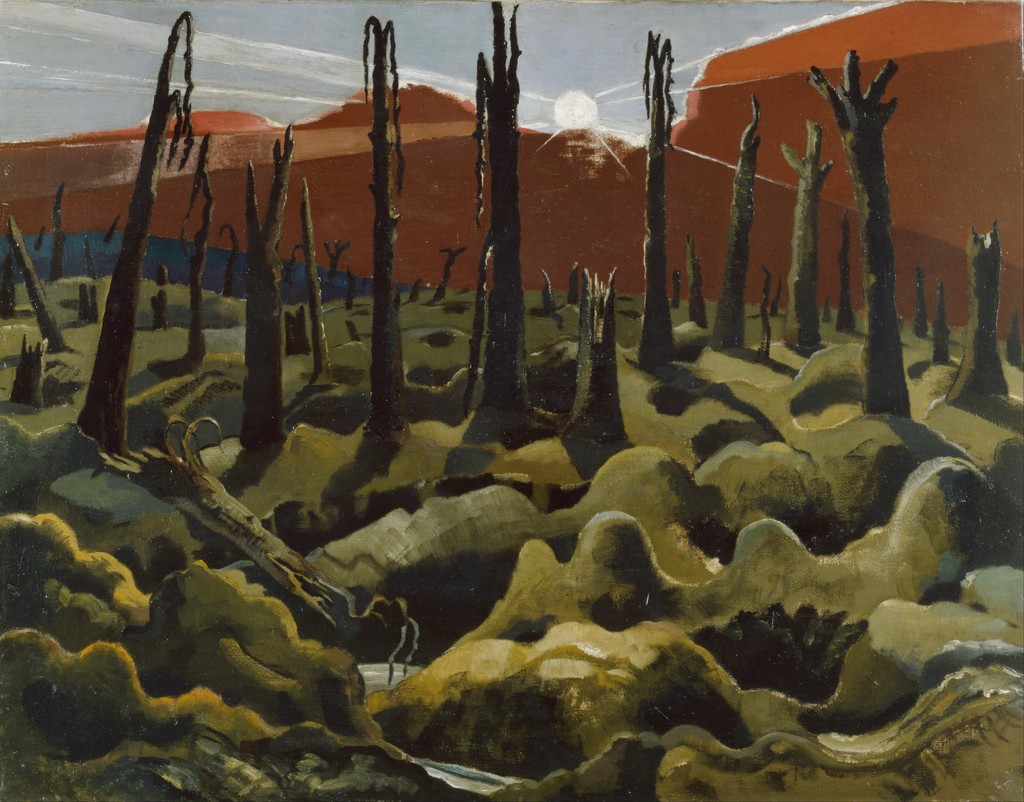
We Are Making a New World presents a battlefield without visible people. Its upright trunks and white sunrise produce a held, accusatory stillness. The Mule Track includes bodies and converts the battlefield into urgent motion. Shared broken trees and churned terrain perform different work in the two paintings.
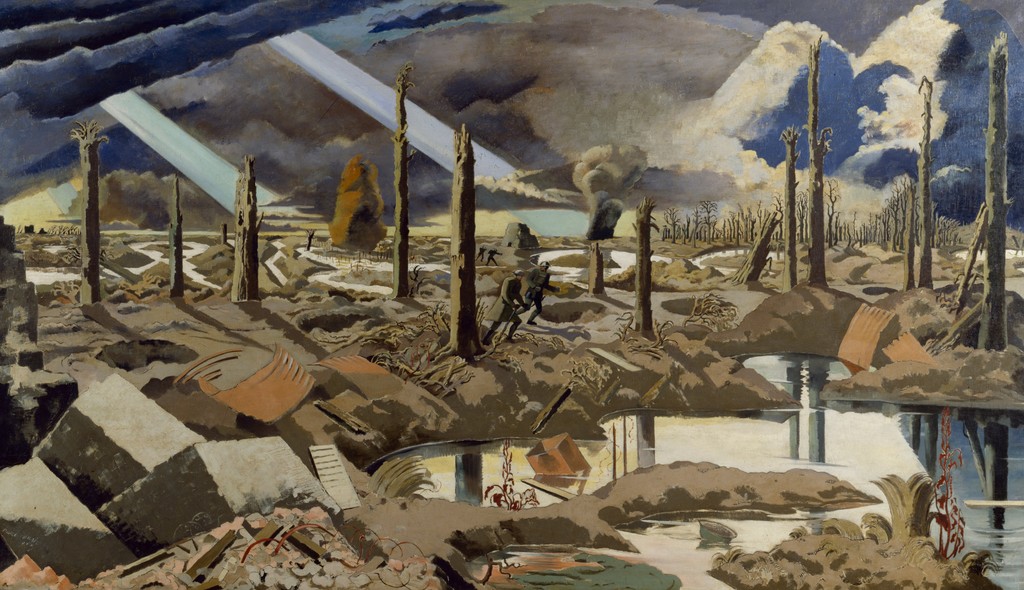
The Menin Road widens the problem again. Its monumental field makes two small figures negotiate a long system of flooded craters, ruins and blocked directions. By comparison, The Mule Track is more concentrated: the convoy appears close to the point where route, explosion and smoke collide.
These differences matter because Nash did not rely on one formula for devastation. Absence, obstructed passage and panicked movement create separate relationships between viewer and land.
Collection Context and Continuing Value
Imperial War Museums preserves The Mule Track as ART 1153 within its collection of British war art.[1] Its continuing value lies partly in its unusual focus. The painting neither isolates a weapon nor elevates an individual combatant. It attends to transport, animal labour and the difficulty of maintaining movement under fire.
That subject expands the history carried by Nash’s landscapes. The Western Front is shown not only as ruined ground but as an unstable network that humans and animals were compelled to use. Colour and diagonal structure keep the event immediate, while the compact canvas rewards the slower labour of finding its figures.
About this directory: These 129 entries form a reproducible researched online works census assembled from current public records. It is not a catalogue raisonné and does not claim absolute completeness.
Artworks directory
| Name | Date | Medium |
|---|---|---|
| A Christmas Card to Arthur and Madeline Clifton, 1926 | 1926 | |
| A German Double Pill Box | 1918 | |
| A Howitzer Firing | 1914 | Painting |
| A Night Bombardment | 1919 | Painting |
| A Shell Crater | 1918 | Drawing |
| Battle of Britain | 1941 | Painting |
| Battle of Germany | 1944 | Painting |
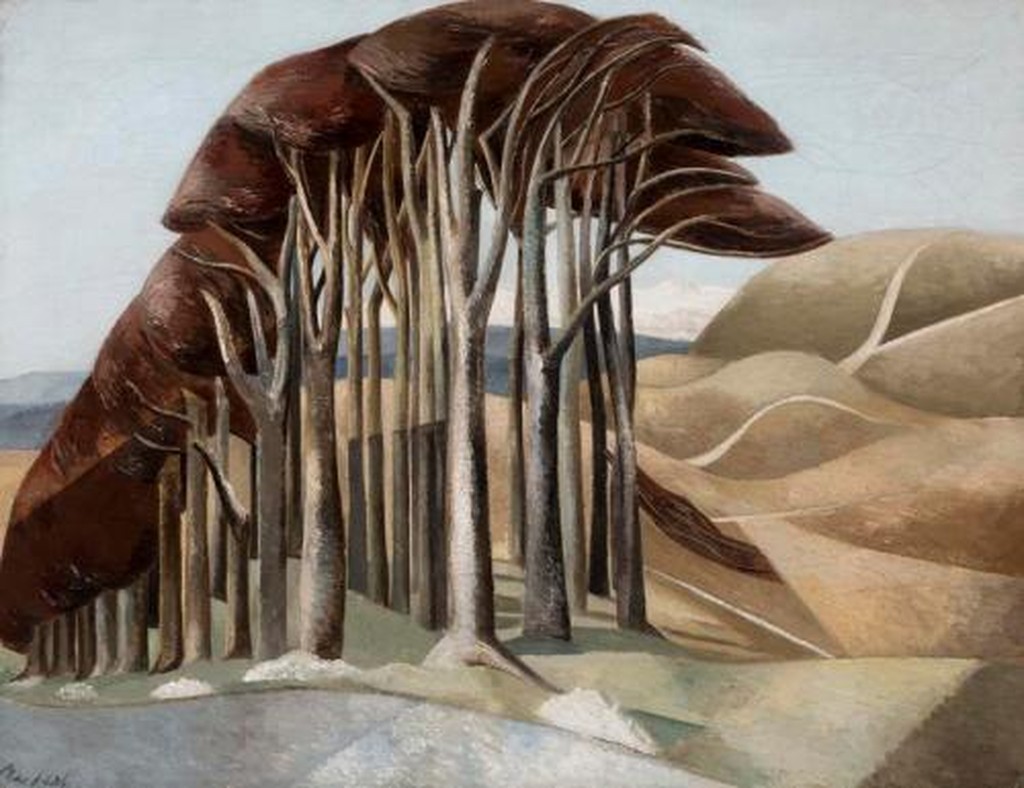
| Beeches in the Wind by Paul Nash - Paul Nash | 1918 | Artwork |
| Behind the Inn | 1920 | Painting |
| Berkshire Downs | 1922 | Painting |
| Blue House on the Shore | 1930 | Painting |
| Bouquet | Date unknown | Painting |
| Bouquet - Paul Nash | 1927 | Artwork |
| Buckinghamshire Landscape | 1927 | Painting |
| Cactus | 1928 | Painting |
| Chestnut Waters | Date unknown | Painting |
| Circle of the Monoliths | 1937 | Painting |
| Cliffs | Date unknown | Drawing |
| Cloudscape (recto) | 1939 | Painting |
| Composition (Design for Today) | 1934 | Painting |
| Coronilla | 1929 | Painting |
| Cotswold Hills | 1920 | Painting |
| Day Fighter | 1940 | Painting |
| Dead Spring | 1929 | Painting |
| Defence of Albion | 1942 | Painting |
| Design for a bookplate for Kenneth Fitzpatrick Mackenzie | 1909 | Drawing |
| Division of the Light from the Darkness | 1924 | |
| Druid Landscape | 1938 | Painting |
| Dunbarton Lakes | 1910 | Drawing |
| Dymchurch, Kent | Date unknown | Painting |
| Dymchurch Steps | Date unknown | Painting |
| Dymchurch - The Strange Coast | 1920 | |
| Eclipse of the Sunflower | 1945 | Painting |
| Edge of the marsh | 1925 | Painting |
| Equivalents for the Megaliths | 1935 | Painting |
| Event on the Downs | 1934 | Painting |
| Flight of the Magnolia | 1944 | Painting |
| Footballers Prefer Shell | 1935 | Painting |
| Fruits and Vegetables | 1930 | |
| Granary | 1922 | Painting |
| Graveyard in a Ruined Orchard near Vimy | 1917 | Drawing |
| Grotto in the Snow | 1939 | Painting |
| Harbour and Room | 1934 | Painting |
| Iver Heath, Buckinghamshire, Snow | 1927 | Painting |
| Kinetic Feature | 1931 | Painting |
| Landscape | 1926 | Painting |
| Landscape at Iden | 1929 | Painting |
| Landscape Composition (Objects in Relation) | 1934 | Painting |
| Landscape from a Dream | 1937 | Painting |
| Landscape of Bleached Objects | 1934 | Painting |
| Landscape of the Bagley Woods | 1943 | Painting |
| Landscape of the Brown Fungus | 1943 | Painting |
| Landscape of the Malvern Distance | 1943 | Painting |
| Landscape of the Megaliths | 1934 | Painting |
| Landscape of the Moon's First Quarter | 1943 | Painting |
| Landscape of the Moon's Last Phase | 1944 | Painting |
| Landscape of the summer solstice | Date unknown | Painting |
| Landscape of the Vernal Equinox (III) | 1944 | Painting |
| Landscape (verso) | 1939 | Painting |
| Landscape with Megaliths - Paul Nash | 1936 | |
| Landscape - Year of Our Lord, 1917 | 1910 | Drawing |
| Lares | 1929 | Painting |
| March Landscape | 1944 | Painting |
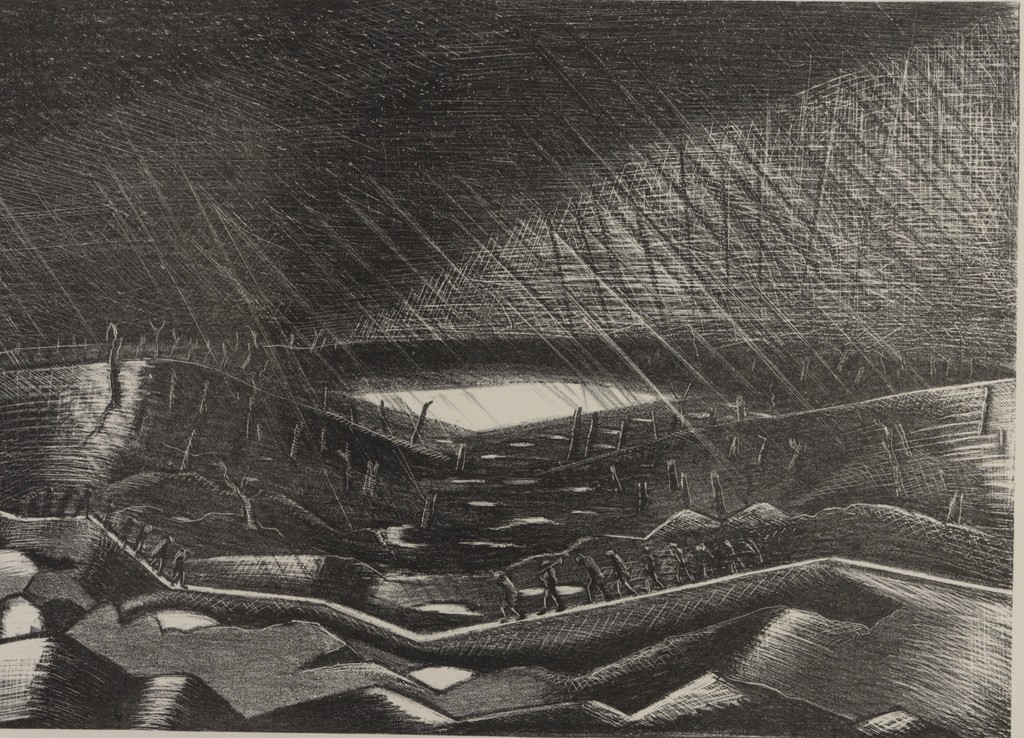
| Men Marching at Night | 1918 | |
| Metamorphosis | 1938 | Painting |
| Michaelmas Landscape | 1943 | Painting |
| Mimosa Wood | 1926 | Painting |
| Mineral Object | 1935 | Painting |
| 'Modern Textiles' (shop sign board) | 1926 | Painting |
| Monument to Fallen Canadians on Vimy Ridge | 1917 | Drawing |
| Nest of the Siren | 1930 | Painting |
| Night Fighter | 1940 | Painting |
| Nocturnal Landscape | 1938 | Painting |
| Northern Adventure | 1929 | Painting |
| Nostalgic Landscape | 1930 | Painting |
| November Moon | 1942 | Painting |
| Oxenbridge Pond | 1927 | Painting |
| Oxford During the War | 1942 | Painting |
| Pillar and Moon | 1937 | Painting |
| Pink Hyacinth | 1921 | Painting |
| Plage | 1928 | Painting |
| Riviera Landscape | 1926 | Painting |
| Riviera Window, Cros-de-Cagnes | 1926 | Painting |
| Sandling Park, Kent | 1924 | Painting |
| Sluice | 1920 | |
| Solstice of the Sunflower | 1945 | Painting |
| Souvenir of Florence | 1929 | Painting |
| Spring in the Trenches, Ridge Wood, 1917 | 1918 | Painting |
| St Pancras Lilies | 1927 | Painting |
| St Pancras, London | 1927 | Painting |
| Still Life I - Paul Nash | 1924 | Artwork |
| Still Life with Bog Cotton | 1927 | Painting |
| Strange Coast | 1920 | |
| Study of Mrs. Nash | 1916 | Drawing |
| Sunflower and sun | 1942 | Painting |
| Sunrise, Inverness Copse | 1918 | Painting |
| Telecommunications | 1934 | Painting |
| The Archer | Date unknown | Painting |
| The Diving Stage | 1928 | Painting |
| The Edge of the Wood | 1919 | Painting |
| The Menin Road | 1919 | Painting |
| The Mule Track | 1918 | Painting |
| The Pond at Souldern | 1926 | Painting |
| The Raider on the Moors | 1940 | |
| The Rye Marshes, East Sussex | 1932 | Painting |
| The Sea | 1923 | Painting |
| The Sea Wall | 1920 | |
| The Shore | 1923 | Painting |
| The Stackyard | 1925 | Painting |
| The Window, Iver Heath | Date unknown | Painting |
| The Ypres Salient at Night | 1918 | Painting |
| Through a Window, Riviera | 1927 | Painting |
| Tide at Dymchurch | 1920 | |
| Token [verso: Tree in a Landscape (unfinished)] | 1929 | Painting |
| Totes Meer (Dead Sea) | 1940 | Painting |
| Vale of the White Blackbird | 1942 | Painting |
| View from a Window, Nice | 1934 | Painting |
| View R | 1940 | Painting |
| Void | 1918 | Painting |
| Voyages of the Moon | 1935 | Painting |
| We Are Making a New World | 1918 | Painting |
| Whiteleaf Cross | 1931 | Painting |
| Winter, Hampden | Date unknown | |
| Winter Sea | 1931 | Painting |
| Wittenham Clumps | 1943 | Painting |
| Wood on the Downs | 1929 | Painting |
| Wooded Landscape | 1942 | Painting |
| Worth Matravers, Dorset | 1936 | Drawing |
| Wounded, Passchendaele | Date unknown | Painting |
Frequently Asked Questions
The painting shows pack mules and handlers struggling along duckboards during a bombardment. Smoke, debris and ground bursts surround the convoy, making its figures difficult to separate from the damaged terrain.[1]
Mules carried supplies over ground where mud, shell holes and damaged roads restricted motor transport. Their strength and footing were valuable, but they remained vulnerable to blast, noise and panic. Handlers had to keep them moving along narrow prepared tracks.[1]
It grew from Nash’s experience and drawings of the Western Front, including material gathered after he returned as an official war artist. The oil itself is a considered studio construction, not a scene completed during bombardment.[2][4]
He crossed a zig-zag duckboard route with leaning smoke, flying debris, broken trees and flashes of yellow and white. Overlapping the handlers and animals with those forms makes movement difficult to read and denies the convoy visual control.[1][3]
It belongs to Imperial War Museums in London and is recorded as ART 1153.[1] Museum displays can change, so visitors should check current object information before travelling.
Discussion
What should readers notice when looking closely at The Mule Track?
Reader Insights
Track the diagonal route through flashes, smoke, handlers and rearing animals.
Keep logistics and animal vulnerability visible within the official-war-art context.
Where does movement become a measure of fear?
Join the Conversation
Share your reading below, keeping observations specific and evidence clear.
References
- The Mule Track, ART 1153 — Imperial War Museums, accessed 31 August 2026.
- Paul Nash fonds TGA 769 — Tate Archive, accessed 31 August 2026.
- Truth and Memory: First World War art material — Imperial War Museums, accessed 31 August 2026.
- German Double Pill Box, Gheluvelt — British Council Collection, accessed 31 August 2026.
- Brothers in Arms: John and Paul Nash and the Aftermath of the Great War — Arts University Bournemouth, accessed 31 August 2026.