 by Tom Gurney
Tom Gurney BSc (Hons) is an art history expert with over 20 years experience
Page Created on August 31, 2026 / Page Updated on November 6, 2026
Email: tomgurney1@gmail.com / Phone: +44 7429 011000
Battle of Germany: Introduction
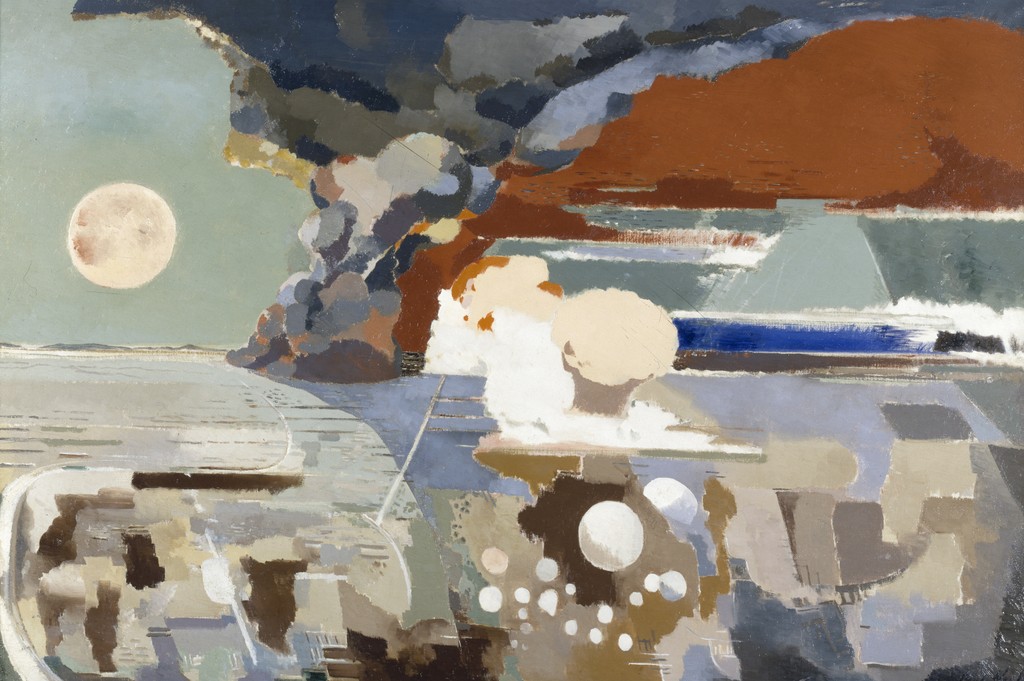
Paul Nash’s Battle of Germany compresses an air raid into two conflicting states. A moonlit city appears to wait beneath a rising column of smoke, while the other side of the canvas breaks into red sky, detonations and falling discs. The contrast is deliberate: suspense and violent action occupy the same imagined aerial field.[1]
Completed in 1944, the painting brings Nash’s official war art close to its endpoint without closing his career. It is neither a report from an aircraft nor a diagram of one documented raid. Research, aerial photographs and invention allowed him to picture bombardment at a scale no stationary witness could command.[1][2]
At a Glance
- ArtistPaul Nash (1889–1946).
- Date1944.
- Medium and dimensionsOil on canvas; support 1,219 × 1,828 mm.
- CollectionImperial War Museums, London; ART LD 4526.
- CommissionWar Artists Advisory Committee commission, delivered in September 1944.
- Visual structureA divided field of moonlit waiting, smoke, burning and active bombardment.[1]
Paul Nash in context
Contents
- A Commission That Changed Direction
- An Aerial View Made on the Ground
- A City between Waiting and Attack
- Smoke, Fire and the Moon
- Colour as Bombardment
- Falling Discs and Unresolved Meaning
- From Battle of Britain to Battle of Germany
- Landscape, Cosmic Cycles and the End of War Work
A Commission That Changed Direction
The War Artists Advisory Committee commissioned the work in 1944. IWM preserves evidence that an earlier proposal was to make a sequel to Battle of Britain concerned with the flying bomb. Nash could not find a convincing compositional beginning for that subject, and the proposal fell away. In a September letter he referred instead to an “invasion painting” then at a critical stage; IWM considers this likely to have been Battle of Germany, which reached the committee that month.[1]
This history warns against reading the completed canvas as an illustration of the V-1 campaign. Its subject became broader: an imagined bomber’s approach, a city under threat and the opening of an attack. The title names Germany, while the museum associates the picture with the Allied air offensive of 1942–45 rather than with one fixed target and date.[1]
The commission belonged to Nash’s second period of official war work. Tate Archive dates his Air Ministry role to 1940 and his subsequent Ministry of Information appointment to 1941.[3] By 1944 his response to air power had moved beyond depicting individual machines towards organising whole environments of altitude, weather, target and explosion.
An Aerial View Made on the Ground
Nash had never flown in an aeroplane. IWM’s Visions of War Above and Below therefore describes Battle of Germany as an imaginative and poetic portrayal of a bomber approaching its target.[2] The elevated viewpoint should not be mistaken for a pilot’s recollection.
Imagination did not mean an absence of evidence. IWM states that Nash worked from aerial photographs as well as his own ideas.[1] Such material could supply the flattened appearance of land, routes and urban blocks seen from height. He then reorganised those components to convey a movement through space: across the foreground city, towards smoke and into the unstable sky beyond.
This procedure connects the painting to Nash’s photography, design and printmaking. Framing, cropping and recombination had long enabled him to make familiar objects behave differently. In the aerial painting, photographic information anchors a view that remains impossible to occupy as a single, continuous vantage point.
A City between Waiting and Attack
The lower part of the picture resembles a city translated into broad grey, brown and blue planes. Roads curve across the surface, and block-like shapes suggest buildings without resolving into an exact street plan. The lack of minute architectural detail allows the city to register as a target area rather than as a portrait of a known centre.
Nash’s surviving explanation, paraphrased by IWM, divides the scene by time and mood. One zone waits under uncertain lunar light; another shows bombardment beginning. The distinction is not presented as a tidy sequence of panels. Smoke crosses the boundary, pale explosive forms interrupt the middle, and the red upper field presses towards the quieter half.[1]
The city is therefore simultaneously revealed and obscured. Moonlight makes its extent visible, while smoke expands and casts an approaching shadow. The viewer sees enough to understand vulnerability but not enough to claim a secure, surveying mastery of the place.
Smoke, Fire and the Moon
A pale moon hangs in the cooler left-hand sky. Near the centre, a dark column swells upward from what Nash identified as a burning factory outside the city. His account treats moon and smoke pillar as parallel presences whose threat can rival the bombers in the red sky.[1]
The comparison is unsettling because the two forms behave differently. The moon is circular, distant and apparently still. Smoke changes as it rises, accumulating coloured lobes and spreading into the dark upper band. One illuminates; the other blocks light. Together they organise the quiet half of the canvas without making it safe.
It would be too rigid to assign the moon a single symbolic translation. IWM’s evidence supports its double function as illumination and menace in this particular painting.[1] More broadly, the British Council identifies moon, fungus and other natural forms as recurring elements in Nash’s art.[4] Their recurrence establishes a visual vocabulary, not a code in which every moon means precisely the same thing.
Colour as Bombardment
On the right, a rust-red sky is cut by blue-grey bars and pale bursts. Near the centre, cream, white and ochre forms swell and overlap. Nash explained that he used deliberately free shapes and percussive colour to suggest explosion and detonation rather than to chart the mechanics of particular weapons.[1]
That choice creates an uneasy beauty. The colours are balanced and the rounded forms can resemble clouds, flowers or fungal growth, yet their place within the scene identifies violence. IWM interprets the fungal shapes through Nash’s associations with both death and rebirth.[1] Visible resemblance supports the comparison, but it does not turn an explosion into a reassuring emblem of renewal.
The painting makes destruction attractive enough to hold attention and unstable enough to resist pleasure without consequence. Its abstraction is not an escape from the raid. It is the means by which noise, pressure and rapid change enter a still canvas.
Falling Discs and Unresolved Meaning
White and pale-blue discs descend through the lower centre. Some are large, others diminish into a trail. Nash’s explanatory text does not settle their identity: he suggested that they might be paratroops or members of aircrews escaping damaged aircraft.[1]
This uncertainty is integral rather than accidental. If the forms are parachutes, their clean circular shapes imply vulnerable bodies without showing them directly. They can also look like spores, bubbles, planets or flowers, carrying the imagery towards Nash’s modernism and Surrealism. A precise military possibility coexists with visual associations that exceed it.
The IWM interpretation connects such airborne forms with Nash’s interest in parachutes as blossoms of danger.[1] The important point is not to force one answer. The discs keep the painting poised between reportable event and poetic transformation.
From Battle of Britain to Battle of Germany
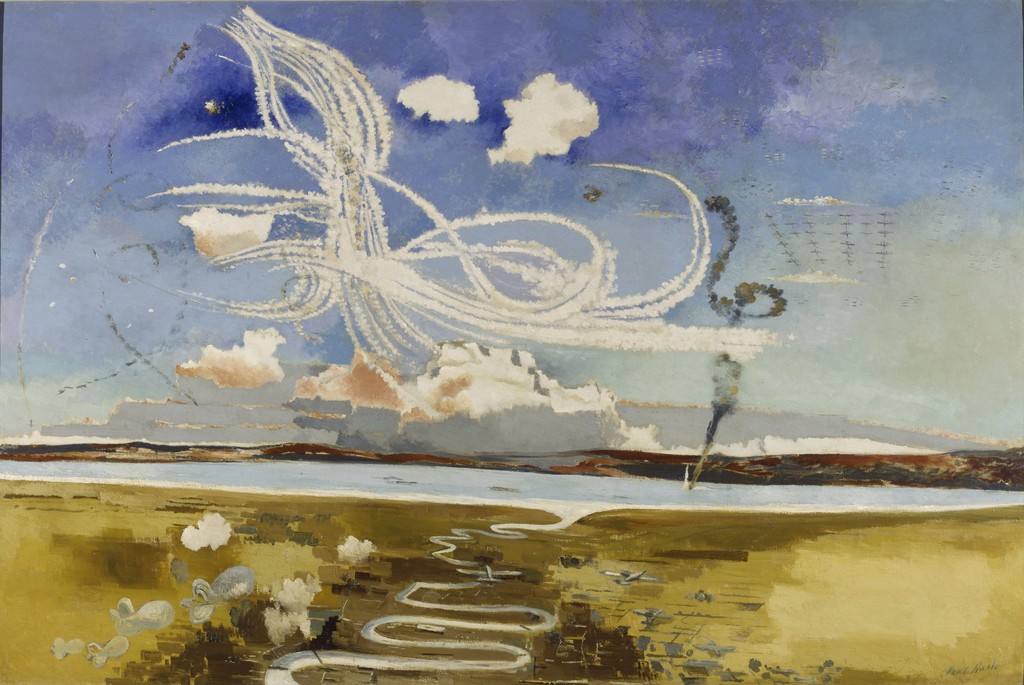
The earlier Battle of Britain summarises a defensive campaign across a broad expanse of coast, Channel and sky. Aircraft formations and curving trails remain readable within that panorama. Battle of Germany offers a darker and more compressed counterpart: city, target, smoke and bombardment are pushed into competing zones rather than opened across a continuous horizon.
Both works belong within Nash’s Second World War art and both use invented aerial command rather than witnessed flight.[1][2] Yet the later painting does not simply reverse the direction of attack. The earlier work’s expansive geography gives way to a divided psychological structure, with waiting on one side and violent release on the other.
The abandoned request for a flying-bomb sequel remains part of the commission history, but the painting Nash delivered is a more searching relation to Battle of Britain. It shifts from the overview of a campaign towards the unstable experience of approaching a target.
Landscape, Cosmic Cycles and the End of War Work
Nash’s landscape practice remains active even though the view is aerial and urban. Horizon, weather, light and spatial division carry the composition. The British Council characterises his Second World War imagery as Surreal yet rooted in English landscape traditions, joining sinister and lyrical effects.[4]
Battle of Germany stands at the end of Nash’s major completed war paintings, but it was not his final painting. In 1945 he continued with sunflower works concerned with celestial and natural cycles. The British Council records Eclipse of the Sunflower and Solstice of the Sunflower as his final two oils.[5] Moon, darkened disc, flame-like petals and stormy atmosphere extend questions of destruction and transformation beyond the official commission.
The later works do not supply a key that resolves Battle of Germany. They show that its moon, fungal shapes and suspended forms belong to a continuing investigation of recurrence, mortality and changing matter. The paintings overview places this endpoint of war art within a career that continued to move between natural observation and imaginative structure.
About this directory: These 129 entries form a reproducible researched online works census assembled from current public records. It is not a catalogue raisonné and does not claim absolute completeness.
Artworks directory
| Name | Date | Medium |
|---|---|---|
| A Christmas Card to Arthur and Madeline Clifton, 1926 | 1926 | |
| A German Double Pill Box | 1918 | |
| A Howitzer Firing | 1914 | Painting |
| A Night Bombardment | 1919 | Painting |
| A Shell Crater | 1918 | Drawing |
| Battle of Britain | 1941 | Painting |
| Battle of Germany | 1944 | Painting |
| Beeches in the Wind by Paul Nash - Paul Nash | 1918 | Artwork |
| Behind the Inn | 1920 | Painting |
| Berkshire Downs | 1922 | Painting |
| Blue House on the Shore | 1930 | Painting |
| Bouquet | Date unknown | Painting |
| Bouquet - Paul Nash | 1927 | Artwork |
| Buckinghamshire Landscape | 1927 | Painting |
| Cactus | 1928 | Painting |
| Chestnut Waters | Date unknown | Painting |
| Circle of the Monoliths | 1937 | Painting |
| Cliffs | Date unknown | Drawing |
| Cloudscape (recto) | 1939 | Painting |
| Composition (Design for Today) | 1934 | Painting |
| Coronilla | 1929 | Painting |
| Cotswold Hills | 1920 | Painting |
| Day Fighter | 1940 | Painting |
| Dead Spring | 1929 | Painting |
| Defence of Albion | 1942 | Painting |
| Design for a bookplate for Kenneth Fitzpatrick Mackenzie | 1909 | Drawing |
| Division of the Light from the Darkness | 1924 | |
| Druid Landscape | 1938 | Painting |
| Dunbarton Lakes | 1910 | Drawing |
| Dymchurch, Kent | Date unknown | Painting |
| Dymchurch Steps | Date unknown | Painting |
| Dymchurch - The Strange Coast | 1920 | |
| Eclipse of the Sunflower | 1945 | Painting |
| Edge of the marsh | 1925 | Painting |
| Equivalents for the Megaliths | 1935 | Painting |
| Event on the Downs | 1934 | Painting |
| Flight of the Magnolia | 1944 | Painting |
| Footballers Prefer Shell | 1935 | Painting |
| Fruits and Vegetables | 1930 | |
| Granary | 1922 | Painting |
| Graveyard in a Ruined Orchard near Vimy | 1917 | Drawing |
| Grotto in the Snow | 1939 | Painting |
| Harbour and Room | 1934 | Painting |
| Iver Heath, Buckinghamshire, Snow | 1927 | Painting |
| Kinetic Feature | 1931 | Painting |
| Landscape | 1926 | Painting |
| Landscape at Iden | 1929 | Painting |
| Landscape Composition (Objects in Relation) | 1934 | Painting |
| Landscape from a Dream | 1937 | Painting |
| Landscape of Bleached Objects | 1934 | Painting |
| Landscape of the Bagley Woods | 1943 | Painting |
| Landscape of the Brown Fungus | 1943 | Painting |
| Landscape of the Malvern Distance | 1943 | Painting |
| Landscape of the Megaliths | 1934 | Painting |
| Landscape of the Moon's First Quarter | 1943 | Painting |
| Landscape of the Moon's Last Phase | 1944 | Painting |
| Landscape of the summer solstice | Date unknown | Painting |
| Landscape of the Vernal Equinox (III) | 1944 | Painting |
| Landscape (verso) | 1939 | Painting |
| Landscape with Megaliths - Paul Nash | 1936 | |
| Landscape - Year of Our Lord, 1917 | 1910 | Drawing |
| Lares | 1929 | Painting |
| March Landscape | 1944 | Painting |
| Men Marching at Night | 1918 | |
| Metamorphosis | 1938 | Painting |
| Michaelmas Landscape | 1943 | Painting |
| Mimosa Wood | 1926 | Painting |
| Mineral Object | 1935 | Painting |
| 'Modern Textiles' (shop sign board) | 1926 | Painting |
| Monument to Fallen Canadians on Vimy Ridge | 1917 | Drawing |
| Nest of the Siren | 1930 | Painting |
| Night Fighter | 1940 | Painting |
| Nocturnal Landscape | 1938 | Painting |
| Northern Adventure | 1929 | Painting |
| Nostalgic Landscape | 1930 | Painting |
| November Moon | 1942 | Painting |
| Oxenbridge Pond | 1927 | Painting |
| Oxford During the War | 1942 | Painting |
| Pillar and Moon | 1937 | Painting |
| Pink Hyacinth | 1921 | Painting |
| Plage | 1928 | Painting |
| Riviera Landscape | 1926 | Painting |
| Riviera Window, Cros-de-Cagnes | 1926 | Painting |
| Sandling Park, Kent | 1924 | Painting |
| Sluice | 1920 | |
| Solstice of the Sunflower | 1945 | Painting |
| Souvenir of Florence | 1929 | Painting |
| Spring in the Trenches, Ridge Wood, 1917 | 1918 | Painting |
| St Pancras Lilies | 1927 | Painting |
| St Pancras, London | 1927 | Painting |
| Still Life I - Paul Nash | 1924 | Artwork |
| Still Life with Bog Cotton | 1927 | Painting |
| Strange Coast | 1920 | |
| Study of Mrs. Nash | 1916 | Drawing |
| Sunflower and sun | 1942 | Painting |
| Sunrise, Inverness Copse | 1918 | Painting |
| Telecommunications | 1934 | Painting |
| The Archer | Date unknown | Painting |
| The Diving Stage | 1928 | Painting |
| The Edge of the Wood | 1919 | Painting |
| The Menin Road | 1919 | Painting |
| The Mule Track | 1918 | Painting |
| The Pond at Souldern | 1926 | Painting |
| The Raider on the Moors | 1940 | |
| The Rye Marshes, East Sussex | 1932 | Painting |
| The Sea | 1923 | Painting |
| The Sea Wall | 1920 | |
| The Shore | 1923 | Painting |
| The Stackyard | 1925 | Painting |
| The Window, Iver Heath | Date unknown | Painting |
| The Ypres Salient at Night | 1918 | Painting |
| Through a Window, Riviera | 1927 | Painting |
| Tide at Dymchurch | 1920 | |
| Token [verso: Tree in a Landscape (unfinished)] | 1929 | Painting |
| Totes Meer (Dead Sea) | 1940 | Painting |
| Vale of the White Blackbird | 1942 | Painting |
| View from a Window, Nice | 1934 | Painting |
| View R | 1940 | Painting |
| Void | 1918 | Painting |
| Voyages of the Moon | 1935 | Painting |
| We Are Making a New World | 1918 | Painting |
| Whiteleaf Cross | 1931 | Painting |
| Winter, Hampden | Date unknown | |
| Winter Sea | 1931 | Painting |
| Wittenham Clumps | 1943 | Painting |
| Wood on the Downs | 1929 | Painting |
| Wooded Landscape | 1942 | Painting |
| Worth Matravers, Dorset | 1936 | Drawing |
| Wounded, Passchendaele | Date unknown | Painting |
Frequently Asked Questions
It presents an abstract aerial view of a bombing raid: a city below, an outlying factory burning, a rising smoke column, moonlight, bombers, explosions and descending discs that may represent parachutes or escaping aircrew.[1]
No specific raid, city and moment are established by the consulted records. IWM describes an abstract view associated with the Allied air offensive against Germany. Nash constructed it through aerial photographs and imagination rather than from witnessed flight.[1][2]
Within Nash’s explanation, the moon illuminates the waiting city but also feels threatening beside the growing smoke pillar.[1] That dual role is secure; any more exact symbolic decoding would be speculative. Moon imagery recurs elsewhere in his art, but its meaning changes with each relationship.[4]
The commission initially involved the idea of a flying-bomb sequel to Battle of Britain, although that proposal did not become the finished subject.[1] Both paintings imagine aerial warfare, but the 1944 canvas replaces the earlier panorama with a divided field of suspense and detonation.
The painting belongs to Imperial War Museums in London. Its accession number is ART LD 4526, and its canvas support measures 1,219 × 1,828 mm.[1]
Discussion
What should readers notice when looking closely at Battle of Germany?
Reader Insights
Compare the quiet moonlit half with the agitated field of smoke and explosion.
Use Nash’s explanation as evidence without reducing every ambiguous form to one fixed meaning.
Does the division stabilise the image or make its realities collide?
Join the Conversation
Share your reading below, keeping observations specific and evidence clear.
References
- Battle of Germany, ART LD 4526 — Imperial War Museums, accessed 31 August 2026.
- Visions of War Above and Below — Imperial War Museums, accessed 31 August 2026.
- Paul Nash fonds TGA 769 — Tate Archive, accessed 31 August 2026.
- Paul Nash artist record — British Council, accessed 31 August 2026.
- Eclipse of the Sunflower — British Council, accessed 31 August 2026.