 by Tom Gurney
Tom Gurney BSc (Hons) is an art history expert with over 20 years experience
Page Created on August 31, 2026 / Page Updated on November 6, 2026
Email: tomgurney1@gmail.com / Phone: +44 7429 011000
Battle of Britain: Introduction
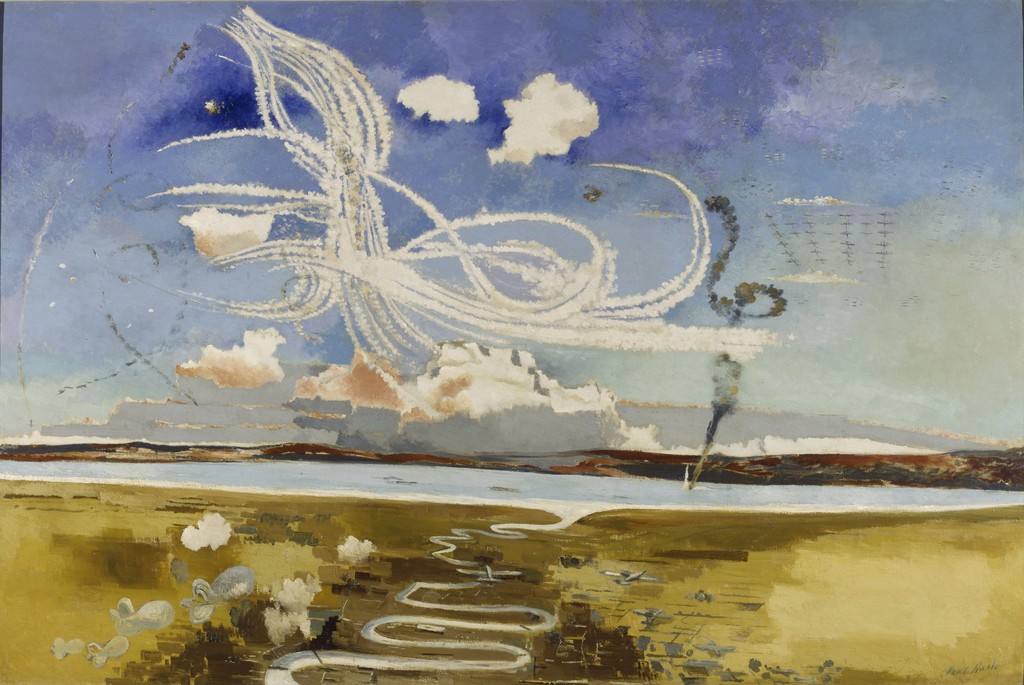
Paul Nash’s Battle of Britain gathers a summer air campaign into one expansive field of land, water and sky. Aircraft arrive in ranks, fighters cross their path, and white trails loop above a river, coast and the English Channel. The painting does not preserve a dogfight seen from one position. It builds a symbolic panorama from recurring elements of aerial warfare.[1]
That difference between witness and construction is essential. Nash had not flown, yet he could organise researched facts into an image whose scale exceeds any single observer’s view. The result joins official history to the habits of a landscape painter.
At a Glance
- ArtistPaul Nash (1889–1946)
- Completed1941.[1]
- Medium and supportOil on canvas, 1,226 × 1,835 × 23 mm.[1]
- CollectionImperial War Museums, London; ART LD 1550.[1]
- SubjectAn imagined overview of RAF defence against approaching Luftwaffe formations.[1]
- ViewpointImagined by a non-flying artist; the 1940 Air Ministry role was followed by a Ministry of Information appointment the next year.[2][3]
Paul Nash in context
Contents
- An Official Commission with an Unusual Answer
- A Battle Assembled across Time and Space
- River, Coast and Channel
- A Sky Written in Trails and Cloud
- Formations, Fighters and Deliberate Scale Shifts
- Nature and Machine as Visual Analogues
- Colour, Rhythm and the Broad Format
- Exhibition, Interpretation and Reception
An Official Commission with an Unusual Answer
Nash came to the Second World War with experience of making public art about conflict. Tate’s archive chronology records an Air Ministry appointment during 1940, followed the next year by one from the Ministry of Information.[2] Imperial War Museums identifies Battle of Britain as a War Artists Advisory Committee commission.[1] The institutional setting matters, but it did not dictate a conventional scene of pilots and recognisable machines at close range.
Instead, Nash made the entire environment carry the campaign. Weather, cultivated ground, water, distant shores and mechanical movement share the canvas. The biographical chronology places the picture after his interwar work with modern design, found objects and Surrealism, while the wider Second World War art context shows that this was one response among several to aircraft and aerial violence.
The commission therefore joined a public subject to a personal method. It could present resistance and victory, as the IWM interpretation notes, while departing from literal military illustration.[1] Its authority rests on an intelligible campaign structure rather than a claim to have recorded a particular sortie.
A Battle Assembled across Time and Space
No airborne vantage was available to Nash. IWM explicitly records that he had never flown and characterises his aerial vision as imaginative.[3] This qualification does not detach the painting from wartime reality; it tells us how to understand its evidence.
The picture accumulates features associated with the campaign: aircraft paths, smoke from damaged machines, formations, clouds, parachutes and balloons. Below them, a river crosses dry country and reaches the sea; a further shore lies beyond.[1] These elements need not have appeared together at one instant. Nash’s purpose was to make simultaneous pressures legible across a wide area.
A witnessed view would be restricted by altitude, direction, weather and duration. The canvas instead behaves like a visual synthesis. Its high position reveals geography, its lowered horizon gives the sky exceptional breadth, and its shifts of scale keep small signs readable. The approach resembles montage without becoming a collage: selected information is recomposed in oil.
This constructed method also relates to Nash’s photography, design and prints. Framing, simplification and the arrangement of separate motifs had long helped him turn observed material into a concentrated image. Here those habits solve the problem of representing combat that had no stable viewpoint.
River, Coast and Channel
The lower part of Battle of Britain is not incidental scenery. Ochre fields occupy the foreground, cut by a bright, winding river. Beyond it, pale water separates the English coast from a distant continental strip. IWM associates the geography with the Thames Estuary, Kent, the English Channel and France, while also warning that the emphasis is imaginative rather than cartographic.[1]
This geography gives the combat direction. The Channel is at once distance, route and boundary: approaching formations must cross it, while defending fighters sweep along it. Land and sea make the aerial movements understandable even when individual aircraft are tiny.
Nash’s long engagement with landscape and place prepared him to use a river or horizon structurally. The white river bends through the foreground like a slower counterpart to the vapour trails above. A natural course and machine-made paths answer one another without becoming identical. The coast anchors action that might otherwise dissolve into decorative marks.
A Sky Written in Trails and Cloud
Most of the canvas is sky. Its blue changes from pale, greenish colour near the horizon to a deeper blue-violet overhead. Cumulus clouds gather above the distant coast, while smaller white masses sit among the aircraft paths. The sky has depth, but it also functions as a surface across which movement can be drawn.
White trails bend, double back and cross. Some open into broad loops; others rise in bundled curves or run horizontally across the middle. Darker smoke falls in broken spirals or narrow columns, signalling damage and descent.[1] Because the aircraft themselves are minute, their tracks carry much of the action.
The trails also alter time. A plane marks its present position, while the line behind it preserves a recent route. Several such records can occupy the image together, turning motion into a visible history. Cloud differs from trail in cause, but their shared colour lets weather and combat meet. The air seems full of growth, erasure and collision.
Formations, Fighters and Deliberate Scale Shifts
At upper right, numerous aircraft repeat in disciplined rows. IWM identifies them as advancing Luftwaffe formations. Allied fighters, by contrast, break across the wider sky and disrupt that order.[1] The contrast is compositional before it is technical: a grid meets arcs, ranks meet curves, and distant repetition meets energetic dispersal.
The record does not name a model for every painted silhouette. Calling all the defenders Spitfires, or assigning each enemy mark to a specific bomber type, would imply precision the image does not provide. The secure identification is collective—RAF fighters opposing Luftwaffe formations—not an aircraft-recognition chart.
Scale is equally flexible. IWM notes that planes and barrage balloons seen from above are not proportionate to the shadowed settlements below.[1] Enlarging a balloon or preserving a tiny aircraft’s readable outline allows several layers of the campaign to coexist. Spatial inconsistency is not an error to correct; it is part of the summary form.
Nature and Machine as Visual Analogues
The British Council describes Nash’s practice as analytical: subjects are reduced to essential forms, yet do not become wholly mechanical.[4] That tendency shapes the battle. White curves made by defending aircraft resemble stems, petals or unfolding wings, while the enemy ranks read as a rigid manufactured pattern. IWM’s interpretation makes this organic-versus-regimented opposition central to the painting’s allegory.[1]
The analogy should not be mistaken for literal botany. Vapour trails are produced by machines, and their flower-like arrangement is Nash’s design. Nor does every pale curve automatically stand for virtue. The visible contrast supports an official narrative of defence, but smoke, cloud and fragile loops also keep the sky unstable.
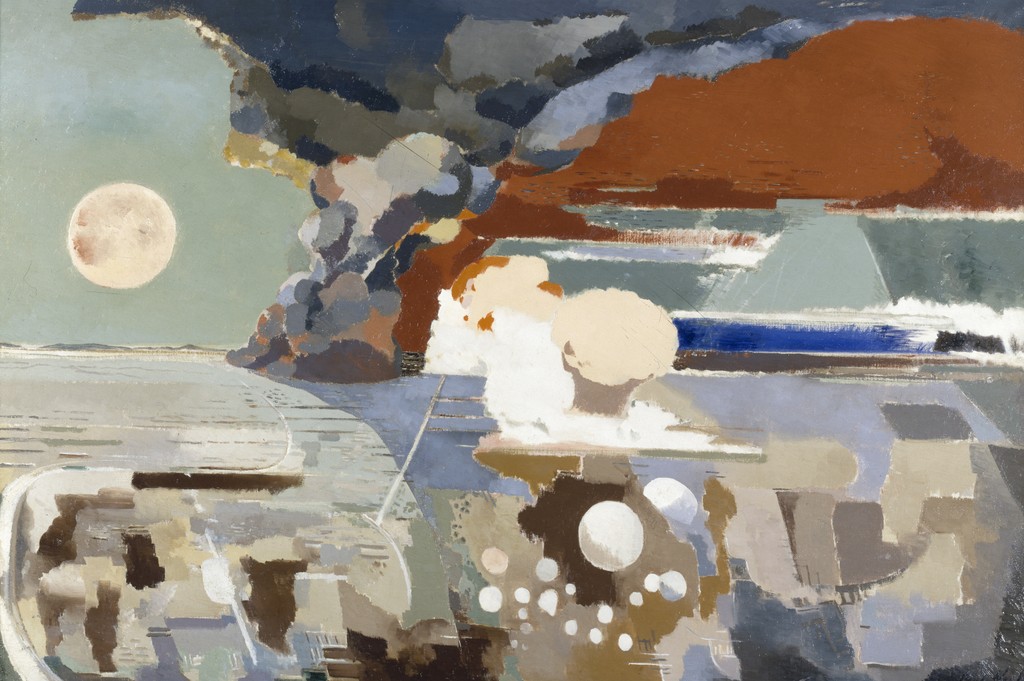
Battle of Germany later gives nature-machine correspondences a darker setting of fire, smoke, moon and bombardment. The two works share imagined aerial reach without repeating the same construction. Battle of Britain spreads action laterally across daylight and coast; its successor compresses destruction into a divided night field.
Colour, Rhythm and the Broad Format
The painting’s width permits several speeds to operate together. The low river meanders slowly; the Channel forms a calm horizontal band; aircraft rows advance steadily; white trails accelerate into loops. A viewer does not read these zones in one fixed sequence. The eye can follow a curve, return to the land, then discover a distant formation.
Colour reinforces the division without sealing it. Warm yellow-brown fields establish a dry summer foreground. Cool water and the blue sky occupy most of the support. White is shared by river, cloud and aircraft trails, binding ground and air, while black and grey smoke interrupt that continuity. Small orange-brown edges near the horizon suggest evening light rather than a timeless diagram.
The broad composition makes violence appear both immense and remote. Tiny machines affect an enormous sky; a black fall of smoke can compete with a whole formation. Nash’s scale changes move attention between individual incidents and the campaign’s geographic reach.
Exhibition, Interpretation and Reception
Nash delivered the work to the committee in October 1941. It was shown at the National Gallery in January 1942, giving the recent air campaign a prominent public setting.[1] Those facts establish early institutional circulation, not a single, measurable audience response.
The IWM label presents the painting as an epitome of Fighter Command’s resistance and stresses its symbolic, allegorical method rather than factual exactitude.[1] The British Council later characterised Nash’s Second World War images as simultaneously sinister and lyrical, Surreal in transformation but grounded in English landscape tradition.[4] These readings explain why Battle of Britain has persisted beyond its immediate commissioning purpose.
Its place in Nash’s paintings and artworks depends on more than historical subject. The canvas asks a lasting pictorial question: how can dispersed action, unavailable to one pair of eyes, be made coherent without pretending to be direct testimony? Nash answers by turning geography, weather, marks and machines into one invented field.
About this directory: These 129 entries form a reproducible researched online works census assembled from current public records. It is not a catalogue raisonné and does not claim absolute completeness.
Artworks directory
| Name | Date | Medium |
|---|---|---|
| A Christmas Card to Arthur and Madeline Clifton, 1926 | 1926 | |
| A German Double Pill Box | 1918 | |
| A Howitzer Firing | 1914 | Painting |
| A Night Bombardment | 1919 | Painting |
| A Shell Crater | 1918 | Drawing |
| Battle of Britain | 1941 | Painting |
| Battle of Germany | 1944 | Painting |
| Beeches in the Wind by Paul Nash - Paul Nash | 1918 | Artwork |
| Behind the Inn | 1920 | Painting |
| Berkshire Downs | 1922 | Painting |
| Blue House on the Shore | 1930 | Painting |
| Bouquet | Date unknown | Painting |
| Bouquet - Paul Nash | 1927 | Artwork |
| Buckinghamshire Landscape | 1927 | Painting |
| Cactus | 1928 | Painting |
| Chestnut Waters | Date unknown | Painting |
| Circle of the Monoliths | 1937 | Painting |
| Cliffs | Date unknown | Drawing |
| Cloudscape (recto) | 1939 | Painting |
| Composition (Design for Today) | 1934 | Painting |
| Coronilla | 1929 | Painting |
| Cotswold Hills | 1920 | Painting |
| Day Fighter | 1940 | Painting |
| Dead Spring | 1929 | Painting |
| Defence of Albion | 1942 | Painting |
| Design for a bookplate for Kenneth Fitzpatrick Mackenzie | 1909 | Drawing |
| Division of the Light from the Darkness | 1924 | |
| Druid Landscape | 1938 | Painting |
| Dunbarton Lakes | 1910 | Drawing |
| Dymchurch, Kent | Date unknown | Painting |
| Dymchurch Steps | Date unknown | Painting |
| Dymchurch - The Strange Coast | 1920 | |
| Eclipse of the Sunflower | 1945 | Painting |
| Edge of the marsh | 1925 | Painting |
| Equivalents for the Megaliths | 1935 | Painting |
| Event on the Downs | 1934 | Painting |
| Flight of the Magnolia | 1944 | Painting |
| Footballers Prefer Shell | 1935 | Painting |
| Fruits and Vegetables | 1930 | |
| Granary | 1922 | Painting |
| Graveyard in a Ruined Orchard near Vimy | 1917 | Drawing |
| Grotto in the Snow | 1939 | Painting |
| Harbour and Room | 1934 | Painting |
| Iver Heath, Buckinghamshire, Snow | 1927 | Painting |
| Kinetic Feature | 1931 | Painting |
| Landscape | 1926 | Painting |
| Landscape at Iden | 1929 | Painting |
| Landscape Composition (Objects in Relation) | 1934 | Painting |
| Landscape from a Dream | 1937 | Painting |
| Landscape of Bleached Objects | 1934 | Painting |
| Landscape of the Bagley Woods | 1943 | Painting |
| Landscape of the Brown Fungus | 1943 | Painting |
| Landscape of the Malvern Distance | 1943 | Painting |
| Landscape of the Megaliths | 1934 | Painting |
| Landscape of the Moon's First Quarter | 1943 | Painting |
| Landscape of the Moon's Last Phase | 1944 | Painting |
| Landscape of the summer solstice | Date unknown | Painting |
| Landscape of the Vernal Equinox (III) | 1944 | Painting |
| Landscape (verso) | 1939 | Painting |
| Landscape with Megaliths - Paul Nash | 1936 | |
| Landscape - Year of Our Lord, 1917 | 1910 | Drawing |
| Lares | 1929 | Painting |
| March Landscape | 1944 | Painting |
| Men Marching at Night | 1918 | |
| Metamorphosis | 1938 | Painting |
| Michaelmas Landscape | 1943 | Painting |
| Mimosa Wood | 1926 | Painting |
| Mineral Object | 1935 | Painting |
| 'Modern Textiles' (shop sign board) | 1926 | Painting |
| Monument to Fallen Canadians on Vimy Ridge | 1917 | Drawing |
| Nest of the Siren | 1930 | Painting |
| Night Fighter | 1940 | Painting |
| Nocturnal Landscape | 1938 | Painting |
| Northern Adventure | 1929 | Painting |
| Nostalgic Landscape | 1930 | Painting |
| November Moon | 1942 | Painting |
| Oxenbridge Pond | 1927 | Painting |
| Oxford During the War | 1942 | Painting |
| Pillar and Moon | 1937 | Painting |
| Pink Hyacinth | 1921 | Painting |
| Plage | 1928 | Painting |
| Riviera Landscape | 1926 | Painting |
| Riviera Window, Cros-de-Cagnes | 1926 | Painting |
| Sandling Park, Kent | 1924 | Painting |
| Sluice | 1920 | |
| Solstice of the Sunflower | 1945 | Painting |
| Souvenir of Florence | 1929 | Painting |
| Spring in the Trenches, Ridge Wood, 1917 | 1918 | Painting |
| St Pancras Lilies | 1927 | Painting |
| St Pancras, London | 1927 | Painting |
| Still Life I - Paul Nash | 1924 | Artwork |
| Still Life with Bog Cotton | 1927 | Painting |
| Strange Coast | 1920 | |
| Study of Mrs. Nash | 1916 | Drawing |
| Sunflower and sun | 1942 | Painting |
| Sunrise, Inverness Copse | 1918 | Painting |
| Telecommunications | 1934 | Painting |
| The Archer | Date unknown | Painting |
| The Diving Stage | 1928 | Painting |
| The Edge of the Wood | 1919 | Painting |
| The Menin Road | 1919 | Painting |
| The Mule Track | 1918 | Painting |
| The Pond at Souldern | 1926 | Painting |
| The Raider on the Moors | 1940 | |
| The Rye Marshes, East Sussex | 1932 | Painting |
| The Sea | 1923 | Painting |
| The Sea Wall | 1920 | |
| The Shore | 1923 | Painting |
| The Stackyard | 1925 | Painting |
| The Window, Iver Heath | Date unknown | Painting |
| The Ypres Salient at Night | 1918 | Painting |
| Through a Window, Riviera | 1927 | Painting |
| Tide at Dymchurch | 1920 | |
| Token [verso: Tree in a Landscape (unfinished)] | 1929 | Painting |
| Totes Meer (Dead Sea) | 1940 | Painting |
| Vale of the White Blackbird | 1942 | Painting |
| View from a Window, Nice | 1934 | Painting |
| View R | 1940 | Painting |
| Void | 1918 | Painting |
| Voyages of the Moon | 1935 | Painting |
| We Are Making a New World | 1918 | Painting |
| Whiteleaf Cross | 1931 | Painting |
| Winter, Hampden | Date unknown | |
| Winter Sea | 1931 | Painting |
| Wittenham Clumps | 1943 | Painting |
| Wood on the Downs | 1929 | Painting |
| Wooded Landscape | 1942 | Painting |
| Worth Matravers, Dorset | 1936 | Drawing |
| Wounded, Passchendaele | Date unknown | Painting |
Frequently Asked Questions
It depicts RAF fighters disrupting approaching Luftwaffe formations over a landscape that suggests the Thames Estuary, Kent, the Channel and France beyond. Aircraft trails, smoke, clouds, parachutes and balloons combine with the river and coast. The scene summarises the campaign instead of reconstructing one engagement.[1]
No. Imperial War Museums records that Nash had never flown.[3] The elevated panorama was created imaginatively from researched and observed material. It should not be described as a memory from a cockpit or as one eyewitness dogfight.
IWM identifies RAF fighters and advancing Luftwaffe formations.[1] The small, simplified silhouettes do not support a secure model-by-model inventory. Their grouping, movement and contrast are more important to the composition than precise technical identification.
Ordered enemy ranks confront flexible white arcs associated with the defenders. Those arcs can resemble petals or growing forms, making defence seem to rise from the landscape.[1] This allegorical contrast supports the official victory theme, while dark smoke and unstable scale prevent the image from becoming a straightforward diagram.
The painting belongs to Imperial War Museums in London and carries the catalogue number ART LD 1550.[1] It is oil on canvas, with support dimensions of 1,226 × 1,835 × 23 millimetres. Visitors should check current display information before travelling.
Discussion
What should readers notice when looking closely at Battle of Britain?
Reader Insights
Separate coast, sea, cloud, vapour trails and formations before reading the whole panorama.
Treat the view as an imaginative synthesis rather than a witnessed dogfight.
How does pattern make the battle legible and unstable at once?
Join the Conversation
Share your reading below, keeping observations specific and evidence clear.
References
- Battle of Britain, ART LD 1550 — Imperial War Museums, accessed 31 August 2026.
- Paul Nash fonds TGA 769 — Tate Archive, accessed 31 August 2026.
- Visions of War Above and Below — Imperial War Museums, accessed 31 August 2026.
- Paul Nash artist record — British Council Collection, accessed 31 August 2026.