 by Tom Gurney
Tom Gurney BSc (Hons) is an art history expert with over 20 years experience
Page Created on August 31, 2026 / Page Updated on November 6, 2026
Email: tomgurney1@gmail.com / Phone: +44 7429 011000
Paul Nash: Landscape and Place: Introduction
Paul Nash returned to particular English places until their shapes became part of his visual language. Wittenham Clumps, Whiteleaf, Dymchurch, Iden, Swanage, Avebury and Oxford were more than stops in a chronology. Each offered physical structures—trees, slopes, stones, walls, water or horizon—that could carry memory, conflict and unexpected association.[1][2][3]
His landscapes usually begin with recognisable geography. Their strangeness develops through selection and rearrangement, not through the abandonment of the visible world.
At a Glance
- Principal placesWittenham Clumps, Whiteleaf, Ypres, Dymchurch, Romney Marsh, Iden, Swanage, Avebury and Oxford.
- Active spanEarly landscape drawings from the 1910s through the late natural cycles of 1945.[1][2]
- MediaDrawing, watercolour, oil, printmaking and photography all shaped Nash’s response to place.[1][3]
- Recurring formsTree groups, paths, pools, sea walls, horizons, standing stones, moons and thresholds.
- Key turning pointHis 1933 encounter with Avebury joined ancient monuments to modern form and archaeological inquiry.[4]
- Archive evidenceCorrespondence, photographs and an annotated album help establish when and how motifs moved between places and media.[1][5]
Contents
- Place as a Working Method
- Wittenham Clumps and Whiteleaf
- The Western Front as Altered Geography
- Dymchurch and Romney Marsh
- Iden and the Downs in the Late 1920s
- Swanage, Worth Matravers and the Camera
- Avebury: Antiquity, Archaeology and Geology
- Oxford, War and the Late Landscape
- Coast, Tree, Stone and Threshold
Place as a Working Method
Nash did not treat landscape as a neutral view waiting to be copied. He looked for relationships: a tree answering another tree, a wall dividing land from sea, a stone appearing to lean towards its neighbour. Drawing could clarify those intervals, while later work from memory allowed proportions and positions to change. A place remained identifiable even when its features acquired an unfamiliar intensity.
This method connects the successive stages of his biography and the varied objects in Paintings and Artworks. It also requires restraint from the viewer. A suggestive arrangement is not proof of a private code. Nash’s imaginative landscapes remain built from material things, observed conditions and accumulated knowledge.
Wittenham Clumps and Whiteleaf
Wittenham Clumps entered Nash’s work around 1912 and remained available to him decades later. The paired tree-crowned hills provide bold profiles against the sky, long approaches and a view marked by both natural form and human history. An Oxfordshire account places the Clumps at the beginning of his sustained engagement with landscape and records his return to the subject during the 1940s.[2]
Their importance lies partly in repetition. A first drawing could register the site’s outline; a later version could test what memory retained or changed. The Clumps therefore offered continuity without demanding an identical view. They show why no single place needs to be named as Nash’s sole favourite.
Whiteleaf supplied a related but distinct problem. The chalk cross cut into its Buckinghamshire hillside is both a visible landmark and a human intervention in the land. The British Council’s Whiteleaf Cross record anchors Nash’s response to that named place.[6] Hill, mark and surrounding vegetation allow ancient association to arise from an actual worked surface rather than from invented scenery.
The Western Front as Altered Geography
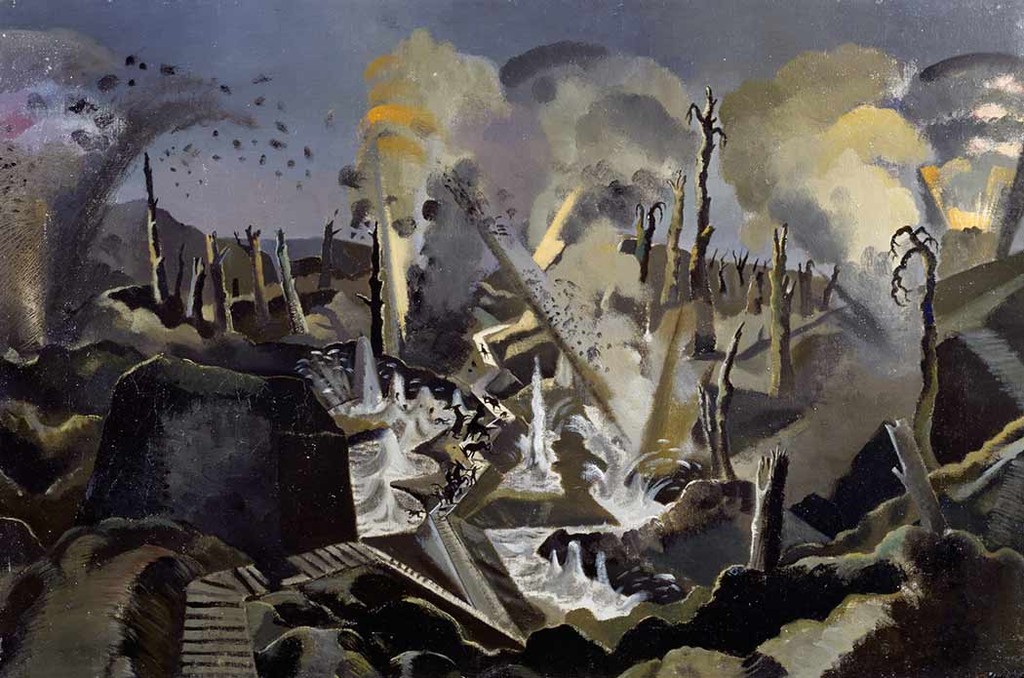
The First World War forced Nash to confront landscape changed rapidly and violently. Near Ypres, artillery, trenches, military roads and waterlogging remade familiar elements of terrain. Broken trees showed blast; shell holes interrupted routes; concrete positions and wire embedded human systems in the ground. The British Council’s record for German Double Pill Box, Gheluvelt keeps one such structure tied to a named location and to Nash’s 1917–18 war work.[7]
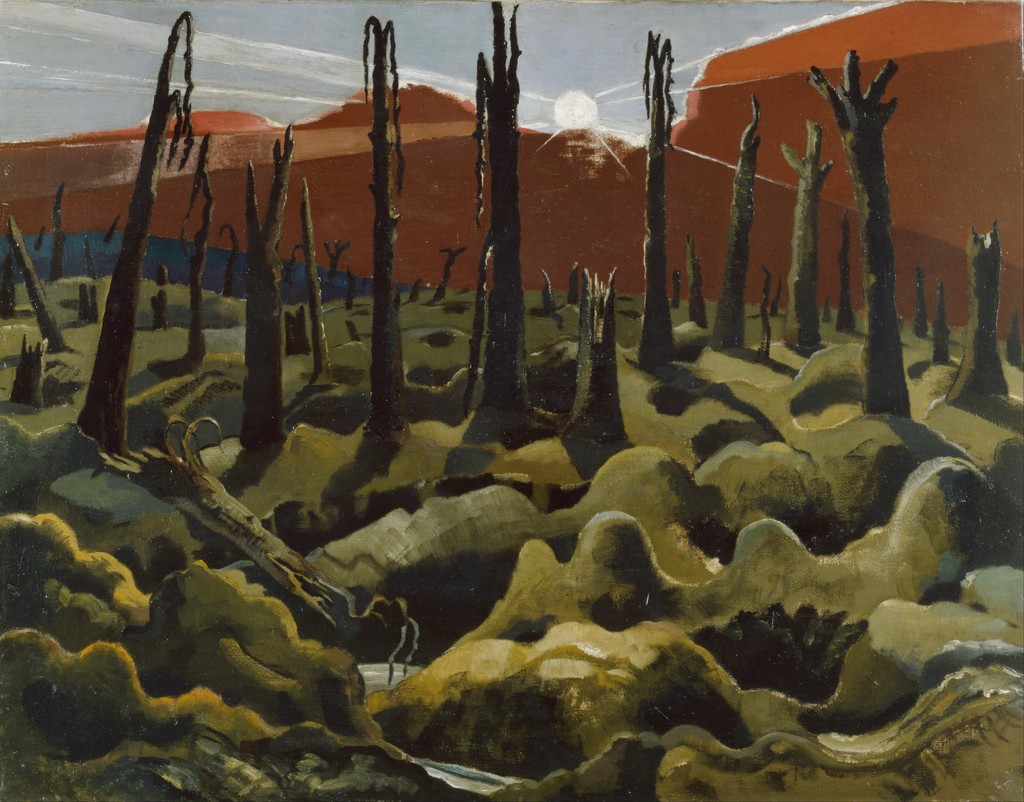
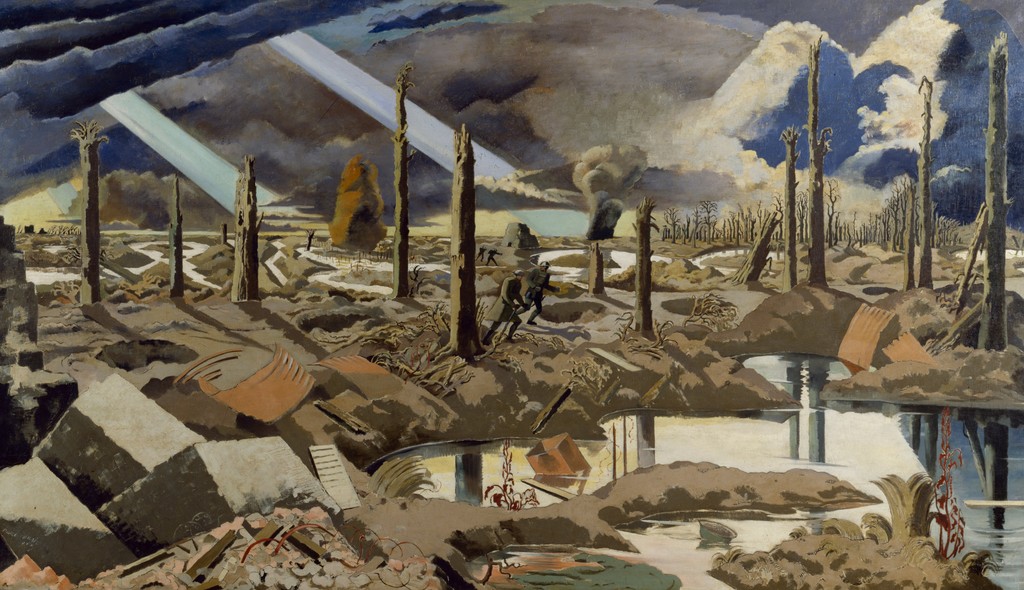
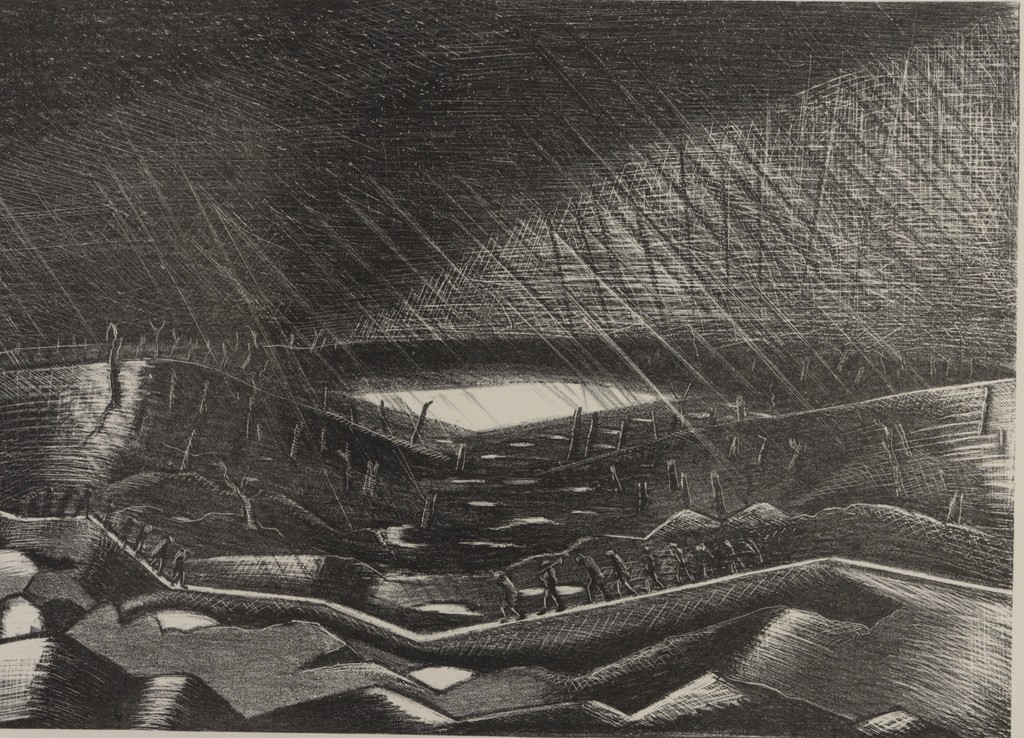
His First World War art makes the damaged environment a bearer of human history even when figures are small. We Are Making a New World turns furrowed earth and stripped trunks into an image of destructive remaking. The Menin Road uses blocked paths and flooded ground to deny easy passage, while The Mule Track places movement within bombardment.
These places are historically specific, but their pictorial order was constructed after observation. Nash selected, compressed and repeated features so that geography registered the operations of war rather than merely locating them.
Dymchurch and Romney Marsh
At Dymchurch, the meeting of sea, wall and flat land produced a different kind of pressure. The engineered sea defence makes a long, hard boundary; steps interrupt it; water and sky extend horizontally beyond it. Romney Marsh adds low ground, drainage and an exposed horizon. Together they gave Nash a landscape in which nature and construction could not be separated neatly.[3]
The surviving titles need careful distinction. Dymchurch – The Strange Coast is a separate object from Dymchurch Steps and The End of the Steps. The Aberdeen-linked record for The Strange Coast provides one securely named example of the group.[8] Rather than treating all Dymchurch images as interchangeable views, it is more useful to follow how a wall, stair or shoreline receives a different emphasis in each.
Coastal experience also established forms that travelled. A hard horizon, a bank resembling a wave and an opening between barriers could later serve pictures far removed from Kent. The coast was both a locality and a store of visual structures.
Iden and the Downs in the Late 1920s
Iden in Sussex brought buildings, garden spaces and cultivated land into Nash’s interwar geography. Here, enclosure matters as much as distance: walls, hedges and the edges of fields divide one zone from another. Yale’s Landscape of 1926 helps document the period’s increasingly concise handling of terrain, in which broad shapes establish spatial relations without dissolving the subject.[9]
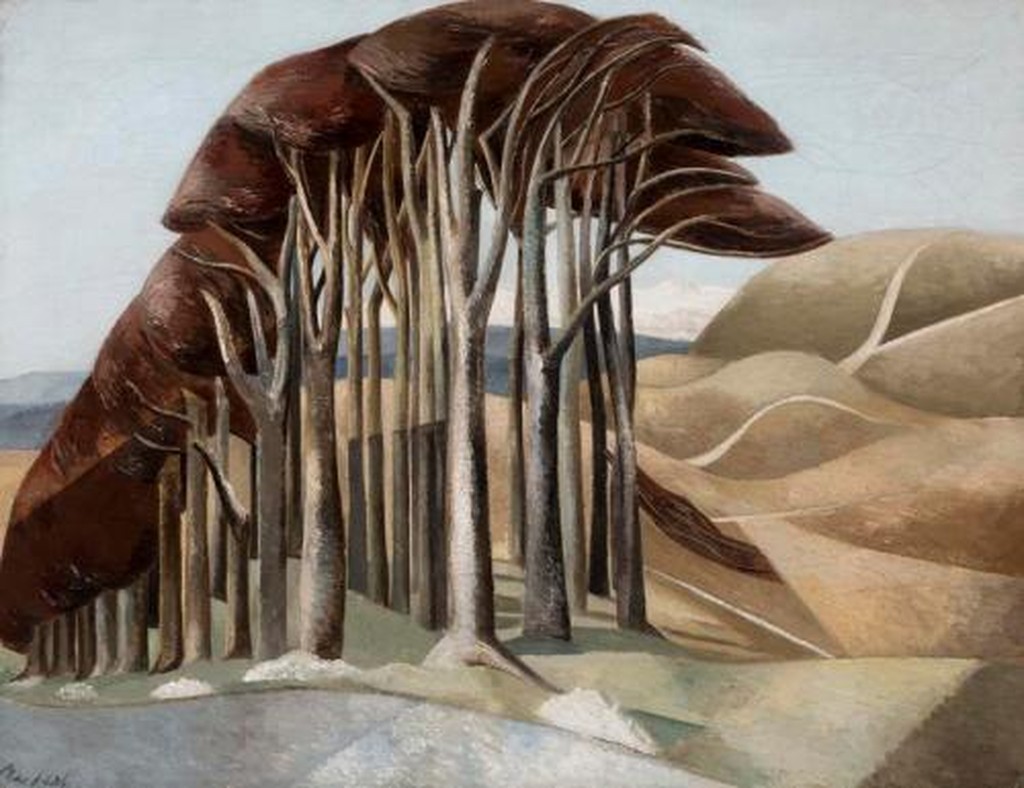
Wood on the Downs, an oil of 1929 in Aberdeen Art Gallery, offers another view of this structural approach.[10] Its title identifies wood and downland but does not securely locate the scene at Iden, so the places should not be collapsed. The work is valuable precisely as a comparison: clustered growth and open ground become active masses rather than decorative scenery.
Trees in Nash’s art can enclose, divide, shelter or confront. Their role depends on arrangement. A wood may appear compact from outside while remaining penetrable through gaps, making the edge between open and enclosed space a subject in its own right.
Swanage, Worth Matravers and the Camera
The Dorset coast around Swanage and Worth Matravers offered cliffs, quarries, fields, stone and sea. Yale’s Worth Matravers, Dorset records Nash working in watercolour and drawing within that environment.[11] The area encouraged attention to objects found outdoors as well as to panoramic views: weathered matter could be isolated, moved mentally into a new relation, or remembered alongside a different setting.
Photography strengthened that process. The album annotated by Paul and Margaret Nash links photographs and works across the 1930s, preserving titles and related versions without implying that every image was a preparatory study.[5] A photograph could hold a chance alignment, sharpen a silhouette or remove distracting surroundings. The Photography, Design and Prints guide follows this movement between camera, paper and painted image.
Such framing helped turn boundaries into events. A window could contain a second landscape; an opening in a hedge could become a stage; a stone or branch could acquire presence through isolation. The visible object remained real even as the encounter became improbable.
Avebury: Antiquity, Archaeology and Geology
Nash encountered Avebury in 1933. The stones offered upright masses, intervals and alignments on a scale that suited his modern pictorial concerns, but they also belonged to an archaeological landscape with its own material history. The British Council account of Landscape of the Megaliths describes the painting’s relation to memory, aerial archaeology and the Unit One context.[4]
The Megaliths and Ancient Landscape study separates four related titles: the British Council’s 1934 Landscape of the Megaliths, Tate’s 1935 Equivalents for the Megaliths, Druid Landscape and Landscape with Megaliths. Tate scholarship places Nash’s Wiltshire work within a longer artistic engagement with British antiquity.[12]
Geology also sets a useful limit on vague descriptions of mystery. Research into Nash’s reading and imagery shows that strata, fossils, maps and the material formation of land contributed to his sense of what lies beyond immediate sight.[13] The Modernism and Surrealism of these works is therefore compatible with evidence and inquiry. An “unseen landscape” can mean forces, histories and structures that are physically present but not visible from one viewpoint.
Oxford, War and the Late Landscape
Nash moved to Oxford in 1939 and lived at 106 Banbury Road during much of the Second World War.[1][2] The city and its surroundings supplied gardens, trees, Bagley Wood and broad skies, while official commissions redirected his attention towards aerial conflict. In Second World War Art, land, coast and atmosphere remain organising elements even when aircraft dominate.
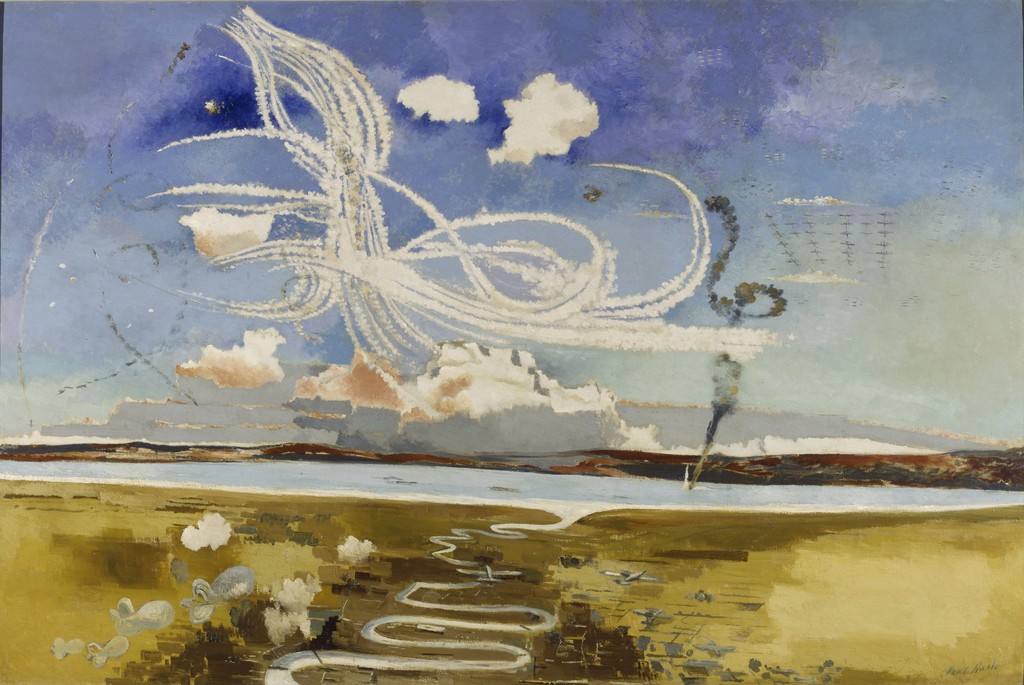
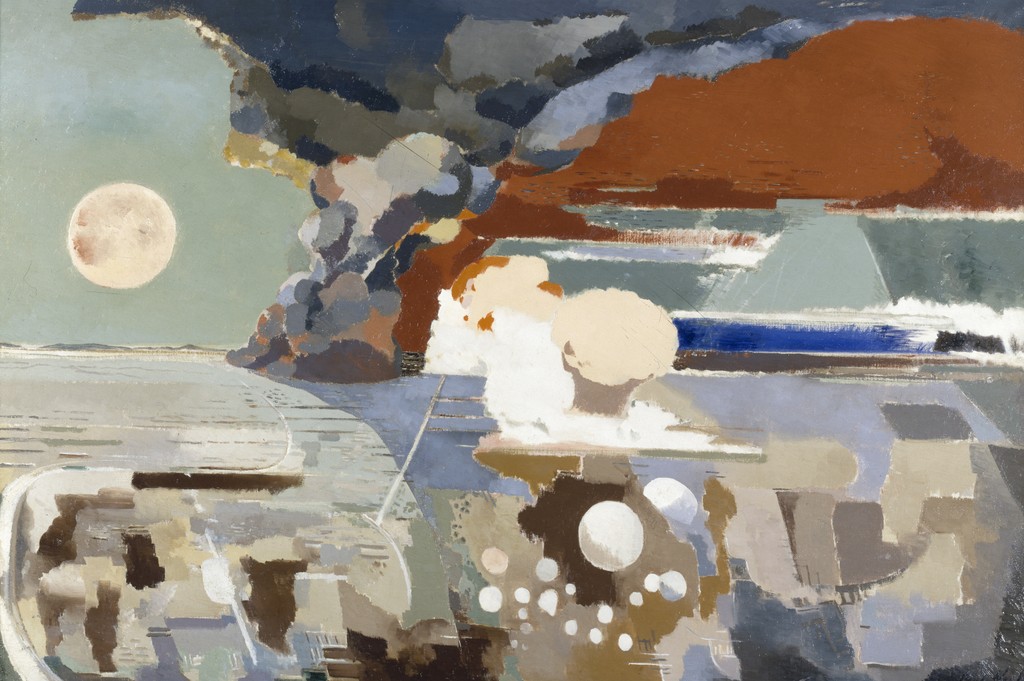
Battle of Britain spreads conflict across sky, water and distant ground; Battle of Germany turns city, smoke and moon into an imagined wartime geography. Neither is a straightforward view from one place. Their scale depends on the same ability to join observed fragments within a larger spatial idea.
Late sunflower and moon paintings bring the garden and seasonal time into that geography. The British Council record for Eclipse of the Sunflower places the 1945 oil within Nash’s final natural cycle.[14] Growth, decline and recurring light replace roads or sea walls as measures of change, but the art still begins with visible forms.
Coast, Tree, Stone and Threshold
Across these places, several motifs perform changing jobs. The coast separates and joins; the tree can act as survivor, screen or living mass; the stone links present sight to deep time. Steps, walls, windows, paths and horizons are thresholds, directing attention towards a space that may remain inaccessible.
Nash’s landscapes are most persuasive when material fact and association are held together. Exact geography prevents symbolism from becoming arbitrary, while memory, framing and formal invention prevent geography from becoming mere record. Repetition across decades does not empty a motif of place. It shows how much a place can continue to generate.
About this directory: These 129 entries form a reproducible researched online works census assembled from current public records. It is not a catalogue raisonné and does not claim absolute completeness.
Artworks directory
| Name | Date | Medium |
|---|---|---|
| A Christmas Card to Arthur and Madeline Clifton, 1926 | 1926 | |
| A German Double Pill Box | 1918 | |
| A Howitzer Firing | 1914 | Painting |
| A Night Bombardment | 1919 | Painting |
| A Shell Crater | 1918 | Drawing |
| Battle of Britain | 1941 | Painting |
| Battle of Germany | 1944 | Painting |
| Beeches in the Wind by Paul Nash - Paul Nash | 1918 | Artwork |
| Behind the Inn | 1920 | Painting |
| Berkshire Downs | 1922 | Painting |
| Blue House on the Shore | 1930 | Painting |
| Bouquet | Date unknown | Painting |
| Bouquet - Paul Nash | 1927 | Artwork |
| Buckinghamshire Landscape | 1927 | Painting |
| Cactus | 1928 | Painting |
| Chestnut Waters | Date unknown | Painting |
| Circle of the Monoliths | 1937 | Painting |
| Cliffs | Date unknown | Drawing |
| Cloudscape (recto) | 1939 | Painting |
| Composition (Design for Today) | 1934 | Painting |
| Coronilla | 1929 | Painting |
| Cotswold Hills | 1920 | Painting |
| Day Fighter | 1940 | Painting |
| Dead Spring | 1929 | Painting |
| Defence of Albion | 1942 | Painting |
| Design for a bookplate for Kenneth Fitzpatrick Mackenzie | 1909 | Drawing |
| Division of the Light from the Darkness | 1924 | |
| Druid Landscape | 1938 | Painting |
| Dunbarton Lakes | 1910 | Drawing |
| Dymchurch, Kent | Date unknown | Painting |
| Dymchurch Steps | Date unknown | Painting |
| Dymchurch - The Strange Coast | 1920 | |
| Eclipse of the Sunflower | 1945 | Painting |
| Edge of the marsh | 1925 | Painting |
| Equivalents for the Megaliths | 1935 | Painting |
| Event on the Downs | 1934 | Painting |
| Flight of the Magnolia | 1944 | Painting |
| Footballers Prefer Shell | 1935 | Painting |
| Fruits and Vegetables | 1930 | |
| Granary | 1922 | Painting |
| Graveyard in a Ruined Orchard near Vimy | 1917 | Drawing |
| Grotto in the Snow | 1939 | Painting |
| Harbour and Room | 1934 | Painting |
| Iver Heath, Buckinghamshire, Snow | 1927 | Painting |
| Kinetic Feature | 1931 | Painting |
| Landscape | 1926 | Painting |
| Landscape at Iden | 1929 | Painting |
| Landscape Composition (Objects in Relation) | 1934 | Painting |
| Landscape from a Dream | 1937 | Painting |
| Landscape of Bleached Objects | 1934 | Painting |
| Landscape of the Bagley Woods | 1943 | Painting |
| Landscape of the Brown Fungus | 1943 | Painting |
| Landscape of the Malvern Distance | 1943 | Painting |
| Landscape of the Megaliths | 1934 | Painting |
| Landscape of the Moon's First Quarter | 1943 | Painting |
| Landscape of the Moon's Last Phase | 1944 | Painting |
| Landscape of the summer solstice | Date unknown | Painting |
| Landscape of the Vernal Equinox (III) | 1944 | Painting |
| Landscape (verso) | 1939 | Painting |
| Landscape with Megaliths - Paul Nash | 1936 | |
| Landscape - Year of Our Lord, 1917 | 1910 | Drawing |
| Lares | 1929 | Painting |
| March Landscape | 1944 | Painting |
| Men Marching at Night | 1918 | |
| Metamorphosis | 1938 | Painting |
| Michaelmas Landscape | 1943 | Painting |
| Mimosa Wood | 1926 | Painting |
| Mineral Object | 1935 | Painting |
| 'Modern Textiles' (shop sign board) | 1926 | Painting |
| Monument to Fallen Canadians on Vimy Ridge | 1917 | Drawing |
| Nest of the Siren | 1930 | Painting |
| Night Fighter | 1940 | Painting |
| Nocturnal Landscape | 1938 | Painting |
| Northern Adventure | 1929 | Painting |
| Nostalgic Landscape | 1930 | Painting |
| November Moon | 1942 | Painting |
| Oxenbridge Pond | 1927 | Painting |
| Oxford During the War | 1942 | Painting |
| Pillar and Moon | 1937 | Painting |
| Pink Hyacinth | 1921 | Painting |
| Plage | 1928 | Painting |
| Riviera Landscape | 1926 | Painting |
| Riviera Window, Cros-de-Cagnes | 1926 | Painting |
| Sandling Park, Kent | 1924 | Painting |
| Sluice | 1920 | |
| Solstice of the Sunflower | 1945 | Painting |
| Souvenir of Florence | 1929 | Painting |
| Spring in the Trenches, Ridge Wood, 1917 | 1918 | Painting |
| St Pancras Lilies | 1927 | Painting |
| St Pancras, London | 1927 | Painting |
| Still Life I - Paul Nash | 1924 | Artwork |
| Still Life with Bog Cotton | 1927 | Painting |
| Strange Coast | 1920 | |
| Study of Mrs. Nash | 1916 | Drawing |
| Sunflower and sun | 1942 | Painting |
| Sunrise, Inverness Copse | 1918 | Painting |
| Telecommunications | 1934 | Painting |
| The Archer | Date unknown | Painting |
| The Diving Stage | 1928 | Painting |
| The Edge of the Wood | 1919 | Painting |
| The Menin Road | 1919 | Painting |
| The Mule Track | 1918 | Painting |
| The Pond at Souldern | 1926 | Painting |
| The Raider on the Moors | 1940 | |
| The Rye Marshes, East Sussex | 1932 | Painting |
| The Sea | 1923 | Painting |
| The Sea Wall | 1920 | |
| The Shore | 1923 | Painting |
| The Stackyard | 1925 | Painting |
| The Window, Iver Heath | Date unknown | Painting |
| The Ypres Salient at Night | 1918 | Painting |
| Through a Window, Riviera | 1927 | Painting |
| Tide at Dymchurch | 1920 | |
| Token [verso: Tree in a Landscape (unfinished)] | 1929 | Painting |
| Totes Meer (Dead Sea) | 1940 | Painting |
| Vale of the White Blackbird | 1942 | Painting |
| View from a Window, Nice | 1934 | Painting |
| View R | 1940 | Painting |
| Void | 1918 | Painting |
| Voyages of the Moon | 1935 | Painting |
| We Are Making a New World | 1918 | Painting |
| Whiteleaf Cross | 1931 | Painting |
| Winter, Hampden | Date unknown | |
| Winter Sea | 1931 | Painting |
| Wittenham Clumps | 1943 | Painting |
| Wood on the Downs | 1929 | Painting |
| Wooded Landscape | 1942 | Painting |
| Worth Matravers, Dorset | 1936 | Drawing |
| Wounded, Passchendaele | Date unknown | Painting |
Frequently Asked Questions
No surviving institutional account establishes one exclusive favourite. Wittenham Clumps had exceptional longevity, appearing near the beginning of his career and again in the 1940s, but Dymchurch, Dorset, Avebury and Oxford each produced distinct bodies of work.[2]
The paired hills combined strong tree silhouettes, extended views and visible human history. Nash first worked there around 1912 and later returned to the subject, allowing observation and memory to operate across a long interval.[2]
They are a group of coastal images shaped by sea walls, steps, shore and horizon. Titles such as Dymchurch – The Strange Coast, Dymchurch Steps and The End of the Steps refer to separate works, not alternative names for one object.[8]
He encountered the Avebury monuments in 1933. The experience led to paintings that connected standing stones with modern geometry, memory and archaeological knowledge, including the distinct Landscape of the Megaliths and Equivalents for the Megaliths.[4][12]
Discussion
What should readers notice when looking closely at Paul Nash: Landscape and Place?
Reader Insights
Look for thresholds: walls, paths, shores, woods, hills and aligned stones.
Balance associative readings with the material facts of each place.
When does an observed landscape begin to behave like an encounter?
Join the Conversation
Share your reading below, keeping observations specific and evidence clear.
References
- Paul Nash fonds TGA 769 — Tate Archive, accessed 31 August 2026.
- Paul Nash chronology — Oxfordshire Blue Plaques Board, accessed 31 August 2026.
- Paul Nash artist record — British Council Collection, accessed 31 August 2026.
- Landscape of the Megaliths — British Council Collection, accessed 31 August 2026.
- Album annotated by Paul and Margaret Nash, 1933 onward — Tate Archive, accessed 31 August 2026.
- Whiteleaf Cross — British Council Collection, accessed 31 August 2026.
- German Double Pill Box, Gheluvelt — British Council Collection, accessed 31 August 2026.
- Dymchurch – The Strange Coast, ABDAG000153 — Aberdeen Archives, Gallery and Museums, accessed 31 August 2026.
- Landscape, B1992.13.9 — Yale Center for British Art, accessed 31 August 2026.
- Wood on the Downs, ABDAG002949 — Aberdeen Archives, Gallery and Museums, accessed 31 August 2026.
- Worth Matravers, Dorset, B1988.19 — Yale Center for British Art, accessed 31 August 2026.
- Thomas Guest and Paul Nash in Wiltshire — Tate Papers, accessed 31 August 2026.
- Paul Nash’s Geological Enigma — British Art Studies, accessed 31 August 2026.
- Eclipse of the Sunflower — British Council Collection, accessed 31 August 2026.