 by Tom Gurney
Tom Gurney BSc (Hons) is an art history expert with over 20 years experience
Page Created on August 31, 2026 / Page Updated on November 6, 2026
Email: tomgurney1@gmail.com / Phone: +44 7429 011000
We Are Making a New World: Introduction
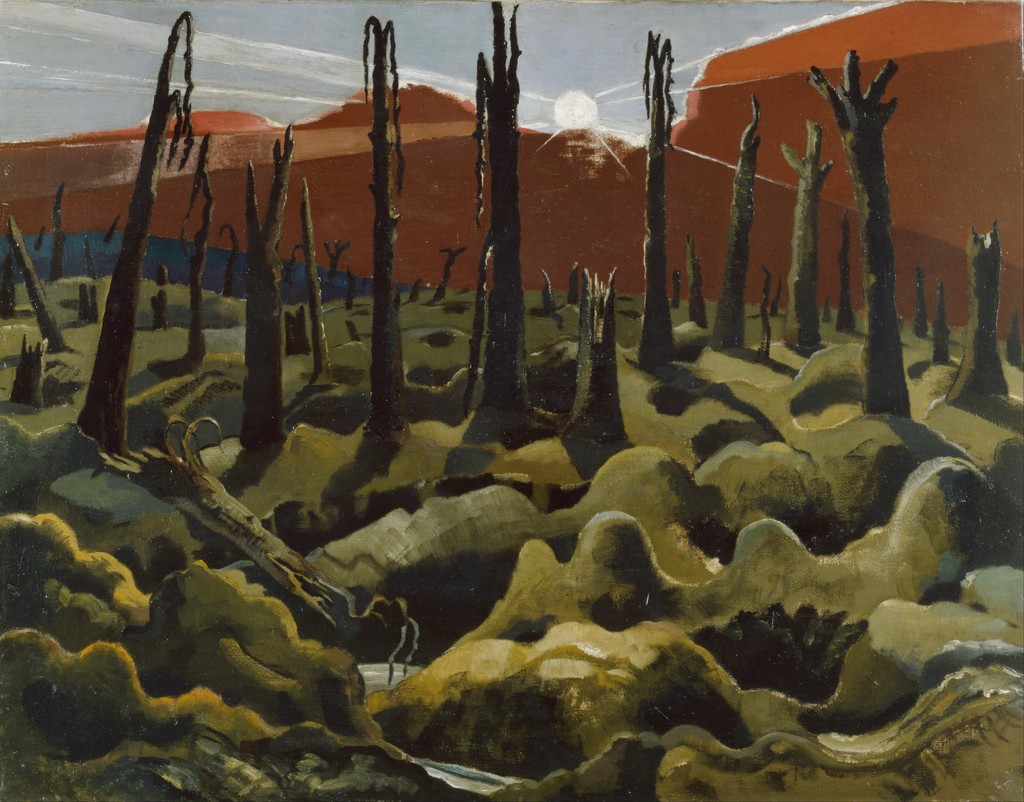
Paul Nash’s We Are Making a New World presents sunrise over a landscape stripped of ordinary life. A white disc appears above bands of rust-red cloud, but below it the ground is gouged into mounds, trenches and dark hollows. The painting’s title promises construction; the image reveals what industrial war has constructed instead.[1]
At a Glance
- ArtistPaul Nash (1889–1946)
- Date1918
- MediumOil on canvas
- Dimensions711 × 914 mm
- CollectionImperial War Museums, London; accession ART 1146
- SubjectA devastated First World War landscape developed from Nash’s front-line view of sunrise at Inverness Copse.[1]
Paul Nash in context
Contents
- The Exact Painting
- A Landscape without Human Figures
- Shattered Trees and Shell-Holed Ground
- Sun, Cloud Bands and Colour
- From Inverness Copse to the 1918 Oil
- Why the Title Is Ironic
- Witness, Construction and Reportage
- Three Wartime Paintings, Three Kinds of Space
- A Landscape Image with a Continuing Legacy
The Exact Painting
Imperial War Museums records We Are Making a New World as ART 1146, an oil on canvas measuring 711 by 914 millimetres and dating from 1918.[1] Those facts identify a moderately sized easel painting, not a mural or field sketch. Its horizontal format gives the damaged terrain room to spread, while the upright trees repeatedly interrupt that breadth.
The work belongs to Nash’s period as a First World War artist, but its importance is not exhausted by that category. It converts a particular wartime environment into a tightly organised image of land under pressure. Readers can locate it within the broader Paintings and Artworks survey, where drawing, print and oil are treated as different stages of visual thought rather than as interchangeable records.
A Landscape without Human Figures
No soldiers occupy the scene. There is no marching column, gun crew or identifiable building. Human action is nevertheless present everywhere through its effects. The ground has been torn open, vegetation has been smashed and the remaining trunks carry blunt, amputated branches. Absence makes the land itself the principal evidence.
Across the foreground, bulbous ridges of olive, ochre and grey-green earth rise and fold into one another. Black gaps and small pools break their continuity. A long piece of fallen timber cuts diagonally from the lower left, contrasting with the surrounding vertical stumps. Farther back, smaller remnants recede towards a narrow blue band, giving a rough measure of depth.
The Landscape and Place context matters here. Nash had treated trees, paths and horizons as active forms before the war. In this painting, those familiar elements have not disappeared; they have been violently altered.
Shattered Trees and Shell-Holed Ground
The tree trunks form an irregular screen. Some are narrow spikes, others widen at the base, and several split into short forked branches. The tallest dark shapes run nearly from the ground to the upper edge, making it difficult for the eye to pass cleanly into the distance. They resemble natural growth only in outline; blast has removed crowns, leaves and shelter.
Below them, shell holes and broken banks deny a stable route. The foreground does not provide the conventional path that might lead a viewer comfortably towards the horizon. Instead, repeated cavities and swelling masses keep attention close to the surface. The land seems both solid and unstable: heavy in colour, yet churned into forms that could collapse or fill with water.
Imperial War Museums has framed such violated landscape as a way First World War artists represented the force of conflict and its human cost.[2] That interpretation fits the visible evidence without requiring a literal body in the scene. Damage to place carries the history of those who passed through it.
Sun, Cloud Bands and Colour
The sun is small, white and slightly right of centre. Its near-perfect circle is one of the few unbroken shapes in the painting. Pale diagonal bands pass across a blue-grey sky, while broad red-brown clouds or atmospheric layers press along the horizon. The upper zone is flatter and more geometrical than the modelled ground below.
This sun does not simply brighten the landscape. Its whiteness contrasts sharply with the black trunks and muddy greens, making it an immediate focal point. Yet the light reveals devastation rather than changing it. Long dark forms remain dominant, and no new growth is visible. Sunrise supplies a conventional expectation of beginning, while the terrain refuses the expected renewal.
Colour strengthens that contradiction. Rust and muted blue make the distance appear vivid, but the foreground is restricted to bruised greens, yellowed earth, black and grey. Nash permits visual intensity without offering a beautiful escape from the subject. The colour holds attention on what the new day exposes.
From Inverness Copse to the 1918 Oil
The painting developed from a front-line drawing known as Sunrise, Inverness Copse.[1] Inverness Copse lay in the Ypres Salient, the area in which Nash served during 1917. The connection supplies a geographical and observational starting point, but it does not make the canvas a direct transcription made on the spot.
Nash had enlisted in the Artists Rifles in September 1914, received a Hampshire Regiment commission in 1916 and reached the Western Front in 1917. An accidental injury brought him back to Britain. A June exhibition of his front-line drawings at the Goupil Gallery preceded his official return to France as a war artist.[3][4]
By 1918, the oil could draw upon both first-hand observation and a later process of selection. The source drawing secured the encounter with place and light; the canvas established a broader rhythm of vertical trunks, horizontal bands and repeated ground forms. The shift of medium allowed colour and painted density to carry meanings unavailable to a quick field record.
Why the Title Is Ironic
“We are making a new world” sounds like a declaration of purposeful creation. Nash sets that confidence against a place where natural and human structures have been destroyed. The title does not name a victorious army or political programme, so its “we” remains deliberately broad. Viewers are implicated in a civilisation capable of describing mechanised devastation as progress.
The irony depends on the sun as well as the ruins. A new day is literally beginning, but its light falls upon a world made uninhabitable. The phrase therefore cannot settle into optimism. Nor does the image allow destruction to look finished: the repeated stumps extend beyond the frame, suggesting that the visible field is only one part of a wider damaged environment.[1][2]
It would be too simple to treat the title as a caption that explains every form. Its force arises from contradiction. Words propose one account; the painted landscape supplies another.
Witness, Construction and Reportage
Nash’s service and source drawing give the work the authority of encounter. The painting is still a studio construction. It compresses space, repeats motifs and controls colour so deliberately that it cannot be mistaken for a neutral survey of Inverness Copse. That distinction is not a weakness. It explains how observation became an argument.
Studies of Paul and John Nash in the aftermath of the war place their art within the difficult movement from individual experience to public memory.[5] We Are Making a New World participates in that movement by refusing anecdotal detail. It does not tell viewers who stood at a given point or what happened in one minute. Instead, it organises cumulative damage into a form that can be revisited.
Painting and reportage overlap but do not coincide. The named source location and battlefield conditions are historical anchors. The vacant foreground, patterned trunks, controlled sunrise and verbal irony belong to Nash’s act of composition.
Three Wartime Paintings, Three Kinds of Space
Within Nash’s First World War Art, this painting is distinguished by frontal stillness. The trees face the viewer like a broken barrier, and the sun fixes attention near the centre. There is little sense that a safe route exists through the image.
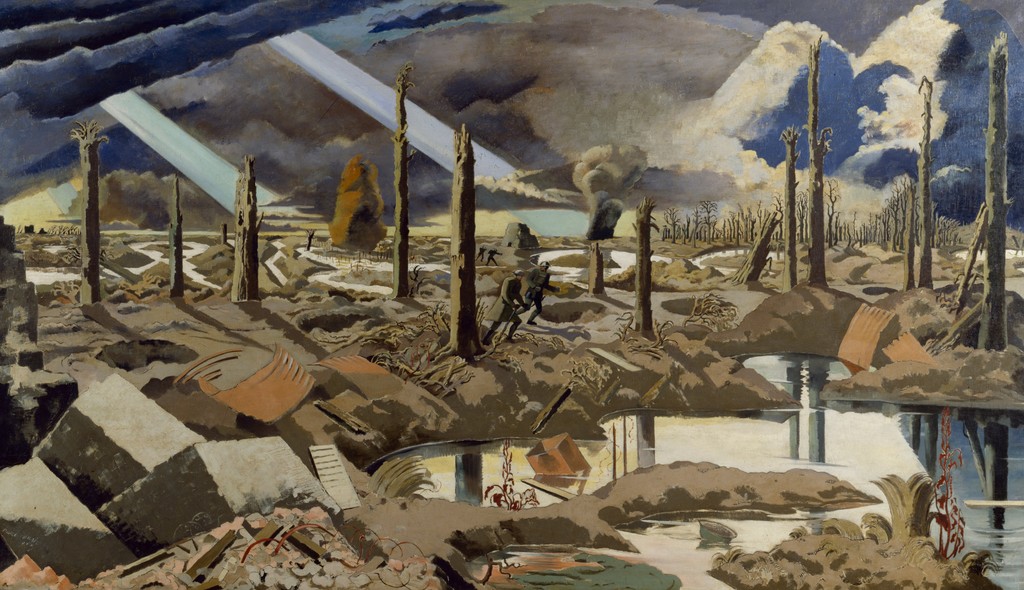
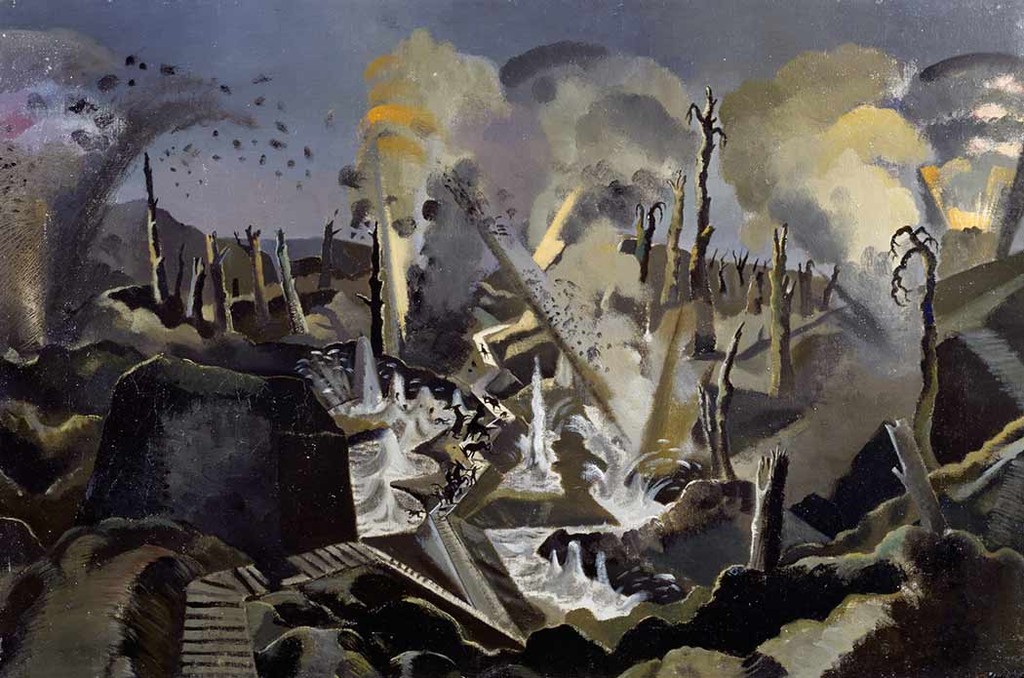
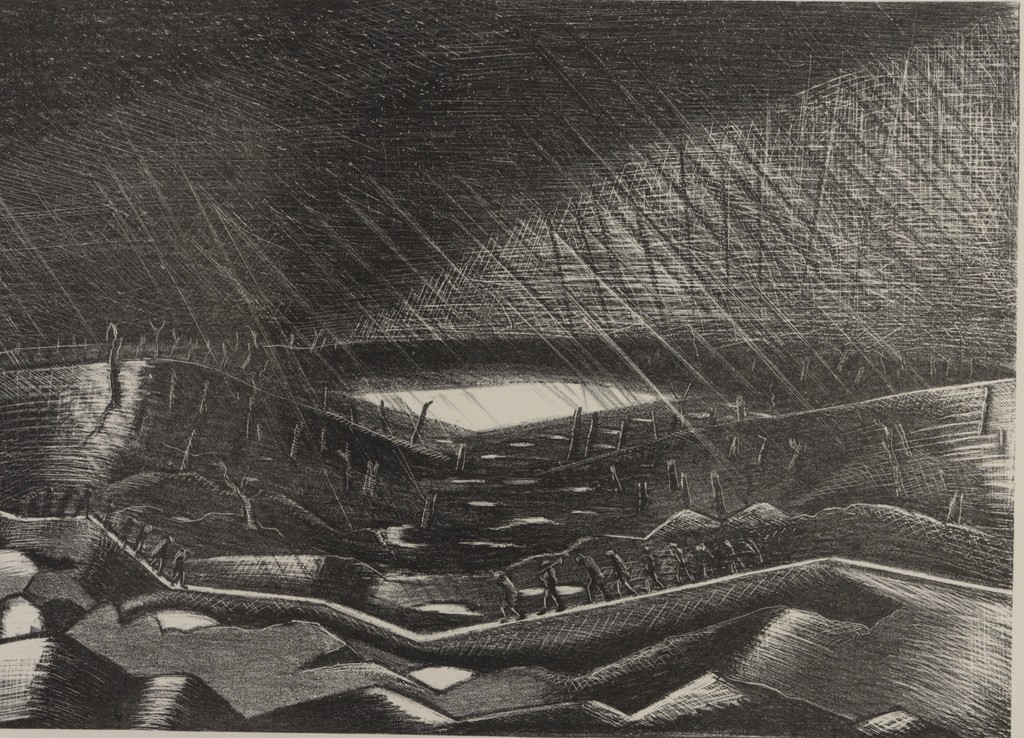
The Mule Track uses a different spatial problem: figures and animals attempt movement while bombardment fractures their surroundings. The Menin Road expands obstruction across a monumental panorama, with small figures negotiating flooded craters and debris. Comparing the three prevents their shared motifs—broken trees, damaged ground, smoke and water—from becoming a generic formula.
In We Are Making a New World, the absence of people and the fixed dawn make destruction feel cumulative rather than momentary. The action has already entered the land.
A Landscape Image with a Continuing Legacy
The painting has become a central object in institutional accounts of British First World War art because it joins a legible historical subject to formal compression and verbal ambiguity.[1][2] Its force does not depend on calling it the definitive war painting. It remains open enough to support questions about witness, environmental destruction, public rhetoric and the ethics of finding visual order in ruin.
Nash’s later landscapes explored coast, stones, geology, photographs and unexpected objects. Scholarly work on his geological imagination shows how persistently he treated land as material shaped by forces and histories beyond a single view.[6] The 1918 canvas belongs to a distinct wartime situation, yet it also demonstrates that durable method: physical terrain is made to bear what human figures alone cannot explain.
Its legacy lies in the tension it preserves. Sunrise is neither cancelled nor trusted; pattern gives coherence without repairing damage; beauty remains visible but cannot turn the scene into consolation.
About this directory: These 129 entries form a reproducible researched online works census assembled from current public records. It is not a catalogue raisonné and does not claim absolute completeness.
Artworks directory
| Name | Date | Medium |
|---|---|---|
| A Christmas Card to Arthur and Madeline Clifton, 1926 | 1926 | |
| A German Double Pill Box | 1918 | |
| A Howitzer Firing | 1914 | Painting |
| A Night Bombardment | 1919 | Painting |
| A Shell Crater | 1918 | Drawing |
| Battle of Britain | 1941 | Painting |
| Battle of Germany | 1944 | Painting |
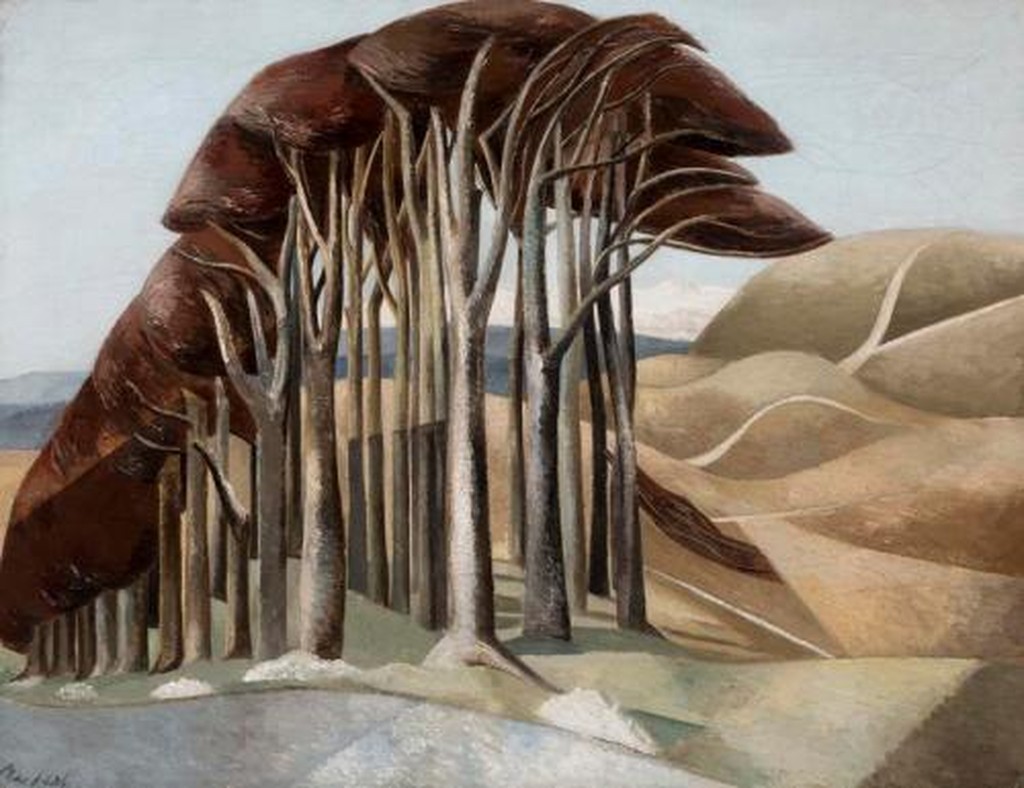
| Beeches in the Wind by Paul Nash - Paul Nash | 1918 | Artwork |
| Behind the Inn | 1920 | Painting |
| Berkshire Downs | 1922 | Painting |
| Blue House on the Shore | 1930 | Painting |
| Bouquet | Date unknown | Painting |
| Bouquet - Paul Nash | 1927 | Artwork |
| Buckinghamshire Landscape | 1927 | Painting |
| Cactus | 1928 | Painting |
| Chestnut Waters | Date unknown | Painting |
| Circle of the Monoliths | 1937 | Painting |
| Cliffs | Date unknown | Drawing |
| Cloudscape (recto) | 1939 | Painting |
| Composition (Design for Today) | 1934 | Painting |
| Coronilla | 1929 | Painting |
| Cotswold Hills | 1920 | Painting |
| Day Fighter | 1940 | Painting |
| Dead Spring | 1929 | Painting |
| Defence of Albion | 1942 | Painting |
| Design for a bookplate for Kenneth Fitzpatrick Mackenzie | 1909 | Drawing |
| Division of the Light from the Darkness | 1924 | |
| Druid Landscape | 1938 | Painting |
| Dunbarton Lakes | 1910 | Drawing |
| Dymchurch, Kent | Date unknown | Painting |
| Dymchurch Steps | Date unknown | Painting |
| Dymchurch - The Strange Coast | 1920 | |
| Eclipse of the Sunflower | 1945 | Painting |
| Edge of the marsh | 1925 | Painting |
| Equivalents for the Megaliths | 1935 | Painting |
| Event on the Downs | 1934 | Painting |
| Flight of the Magnolia | 1944 | Painting |
| Footballers Prefer Shell | 1935 | Painting |
| Fruits and Vegetables | 1930 | |
| Granary | 1922 | Painting |
| Graveyard in a Ruined Orchard near Vimy | 1917 | Drawing |
| Grotto in the Snow | 1939 | Painting |
| Harbour and Room | 1934 | Painting |
| Iver Heath, Buckinghamshire, Snow | 1927 | Painting |
| Kinetic Feature | 1931 | Painting |
| Landscape | 1926 | Painting |
| Landscape at Iden | 1929 | Painting |
| Landscape Composition (Objects in Relation) | 1934 | Painting |
| Landscape from a Dream | 1937 | Painting |
| Landscape of Bleached Objects | 1934 | Painting |
| Landscape of the Bagley Woods | 1943 | Painting |
| Landscape of the Brown Fungus | 1943 | Painting |
| Landscape of the Malvern Distance | 1943 | Painting |
| Landscape of the Megaliths | 1934 | Painting |
| Landscape of the Moon's First Quarter | 1943 | Painting |
| Landscape of the Moon's Last Phase | 1944 | Painting |
| Landscape of the summer solstice | Date unknown | Painting |
| Landscape of the Vernal Equinox (III) | 1944 | Painting |
| Landscape (verso) | 1939 | Painting |
| Landscape with Megaliths - Paul Nash | 1936 | |
| Landscape - Year of Our Lord, 1917 | 1910 | Drawing |
| Lares | 1929 | Painting |
| March Landscape | 1944 | Painting |
| Men Marching at Night | 1918 | |
| Metamorphosis | 1938 | Painting |
| Michaelmas Landscape | 1943 | Painting |
| Mimosa Wood | 1926 | Painting |
| Mineral Object | 1935 | Painting |
| 'Modern Textiles' (shop sign board) | 1926 | Painting |
| Monument to Fallen Canadians on Vimy Ridge | 1917 | Drawing |
| Nest of the Siren | 1930 | Painting |
| Night Fighter | 1940 | Painting |
| Nocturnal Landscape | 1938 | Painting |
| Northern Adventure | 1929 | Painting |
| Nostalgic Landscape | 1930 | Painting |
| November Moon | 1942 | Painting |
| Oxenbridge Pond | 1927 | Painting |
| Oxford During the War | 1942 | Painting |
| Pillar and Moon | 1937 | Painting |
| Pink Hyacinth | 1921 | Painting |
| Plage | 1928 | Painting |
| Riviera Landscape | 1926 | Painting |
| Riviera Window, Cros-de-Cagnes | 1926 | Painting |
| Sandling Park, Kent | 1924 | Painting |
| Sluice | 1920 | |
| Solstice of the Sunflower | 1945 | Painting |
| Souvenir of Florence | 1929 | Painting |
| Spring in the Trenches, Ridge Wood, 1917 | 1918 | Painting |
| St Pancras Lilies | 1927 | Painting |
| St Pancras, London | 1927 | Painting |
| Still Life I - Paul Nash | 1924 | Artwork |
| Still Life with Bog Cotton | 1927 | Painting |
| Strange Coast | 1920 | |
| Study of Mrs. Nash | 1916 | Drawing |
| Sunflower and sun | 1942 | Painting |
| Sunrise, Inverness Copse | 1918 | Painting |
| Telecommunications | 1934 | Painting |
| The Archer | Date unknown | Painting |
| The Diving Stage | 1928 | Painting |
| The Edge of the Wood | 1919 | Painting |
| The Menin Road | 1919 | Painting |
| The Mule Track | 1918 | Painting |
| The Pond at Souldern | 1926 | Painting |
| The Raider on the Moors | 1940 | |
| The Rye Marshes, East Sussex | 1932 | Painting |
| The Sea | 1923 | Painting |
| The Sea Wall | 1920 | |
| The Shore | 1923 | Painting |
| The Stackyard | 1925 | Painting |
| The Window, Iver Heath | Date unknown | Painting |
| The Ypres Salient at Night | 1918 | Painting |
| Through a Window, Riviera | 1927 | Painting |
| Tide at Dymchurch | 1920 | |
| Token [verso: Tree in a Landscape (unfinished)] | 1929 | Painting |
| Totes Meer (Dead Sea) | 1940 | Painting |
| Vale of the White Blackbird | 1942 | Painting |
| View from a Window, Nice | 1934 | Painting |
| View R | 1940 | Painting |
| Void | 1918 | Painting |
| Voyages of the Moon | 1935 | Painting |
| We Are Making a New World | 1918 | Painting |
| Whiteleaf Cross | 1931 | Painting |
| Winter, Hampden | Date unknown | |
| Winter Sea | 1931 | Painting |
| Wittenham Clumps | 1943 | Painting |
| Wood on the Downs | 1929 | Painting |
| Wooded Landscape | 1942 | Painting |
| Worth Matravers, Dorset | 1936 | Drawing |
| Wounded, Passchendaele | Date unknown | Painting |
Frequently Asked Questions
The title is ironic. Its language of collective creation is contradicted by broken trees and cratered land. The “new world” visible in the painting is one produced by industrial war, while the undefined “we” prevents responsibility from being assigned to a single pictured person.[1][2]
The oil derives from Nash’s front-line drawing Sunrise, Inverness Copse, connected with the Ypres Salient in Belgium.[1] The final composition retains that source but reorganises it, so it should not be read as an exact panoramic survey.
No. Nash gathered direct visual evidence during his wartime service and official return, but the 1918 oil was a developed studio painting. His accidental injury had first brought him home in 1917; his Goupil exhibition then preceded his appointment as an official war artist.[3][4]
The painting does not supply a fixed symbolic key. Visually, the white sunrise suggests beginning and attracts the eye, but its light exposes devastation rather than renewal. Reading the sun as an ironic counterweight to the ruined ground is therefore supported by the composition and title.[1]
The painting belongs to Imperial War Museums in London and carries accession number ART 1146.[1] Display arrangements can change, so prospective visitors should consult the museum’s current object information before travelling.
Discussion
What should readers notice when looking closely at We Are Making a New World?
Reader Insights
Move from the cold sun to the shattered trunks and cratered foreground.
Set the ironic title against the painting’s disciplined structure and wartime source drawings.
Does the dawn promise renewal, expose ruin, or hold both possibilities?
Join the Conversation
Share your reading below, keeping observations specific and evidence clear.
References
- We Are Making a New World, ART 1146 — Imperial War Museums, accessed 31 August 2026.
- Truth and Memory: First World War art material — Imperial War Museums, accessed 31 August 2026.
- Paul Nash fonds TGA 769 — Tate Archive, accessed 31 August 2026.
- German Double Pill Box, Gheluvelt — British Council Collection, accessed 31 August 2026.
- Brothers in Arms: John and Paul Nash and the Aftermath of the Great War — Arts University Bournemouth, accessed 31 August 2026.
- Paul Nash’s Geological Enigma — British Art Studies, accessed 31 August 2026.