 by Tom Gurney
Tom Gurney BSc (Hons) is an art history expert with over 20 years experience
Page Created on August 31, 2026 / Page Updated on November 6, 2026
Email: tomgurney1@gmail.com / Phone: +44 7429 011000
Wood on the Downs: Introduction
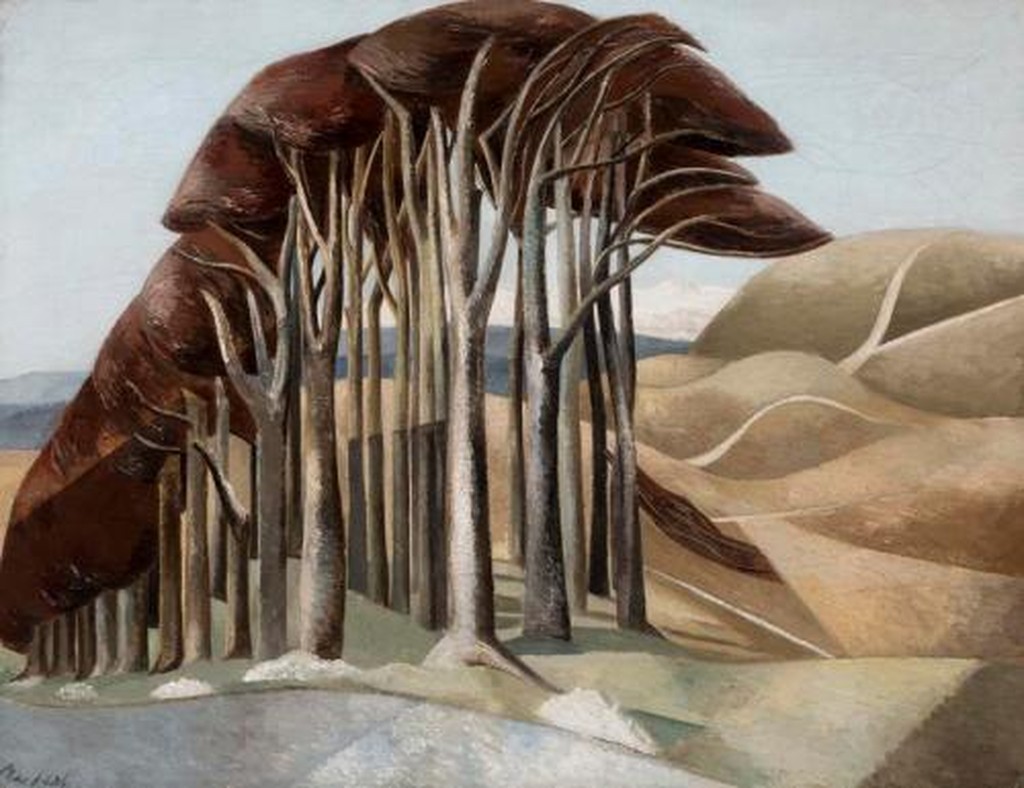
Paul Nash’s Wood on the Downs compresses a stand of trees into a single commanding presence. Pale trunks rise closely together beneath a dark rust-brown crown, while rounded slopes unfold to the right in bands of ochre and cream. The 1929 painting remains recognisably a landscape, yet its geometry makes wood, hill and interval feel newly active.[1]
At a Glance
- ArtistPaul Nash (1889–1946)
- Date1929
- Medium and sizeOil on canvas; 71.5 × 92 cm
- CollectionAberdeen Art Gallery; accession ABDAG002949
- SubjectA compact group of trees set against open downland
- Career phaseAn interwar landscape made after the Dymchurch period and before Unit One and Nash’s Avebury paintings.[1][2][3]
Paul Nash in context
Contents
- The Exact Aberdeen Painting
- What Is Visible
- The Wood as a Living Mass
- Slopes, Horizon and Direction
- Geometry and Organic Form
- Colour and Painted Surface
- From Dymchurch towards a New Landscape Language
- Place as a Constructed Encounter
- A Landscape between Two Wars
The Exact Aberdeen Painting
The institutional record identifies Wood on the Downs as an oil on canvas of 1929, measuring 71.5 by 92 centimetres and carrying the Aberdeen accession ABDAG002949.[1] Its width gives the right-hand slopes substantial room, but the wood remains the dominant form. This is not a small incident within a broad panorama: the trees take possession of much of the painted field.
The title names a kind of setting without establishing a precise mapped viewpoint. It would therefore be unsafe to attach the painting to Iden or another convenient place in Nash’s chronology. The safest reading begins with the object itself and with the broader downland description the title supplies.
Within Paintings and Artworks, the canvas provides a non-war example of how Nash reorganised observed terrain through concentrated form.
What Is Visible
The wood stands slightly left of centre. Tall grey, cream and muted-green trunks are packed into a narrow zone, their spacing alternating between tight bars and slender openings. Some rise almost straight; others bend or branch near the canopy. Through the gaps, strips of blue and brown suggest further ground and distance.
Above them, foliage has been gathered into a broad dark mass. Its reddish-brown lobes overlap and curl, with pale branch lines threading through the underside. The crown descends heavily at the left, where a diminishing row of trunks follows the slope towards the edge. This creates the impression of one organism extending through many stems.
The right half is more open. Rounded hills or field divisions overlap in tan, biscuit and rose-brown. Thin light lines ride their contours. Across the front, cool grey-blue, sage and cream planes lead towards the base of the trees. There are no people, buildings or anecdotal details to establish scale.
The Wood as a Living Mass
Nash does not inventory individual species or leaves. He makes the collective shape of the wood more important than botanical detail. The canopy behaves like a sheltering roof, a wave or a heavy mantle, while the trunks resemble a close-set frame supporting it. These comparisons arise from visible form; they need not be treated as a secret symbolic code.
The compression gives the trees agency. Their dark crown pushes outwards and downwards, meeting open air at a clear edge. At the same time, the narrow gaps between trunks invite the eye inside. Wood and opening are interdependent: solidity is created through repetition, but depth survives in the intervals.
The Landscape and Place guide traces Nash’s recurring interest in tree groups from Wittenham to his later Oxford years. Wood on the Downs shows how that interest could become nearly architectural without ceasing to describe living growth.[2]
Slopes, Horizon and Direction
The composition balances several directional systems. The trunks establish a predominantly vertical rhythm. The edge of the canopy sweeps down towards the lower left. On the right, the ground rises and falls through broad curves, crossed by pale seams that lead diagonally away. These vectors prevent the landscape from settling into symmetry.
The horizon is partly withheld. A thin blue strip appears through the wood and beyond its lower edges, but the rolling forms at right climb high enough to reduce the sky. The viewer cannot occupy one effortless lookout. Instead, space is assembled from overlaps: foreground plane over slope, trunk before horizon, canopy against air.
This construction creates movement without depicting an event. Attention travels up the stems, across the brown crown, down its leftward fall and back through the curved hills. The route is circular and repeated rather than a single path into distance.
Geometry and Organic Form
The painting is built from simplified components—bars, arcs, wedges and rounded masses—but it does not abandon the natural subject. The straight trunks retain irregular spacing and taper; branches twist under the canopy; each hill changes its curve. Geometry is a means of clarifying relationships, not a claim that land and trees are inert diagrams.
This tension situates the work within Nash’s developing modernism. The British Council describes his interwar practice as moving through landscape and applied design towards the abstraction and Surrealism associated with Unit One.[3] In 1929, those later affiliations had not yet supplied a fixed label for the painting. What is already present is a willingness to intensify a place by simplifying it.
The Modernism and Surrealism context therefore helps most when it preserves chronology. Wood on the Downs can anticipate later strangeness without being reduced to an illustration of a movement Nash would engage more publicly in the 1930s.
Colour and Painted Surface
Nash uses a restricted range of earth colours, then varies their temperature. The canopy concentrates the deepest reddish brown. Trunks introduce cool greys and subdued greens. The right-hand slopes shift among sand, pinkish beige and pale ochre, while the foreground contains blue-grey and chalky cream. A narrow blue distance and light sky keep the palette from becoming enclosed.
Dark and light do more structural work than atmospheric shading. The canopy reads as dense because its value is deep and continuous; the trunks read separately because light catches their long vertical faces. On the downs, adjoining colours divide one rise from another even where no hard outline appears.
Oil allows flat passages and softer transitions to coexist. The hills are broad and smooth, while the wood contains finer internal marks. Surface difference reinforces the contrast between open ground and crowded growth.
From Dymchurch towards a New Landscape Language
The late 1920s followed Nash’s sustained engagement with Dymchurch and the coast. Those earlier works often organise space through sea wall, horizon, steps and broad bands. Wood on the Downs exchanges the coastal barrier for a clustered natural form, but the desire to make landscape legible through strong divisions remains.[2][3]
The painting also precedes the foundation of Unit One in 1933 and Nash’s encounter with Avebury that year.[2] Its upright trunks and rounded slopes should not be mistaken for standing stones, yet their forceful grouping prepares the eye for later works in which isolated masses and charged intervals become still more pronounced.
The Megaliths and Ancient Landscape study follows that later development. Scholarly research on Nash’s geological imagination adds an important material dimension: land could hold processes, layers and histories beyond what one viewpoint immediately reveals.[4] That framework enriches comparison without turning this 1929 wood into an archaeological subject.
Place as a Constructed Encounter
The painting occupies a productive space between topography and invention. The subject is plausible and its forms remain natural, but the arrangement feels encountered and composed at once. The wood faces open land as a distinct body; the hills appear to answer its canopy through repeated curves; foreground bands hold viewer and trees apart.
This is construction in the pictorial sense, not evidence that the place was imaginary. Nash selected proportions, compressed distance and limited colour so that looking becomes relational. The question is not simply “where is this?” but “how do these forms meet?”
The distinction protects the painting from two extremes. It is more than a literal record of countryside, yet no unsupported mystical explanation is required. Its unusual presence comes from observable decisions about scale, boundary and direction.
A Landscape between Two Wars
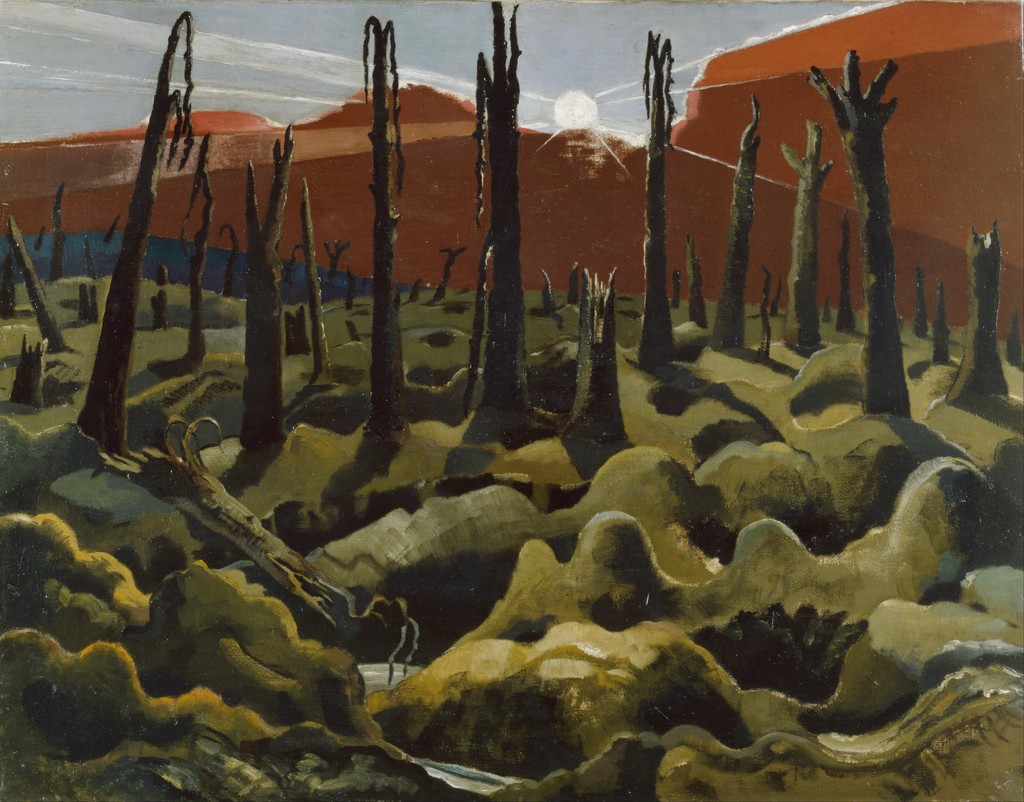
War paintings provide revealing contrasts. In We Are Making a New World, trees have lost their crowns and stand as black evidence of destruction. Here, the canopy remains abundant and continuous, even when stylised. The comparison shows that tree form could carry radically different conditions rather than one permanent meaning.
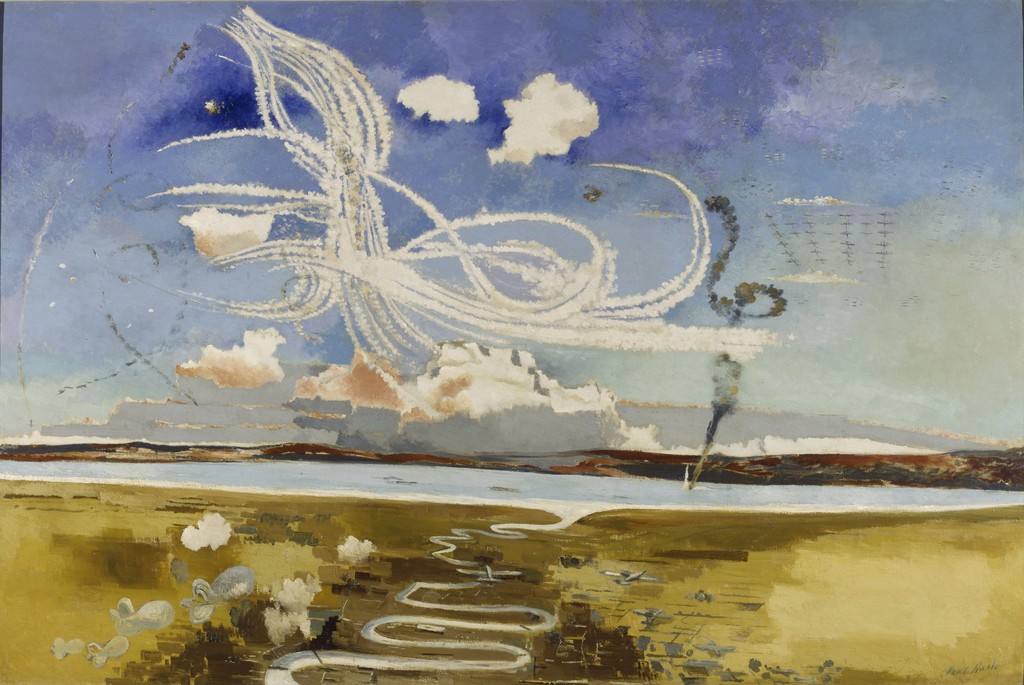
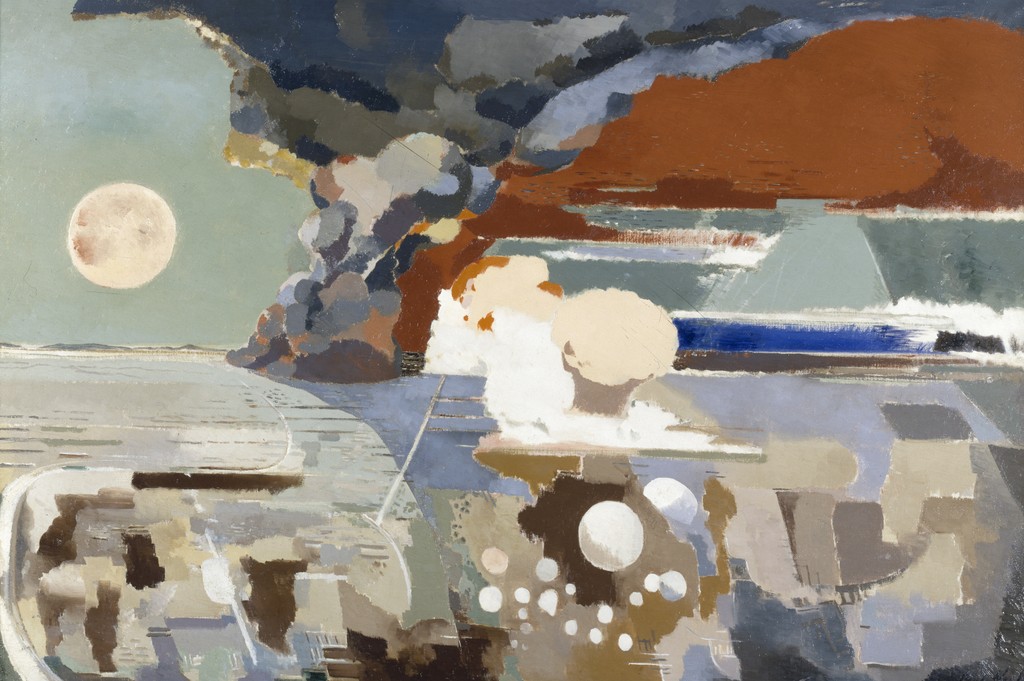
Battle of Britain later spreads action across cloud, coast and aerial traces. Wood on the Downs is closer and quieter: vertical trunks and folded ground create tension without machines or conflict. Read alongside the Paul Nash biography, it prevents the interwar years from appearing as a pause between official commissions.
Aberdeen’s object record and Art UK’s national holdings layer also place the canvas within a dispersed public legacy.[1][5] Its collection context gives a securely identified object through which to study Nash’s landscape modernism outside the better-known war holdings.
About this directory: These 129 entries form a reproducible researched online works census assembled from current public records. It is not a catalogue raisonné and does not claim absolute completeness.
Artworks directory
| Name | Date | Medium |
|---|---|---|
| A Christmas Card to Arthur and Madeline Clifton, 1926 | 1926 | |
| A German Double Pill Box | 1918 | |
| A Howitzer Firing | 1914 | Painting |
| A Night Bombardment | 1919 | Painting |
| A Shell Crater | 1918 | Drawing |
| Battle of Britain | 1941 | Painting |
| Battle of Germany | 1944 | Painting |
| Beeches in the Wind by Paul Nash - Paul Nash | 1918 | Artwork |
| Behind the Inn | 1920 | Painting |
| Berkshire Downs | 1922 | Painting |
| Blue House on the Shore | 1930 | Painting |
| Bouquet | Date unknown | Painting |
| Bouquet - Paul Nash | 1927 | Artwork |
| Buckinghamshire Landscape | 1927 | Painting |
| Cactus | 1928 | Painting |
| Chestnut Waters | Date unknown | Painting |
| Circle of the Monoliths | 1937 | Painting |
| Cliffs | Date unknown | Drawing |
| Cloudscape (recto) | 1939 | Painting |
| Composition (Design for Today) | 1934 | Painting |
| Coronilla | 1929 | Painting |
| Cotswold Hills | 1920 | Painting |
| Day Fighter | 1940 | Painting |
| Dead Spring | 1929 | Painting |
| Defence of Albion | 1942 | Painting |
| Design for a bookplate for Kenneth Fitzpatrick Mackenzie | 1909 | Drawing |
| Division of the Light from the Darkness | 1924 | |
| Druid Landscape | 1938 | Painting |
| Dunbarton Lakes | 1910 | Drawing |
| Dymchurch, Kent | Date unknown | Painting |
| Dymchurch Steps | Date unknown | Painting |
| Dymchurch - The Strange Coast | 1920 | |
| Eclipse of the Sunflower | 1945 | Painting |
| Edge of the marsh | 1925 | Painting |
| Equivalents for the Megaliths | 1935 | Painting |
| Event on the Downs | 1934 | Painting |
| Flight of the Magnolia | 1944 | Painting |
| Footballers Prefer Shell | 1935 | Painting |
| Fruits and Vegetables | 1930 | |
| Granary | 1922 | Painting |
| Graveyard in a Ruined Orchard near Vimy | 1917 | Drawing |
| Grotto in the Snow | 1939 | Painting |
| Harbour and Room | 1934 | Painting |
| Iver Heath, Buckinghamshire, Snow | 1927 | Painting |
| Kinetic Feature | 1931 | Painting |
| Landscape | 1926 | Painting |
| Landscape at Iden | 1929 | Painting |
| Landscape Composition (Objects in Relation) | 1934 | Painting |
| Landscape from a Dream | 1937 | Painting |
| Landscape of Bleached Objects | 1934 | Painting |
| Landscape of the Bagley Woods | 1943 | Painting |
| Landscape of the Brown Fungus | 1943 | Painting |
| Landscape of the Malvern Distance | 1943 | Painting |
| Landscape of the Megaliths | 1934 | Painting |
| Landscape of the Moon's First Quarter | 1943 | Painting |
| Landscape of the Moon's Last Phase | 1944 | Painting |
| Landscape of the summer solstice | Date unknown | Painting |
| Landscape of the Vernal Equinox (III) | 1944 | Painting |
| Landscape (verso) | 1939 | Painting |
| Landscape with Megaliths - Paul Nash | 1936 | |
| Landscape - Year of Our Lord, 1917 | 1910 | Drawing |
| Lares | 1929 | Painting |
| March Landscape | 1944 | Painting |
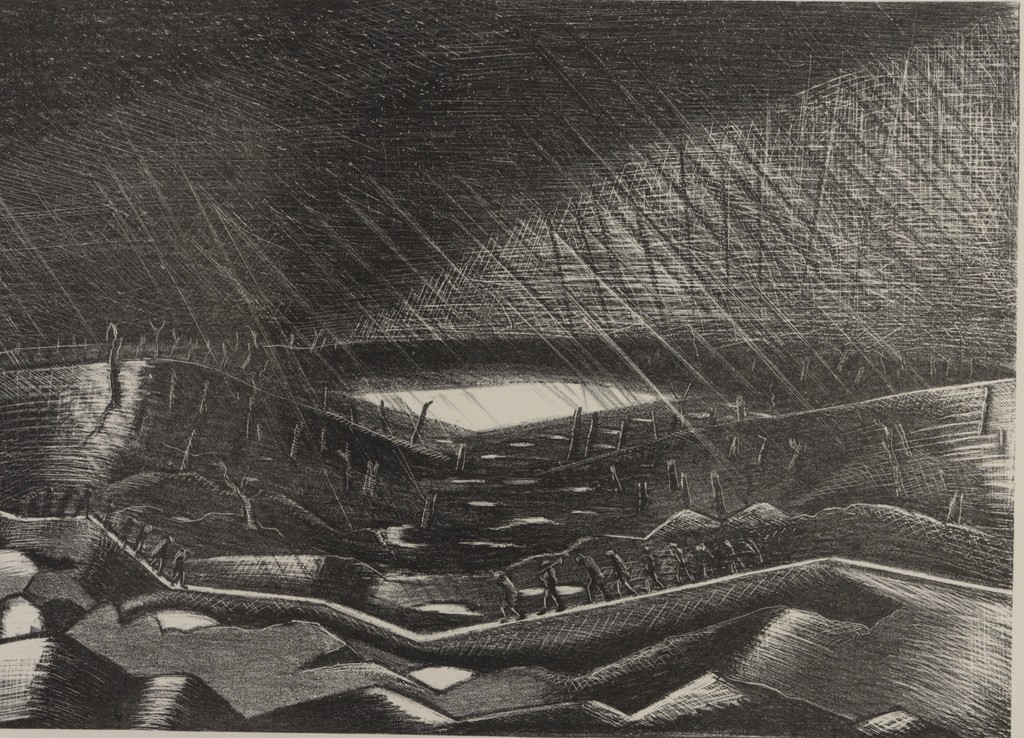
| Men Marching at Night | 1918 | |
| Metamorphosis | 1938 | Painting |
| Michaelmas Landscape | 1943 | Painting |
| Mimosa Wood | 1926 | Painting |
| Mineral Object | 1935 | Painting |
| 'Modern Textiles' (shop sign board) | 1926 | Painting |
| Monument to Fallen Canadians on Vimy Ridge | 1917 | Drawing |
| Nest of the Siren | 1930 | Painting |
| Night Fighter | 1940 | Painting |
| Nocturnal Landscape | 1938 | Painting |
| Northern Adventure | 1929 | Painting |
| Nostalgic Landscape | 1930 | Painting |
| November Moon | 1942 | Painting |
| Oxenbridge Pond | 1927 | Painting |
| Oxford During the War | 1942 | Painting |
| Pillar and Moon | 1937 | Painting |
| Pink Hyacinth | 1921 | Painting |
| Plage | 1928 | Painting |
| Riviera Landscape | 1926 | Painting |
| Riviera Window, Cros-de-Cagnes | 1926 | Painting |
| Sandling Park, Kent | 1924 | Painting |
| Sluice | 1920 | |
| Solstice of the Sunflower | 1945 | Painting |
| Souvenir of Florence | 1929 | Painting |
| Spring in the Trenches, Ridge Wood, 1917 | 1918 | Painting |
| St Pancras Lilies | 1927 | Painting |
| St Pancras, London | 1927 | Painting |
| Still Life I - Paul Nash | 1924 | Artwork |
| Still Life with Bog Cotton | 1927 | Painting |
| Strange Coast | 1920 | |
| Study of Mrs. Nash | 1916 | Drawing |
| Sunflower and sun | 1942 | Painting |
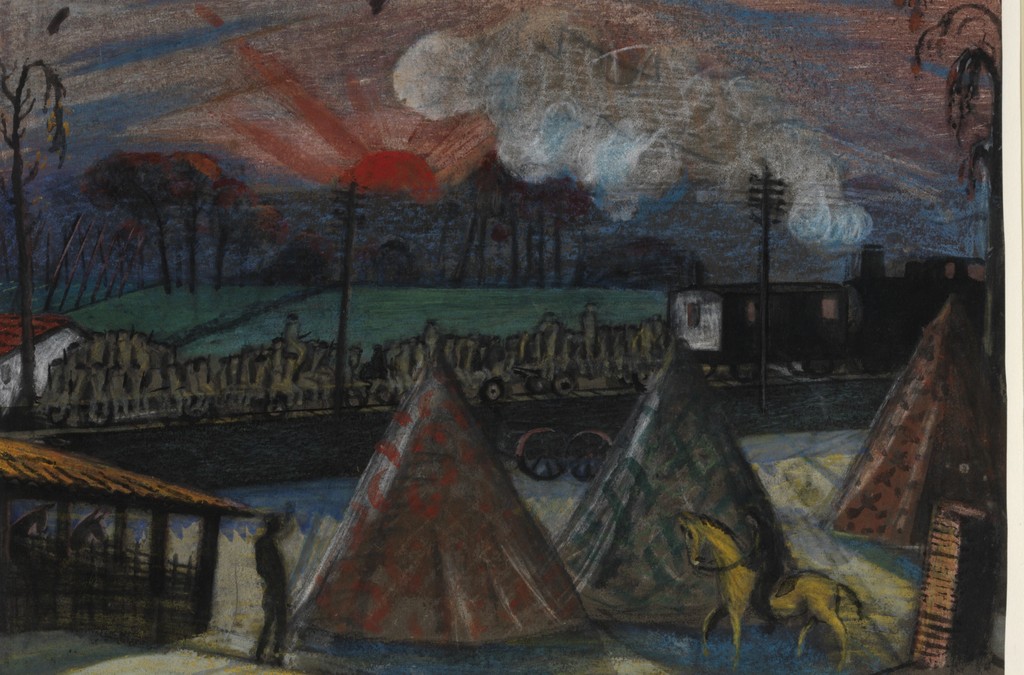
| Sunrise, Inverness Copse | 1918 | Painting |
| Telecommunications | 1934 | Painting |
| The Archer | Date unknown | Painting |
| The Diving Stage | 1928 | Painting |
| The Edge of the Wood | 1919 | Painting |
| The Menin Road | 1919 | Painting |
| The Mule Track | 1918 | Painting |
| The Pond at Souldern | 1926 | Painting |
| The Raider on the Moors | 1940 | |
| The Rye Marshes, East Sussex | 1932 | Painting |
| The Sea | 1923 | Painting |
| The Sea Wall | 1920 | |
| The Shore | 1923 | Painting |
| The Stackyard | 1925 | Painting |
| The Window, Iver Heath | Date unknown | Painting |
| The Ypres Salient at Night | 1918 | Painting |
| Through a Window, Riviera | 1927 | Painting |
| Tide at Dymchurch | 1920 | |
| Token [verso: Tree in a Landscape (unfinished)] | 1929 | Painting |
| Totes Meer (Dead Sea) | 1940 | Painting |
| Vale of the White Blackbird | 1942 | Painting |
| View from a Window, Nice | 1934 | Painting |
| View R | 1940 | Painting |
| Void | 1918 | Painting |
| Voyages of the Moon | 1935 | Painting |
| We Are Making a New World | 1918 | Painting |
| Whiteleaf Cross | 1931 | Painting |
| Winter, Hampden | Date unknown | |
| Winter Sea | 1931 | Painting |
| Wittenham Clumps | 1943 | Painting |
| Wood on the Downs | 1929 | Painting |
| Wooded Landscape | 1942 | Painting |
| Worth Matravers, Dorset | 1936 | Drawing |
| Wounded, Passchendaele | Date unknown | Painting |
Frequently Asked Questions
It shows a densely grouped wood beside open, rolling downland. Pale trunks rise beneath a dark brown canopy, while overlapping tan slopes and cool foreground planes establish the surrounding terrain.[1]
The title establishes a downland setting, but it is not enough on its own to identify a precise viewpoint. The painting should not be assigned to Iden or another site solely because Nash worked there around the same period.[1][2]
It is a modern landscape that simplifies trees and slopes into strong bars, arcs and masses while keeping them recognisable. The work is neither straightforward naturalism nor pure abstraction.[2][3]
It predates Nash’s Unit One initiative and his more public engagement with Surrealism in the 1930s. Its unusual scale and concentrated organic forms can be compared with that later work, but the 1929 landscape should not be classified by chronology alone.[2][3]
Discussion
What should readers notice when looking closely at Wood on the Downs?
Reader Insights
Follow the vertical trunks against the curves and pathways of the downs.
Set the 1929 landscape between observed topography and Nash’s developing modern geometry.
Where does the wood end and the painting’s structure begin?
Join the Conversation
Share your reading below, keeping observations specific and evidence clear.
References
- Wood on the Downs, ABDAG002949 — Aberdeen Archives, Gallery and Museums, accessed 31 August 2026.
- Paul Nash fonds TGA 769 — Tate Archive, accessed 31 August 2026.
- Paul Nash artist record — British Council Collection, accessed 31 August 2026.
- Paul Nash’s Geological Enigma — British Art Studies, accessed 31 August 2026.
- Paul Nash national holdings — Art UK, accessed 31 August 2026.