 by Tom Gurney
Tom Gurney BSc (Hons) is an art history expert with over 20 years experience
Published on June 19, 2020 / Updated on August 29, 2026
Email: tomgurney1@gmail.com / Phone: +44 7429 011000
The Institution That Made His Ambition Public
Turner's Royal Academy career began early and lasted almost his whole working life. It gave him training, public exposure, professional rank and a regular arena in which to test what landscape painting could become. According to the National Gallery, he joined the Academy Schools in 1789, sent watercolours to the exhibition from 1790 and began showing oils there in 1796.[1] By 1799 he was an Associate of the Royal Academy, and in 1802 he became a full Royal Academician. The Met's Heilbrunn essay adds that he was later elected Professor of Perspective and remained active in Academy affairs, including a brief period as acting president in 1845.[2]
That chronology matters because Turner is sometimes imagined as if his radical colour and late atmospheric works came from outside institutional culture. In fact, his career was deeply bound to the Academy. He used its exhibitions, honours and teaching structures while steadily stretching the expectations attached to landscape. The tension between institutional success and pictorial daring is one of the most productive tensions in his art.
At a Glance
- Royal Academy SchoolsJoined in 1789
- First exhibited watercolour1790
- First exhibited oil1796
- Associate Royal Academician1799
- Royal Academician1802
- Professor of PerspectiveElected 1807
- Professor resignation1838
- Acting presidentBriefly in 1845
- Institutional roleTraining, exhibition, rank and teaching
- Landscape ambitionExpanded academic landscape from within
Contents
- The Institution That Made His Ambition Public
- From Student to Exhibitor
- Associate, Academician and Public Professional
- Professor of Perspective
- Landscape Inside the Academy Hierarchy
- Conflict, Criticism and Defence
- The Academy as Memory and Stage
- The Academy and Turner's Public Timing
- Perspective, Architecture and Pictorial Space
- Status, Independence and the Academy
From Student to Exhibitor
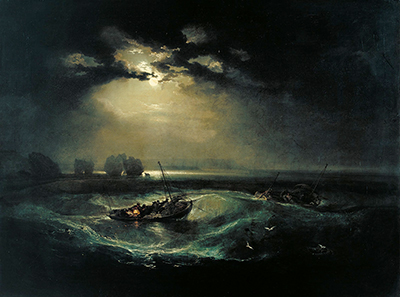
The RA Schools placed Turner inside a culture that valued drawing, perspective, antique study and hierarchy of genres. The young Turner had already worked through topographical drawing, architectural drafting and print-related labour, but the Academy gave those skills a public frame. His first exhibited watercolour, shown in 1790, announced him as a precocious artist still close to architectural and topographical conventions.[1] His first exhibited oil, Fishermen at Sea, came in 1796 and immediately showed that marine painting could carry drama, night light and technical bravura.
Turner's early Academy success was not accidental. He understood the exhibition system. He produced ambitious works, cultivated visibility and learned how large public rooms altered the effect of scale, contrast and subject. Even when he later provoked bewilderment or hostility, he was not working from the margin. He was a central Academy figure testing how far its own values could be extended.
Associate, Academician and Public Professional
Election as Associate in 1799 and full Academician in 1802 gave Turner status at remarkable speed. The National Galleries of Scotland notes that he was one of the youngest artists to become a full Royal Academician.[3] The honour mattered financially and socially, but it also supported his claim that landscape could compete with higher-ranked subjects. Turner did not need to abandon landscape for history painting; he worked to make landscape absorb history, poetry, travel, weather, empire, modernity and memory.
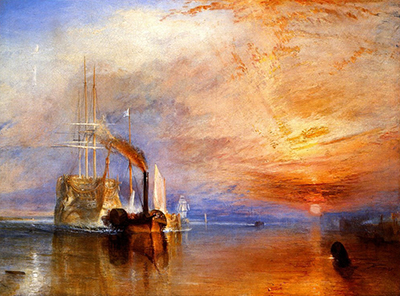
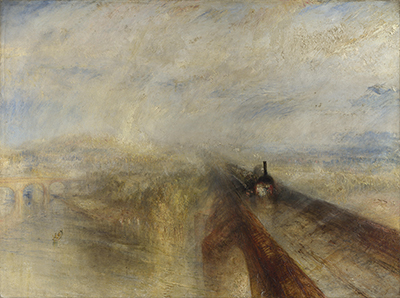
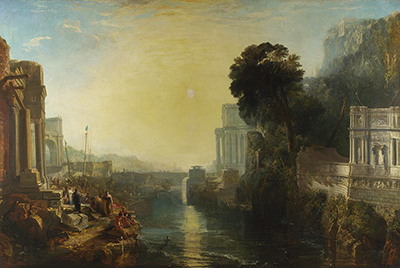
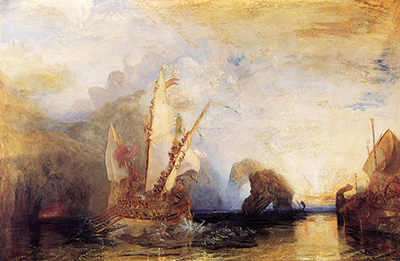
That strategy can be seen across works he showed at the Academy: Dido Building Carthage, Hannibal and his Army Crossing the Alps, Ulysses Deriding Polyphemus, Rain, Steam, and Speed and many maritime paintings. These were not simple views. They were exhibition arguments. Turner used Academy walls to show that landscape could be classical, modern, national, literary and technically daring.
Professor of Perspective
Turner was elected Professor of Perspective in 1807. The British Library catalogue for his Royal Academy lecture papers records the post and the surviving lecture materials, noting his election on 10 December 1807 and resignation on 10 February 1838.[4] The office required public lectures, and Turner's manuscripts show a sustained, if difficult, engagement with perspective, geometry and visual instruction.
The professorship has often attracted jokes about Turner's opacity as a speaker, but it should not be treated as comic decoration. Perspective mattered to him because it joined architecture, landscape, space, optics and pictorial construction. His own art repeatedly turns on the viewer's position before bridges, rivers, harbours, storms, railways and architectural masses. Even when late works seem to dissolve form into light, they often retain a powerful spatial intelligence.
Landscape Inside the Academy Hierarchy
The Academy inherited a hierarchy in which history painting stood above landscape. Turner did not simply reject that hierarchy; he manipulated it. He filled landscape with subjects that traditionally belonged to higher genres: Aeneas and Dido, Hannibal, Ulysses, biblical disaster, naval victory, imperial decline and modern technology. At the same time, he kept the observed world central. Weather, water, stone, smoke and light were not decorative carriers for stories; they were active forces in the meaning of the picture.
This is why Turner's Academy career cannot be separated from his ambition for landscape. The Academy gave him the language of professional elevation, and he used that language to argue that landscape itself could be elevated. His relationship with Claude was part of the same claim. He wanted a modern British landscape painter to be judged beside the Old Masters, not confined to picturesque record.
Conflict, Criticism and Defence
Institutional success did not protect Turner from criticism. His later handling, colour and treatment of modern subjects drew sharp responses. The Met notes that hostile criticism in the 1830s helped prompt John Ruskin's defence of Turner in Modern Painters.[2] Ruskin's intervention made Turner central to Victorian debates about truth to nature, imagination and modern painting. Yet the controversy should not obscure Turner's long Academy authority. He was both a target of conservative unease and an insider with decades of professional standing.
That dual position gave his art unusual force. A young outsider can shock by defiance; Turner shocked from within a system he knew intimately. His late works carry the pressure of a painter who had mastered the old tests and then made them unstable.
The Academy as Memory and Stage
Turner's Academy career also shaped how he managed memory. Exhibition titles, literary quotations and paired works often framed the viewer's response before the image was fully seen. He could use a title to summon a classical story, a modern event or a moral atmosphere. He could also use scale and placement to demand attention. The RA exhibition was not just where the painting appeared; it helped complete the painting's public argument.
By the time Turner died, his Academy career had stretched from youthful watercolours to late works that many contemporaries found difficult to classify. The institution had given him a professional home, but he did not leave that home unchanged. His career showed that an Academician could turn landscape into a vehicle for history, sensation, travel, technology and almost overwhelming pictorial light.
The Academy and Turner's Public Timing
The Royal Academy gave Turner an annual rhythm. Exhibitions created deadlines, audiences and public moments in which pictures had to announce themselves quickly in crowded rooms. That rhythm shaped the scale and theatricality of many major works. Turner learned how to make a picture carry at a distance, how a title could frame expectation and how a dramatic passage of light might distinguish a canvas among competitors.
This does not mean his art was merely showy. It means that he understood the public conditions under which painting was seen. Academy exhibition culture rewarded ambition, novelty and legibility, but it could also punish difficulty. Turner worked within that tension. He could give viewers enough subject to enter the picture while making the handling, colour or atmosphere exceed easy comprehension.
His long participation also meant that Academy audiences watched his development in real time. The same institution that had displayed youthful watercolours later displayed works whose colour and looseness unsettled critics. Turner's public career therefore became a record of institutional memory. Viewers could measure the late painter against the young prodigy, the topographer against the visionary, the Academician against the apparent rule-breaker.
Perspective, Architecture and Pictorial Space
The Professor of Perspective appointment can seem odd if Turner is remembered only for haze and glare. In fact, it fits his art closely. Bridges, harbours, city views, interiors, galleries, castles and architectural ruins recur throughout his work. Even when forms blur, the sense of space often remains powerful. The British Library's archive of lecture material shows that Turner took the office seriously enough to produce substantial notes and diagrams.[4]
Perspective mattered to Turner partly because it was a practical art of construction. It allowed him to manage recessions, viewpoints, angled architecture and the relation between human scale and environment. It also gave him a language for thinking about vision itself. A Turner picture often makes viewers aware of where they stand: before a bridge, below a storm, across a harbour, inside a room, above water or at the edge of a railway cutting.
His late art can appear to dissolve perspective, but dissolution is effective only because spatial expectation has first been established. Light overwhelms forms that the viewer still senses as architectural or geographical. Rain, spray or smoke interrupts space rather than replacing it with emptiness.
Status, Independence and the Academy
Academy rank gave Turner independence of a particular kind. It did not free him from criticism, but it gave him authority, visibility and professional standing. As a full Academician, he could not easily be dismissed as an eccentric outsider. As Professor of Perspective, he held an office within the institution's teaching structure. As a frequent exhibitor, he remained in regular public view.
This status helped Turner take risks. He had patrons and buyers, but he also retained works, ran his own gallery and shaped his posthumous reputation through the bequest. The Academy was one source of that confidence. It gave him a public identity from which he could stretch expectations rather than simply obey them.
At the same time, Academy success intensified the stakes. Turner was not rebelling from invisibility; he was risking reputation from a position of prominence. When critics mocked late pictures, they were mocking one of the central figures of British art. That tension helped make the criticism so charged and the later defence by Ruskin so consequential.
Teaching and the Difficulty of Communication
Turner the lecturer has often been treated as a puzzle. Surviving accounts suggest that his lectures could be difficult, and the lecture papers themselves are dense. Yet the difficulty may reflect more than personal awkwardness. Perspective sits between mathematics, optics, architecture, drawing and practice. Turner was trying to teach a discipline that joins rule and perception, and his own art increasingly explored moments when rules encounter atmospheric uncertainty.
The professorship also placed Turner within a lineage of Academy instruction. He was not only a maker of pictures but a guardian, however idiosyncratic, of professional knowledge. His teaching role complicates the image of Turner as anti-academic. He was academic in training, office and ambition, even when his paintings expanded what academic landscape could mean.
Late Works Inside an Old Institution
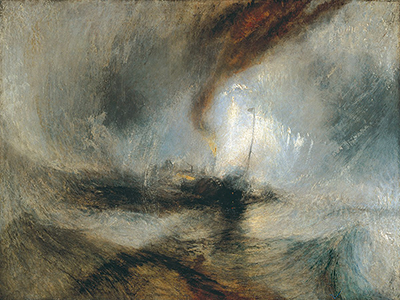
Turner's late Academy exhibits created some of the sharpest contradictions of his career. The Royal Academy had given him legitimacy, yet the works he showed there could seem to undermine familiar standards of finish and clarity. Rain, Steam, and Speed, late Venetian views, storm pictures and luminous colour fields did not abandon subject, but they changed the balance between subject and sensation.
The Academy setting made these experiments public acts. They were not hidden private studies later discovered in a studio. Many appeared before critics and audiences who had to decide whether Turner's changes represented decline, audacity, insight or excess. The institution became the arena in which late Turner was contested.
That is why the Royal Academy career deserves more than a chronological summary. It is one of the central structures of Turner's life. Through it, he moved from student to exhibitor, from ambitious young painter to institutional authority, from teacher to controversial elder. His art changed, but the Academy remained the stage on which much of that change became visible.
The Academy and Turner's Gallery
Turner's relationship with the Academy should also be seen beside his own gallery. He did not rely entirely on institutional exhibition. By opening and using a private gallery, he created another space in which his works could be seen, compared and retained. This private initiative did not replace the Academy; it complemented it. The two together show how carefully Turner managed public presence and control.
The Academy gave him rank and annual visibility. His own gallery gave him a more personal environment and a way to keep important works within reach. This matters for the later bequest. Turner retained pictures not simply because they failed to sell, but because retention became part of his self-fashioning. The artist who served the Academy also imagined a future in which his works would be judged together.
That dual strategy helps explain the complexity of his career. Turner was institutional and independent at once. He used the Academy's prestige while resisting the idea that his art belonged wholly to any one public body or market system.
Rivalry and Companionship
The Academy also placed Turner among rivals. He exhibited in a world that included Constable, Wilkie, Lawrence, Etty, Landseer and many others. Competition was not incidental. It sharpened scale, subject and ambition. Academy rooms made artists visible to one another as well as to critics and patrons.
Constable's famous awareness of Turner's range points to this charged professional environment. Turner was not developing in isolation, and his choices often mattered because they appeared beside the choices of other painters. A large sea picture, a classical landscape or a modern railway subject could function as a claim about what painting should attempt.
Rivalry should not be reduced to anecdote. It was part of the exhibition system. Artists learned from one another, competed for attention and responded to public judgment. Turner's Academy career is therefore also a story of artistic ecology.
Old Rules and New Effects
Turner's achievement within the Academy was to use old rules to produce new effects. He understood composition, perspective, hierarchy and exhibition decorum. He also knew when to strain them. Late colour, uncertain finish and atmospheric force are more radical because they come from an artist who had mastered conventional expectations.
This makes his Royal Academy career one of the best ways to understand his modernity. Turner did not become modern by stepping outside history. He became modern by putting pressure on inherited structures from within. He knew what an Academy picture was expected to do, and he repeatedly asked whether it could do more: carry more light, more speed, more weather, more historical ambiguity.
The result is not an anti-academic career, but a transformed academic one. Turner's Royal Academy life shows how innovation can grow from institutional depth rather than institutional rejection.
Why the Academy Matters to the Whole Turner
The Royal Academy brings together many Turners who are too often separated: the young draughtsman, the ambitious oil painter, the professional exhibitor, the lecturer, the controversial late artist and the planner of a national legacy. It gives the career continuity. The same institution that received his early public efforts later had to face works that seemed to loosen the very standards by which academic art was judged.
For that reason, the Academy is not a background detail. It is one of the main frameworks through which Turner made landscape public, competitive and historically serious. To understand his Academy career is to understand how deeply his originality was rooted in professional structures.
The Academy gave Turner a stage, but he changed the kinds of landscape that could command that stage.
Discussion
How did Turner use the Royal Academy's authority while changing what academic landscape could do?
Reader Insights
Which parts of Turner's ambition depended on Academy training, rank and exhibition?
How does the teaching office alter the usual image of Turner as a painter of haze?
Why are Turner's late effects more radical because they emerged from institutional depth?
Join the Conversation
Share a close observation or a source-based question for other readers.
References
- National Gallery, Joseph Mallord William Turner artist record, https://www.nationalgallery.org.uk/artists/joseph-mallord-william-turner
- Elizabeth E. Barker, "Joseph Mallord William Turner (1775-1851)," Met Heilbrunn Timeline, https://www.metmuseum.org/essays/joseph-mallord-william-turner-1775-1851
- National Galleries of Scotland, Joseph Mallord William Turner artist record, https://www.nationalgalleries.org/art-and-artists/artists/joseph-mallord-william-turner
- British Library Archives and Manuscripts, Add MS 46151 A-BB, https://searcharchives.bl.uk/catalog/032-002019119