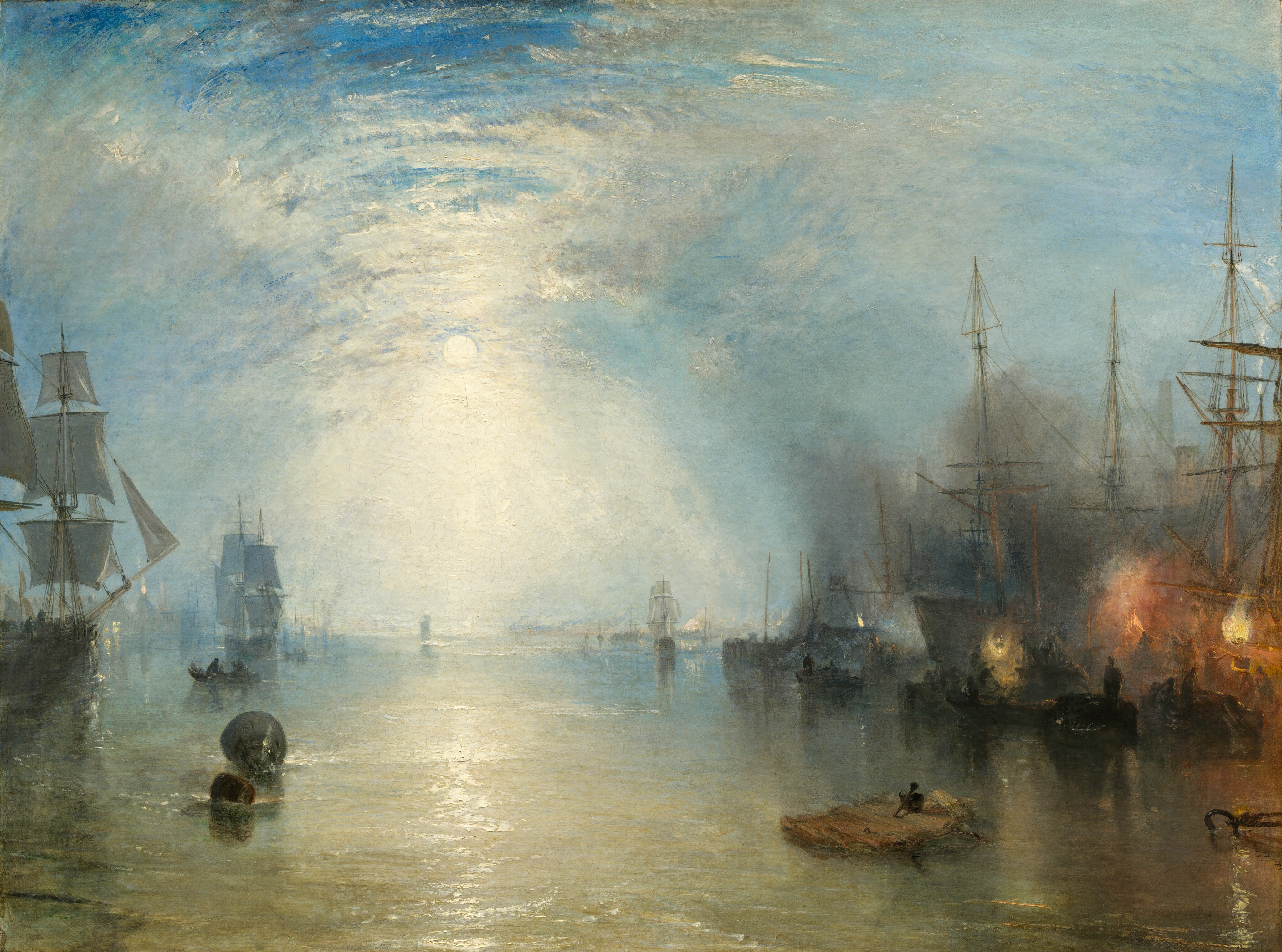
 View the object record
at the National Gallery of Art
National Gallery of Art, Widener Collection. Open Access public-domain image.
 by Tom Gurney
Tom Gurney BSc (Hons) is an art history expert with over 20 years experience
Published on June 19, 2020 / Updated on August 29, 2026
Email: tomgurney1@gmail.com / Phone: +44 7429 011000
Turner's Modern World
Joseph Mallord William Turner lived through an extraordinary concentration of upheaval. He was born in 1775, when the American Revolution was beginning, entered the Royal Academy Schools in the year of the French Revolution and died after railways had redrawn British distance. Between those points came prolonged war with France, accelerating industrialisation, abolition campaigns, parliamentary reform, an expanding press, new financial instruments and scientific discoveries that altered how nature itself was understood. Turner did not merely survive that transformation. Again and again, he made its pressures visible.
That claim needs careful definition. Calling Turner modern does not mean turning him into a twentieth-century abstract painter born too early. His art remained attached to landscape, history, literature, topography and the public institutions of his own time. Even the loosest late work could carry a precise title or contemporary argument. The important question is therefore not how far he resembles later artists, but how he found a language for the world changing around him.[1]
Turner painted foundries, farm labour, canals, coal transport, scheduled boats, steamers, railway travel and catastrophic fire. He addressed Trafalgar and Waterloo, Napoleon's exile, slavery and abolition, contested elections and the decline of maritime empires. His sketchbooks register working people, machinery, harbours, streets and ordinary travel alongside mountains and ruins. Through publishers and engravers, his designs circulated among readers who never entered his gallery or bought an oil painting. Contemporary life reaches through the whole practice rather than appearing only in a handful of famous machines.[2]
The scale of that commitment became especially clear when the Kimbell Art Museum, Tate Britain and the Museum of Fine Arts Boston brought more than one hundred paintings, watercolours, drawings and sketchbooks together. Their selection moved from early observations and the wartime home front through conflict, political campaigns, Venice, steam power and late experiment. Works normally separated by collection and medium could be read as parts of a continuing historical inquiry.[4] The accompanying commentary repeatedly returned to people caught within large systems: cannon founders producing weapons, women searching Waterloo, agricultural labourers beneath Windsor, coal handlers on the Tyne and enslaved victims abandoned by a slaver. Modern history appeared not as background chronology but through bodies required to sustain, endure or resist it.[5]
No single political label contains this record. Turner courted princes and industrial patrons, invested for profit, guarded his property and became wealthy. He also pictured war without triumph, made labour central to ambitious landscape, supported causes associated with liberty and reform, and produced one of the most devastating images connected with Atlantic slavery. The contradictions matter. They place him inside modern structures, neither serenely above them nor consistently opposed to them.
His deepest achievement was to make change look unsettled. In Turner's world, old warships meet steam tugs, ancient cities warn commercial Britain, workers move fuel that may destroy their occupation, and new engines enter weather they cannot control. Light reveals and blinds; speed connects and threatens; spectacle attracts crowds while disaster unfolds. Modernity becomes not a victory procession but a field of competing forces.[3]
A Life Inside Historic Change
Turner's seventy-six years bridge forms of life that can seem to belong to separate eras. As a child in Covent Garden, he knew a city moved largely by human effort, horses, wind and tide. By his final decade he could travel behind a locomotive, communicate through an enlarged periodical culture and watch steam vessels crossing seas once governed by sail. The change was neither even nor instantaneous. New systems accumulated around old ones, producing exactly the temporal overlap that appears throughout his art.
War formed the first great historical pressure. Britain fought Revolutionary and Napoleonic France for most of the period from 1793 to 1815. Conflict restricted Continental movement, stimulated armament manufacture, intensified taxation and shaped public feeling about invasion, naval defence and national identity. Turner never became a soldier, yet the wartime economy entered his subjects long before his first locomotive. An interior of a cannon foundry, made around 1797-98, gives furnace light and human labour to the production of weapons at the start of his independent career.[19]
Peace did not resolve the social strain. Demobilised men returned to uncertain work; grain prices, industrial cycles and political exclusion drove agitation. Peterloo in 1819, the prosecution of radical publishers, the contested Reform Act of 1832 and later campaigns over representation belonged to the public atmosphere in which Turner exhibited. His response was usually indirect. Political meaning often entered through historical analogy, literary quotation, disturbed figures or an event that could sustain several readings at once.
The same decades transformed Britain's global relations. Naval supremacy supported trade and empire. The British slave trade was prohibited in 1807, but enslavement in most British colonies continued until legislation in 1833 and the coercive apprenticeship system beyond it. Illegal Atlantic trafficking remained active. Whaling expanded extraction across oceans. Coal linked northern rivers to London consumption. Finance, insurance and investment bound distant risks to metropolitan wealth.
Scientific change altered intellectual scale. Geology opened immensities of earth time; optics and colour studies investigated perception; steam engineering converted heat into movement; experiments in electricity and magnetism suggested invisible forces connecting matter. Turner did not illustrate a textbook of discoveries. He inhabited a culture in which artists, natural philosophers, engineers and publishers met, argued and shared institutions. The modern world was not one subject among others. It was the changing condition under which every subject could be seen.[8]
Contents
- Turner's Modern World
- A Life Inside Historic Change
- Covent Garden and the Commercial Metropolis
- War Enters Landscape
- Aftermath Rather Than Victory
- The Home Front and Unequal England
- Agriculture, Improvement and Rural Work
- Coal, Ports and Fossil Labour
- Canals and Speculative Infrastructure
- Steam, Sail and Overlapping Time
Covent Garden and the Commercial Metropolis
Turner's beginnings help explain his practical relation to modern culture. He was born above or near his father's barbershop in the Covent Garden district, a dense environment of markets, theatres, print sellers, workshops, taverns and social mixture. His father displayed the boy's drawings for customers. Art entered public circulation not through an inherited estate but through a shop window, personal recommendation and sale.
London gave the young artist extraordinary access. The Royal Academy offered training, exhibitions and professional status. Collectors opened houses; dealers displayed old masters; publishers needed topographical designs; engravers translated watercolour into reproducible lines. The metropolis brought the institutions of elite art into contact with commerce. Turner learned early that a picture could be an aesthetic object, exhibition competitor, reproducible design, piece of stock and long-term investment at the same time.[6]
He remained centred on London even while travelling incessantly. Addresses in Harley Street and Queen Anne Street placed his home, studio and private gallery within the West End art economy. The Thames connected that world to docks, coal traffic, shipyards and overseas commerce. Parliament, the Academy, the insurers of the City and the labour of Wapping occupied one urban system, though wealth and visibility were distributed very differently within it.
The city also trained a kind of looking. Crowded exhibitions demanded rapid comparison. Shop windows and print displays turned images into public attractions. Newspapers converted artistic success or failure into shared talk. Fires drew enormous gatherings. A person standing on a bridge or boarding a riverboat became both participant and observer in urban spectacle. Turner repeatedly positions viewers within such mobile or crowded situations rather than offering only solitary contemplation.
Yet he was not principally a painter of streets in the later realist sense. London's modernity often appears obliquely: through a smoky horizon, a suburban terrace, river traffic, a burning institution or the means by which coal and ships enter the capital. This dispersed geography is revealing. Modern life depends on connections whose distant labour can remain hidden from the consumer. Turner's landscapes make some of those connections perceptible without pretending to map the whole city.
War Enters Landscape
British art offered many ways to glorify conflict: commanders could dominate, flags could clarify allegiance and the decisive instant could become a national emblem. Turner sometimes participated in commemoration, particularly through Trafalgar. Even there, however, damaged rigging, smoke, confusion and the labour of sailors complicate heroic order. His royal painting of the battle compresses different moments rather than behaving as a literal diagram of Nelson's victory.[23]
Ancient history supplied another strategy. For the 1812 Academy exhibition, Turner made Snow Storm: Hannibal and his Army Crossing the Alps, evoking Napoleon's recent mountain passage without depicting the French emperor. A black storm sweeps over an army dwarfed by terrain and weather. Historical distance makes current anxiety available to landscape while refusing simple reportage. Hannibal, Napoleon and the spectator's own wartime present coexist as analogies rather than exact equivalents.
This method allowed Turner to address power without surrendering landscape to portraiture. Commanders shrink; armies become vulnerable matter; sun and storm exceed military intention. Nature does not offer moral innocence, because violence occurs within it and can be intensified by it. Nor does weather merely cancel politics. It changes the scale at which conquest is judged.
Turner's relation to patriotism consequently remains mobile. Britain depended on naval victory, and professional ambition made national commissions attractive. The artist could celebrate seamanship and public courage. He could also emphasise the dead sailor, the broken hull or the families left among bodies. Rather than moving once from youthful nationalism to mature dissent, he returned to the problem through altered circumstances.
Late in life, Napoleon reappeared as a captive. War. The Exile and the Rock Limpet, shown in 1842, places the former emperor alone at Longwood on Saint Helena. A small shell and a blood-red field replace martial command. Exhibited beside Peace - Burial at Sea, the image turns a maker of European history into an isolated body surrounded by colour. The subject is still specific, even though its visual world has become radically unstable. Turner's modern history can therefore move from battle narrative towards psychological and atmospheric concentration without abandoning meaning.[7]
Aftermath Rather Than Victory
Turner's most sustained challenge to heroic war painting comes through aftermath. He visited the Waterloo battlefield in August 1817, more than two years after the fighting. By then the ground had already become a tourist destination. Visitors collected supposed relics, hired guides and looked for scars of an event whose official memory celebrated national victory. Turner entered that culture of visitation but declined to make a commemorative trophy.
The Field of Waterloo, exhibited in 1818, shows a nocturnal mass of dead soldiers and horses while women search by torchlight. Wellington, Napoleon and Blucher are absent. National uniforms can be glimpsed, yet intertwined bodies repeatedly defeat separation into friend and enemy. Byron's catalogue lines supplied a verbal image of common burial, shifting attention from command to shared mortality.[22]
The women are crucial. They bring domestic consequence into military history and use a limited, human light to search through an incomprehensible field. Their torch cannot illuminate the whole. Knowledge arrives as fragments: a face, a uniform, a limb, perhaps a recognition. Turner makes obscurity ethical rather than merely technical. The spectator cannot enjoy omniscience while the painted searchers struggle to know who lies before them.
This was not eyewitness documentary. Turner reconstructed a scene from later travel, uniform study, literature and imagination. The distinction strengthens rather than weakens the argument. He chose aftermath as the form through which victory should be remembered. That choice opposed the commander-centred programme encouraged by competitions for recent military triumphs, though it does not prove a fully articulated pacifist creed.
War returns in other modern forms. Naval combat, exile, coastal defence and the manufacture of cannon connect battlefield violence to labour and state power. The sequence also exposes change within Turner's own treatment. The Trafalgar paintings preserve national commemoration; Waterloo denies triumph; the isolated Napoleon reflects on the defeated ruler. No position remains pure. What persists is distrust of any image in which force produces an uncomplicated historical meaning.[40]
The Home Front and Unequal England
Modern war was experienced far from battle. Foundries cast guns, ports equipped ships, farms faced strategic pressure and consumers paid taxes. Travel restrictions redirected attention to Britain, encouraging artists and tourists to discover a national landscape while conflict made that landscape economically and politically charged. Turner's rivers, estates and rural roads belong to this home front even when no soldier appears.
Elite festivity forms part of the picture. England: Richmond Hill, on the Prince Regent's Birthday, exhibited in 1819, spreads a refined gathering across a vast prospect of the Thames. At approximately eleven feet wide, it was Turner's largest canvas so far. Its scale and subject openly sought attention at the highest social level. A postwar England of pleasure, cultivated scenery and princely association is offered as spectacle.[3]
The same year carried a harsher political resonance. In August, cavalry attacked a reform meeting at Manchester in what became known as Peterloo. It would be crude to turn the Richmond festivities into a secret comment on that massacre; the painting derived from an earlier celebration and offers no documented satire. The proximity nevertheless warns against confusing one elite vision with the nation's complete experience.
Turner's career depended on wealthy collectors, estate owners, manufacturers and publishers. He painted country houses and accepted hospitality. These relationships gave access to collections, landscapes and markets. They could also place agricultural workers, servants and industrial labour within views owned by those who benefited from existing structures. Patronage does not dictate meaning, but it shapes the conditions under which meaning was made.
The artist's social mobility complicates the story further. A barber's son became a Royal Academician, professor, landlord and prosperous property owner. The institutional system offered him advancement unavailable to many labourers he represented. His success could encourage belief in professional merit while also showing how exceptional such ascent was. Turner's England is unequal not because every picture announces protest, but because courtly leisure, arduous work, commercial ambition and political exclusion occupy the same career.
Agriculture, Improvement and Rural Work
Industrial modernity did not eliminate agricultural transformation. New rotations, enclosure, livestock breeding and market production were central to Britain's changing economy. During war, domestic food supply acquired patriotic urgency. The rhetoric of “improvement” promised efficiency and abundance, yet its costs were unevenly carried by tenants and rural workers.
Turner brought that tension into ambitious landscape. Ploughing Up Turnips, near Slough ('Windsor'), exhibited in 1809, places labourers in a muddy field below Windsor Castle. Turnips supported crop rotation and winter cattle feeding; George III's interest in agriculture made them part of royal improvement culture. The distant castle can therefore sanction a productive national order.[16]
The foreground resists effortless celebration. Men and women bend, pause and work around cattle and a plough that appears interrupted or damaged. The ground is heavy, and the labour has bodily weight. Michele Miller argues that Turner uses this contrast to expose hardship and cultural dissent within patriotic agricultural imagery. That reading is persuasive because the workers command attention, but it remains a scholarly interpretation rather than Turner's written declaration.[17]
Frosty Morning, exhibited four years later, removes even the grand landmark. A road, cart, horses, tools and dispersed figures occupy a low strip beneath pale cold air. The uncertain task has been identified as ditching, road repair, turnip storage or another rural activity. Whatever its exact name, the work makes ordinary exposure the centre of a monumental Academy landscape.[18]
These paintings challenge the easy opposition between picturesque countryside and modern industry. Rural life was already reorganised by markets, war and improvement. Human figures may be small, but their work links weather to subsistence and national policy. A field under Windsor and a frosted roadside can reveal modern England as powerfully as a locomotive.
Turner does not convert workers into individual social portraits. Their names and biographies remain unknown. That anonymity limits what can be claimed, yet it also directs attention towards a class of activity normally treated as decorative staffage. Landscape's supporting figures become the reason the land is productive, inhabited and contested.
Coal, Ports and Fossil Labour
Coal made Britain's industrial expansion possible while binding distant regions into one economy. Fuel extracted around Newcastle moved by wagonway to the Tyne, then through shallow craft and seagoing colliers towards consumers, especially London. Turner's Tyneside images reveal this chain through the labour concentrated along water.
In Keelmen Heaving in Coals by Moonlight, painted in 1835 from memories and studies associated with an 1818 visit, a broad pale river opens beneath the moon. At the right, fires, smoke, masts and dark bodies compress the transfer of coal. Skilled keelmen shovel from flat-bottomed boats into larger vessels. Their work continues at night so shipping can respond to tide and departure.[15]
The beauty is inseparable from arduous activity. Cool moonlight creates spacious distance, while hot local fire reveals workers only to lose them in smoke. Turner adapts the luminous harbour structures admired in older art, but the cargo is the fuel of contemporary production. Industry does not sit outside landscape. It reorganises light, labour and the river itself.
Technology threatened the occupation it made visible. Direct-loading staiths reduced dependence on keels, and steam tugs helped ships move upriver. Keelmen organised collectively against unemployment, wage pressure and altered loading methods. The painting does not narrate a particular dispute, but its date belongs to a workforce already experiencing displacement. Human effort and mechanised efficiency share the same economic system.
Turner's own London life touched the trade. He inherited a public house in Wapping associated with coal whippers, labourers who unloaded vessels under exploitative conditions. Property records do not establish close personal solidarity, but they prevent the artist from being imagined as a detached visitor to industrial poverty. Coal entered his income as well as his imagery.[13]
Modern viewers may recognise an environmental history in smoke, fossil energy and altered estuaries. That response is legitimate if it remains historically bounded. Turner had no knowledge of current climate models. What he could see was a river changed by extraction, transport, construction and ceaseless work. The picture makes that dependence radiant without making it harmless.
Canals and Speculative Infrastructure
Before railway lines became the defining emblem of speed, canals transformed the movement of heavy goods. They represented engineering confidence and attracted speculative capital. Their embankments, locks and cuts also changed familiar land, creating new viewpoints and commercial connections. Turner treated them as both working systems and settings for light.
Chichester Canal, painted about 1828, is unusually tranquil. A long horizontal stretch of water reflects evening light; boats and buildings remain subdued; distant Chichester Cathedral links the engineered channel to an older horizon. Yet the enterprise behind this calm view had disappointed its investors. Intended to form part of a larger connection between London and the south coast, it failed to generate the expected traffic.[28]
The tension is instructive. A commercially unsuccessful structure can produce a compelling landscape. Turner neither needs to advertise the canal nor expose it through caricature. He allows sunset, stillness and financial disappointment to coexist. Modern infrastructure enters cultural memory even when its practical promise falters.
Canals also reveal the importance of patronage. The Sussex context connects the painting to Lord Egremont and Petworth, where art, estate management, agriculture and transport met. Wealthy supporters of improvements could commission views that transformed their surroundings into aesthetic possession. Turner responded to that world while retaining enough ambiguity for the waterway to seem useful, melancholy or simply beautiful.
His wider river practice prepared this engagement. Locks, bridges, barges and towpaths occur throughout drawings and print projects. Such motifs are not always industrial declarations. They are the ordinary mechanisms by which travellers and commodities pass through landscape. Repetition taught Turner to see infrastructure as rhythm: a bank redirects movement, a lock interrupts flow, a bridge frames distance.
The canal therefore corrects a machine-centred account of modernity. Change could be slow, quiet and unsuccessful. Capital might leave a reflective watercourse rather than a roaring engine. Turner's modern world includes abandoned expectations and transformed places whose economic history is almost invisible at first glance.
Steam, Sail and Overlapping Time
Steam power altered movement, but it did not instantly remove wind, tide, horses or human muscle. Turner's maritime paintings repeatedly show technologies coexisting. Their encounters produce a historical tension more subtle than a simple succession from old to new.
In Staffa, Fingal's Cave, a steamer approaches a celebrated geological formation through difficult water. The island carried Ossianic literary associations and had become a destination for adventurous travellers. Steam made access more regular, yet smoke and dark sea prevent the vessel from mastering the scene. Modern tourism enters deep geological time as a small, vulnerable interruption.[29]
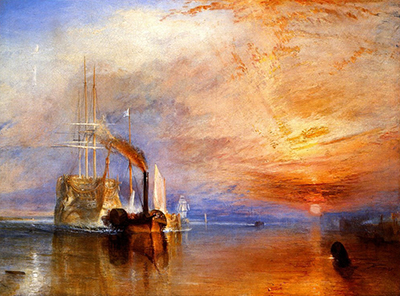
The Fighting Temeraire offers the most famous meeting. A compact steam tug tows the veteran of Trafalgar towards breaking. Turner altered literal circumstances: the warship's masts, the direction of movement and the spectacular sunset serve memory rather than documentation. Steam is effective but visually dark; the old vessel is pale, enlarged and almost spectral. Progress and elegy cannot be separated.[24]
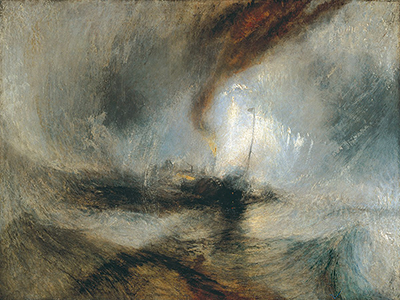
In Snow Storm - Steam-Boat off a Harbour's Mouth, the vessel is difficult to secure inside a vortex of wind, water and smoke. Turner's disputed story of being tied to a mast should not govern interpretation. The visible relation is enough: technology becomes a point of human persistence within conditions that destroy stable orientation.
Safety systems could also fail to reassure. Rockets and Blue Lights names warning signals for steam vessels near shoal water, while figures at the shore bend beneath violent weather. The steamers themselves are remote or uncertain. Modern navigation depends on coordinated signals, human attention and visibility, all vulnerable in a storm.[30]
These works resist both celebration and nostalgia. Sail carried war, empire and dangerous labour; it was never innocent. Steam enlarged access and speed but introduced new dependence and risk. Turner grants neither technology a moral monopoly. His seas show history as overlap, where one system drags, warns, competes with or survives beside another.
Railway, Bridge and Accelerated Vision
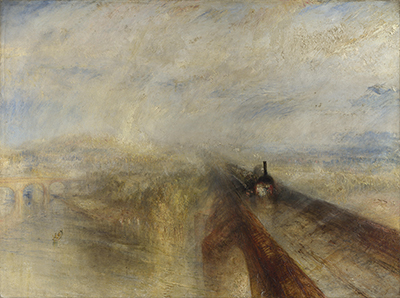
The railway concentrated many dimensions of nineteenth-century change: engineering, capital, standardised time, mass travel, noise and unfamiliar speed. Turner addressed it directly in Rain, Steam and Speed - The Great Western Railway, shown in 1844. A locomotive advances over Isambard Kingdom Brunel's Maidenhead Railway Bridge while rain and vapour reduce the world to shifting bands.[25]
The train does not sit crisply within a stable panorama. Its dark front emerges from weather, and the bridge's diagonal pulls the eye towards an approaching force. Fields, river traffic and a possible hare on the track belong to older rhythms now crossed by the line. Turner turns velocity into a problem of recognition: how does a moving observer see, and how does a stationary observer face movement?
The bridge matters as much as the engine. Its low brick arches were an engineering achievement, carrying the railway over the Thames while preserving a broad span. In the painting, structure is both solid and atmospherically dissolved. Modern construction changes the landscape, but mist, rain and reflected light prevent it from becoming a technical illustration.
Rail travel also transformed Turner's practice. It reduced journey times and offered new sequences of glimpsed terrain. The view from a carriage is partial, framed and transient; near objects blur while distance may remain strangely calm. One need not prove that this canvas reproduces a single ride to recognise its engagement with altered spectatorship.
Later admiration has often treated the work as proof that Turner welcomed the machine age. Its energy supports that response, but the painting supplies no uncomplicated hymn. A small animal faces danger, weather limits control and the engine appears almost monstrous. The force is exhilarating because it is also uncertain.
Turner's railway is thus one component of a larger argument. The same artist had studied cannon production, agricultural improvement, canals, coal carriage and steam navigation. Speed arrives late in a career already alert to the systems beneath modern movement. The locomotive is not the beginning of his modernity; it is its most compressed emblem.
Maritime Commerce, Empire and Extraction
Turner's sea is never only natural. It carries navies, merchants, fuel, migrants, tourists, enslaved captives and hunters. Harbours connect visible vessels to distant economies. A mast may signify craft and adventure, but it can also belong to war, colonial profit or extraction. Maritime beauty therefore contains histories that the horizon does not immediately reveal.
Britain's naval power was inseparable from commercial expansion. Trafalgar protected national security and helped sustain imperial movement. Merchant ports brought sugar, timber, cotton and other commodities into domestic life. Insurance converted dangers at sea into calculated premiums and claims. Shipbuilding, towing, loading and breaking distributed labour around every voyage.
Turner's whaling pictures of 1845 and 1846 expose one extractive frontier. Based partly on Thomas Beale's account of sperm whales and the industry, the four oils show pursuit, killing, processing and turbulent shipboard activity. Smoke, blood, spray and broken forms make the hunt difficult to read, while titles tell spectators what is occurring. The modern industry appears energetic and violent rather than scientifically neutral.[31]
Venice provided a historical mirror. Turner repeatedly pictured a city once dominant in Mediterranean commerce but deprived of independence and controlled by Austria. Its palaces dissolve into luminous atmosphere; modern boats and figures continue ordinary life among signs of former power. The beauty can become a warning to Britain, another maritime empire imagining its own ascent as permanent.[32]
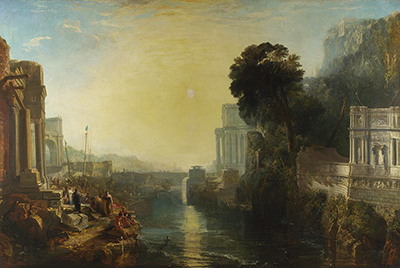
Classical history extends that analogy. Carthage and Rome allowed Turner to picture foundation, trade, luxury, conquest and decline. Dido building Carthage fills a radiant port with construction and human activity, yet viewers aware of the story know destruction will follow. The ancient city is not an escape from modernity. It gives modern Britain a longer historical scale.[33]
Empire in Turner is therefore dispersed across military memory, classical analogy, port traffic, colonial violence and vanished sovereignty. Not every vessel bears an imperial message, and not every Venetian haze predicts Britain's fall. The recurring pattern nevertheless prevents the sea from remaining innocent scenery. Water connects prosperity to what metropolitan spectators may not see.
Slavery, Abolition and the Limits of Distance
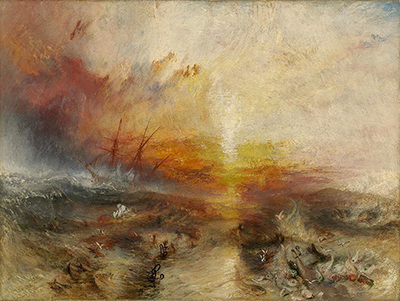
Slave Ship, exhibited under a longer descriptive title in 1840, forces the violence beneath maritime commerce into the foreground. Human limbs remain visible among chains, fish, birds and surging water while the guilty vessel moves into a blood-coloured storm. Beauty and horror are deliberately inseparable, making aesthetic distance itself morally unstable.[14]
The historical field is complex. In 1781, the crew of the Zong murdered more than 130 enslaved Africans so that the owners could seek insurance compensation for people treated as cargo lost at sea. Court proceedings in 1783 helped expose the financial logic of the massacre. Turner could have encountered the case through Thomas Clarkson's abolition history, newly issued in 1839. James Thomson's poem about a slave ship in a typhoon supplied another important verbal source.
Yet the painting should not be reduced to an illustration of one past event. Illegal trafficking and lethal jettison continued in Turner's present, sometimes as slavers tried to escape naval patrols. Scholars disagree about the balance between Zong memory and contemporary accusation. The image can hold both times, denying the comforting idea that abolition legislation had closed the history.[13]
The problem of moral authority
Turner was not economically untouched by slavery. Research by Sam Smiles established that in 1805 he invested in a tontine connected to a Jamaican cattle plantation worked by enslaved people. The investment operated like a survivorship annuity: returns grew as nominated lives ended. This fact makes a simple conversion of the artist into an unimplicated abolitionist hero impossible.
No document explains how Turner later understood that investment or whether remorse shaped the 1840 painting. Inventing a moral conversion would replace evidence with reassurance. The stronger account preserves the contradiction. A person who had profited from a slave economy could later make an image of its violence, without thereby cleansing the earlier entanglement.
The picture's abolitionist force remains substantial. It was shown when the World Anti-Slavery Convention met in London, though direct coordination is unproven. Its title names slavers' action, and the foreground denies viewers the privilege of seeing only atmospheric splendour. Human beings reduced by commerce to insurable property return as victims whose suffering overwhelms the supposed rationality of trade.
Insurance, Investment and Calculated Risk
Insurance may appear remote from landscape painting, but it ran through Turner's working life. At twenty-two, he insured unsold artistic stock kept at his family home. Later he insured paintings transported from Rome, required protection for property and imagined fire cover preserving his gallery after death. Risk management accompanied making, moving, owning and bequeathing art.[13]
His early patron John Julius Angerstein was a major marine underwriter. Angerstein's collection, purchased by the state in 1824, became the foundation of the National Gallery. Turner eventually planned to give paintings to that institution, requiring some to hang beside Claudes once owned by the insurer. Art, national culture and financial capital were materially interwoven.
The Zong reveals insurance's most brutal capacity. Enslaved people were converted into values recoverable under certain maritime conditions. The murderers' claim failed after litigation, but the underlying argument showed how an actuarial system could classify human death as commercial loss. Slave Ship makes bodies and cargo return within a natural force that exceeds calculation.
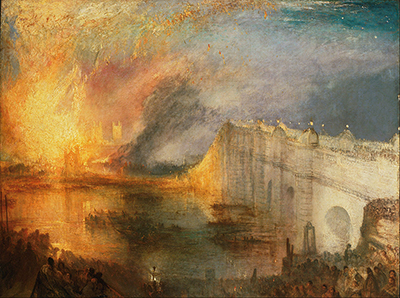
The Parliament fire offers another link. In the Cleveland painting, a firefighting vessel bears the words and solar emblem of the Sun Fire Office, Turner's insurer. The tiny mark enters an enormous blaze caused while obsolete state accounting sticks were being destroyed. Fire insurance, firefighting technology and administrative failure meet inside one public catastrophe.[27]
Turner was also an investor and landlord. He accumulated property, protected stock and managed a profitable career. His proposed charity for impoverished male artists depended on wills, leases, dividends and maintained capital. Benevolence did not float free from finance; it required the same structures through which wealth endured.
None of this means every sunset is secretly about underwriting. Insurance is better understood as part of the environment in which modern art operated. It enabled mobility, protected value, shaped institutions and transformed uncertainty into a commodity. Turner painted storms and fires while purchasing instruments intended to survive them. That practical contradiction gives his elemental imagery a sharper historical edge.
Reform, Liberty and Political Indirection
Turner's political reputation has shifted because the evidence resists a manifesto. He left no orderly statement of party belief. Many pictures can be enjoyed without recognising any topical reference. Yet scholarship has identified a greater engagement with reform, free expression and abolition than older accounts of an apolitical visionary allowed.[11]
The Northampton Election, 6 December 1830 is unusually direct. Its crowd, banners and public action concern a contemporary contest during the agitation preceding the Reform Act. Political participation becomes a visible social event rather than an allegory hidden in ancient history. Even here, Turner records energy and confusion more readily than a simple programme.[20]
Other meanings are veiled. Sam Smiles has connected Kirkby Lonsdale Churchyard with the trials of radical publisher William Hone. Boys fighting in a tranquil setting may allude to disputes over education, religion, press freedom and corrupt representation. The interpretation explains their disruptive prominence, but a casual spectator would not necessarily decode it.
An unfinished oil traditionally called Death on a Pale Horse has been reinterpreted as The Fall of Anarchy (?). Smiles relates its fallen crowned body to Percy Bysshe Shelley's poem prompted by Peterloo, published only in 1832, and to debates surrounding the Anatomy Act. The question mark is essential. The painting lacks an artist-given title, and the political identification remains an argument, not settled fact.[12][21]
The pattern is one of strategic indirection. Classical episodes, literary sources and ambiguous figures allowed political association without turning landscape into caricature. Such indirection suited an era of prosecution and institutional caution, but it also reflected Turner's preference for meanings that remain active rather than closed.
His conduct prevents easy purity. He pursued royal favour, served the Academy loyally and defended property. Reformist sympathies developed within, not outside, those commitments. The result is historically credible: modern political consciousness often consists of inconsistent attachments. Turner could value liberty, national art, professional hierarchy and personal wealth simultaneously.
Fire, State and the Modern Crowd
On 16 October 1834, the old Palace of Westminster caught fire after workmen burned a stockpile of wooden Exchequer tally sticks in furnaces beneath the House of Lords. Panelling ignited, flames spread and much of the parliamentary complex was destroyed. An obsolete accounting technology helped consume the physical seat of government shortly after electoral reform.[26]
The blaze became a mass event. Thousands gathered along the banks and on bridges; boats crowded the Thames; artists and printmakers worked by firelight. The river offered a mobile viewing platform but also obstructed firefighting. News, eyewitness testimony and images rapidly transformed destruction into a national spectacle.
Turner made watercolour studies from different positions and developed at least two major oils. One view looks across Westminster Bridge; another, now in Cleveland, draws a chain of boats towards a central column of flame. Neither should be treated as a transparent record of one fixed instant. Observation became studio reconstruction and exhibition drama.
The event condensed old and new systems. Medieval tally sticks, Georgian institutional fabric, organised fire engines, river transport, insurance and the reform-era state met in one failure. Spectators could understand the burning as accident, sublime spectacle, punishment, political symbol or opportunity to rebuild. Turner allows these responses to compete.
His intense colour made light physically expansive. Orange, white and red move across smoke and reflection, nearly dissolving architecture. Boats and crowds remain small before the blaze, yet they establish the social scale. The fire is not only an elemental power; it is a public event witnessed through modern urban networks.
Turner's imagery also participated in the spectacle it represented. Exhibited paintings and published reproductions allowed people to revisit a disaster they had seen or read about. The Academy converted catastrophe into cultural competition. Modern spectatorship thus operates twice: within the view, where crowds gather, and before the canvas, where another crowd judges how the event has been transformed.
London, Suburb and the Working Thames
The Thames gave Turner a continuous cross-section of modern Britain. Upstream estates and gardens led towards bridges, wharves, Parliament, commercial docks and shipyards. Barges, passenger craft, naval hulks and coal vessels shared the water. A river conventionally associated with national poetry was also infrastructure.
At Mortlake, Turner painted a commissioned terrace looking over brilliant water. The sun appears almost materially attached to the canvas, while a dog, chairs, trees and a stone balustrade define cultivated leisure. Beyond the garden, suburban development was extending along the river. A private prospect therefore opens onto metropolitan growth.[36]
Closer to central London, bridges reorganised movement and sight. Westminster Bridge offered access to the Parliament fire; newer engineering structures changed the rhythm of river travel. In Rain, Steam and Speed, the railway bridge crosses the Thames farther west, overlaying water transport with a new network. The river remains, but its function and visual authority change.
Downstream, labour becomes harder to ignore. Coal arrived for urban heating and industry. Shipyards dismantled obsolete vessels. The Temeraire's last journey towards Rotherhithe connects national military memory to a commercial breaking yard. Wapping property tied Turner to the lives of coal whippers, even if his pictures rarely identify that specific occupation.
London also concentrated consumption. A spectator admiring moonlit coal work might burn northern fuel at home. Someone enjoying a luminous harbour could own wealth linked to overseas shipping. The metropolis gathered benefits while keeping extraction and danger beyond immediate view. Turner's river imagery sometimes restores those distances through the vessels that cross them.
He never offers a comprehensive urban sociology. The Thames is too mutable for that. Instead, it becomes a moving archive in which leisure, government, engineering, work and memory appear at different reaches. Modern London is not one skyline. It is the circulation that joins terrace to dock, Parliament to crowd and northern coal to southern light.
Travel Becomes a Modern Industry
Turner's identity as a traveller developed alongside major changes in mobility. During war, Continental access was intermittent. The Peace of Amiens enabled a first journey to France and Switzerland in 1802; sustained European travel resumed after Napoleon's defeat. Stagecoach improvements, scheduled cross-Channel services, steam navigation and eventually railways altered where he could go and what kind of visual sequence he experienced.
Sketchbooks were practical instruments within this system. Turner travelled lightly, recording profiles, buildings, weather, costumes and spatial relations in rapid notations. These marks were not always intended as independent works. They served as memory stores from which finished watercolours, oils and print designs could emerge months or decades later.[39]
Modern transport changed perception. A walker can stop and adjust position; a coach passenger receives framed intervals; a steamer combines vibration, smoke and moving water; a train accelerates near objects into blur. Turner's increasingly abbreviated studies answer both practical speed and an interest in transient effect. One should not reduce stylistic development to vehicles, but mobility enlarged the range of visual problems available to him.
Travel was also labour. It required schedules, border documents, money, luggage, accommodation and negotiation with publishers or patrons. Turner sometimes journeyed for specific commissions, gathering material that had to satisfy topographical recognition and engraving dimensions. Freedom of movement existed within commercial obligations.
The resulting works reached people who travelled imaginatively. A print of the Rhine, Alps or Venice could be bought, bound and revisited at home. Turner supplied not only memories for those who had made a journey but anticipations for those planning one. Landscape became part of the apparatus through which destinations acquired cultural value.
His modern traveller is therefore both observer and consumer. Ruins, mountains and coasts arrive already layered with guidebooks, poems, histories and earlier pictures. Turner did not abandon those associations in favour of raw experience. He tested them against weather, movement and changing access.
Tourism, Danger and Historical Memory
Nineteenth-century tourism made difficult places increasingly reachable without making them harmless. Travellers sought the Rhine, Alps, Scottish islands, battlefields and Italian ruins precisely because they promised encounters beyond ordinary life. Transport companies, guides, inns and publishers organised that desire.
Waterloo demonstrates how quickly catastrophe became destination. Visitors arrived soon after the battle, collected fragments and purchased stories. By Turner's 1817 visit, the landscape was already shaped by memory commerce. His later oil refuses the clean relic, returning instead to bodies and searching families. Tourism grants access but not moral mastery.
Staffa offered another combination. Fingal's Cave carried geological wonder and the literary aura of Ossian. A steamer could bring travellers near, yet weather and landing remained uncertain. Turner's painting includes smoke and troubled water, preserving danger within a commercial excursion. The modern tourist approaches the sublime through machinery without neutralising it.[29]
Venice posed a different problem. Hotels, guidebooks and regular travel made an inhabited city into a visual destination saturated with Canaletto, Byron and historical decline. Turner drew from rooms and waterfronts while avoiding a mere checklist of monuments. Familiar buildings frequently dissolve into atmosphere, asking what repeated tourism can still discover.[7]
Switzerland likewise joined precise topography to a market for sublime experience. Turner's late sample studies offered collectors choices among light effects on known mountains. Commercial method and profound observation coexisted. The buyer selected a subject; Turner produced a unique variation. Repetition became a means of attending to difference.
Tourism therefore changes landscape in two directions. It enables direct encounter and overlays places with expectations. Turner's best responses neither reject visitors nor obey their scripts. They show modern access meeting histories, weather and terrain that remain resistant to possession.
Prints, Books and the Expanded Audience
Turner's public was far larger than the number of people who saw his oils. Around 820 engravings after his designs appeared during his lifetime. Topographical series, literary volumes, annuals and independent plates translated his art into reproducible form. This was not passive copying. It was a coordinated industry involving publishers, engravers, printers, booksellers and repeated correction.[34]
Early commissions established his reputation through architecture and scenery. Later projects such as the Southern Coast, Rivers of England and Picturesque Views in England and Wales joined travel to serial publication. Buyers could acquire parts over time rather than paying for an oil. The nation became a sequence of portable views shaped by editorial and commercial decisions.
Steel engraving intensified the market in the 1830s. Its durability and fine line supported larger editions and richly illustrated books. Turner's small vignettes for Rogers, Scott, Byron and Campbell moved between text and blank paper without hard borders. Readers held mountains, cities and storms close, encountering them within the rhythm of turning leaves.[35]
The original watercolour, engraved plate and printed impression were distinct objects. Colour had to become value, texture or line. Turner supervised proofs, requesting stronger darks, clearer forms or adjusted distances. Engravers interpreted his designs through skilled labour. Reproduction was therefore collaborative even when the published credit privileged his name.
Print widened access but did not erase class. Luxury volumes and collected series could remain expensive. Images could also be reused, separated from text or sold in later states. Circulation expanded through degrees rather than creating a universal audience.
This reproductive career changes the meaning of modernity. Turner did not merely represent networks of transport and commerce; his art moved through networks of its own. A view made during travel became a watercolour, passed to an engraver, entered a book and reached a domestic reader. The modern world was both subject and distribution system.[6]
Art, Property and the Business of Reputation
Turner managed his career with formidable commercial intelligence. Academy membership supplied authority, but he did not rely on one institution. He accepted commissions, negotiated publishing work, opened a private gallery, retained paintings and accumulated property. By the end of his life, the barber's son possessed a large artistic estate whose legal fate would occupy years.
His private gallery gave control over arrangement and access. Paintings could remain visible beyond one annual exhibition, and unsold works formed stock as well as a developing personal collection. Retention was not simply inability to sell. It helped Turner build a legacy and compare works across time.
Financial documents reveal an artist attentive to risk. He insured stock, worried about pictures shipped from Rome and required protection for property. In his wills, investments and rents were expected to sustain buildings, pictures or beneficiaries. The imagined permanence of art depended on practical administration.[13]
Patrons came from old landed wealth, commerce and industry. Henry McConnel, who commissioned Keelmen as a pendant to a Venetian view, belonged to a leading Manchester cotton-manufacturing family. The pairing could contrast contemporary productive power with a historic commercial city. Yet McConnel's background does not prove that Turner received a political instruction. Patron and artist brought different interests to the same objects.
Turner's proposed “Gift” for poor male artists reveals both concern and limitation. He wanted wealth to support professional colleagues, but the plans shifted and suffered contradictory drafting. Eventually the surviving bequest delivered a vast body of art to the nation rather than the fully realised charitable institution he had imagined.
Reputation was itself a managed asset. Exhibitions created scarcity and attention; print projects enlarged name recognition; retained works controlled posthumous memory. Turner could resist buyers, cultivate mystery and still understand the market sharply. The modern artist appears here not as an isolated genius but as a producer negotiating institutions, capital and circulation.
Science, Experiment and Shared Institutions
Art and science in Turner's Britain were not separated into entirely distinct cultures. During his formative years, the Royal Academy and Royal Society occupied Somerset House. The Royal Institution offered public lectures and demonstrations. Clubs and dinner circles brought painters, engineers, physicians and natural philosophers together. Curiosity moved through conversation as well as formal publication.[9]
Turner's acquaintances included Michael Faraday, Mary Somerville and other leading scientific figures. Faraday's work on electricity, magnetism, chemistry and light transformed physical understanding; he also advised artists about materials. Somerville synthesised astronomy, physics, geography and meteorology for a broad audience. Turner moved within their intellectual society without becoming a practising scientist.[10]
James Hamilton has argued that these contacts affected how Turner thought about the sun, magnetism, colour, geology and new technology. The broad connection is secure. Specific claims require more restraint. A violet sky cannot automatically be assigned to one experiment, and a swirling composition is not a diagram of invisible force.[8]
What science offered was an enlarged imagination of relation. Light could be a measurable phenomenon, painterly material, religious symbol and bodily sensation. A waterfall could be scenic, geological and mechanical. Steam could power transport while producing cloudlike matter that confused distinctions between machine and weather.
The Royal Institution's popularity also matters. Public experiment was theatrical: apparatus, lecturer, audience and surprising effect turned knowledge into spectacle. Turner understood comparable dynamics in exhibition. His paintings could make spectators test their own perception, searching through glare or smoke for the named subject.
Science therefore belongs to his modern world less as hidden iconography than as a habit of inquiry. Turner observed, compared, varied and tested effects across media. His studio procedures were not laboratory experiments in a strict sense, but they shared a culture fascinated by what forces do and how evidence becomes visible.
Weather, Geology and Optical Knowledge
Turner's storms and mountains participate in a period when natural phenomena acquired new historical and scientific dimensions. Geologists debated how rocks formed and how old the earth might be. Meteorological observation became more systematic. Optics investigated light and colour while artists continued to inherit philosophical, poetic and theological meanings for both.
The result was not a replacement of wonder by explanation. Staffa could be understood as volcanic geology, tourist destination and legendary architecture at once. Alpine glaciers carried evidence of immense processes while still producing fear and delight. Vesuvius joined classical catastrophe to active earth science. Turner's landscapes thrive on these overlapping kinds of knowledge.
Weather was immediate but not simple. Clouds reveal moisture, wind and changing pressure, yet they also determine visibility and emotion. Turner filled sketchbooks with rapid atmospheric records and later transformed them in the studio. Observation grounded invention without dictating one-to-one transcription.
Colour theory supplied another bridge. Charles Lock Eastlake translated Goethe's Theory of Colours into English in 1840. Turner explicitly invoked Goethe in the titles of two exhibited paintings in 1843, opposing shade and darkness to light and colour through the biblical Deluge. Theory entered public meaning, but it did not suddenly govern every hue he had ever used.
Optical uncertainty became especially productive in modern subjects. Rain, smoke and steam overlap because they truly do interfere in the atmosphere, not because Turner wished to abolish representation. Fire blinds while illuminating. Reflections detach colour from solid objects. A viewer must work through these effects, experiencing perception as contingent.
This is one reason later audiences find the art modern. Turner made seeing itself historical. New machines, scientific vocabularies and accelerated movement changed what observers expected to recognise. His pictures do not merely display that world; they reproduce the difficulty of securing it.
The Materials of a Changing Art
Modern painting depended on manufactured materials. Colourmen supplied prepared pigments, papers, brushes and other goods, reducing artists' control over some stages while expanding available effects. New colours entered the market, and older materials could vary in quality. Innovation arrived with commercial risk.[38]
Turner exploited this changing supply. In watercolour he combined transparent wash, opaque bodycolour, reserve, scratching, rubbing and removal. Different papers absorbed or resisted liquid in useful ways. In oil, thin veils could sit beside dense highlights, scumbled haze and worked surface. Technique responded to subject without becoming a fixed formula.
Smoke, spray and glare benefit from such variety. A sharp mast may cross a broad vapour; an opaque touch can flash against stained ground; scraped lines can recover rigging or light. Form emerges through material contrast. Reduced detail does not mean absence of control.
Contemporaries worried about finish and durability. Turner sometimes used unstable combinations or worked quickly on exhibition walls. Critics could interpret visible process as carelessness, while supporters found truth to transient effect. Modern conservation has shown that ageing also changes what viewers see, making precise pigment and layer claims dependent on technical study rather than intuition.
The supply chain adds another social dimension. Pigments came from minerals, plants, chemical manufacture and global trade. Paper required industrial production; engravings depended on metal, presses and skilled workers. Even an image of untouched nature was materially connected to commerce.
Turner's technical freedom therefore belongs within, not beyond, modern manufacture. He transformed what the market supplied, sometimes pushing materials hard enough to threaten permanence. The resulting surfaces embody the same combination of possibility and instability found in his subjects.
Exhibition, Press and Competitive Looking
Turner made many of his boldest works for public exhibition. The Royal Academy's annual event crowded pictures across high walls and attracted spectators carrying catalogues. A painting competed with neighbours, distance, changing light and limited attention. Scale, colour and title became practical means of survival.[37]
The Academy also allowed artists to finish works on varnishing days before opening. Turner became famous for transforming apparently incomplete canvases in front of colleagues, adding decisive lights, figures or contrasts. These performances were not spontaneous magic detached from preparation. They were the public culmination of studio planning within a competitive ritual.[7]
Titles directed spectators towards subjects that might otherwise remain obscure. Long descriptions, historical context and poetic lines made reading part of looking. In late whaling or storm paintings, verbal precision could coexist with visual turbulence. The tension was deliberate: the spectator knows what to seek but may struggle to find it.
The press extended the encounter. Newspapers and magazines praised brilliance, condemned obscurity and recycled jokes about yellow, mops, food or unfinished surfaces. Ridicule could make Turner notorious even among people who had not seen the work. Modern reputation formed through repetition, caricature and controversy as well as connoisseurship.
Criticism was never unanimous. One year's daring effect might be another reviewer's failure of drawing. Works now treated as masterpieces could divide first audiences. Recovering those disagreements prevents inevitable-progress stories in which Turner advances while everyone else simply fails to understand him.
His own gallery added a different public arrangement. There he controlled sequence more closely and could retain works across seasons. Academy crowding and private display formed complementary strategies. Turner was both institutional competitor and proprietor of his own artistic environment.
A New Visual Language for Instability
Turner's formal innovations are most convincing when understood as answers to historical subjects. Steam mixes with rain because the railway world produces both. A burning building loses edge because flame and smoke overwhelm architecture. Enslaved bodies merge with surf because maritime violence has thrown them into elemental disorder. Material looseness can carry meaning.
This does not make every indistinct passage documentary. Turner exaggerated, reorganised and remembered. The point is that his transformations remain connected to experiences of unstable vision: speed, glare, darkness, distance, storm and crowding. He asks viewers to reconstruct what conditions prevent them from seeing clearly.
Format participated in the experiment. Square, circular and octagonal supports altered the inherited landscape window. Paired works created arguments across colour or subject. Serial whaling and Venetian pictures invited comparison rather than one conclusive statement. Modern meaning could be distributed across a group.
Late unfinished paintings require special caution. Works left in the studio were not necessarily meant to be shown, and their openness cannot automatically prove a public commitment to abstraction. They reveal process, alternatives and experimentation, but intention varies. The Getty's Painting Set Free project emphasised this historical discipline while demonstrating the extraordinary inventiveness of the final decades.[7]
Turner's relation to older art remained active. Claudean harbour structures could organise coal labour; Venetian precedent could frame contemporary empire; epic history could address Napoleon. Modern language emerged through revision of tradition, not rejection of it.
That combination explains why the art can look simultaneously old and new. Literary quotation, Academy hierarchy and classical analogy coexist with locomotives, insurance and mass print. Turner did not cross a clean border into modernism. He made inherited forms absorb a world for which they had not been designed.
Neither Progress Nor Nostalgia
Turner's modern world is often organised through oppositions: sail and steam, nature and machine, old state and reform, ancient empire and contemporary Britain. Yet his paintings rarely allow one side to win completely. The tug is small but effective; the Temeraire is magnificent but obsolete. The railway is powerful but exposed. The canal fails commercially and succeeds pictorially.
This ambivalence should not be mistaken for indecision. It is a historically exact response to transition. People experienced new mobility alongside danger, wider print access alongside commercial control, political reform alongside continued exclusion, and abolition legislation alongside ongoing slavery and its profits. A celebratory or nostalgic verdict would simplify what Turner repeatedly held together.
His own position was equally mixed. He benefited from Academy rank, wealthy patrons, property, insurance and investment. He worried about poor artists and planned support for them. He made work associated with liberal causes while pursuing royal attention. He had once invested in a slave-worked enterprise and later exposed the violence of slave commerce. Biography cannot resolve these tensions without distortion.
Nor does nature provide escape. Weather can defeat engines, but it can also kill vulnerable people. Light can ennoble labour while making bodies difficult to distinguish. The sublime expands moral scale, yet it can aestheticise catastrophe. Turner repeatedly makes the spectator feel attraction and then confront what that attraction contains.
The result is a modernity of unstable judgment. His pictures do not tell viewers simply to accept or reject change. They ask who moves, who works, who profits, who suffers and what remains visible. Those questions emerge through relations among figures, vessels, atmosphere and title rather than through slogans.
Turner remains compelling because he trusted contradiction. Progress can carry loss without becoming false; nostalgia can preserve memory without restoring justice. The world changes, but no technology, empire or institution gains immunity from weather, time and human consequence.
That refusal of immunity gives apparently separate subjects a common pressure. Foundry, farm, battlefield, harbour, election, gallery and railway become places where authority meets material resistance. Paint can hold those encounters open after the immediate controversy, commission or invention has passed.
Why Turner Still Looks Modern
Later artists recognised possibilities in Turner's colour, atmosphere and open handling. Impressionists found precedents for transient light; twentieth-century viewers saw near-abstraction in unfinished or late works. Those afterlives are real, but they should not erase the history within the pictures.[36]
Turner looks modern first because he treated contemporary life as worthy of ambitious art. A foundry interior, cold labourers, coal barges, a failed canal, a steam tug and a railway bridge could carry the seriousness once reserved for biblical or classical history. He expanded landscape's intellectual range without abandoning its past.
Second, he understood that modern systems alter perception. Speed fragments views; smoke conceals work; print separates image from unique object; public exhibition turns looking into competition; insurance makes risk calculable at a distance. His art often makes the viewer experience those conditions rather than merely naming them.
Third, he exposed hidden connections. Coal work relates northern extraction to London comfort. Maritime splendour touches empire, whaling and slavery. A parliamentary fire links obsolete accounts to mass spectatorship and insurance. Ancient Venice and Carthage speak to British commercial confidence. No subject remains isolated.
Finally, Turner avoided a consoling position outside history. He was implicated in the economy he observed and inconsistent in his politics. That does not neutralise the critical force of particular works. It makes their force more difficult and human. Slave Ship is not less terrible because its maker once held a slave-connected investment; the fact changes the moral authority from which the picture must be discussed.
Turner's modern world is therefore not a catalogue of inventions. It is a sustained inquiry into accelerated, unequal and spectacular change. Machines, institutions and empires promise control, while paint returns them to weather, time and bodily consequence. His achievement was to create forms spacious enough for exhilaration and grief, profit and violence, radiance and obscurity to occupy the same historical view.
Discussion
How did Turner make modern change visible without reducing it to either progress or decline?
Reader Insights
How do small workers, smoke, shipping and industrial systems share pictorial space?
Where do mobility and spectacle coexist with exploitation, danger or loss?
How do glare, movement and reduced contour answer the instability of contemporary life?
Join the Conversation
Share a close observation or a source-based question for other readers.
References
- David Blayney Brown, Amy Concannon and Sam Smiles, *Turner's Modern World*, Tate Publishing, 2020, https://shop.tate.org.uk/turners-modern-world-paperback/24873.html
- Museum of Fine Arts Boston, “Turner's Modern World,” https://www.mfa.org/exhibition/turners-modern-world
- Museum of Fine Arts Boston, “MFA Boston Presents Landmark Exhibition of 100+ Works by J. M. W. Turner,” https://www.mfa.org/press-release/turners-modern-world
- Kimbell Art Museum, “Turner's Modern World,” https://kimbellart.org/exhibition/turners-modern-world
- Kimbell Art Museum and Tate, *Turner's Modern World Audio Tour Transcript*, https://kimbellart.org/sites/default/files/2021-10/Turner%20audio%20tour%20script.pdf
- Metropolitan Museum of Art, “Joseph Mallord William Turner (1775-1851),” https://www.metmuseum.org/essays/joseph-mallord-william-turner-1775-1851
- J. Paul Getty Museum, “Getty Presents J.M.W. Turner: Painting Set Free,” https://www.getty.edu/news/getty-presents-english-painter-jmw-turner-painting-set-free/
- James Hamilton, *Turner and the Scientists*, Tate, 1998.
- Kunstmuseum Luzern, “Painter of the Modern World,” https://www.turner2019.ch/en/
- Royal Institution, “Faraday Museum,” https://www.rigb.org/visit/faraday-museum
- Sam Smiles, “Social and Political Allusions in Turner's Kirkby Lonsdale Churchyard,” *British Art Studies* 25, https://britishartstudies.ac.uk/issues/25/social-and-political-allusions-in-turners-kirkby-lonsdale-churchyard
- Sam Smiles, “The Fall of Anarchy: Politics and Anatomy in an Enigmatic Painting by J.M.W. Turner,” *Tate Papers* 25, https://www.tate.org.uk/research/tate-papers/25/fall-of-anarchy-politics-anatomy-turner
- Matthew C. Hunter, “The Sun Is God: Turner, Angerstein, and Insurance,” *Oxford Art Journal* 47.1, https://academic.oup.com/oaj/article/47/1/39/7695169
- Museum of Fine Arts Boston, “Slave Ship,” 99.22, https://collections.mfa.org/objects/31102/
- National Gallery of Art, “Keelmen Heaving in Coals by Moonlight,” 1942.9.86, https://www.nga.gov/artworks/1225-keelmen-heaving-coals-moonlight
- Tate, “Ploughing Up Turnips, near Slough ('Windsor'),” N00486, https://www.tate.org.uk/art/artworks/turner-ploughing-up-turnips-near-slough-windsor-n00486
- Michele L. Miller, “J. M. W. Turner's Ploughing Up Turnips, near Slough: The Cultivation of Cultural Dissent,” *Art Bulletin* 77.4, 1995.
- Tate, “Frosty Morning,” N00492, https://www.tate.org.uk/art/artworks/turner-frosty-morning-n00492
- Tate, “An Interior of a Cannon Foundry,” N05543, https://www.tate.org.uk/art/artworks/turner-an-interior-of-a-cannon-foundry-n05543
- Tate, “The Northampton Election, 6 December 1830,” T12321, https://www.tate.org.uk/art/artworks/turner-the-northampton-election-6-december-1830-t12321
- Tate, “The Fall of Anarchy (?),” N05504, https://www.tate.org.uk/art/artworks/turner-the-fall-of-anarchy-n05504
- Tate, “The Field of Waterloo,” N00500, https://www.tate.org.uk/art/artworks/turner-the-field-of-waterloo-n00500
- Royal Museums Greenwich, “The Battle of Trafalgar, 21 October 1805,” BHC0565, https://www.rmg.co.uk/collections/objects/rmgc-object-11777
- National Gallery, “The Fighting Temeraire,” NG524, https://www.nationalgallery.org.uk/paintings/joseph-mallord-william-turner-the-fighting-temeraire
- National Gallery, “Rain, Steam, and Speed - The Great Western Railway,” NG538, https://www.nationalgallery.org.uk/paintings/joseph-mallord-william-turner-rain-steam-and-speed-the-great-western-railway
- UK Parliament, “Destruction by Fire, 1834,” https://www.parliament.uk/about/living-heritage/building/palace/estatehistory/reformation-1834/destruction-by-fire/
- Cleveland Museum of Art, “The Burning of the Houses of Lords and Commons, 16 October, 1834,” 1942.647, https://www.clevelandart.org/art/1942.647
- Tate, “Chichester Canal,” N00560, https://www.tate.org.uk/art/artworks/turner-chichester-canal-n00560
- Yale Center for British Art, “Staffa, Fingal's Cave,” B1978.43.14, https://collections.britishart.yale.edu/catalog/tms:1275
- Clark Art Institute, “Rockets and Blue Lights,” 1955.47, https://www.clarkart.edu/artpiece/detail/rockets-and-blue-lights
- Metropolitan Museum of Art, “Turner's Whaling Pictures,” https://www.metmuseum.org/exhibitions/listings/2016/turners-whaling-pictures
- National Gallery of Art, “Venice with the Dogana and San Giorgio Maggiore,” 1942.9.85, https://www.nga.gov/artworks/1224-venice-dogana-and-san-giorgio-maggiore
- J. Paul Getty Museum, “Venice and Empire in Turner's Late Work,” within *Painting Set Free*, https://www.getty.edu/publications/virtuallibrary/9781606064276.html
- Manchester Art Gallery, “Turner: Prints from the Collection,” https://manchesterartgallery.org/exhibitions-and-events/exhibition/turner-prints/
- National Galleries of Scotland, “Turner and Campbell,” https://www.nationalgalleries.org/art-and-artists/features/turner-and-campbell
- Metropolitan Museum of Art, “J. M. W. Turner,” 2008 exhibition, https://www.metmuseum.org/exhibitions/listings/2008/j-m-w-turner
- Royal Academy Chronicle 250, Turner exhibition records and catalogues, https://chronicle250.com/
- Joyce H. Townsend, *How Turner Painted: Materials, Methods and Techniques*, Thames & Hudson, 2019.
- Ian Warrell, ed., *J.M.W. Turner: The Making of a Master*, Tate, 2013.
- Leo Costello, *J.M.W. Turner and the Subject of History*, Routledge, 2012.