 by Tom Gurney
Tom Gurney BSc (Hons) is an art history expert with over 20 years experience
Published on June 19, 2020 / Updated on August 29, 2026
Email: tomgurney1@gmail.com / Phone: +44 7429 011000
A Road Becomes Monumental
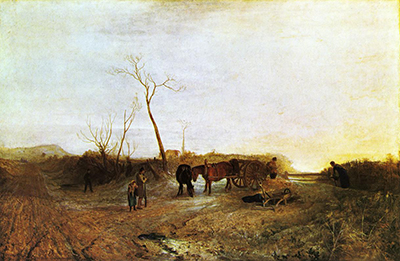
There is no mountain, ruin, palace or storm in Frosty Morning. J. M. W. Turner gives us a country road, low hedges, bare trees, a cart, two horses and people caught in the cold. Most of the canvas is pale sky. The land occupies a narrow strip below it, and the human activity is so quiet that the scene can initially appear almost empty. Yet Turner painted it on a scale associated with his major exhibition pictures. The canvas is nearly a metre and three quarters wide. Ordinary weather and ordinary work have been asked to sustain the weight of public art.[1][3]
That decision is the painting's first source of power. A picturesque landscape usually promises a feature worth seeking: an abbey, a crag, a waterfall or a recognised view. Here the road does not arrive at a monument. It bends through open country and disappears. The distant hills are low; the trees are thin; the hedges offer no luxuriant foliage. Even the sunrise is restrained, a weak yellow warmth gathered toward the far right rather than a theatrical disc in the centre. Turner removes the customary reasons for admiring a place and makes the act of seeing itself the subject.
The title directs attention to an effect that is everywhere and nowhere. Frost has no single outline. It catches in ruts, grass, verges and shaded ground, altering the relation between earth and light. The scene contains no deep snow. Instead, cool grey-white touches and veils pass across brown and olive land. The cold is apprehended through differences: where brightness remains, where warmer earth begins to emerge, where a horse lowers its head, where workers pause beside tools that seem heavy in the hardened ground.
Turner exhibited the painting in 1813 with one line from James Thomson's The Seasons: “The rigid hoar-frost melts before his beam.”[6][9] The verb matters. This is not simply a record of frozen stillness. It is a picture of change already under way. Night has ended, the sun has begun its work, and the surface of the land is passing from rime to moisture. The people and animals occupy the same unstable interval. They are present for labour or travel, yet nearly every movement appears arrested.
Object at a Glance
- ArtistJoseph Mallord William Turner
- TitleFrosty Morning
- Historical titleA Frosty Morning: Sunrise
- ExhibitedRoyal Academy, 1813
- Catalogue number15
- MediumOil on canvas
- Dimensions113.5 × 174.5 cm
- CollectionTate Britain
- AccessionN00492
- AcquisitionTurner Bequest, 1856
Frosty Morning is an oil painting on canvas by Joseph Mallord William Turner, exhibited in 1813. It measures 113.5 by 174.5 centimetres and belongs to Tate Britain, where it carries the accession number N00492.[1][3] Earlier National Gallery records called it A Frosty Morning: Sunrise and numbered it 492, a history preserved in the Gallery's archive.[18] The shorter current title retains the weather and hour while allowing the image to do more of the descriptive work.
The picture appeared at the Royal Academy's forty-fifth annual exhibition at Somerset House as number 15. Its catalogue line from Thomson identified hoar frost and sunrise without supplying a locality or narrative.[5][6] Turner also exhibited The Deluge, number 213, a large biblical catastrophe accompanied by lines from Milton. The pair demonstrated the range of landscape painting as Turner understood it. One work staged the destruction of the world; the other found consequence in a road on the last edge of a cold season.
Turner retained Frosty Morning. Tate describes it as one of his favourite pictures and perhaps among his most personal.[2] That judgment is supported by later recollections, though the reasons remain partly conjectural. The painting was still in his possession at his death in 1851 and entered the national collection through the Turner Bequest settlement of 1856. It is therefore both an Academy picture made for public judgment and an object Turner continued to live with.
The present dimensions help explain its effect. At 174.5 centimetres across, the road unfolds at something closer to bodily scale than to the compact proportions of a cabinet landscape. Figures remain small in relation to sky, but the canvas allows the viewer to register their separation: the standing pair to the left, the horses and cart near the centre, workers spaced across the verge, and the distant coach. The width creates travel without speed. One can move across the image, yet each incident feels held by the same temperature.
Contents
- A Road Becomes Monumental
- Object at a Glance
- A Sky That Exposes the Earth
- People, Horses and Interrupted Work
- Yorkshire, Memory and Personal Traces
- What Are They Doing?
- Thomson's Last Autumnal Day
- Simple Nature and Pastoral Labour
- Agriculture, War and Uneasy Improvement
- Cuyp, Claude and an English Road
A Sky That Exposes the Earth
The horizon lies very low, leaving roughly two thirds of the canvas to air. This is not a cloud drama in the manner of Turner's later storms. The sky is broad, quiet and finely varied, moving through pearl grey, pale green, cream and diluted yellow. Thin horizontal changes suggest layers of vapour without breaking the whole into separate cloud banks. The effect is less of objects suspended overhead than of cold air pressing continuously upon the land.[3]
At the far right, warmth gathers close to the horizon. Turner does not give the sun a hard circular boundary. Light spreads through the atmosphere and reaches the ground unevenly. The nearest road remains largely cool, while warmer ochres and browns emerge farther across the verge. This asymmetry makes the sunrise a force moving into the scene. It has not yet conquered the frost; the picture depends upon their coexistence.
The low landscape answers the sky through long horizontal bands. Distant hills darken the far left. Bare hedges and field boundaries run across the middle distance. A rail or narrow crossing interrupts the right side, while the road curves from the foreground toward the left distance. The thin central tree rises into the open air but cannot divide it. Its small branches seem exposed against the pale expanse, as vulnerable to the morning as the figures below.
That exposure gives emptiness emotional weight. A large sky can suggest freedom, but here there is little shelter. The trees have lost their leaves, the hedges are low and the nearest building is absent. People, animals and tools are distributed across an open strip where cold has equal access to all. The atmosphere does not merely surround the action; it regulates it. Stiff legs, bowed bodies and suspended work become bodily equivalents of the hardened ground.
The muted palette is equally active. Brown is not simply local colour for earth, nor grey a neutral sign of cold. Warm and cool variations reveal where light has reached, where shade remains, and where frost reflects the sky. Small accents of blue on the child, rusty red on the harnessed horse and darker clothing among the workers are conspicuous because the larger field is restrained. Colour does not decorate the scene; it measures difference inside a nearly colourless hour.
Early criticism recognised this achievement. A Morning Chronicle reviewer praised the work's “silvery brightness,” placing its effect beside Cuyp and Claude.[6] The phrase captures the paradox. Silver can shine, but it is a cool shine, unlike the golden abundance often associated with ideal landscape. Turner's morning is luminous without being consoling. The sky opens the world to vision while making its coldness impossible to avoid.
People, Horses and Interrupted Work
The human and animal group does not form a single compact episode. Turner strings it across the low band of land. Left of the cart stand a taller figure and a small girl in blue with a pale covering around her head and shoulders. Farther left, another dark figure occupies the roadside. Near the cart, people and tools merge with the verge. A man appears to stand or work close to the ditch, while a larger bent figure at the far right turns towards the ground. The separation makes the group social but not theatrical. No one commands the action.[3]
Two horses give the centre its mass. A reddish-bay animal is attached to the cart. A darker horse nearby lowers its head, its neck forming a heavy curve against the lighter road. They are neither galloping nor posed as noble creatures. Their legs, harness and lowered bodies belong to work. The cart itself is plain, its large wheels clearly visible, its rectangular bed offering no sign of luxury. It may be waiting to receive material, paused during a journey, or standing while the people decide what can be done.
Tools deepen this uncertainty. Upright and fallen handles punctuate the right-hand ground. A wheelbarrow or barrow-like form lies near the workers. Dark disturbed earth gathers around the ditch and verge. These details establish manual activity without providing a diagram of it. Turner lets the implements remain recognisable enough to imply effort and indistinct enough to frustrate a single occupational label.
The road is therefore not empty infrastructure. It is a workplace, meeting place and route. The distant coach represents scheduled movement through the landscape, while the stopped cart and labouring figures represent interruption. One vehicle approaches; the other cannot or need not proceed. The contrast is subtle because the coach is small and softened by distance, but it gives the image an internal clock. Travel continues elsewhere while this group remains exposed to the cold.
Later descriptions have identified the object around the girl's shoulders as a hare and a nearby standing man as a gamekeeper.[17] The public image permits a pale, fur-like shape, but not every detail is conclusive. The distinction matters because a hare could connect the painting to hunting, seasonal violence and Thomson's poem. It could also be a warm garment or an object whose identity Turner never intended to dominate. The painting rewards careful looking precisely because recognition repeatedly approaches certainty and then recedes.
This is one reason the picture resists easy sentiment. There is no cottage smoke promising comfort and no landowner supervising improvement. The people are neither cheerful pastoral ornaments nor dramatised victims. They occupy the scene with the horses, tools and road, sharing its material limits. Their dignity comes from Turner's sustained attention, not from idealisation.
Yorkshire, Memory and Personal Traces
The most familiar account of the painting's origin comes from Walter Thornbury's 1862 biography of Turner. Thornbury quoted F. E. Trimmer, the son of one of Turner's friends, who remembered that the artist called it his “Frost Piece,” regarded it as a favourite and said he had sketched the scene while travelling by coach in Yorkshire.[8] The story is compelling because the painting includes an approaching coach and because Yorkshire was central to Turner's working life. It is also retrospective testimony, published eleven years after his death, not a dated note attached to a surviving preparatory sheet.
That distinction changes how the image should be understood. A journey may have supplied the observed arrangement: a coach halts or passes, workers stand beside a road, horses wait in frost. The large finished canvas is nevertheless an act of selection and memory. Turner suppresses any landmark that would establish a precise Yorkshire location. He organises separate people, tools and animals into an extended frieze and adjusts the sunrise to the poetic line chosen for exhibition. Observation is the beginning, not the whole explanation.
The distant stagecoach has often been interpreted as Turner's own vehicle approaching the group. It may indeed preserve the position of the traveller who first noticed the scene. Yet the painted viewpoint is not simply a passenger's snapshot. The road fills the foreground, and the viewer seems already outside the vehicle, close to the ground and the workers. Turner turns a possible travel memory into a position from which the elite visitor to the Academy must share the roadside.
Trimmer supplied another personal association. Turner owned an old crop-eared bay horse or horse-pony that pulled his gig on sketching trips. According to the recollection, both horses in Frosty Morning were based upon this animal, and Turner had caught the stiffness of its forelegs.[8] The Tate account repeats the resemblance while preserving its status as reported tradition.[2] The anecdote is valuable not because it proves that the canvas is autobiography, but because it links the painted animals to the practical machinery of Turner's travel. The horse was a companion in the production of landscape, not merely a motif found within it.
Tate also notes that the girl in blue is said to be Turner's eldest daughter, Evelina.[2] Nothing in the image conclusively establishes a portrait. Her face is too small, and no contemporary inscription names her. The claim therefore needs the same caution as the horse story. If the likeness was intended, the painting brings private recognition into a public rural scene without announcing it. If it was not, the tradition still shows how later viewers experienced the canvas as unusually close to Turner's life.
Personal does not have to mean confessional. The picture contains the conditions under which Turner worked: travel, sketching, weather, a remembered horse, attention to strangers and the conversion of a fleeting encounter into a finished oil. It also remained with him. Tate's statement that he was reluctant to part with it should not be inflated into a simple refusal of the market, but continued possession allowed family and journey associations to accumulate around the object.[2][6]
What Are They Doing?
The workers' task has become one of the most disputed details in Turner's art. Some descriptions call it hedging and ditching, an interpretation encouraged by the men at the verge, the upright tools and the disturbed ground. David Hill proposed that they are digging sand or gravel for road or path repairs around Farnley Hall in Yorkshire. The cart, pick, spade and abundance of suitable material in the Wharfe valley support that practical reading.[14]
John Barrell offered a different possibility: the men may be hacking stored turnips from a frozen clamp or pile so the roots can be carted to livestock. Elizabeth Helsinger develops this proposal within the agricultural history of the period. Turnips were often stored for winter feeding, and the frozen conditions would explain the tools, waiting cart and difficulty of the work.[12] Turner had already made turnip labour the explicit subject of Ploughing Up Turnips, near Slough, so the activity belonged to his visual vocabulary.
Janis Tomlinson's interpretation begins not with the implements but with the poem printed in the Academy catalogue. Immediately after Thomson's frost line, Autumn describes a beehive “robb'd, and murder'd” in a pit. Its occupants have been suffocated over sulphur so their honey can be taken. Tomlinson argues that the clustered figures and dark ground may represent or allude to that act, converting the observed landscape into an allegory of destructive human dominion.[9][10]
Each proposal explains some elements and leaves others unresolved. Ditching accounts for the verge but not necessarily the cart's position. Road repair fits the pick and wheelbarrow but depends upon a particular Yorkshire context that the painting does not identify. Turnips connect the scene to winter feeding and Turner's earlier subject, yet no clearly legible roots settle the question. The hive reading gives the catalogue quotation unusual depth, but the supposed hive cannot be securely isolated in the reproduction.
The responsible conclusion is not that one reading must defeat the rest. Turner's picture is materially exact and narratively reticent. We can identify work, tools, cold, road and waiting transport. We cannot confidently name the substance being moved. The ambiguity may arise from changes to the painting's surface, the scale of details, Turner's handling or a deliberate refusal to make labour into an instructional scene.
What remains certain is more important than the missing noun. People are working or preparing to work in conditions that resist them. The ground is hard. The tools are heavy. The horses and cart stand ready, but production has slowed. The painting gives this interruption the breadth and seriousness of a major landscape. Whether the material is gravel, earth, turnips or honey, the human relation to it is one of effort rather than possession.
Thomson's Last Autumnal Day
Turner's catalogue quotation comes from “Autumn,” not “Winter.” In Thomson's sequence, the lengthened night has ended and morning unfolds the last autumnal day. The mounting sun disperses fog; hoar frost melts; dew drops glitter on grass and spray.[9] The distinction prevents the picture from becoming a generic winter scene. It occupies a threshold at which autumn has almost surrendered, but winter has not yet fully arrived.
The line gives the painted frost duration. A noun would identify a state; “melts” describes a process. The pale road can consequently be read as uneven in time. Frost survives where the ground remains shaded, while warm colours reappear nearer the right-hand glow. Water will replace rigidity, and the road will change again beneath wheels, hooves and feet. Turner's atmospheric unity contains many local stages of thaw.
Thomson's poem also changes scale rapidly. The passage moves from a lost rider crossing dangerous ground to serene sunrise, then from glittering dew to the mass killing of bees. The hive had stored the results of collective labour for winter. Human beings destroy that community to take its food, and the poet condemns wasteful power.[9] Tomlinson's argument asks viewers to read Turner's pit, workers and cart in the shadow of these adjoining lines.[10]
Even if no hive is depicted, the poetic context unsettles an innocent sunrise. Natural renewal does not erase violence. The same sun that reveals dew also reveals the aftermath of appropriation. This double movement suits a painting in which luminous air coexists with tools, a possible dead hare and bodies bent toward the ground. Turner's single quotation could invite readers familiar with The Seasons to remember more than the one line printed.
The possible hare creates a second connection. Earlier in “Autumn,” Thomson attacks hunting for sport and dwells upon the pursuit of a timid hare.[9] Later critics identified a hare with the girl and a gamekeeper beside her.[17] The visual evidence is not firm enough to prove a coordinated programme, but the echo is suggestive. Frost, hunted animal, damaged hive and rural labour all ask how humans inhabit and use the seasonal world.
Thomson does not simply oppose humanity and nature. His poem celebrates industry, agriculture, shelter and stored abundance elsewhere. Its anger is directed at needless cruelty and destruction. That complexity is useful for Turner. The cart, tools and road represent necessary work; they are not intrusions into untouched wilderness. The moral question concerns relations within an already inhabited landscape: who labours, what is taken, what survives and whether use becomes waste.
Poetry therefore does more than caption the weather. It expands the temporal field before and after the painted instant. We imagine the night, the arrival of sun, the thaw, renewed work and the winter to come. It also expands the ethical field, placing a quiet roadside within Thomson's larger meditation on industry, pleasure, suffering and human power. Turner does not illustrate every line. He uses one exact phrase as a door into a much less settled landscape.
Simple Nature and Pastoral Labour
A. J. Finberg placed Frosty Morning within a phase of Turner's work from about 1808 to 1813 that contemporaries sometimes called “Simple Nature.” The group includes Windsor, Abingdon, Kingston Bank, Sandbank with Gipsies, Harvest Dinner and other views of ordinary country life. Finberg argued that these pictures should be understood together, not as isolated intervals between Turner's more famous sublime and classical subjects.[11]
Turner's own categories for the Liber Studiorum help explain the distinction. “Pastoral” could mean real labouring men and women, working land and unideal children. “Elegant Pastoral” belonged to nymphs, classical shepherds, goddesses and peacocks.[11] Frosty Morning is emphatically on the ordinary side. Its horses are work animals; its trees are sparse; its road is rutted; its figures wear contemporary clothes and attend to physical tasks.
The adjective “simple” does not mean naive or easy. The canvas's tonal relations are highly controlled, and its apparent lack of incident results from omission. Turner could paint recognised buildings and dramatic narratives. Here he chose not to. He builds the composition from a low horizon, a broad field of air and a dispersed set of actions whose meaning remains partly hidden. Simplicity is an achieved concentration.
Finberg compared the mood of these works to Wordsworth's encounter with ordinary nature and the “still, sad music of humanity.” His language reflects early twentieth-century spiritual criticism and should not be mistaken for Turner's declared intention. It nevertheless identifies something the picture continues to produce: rural facts are neither catalogued neutrally nor transformed into theatrical pathos. They are held within a quiet, sustained attention that asks for contemplation.[11]
This pastoral also differs from reassurance. In many ideal country scenes, labourers and animals confirm that land is productive, society ordered and nature generous. Turner's figures pause in cold, and no abundant harvest is visible. The empty cart, scattered tools and low colours frustrate the easy conversion of work into plenty. The road connects places, but it also exposes people to weather. Pastoral has become a way of examining life on the land rather than escaping into it.
Comparison with Hedging and Ditching from the Liber Studiorum is instructive. That category of labour transforms boundaries and drainage, the ordinary systems through which cultivated countryside is maintained. Such work is often visually subordinated to the landscape it produces. Turner reverses the hierarchy by making tools, bent bodies and a cut verge the principal events. The landscape does not exist before work as a finished setting; it is continually made and repaired.
The absence of a landowner sharpens this emphasis. No figure directs the others from horseback, and no great house claims the horizon. The people do not perform rural harmony for a patron within the scene. They occupy an open, unnamed place where their relation to one another must be inferred. Turner grants them neither individuality through portraiture nor anonymity through decorative distance. They remain particular bodies whose names we do not know.
Agriculture, War and Uneasy Improvement
Turner painted Frosty Morning during the long war with Napoleonic France, when British agriculture carried unusual strategic and symbolic importance. Continental conflict constrained trade, and domestic production could be represented as a form of national strength. Turner's Ploughing Up Turnips, near Slough of 1809 has often been read within this patriotic setting: agricultural labour proceeds in sight of Windsor Castle, joining food, monarchy and the cultivated Thames valley.[12][13]
Yet improvement was not a neutral good experienced equally. New crop rotations, turnip cultivation and enclosure could increase output while altering common rights, employment and access to land. Michele Miller argues that Turner's turnip picture contains disorder, exhaustion and poverty that complicate any simple celebration of progressive farming.[13] Helsinger similarly treats rural imagery as contested ground on which different accounts of nation and labour could be made visible.[12]
Frosty Morning inherits that tension while removing the explicit royal landmark. If the men are retrieving stored turnips, their activity belongs directly to improved winter feeding. Turnips could sustain livestock when pasture failed, but digging or hacking frozen roots was arduous. If the men are repairing roads, they maintain the transport network through which people, food and goods moved. If they are ditching, they preserve drainage and boundaries. Every proposal places labour beneath the apparent naturalness of the countryside.
The low palette resists the language of bounty. There are no full sheaves, swelling fruit or fat cattle. The cart appears unladen, and the ground offers little that can be confidently named as produce. Sunrise supplies radiance, but not abundance. Work must occur before the landscape yields anything. This is a national countryside understood from the roadside rather than from the estate prospect.
The human pauses are equally important. Agricultural art often presents labour as continuous rhythm: reaping, haymaking, ploughing, driving animals. Turner's figures are stopped or bent in ways that do not add up to an efficient sequence. Frost interrupts the ideal of effortless improvement. It exposes the dependence of productivity upon bodies, animals and weather that cannot be reduced to a plan.
This does not make the painting a manifesto against enclosure or war. No statement by Turner fixes such a programme, and the scene can support affectionate memory as strongly as social unease. Its achievement lies in refusing to separate them. A traveller can remember the beauty of Yorkshire light and still register the difficult work that maintains the route. A nation can value agricultural production while confronting the people upon whose cold hands it depends.
The year 1813 also gives Fisher's later joke its edge. Napoleon's army had suffered catastrophic losses during the retreat from Russia in 1812. When Fisher told Constable that he was a great man like Bonaparte and “only beaten by a frost,” he converted a geopolitical disaster into a compliment about Turner's weather.[7] The wit belongs to its moment: frost could be both a delicate pictorial effect and a force capable of defeating imperial power. Turner's road contains no soldiers, but its cold had contemporary historical resonance.
Cuyp, Claude and an English Road
The Morning Chronicle claimed that Frosty Morning, in “silvery brightness of effect,” equalled the richest work of Aelbert Cuyp or Claude Lorrain.[6] Those names placed a scene of anonymous road labour within the highest lineage available to landscape painting. The comparison was not merely flattering. It identified the means by which Turner elevated his subject: organised light, spacious air and the integration of small figures with a commanding natural effect.
Cuyp was admired in Britain for Dutch landscapes bathed in warm, often Italianate light. His cattle, horses and herdsmen inhabit low horizons beneath luminous skies. The Metropolitan Museum describes one such painting as a studio composition based on studies from nature, where resting livestock and agrarian workers become timeless elements in a reassuring vision for a landowning audience.[15] The National Gallery notes the importance of Cuyp's clear light to British painters including Turner and Constable.[16]
Turner borrows the authority of that structure but changes its temperature and social tone. His sky is not a golden envelope in which cattle rest securely. The light is silver-grey, the land hardened, the horses visibly tied to transport and the workers difficult to absorb into a timeless idyll. The road has a destination outside the frame, and the coach introduces modern movement. Cuyp's calm survives, but reassurance does not.
Claude offered another model: a broad landscape unified by light, often framing biblical or classical narrative within ideal architecture and distant space. Turner repeatedly measured his ambitions against Claude, and the comparison would have signalled poetic elevation to an Academy audience. Yet Frosty Morning contains none of the Mediterranean buildings through which Claude's prestige was usually recognised. Turner demonstrates that atmospheric order can dignify a scene without antique authority.
This is not a rejection of old masters in favour of raw transcription. The finished canvas is carefully composed. The low horizon, central tree, cart group, distant coach and right-hand sunrise distribute attention across the width. Memory and poetic quotation shape what may have begun as a roadside sketch. Turner's modernity lies in making observed common nature capable of carrying inherited pictorial seriousness.
The 1813 critic's pairing of Cuyp and Claude also places Frosty Morning between naturalism and idealisation. Cuyp suggested close observation of animals, local landscape and light; Claude represented composed poetry and the elevated tradition. Turner refuses to choose. The stiff horses, tools and ruts insist on circumstance, while the enormous sky and measured dawn transform circumstance into a meditation on time.
Paint, Frost and the Problem of Change
The surviving surface appears restrained and predominantly thin. Broad transitions across the sky are achieved without heavy peaks of paint. The lower band uses firmer marks for bare branches, cart wheels, harness, tool handles and figures, while pale touches catch along the road and vegetation. The handling changes with the function of each part: atmosphere is continuous, objects interrupt it, and frost appears through small local differences rather than a covering of opaque white.[3]
This economy helps the canvas feel cold. Thick, brilliant highlights might make frost decorative. Turner's silvery veil stays close to the earth colours beneath it. Brown, ochre, olive and muted green remain visible, so the land seems glazed or rimed rather than buried. Where warmer colour emerges, the eye senses thaw before it can name a physical change.
The trees show another kind of precision. Their branches are thin and irregular, but they do not form a lacework display. The central trunk rises through the pale sky with only enough definition to establish its structure. Smaller trees recede through softer tonal contrast. Turner balances drawing and atmosphere: branches remain bare facts, yet cold air continually reduces their edges.
Historical viewers believed the picture's appearance had altered. W. L. Wyllie described it as a brown, thinly painted canvas and thought the hoar frost that had caused such excitement in 1813 was no longer visible.[20] C. Lewis Hind made a similar complaint in the early twentieth century. Such statements are evidence about reception and perceived change, but they do not identify a material cause. Ageing varnish, pigment alteration, cleaning history, reproduction and changing expectations can all affect judgment; no one explanation should be invented without a modern technical examination.
Other observers continued to find the seasonal effect persuasive. The 1862 Spectator described frost still sparkling where sunlight had not reached and praised the leafless trees, hard road and calm sky.[17] An 1888 National Gallery handbook called the picture one of the best works in Turner's first manner.[22] The disagreement is revealing. Frost may be less a discrete painted substance than a relation among tone, texture and temperature. Even viewers who believed some sparkle had gone could still experience the morning as cold.
A nineteenth-century Turner Gallery account praised both the detailed figures and herbage and the breadth of the light, arguing that Turner raised an ordinary landscape into poetry.[21] That combination remains visible. Close marks are not distributed evenly for their own sake. They accumulate where the road, workers and vegetation need resistance; the sky is allowed to breathe. Finish is therefore selective, serving the transition between hard ground and expanding light.
The Royal Academy in 1813
The Royal Academy exhibition opened at Somerset House on 3 May 1813. It contained 945 works by 476 artists.[4] Turner was thirty-eight and had been a Royal Academician for more than a decade. He was not an emerging outsider seeking his first notice. The surprise of Frosty Morning came from an established artist giving such prominence to a contemporary and apparently uneventful rural scene.
The exhibition around it was crowded with stronger narratives. William Hilton's Mary Anointing the Feet of Jesus attracted debate about history painting and national patronage. Edward Bird showed a sequence concerning a poacher. David Wilkie's Blind Man's Buff, positioned prominently by an artist serving on the hanging committee, drew the greatest crowds.[4] Turner's own Deluge offered catastrophe on a large scale. Against such works, frost on a road had to command attention through painting rather than story.
It succeeded. The Morning Chronicle published its comparison with Cuyp and Claude on the exhibition's opening day.[6] Robert Hunt praised the identity of ground frost and atmosphere, the warming sun, misty distance and touches of yellow earth, calling the picture one of the nearest imitations of common nature.[14] These responses show that early viewers did not experience the muted canvas as empty. They saw an exceptionally exact organisation of light and season.
John Fisher's response entered the history of the painting through his correspondence with Constable. Fisher had heard Constable's Landscape: Boys Fishing praised and called it one of the exhibition's best pictures. He preferred only Turner's frost, which he named a “picture of pictures.” He then softened the comparison with his joke about Bonaparte being beaten by frost.[7] The letter was encouragement from a friend and patron, not a published verdict by Constable himself.
The episode nevertheless reveals landscape painting's changing position. Turner and Constable could be discussed as serious competitors inside an institution still organised around the prestige of history painting. Current scholarship treats their shared pursuit of landscape's status without reducing their careers to a simple rivalry.[7][23] Frosty Morning helped make that advance by showing that imagination did not require an ancient subject and that naturalism did not have to remain a small record of place.
Later criticism transformed the terms of praise. The 1862 Spectator valued the canvas as “thoroughly English,” contrasting its everyday truth with Turner's classical works.[17] That national label can obscure the painting if it turns road and frost into comforting identity. The scene is English in its weather, labour and transport, but it is not complacent. Its people are cold, its activity uncertain and its destination withheld.
Afterlives: National Gallery, Monet and Tate
Turner's death in December 1851 did not transfer the whole contents of his studio immediately. Relatives contested his complex will, and the settlement was reached in 1856. The nation received not only finished oils but the immense body of paintings, drawings and sketchbooks now called the Turner Bequest.[19] Frosty Morning, still in Turner's possession, became part of that public inheritance rather than passing through a private collection.
The Bequest moved through several institutional arrangements. Finished paintings were shown at Marlborough House and South Kensington before being reunited at the National Gallery. By 1861 the finished pictures formed a separate Turner Collection in Trafalgar Square; later extensions allowed more of the Bequest to return there.[19] Frosty Morning was therefore encountered not only as an 1813 Academy success but as one element in a national survey of Turner's career.
Archival correspondence records the practical life of that display. In September 1886 the National Gallery told a copyist, Alice Ivey, that she could resume her place before Frosty Morning.[24] The small document shows the painting functioning as a school for later artists. Its restrained colours, thin handling and tonal control could be studied at length, far from the brief encounter of an Academy exhibition.
The National Gallery's limited space eventually led to another division. In 1910 the bulk of the Turner Bequest was transferred to Tate, established in 1897 as the National Gallery of British Art.[19] Some famous oils remained in Trafalgar Square, but Frosty Morning moved into the institution now known as Tate Britain. Its present accession number, N00492, preserves its earlier National Gallery sequence while locating it within Tate's collection.[1][18]
Tate also transmits one of the picture's most famous later responses. Claude Monet reportedly said that Frosty Morning had been painted with “wide open eyes.”[2] No dated primary document accompanies the phrase on the current public account, so it should be treated as a reported judgment rather than the foundation of a direct influence story. Its value lies in the kind of looking it recognises: attentive to light as a changing condition rather than a coating applied to fixed objects.
Monet's remark can easily tempt a teleological history in which Turner anticipates Impressionism. That reading diminishes both painters. Turner's canvas is not a rapid outdoor impression. It is a large studio oil shaped by memory, poetry, old-master competition and Academy exhibition. Its figures and rural work are as important as its atmosphere. “Wide open eyes” is most useful when it directs us back to the specificity of frost, road, horse and labour rather than forward to a later movement.
Ruskin's place in the afterlife also needs proportion. He transformed Turner's reputation and worked on the Bequest, but he did not produce the sustained account of Frosty Morning that he devoted to other works. The popular National Gallery handbook partly assembled from his writings called it among the best of Turner's first manner, yet the entry should not be treated as a complete Ruskin text.[22] The picture's later fame grew through many voices: museum catalogues, copyists, critics, artists and biographers.
Why Frosty Morning Matters
Frosty Morning makes a large claim through limited means. A low road bears the marks of wheels and cold. Workers stand or bend beside tools whose exact purpose cannot be settled. Horses wait by a cart. A coach approaches in the distance. Above them, a pale sky changes almost imperceptibly as weak sunlight begins to warm the right-hand horizon. Turner does not add a monument because the relation among these things is already enough.
The painting's truth is not photographic completeness. We do not know the exact road, the date of the journey, the identity of the workers or what they are extracting from the ground. Even the personal traditions remain conditional: the girl may recall Evelina; the horses may derive from Crop-ear; the coach may preserve Turner's viewpoint. What feels truthful is the interdependence of particulars. The stiffness of a horse makes sense beside hardened soil; the stopped cart makes sense beside tools; the silver road makes sense beneath the enormous cold sky.
Thomson's line adds another form of truth. Frost is already melting. The image does not preserve a fixed world but catches different rates of change. Light travels, rime turns to water, work pauses and resumes, vehicles approach and pass. Autumn gives way to winter even as morning replaces night. A still painting becomes an account of time because every surface occupies a slightly different stage.
The uncertain labour prevents atmosphere from floating free of social life. Frost may be beautiful to the traveller and difficult for the person repairing a road, clearing a ditch or recovering winter feed. Turner neither converts the workers into decorative peasants nor supplies a simple indictment of rural society. He gives their pause visual consequence. The broad sky that could dwarf them instead makes their exposure legible.
That balance explains why the picture can support formal, biographical, poetic and social readings without being exhausted by any one. It belongs to Turner's “Simple Nature” phase, but its simplicity is complex. It remembers Yorkshire, but suppresses the landmark. It rivals Cuyp and Claude, but refuses their reassuring pastoral world. It entered the national collection, but builds English landscape from unnamed people and an uncelebrated road.
The early Morning Chronicle critic saw silver brightness. Fisher saw a “picture of pictures.” The later Spectator saw everyday English truth, and Monet reportedly saw an artist looking with open eyes.[2][6][7][17] Each response isolates one strength. Together they point to Turner's deeper achievement: he made close observation inseparable from imagination. Weather is precise, yet it becomes mood; labour is ordinary, yet it becomes monumental; memory is personal, yet it becomes public.
The painting asks for the same kind of attention it embodies. At first glance, little happens. Then differences accumulate: the road's ruts, frost in shade, warmer earth, a blue-clad child, the dark horse's lowered head, the thin tree, the bent worker, the tiny coach and the spreading yellow at the horizon. Frosty Morning does not announce its importance. It demonstrates how importance can emerge when nothing in the visible world is dismissed as too common to sustain thought.
Discussion
How does Turner make ordinary weather, interrupted labour and an uncelebrated road sustain a monumental landscape?
Reader Insights
Where does frost remain, and where does the right-hand warmth begin to dissolve it?
How does uncertainty about the task change the way you read the figures and tools?
What survives of an observed journey after landmark and exact location disappear?
Join the Conversation
Share a close observation or a source-based question for other readers.
References
- Tate, “Frosty Morning,” N00492. https://www.tate.org.uk/art/artworks/turner-frosty-morning-n00492
- Tate, “JMW Turner: Frosty Morning.” https://shop.tate.org.uk/jmw-turner-frosty-morning/turner1513.html
- Wikimedia Commons, “Turner - Frosty Morning, exhibited 1813, N00492.” https://commons.wikimedia.org/wiki/File:Turner_-_Frosty_Morning,_exhibited_1813,_N00492.jpg
- Tom Ardill, “1813: Church Painting on Show at the Summer Exhibition,” *The Royal Academy Summer Exhibition: A Chronicle, 1769-2018*. https://chronicle250.com/1813
- Royal Academy, *The Exhibition of the Royal Academy, 1813*, Paul Mellon Centre IIIF manifest. https://presley-pmc.dlc.services/iiif/raa/Vol45/manifest
- Art Institute of Chicago, *Masterpieces of Western Art*, entry 49, “Frosty Morning.” https://www.artic.edu/assets/d3477368-5d4e-7f1a-f325-21c09242f62f
- David Blayney Brown, “'Fire and Water': Turner and Constable in the Royal Academy, 1831,” *Tate Papers*, no. 33. https://www.tate.org.uk/research/tate-papers/33/fire-water-turner-constable-royal-academy
- Walter Thornbury, *The Life of J. M. W. Turner, R.A.*, vol. 1, 1862. https://upload.wikimedia.org/wikipedia/commons/6/63/The_life_of_J._M._W._Turner%2C_R.A.%3B_founded_on_letters_and_papers_furnished_by_his_friends_and_fellow_academicians_%28IA_gri_33125004491185%29.pdf
- James Thomson, “Autumn,” *The Seasons*, 1735 text, Eighteenth-Century Poetry Archive. https://www.eighteenthcenturypoetry.org/works/o3549-w0030.shtml
- Janis A. Tomlinson, “Landscape into Allegory: J. M. W. Turner's ‘Frosty Morning’ and James Thomson's ‘The Seasons’,” *Studies in Romanticism* 29, no. 2, 1990. https://www.jstor.org/stable/25600834
- A. J. Finberg, *Turner's Sketches and Drawings*, chapter 5, “Simple Nature - 1808-1813.” https://gutenberg.org/cache/epub/64312/pg64312-images.html
- Elizabeth K. Helsinger, *Rural Scenes and National Representation: Britain, 1815-1850*. https://www.jstor.org/stable/j.ctt7ztrkz
- Michele L. Miller, “J. M. W. Turner's Ploughing Up Turnips, near Slough: The Cultivation of Cultural Dissent,” *The Art Bulletin* 77, no. 4. https://doi.org/10.1080/00043079.1995.10786657
- Lydia Chavez, “John Linnell's Kensington Gravel Pits: A Landscape from the Edge of London.” https://lydiachavez.com/john-linnells-kensington-gravel-pits-a-landscape-from-the-edge-of-london/
- Metropolitan Museum of Art, Aelbert Cuyp, “Young Herdsmen with Cows.” https://www.metmuseum.org/art/collection/search/436064
- National Gallery, London, “Aelbert Cuyp.” https://www.nationalgallery.org.uk/artists/aelbert-cuyp
- *The Spectator*, Turner collection review, 18 January 1862. https://archive.spectator.co.uk/article/18th-january-1862/17/lint-irto
- National Gallery Archive, “Dossier on Turner ‘Frosty Morning: Sunrise’,” NG3/492/1. https://www.nationalgallery.org.uk/research/research-centre/archive/record/NG3/492/1
- National Gallery, London, “The Turner Bequest.” https://www.nationalgallery.org.uk/about-us/history/the-turner-bequest
- W. L. Wyllie, *Life of J. M. W. Turner*, 1905. https://pettersson-fanpage.de/Turner1/J.M.W.%20Turner%20-%20Wyllie%2C%20William%20Lionel%2C%201851-1931.pdf
- *The Turner Gallery: A Series of One Hundred and Twenty Engravings from the Works of the Late J. M. W. Turner, R.A.*, 1878. https://upload.wikimedia.org/wikipedia/commons/d/de/The_Turner_Gallery%3B_a_series_of_one_hundred_and_twenty_engravings_from_the_works_of_the_late_J.M.W._Turner%2C_R.A.%3B_%28IA_gri_33125008236784%29.pdf
- Edward T. Cook, *A Popular Handbook to the National Gallery*, vol. 2, 1888. https://upload.wikimedia.org/wikipedia/commons/a/a4/A_Popular_handbook_to_the_National_gallery_-_including%2C_by_special_permission%2C_notes_collected_from_the_works_of_Mr._Ruskin_%28IA_popularhandbookt02cook_0%29.pdf
- Nicola Moorby, *Turner and Constable: Art, Life, Landscape*, Yale University Press, 2025. https://yalebooks.yale.edu/book/9780300266481/turner-and-constable/
- National Gallery Archive, letter to Alice Ivey, 8 September 1886, NG6/12/107. https://www.nationalgallery.org.uk/research/research-centre/archive/record/NG6/12/107