 by Tom Gurney
Tom Gurney BSc (Hons) is an art history expert with over 20 years experience
Published on June 19, 2020 / Updated on August 29, 2026
Email: tomgurney1@gmail.com / Phone: +44 7429 011000
Overview
Venice gave J. M. W. Turner one of the great subjects of his later career. It was a city of water, architecture, reflected light, memory, theatre, commerce and historical decline. For Turner, Venice was not merely a picturesque destination. It was a repeated visual problem: how to paint a place where buildings seem to rise from water, where light breaks forms apart, where travel memory competes with topographical fact, and where the past remains visible in a changing present.
Turner's Venice works include sketchbook notations, finished watercolours, exhibition oils and later pictures whose titles and dates require care. They should not all be treated as the same kind of object. A pencil study made during travel, an oil painting shown at the Royal Academy, a finished watercolour for a patron and a late atmospheric canvas each belong to different working conditions. Venice mattered because Turner could move between those conditions while returning to the same city.
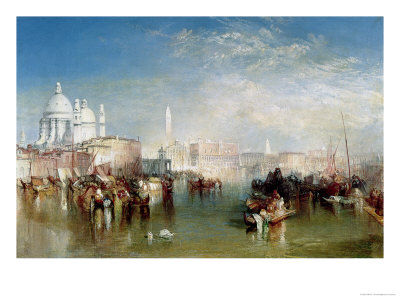
The Metropolitan Museum of Art's record for Venice, from the Porch of Madonna della Salute gives a compact example of this layered process. The Met states that Turner based the composition on a slight pencil drawing from his first Venice trip in 1819, but that the painting was really the outcome of his second visit in 1833 and was exhibited at the Royal Academy in 1835. [1] That sequence is crucial. Venice for Turner was not a single moment of sightseeing. It was observation remade through return, memory and studio transformation.
The National Gallery of Art's Venice records show the range of his oil practice. Venice: The Dogana and San Giorgio Maggiore is dated 1834, while Approach to Venice is dated 1844 and places the city in a late, luminous atmosphere shaped by sun, moon, lagoon and poetry. [2][3] These works should be connected, but not merged. Venice changed in Turner's art as his handling, travel experience and exhibition ambitions changed.
The safest way to read Turner and Venice is therefore comparative. Look at travel sketchbooks beside oils, watercolours beside exhibition pictures, architectural description beside light effects, and Byron-inflected titles beside material evidence. Venice is both a real place and a pictorial laboratory. Turner made that tension productive.
This comparative approach also protects the later object articles. A broad Venice account can explain why the city mattered, what kinds of works Turner made from it and how the subject changed across time. It should not exhaust the individual histories of The Dogana and Santa Maria della Salute or Venice, from the Porch of Madonna della Salute. Those works need close readings of their own. Here, the task is to build the larger frame: Venice as repeated encounter, working memory and luminous problem.
At a Glance
- Working siteVenice as a repeated subject and image problem
- First visit1819, with sustained sketchbook observation
- Later visitsFurther work in the 1830s and 1840s
- MediaOil paintings, finished watercolours and sketchbook pages
- ArchitecturePalaces, churches, campanili, Dogana and lagoon edges
- Visual structureBuildings, boats, water, reflection and atmosphere
- Literary frameByron and Venice's historical imagination
- Exhibition cultureVenice pictures as public Royal Academy statements
- Key cautionTitles, dates, viewpoints and versions require separation
- Close-looking questionHow does light alter the balance of solidity and reflection?
Contents
- Overview
- Why Venice Mattered to Turner
- The First Encounter and the Sketchbook Habit
- The 1830s Venice Oils
- Approach, Lagoon and Late Light
- Venice in Watercolour
- Architecture and Reflection
- Titles, Dates and Version Caution
- Venice, Poetry and Historical Memory
- Technique, Colour and Light
Why Venice Mattered to Turner
Venice suited Turner because it combined several of his strongest interests. It was maritime but urban, architectural but reflective, historical but unstable. Its buildings were recognisable, yet their reflections made them seem to dissolve. Its waterways turned movement into drama. Its history offered grandeur and decline. Its light gave Turner a way to test the boundary between description and atmosphere.
This made Venice different from a conventional city view. A city built on water changes how architecture is seen. Foundations, walls, domes and campanili meet reflections, ripples, boats and haze. Solid buildings lose some of their weight. Water becomes both foreground and mirror. Turner could use this condition to make architecture appear real and unstable at the same time.
Venice also carried art-historical weight. It was the city of Titian, Veronese, Canaletto and Guardi, a place already saturated with painting and collecting. Turner did not approach it as blank scenery. He entered a tradition of Venetian imagery while bringing his own concerns: marine painting, watercolour technique, luminous colour, modern travel and the imaginative transformation of observed places.
The city also allowed Turner to join travel and memory. A sketch made in 1819 could remain active years later. A later visit could revise the first impression. A finished oil could compress multiple experiences. This makes Venice central to Turner's method because it shows how he worked from both observation and recollection.
Venice mattered finally because it gave him a subject in which history itself seemed atmospheric. The city had once been a major maritime power, but by Turner's mature career it carried the aura of political decline and cultural memory. He did not need to make this history explicit in every work. The city's light, water and architecture could already suggest a world suspended between presence and disappearance.
The city also suited Turner's habit of return. Some subjects are solved once and left behind; Venice was not one of them. Its value increased through repetition. Each return allowed Turner to ask a different question: how much architecture must remain visible, how far colour can carry a view, how water changes a building, how memory alters topography, and how a city already famous in art can be made newly unstable.
This makes Venice one of the best subjects for understanding Turner as both observer and inventor. The observer notices the specific relation of dome, canal, boat and light. The inventor changes scale, emphasis, colour and mood. Venice allowed both acts to happen together because the place itself appears to transform under changing light.
The First Encounter and the Sketchbook Habit
Turner's first visit to Venice in 1819 gave him material that remained useful long afterward. The Met's account of Venice, from the Porch of Madonna della Salute is important because it connects an 1819 pencil drawing to a later oil painting associated with the 1833 visit and the 1835 Royal Academy exhibition. [1] That connection shows how a modest travel note could become part of a much larger pictorial process.
Ian Warrell's Turner's Sketchbooks gives the broader context for this habit, with Tate presenting the book as a survey of Turner's notebook practice from youthful exploration to late colour studies. [4] Venice fits that model. A quick note could preserve a view, a relation of forms, a waterfront rhythm or a light condition that later painting could transform.
Sketchbooks are especially important for Venice because the city rewards movement. A view changes from a boat, a bridge, a quay or a doorway. A dome may appear, disappear and reappear between buildings. Reflections alter with weather and wake. Turner could not solve Venice from one fixed viewpoint. He needed portable notations that caught fragments and relations.
Those notations should not be mistaken for finished works. A sketchbook leaf may record the position of a church, the sweep of a waterfront, the placement of boats or the fall of light. It may not carry the colour and atmosphere of the later painting. Its value is often practical rather than decorative. It shows what Turner needed to keep.
The sketchbook habit also helped Turner avoid mere topographical reporting. He could gather enough information to return to the subject later without being bound to exact transcription. Venice, perhaps more than any other city he painted, encouraged this flexible relation between fact and invention. The observed city became a storehouse for later acts of colour, memory and composition.
Sketching also gave Turner a way to manage abundance. Venice offers too much: facades, domes, campanili, bridges, boats, reflections, crowds, ceremonial associations and historical memory. A notebook could reduce that abundance to usable relations. It might keep a skyline, a water edge, a cluster of boats or a view through architectural framing. Such reductions were not failures of description. They were the means by which later complexity became possible.
The travel note also carries time differently from a finished picture. A sketch may belong to a few minutes of looking. A later oil may condense years of remembered Venice. That difference is central to Turner. The city was not simply copied from life; it was stored, reactivated and transformed. The sketchbook is the hinge between the actual visit and the later image.
The 1830s Venice Oils
The 1830s were decisive for Turner's Venice. The Met dates Venice, from the Porch of Madonna della Salute to about 1835 and notes that it was exhibited at the Royal Academy that year. [1] The National Gallery of Art dates Venice: The Dogana and San Giorgio Maggiore to 1834, with oil on canvas as the medium and the Widener Collection as credit line. [2] These works show Turner bringing Venice into public oil painting with high ambition.
They also show that Venice was not only a watercolour subject. Oil gave Turner scale, density and exhibition authority. It allowed him to make Venice a public statement about light and architecture, not just a travel memory. The city appears as a place where painting can test the relation between structure and atmosphere.
In Venice: The Dogana and San Giorgio Maggiore, the National Gallery of Art record gives the basic object facts: date 1834, Turner as artist, oil on canvas, and Washington as holder. [2] The work's importance for a general Venice article is not to replace a detailed object study, but to show that Turner was already treating Venetian architecture and water as a major oil subject in the mid-1830s.
The Met's account adds another important point: Turner drew on his experience as a marine painter and watercolourist to make the foundations of Venetian palaces merge into lagoon water through delicate reflections. [1] That sentence helps explain why Venice suited him. It brought marine skill, watercolour brilliance and architectural subject matter together.
The 1830s Venice oils should therefore be read as hybrid works. They are not pure city views, pure marine scenes or pure atmospheric experiments. They are all three. Turner uses oil painting to make Venice hover between material architecture and reflected light. This hybridity is one of the reasons his Venice pictures feel so distinctive.
The 1830s works also show Turner thinking about public display. A Venice oil shown at the Royal Academy had to address viewers who knew Venice through travel, literature, earlier art or reputation. Turner could rely on that cultural familiarity while still unsettling it. The city might be recognisable, but the handling of light and reflection made recognition feel provisional.
Oil painting gave Turner another advantage: it allowed him to make Venice physically substantial even while dissolving it optically. Thick or blended passages, layered colour and luminous contrasts can make the city both material and atmospheric. This doubleness is hard to discuss if Venice is treated only as "beautiful." The paintings are beautiful because they work through conflict: stone and water, structure and reflection, memory and immediacy.
Butlin and Joll's catalogue of Turner's paintings remains an important control for this oil-painting field because it helps separate titles, dates, exhibited works and related versions. [7] Venice is a subject where loose naming can quickly create confusion. A public reader does not need catalogue numbers at every turn, but the underlying discipline matters: one must know which painting is being discussed before making claims about it.
Approach, Lagoon and Late Light
Approach to Venice, dated 1844 by the National Gallery of Art, belongs to a later moment in Turner's treatment of the city. The NGA record describes the work as oil on canvas and notes that, when first exhibited in 1844, Turner quoted Lord Byron in the catalogue description: "The moon is up, and yet it is not night / The sun as yet disputes the day with her." [3] This literary frame matters because it places Venice between day and night, sight and imagination, painting and poetry.
The painting is useful for understanding Turner's late Venice because it shows how little architectural detail may be needed for the city to remain present. The NGA visual description presents a hazy scene in which clouds, water, sky and distant buildings blend in bands of colour, with boats moving toward the town. [3] Venice becomes less a collection of monuments than a condition of approach.
This does not make the work abstract in a simple sense. It still has boats, horizon, water, light and city. But the emphasis shifts toward atmosphere and transition. The viewer is not standing before a clearly bounded monument. The viewer is moving toward a city that seems to appear through light.
The Byron quotation also warns against treating Turner's Venice as only optical. Literature shaped how nineteenth-century viewers imagined the city. Byron's Venice was a place of beauty, history, melancholy and theatrical memory. Turner could use such associations without becoming merely illustrative. The quotation opens a mood; the painting solves it through colour and composition.
Late Venice therefore intensifies a problem already present in the earlier works: how to keep a city recognisable while allowing light and water to transform it. Turner does not abandon architecture. He loosens it. Buildings become vertical notes within an atmospheric field. Water and sky become the major carriers of meaning.
The approach motif is especially important because it shifts Venice from fixed view to arrival. The viewer is not simply presented with the city as a stable arrangement of monuments. The city is encountered across water, from a distance, through haze. That makes the act of seeing feel like travel. Turner turns approach itself into a subject.
The late light also changes the role of boats. They are not only staffage or local colour. They provide scale, direction and human movement. They carry the eye toward the city and keep the lagoon from becoming pure atmosphere. In a painting where buildings are blurred and colour is expansive, boats can become the evidence that the scene is still inhabited and navigable.
By 1844, Turner could use Venice as a subject in which sky, water and architecture nearly exchange roles. Water reflects sky; buildings appear as colour notes; boats become small intervals of motion; sun and moon complicate time of day. This is not a loss of subject. It is a more radical way of making the subject visible.
Venice in Watercolour
Venice also belongs to Turner's watercolour practice. Tate's works-on-paper publication identifies the Turner collection as the world's largest body of his sketchbooks, drawings and watercolours and presents it as a major source for his creative process. [5] For Venice, this matters because works on paper allow a different kind of speed and luminosity from oil painting.
Watercolour can make Venice feel immediate because paper itself can become light. Transparent washes, reserved brightness, opaque touches and quick colour relations are especially suited to lagoon effects. A pale wash can suggest water and air together. A small accent can identify a dome, mast or boat. A reserved light can make the scene glow without heavy description.
Joyce Townsend's technical work, represented publicly through Thames & Hudson's description of How Turner Painted, supports this kind of material caution. The publisher presents the book as an account of Turner's materials, watercolour innovation, paint handling, compositional practice and technical imaging. [6] When discussing Venice, that technical frame prevents loose claims about colour from becoming vague admiration.
Venice watercolours should not be placed automatically below oils. They solve different problems. An oil may give Turner public scale and density. A watercolour may give him speed, transparency and the power of paper light. A sketchbook note may give him structure. Together they form a working system rather than a hierarchy.
The distinction between finished watercolour and working study matters. Some Venice sheets may be polished enough to stand as independent works. Others may function as colour tests, travel records or compositional notes. The public viewer should ask what kind of object is being seen before judging finish or intention.
Watercolour also allowed Turner to think serially. A city of shifting light does not yield one final solution. It invites variations: morning, evening, haze, reflection, architectural emphasis, open lagoon, close view, distant approach. Works on paper can pursue these variations with a speed and delicacy that oil painting does not always permit.
The paper support matters too. In watercolour, light is often created by leaving the paper active, by allowing a wash to remain transparent or by adding opaque accents only where needed. Venice, with its pale stone and reflective water, was especially suited to such means. The city could be made to glow from the support upward rather than from heavy description downward.
Architecture and Reflection
Venice offered Turner architecture that could not be separated from reflection. Churches, palaces, campanili and waterfront facades meet water immediately. The city asks the painter to decide where building ends and reflection begins. Turner often makes that boundary uncertain.
The Met's record for Venice, from the Porch of Madonna della Salute says the foundations of palaces merge into lagoon water by means of delicate reflections. [1] This is one of the most concise descriptions of the Venetian problem in Turner. Reflection is not a decorative addition. It is a structural condition of the city.
Turner could use this condition to soften architecture without losing it. A dome, porch or campanile may remain identifiable, but its lower edge becomes unstable. Boats, water steps and reflections complicate the foreground. The city is both built and mirrored. That duality suits Turner's larger interest in visibility as something changing rather than fixed.
Reflection also allows Turner to connect colour across the image. A sky colour can enter water. A building tone can ripple downward. A sail or boat can interrupt a field of light. This makes Venice a place where composition is built through echo rather than only through line. The viewer reads the city vertically and horizontally at once.
Such effects should still be tied to object evidence. Not every Venice work handles architecture in the same way. A more finished oil, a late atmospheric painting and a quick sheet on paper may use reflection differently. The general claim is that Venice made reflection central to Turner's practice; the specific reading belongs to each individual work.
Reflection also affects time. A reflected building is never quite as stable as the building itself. It changes with the water and with the viewer's position. Turner could use that instability to make Venice feel historical without narrating history. The city seems present and vanishing at once. This is not only mood; it is a visual fact of architecture on water.
The same principle applies to colour. Reflected colour can detach from the object that produced it. A warm building may become a broken passage on water. A pale sky may spread across a canal. A dark boat may interrupt a luminous field. Turner uses these effects to make Venice less like a map of monuments and more like an environment of relations.
Titles, Dates and Version Caution
Turner and Venice requires caution about titles and dates. The city appears across many works, and similar locations can generate confusingly similar titles. A reference to the Dogana, Santa Maria della Salute, San Giorgio Maggiore, the Grand Canal or an approach to Venice must be tied to a particular object record when possible.
The National Gallery of Art, for example, holds both Venice: The Dogana and San Giorgio Maggiore and Approach to Venice, but they are different works with different dates, dimensions, credit lines and accession numbers. [2][3] The Met's Venice, from the Porch of Madonna della Salute is another distinct object, dated about 1835 and associated with the 1835 Royal Academy exhibition. [1] These records prevent a broad Venice discussion from collapsing separate pictures into one generalized "Turner Venice" image.
Butlin and Joll's catalogue remains important for the larger oil-painting framework because Venice works often have title variants, exhibition histories and version questions. The public article does not need to reproduce catalogue machinery, but it should respect the principle: identify the work before interpreting it.
Date distinctions also matter. The 1819 first trip, the 1833 return and the 1840s exhibition works belong to different phases. The Met explicitly links an 1819 drawing, the 1833 visit and an 1835 exhibition painting. [1] The NGA dates Approach to Venice to 1844. [3] These dates show that Venice was not a single late flourish but a subject reactivated across decades.
Version caution protects interpretation. A claim about one Venice oil should not automatically be applied to all Venice works. A late haze, a Byron quotation, a particular view of the Dogana or a Met provenance fact belongs to a specific object. Venice is a cluster of related works, not a single image repeated mechanically.
This caution is especially important because Turner reused vantage points, subjects and architectural motifs. Similar titles can conceal different objects, and different titles can point to related visual problems. Museum records provide the safest public anchors: title, date, medium, holder, dimensions and object number. Catalogue literature then helps place the work within the larger painting sequence.
Dates are not just labels. They change interpretation. An 1834 oil belongs to a different moment from an 1844 exhibition work. A drawing associated with 1819 carries different evidence from a canvas shaped by the 1833 return. Venice becomes clearer when the viewer sees it as an evolving subject rather than a single late style.
Venice, Poetry and Historical Memory
Venice in Turner's art is also literary. The Byron quotation attached to Approach to Venice shows that Turner allowed poetry to frame the city's light and mood. [3] The quoted lines describe a moment between moon and daylight, making the picture's atmosphere a kind of temporal threshold.
This literary framing should not be overused. Turner did not need poetry to make Venice meaningful, and not every Venice work should be read through Byron. But in the 1844 picture, the catalogue quotation gives evidence for how he invited viewers to approach the work. It signals twilight, ambiguity and historical resonance.
Venice already carried historical memory for British audiences. It suggested art, trade, maritime power, decline, romance and political loss. Turner could draw on these associations while avoiding literal historical narrative. A lagoon view can carry memory without showing a historical event. A building half-lost in light can suggest the fragility of cultural power.
This is where Venice differs from Turner's explicitly modern subjects such as railways or the Parliament fire. Venice is modern in another sense: it is a historical city seen through modern travel, exhibition, collecting and literary imagination. Turner does not paint it as untouched past. He paints it as a place mediated by memory and viewing.
The result is not simple nostalgia. Venice in Turner can be radiant, theatrical, unstable and experimental. Its beauty is inseparable from dissolution. The city is most powerful when it seems to hover between factual architecture and remembered light.
Historical memory also affects the viewer's assumptions. Many nineteenth-century viewers approached Venice through books, travel writing, prints and earlier paintings before seeing Turner's works. Turner could assume that the city already had a cultural image. His achievement was to make that familiar city feel unstable again. Instead of repeating a settled view, he made Venice shimmer, recede, glow or dissolve.
This is why generic tourist language weakens Turner. Venice is not interesting in his art merely because it is charming or romantic. It is interesting because it lets him test how a historically saturated place can be remade through perception. The city's fame becomes part of the challenge. Turner paints not only Venice, but the difficulty of seeing Venice after so many earlier images.
Technique, Colour and Light
Turner's Venice depends on technique. The city gives him light, but technique makes that light visible. Oil paint, watercolour, paper, ground, wash, opacity, transparency and brush handling all shape the effect. It is not enough to say that Venice is luminous. The question is how luminosity is produced.
In oil, Turner can use layered colour, loose brushwork and atmospheric transitions to make buildings and water merge. In watercolour, the paper can contribute brightness directly. In a sketchbook, a few marks can hold the relation of skyline and lagoon. Each medium creates a different Venice.
The NGA visual descriptions for the Washington Venice works are useful because they show how colour bands, hazy horizons, visible brushstrokes and shimmering reflections structure the paintings. [2][3] These descriptions support a technical reading without requiring unsupported claims about Turner's emotions.
Townsend's technical framework reinforces that caution. How Turner Painted is described as explaining Turner's materials and methods across oil and watercolour, including composition process and technical imaging. [6] Venice should be read through that kind of material awareness. A colour effect may depend on medium, support, layering, condition or later visibility.
Light in Turner is never only a subject. It is also a method of transformation. In Venice, light can reduce detail, connect sky and water, soften architecture, delay recognition and make the city feel suspended. The stronger the light effect, the more important it is to ask what material decisions made it possible.
This technical awareness also protects against vague praise. Saying that Turner painted Venetian light beautifully is true but insufficient. A better account asks whether the effect depends on thin paint, visible brushwork, reflected colour, reserved paper, opaque touches, loose drawing, or the relation between warm and cool passages. Different Venice works answer those questions differently.
The material issue is also tied to condition. Some colours and surfaces may have changed over time, and reproductions can flatten the delicacy of watercolour or the surface of oil. A conservation-aware approach does not make the works inaccessible. It simply reminds viewers that Turner's Venice is made from specific materials, not from light alone.
How to Read Turner’s Venice
Begin by identifying the object type. Is it an oil painting, a finished watercolour, a sketchbook leaf, a colour study or a later work with uncertain status? Venice appears across different media, and interpretation changes with medium.
Next, ask which Venice moment is involved. Does the evidence relate to the 1819 first visit, the 1833 return, the mid-1830s oils or the 1840s late works? The Met's account of the 1819 drawing, 1833 visit and 1835 exhibition picture is a model for keeping sequence clear. [1]
Then look at the balance between architecture and atmosphere. Which buildings are identifiable? Which forms dissolve? Does water mirror the city, obscure it or carry the viewer toward it? Turner's Venice often depends on the tension between stable landmarks and unstable light.
Ask also whether a literary frame is present. Approach to Venice carries a Byron quotation in its 1844 exhibition context. [3] That matters for that work, but it should not be applied automatically to all Venice pictures.
Finally, preserve uncertainty where the evidence requires it. Turner often transformed observation through memory, studio work and exhibition ambition. Venice is not reduced by that uncertainty. It becomes more interesting because the works show observation being remade into atmosphere.
A useful reading therefore moves in stages. Identify the work. Identify the medium. Establish the date or likely phase. Ask what evidence connects it to travel. Then look at how water, architecture and light interact. Only after those steps should broader claims about memory, poetry or historical feeling be made.
This order keeps Venice from becoming a blur of attractive impressions. Turner certainly made the city luminous, but he did so through disciplined looking, repeated travel, technical experiment and careful transformation of earlier notes. The more precise the evidence, the richer the atmosphere becomes.
Frequently Asked Questions
Venice allowed Turner to combine water, architecture, reflection, travel memory, historical resonance and experimental light. It suited his marine experience, watercolour technique and later interest in atmosphere.
No. Oils, finished watercolours, sketchbook leaves and colour studies have different materials, purposes and degrees of finish. They should be compared, but not collapsed into one category.
Byron is directly relevant to Approach to Venice, whose 1844 catalogue description included lines about moon and sun sharing the sky. The quotation helps frame that painting's twilight atmosphere. [3]
Venice's architecture is seen through water, reflection, haze and light. Turner used these conditions technically, making solid buildings merge with lagoon atmosphere while often keeping enough structure for recognition.
Discussion
How does Turner make Venice feel observed, remembered and transformed at the same time?
Reader Insights
Which architectural and maritime forms organise the view?
Where do buildings remain solid, and where do they merge with water or sky?
What evidence helps distinguish an oil, watercolour, sketchbook page or later title?
Join the Conversation
Share a close observation or a question for other readers.
References
- Metropolitan Museum of Art, "Venice, from the Porch of Madonna della Salute." https://www.metmuseum.org/art/collection/search/437853
- National Gallery of Art, Washington, "Venice: The Dogana and San Giorgio Maggiore." https://www.nga.gov/artworks/1224-venice-dogana-and-san-giorgio-maggiore
- National Gallery of Art, Washington, "Approach to Venice." https://www.nga.gov/artworks/117-approach-venice
- Tate Shop, Ian Warrell, *Turner's Sketchbooks*. https://shop.tate.org.uk/turners-sketchbooks-paperback/20184.html
- Tate, "J.M.W. Turner: Sketchbooks, Drawings and Watercolours." https://www.tate.org.uk/art/research-publications/jmw-turner
- Thames & Hudson, Joyce H. Townsend with Tony Smibert, *How Turner Painted*. https://www.thamesandhudsonusa.com/books/how-turner-painted-softcover
- Martin Butlin and Evelyn Joll, *The Paintings of J. M. W. Turner*, revised edition. New Haven and London: Yale University Press, 1984.