 by Tom Gurney
Tom Gurney BSc (Hons) is an art history expert with over 20 years experience
Published on June 19, 2020 / Updated on August 29, 2026
Email: tomgurney1@gmail.com / Phone: +44 7429 011000
Venice as a Working Harbour
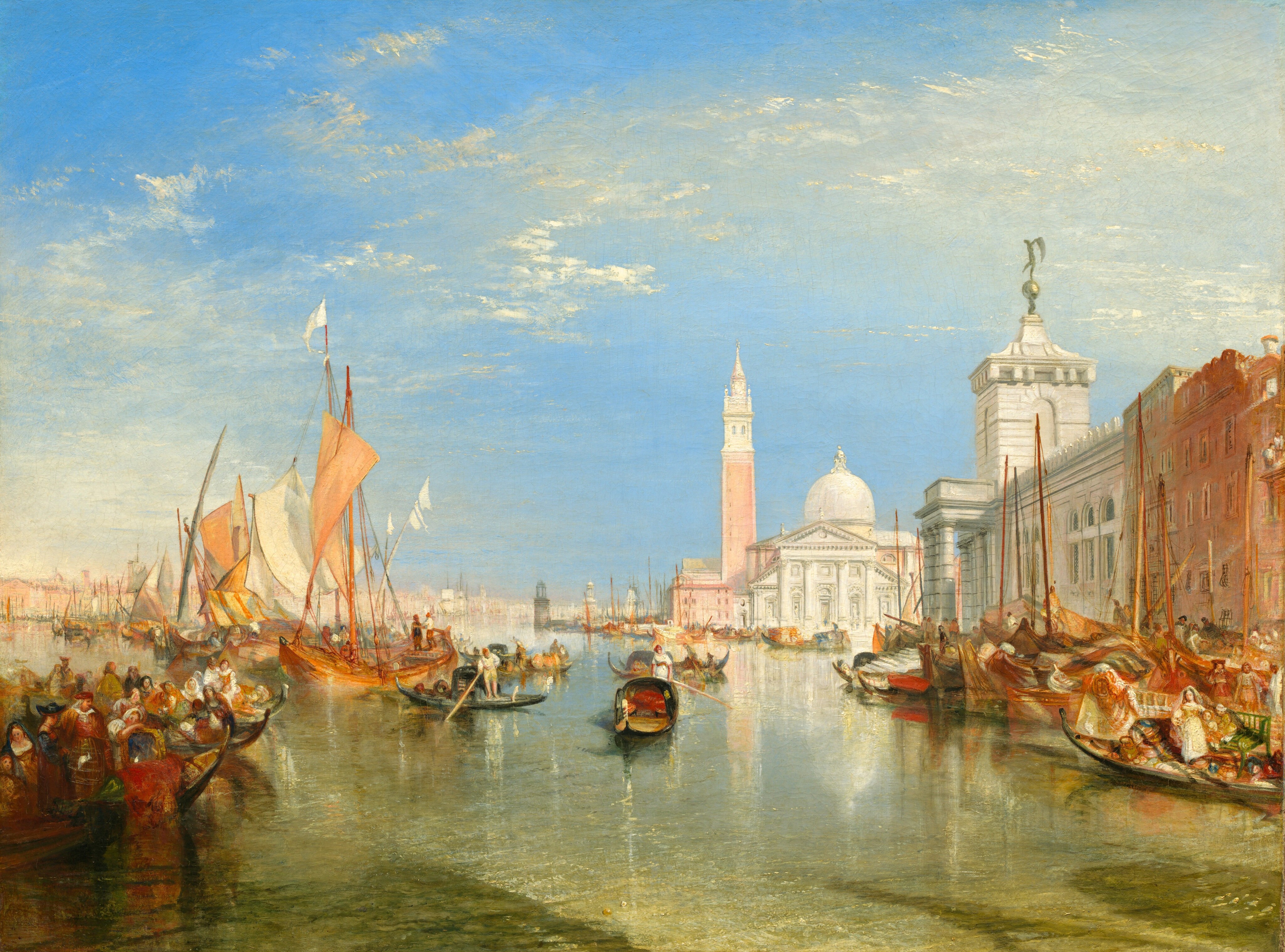
J. M. W. Turner's Venice: The Dogana and San Giorgio Maggiore presents the city through movement. Boats crowd the lower corners, sails rise into the sky, passengers gather in gondolas, goods lie beside them, and an open channel leads towards white architecture. The water is not an empty foreground placed before a famous view. It is Venice's principal means of circulation, the surface across which people, merchandise, reflections and the viewer's attention all travel. Turner makes the city beautiful without making it idle.
The customs house stands at the right, its tower crowned by the globe and revolving figure of Fortune. Beyond it, across the basin, the facade, dome and campanile of San Giorgio Maggiore rise in pale sunlight. These landmarks had different purposes. The Dogana regulated maritime trade at the entrance to the Grand Canal; San Giorgio was a Benedictine church and monastery on its own island. Turner joins them visually across the water, so the painting brings administration, religion, commerce, travel and spectacle into one field.[1][9][10]
The apparent ease of the scene is carefully constructed. Darker and more crowded areas press inward from both lower edges, while the centre opens into a broad lane of calm water. A nearly black gondola sits on that lane with its stern towards the viewer. Farther back, small craft and masts divide the luminous interval into successive distances. The eye is invited forward, yet it cannot proceed without passing between the social and commercial activity on either side. Venice is approached through its traffic.
Light gives that traffic ceremony. The unseen sun lies behind the viewer, casting long shadows and warming white stone, reddish walls, sails and clothing. Thin cloud streaks sweep diagonally over a blue sky that occupies most of the canvas. Their direction continues the lean of masts and sails below, while broken reflections carry architecture downward into the basin. The city does not dissolve as completely as in Turner's later Venetian oils. Its structures remain strongly identifiable, but they are already inseparable from the conditions in which they are seen.[2][5]
This balance helps explain the painting's importance. It belongs neither to a purely documentary tradition nor to the late, almost dematerialised Venice often treated as the whole of Turner's achievement. Made in 1834, it stands at the beginning of his sustained sequence of exhibited Venetian oils. Recognition, invention, patronage and experiment are all active. The picture shows Turner discovering how an exact place could be enlarged into an argument about what made Venice visible and what had made it powerful.
At a Glance
- ArtistJoseph Mallord William Turner
- TitleVenice: The Dogana and San Giorgio Maggiore
- Date1834
- MediumOil on canvas
- Dimensions91.5 × 122 cm
- CollectionNational Gallery of Art, Washington
- Accession1942.9.85
- CreditWidener Collection
- ExhibitedRoyal Academy, 1834, no. 175
- Butlin and JollNo. 356
Contents
- Venice as a Working Harbour
- Object Facts and the Meaning of the Title
- A Composition of Crowds and Open Water
- Afternoon Light and the Painted Basin
- The Dogana and the Turning Fortune
- San Giorgio Maggiore Across the Water
- Observation, Distortion and a View from a Boat
- The Brief Return to Venice in 1833
- Making Luminosity from a White Ground
- Henry McConnel and the Price of Venice
Object Facts and the Meaning of the Title
The National Gallery of Art in Washington, DC, holds the canvas. The Gallery dates it to 1834 and records the medium as oil on canvas. It measures 91.5 by 122 centimetres, bears the accession number 1942.9.85 and forms part of the Widener Collection.[1] Its size is substantial enough for architectural and figure detail, but the low horizon gives more than half of the rectangular surface to sky. Scale serves atmosphere as much as topography.
Turner exhibited the work at the Royal Academy in 1834 as number 175. The catalogue called it simply Venice.[1][8] The present expanded title is useful because it names the two principal landmarks, yet it also changes the emphasis. The original title invited the whole crowded basin to represent the city. The modern one directs attention towards the Dogana and San Giorgio, encouraging a reading built around commerce and architecture. Both frames are valid if neither is allowed to suppress the other.
The work was painted for Henry McConnel, a Manchester cotton manufacturer, and was in his possession from the beginning. It was therefore not among the paintings that entered the British national collection through Turner's bequest. McConnel paid the price Turner set while the canvas was still newly displayed, kept it for fifteen years, and later commissioned Keelmen Heaving in Coals by Moonlight as a companion. The Washington title, Widener credit and American location belong to a much longer history of private ownership and collecting.[1][3]
Clear identification matters because Turner repeatedly painted the same district from changing positions. The National Gallery of Art also owns The Dogana and Santa Maria della Salute, Venice of 1843, a later work centred on a different church and radically different atmospheric handling. Tate holds The Dogano, San Giorgio, Citella, from the Steps of the Europa, exhibited in 1842. Neither is the 1834 McConnel canvas. Similar names preserve Turner's return to a favoured group of landmarks, but they do not make the objects interchangeable.[1][5]
One further correction is necessary. The 1835 Keelmen is signed on a buoy with Turner's initials. The current Venice record displays information about that companion nearby, which can make the detail easy to misassign. No such signature is recorded for the 1834 painting.[1][3] Its authorship rests on secure exhibition, commission and provenance evidence rather than a buoy inscription.
A Composition of Crowds and Open Water
Turner sets the horizon roughly one third of the way up the canvas. This division allows the tall sky to press downward while the water widens towards the viewer. The two zones are joined by masts, campanile, Dogana tower and reflections. Almost every strong vertical either rises out of a boat or descends through mirrored light. The horizontal format consequently feels less like a stable panorama than a field of crossings.
At the far left, the city recedes in a low, pale band. In front of it, numerous masts and sails overlap. One large peach-coloured sail leans towards the centre, supported by a red mast and a white flag. Cream, ochre and muted orange sails form an irregular fan around it. Their warm colour is intensified by the blue surrounding sky. Turner does not render each rope with equal insistence. Some rigging is a fine line, some a dragged mark, and some disappears where light crosses it. The vessels remain credible without becoming a technical inventory.[2][3]
The left foreground is densely inhabited. A black gondola cuts in from the edge, filled with passengers in red, white, blue and dark clothing. Some faces are only small accents; others are sufficiently articulated to suggest conversation and display. A second crowded craft overlaps the first. The proximity of these figures makes them almost confrontational: the spectator seems to have arrived among other waterborne travellers rather than received a distant, privileged view.
The right foreground answers this cluster with another compressed gathering. Boats lie beside the reddish waterfront buildings and Dogana quay. Sails or folded coverings create angular piles of brown, cream and orange. At the extreme lower right, an elegant gondola carries passengers and conspicuous goods. Light fabric, patterned material and green produce or packages turn the boat into a floating display. The National Gallery's educational account reads such cargo as fine textiles and spices, fitting the customs setting and McConnel's interest in commerce.[2][5] The exact contents cannot all be proved, but Turner plainly wanted abundance to be seen.
Between these crowded margins lies a much quieter centre. The nearest dark gondola presents a curved black opening with a warm red interior. It is nearly isolated, its form reflected loosely below. A gondolier farther left stands and pulls across the open lane; smaller craft gather beyond. This interval prevents the picture becoming a continuous decorative frieze. It creates navigable depth and turns the viewer's gaze into another vessel moving through the scene.
The red bale noted in the National Gallery's systematic catalogue appears in a gondola close to the centre. Its concentrated colour acts like a hinge between the red-brown shipping at the edges and the pale buildings beyond.[3] Red recurs in masts, caps, coats, facades and tiny figures, but nowhere else does it occupy such a compact block. The bale is both cargo and compositional device. It makes commerce structurally central without requiring a narrative incident.
San Giorgio forms the principal architectural focus, but Turner avoids placing it on the exact centreline. The campanile rises slightly right of centre, with the facade and dome beside it. The Dogana tower stands farther right and higher in the visual field because it is nearer. This offset arrangement keeps the church from closing the open channel like a stage backdrop. Water continues around it towards the left distance, where sails and buildings fade into haze.
The picture's pleasure comes partly from this distribution of unlike densities. Crowds and cargo accumulate near the viewer; solitary dark forms occupy the centre; architecture becomes clearer in the middle distance; the far city breaks into light. Turner offers many details, but he does not spread them evenly. Looking becomes rhythmic: compression, release, pause, ascent and recession.
Afternoon Light and the Painted Basin
The sun itself is outside the canvas. Its position can be inferred from the bright faces of buildings, the illuminated sails and the long shadows extending towards the viewer. The National Gallery describes the scene as late afternoon, with warm light coming from behind the spectator.[6] By excluding the solar disc, Turner avoids a single obvious centre of radiance. The whole upper-right sky becomes a source, and surfaces throughout the basin answer it differently.
The blue is neither flat nor uniform. It deepens towards the upper left and becomes paler, warmer and more veiled towards the upper right. Fine pale strokes cross it in diagonal groups. Some resemble high cloud; others approach dry-brush notation, allowing the blue underneath to remain active. Near the architecture, the sky is smoother, producing a calm field around the campanile, dome and Fortune. The busiest cloud handling occurs above and away from the landmarks, where it can animate the expanse without obscuring them.[2]
The sails convert atmospheric light into local colour. White fabric becomes ivory, cream, pink or cool grey depending on its angle. The large peach sail at left is bright enough to compete with San Giorgio, yet its irregular edge and surrounding rigging keep it attached to the working foreground. Dark masts crossing pale canvas create sharp accents, while flags dissolve into small strokes against the blue.
Water behaves differently. Close to the lower edge it is greenish brown, grey and subdued gold. Farther back it becomes pale blue, cream and silver. Turner uses this shift to establish distance, but reflections complicate the recession. The Dogana drops a broken vertical of white and grey; San Giorgio produces a pale, elongated echo; sails and reddish buildings scatter warm touches across cooler bands. These reflections do not duplicate objects. They lengthen, interrupt and mingle them.
Long horizontal strokes suggest gentle ripples, while vertical drags give the light downward momentum. The surface seems calm, yet no mark is completely still. A stroke that begins as reflected architecture can end as independent paint. This instability suits a city whose solid appearance depends on water. Buildings are not weakened by their reflections; they acquire a second, mobile presence.
Turner's later Venetian paintings often allow atmosphere to overwhelm edges and scale. Here the negotiation is more equal. Windows, columns, rooflines, masts, figures and cargo can still be located, but the viewer cannot isolate them from glare. The painting therefore belongs to a developing method rather than a crude division between an early detailed Turner and a late formless one. Colour and light already organise space, while description remains abundant.[4][5]
The light also affects time. Shadows indicate that the day is declining, but the crowds have not dispersed and the harbour has not closed. Sails remain raised, gondolas carry passengers, and goods continue to circulate. Turner's afternoon is poised between activity and release. The brightness celebrates Venice while its lateness introduces a historical undertone: splendour can be most compelling when it is about to pass.
The Dogana and the Turning Fortune
The Dogana da Mar occupied the pointed entrance where the Grand Canal meets the Giudecca Canal and the Bacino di San Marco. Its location made architecture serve regulation. Goods entering Venice by sea could be inspected and charged before proceeding into the city's internal waterways. The building's triangular plan follows the narrow wedge of land, so it projects towards the basin like a prow.[10][11]
Turner shows its tower prominently at the right. Two Atlases support a gilded globe, and above the globe stands Fortune with a sail. The figure turns with the wind, combining practical weather vane and political emblem.[10] In a maritime republic, Fortune's command of wind and sea could signify prosperity and reach. Its rotation also made changeability visible. Commercial success depended on forces that no merchant or state could fix.
The National Gallery's account of Francesco Guardi's Dogana views explains the figure as a personification of Venetian supremacy over the Adriatic and records the building's role in the unloading and taxation of cargo.[11] That older view-painting tradition matters to Turner's choice. British collectors already knew the Dogana as both a recognisable landmark and a symbol of Venice's maritime past. Turner could activate those associations without adding an explanatory event.
In the 1834 canvas, Fortune is silhouetted against a pale part of the sky. The small dark sail, globe and supporting forms are legible at a surprising distance. Turner gives the emblem more emphasis than strict scale requires. It is the highest point on the right-hand architecture and almost level with the upper part of San Giorgio's campanile. Trade and church become visual counterparts, each marked by an elevated sign.
The goods and passengers below prevent the Dogana from becoming a funerary monument to vanished power. Merchandise still reaches its threshold, boats still assemble, and the basin remains socially crowded. At the same time, the former republic had lost its political independence before Turner first saw Venice. The image can therefore hold present activity and historical afterglow together. It is not necessary to choose between a living port and a declined empire.
The red and ochre buildings extending to the right of the tower complicate the customs house's white geometry. Some no longer exist or may have been invented to strengthen perspective.[3] Their diagonal recession drives the eye towards San Giorgio and encloses the right side of the basin. Turner uses the Dogana as both historical sign and spatial pivot. Its tower halts the warm waterfront, while its quay releases boats into open water.
McConnel's involvement gives the emblem additional force. A manufacturer whose wealth depended on raw material, mechanised production and wide markets asked Turner for this Venetian view. The Dogana could speak to him through its beauty and through its function. Yet there is no surviving instruction in which McConnel assigns a precise meaning to Fortune, the cargo or the church. The painting's commercial intelligence should not be converted into a diagram dictated by its owner.
San Giorgio Maggiore Across the Water
San Giorgio Maggiore occupies an island facing the central Venetian waterfront. Andrea Palladio designed the monastery church in 1565. Its main construction proceeded from 1565 to 1576, while the present facade was completed between 1607 and 1611, after the architect's death and with changes from his original intentions.[9] Turner therefore paints a structure that was already a layered work of architectural history.
From the basin, its white facade combines temple-like fronts of different scales. Giant columns and pediments organise the central nave and lower aisles, while the dome rises behind. The detached campanile creates a narrow vertical counterweight. Turner records enough of this system for the building to be recognised: triangular pediment, columns, openings, dome, lantern and pink campanile all remain distinct.[2]
He does not render them with archaeological neutrality. The systematic catalogue notes that the cupola should be larger in relation to the dome, and that other spatial proportions are altered.[3] San Giorgio is made to fit the atmospheric and perspectival order of the canvas. Its facade is broad and luminous, its dome comparatively restrained, and its campanile elongated by contrast with the low horizon. The result is more immediately legible across the crowded basin than a mechanically exact transcription might have been.
White stone takes on several colours. The facade includes cool grey, cream and faint rose; the dome carries warmer touches; the campanile shifts from peach at its base towards ivory higher up. Fine dark lines define openings and edges, but they do not form a rigid contour around the building. Light appears to pass through the architecture even while columns and pediment retain mass.
The church also changes the meaning of the water. The open channel is not directed solely towards a market or palace. It leads towards a sacred building whose facade addresses the city from across the basin. Gondolas carrying goods and passengers move under that orientation. Turner does not stage a religious procession, but he allows ordinary circulation to take place within a monumental civic and devotional setting.
Palladio's classical language carried particular importance for British viewers familiar with Palladian architecture at home. San Giorgio could appear simultaneously foreign and foundational to their own architectural culture. Turner capitalises on that familiarity, but his chief transformation is chromatic. The church is not presented as a set of rules. It is an event in afternoon light.
Observation, Distortion and a View from a Boat
An older identification placed the viewpoint on the steps of the Grand Hotel Europa, where Turner stayed during later visits. The National Gallery's systematic catalogue rejects that position because the hotel stood almost directly opposite the Dogana. The relationships among the customs house, San Giorgio and the receding waterfront instead indicate a view from a boat near the south bank of the Grand Canal.[3]
This correction changes how the composition is understood. The viewer does not stand securely on a stone landing while water traffic passes below. The implied position is already afloat, sharing the unstable level of gondolas and cargo vessels. The close boats at both corners are therefore not decorative repoussoir alone. They establish the crowded conditions of seeing from within the basin.
Turner nevertheless refuses the limits of one optical instant. He enlarges the foreground and stretches the extent of the water to accommodate more shipping. The catalogue points out that the actual distance between San Giorgio and the Riva degli Schiavoni is no greater than that between San Giorgio and the Dogana, whereas the painting opens the former into a deep prospect.[3] The geography is adjusted to create a grander harbour.
This adjustment does not erase local knowledge. San Giorgio and the Dogana are generally well described. The direction of the waterfront, the island position of the church, the entrance to the Grand Canal and the pattern of vessels all preserve a coherent Venetian setting. Turner changes intervals and relative scale while protecting recognition. His method resembles the liberties of earlier view painters who rearranged a city to make its characteristic relationships clearer.
Canaletto supplied British collectors with detailed Venetian prospects in which particular places, fair-weather sunlight, quayside life, gondolas and ocean-going vessels were all sharply articulated. The National Gallery of Art notes that English travellers valued such works as vivid recollections of place.[12] Turner's picture responds to this inheritance. It offers the expected landmarks and activity, but it makes aerial colour and the viewer's movement through water more decisive.
Guardi provides a second comparison. His Dogana scenes combine cargo, merchants, small craft, luminous sky and animated brushwork, while allowing figures to merge with their surroundings.[11] Turner intensifies that union. Crowds remain visible, yet they are woven into sails, reflections and paint texture. The city is not emptied of everyday life in order to become poetic. Its poetry comes from the way everyday movement enters light.
The buildings at the far right reveal the boundary between fact and invention. The catalogue observes that they either disappeared or were added for pictorial reasons, since they do not occur in comparable Canaletto views.[3] Turner makes no apology for this uncertainty. Their warm diagonal is needed to counter the sail cluster on the left and to direct recession towards the church. Topography is made answerable to composition.
The painting is consequently truthful in a richer sense than exact measurement. It preserves the experience of being among boats at the bright opening of Venice, where famous structures continually change alignment as a vessel moves. A map fixes distances; Turner's basin stages their visual instability. He paints not only what stands there, but how a waterborne city rearranges itself around a travelling eye.
The Brief Return to Venice in 1833
Turner first reached Venice in 1819 during a larger Italian journey. He stayed only a few days and concentrated on pencil records of buildings, though several exceptional watercolours already explored structures lit from the front or from behind. Colin Harrison estimates that Turner's three Venetian visits of 1819, 1833 and 1840 together amounted to less than four weeks.[4] The scale of the painted achievement is therefore out of proportion to the time spent there.
Before the second journey, Venice entered his public oil painting. His two Venetian exhibits of 1833 included Bridge of Sighs, Ducal Palace and Custom-House, Venice: Canaletti Painting. Press discussion turned that canvas into a supposed contest with Clarkson Stanfield, whose own Venetian view appeared at the Academy. Harrison regards the story that Turner improvised his picture in two or three days after learning of Stanfield's contribution as unlikely, although contemporary reviewers clearly enjoyed the rivalry.[4]
Later that year Turner went back to Venice, financially supported by Hugh Andrew Johnstone Munro of Novar. Munro anticipated that the journey would supply material for a commission. The chronology has not been fixed beyond dispute. The National Gallery catalogue describes a probable ten-day September visit, while noting scholarly reservations about how firmly the surviving evidence proves that reconstruction.[3] Caution is preferable to a false itinerary. What matters is that the stay was brief, purposeful and productive enough to refresh Turner's knowledge.
The 1834 painting was not made for Munro. Henry McConnel was its patron. Munro's support nevertheless helped Turner gather material that could serve other commissions and exhibitions. This distinction reveals how travel studies operated within his practice. A journey undertaken under one patron's encouragement could generate a reservoir of motifs rather than one contractually sealed result.
A coloured study in the Tate collection has often been associated with the Washington oil. Executed in watercolour and gouache over pencil, with touches of red and black chalk on grey paper, it shows the Dogana and San Giorgio with boat groups comparable to those in the canvas. The viewpoint, concentrated light on the church and prominent left sail all make the connection persuasive.[3]
Its date remains problematic. The National Gallery catalogue discussed it as a likely study for the oil but recorded an argument that the grey-paper series belonged to 1840, Turner's third visit. Later institutional listings have allowed circa 1833 or 1840. The sheet can therefore demonstrate how Turner tested the relation of boats, architecture and light, but it cannot securely prove every stage of the 1834 picture's genesis.
That uncertainty is instructive. Turner repeatedly revisited the same Venetian landmarks and could develop old material after new encounters. A study may anticipate an oil, return to its structure or belong to a later re-examination of the same view. The desire for a single preparatory drawing leading neatly to a finished canvas understates the mobility of his memory.
The Washington painting was completed in London for exhibition. Its large finely woven canvas, layered oil technique and carefully orchestrated crowds differ from a portable colour study. Turner did not simply enlarge the grey-paper arrangement square by square. He converted rapid notation into a public spectacle, introducing abundant figures, goods, architectural articulation and a sky broad enough to control the room around it.
Making Luminosity from a White Ground
The National Gallery's 1992 technical account gives unusually precise evidence for the painting's construction. The canvas is finely plain woven and covered by a thick white ground that largely hides the weave. Grey and beige imprimatura appear in some areas above it.[3] This foundation allowed Turner to build both brilliant passages and muted reserves without starting from a uniformly dark support.
The paint ranges from freely handled opaque layers to fluid glazes. Glaze can deepen colour while allowing underlying light to return through it; scumble deposits a lighter, broken veil across the surface. Turner drew, scraped and dragged these layers over one another. The strongest whites are heavily impasted, so luminosity is not only an optical effect. It has physical relief.[3]
This range can be seen across the high-resolution image. The upper-left blue appears comparatively broad and opaque, while pale cloud strokes skip across it. Around San Giorgio, thinner transitions soften the architecture into air. The white facade receives small ridges and accents, whereas distant vessels are compressed into lines. In the foreground, the clothes, cargo and gunwales combine thicker dabs with liquid darks.[2]
Architectural details and rigging were often placed with very thin paint. Turner also scratched into passages with a blunt tool.[3] Incision could recover a line after layers had been laid down, allowing a mast, rope or edge to emerge from colour rather than remain enclosed by preliminary drawing. The method helps explain why the picture feels both exact and improvisatory. Precision was inserted, removed and reasserted during painting.
Water required all these approaches at once. Thin horizontal strokes establish calm distance; vertical drags pull reflections towards the foreground; opaque pale touches break the surface; warm transparent colour allows darker layers to remain visible. The basin is the most technically various part of the canvas because it must receive every other element without becoming a mirror polished to stillness.
The historical condition record also demands care. The canvas was lined in 1971. The catalogue noted abrasion in thinner paint, extensive craquelure, retouching mainly along edges and over cracks, and substantial residue from an earlier natural-resin varnish that had yellowed beneath a dammar varnish applied in 1971.[3] These observations describe the painting as examined for the 1992 publication. They are not a substitute for a current conservation assessment.
Yellowed varnish and abrasion can affect how present viewers judge Turner's original balance of cool and warm colour. It would be unsafe, however, to assign every greenish or golden passage to alteration. The artist deliberately used beige preparation, warm glazes, cream impasto and coloured reflections. Material history complicates perception without nullifying intentional colour.
The technique also resists the notion that the picture is a transparent atmospheric effect laid down in one inspired rush. Its apparent freshness depends on sequence: ground, imprimatura, opaque colour, glaze, scumble, dragging, scraping, incision and impasto. Turner made spontaneity through revision.
Henry McConnel and the Price of Venice
Henry McConnel belonged to a major Manchester cotton-spinning family. McConnel and Kennedy had been established in 1795, became one of the city's leading manufacturing concerns and adopted steam power and gas lighting early. By 1816 it employed more than a thousand people. Henry entered the partnership after John Kennedy's retirement in 1826, and the firm became McConnel & Co.[14][15]
Such facts matter because the painting makes trade visible. McConnel's wealth came from mechanised production, raw cotton, labour, transport and markets. In Turner's Venice he acquired an image organised around a customs house, imported goods and water traffic. The subject joined aesthetic possession to the economic systems that made possession possible.
McConnel later stated that the picture was painted at his “especial suggestion.” He was correcting Walter Thornbury's colourful account of Turner deciding how much to charge after observing the buyer's enthusiasm. According to McConnel, he paid Turner's fixed price of 350 pounds without hesitation before the work had hung at the Royal Academy for a week.[3] His testimony replaces anecdotal bargaining with advance interest and prompt purchase.
The sum was significant. It demonstrates that the canvas was not a speculative studio experiment awaiting an uncertain buyer. Turner knew both subject and patron while completing it. At the same time, McConnel's phrase does not tell us exactly what he suggested. It may refer to the Venetian prospect, its commercial associations, or the picture as a whole. No detailed instructions survive.
The distinction limits interpretation responsibly. The goods, Dogana and Fortune make commercial meaning unavoidable; McConnel's background sharpens it. Yet Turner retained control of viewpoint, expanded geography, crowding, light and historical resonance. Patron and painter brought different knowledge to the commission. McConnel understood industrial and mercantile wealth from within; Turner understood how a harbour image could join contemporary commerce to the memory of an older maritime power.
The commission also refutes a hostile story circulated during the 1834 exhibition. The Morning Chronicle alleged that Turner had produced his Venice out of spite because the Marquess of Lansdowne gave a commission to Clarkson Stanfield instead. McConnel's prior involvement makes that explanation untenable.[3] Rivalry may have influenced how critics compared the artists, but it cannot account for the painting's origin.
Turner's price did not prevent McConnel from becoming attached to the work. He later ordered the 1835 companion and kept both until business difficulties led to their sale in 1849. In 1861 he tried to recover at least one from John Naylor, admitting his continuing longing for the Turners.[1][3] The failed attempt suggests that the original transaction was more than a fashionable acquisition. The pair had become central to how he imagined his collection.
The Royal Academy and the 1834 Critics
The Royal Academy exhibition opened at Somerset House on 5 May 1834 and ran until 19 July. It contained 1,121 works by 556 artists.[7] Turner's Venice, numbered 175, competed for attention in a dense display of portraits, histories, landscapes, sculpture and architecture. Its large blue sky, warm sails and brilliant white buildings would have operated from a distance before the foreground details became legible.
The year generated exceptional written criticism. The Royal Academy Chronicle notes that the Athenaeum alone published three instalments amounting to almost six thousand words, while other newspapers and periodicals also examined individual works at length.[7] Viewers could encounter Turner's painting through reviews even if they never entered Somerset House. Its public identity was formed by prose, gossip and comparison as well as direct sight.
London reception mixed admiration with suspicion. The alleged dispute with Stanfield supplied an easy story about professional jealousy. It continued an argument already attached to Turner's Venetian contribution of 1833.[3][4] Such narratives made artistic production resemble a contest decided under exhibition pressure. They also underestimated the documented patronage behind the 1834 work.
Even the hostile Morning Chronicle called Venice Turner's best contribution to the Academy that year.[3] The reluctant praise is revealing. A critic might object to his motives or manner while conceding the picture's dominance within his display. The painting's high colour, legible landmarks and active foreground offered more conventional points of entry than some later works, without sacrificing atmospheric experiment.
After London, McConnel sent the picture to the Royal Manchester Institution, where it appeared as number 53.[1] In the city of its owner, the response became rapturous. The Manchester Guardian described spectators standing transfixed before Turner's sunshine, colour, transparency and poetry. The Manchester Courier praised the ability to employ colours that approached glare yet remained harmonious and dazzling rather than offensive.[3]
These reactions show that brilliance was not simply a later discovery. Contemporary reviewers understood colour as the painting's principal force. They also connected that force with recognisable Venice. Transparency, water and sun were praised because they made a known city newly intense, not because the subject had disappeared.
The Manchester setting added another layer. Industrial wealth had helped sustain the Institution and many of its collectors. McConnel's canvas showed an older mercantile capital to an audience living amid the expansion of British manufacturing. Its crowded goods and customs emblem could be admired as picturesque Venetian detail while also prompting comparison with the systems that financed local collections.
The work's favourable press should not be turned into unanimity. Turner's colour could be called glaring; rivalry stories questioned his motives; the distortions of his Venetian settings remained available to critics who valued stricter topography. What the 1834 record proves is not universal approval but sustained attention. The painting could not be dismissed as a vague late eccentricity. It was a commissioned, prominently exhibited and immediately debated success.
The Companion: Keelmen Heaving in Coals by Moonlight
In 1835 McConnel asked Turner for a companion painting. The result was Keelmen Heaving in Coals by Moonlight, now accession 1942.9.86 at the National Gallery of Art. The canvases are nearly identical in scale and share a broad waterway receding between concentrated masses at the sides. Their visual conditions, however, are deliberately opposed.[1][6]
Venice is lit by an unseen afternoon sun. Its sky is blue, its cloud pale and its architecture white or warm. The water is relatively smooth, passengers sit among brightly coloured goods, and sails catch a gentle light. Keelmen is a smoky night scene on the Tyne. Moon, braziers and industrial flame divide the darkness; workers shovel coal among heavy vessels, timber and masts. One picture makes commerce elegant and sociable, the other makes its labour bodily and dangerous.[6]
The opposition is powerful but incomplete. Venice is not free of work. Cargo, rigging, boat handling and customs regulation fill the canvas. Nor is Tyneside denied beauty. Moonlight, reflection and the glowing arch of cloud make Keelmen one of Turner's most compelling nocturnes. The pair does not sort beauty into Italy and labour into Britain. It reveals different forms through which trade becomes visible.
The National Gallery suggests that Turner may have contrasted Venice's declining maritime influence with Britain's rising power in trade and manufacture.[6] Its educational publication likewise treats the two paintings as a comparison between great commercial powers.[5] This reading is persuasive because the Dogana and cargo make the Venetian economy explicit, while coal and shipping drive the English scene. McConnel's own fortune connects the comparison to industrial patronage.
Yet no surviving statement by Turner sets out a complete allegory. The pair was not labelled “decline” and “progress.” Venice remains crowded and active; Tyneside is veiled in pollution and nocturnal uncertainty. If Britain succeeds Venice, it does so under conditions that expose labour, smoke, energy consumption and technological disruption. Succession is neither simple triumph nor inevitable moral improvement.
Recent scholarship has pushed the comparison further by examining the keelmen's collective identity, resistance to mechanisation and the industrial position of the patron. Caterina Franciosi argues that Keelmen can be understood within a fossil-fuel economy in which workers were both essential and threatened.[16] Seen beside Venice, this interpretation shifts attention from abstract national power to the people and materials supporting it.
The 1834 canvas contributes to that discussion in quieter ways. Its foreground figures are more finely dressed and less visibly exerted, but they remain embedded in commodity movement. The patterned fabrics and packages at the right transform a gondola into a display of consumption. The Dogana regulates entry; Fortune presides; a manufacturer owns the result. Labour is less explicit than in Keelmen, not absent from the commercial world the picture constructs.
Lighting creates another historical contrast. Venice's sun is behind the viewer, so its source cannot be possessed within the scene. The Tyne's moon and fires are visible, competing illuminants generated by nature and industry. In the former, coloured surfaces receive radiance; in the latter, light struggles through smoke. Turner makes two economic atmospheres rather than adding commerce as a detachable theme.
The pair also reverses conventional prestige. A Venetian prospect associated with Palladio, old-master view painting and Grand Tour culture would have suited a collector's drawing room. Coal handling was a contemporary working subject without the same inherited status. By matching their dimensions and ownership, Turner made industrial labour demand the same scale of attention as a celebrated Italian city.
McConnel paid 350 pounds for Venice and 300 for Keelmen.[3] The difference may reflect subject, timing or negotiation, but it should not be treated as a simple ranking of artistic worth. Together the pictures became more meaningful than either price. They allowed an industrial collector to place his world beside an older commercial civilisation and to encounter both through Turner's manipulation of light.
Ownership, Condition and Changing Contexts
McConnel sold both paintings in 1849 to John Naylor of Leighton Hall near Liverpool. They passed to Naylor's wife, Georgiana. In 1910 the Venice was purchased through Dyer and Sons by Thomas Agnew & Sons, entered joint ownership with Arthur J. Sulley & Co., and was bought on 13 June by Peter A. B. Widener of Elkins Park, Pennsylvania.[1][3]
The Widener family assembled a collection of major European art at Lynnewood Hall. The painting passed through Peter Widener's estate by a power of appointment exercised by Joseph E. Widener. It entered the National Gallery of Art with the Widener Collection in 1942.[1] Its American museum history therefore emerged from the same private-market mobility that had taken it from an industrial Manchester patron to a Liverpool collection and London dealers.
The canvas and Keelmen ultimately remained together. Their present proximity allows the commission's paired logic to be recovered more directly than if the works had entered separate collections. Current interpretation can test afternoon against moonlight, gondola passengers against coal workers and the Dogana against the industrial Tyne without relying solely on reproduction.[6]
The picture has also travelled in temporary exhibitions. It appeared in the Royal Manchester Institution display immediately after the Academy and at a Liverpool civic gathering in 1854. Later exhibitions placed it within Turner's career, the mythology of Venice, late seascapes, maritime painting and modernity. It was included in Turner and Venice in 2003-04, Turner & the Sea in 2013-14 and Turner's Modern World in Boston in 2022.[1][13]
Each context changes the questions asked. A Venice exhibition stresses repeated landmarks and the development of colour; a maritime exhibition brings vessels, cargo and waterborne viewing forward; a modern-world exhibition highlights commerce, industrial patronage and the relationship to Keelmen. The painting supports all three because it is neither only a city view nor only a commercial allegory.
Material condition adds a less visible history. Lining, varnish, abrasion, craquelure and retouching affect the surface through which Turner's decisions are now seen.[3] Conservation has enabled the canvas to survive, but it also means the current object is not materially identical to the one displayed in 1834. Responsible looking distinguishes this history from claims about the artist's intention.
The absence of a direct line into the Turner Bequest is also important. The work's status was made through purchase, resale, regret, dealing, inheritance and gift. Its subject is the circulation of people and commodities; its own history is one of circulation among collectors and institutions. That parallel is not an allegory Turner planned, but it has become part of what the painting means.
Why Venice: The Dogana and San Giorgio Maggiore Matters
The painting matters because it makes atmosphere carry information rather than erase it. Light reveals the afternoon, the breadth of the basin, the surfaces of sails, the whiteness of Palladian architecture, the cargo in gondolas and the change of distance. At the same time, glare loosens outlines and lets reflections mix institutions with water. Turner turns visibility itself into the subject while keeping Venice specific.
Its geography demonstrates imaginative topography at a high level. The basin is widened, some proportions are adjusted, and the implied position is mobile. These changes do not produce a generic fantasy. They clarify the experience of entering a harbour dense with famous structures and moving craft. Turner understands that a waterborne view is never fixed long enough to behave like an architectural elevation.
The Dogana gives beauty an economic centre. Fortune, globe, customs threshold, cargo and passengers recall the maritime systems on which Venice depended. San Giorgio supplies an architectural and spiritual counterweight, though the two are not presented as enemies. Trade and religion share the same light because both belong to the city's visible history.
McConnel's commission brings nineteenth-century Britain into that history. A Manchester manufacturer bought an image of Venetian commerce, then asked for a northern coal scene to accompany it. The resulting pair crosses time and geography: former republic and industrial nation, Mediterranean afternoon and English night, imported luxury and fuel, leisure and exertion. Its meanings remain open because Turner avoids a simple verdict.
The 1834 reviews recognised the canvas's immediate power. Critics disagreed over rivalry, brilliance and excess, but the strongest responses fixed on sunshine, transparency, harmony and dazzling colour.[3] Later admiration did not invent those qualities. What changed was the language used to connect them with modern painting, industrial history and the instability of empire.
Turner's technique is essential to the argument. Thick white ground, glaze, scumble, dragged paint, scratching and impasto make air and water materially complex. The picture does not float free of its canvas. Its radiance is built, layered and revised. Even the apparently weightless cloud marks depend on resistance between pale paint and the blue beneath.
At the centre, the dark gondola continues forward across the open lane. It is modest beside the crowded corners and brilliant architecture, yet it gives the composition its human direction. The viewer follows it towards San Giorgio while passing the Dogana and the commerce it governs. Turner does not offer Venice as a static possession. He offers the city as a passage through work, wealth, history and light.
Discussion
How does Turner keep harbour work, architecture, sociability and atmosphere active within one luminous basin?
Reader Insights
How do crowded corners and open central water guide the viewer through the harbour?
What different meanings do the Dogana and San Giorgio bring across the water?
How does the afternoon Venice canvas change beside the nocturnal Keelmen companion?
Join the Conversation
Share a close observation or a source-based question for other readers.
References
- National Gallery of Art, [*Venice: The Dogana and San Giorgio Maggiore*](https://www.nga.gov/artworks/1224-venice-dogana-and-san-giorgio-maggiore), 1942.9.85.
- National Gallery of Art, [public-domain high-resolution image of *Venice: The Dogana and San Giorgio Maggiore*](https://api.nga.gov/iiif/e69c25bb-f772-4ac2-966f-2954eb420a84/full/full/0/default.jpg).
- John Hayes, [*British Paintings of the Sixteenth through Nineteenth Centuries*](https://www.nga.gov/content/dam/ngaweb/research/publications/pdfs/british-paintings-16th-19th-centuries.pdf), National Gallery of Art, 1992, pp. 274-277.
- Colin Harrison, [“Turner's Paintings of Venice”](https://ora.ox.ac.uk/objects/uuid:83e230f9-3d9e-454f-a797-3ad6b7826054/files/sh702q7860), University of Oxford.
- National Gallery of Art, [*An Eye for Art: Joseph Mallord William Turner*](https://www.nga.gov/content/dam/ngaweb/Education/learning-resources/an-eye-for-art/AnEyeforArt-JosephMallordWilliamTurner.pdf).
- National Gallery of Art, [“Sublime Light: J. M. W. Turner's Keelmen”](https://www.nga.gov/stories/articles/sublime-light-jmw-turner-keelmen).
- Royal Academy and Paul Mellon Centre, [1834 Summer Exhibition Chronicle](https://chronicle250.com/1834).
- [*Venice Pictures in the Royal Academy between 1834 and 1837*](https://file.artbutler.com/abx/prod/a44a1abd-4d1d-47c3-9eb5-47ba4ba65340/d9442043-54ea-458a-a956-9232c33f1ce7/98048a70-9f6b-4473-9748-3886afe262ff.pdf).
- Palladio Museum, [*Chiesa del monastero San Giorgio Maggiore, Venezia*](https://mediateca.palladiomuseum.org/palladio/opera.php?id=34).
- Pinault Collection, [Punta della Dogana](https://www.pinaultcollection.com/palazzograssi/it/punta-della-dogana).
- National Gallery, London, [Francesco Guardi, *Venice: The Punta della Dogana*](https://www.nationalgallery.org.uk/paintings/francesco-guardi-venice-the-punta-della-dogana), NG2098.
- National Gallery of Art, [Canaletto, *Entrance to the Grand Canal from the Molo, Venice*](https://www.nga.gov/artworks/32589-entrance-grand-canal-molo-venice), 1945.15.4.
- Museum of Fine Arts Boston, [*Turner's Modern World*](https://www.mfa.org/exhibition/turners-modern-world).
- Science Museum Group, [McConnel & Co.](https://collection.sciencemuseumgroup.org.uk/people/ap13770/mcconnel-co).
- University of Manchester Library, [McConnel and Kennedy Archive](https://www.library.manchester.ac.uk/rylands/special-collections/a-to-z/detail/?mms_id=992983876603001631).
- Caterina Franciosi, [“Turner and the Keelmen: Landscapes of Labour and Resistance in the Fossil Economy”](https://doi.org/10.1093/arthis/ulag007), *Art History* 49.1, 2026.