 by Tom Gurney
Tom Gurney BSc (Hons) is an art history expert with over 20 years experience
Published on June 19, 2020 / Updated on August 29, 2026
Email: tomgurney1@gmail.com / Phone: +44 7429 011000
Coal, Moonlight and Work
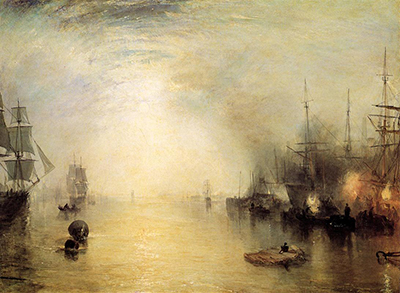
J. M. W. Turner's Keelmen Heaving in Coals by Moonlight appears at first to offer stillness. A full moon shines through cloud left of centre. Its reflection opens a pale road across calm water, and ships seem to wait in an immense blue-grey atmosphere. Yet the painting's right side tells another story. There, flames burn behind smoke, masts crowd together, hulls become a near-black wall, and labourers move coal between vessels. The river is quiet only where work is distant from view.
Turner painted this modern industrial nocturne in 1835. It is an oil on canvas measuring 92.3 by 122.8 centimetres, now in the National Gallery of Art, Washington, as part of the Widener Collection. The accession number is 1942.9.86, and Turner placed his initials on a buoy in the lower left. He exhibited it as number 24 at the Royal Academy in London and later that year as number 260 at the Royal Manchester Institution.[1]
The National Gallery's current title ends by Moonlight. The established alternative Keelmen Heaving in Coals by Night, used in earlier exhibition records and retained in the work's familiar address, refers to the same canvas.[1] Moonlight is the more revealing phrase because it identifies more than the hour. It names one half of a visual contest. Cool light spreads through sky and water; hot light flares beside working bodies. One source seems natural, remote and continuous, the other manufactured, local and consumed as quickly as fuel.
The men are keelmen, specialist river workers who carried coal down the Tyne in broad, shallow craft called keels. Coal from the north-eastern coalfield travelled by wagonway to riverside staiths, then by keel toward larger seagoing colliers, many supplying London. At Shields, cargo had to be transferred under the pressure of tide and sailing time. The National Gallery explains that loading continued through the night so vessels could leave with the morning tide.[2][3]
Turner did not paint an incidental riverside task. He painted an operation connecting pit, railway, river, sea, metropolis, factory and household fire. Coal powered the engines transforming Britain, but those engines also threatened the workers represented here. Direct-loading equipment and steam towage were making parts of the keelmen's role unnecessary. In the years between Turner's first Tyneside visit and this commission, the men had responded through petitions, strikes, obstruction and legal action. Their silhouettes therefore belong to two histories at once: the ascent of coal-powered Britain and the weakening of an organised labouring community that had helped make the trade possible.[5][7]
At a Glance
- ArtistJoseph Mallord William Turner
- TitleKeelmen Heaving in Coals by Moonlight
- Alternative titleKeelmen Heaving in Coals by Night
- Date1835
- MediumOil on canvas
- Dimensions92.3 × 122.8 cm
- CollectionNational Gallery of Art, Washington
- Accession1942.9.86
- CreditWidener Collection
- Commissioned byHenry McConnel
- *Artist: Joseph Mallord William Turner (1775-1851) - Current title: Keelmen Heaving in Coals by Moonlight - Alternative title: Keelmen Heaving in Coals by Night - Date: 1835 - Medium: Oil on canvas - Dimensions: 92.3 x 122.8 cm - Collection: National Gallery of Art, Washington - Credit: Widener Collection - Accession: 1942.9.86 - Inscription: `JMWT` on the buoy at lower left - First exhibition: Royal Academy, London, 1835, no. 24 - Patron: Henry McConnel - Companion painting: Venice: The Dogana and San Giorgio Maggiore*, 1834
The canvas was commissioned by the Manchester cotton manufacturer Henry McConnel as a companion to a Venetian view he already owned.[1][16] The pairing is indispensable. Turner opposed a bright afternoon of graceful leisure in a city associated with past commercial greatness to a smoky English night driven by contemporary labour. Yet Keelmen is not simply the dark half of an easy comparison. Its moon is more commanding than the hidden Venetian sun, and its workers generate an intensity that the languid gondola passengers do not possess.[2]
Contents
- Coal, Moonlight and Work
- At a Glance
- Reading the River
- How Coal Moved Down the Tyne
- A Skilled and Organised Workforce
- Mechanisation and the Long Stop
- Turner on Tyneside, 1818 to 1823
- From Claudean Harbour to Industrial Port
- Two Kinds of Light
- Henry McConnel and the Venetian Pendant
Reading the River
The horizon lies low, roughly one third of the way up the canvas, leaving the sky unusually expansive. Turner positions the moon left of centre rather than on the central axis. Cloud gathers around it in a broad, tunnel-like halo. Below, its reflection widens as it approaches the foreground, making the river seem open, deep and almost metallic. Brightness does not describe every ripple separately. It dissolves water into layers of pearl, silver, blue and pale yellow.[1][4]
Ships frame that luminous corridor. On the far left, a large vessel is cropped by the edge; another square-rigged ship stands just inside it, its grey sails crossing the sky. A smaller craft sits farther back, and a dark rowboat carrying two people interrupts the water below. The sequence creates depth without relying on a rigid perspective grid. Each vessel marks another interval between the spectator and the distant horizon.
The right side is radically denser. Tall masts and rigging rise through smoke, while the nearest hull forms a dark mass against three fires. One flame is orange-red and diffuse; two are more concentrated yellow lights. Human figures appear and vanish around them. Some stand upright, some bend, and others merge with boats, coal and shadow. The National Gallery identifies men shovelling among barges and cargo, but the high-resolution image does not allow every gesture or object to be named with certainty.[1][4]
This difference in legibility is meaningful. Turner gives the moon a clear disc and an immense field of reflection, but the labourers who sustain the coal economy are visually difficult to separate from its machinery and waste. They are not omitted. Their repeated silhouettes make the right bank pulse with activity. Yet no single worker becomes a portrait or hero. Bodies register as a collective force under conditions that obscure individuality.
The centre remains relatively empty. A distant ship occupies the horizon, but the open water functions almost like a passage through the painting. The eye can travel from the foreground reflection toward the moon without entering the smoky work zone. That ease is seductive. Turner allows viewers to enjoy a luminous harbour before making them recognise what generates its dark, fiery counterweight.
The horizon adds another contradiction. It is low enough to make the heavens dominant, yet it is crowded with minute evidence of habitation: points of light, chimneys, spars and structures extend across the distance. A white flame appears to issue from a chimney left of the moonlit opening. On the right, smoke thickens upward until industrial emission can no longer be cleanly distinguished from weather. Turner does not place a pristine sky above a polluted river. He paints one atmosphere receiving light, vapour and combustion together.[1][4]
Scale changes sharply across the foreground. The buoy seems enormous beside distant buildings, while the nearest timber projects into the spectator's space. Keelmen at the right are smaller than these floating objects even though they carry the human meaning of the title. This is not carelessness about proportion. It makes viewing contingent upon position: what lies near can dominate optically, while socially consequential activity becomes compressed by distance. The spectator is placed on water, not safely above the harbour, and must assemble the scene from partial bearings.
Small foreground objects prevent the scene from floating entirely into dream. The initialled buoy at lower left has a blunt circular weight. A second reddish buoy sits nearby. At lower right, a broad plank or raft-like fragment drifts close to the spectator, and a dark iron ring or chain enters at the extreme corner. Such objects give the water scale and physical occupancy. They also suggest a working river full of moorings, debris and obstacles rather than an untouched marine expanse.[1][4]
The setting is the lower Tyne between North and South Shields, downriver from Newcastle. The exact arrangement is poetic rather than a dependable chart. Turner compressed a working port into an image governed by light, recession and contrast. Distant buildings and a chimney are visible, but no secure evidence permits every structure or vessel to be assigned a precise identity.[2]
How Coal Moved Down the Tyne
The keelmen occupied a crucial stage in a much longer transport system. Coal was extracted from inland pits and brought by wagonway to staiths along the Tyne. An off-putter employed by the coal owner supervised loading at the riverbank. Rowe's study of the occupation records that a customary keel carried a crew of three men and a boy and was supplied by the fitter or colliery under an annual bond. The men were paid at piece rates for each delivery rather than receiving a stable wage independent of conditions.[8]
The fitter connected colliery production with buyers and shipping, while the keel crew converted commercial orders into difficult river movement. Loading a measured quantity mattered because payment, safety and the reputation of coal in distant markets all depended upon it. Arguments over the customary eight-chaldron load were therefore not obscure ritual. They concerned how much risk owners could transfer onto a low craft and the bodies controlling it. The boy's presence also shows that occupational knowledge was reproduced within crews rather than supplied by machinery alone.[8]
Keels were broad, shallow and capacious. Their form suited reaches that were difficult for deeply laden seagoing vessels, especially before major improvements to the river. Crews moved coal downstream to the harbour at Shields, where it could be transferred to colliers. The work demanded intimate knowledge of tides, channels, congestion and weather. A heavily loaded craft did not become easy to manage because the water appears calm in Turner's painting.
Payment by tide or journey transferred risk to the crew. If bad weather prevented movement, the men did not earn. During depressed trading conditions they could spend long periods without sufficient employment, while excessive loading exposed keels to greater danger in strong currents or storms.[8] Night work introduced another set of hazards. Fires made handling possible, but smoke, glare and deep shadow complicated vision among rigging, hulls and moving boats.
At Shields, the cargo had to move again. Turner concentrates on the physically demanding transfer from low keels into much larger ships. The title's word heaving conveys collective exertion rather than passive carriage. The figures bend, lift and shovel in groups, their work paced by cargo volume and departure time. The National Gallery's educational account describes the operation as preparation for colliers leaving down the coast toward London with the morning tide.[3][21]
The height difference between craft explains much of the toil. A keel sat low in the water under its mineral load, while the receiving collier's deck and hold belonged to a larger structure. Coal had to cross that vertical gap without paralysing movement around neighbouring vessels. Turner's painting does not diagram every basket, shovel or stage. Instead, repeated diagonals at the firelit edge - bent backs, poles, planks and rigging - translate transfer into a continuous upward pressure.
London's dependence gave Tyneside coal national importance. The capital burned enormous quantities for domestic heat and industrial production, while coal also fed mills, steamships, locomotives and factories. Interruption on the Tyne could affect prices and supply far beyond the north-east. This gave keelmen economic leverage. Their labour was physically subordinate within the ownership structure, but strategically powerful because stopping it could constrict the entire chain.
Turner's moon therefore illuminates more than a harbour. It reveals infrastructure before the term acquired its modern familiarity: linked human, mineral, mechanical and maritime systems that usually remained outside the metropolitan consumer's sight. The painting brings the night shift of energy distribution into the Academy, where industrial work competed with portraiture, history and ideal landscape for public attention.
A Skilled and Organised Workforce
The keelmen were neither an unstructured crowd nor a newly assembled factory labour force. Their occupation had generated enduring customs, neighbourhoods and collective institutions. They were bound annually to fitters, worked in crews and defended agreed measures, allowances and working conditions. Their ability to act together was documented from the seventeenth century onward.[7][8]
Their Keelmen's Hospital remains material evidence of that community. Built in Newcastle in 1701, it provided almshouses for poor keelmen and keelmen's widows. Historic England records that the workers themselves paid for it; the building is now protected at Grade II*.[9] A statutory levy on coal carried by keel helped sustain the charity. When more coal moved by direct-loading equipment that did not contribute the same levy, technological change endangered collective welfare as well as individual earnings.[8]
Mutual provision also complicates stereotypes repeated by hostile authorities. Magistrates often described keelmen as turbulent, and conflicts could involve intimidation or obstruction. Yet an institution maintained across generations demonstrates planning beyond an immediate stoppage. Workers collectively addressed age, injury, poverty and bereavement in an occupation exposed to irregular earnings and physical danger. The hospital makes visible a social structure that Turner's anonymous silhouettes alone cannot explain.[7][9]
The occupation's strategic position made collective action unusually effective. In 1809, amid wartime inflation, keelmen petitioned for higher payment per tide and compensation for losses caused by weather. They argued that their rates had failed to keep pace with food and other necessities. A stoppage followed when negotiation failed. The conflict involved warrants, constables and preparations for military intervention, evidence that the authorities understood a halt in coal movement as a threat to public order and commerce.[8]
In 1819, unemployment and mechanisation became central grievances. Spouts and the newer coal drop enabled some vessels to load directly at staiths, reducing the proportion carried by keel. Workers asked that colliers receive only a limited quantity in this manner and take the remainder from keels. They also objected to overloading and to the damage direct shipment caused the hospital fund. Local newspapers defended machinery and freedom of trade, casting the men's demand as an attempt to preserve expensive manual labour.[8]
That language is important for Turner's later painting. The men at the right are often described as survivals within an advancing industrial order, but they were themselves part of a sophisticated transport economy. The conflict was not manual tradition against all innovation. It concerned who bore the cost when owners adopted methods that increased speed or reduced labour. A spout could appear as efficient engineering to a coal owner and as unemployment to a keel crew.
Nor should Turner's reduced figures be read as proof of passivity. Recent scholarship has returned agency to these bodies. Caterina Franciosi argues that communal work practices enabled resistance and that Turner's two Tyneside compositions register both organisation and dispossession.[5] The workers' visibility is unstable, but their concentrated activity unsettles the painting's quiet left side. They remain the source of its hottest light, thickest darkness and greatest density.
Mechanisation and the Long Stop
Turner visited Tyneside in 1818, as direct loading and steam power were altering the river. Spouts had initially helped fill keels, but colliers increasingly came to staiths and received coal without the same downstream carriage. Steam tugs enabled larger ships to move farther along the Tyne. Fifteen such tugs entered service between 1814 and 1822, according to Fewster's occupational history.[7] Rail connections and coal drops added further pressure.
The most sustained confrontation came four years after Turner's visit. On 1 October 1822, many keelmen working above Newcastle Bridge stopped and obstructed crews attempting to depart. The action spread rapidly; by the following morning the wider workforce had joined. Their petition placed unemployment first, asking that no more than six keel-loads be put into a ship by spout until work improved. They also sought restoration of traditional payments and allowances.[7]
The earnings evidence explains the urgency. In one relatively busy above-bridge concern, weekly wages during 1822 averaged only fourteen or fifteen shillings. Below the bridge, many earned seven or eight shillings, while another informed estimate placed typical income there between ten and twelve. These were averages under irregular conditions, not guaranteed weekly wages. The petitioners argued that families lacked necessities and faced further decline.[7]
Magistrates met representatives of labour and the coal trade, but neither discussion nor orders immediately ended the stoppage. The authorities mobilised constables and troops, while owners sought substitute crews and mechanical means of moving cargo. Contemporary reports describe military protection for vessels and the use of a steam-powered craft in breaking resistance. The stoppage lasted about ten weeks before work resumed.[7]
The Long Stop did not halt technological change. Keelmen pursued legal remedies against direct-loading structures, but spouts and drops continued to reduce demand during the following eight years. At Wallsend staiths, where sixty keelmen had once worked, only twenty-four remained by 1828. By 1842 scarcely any keels were employed there. The pattern varied along the river, so this was erosion rather than sudden disappearance.[7]
Direct loading changed geography as well as employment. Wherever a collier could reach a staith and receive coal from above, the downstream journey in a keel became avoidable. Steam towage extended that possibility by helping larger ships negotiate parts of the river formerly reserved to shallow craft. Owners could see fewer transfers, lower handling costs and faster shipment. Keelmen saw the removal of the very stage on which their inherited knowledge had economic value. Both descriptions concern efficiency, but they distribute its benefits and injuries differently.
Demand for coal could temporarily conceal displacement. Expanding output meant that old and new methods overlapped, and some crews continued to find work even as their share declined. This helps explain why Turner's 1835 harbour can appear intensely active without contradicting the history of occupational contraction. A threatened system does not look empty at every moment; it may look busiest while older labour and new capacity coexist.[7]
When Turner painted the oil in 1835, viewers familiar with the Tyne coal trade could therefore have understood the workers as economically necessary yet increasingly vulnerable. They load large sailing ships in an operation already being bypassed elsewhere. Their firelit intensity may signify productivity, but it also makes visible labour whose future is narrowing.
Franciosi reads the painting as invoking the keelmen's dissolution while insisting on the working body's disruptive force.[5] That formulation respects the canvas's tension. Turner does not show a strike, soldiers or a steam tug defeating workers. He gives no explicit political verdict. Yet a historically informed spectator can see that the figures are neither timeless harbour types nor neutral accessories. Their crowded position condenses a conflict between embodied knowledge and fossil-fuelled mechanisms designed to reduce dependence on it.
Turner on Tyneside, 1818 to 1823
Turner's relation to the subject began with travel. In 1818 he visited Newcastle, North Shields and South Shields during a northern journey. He observed the coal district seventeen years before completing the Washington canvas.[3][6] That interval matters. The oil was not a journalistic record painted beside the river in 1835; it was a studio reconstruction drawing upon travel, an earlier finished watercolour, print culture and a new patron's request.
The closest earlier composition is Shields, on the River Tyne, dated 1823. The watercolour, now associated with Tate, measures 15.4 by 21.6 centimetres. It is another nocturne: ships occupy the river, a full moon gleams through cloud, and workers handle coal near a furnace or brazier in the foreground.[10] Turner made it for The Rivers of England, a projected series of modern river scenery.
Charles Turner, who was not related to the artist, translated the design into steel mezzotint. The first state was published by W. B. Cooke on 2 June 1823 as the opening plate of the series. Surviving impressions name J. M. W. Turner as draughtsman and Charles Turner as engraver; museum records preserve both sheet and plate measurements as well as the publication line.[11][12]
Steel mattered to circulation. It could sustain a larger print run than a softer copper plate while mezzotint retained broad tonal gradations suited to moon, cloud and fire. The collaborative object consequently moved Tyneside labour into drawing rooms and portfolios far from the Tyne. Its title identified a real river and port rather than presenting the workers as an imaginary nocturnal genre. Modern industry entered a series advertised through the picturesque beauty and characteristic scenery of English rivers.[11]
The medium changed the image. In the watercolour, blue washes, pale moonlight and warm furnace glow remain soft and mutually permeable. The mezzotint strengthens outlines and tonal masses so that vessels, labourers and equipment become easier to read. A Frick Collection interpretation calls attention to this difference: forms that are indistinct in the watercolour gain definition in print.[13] Reproduction made the scene legible to a wider audience while demonstrating how Turner's atmospheric uncertainty could be translated rather than merely copied.
Another design from the same publication project, Newcastle-on-Tyne, presents the river with bridges, buildings, boats, chimneys and smoke.[24] Together these works show that Turner did not encounter north-eastern industry only as a spectacular flame in darkness. He considered the wider urban and transport landscape through which coal moved.
The 1835 canvas returns to the nocturnal idea but greatly enlarges its ambitions. It is not a mechanical enlargement of Shields. The oil opens the central water, multiplies ships, expands the sky and separates moonlight from industrial fire across the full width. The earlier design establishes memory and continuity; the commission transforms that material into a major public painting.
Comparison also reveals a change in the worker's pictorial place. In the smaller design, foreground labour can be read as the entry into the scene. In the Washington oil, the broad reflection first seizes attention and the figures must be found along the dark margin. Their reduced clarity corresponds historically with the weakening of their occupation, but Turner still lets their fires reorganise the entire colour balance. Loss of prominence is not disappearance.
From Claudean Harbour to Industrial Port
Turner organised the scene through a type associated with Claude Lorrain: a harbour opening toward distant light, with ships and built masses framing water on either side. Claude's seaports had joined luminous atmosphere, classical architecture and small figures within idealised Mediterranean worlds. Turner understood their authority and repeatedly adapted it.[20]
In Keelmen, the central recession remains, but the materials have changed. Instead of antique buildings, there are colliers, barges, factories and a forest of modern rigging. The figures do not embark upon a biblical or imperial journey. They shovel coal. Moonlight replaces the golden sun commonly associated with Claudean harbours, while industrial fires create a second, unstable illumination at the edge.
This adaptation raises coal transfer toward the scale of history painting without converting it into classical costume. The canvas is substantial, and its first public audience encountered it at the Royal Academy among works claiming national, religious and historical importance. Turner made a contemporary labour system capable of carrying the grandeur, distance and optical drama of a high-art seaport.[20]
Yet the inherited form is not simply a compliment to industrial progress. Claudean depth promises harmonious order: foreground, middle distance and radiant horizon belong to one comprehensible world. Turner's right side resists that harmony. Smoke interrupts recession, bodies merge with cargo, and artificial light fragments space. The old compositional structure holds, but the modern economy strains it.
The painting's beauty therefore has a double action. It grants industrial labour exceptional visibility within elite culture, while making that visibility unstable. The river can be contemplated as a sublime expanse, but the coal operation cannot be absorbed without remainder. Its heat and darkness press against the luminous central avenue like the material cost of the view itself.
The old-master analogy also affects time. A Claudean harbour often seems suspended in an ideal antiquity, even when figures undertake trade or departure. Turner's ships belong to a recognisable nineteenth-century economy, yet the enveloping moon gives the moment monumental duration. This is not classicism abandoned for reportage. It is inherited pictorial authority redirected toward an England whose claims to greatness now rested upon mineral fuel, mechanised production and maritime distribution.[20]
By retaining the luminous opening, Turner prevents modernity from becoming merely ugly. By loading the flank with smoke and strenuous bodies, he prevents grandeur from becoming innocent. The composition holds attraction and cost within the same prestigious form.
Two Kinds of Light
The full moon supplies a remarkably broad illumination. Turner does not isolate it as a neat disc against blackness. Cloud surrounds and partly veils it, forming an hourglass or tunnel of white, cream and pale blue. The reflection continues this vertical opening into the water. Because the glow is so extensive, the scene approaches daylight without becoming day. A contemporary response described Turner's nocturnal effect as "neither night nor day."[2][20]
Fire behaves differently. It clings to the labour zone and reveals by glare. The yellow lights are small and concentrated, while the orange blaze spreads into smoke. Nearby hulls and figures become darker by contrast. The flames do not provide a stable survey of the work. They produce moments of legibility - a bending body, the edge of a boat, a mast or heap - and then lose them in haze.
These systems also imply different durations. Moonlight seems inexhaustible within the painting, though clouds alter it. Fire consumes fuel and requires tending. It belongs to the same carbon economy as the cargo. Coal is both the thing being moved and, directly or indirectly, the power that permits work to continue after dark.
The central moon can suggest nature, while the fires signify manufacture, but Turner does not keep them pure. Smoke drifts into the moonlit atmosphere. Yellow and grey mingle on the water. Reflections carry fire away from its source, while the moon's pale radiance touches industrial vessels. No boundary separates environment from economy.
Nor does one light simply defeat the other. The moon occupies more space, but the fires command the strongest colour contrast. The eye moves between them, pulled from cool breadth to hot concentration and back again. Franklin Kelly has described this as visual pushing and pulling: the moon's line of reflected light draws attention into depth while torchlight competes from the side.[1]
That movement gives the viewer a moral as well as optical difficulty. The central passage offers release from smoke and strain, but the painting continually redirects attention to those working at its edge. Beauty is not a screen placed over labour. It is the means by which Turner makes avoidance impossible.
Colour temperature sharpens the oscillation. Cool is not confined to blue, since the moon contains cream and faint yellow; warmth is not confined to flame, since ochre travels into foreground water. Turner establishes two poles and then lets their colours contaminate one another. The result feels atmospheric rather than diagrammatic. It also defeats a simplistic opposition in which nature remains untouched while industry occupies a sealed corner.
The moon's vertical reflection and the masts' vertical rise perform contrary kinds of order. One is soft, widening and repeatedly broken by ripples. The other is narrow, rigid and multiplied until it forms a barrier. Between them, small boats cross horizontally. The harbour becomes a field of competing directions, with natural radiance drawing inward and human construction accumulating at the edge.[4]
Henry McConnel and the Venetian Pendant
Henry McConnel belonged to one of industrial Manchester's leading cotton firms. McConnel & Kennedy had been founded in 1795 and became the city's largest cotton mill by 1812. The company adopted steam power early, installed gas lighting in 1809 and employed 1,020 people by 1816. After John Kennedy retired in 1826, Henry and his brother James became partners; the concern was renamed McConnel & Co.[14][15]
This background gives the commission unusual resonance. The patron who asked Turner to represent coal handling derived his wealth from mechanised production dependent upon energy, machines, transport and disciplined labour. He was not an outside observer of industrial change. Yet no surviving instruction proves that he requested a political allegory or a sympathetic account of keelmen's resistance.
McConnel's industrial setting also brings the painting's artificial illumination close to his experience. His family firm had installed gas lighting decades before the commission, extending productive hours inside the mill just as the Tyne fires extend labour through darkness. The technologies differ, and Turner does not paint McConnel's factory, but the shared organisation of night work would have been legible to a manufacturer whose enterprise joined power, light and labour discipline.[14]
McConnel already owned Turner's Venice: The Dogana and San Giorgio Maggiore, exhibited in 1834. He commissioned Keelmen as its pendant.[1][16] The two canvases are nearly the same size and share a broad waterway receding between vessels and architecture. Their contrasts are nevertheless emphatic.
Venice is an afternoon world of pastel blue, pink, peach and white. Gondolas move across a smooth lagoon. Finely dressed passengers sit among goods, and long shadows indicate a sun outside the frame. The atmosphere feels airy and leisurely. In the English painting, night work replaces social display. Smoke thickens the sky, coal blackens the right side, and the full moon confronts the viewer directly.[2]
The pair also compares trading cultures across time. Venice represented a maritime republic whose commercial dominance belonged largely to history. Tyneside embodied Britain's expanding production and distribution. The National Gallery proposes that Turner may have contrasted England's rising manufacturing power, the foundation of his patron's fortune, with Venice's declining economic influence.[2] The word may is essential. The canvases support the interpretation, but Turner left no statement fixing it as the only meaning.
Pleasure and work provide a more immediate contrast. Venetian figures appear to occupy boats for transport, sociability or repose; the keelmen bend into arduous handling. Yet the English workers generate the more forceful image. Their fires, smoke and collective movement create visual energy, while Venice's elegance approaches suspension. Productivity may be harsh, but it is not lifeless.
Recent scholarship adds a less comfortable parallel. Franciosi argues that the keelmen's resistance to mechanisation could have recalled labour conflict within McConnel's own cotton world.[5][6] The suggestion is historically plausible because his firm was technologically advanced and managed a large workforce. It remains an interpretation rather than a recovered private response. Its value lies in exposing what the pendant could make an industrial patron confront: wealth's dependence on workers whose skills machinery was designed to reorganise or replace.
Labour, Resistance and the Industrial Sublime
Turner makes coal work sublime by placing it within forces larger than any individual body: moon, tide, smoke, ships, mineral energy and international commerce. Scale, uncertain visibility and opposed lights produce awe as effectively as mountain, storm or avalanche. The innovation is not that nature disappears, but that natural and industrial powers become inseparable.
Contemporary aesthetic convention made this combination contentious. The Literary Gazette complained of "a flood of glorious moonlight" spent on dingy coal workers when it might have guided lovers to a bower.[19] The short objection reveals a hierarchy of subjects. Moonlight was acceptable as an atmosphere for romance; applying it to industrial labour seemed like waste. Turner violated that expectation by making coal transfer the occasion for his most extraordinary lunar display.
It would be equally misleading to claim that radiant light ennobles the workers without qualification. Their bodies are small, dark and hard to distinguish. Turner does not supply names, facial expression or a narrative of individual suffering. The sublime can magnify the system while diminishing the person. Ships and atmosphere command more canvas than flesh.
Franciosi's interpretation addresses precisely this tension. Her study traces how Shields emphasises communal practices that enabled resistance, while the oil invokes an occupation being dissolved by fossil-powered technologies. Even so, the working body retains disruptive force inside the industrial scene.[5] The figures cannot dominate spatially, but the painting's hottest colour and most restless handling gather around them.
This reading corrects two simpler accounts. One celebrates Turner's fascination with modern industry as though progress had no losers. The other makes smoke and darkness an uncomplicated condemnation. The canvas sustains attraction and disturbance together. Machinery and shipping expand human capability; coal labour is energetic and socially essential; mechanisation threatens a community; combustion transforms the shared atmosphere.
Modern viewers can also recognise environmental consequences. Coal smoke altered urban air, and the engineering of ports and rivers changed estuarine habitats. The National Gallery's ecological discussion stresses, however, that Turner's contemporaries lacked today's accumulated data and long-term climate understanding.[1] It is reasonable to ask what the image means in a carbon-intensive present. It is not responsible to call Turner a documented prophet of climate change.
The painting offers something more historically exact: an early fossil economy becoming visible to itself. Mineral fuel, artificial light, transport technology, organised labour and atmospheric pollution meet in one harbour. Turner does not resolve their conflicts. He gives them a form beautiful enough to hold attention and unstable enough to resist complacency.
Paint, Smoke and Material Light
Turner's handling makes atmosphere physical. Across the sky, blended strokes pass through blue, grey, cream and white. Some areas are thin enough to allow transitions to remain soft; others rise from the surface. The moon, its surrounding glow and the brightest reflections retain visible ridges and touches. At the right, orange and yellow paint gives the fires a material presence against translucent smoke.[1][4]
The National Gallery's educational analysis identifies impasto in the silvery moon and torchlights and discusses Turner's unconventional use of a palette knife. Raised paint catches real illumination on the canvas, so depicted light changes subtly with the conditions in which the work is viewed.[3][21] Light is therefore both image and material event.
Rigging requires another vocabulary. Fine brown and black lines articulate masts, yards and ropes over broad atmospheric fields. Some are crisp; others fade as smoke crosses them. Hulls are assembled from dark masses with a few warm accents. The workers emerge from touches rather than detailed anatomical drawing. Turner varies precision according to function: linear marks give the harbour structure, while blended and broken paint makes air difficult to see through.
Edges are distributed with equal care. The moon is bounded enough to remain a celestial body but softened enough to seem embedded in vapour. The left sails have firmer contours where they cross pale sky, then dissolve toward water. On the right, some spars cut cleanly through blue while lower structures disappear into brown-black haze. Looking moves from recognition to uncertainty within the same vessel. Turner thereby represents not only objects in smoke but the act of vision being defeated and renewed.
The central reflection is not a smooth white stripe. Short horizontal strokes interrupt its vertical direction, allowing water to remain mobile. Near the fires, warmer fragments stretch across darker water. The different reflections keep the two lights distinct even after both enter the river.
Surface texture gives the foreground water an especially slow rhythm. Pale marks lie across muted green, ochre and grey rather than following one repeated wave pattern. The eye can neither count ripples nor reduce them to a polished mirror. This irregularity supports the apparent calm while preserving tidal movement beneath it. The harbour waits, but it is never still.
This technique also complicates time. Masts and ships imply durable construction, but haze is momentary; a fire flares, smoke shifts, and reflections change with every movement of water. Turner binds those durations within one surface. Solid objects are never fully free of atmosphere, and transient light gains the thickness of paint.
The National Gallery documented major conservation treatment in 2002, but the public record does not supply a complete technical history.[22] It would therefore be unsafe to infer exact pigments, every layer or present condition from reproduction alone. What can be said securely is visible: density is concentrated where light is most intense, and varied handling makes smoke alternately conceal and disclose the industrial world.
Royal Academy 1835 and Reception
The Royal Academy exhibition opened at Somerset House on 4 May 1835 and closed on 18 July. It contained 1,138 works by 579 artists.[17] Turner was an established Academician, but his atmospheric experiments continued to challenge critics who expected objects to remain clearly bounded and subjects to observe inherited decorum.
The canvas appeared as number 24. Its prominent industrial theme was unusual enough, but its light made it harder to classify. The 1835 critical vocabulary surrounding Turner included "dazzling," "obscure," "curious" and "extraordinary."[17][18] Such terms could praise and dismiss at once. Dazzle admitted optical power while implying impaired judgment; obscurity could mean poetic atmosphere or inadequate finish.
The response that found the scene neither night nor day registered Turner's transformation of nocturnal convention.[2][20] The moon is too expansive for conventional darkness, yet smoke prevents daylight clarity. Rather than failing to choose an hour, the painting represents illumination altered by cloud, combustion and suspended matter.
The Literary Gazette objection focused less on accuracy than subject. Its preference for lovers under moonlight exposed discomfort with investing coal handlers with pictorial splendour.[19] Turner's choice made industrial labour compete for attention inside Britain's most important annual art exhibition. The argument about finish was also an argument about who and what deserved beauty.
John Ruskin later remembered that the Turners he saw before 1836 were difficult beside more immediately attractive works by David Wilkie and Edwin Landseer. In Praeterita, written decades afterwards, he recalled Keelmen as offering little charm in colour to his younger eyes.[23] This is not an immediate review, and Ruskin's mature defence of Turner transformed his judgment. The memory is valuable because it records how slowly an advanced painting could disclose itself even to the critic who became Turner's greatest advocate.
Divided reception belongs to the work's history rather than standing outside it. The same features once treated as confused - mixed illumination, veiled objects, exposed handling and an industrial subject - now make the painting central to accounts of Turner and modernity.
Ownership and Lasting Importance
Turner painted Keelmen for Henry McConnel, who kept it with the Venetian companion. In 1849, during business adversity, McConnel sold both to John Naylor of Leighton Hall near Liverpool. The pictures passed to Naylor's wife, Georgiana. McConnel regretted the sale and wrote to Naylor in 1861 trying unsuccessfully to recover at least one of the two canvases.[1][16]
In 1910, Dyer and Sons acted in their purchase by Thomas Agnew & Sons. Agnew's stock record then placed them in joint ownership with Arthur J. Sulley & Co. On 13 June, Peter A. B. Widener bought the pair through Sulley. They travelled to his collection at Elkins Park, Pennsylvania, and passed through the Widener family before entering the National Gallery of Art in 1942.[1]
The shared provenance preserved Turner's intended comparison. When the canvases hang together, the patron's original act of looking remains available: Venice and Tyneside, afternoon and night, leisure and labour, inherited maritime grandeur and contemporary fossil power. Their reunion in a public collection also turns a private industrial commission into a sustained historical question.
Keelmen Heaving in Coals by Moonlight matters because no single category contains it. It is a marine painting whose water is infrastructure, a landscape dominated by mineral trade, a labour image without individual portraiture, a modern industrial subject organised through an old-master harbour, and a sublime nocturne whose beauty depends upon smoke.
It also preserves an occupation at the moment its strategic power was being weakened. The keelmen had created institutions, defended measures and wages, stopped the coal trade and resisted technologies that displaced them. Turner does not illustrate those confrontations directly. He paints their historical pressure into the relation between crowded bodies and open water, local fires and remote moon, manual exertion and the immense ships it serves.
The result is neither a hymn to progress nor a simple lament. Industry has made the harbour busy, connected and powerful. It has also made the air opaque and human skill disposable. The workers are diminished in scale but indispensable to the image. Remove them and the right side loses not only its subject but its light.
The luminous centre promises escape, yet Turner's composition never lets the eye remain there. Masts lead back to smoke; warm reflections cross cool water; the signed buoy fixes the artist within the working river. The painting's lasting achievement is to make beauty carry historical weight. Moonlight does not redeem the coal economy. It exposes how much activity, conflict and cost can gather around a path that looks, for one suspended moment, perfectly calm.
Discussion
How does Turner make moonlight, fire and industrial labour coexist without letting beauty erase the workers?
Reader Insights
How do moonlight and firelight organise different kinds of space and visibility?
Where does reduced legibility intensify rather than remove the keelmen's work?
How does technological transition enter the painting without becoming a simple progress story?
Join the Conversation
Share a close observation or a source-based question for other readers.
References
- National Gallery of Art, [*Keelmen Heaving in Coals by Moonlight*, 1942.9.86](https://www.nga.gov/artworks/1225-keelmen-heaving-coals-moonlight).
- National Gallery of Art, ["Sublime Light: J. M. W. Turner's Keelmen Heaving in Coals by Moonlight"](https://www.nga.gov/stories/articles/sublime-light-jmw-turner-keelmen), 12 January 2026.
- National Gallery of Art, [*Keelmen Heaving in Coals by Moonlight* educational transcript](https://www.nga.gov/node/856426).
- National Gallery of Art, [public-domain high-resolution image](https://api.nga.gov/iiif/c1e33e8d-ffe4-4d20-a267-87ffcf94f7ce/full/full/0/default.jpg).
- Caterina Franciosi, ["Turner and the Keelmen: Landscapes of Labour and Resistance in the Fossil Economy"](https://doi.org/10.1093/arthis/ulag007), *Art History* 49, no. 1, February 2026, pp. 126-154.
- Paul Mellon Centre, ["J.M.W. Turner and the Coal-Powered Landscape"](https://www.paul-mellon-centre.ac.uk/whats-on/past/turner-coal-powered-landscape), Caterina Franciosi research abstract, 24 January 2025.
- Joseph M. Fewster, [*The Keelmen of Tyneside: Labour Organisation and Conflict in the North-East Coal Industry, 1600-1830*](https://www.jstor.org/stable/10.7722/j.ctt81s4c), Boydell Press, 2011, especially chapters 13-15.
- D. J. Rowe, ["The Strikes of the Tyneside Keelmen in 1809 and 1819"](https://doi.org/10.1017/S0020859000000432), *International Review of Social History* 22, no. 1, 1977, pp. 58-83.
- Historic England, [*The Keelmen's Hospital*, National Heritage List entry 1024902](https://historicengland.org.uk/listing/the-list/list-entry/1024902).
- Tate, [*Shields, on the River Tyne*, D18155](https://www.tate.org.uk/art/artworks/turner-shields-on-the-river-tyne-d18155).
- University of Manchester, J.M.W. Turner Prints, [*Shields on the River Tyne*, Rawlinson 752, state ia](https://jmwturnersprints.manchester.ac.uk/original-publications/87_ii_iii_riversengland/r752-shields-on-the-river-tyne/state-ia-hg1265/).
- Royal Museums Greenwich, [*Shields, on the River Tyne by moonlight*, PAF5078](https://www.rmg.co.uk/collections/objects/rmgc-object-129213).
- Frick Collection, [*Shields, on the River Tyne*](https://www.frick.org/exhibitions/turner/37_a).
- Science Museum Group, [McConnel & Co.](https://collection.sciencemuseumgroup.org.uk/people/ap13770/mcconnel-co).
- University of Manchester Library, [McConnel and Kennedy Archive](https://www.library.manchester.ac.uk/rylands/special-collections/a-to-z/detail/?mms_id=992983876603001631).
- National Gallery of Art, [*Venice: The Dogana and San Giorgio Maggiore*, 1942.9.85](https://www.nga.gov/artworks/1224-venice-dogana-and-san-giorgio-maggiore).
- Paul Mellon Centre and Royal Academy Chronicle 250, ["1835: A Collector Makes His Rounds"](https://chronicle250.com/1835).
- *The Spectator*, ["Pictures and Artists," 9 May 1835](https://archive.spectator.co.uk/page/9th-may-1835/19).
- Leanne Bunn, [doctoral study of visual culture in the north-east coalfield](https://nrl.northumbria.ac.uk/3677/1/bunn.leanne_phd.pdf), Northumbria University, including the 1835 *Literary Gazette* response.
- Metropolitan Museum of Art, [*J.M.W. Turner* exhibition image record](https://www.metmuseum.org/exhibitions/listings/2008/j-m-w-turner/photo-gallery), 2008.
- National Gallery of Art, [*An Eye for Art*, "A British Master" and "Painterly Technique"](https://www.nga.gov/sites/default/files/2025-09/an_eye_for_art_opt.pdf), pp. 129-131.
- National Gallery of Art, [*Annual Report 2002*](https://www.nga.gov/sites/default/files/migrate_images/content/dam/ngaweb/About/pdf/annual-reports/annual-reports/annual-report-2002.pdf), conservation section.
- John Ruskin, [*Praeterita*](https://www.lancaster.ac.uk/media/lancaster-university/content-assets/documents/ruskin/35Praeterita.pdf), Lancaster University edition.
- British Museum, [*Newcastle-on-Tyne*, 1823, 1854,1111.101](https://www.britishmuseum.org/collection/object/P_1854-1111-101).