 by Tom Gurney
Tom Gurney BSc (Hons) is an art history expert with over 20 years experience
Published on June 19, 2020 / Updated on August 29, 2026
Email: tomgurney1@gmail.com / Phone: +44 7429 011000
Wales at the Beginning of Turner's Career
Wales was one of the places where J. M. W. Turner learned what a landscape artist could become. Between 1792 and 1799, while moving from teenage architectural draughtsman to Royal Academician, he returned repeatedly to Welsh rivers, ruins, towns, industrial valleys and mountains. The National Library of Wales counts five tours during those years.[1] They generated hundreds of sketches and a succession of watercolours and oils, but their importance cannot be measured by quantity alone. Welsh material helped Turner join exact topography to changing weather, local history, modern labour and ambitious public composition.
The association began with places already made fashionable by tourism. Tintern Abbey, Chepstow and the Wye Valley belonged to an established picturesque itinerary. It later expanded far beyond that corridor. Turner travelled through Glamorgan and the Tywi valley, crossed Pembrokeshire and Cardiganshire, worked north through the Dyfi and Mawddach regions, and entered the mountains and lakes of Eryri, historically called Snowdonia in the English records he knew. He drew mills and bridges as attentively as castles. Tidal shores, working animals and river traffic repeatedly share space with medieval architecture.
Wales also gave Turner access to several kinds of time. Ruined abbeys recalled religious foundations and dissolution. Native princely strongholds and Edward I's conquest castles carried different political histories. Mills, furnaces and improved estates belonged to contemporary economic change. Tourists and anglers occupied the present. Weather altered every category, making stone, water, work and memory visible under temporary conditions.
That complexity challenges the familiar idea that Turner merely searched Wales for “wild” scenery. The country he encountered was inhabited, cultivated, industrialising and already extensively represented. Guidebooks taught visitors where to stop and how to frame a prospect. Antiquarian writers interpreted monuments. Patrons expected recognisable views. Welsh workers supplied the daily life through which rivers and roads functioned. Turner participated in this culture of outside observation, yet his strongest works prevent scenery from becoming a passive backdrop.
His Welsh engagement did not end when the journeys became less frequent. Early sketches continued to produce paintings and engravings decades later. In the 1830s, Welsh castles entered the great publication Picturesque Views in England and Wales, carrying places first known in youth to a wide print audience.[24][25] Wales was therefore both an origin and a reserve: a region in which Turner formed his methods, then a body of visual memory to which he could return throughout his career.
Five Tours, Several Sketchbooks and Necessary Uncertainty
The broad pattern of Turner's early Welsh travel is secure, but a false precision can obscure it. Institutional accounts agree that he made five tours between 1792 and 1799, while the exact status and date of every short journey remain debated. A diary long associated with the first tour has attracted doubts about authorship. It is safer to build the chronology from drawings, sketchbooks, commissions, exhibition records and contemporary testimony than to force each excursion into an unquestioned itinerary.
Four anchors are especially strong. In 1792 the seventeen-year-old Turner travelled along the Wye into South Wales. In 1795 he made a further South Wales campaign recorded in the sketchbook bearing that name. In 1798 he crossed a large part of the country during seven weeks alone on horseback. The following year he produced the Dolbadarn sketchbook and returned intensively to the Llanberis and Snowdonia subjects that would culminate in his great Academy oil.[2][9][12]
These journeys survive through multiple books rather than one continuous diary. The South Wales volume records subjects and prospective commissions from the 1795 trip. The Hereford Court and Dynevor Castle books contain much of the extraordinary 1798 circuit. Dolbadarn and Lancashire and North Wales deepen the northern material around 1799. Sheets have been removed, sequences have been interpreted differently, and some identifications remain tentative.[9][10][11][12]
This fragmented evidence is not a defect. It helps explain Turner's working method. A travel book was a portable repository, not a polished record prepared for later historians. He used rapid graphite contours, inscriptions, tonal marks and occasional colour. He might turn a volume around, begin from both ends, return to an earlier leaf or place unrelated studies close together. A subject could be developed promptly, remain unused for years or reappear in a transformed setting.
The Welsh chronology should consequently be understood as cumulative. Each journey increased Turner's knowledge of routes, architecture, weather and available subjects. Repetition mattered: returning to the Wye or North Wales was not failure to find somewhere new. It allowed him to compare memory with fresh observation and to recognise how a familiar place could support another kind of work.
Contents
- Wales at the Beginning of Turner's Career
- Five Tours, Several Sketchbooks and Necessary Uncertainty
- The Picturesque Tourist's Wales
- 1792: Tintern and the Wye
- 1795: South Wales and the Commission Economy
- 1798: Seven Weeks across South and North
- Rain, Roads and the Physical Practice of Drawing
- Abergavenny and the Ambition of Early Watercolour
- Mills, Waterfalls and Industrial South Wales
- West Wales: Estuaries, Ruins and Coastal Communities
The Picturesque Tourist's Wales
Turner entered Wales through a visual culture formed before his arrival. During the later eighteenth century, domestic travel expanded as war and expense restricted continental tourism. Wales offered antiquity and dramatic scenery within reach of English patrons. The Wye voyage became particularly fashionable, with boats carrying visitors from Ross towards Monmouth, Tintern and Chepstow.
William Gilpin's published observations helped define how travellers understood the picturesque. A successful prospect might combine rough texture, irregular form, contrasting masses and a carefully selected viewpoint. Ruins gained value because time had broken architectural order into varied silhouettes. Trees could frame a scene, boats could animate it, and distance could merge detail into harmonious tone. Looking became a learned activity, assisted by guidebooks and prints.
Tintern Abbey demonstrates both the attraction and the artifice. By 1792, when Turner arrived, it was no forgotten ruin. Prints, descriptions and local services had made it a busy destination. Gilpin admired its setting while objecting to architectural regularities that did not fit his taste. Visitors approached with expectations about where beauty should be found and which intrusions should be ignored.[3]
Turner learned from that tradition without remaining confined by it. His earliest drawings could be exacting, and patrons valued identifiable architecture. Yet he increasingly allowed light, weather and human activity to disturb the stable prospect. A bridge is not only a graceful shape; it is crossed, reflected or threatened by water. A castle is not only irregular stone; it belongs to conquest, settlement and tourism. A mill makes a waterfall productive rather than purely scenic.
The picturesque was therefore both opportunity and limitation. It created a market for Turner's Welsh views and taught him compositional selection. It could also turn a complex country into consumable scenery for outsiders. His work never fully escapes that economy. What distinguishes it is the pressure he places upon the selected view, introducing labour, danger, historical conflict and atmospheric change where a more comfortable image might offer repose.
Tourism depended on infrastructure even when its rhetoric celebrated escape from modern convenience. Boats were hired, inns supplied travellers, guides offered services, roads determined access and landowners maintained walks towards favoured prospects. At Tintern, local people whom polite accounts might treat as visual intrusions participated in the economy created by the ruin. The composed view was made possible by work beyond its frame.
Portable optical habits reinforced this selection. Some visitors used a tinted mirror known as a Claude glass to reduce a landscape to a bounded tonal arrangement. Others framed scenes through sketching devices or compared them directly with published engravings. Turner did not need to use every instrument to inhabit the same culture. His training taught him to convert three-dimensional movement into a succession of potential compositions.
The language of improvement added another complexity. Picturesque theorists valued irregularity and apparent natural growth, while estate owners reshaped roads, planted trees, redirected water and constructed viewpoints to produce those effects. Hafod became famous because Thomas Johnes's extensive interventions appeared to reveal rather than manufacture natural beauty.[28] Turner's Wales lay between worked improvement and the desired illusion of wildness.
His pictures could expose that contradiction by making process visible. A road enters a valley, a wall divides ground, smoke identifies production, or figures struggle rather than contemplate. Even the most elevated mountain design usually contains a way by which someone arrived. Turner learned the picturesque well enough to make its exclusions unstable.
1792: Tintern and the Wye
Turner's first substantial independent tour took him to the Wye in 1792, when he was seventeen. The journey included subjects around Ross, Goodrich, Monmouth, Tintern, Chepstow and the meeting of the Severn and Wye. He travelled as a young professional searching for material that could be developed in London, not as an amateur keeping private holiday memories.
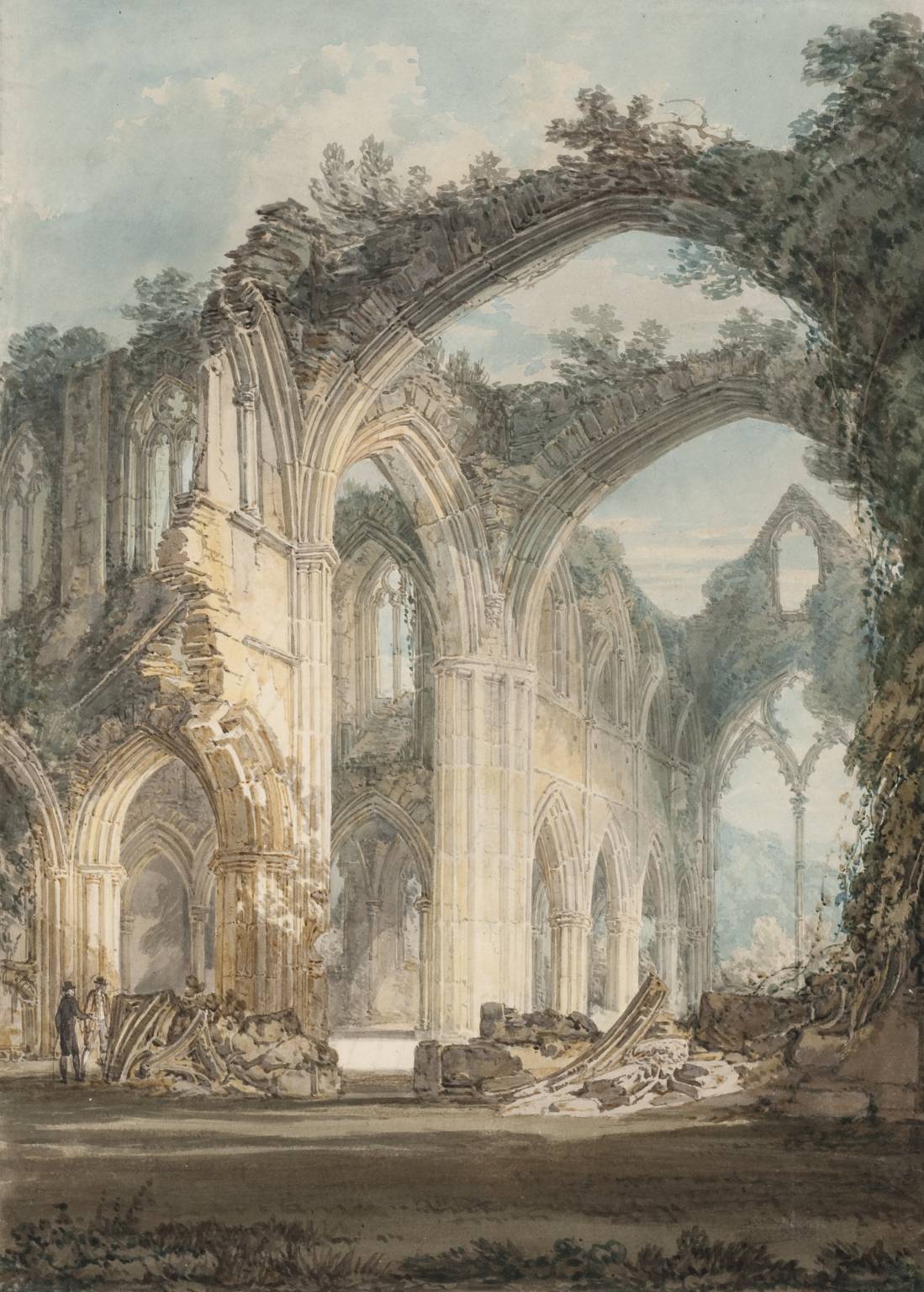
Tintern supplied one of his most productive subjects. Pencil studies made during the journey became finished watercolours over the next several years. The Chancel and Crossing of Tintern Abbey, Looking towards the East Window demonstrates the architectural training Turner had received from Thomas Malton. Columns, arches and wall planes remain coherent, while vegetation, broken masonry and graded light establish ruin and atmosphere.[7]
The choice of an interior was significant. Standard Wye tourism often valued the abbey within wooded surroundings, but Turner entered the shell and made spatial depth itself dramatic. The great east window draws the eye through successive arches. Roofless light enters what had once been enclosed. Small figures or scattered materials measure the changed use of a sacred building. Topographic description becomes a study in historical absence.
Watercolours derived from this journey appeared at the Royal Academy in 1794 and 1795. Their finish and scale announced more than precocious skill. Turner was demonstrating that a medium often associated with sketches and tinted drawings could sustain serious exhibition art. Welsh architecture gave him an accepted subject through which to enlarge the authority of watercolour.
The interval between observation and exhibition is crucial. Turner did not carry a large finished sheet through the abbey and complete it in one sitting. Travel supplied visual evidence; the studio supplied selection, tonal organisation, colour and public address. This movement from graphite notation to ambitious watercolour would remain central to his Welsh practice. It also allowed one journey to continue generating work after he had left the country.
1795: South Wales and the Commission Economy
The 1795 tour moved Turner's Welsh engagement beyond the best-known Wye circuit. The South Wales sketchbook records a journey through places including Newport, Ewenny, Neath, Aberdulais and the Tywi region. It also preserves evidence that fieldwork was closely linked to commissions. A list includes an Aberdulais subject for a “Mr Mitchell” and another of Llandeilo Bridge for the same customer.[1][9]
Such notes reveal a practical business. A patron might select a place already visited, request a known estate or respond to a sample. Turner gathered architectural and landscape information during summer, then converted it into saleable works in winter. His father's Covent Garden barber shop had displayed drawings from an early stage, while Academy exhibitions and collector networks expanded demand. Touring was simultaneously education, observation and inventory building.
Aberdulais Mill, Glamorgan, completed around 1796-97, exemplifies the transformation. The National Library of Wales relates it to a detailed pencil study in the South Wales book. The finished composition strengthens selected elements and adds incident, creating an account of a working place rather than a transcription. Buildings, water, figures and terrain form an integrated industrial landscape.[1][8]
Aberdulais had used the River Dulais for industrial power since the sixteenth century. Its history included copper working and later forms of manufacture. For Turner, the place joined two subjects too often separated in later accounts: waterfall and machine. Water could possess visual force while driving productive equipment. Rock and woodland did not define a world outside modern life; they shaped the conditions of industry.
Ewenny Priory offered a contrasting subject on the same regional journey. The surviving transept watercolour combines close architectural study with the emotional appeal of ancient religious space. Amgueddfa Cymru identifies Turner's visit in 1795 and preserves this strand of his early Welsh work.[5] South Wales was already teaching him to move between industry, medieval building, river transport and patron demand rather than cultivate one regional formula.
1798: Seven Weeks across South and North
Turner's 1798 expedition was the decisive Welsh journey. Christie's reconstruction from sketchbook and documentary evidence traces a wide circuit beginning in the south-east and moving across almost the whole country. Turner went from Chepstow up the Wye and towards Brecon, descended through Glamorgan, travelled west through the Tywi and Pembrokeshire, then followed the coast and river valleys north to Aberystwyth, Machynlleth and Dolgellau before entering Snowdonia and returning by Denbigh, Llangollen and Ludlow.[4]
Joseph Farington recorded Turner's return to London by 26 September. He had been in South and North Wales for seven weeks, “alone and on horseback,” and had encountered much rain, which he considered better for effects. The compact remark supplies rare evidence about both physical endurance and artistic attitude. Weather complicated travel but multiplied visual conditions.
A Journey Reconstructed through Places
The itinerary joined remarkably different landscapes. Abergavenny and Brecon introduced river crossings and mountain approaches. Cardiff and Ewenny connected settlement to ecclesiastical antiquity. Neath and Aberdulais offered waterfalls and industry. Llandeilo, Dynevor and the Tywi corridor opened routes towards Carmarthen and the coast. Pembrokeshire supplied castles, estuaries and maritime horizons. Cardigan and Cilgerran led towards the western uplands, while Aberystwyth and Machynlleth marked the turn north. Cader Idris, Dolgellau, Conwy and the Vale of Llangollen brought mountains and fortresses into the final stages.
Turner could not investigate every place equally. The rapid movement of a horseback tour demanded decisions about what to record. Sketchbook lines isolate a ridge, bridge profile, tower, bend in a river or relation between foreground and distance. In some locations he made several studies from changing positions; elsewhere one notation had to preserve enough information for later invention.
The circuit also undermines any division between a picturesque South and sublime North. Industrial water, ruined castles, mountains and working settlements appeared throughout the journey in different combinations. Turner experienced Wales as connected movement along roads, rivers and coasts. Later works often isolate one place, but the books preserve the relational geography behind them.
The seven weeks transformed his professional resources. He returned with material for immediate commissions and Academy exhibits, but also with forms that would recur for decades. Welsh travel became a store of spatial problems: how to set a bridge against weather, reveal a fortress through mist, place labour before a mountain or make a ruin hold historical meaning without losing the present around it.
The journey also placed Turner across linguistic and social boundaries rarely documented in his own words. He moved through communities where Welsh was widely spoken, yet his surviving notes largely preserve place labels, visual reminders and professional information rather than conversation. Inns, ferries, horse care and directions required continual interaction. The silence of the record should not be mistaken for solitary movement through unpeopled terrain.
Travel costs shaped decisions. Seven weeks required economical drawing and a pace that balanced coverage against depth. A horse increased range but created obligations and limited some mountain access. Finished colour was vulnerable to rain and abrasion, whereas graphite could be deployed quickly and protected when the weather turned. Turner's celebrated speed was therefore partly a learned response to material constraint.
News and reputation moved alongside him. By 1798 he was no unknown student: annual Academy exhibits had made his name familiar to patrons and fellow artists. Returning with a large body of Welsh material strengthened that position because it promised new public works. The tour was a personal feat, but also a calculated extension of professional capacity.
The journey's broad sweep gave Turner a comparative knowledge difficult to obtain from prints alone. He could assess how an Edwardian fortress commanded one estuary and a native tower occupied another valley; how South Wales water power differed from northern lake scenery; how western coastal light changed the relation between ruin and shore. Comparison became a source of invention when he later recombined observed structures.
Rain, Roads and the Physical Practice of Drawing
The romance of the solitary young artist on horseback should not obscure the mechanics of the journey. Turner had to manage money, accommodation, drawing materials, clothing and the safety of works carried through persistent rain. Roads varied greatly, and mountain travel could be slow or hazardous. The speed and economy of graphite were practical responses to those conditions.
His books allowed him to work standing, seated or during pauses in movement. A few outlines could register the profile of a castle or the relation of a valley to distant peaks. Inscriptions supplied names, colours or directional reminders. Limited wash might clarify cloud or water, but many records remained monochrome. Portable equipment made observation possible; it did not turn every halt into a finished painting session.[32][33]
Weather entered the drawings physically. Rain spots survive on sheets associated with the 1798 tour, including material around Cader Idris. Such marks are evidence of exposure, though they should not be romanticised as automatic artistic effects. Water could damage a drawing as easily as enrich it. Turner's comment reported by Farington suggests that changing conditions mattered because they revealed transitions in visibility and light.
Horseback travel also shaped viewpoint. Roads and tracks determined approach; river crossings, inns and bridges structured pauses. A picturesque prospect was never purely found by wandering at random. It emerged where mobility, access, inherited recommendation and visual opportunity met. Turner's ingenuity lay partly in converting those practical constraints into compositional variety.
The large works made after returning to London should therefore be understood as memory constructions grounded in field evidence. A small sketch fixed essential relations, while remembered rain, written history, another drawing and the demands of a patron could alter the result. The studio did not betray the journey. It was where observations acquired the scale, colour and narrative needed to communicate beyond it.
Abergavenny and the Ambition of Early Watercolour
Abergavenny Bridge demonstrates how far Turner could move from a rapid travel notation. Tiny graphite studies in the Dynevor Castle sketchbook record the crossing and its surroundings. From this slight foundation he developed more than one substantial watercolour, varying proportions, weather, cattle, bridge and valley rather than repeating a fixed design.[11][20]
The largest surviving version, now in a private collection, bears Turner's signature and an inscription naming Abergavenny Bridge in Monmouthshire. Gainsborough's House currently identifies it with the major work shown at the Royal Academy in 1799, while earlier scholarship expressed the connection more cautiously.[19] That attribution history should remain visible because a documented subject and a surviving version are not automatically identical.
Farington recorded that Turner was working on an Abergavenny drawing for the portraitist Thomas Lawrence in March 1799. The commission demonstrates the young landscape artist's standing within Academy circles. It does not establish a complete chain proving that Lawrence owned the large surviving sheet. Multiple versions, later sales and incomplete documentation require a distinction between the commissioned idea and the exact object.
What is secure is the scale of transformation. The finished compositions turn a bridge and river into an event of weather. Dark banks, cattle, reflective water and illuminated distance organise movement from recent storm towards clearing. Human and animal activity grounds the scene without neutralising the atmosphere. A topographical crossing becomes a public demonstration of watercolour's capacity for breadth and emotional progression.
Abergavenny also complicates the category of Welsh sublimity. No jagged summit is required. The drama comes through rain, changing illumination and the relation between ordinary movement and an enlarged sky. Wales helped Turner discover that weather could make historical or natural grandeur from a working river landscape.
Mills, Waterfalls and Industrial South Wales
Turner's Welsh scenes repeatedly join water's scenic appeal to its economic use. The Vale of Neath and nearby valleys were celebrated for waterfalls, wooded ravines and changing moisture. They were also sites of mills, mines, transport and expanding industry. An interpretation concerned only with untouched nature misses the relationships visible in his drawings.
At Aberdulais, diverted water powered machinery. At other mills, wheels, channels and buildings modify the river's movement. Bridges and roads enable goods and people to circulate. Smoke or masonry may be visually small, yet it identifies the valley as worked. Turner could heighten rock, fall and cloud while preserving these practical systems.
This combination suited his developing conception of landscape as an arena of forces. A waterfall is not a static object. Gravity, volume, spray and weather continually remake its appearance. A mill harnesses part of that force without ending it. The relation anticipates Turner's later fascination with furnaces, canals, steam and modern transport, but the Welsh works establish it within an early topographical practice.
Figures matter within this setting. Labourers, travellers, cattle and people near water are sometimes dismissed as staffage, a term that makes them accessories to scenery. In Turner's compositions they frequently establish the scale of a bank, the depth of a ford or the use of a road. Their work connects visual space to economic life. Smallness need not mean insignificance.
The historical record also asks for caution. South Wales industrialised unevenly, and not every stream or ruin should be read as an emblem of a coming industrial revolution. Turner attended to particular places. The larger pattern emerges because those places show natural systems already entwined with production, long before his famous late images of steam and railway speed.
West Wales: Estuaries, Ruins and Coastal Communities
The westward portion of the 1798 tour broadened Turner's repertoire through Carmarthenshire, Pembrokeshire and Cardiganshire. Castles at Llansteffan, Kidwelly, Pembroke and Cilgerran occupied rivers or tidal ground where military position, settlement and maritime movement could be read together. Their histories were not interchangeable, and Turner did not always use them immediately.
Kidwelly offers a clear example of long memory. Turner drew the area during his early Welsh travel, but the elaborate watercolour made for Picturesque Views in England and Wales belongs to the 1830s. In the later design, figures and animals occupy the foreground while castle, weather and town recede through atmosphere. The medieval structure remains essential without monopolising contemporary life.[22]
Pembroke entered the same publication project. Its fortress had royal and civil histories distinct from the native-prince associations of Dolbadarn. The engraved image carried a Welsh place into homes far from the original location, translating a coloured watercolour through etched and engraved line.[23] Print circulation made regional specificity available within a commercial national series.
Cilgerran, historically often written Kilgarren in Turner's titles and records, gave him a steep wooded gorge, river activity and ruined towers. The combination attracted patrons and later collectors because it condensed many picturesque elements. Yet the river was also a corridor for local movement and work. Boats beneath the castle turn scale into a social relation, not only an aesthetic device.
These western scenes demonstrate that the coast was never merely an edge. Estuaries connected inland communities to wider waters; castles controlled crossings and approaches; tide changed usable ground. Turner's path followed these links. His later isolated images retain traces of travel through a connected region, even when the original journey is no longer visible to the spectator.
North Wales: Mountains, Lakes and Human Scale
North Wales confronted Turner with mountains and enclosed valleys unlike the Wye's wooded river corridor. Cader Idris, the Llanberis lakes, Snowdon, mountain passes and high roads demanded new solutions to scale. A single viewpoint could not easily contain their changing recession, and weather could erase a summit between one notation and the next.
The Hereford Court book records material from the 1798 approach, including Cader Idris and Conwy. The 1799 Dolbadarn sketchbook concentrated on the Llanberis area, while the related Lancashire and North Wales volume preserves further routes and textual notes.[10][12] Repeated observation let Turner compare profiles, lake edges, roads and the round tower of Dolbadarn from multiple positions.
Mountain experience was physical before it became philosophical. Roads rose, narrowed and turned; rain changed surfaces; lakes reflected or concealed surrounding forms. Small travellers, boats and buildings made height legible. Turner could then amplify those relations in finished work, enlarging a mountain or shifting a lake to produce a more compelling structure.
The sublime provided one language for this encounter. Vastness, danger, obscurity and awe could overwhelm ordinary measures. Yet Turner's North Wales is not a continuous spectacle of terror. Calm water, fishing, settlement and historical association coexist with storm. The mountains become environments inhabited over time rather than theatrical backdrops waiting for an artist.
Nor was Turner the first to make them visible. Richard Wilson, born in Wales, had given British landscape painting an elevated classical model. Paul Sandby, John “Warwick” Smith and many touring draughtsmen represented Welsh mountains and monuments. Thomas Girtin travelled through North Wales in 1798. Turner's distinction lies not in discovery but in the intensity with which he joined topography to weather, history and evolving technique.
Conwy and Caernarfon: Architecture of Conquest
Conwy and Caernarfon castles dominate many tourist accounts of North Wales, but their visual grandeur cannot be separated from conquest. Edward I established the fortified towns after military campaigns against Welsh rule. Master James of St George and large labour forces created walls, towers, gates, quays and royal accommodation that asserted administrative as well as defensive power. Conwy, Caernarfon, Harlech and Beaumaris are now recognised together by UNESCO for this architecture.[16][17][18]
Turner's Conway Castle, North Wales of 1798 places the fortress above an estuary during severe weather. Fishermen struggle with boats below while sunlight reaches castle and coast through cloud. The architecture is formidable, but human exposure and unstable water prevent it from becoming an isolated monument.[13] Several related drawings, watercolours and oils survive, so no one version should be treated as the complete record of his response.
Caernarfon occupied Turner across a longer span. Early works draw energy from the castle's mass, estuary and mountain setting. A finished watercolour of around 1833 for Picturesque Views in England and Wales shifts the balance. Boats, bathers and shore figures inhabit hazy evening light while the fortress stands in the middle distance.[14] Modern life neither erases conquest nor submits entirely to it.
Names carry this history. Turner's titles and older English records commonly use “Conway” and “Caernarvon.” Current Welsh usage is Conwy and Caernarfon. Preserving historic object titles while using modern place names in geographic discussion acknowledges both documentary accuracy and living language.
Turner did not provide one settled political judgement on the Edwardian castles. They could signify historical power, picturesque antiquity and visual order at once. A modern account can identify the colonial violence embodied in their construction without pretending that every patch of storm light is a coded nationalist statement. The paintings are most revealing where domination, endurance and ordinary use remain in tension.
The distinctions between castles also shaped what Turner could ask of composition. Conwy's walls and towers remain closely joined to its fortified town and river supply. Caernarfon's polygonal towers and coloured masonry carried an especially ceremonial claim, linking architecture to Edward's imperial language. Flint stood closer to an exposed shore and later commercial activity. The strategic position in each case is part of the historical evidence, not a neutral pedestal for attractive stone.
Native-prince architecture required another frame. Dolbadarn's surviving round tower lacks the vast circuit of Edwardian fortification, yet association with Llywelyn and Owain gave it concentrated emotional power. A small structure could dominate because mountain, lake and story amplified it. Turner understood that physical size and historical magnitude need not coincide.
Later ruin altered these meanings again. By Turner's day the castles no longer exercised their original military functions, and tourists could approach them as antiquities. Picturesque pleasure depended on political distance: conquest architecture became safe enough to admire once its violence appeared historical. The continuing presence of Welsh language and memory prevents that distance from being complete.
Turner's shifting weather can be read within this layered condition without turning atmosphere into a code. Storm over Conwy changes visibility and human action; haze at Caernarfon allows modern recreation to occupy the foreground; light at Dolbadarn directs attention between captive and tower. Each effect produces a historical relation specific to the composition.
Dolbadarn: From Topography to Tragic History
Dolbadarn Castle allowed Turner to make Welsh history central rather than implicit. The thirteenth-century round tower stands near the Llanberis lakes, associated with the native princes of Gwynedd. Turner linked it to Owain Goch ap Gruffydd, imprisoned by his brother Llywelyn ap Gruffydd after a struggle for power. The Academy exhibit of 1800 carried verse invoking the captive's fate.[2][34]
The large oil, historically titled Dolbadern Castle, North Wales, should be distinguished from the smaller panel now at the National Library of Wales. The panel helped Turner develop the conception; the exhibited canvas later became his diploma work after election as a full Royal Academician in 1802. Their relationship reveals careful construction, not one spontaneous response.
Turner's composition combines observed prospects around the castle rather than reproducing a single position. Tower, lake, slopes and foreground figures are brought into a mountain design governed by atmosphere and emotional direction. Owain, identified through his red clothing and escort, is minute relative to the setting. Human tragedy acquires weight through landscape without disappearing into it.
Thomas Pennant's writings helped Turner understand the location. He copied material concerning the Snowdon journey and Dolbadarn into northern sketchbooks.[6] Text, prior illustration and direct observation entered the studio together. The result is not a literal reconstruction of medieval events but a Romantic history painting built from a Welsh place.
Dolbadarn marks an institutional claim. Academic theory ranked history painting above landscape because it addressed morally significant human action. Turner used landscape to carry exactly that seriousness. Welsh topography was not the decorative setting of a separate historical drama; mountain, weather, tower and captivity formed one argument. The work helped secure his position within the Academy while expanding what its hierarchies could admit.
Reading Wales through Gilpin and Pennant
Travel did not give Turner unmediated access to Wales. He arrived with books, images and habits of classification. Gilpin taught generations of visitors to evaluate Wye scenery through picturesque composition. Thomas Pennant's A Tour in Wales provided a wider combination of routes, natural history, antiquities, biography and local tradition. Turner copied extracts from Pennant, making the relationship documentary rather than merely probable.[6]
Pennant was himself Welsh, born at Downing in Flintshire, but wrote within eighteenth-century antiquarian networks and in English. His work preserved extensive information while organising places for educated readers and travellers. Turner could use it to identify historical associations not obvious from surviving stone. The Dolbadarn story is the clearest outcome.
Reading and looking interacted. A copied description could direct attention towards a tower or road. An engraving could establish a conventional prospect that Turner repeated, revised or rejected. On location, weather and access changed what the book promised. In London, remembered sensation could alter the initial drawing.
This process complicates the ideal of solitary genius. Turner's Welsh imagery was collaborative across time, dependent on writers, earlier artists, guides, patrons and engravers. Originality emerged through transformation, not through freedom from sources. He made inherited material answer new pictorial problems.
The mediation also carried political limits. Antiquarian and tourist writing could treat Wales as a reservoir of legend within a British narrative, converting conflict into picturesque memory. Turner participated in that market. His strongest historical landscapes nonetheless preserve unease: captivity, storm and ruined power do not settle comfortably into decorative national unity.
Patrons, Orders and the Professional Value of Travel
Turner's Welsh tours were investments in a career. Travel supplied subjects that could be exhibited, sold to collectors or engraved. Sketchbook lists connected named places to prospective buyers. One compact notation might eventually generate multiple finished versions at different scales, each serving a separate patron or market.
Mr Mitchell's orders for Aberdulais and Llandeilo Bridge provide the clearest 1795 evidence. Thomas Lawrence's Abergavenny commission links Turner to a leading portrait painter and influential Academician. Such support mattered materially and reputationally. It demonstrated that landscape drawings could belong within serious collections rather than remain secondary records.
Sir Richard Colt Hoare became another important patron by the turn of the century. An antiquary, traveller and owner of Stourhead, he valued historical topography and collected Turner's work.[29][30] His interests align closely with Welsh subjects, but that affinity must not be converted into unsupported claims that Turner accompanied every Hoare journey or made each view to order.
Thomas Johnes of Hafod represents a related culture. At his Ceredigion estate, he created celebrated walks and improvements shaped by picturesque theory, pursued agriculture and patronised the arts.[28] Hafod drew visitors because designed landscape and dramatic terrain appeared to merge. Turner travelled through this world of estates and cultivated prospects, even where a specific commission cannot be established.
Patronage never removed Turner's agency. He chose weather, format, emphasis and degree of transformation. At the same time, artistic daring operated inside economic relations. Wales provided material because there were audiences prepared to value ruins, mountains and named estates. Understanding that market does not diminish the pictures; it explains how travel, memory and public ambition became sustainable work.
Turner and Thomas Girtin in the Welsh Landscape
Thomas Girtin was Turner's closest contemporary in the expansion of British watercolour. Both worked in the circle of Dr Thomas Monro during the 1790s, where young artists copied and translated existing drawings. This practice sharpened their command of wash and composition while making transformation from another image an ordinary part of training.
Girtin travelled through North Wales in 1798, though not with Turner. Contemporary evidence records the costs and circumstances of his journey with a companion. He developed subjects such as Near Beddgelert into large exhibition watercolours that helped change expectations of the medium.[27] His Welsh work often establishes broad tonal architecture and a powerful sense of material mass.
The artists sometimes treated the same places. A Girtin view of Dolbadarn made in Monro's circle derives from an earlier source, while Turner's later pencil drawing came from his own tour.[26] Comparison shows how shared motifs passed through copying, memory and field observation. It does not establish theft or a private contest.
Turner increasingly made weather and directional light disruptive; Girtin often gave buildings and ground a weighty calm. These are tendencies rather than rigid opposites. Both enlarged watercolour, both depended on patronage, and both recognised Wales as a field in which topography could become ambitious art.
Later storytelling has sometimes turned them into doomed rival and triumphant survivor. Girtin's death in 1802 at twenty-seven gave the comparison emotional force, but it can distort their actual relationship. Welsh art history gains more from seeing parallel experimentation. The region supported a generation testing how British landscape could rival the scale and seriousness associated with oil painting.
Welsh Subjects and Royal Academy Ambition
Turner's rise at the Royal Academy was remarkably rapid. Welsh works contributed at several stages. Tintern interiors in the mid-1790s displayed architectural understanding and controlled watercolour. Large later sheets such as Abergavenny demonstrated atmosphere and scale. Dolbadern Castle brought historical narrative into landscape and eventually served as his diploma presentation.
This progression did not mean abandoning topography. Identifiable place remained the foundation from which Turner made increasingly complex claims. The academy audience could recognise a castle or abbey while encountering colour, weather and narrative that exceeded ordinary record. Welsh specificity gave experimental handling an anchor.
The status of watercolour was central. The Academy hierarchy privileged oil and the elevated genres, while watercolour remained associated with drawing and topographic service. Turner showed that transparent colour on paper could command walls and critical attention. His eventual move into ambitious oils did not make the earlier medium obsolete; he continued to use each for different forms of invention.
Dolbadarn crystallised the institutional argument. Landscape could contain a tragic human subject without becoming mere backdrop. Mountain scale could carry moral emotion. A regional scene could address national history. Turner's election as an Associate in 1799 and full Academician in 1802 belongs to a career in which Welsh work was highly visible.
Wales should therefore not be described as a youthful exercise left behind once continental travel opened in 1802. It helped Turner build the authority that made France, Switzerland and Italy possible as professional undertakings. The Welsh years established habits of travel, synthesis and exhibition that remained operative abroad.
1808: A Fishing Return from Tabley
Turner's intensive Welsh campaign ended around 1799, but his physical connection did not cease completely. In 1808 he stayed with Sir John Fleming Leicester at Tabley in Cheshire, working on estate commissions and spending notable time fishing. From there he made an excursion into North Wales supported by letters, sketchbooks and the subject of The Trout Stream in the Taft Museum of Art.[31]
The later trip differed from the seven-week survey. Angling encouraged repeated attention to one stretch of moving water, light and bank rather than the rapid collection of architectural prospects. It also belonged to sociability and recreation within a patron's circle. Turner the professional guest and Turner the fisherman were not separate identities; observation continued while formal work appeared to pause.
Fishing offered bodily knowledge of current, depth, reflection and weather. Standing near or within a stream changed the viewpoint from which water was understood. That experience mattered across Turner's art, though no single effect should be attributed automatically to one excursion.
The 1808 coda also corrects an overly neat narrative in which Turner replaced Wales with Europe. His geography expanded, but earlier regions remained active. Patronage, memory and leisure could bring him back. Wales was no longer the primary frontier of his travel, yet it continued to offer river experience and artistic material.
Picturesque Views in England and Wales
Turner's largest later return to Welsh subject matter occurred through print culture. From 1825 he worked with publisher Charles Heath on Picturesque Views in England and Wales. Ninety-six plates appeared between 1827 and 1838, short of the projected 120. Turner supplied highly finished watercolours that specialist engravers translated into black-and-white line.[24][25]
The undertaking was a synthesis of British topography and one of the most demanding publication projects of his career. Finished designs had to combine recognisable location with concentrated drama at a scale suitable for reproduction. Engravers interpreted minute tonal relations through etched and engraved marks, sending Turner's compositions to an audience much larger than buyers of unique watercolours.
Welsh subjects included Caernarfon, Flint, Kidwelly, Pembroke and Criccieth. Several drew ultimately on journeys made three decades earlier. At Criccieth, British Museum scholarship notes that Turner's only known direct studies of the coastal area dated from 1798. The later watercolour altered cliff height and beach extent while placing the ruined castle behind contemporary activity.[15]
Flint likewise joined historical structure to working shore. The castle belonged to Edward I's conquest system, but vessels unloading and figures in the foreground established modern commerce.[21] Turner had also used Flint in the Liber Studiorum, showing how one Welsh place could enter different publication systems and aesthetic categories.
The title England and Wales carries political weight. It joins two countries within a commercial national survey produced for a predominantly metropolitan market. Individual views preserve Welsh names and historical differences, but the series can also absorb regional identity into a unified picturesque Britain. Turner's images do not resolve that tension. Their mobility depended on the very print economy that transformed place into collectible representation.
Production required sustained negotiation among artist, publisher and engravers. Turner delivered watercolours of exceptional finish, often dense with small figures and complex atmospheric transitions. An engraver first established the image through etching and then built tone through closely controlled burin work. Proofs travelled back for correction. Changes to cloud, architecture, figures or tonal emphasis could continue before publication.
This collaboration complicates the common idea that reproductive printmaking merely copied an original. Each plate translated colour into systems of line and white paper. A yellow glow might become an area of reserve surrounded by graduated marks; a violet shadow required density and direction rather than pigment. The engraver's judgement determined whether Turner's atmosphere survived in another medium.
Publication in parts spread cost and encouraged collecting over time. Subscribers encountered Welsh views among English cathedrals, ports, towns and landscapes, producing comparison across the series. The sequence could make the country feel accessible as an array of named destinations even to readers who never travelled there. It also detached images from the bodily difficulty of Turner's original journeys.
Commercial failure eventually limited the proposed 120 views to ninety-six. Ambition, critical admiration and artistic quality did not guarantee a sustainable market. The unfinished total is a reminder that national vision was also a financial enterprise involving paper, steel, printing, distribution and subscriber demand.
The Welsh plates acquired lives beyond the original parts. Impressions circulated separately, entered albums and collections, and were copied in later publications. Their historical spellings and visual choices influenced how places were imagined. The young Turner's horseback observations had become reproducible cultural memory.
Returning to Old Sketches with New Colour
The long delay between Turner's journeys and many later Welsh watercolours demonstrates how radically he could reuse observation. Early graphite supplied architecture, contour and spatial relation. By the 1830s his colour had brightened, his atmospheric transitions had become more daring, and his figures often played a larger role in the social life of a scene.
Caernarfon is exemplary. The later watercolour places bathers and boats before the castle under hazy yellow, vermilion and purple effects. The fortress remains identifiable, but its meaning changes through light and human occupation. An early mountain drama becomes a warm, inhabited shore without requiring a new visit.[14]
Memory was not a defective substitute for direct sight. It allowed Turner to release a place from one weather condition and one viewpoint. Colour beginnings, old sketches, prints and accumulated knowledge could be combined. He might exaggerate a cliff or reposition architecture to strengthen an image. Such alterations are evidence of artistic purpose, not reasons to dismiss the result as inaccurate.
Engraving introduced another transformation. A watercolour's hue could not pass directly into monochrome. Line density, pattern and reserve had to suggest luminosity and atmosphere. Turner scrutinised proofs and often demanded revisions. Welsh scenery thus travelled through several acts of interpretation: seen on tour, abbreviated in graphite, reconstructed in colour, translated by an engraver and encountered as print.
This chain helps explain the durability of the early tours. Turner did not preserve Welsh sketches as relics of youth. He treated them as active visual capital, capable of supporting new methods and audiences. The country changed in the intervening decades, while the published images deliberately joined remembered topography to contemporary artistic language.
Castles, Conquest and Everyday Occupation
Welsh castles are among Turner's most recognisable regional motifs, but “castle” names historically different structures. Conwy, Caernarfon and Flint were instruments of Edward I's conquest and settlement. Dolbadarn belonged to the princes of Gwynedd. Kidwelly and Pembroke developed through Norman, marcher, royal and civil histories. Criccieth carried associations with native rule, English occupation and Welsh revolt.
Treating them as interchangeable ruins empties the paintings of historical force. It also repeats a picturesque habit of valuing broken stone while forgetting the power that built it. Current Cadw and UNESCO scholarship makes conquest architecture explicit, allowing Turner's compositions to be read with greater precision.[16][17][18]
The works themselves often introduce modern occupation. Boats unload near Flint. Bathers enter the water before Caernarfon. Figures, livestock and market activity occupy Kidwelly and Criccieth. Castle and community share space, though not always equal visual authority. This present life prevents history from remaining sealed in monument.
Turner's politics cannot be reduced to a single position. The grandeur of a fortress may acknowledge its power; storm or distance may qualify it; ordinary use may domesticate it. Dolbadarn's tragic story brings sympathy towards a captive Welsh prince, but that does not prove a comprehensive nationalist programme. The critical task is to preserve contradiction rather than assign a slogan.
Landscape itself participates in these histories. Castles command estuaries, roads and river crossings because geography was strategic. Turner recognised that relation visually. Water and mountain are not neutral settings around politics; they explain why fortification, settlement and later tourism developed where they did.
People, Work and the Limits of “Wild Wales”
Descriptions of Turner's Welsh art have often celebrated wildness, solitude and untouched nature. These terms can identify a visual effect, but they become misleading when applied to the country as fact. Farms shaped hillsides, roads crossed passes, rivers powered mills, mines altered valleys, boats served estuaries, and communities lived around the monuments tourists came to see.
Turner's figures register this occupied landscape. They haul boats, tend animals, travel, fish, bathe, work near mills or gather beside roads. Their small scale often makes them vulnerable to weather and architecture, yet it also establishes the dimensions of the environment. A mountain feels vast because a traveller must cross it; a flooded river feels dangerous because bodies and cattle enter its plane.
The perspective remains that of an outsider. Turner travelled from London, worked for patrons and circulated images through British institutions. He relied heavily on English-language guidebooks and historical texts. Welsh people seldom become named subjects with independent biographies. Recognising their presence should not be confused with claiming ethnographic completeness.
Industry creates another limit to the wild-Wales myth. Aberdulais and the Neath valley show natural force channelled through production. Flint's shore supports commerce. Bridges connect markets and routes. Turner's art could heighten atmospheric grandeur without removing infrastructure.
This tension makes the works historically valuable. They record how picturesque desire met a lived and changing country. Sometimes labour becomes aesthetically absorbed into colour and scale. At other moments it reorganises the whole composition. A responsible interpretation keeps asking whether the people represented are being treated as decorative evidence of rusticity or as participants in the landscape's actual use.
Wales, Britain and the Politics of Naming
Turner's Welsh works entered a British art world during the political union of England and Wales, when metropolitan institutions often treated Wales as a scenic province. The Royal Academy presented named Welsh places to London audiences. Picturesque Views in England and Wales placed both countries under one publishing enterprise. Collectors could possess regional difference as part of national culture.
That framework did not erase Welsh history, but it shaped how it was told. Native princes could become Romantic figures after political defeat. Conquest castles could become beautiful antiquities. Industrial valleys could appear as combinations of rock, smoke and water rather than sites of economic power. The picturesque made difficult histories visually available while sometimes softening them.
Modern naming exposes the continuing negotiation. Conwy and Caernarfon are the current Welsh forms used by heritage bodies and communities. “Conway” and “Caernarvon” remain embedded in historic artwork titles, catalogues and engravings. Accuracy requires both: preserve the documentary title while speaking about the present place in its modern form.
Eryri is now the preferred name used by the national park authority for the region long called Snowdonia in English. Historic discussion must recognise the terminology Turner encountered without suggesting that his language is timeless or neutral. Names are not cosmetic additions to landscape; they carry authority, memory and belonging.
Turner cannot be made into a modern Welsh national painter. He can, however, be understood as an artist whose career depended profoundly on Welsh places and histories. That dependence creates obligations for interpretation: identify conquest, resist emptiness, distinguish local histories and avoid treating the country merely as a dramatic extension of England.
Welsh Collections and the Afterlife of the Tours
Turner's Welsh engagement is now dispersed across collections, but institutions in Wales hold a crucial role in its interpretation. The National Library of Wales owns Aberdulais Mill and the Dolbadarn panel. Displayed together in its digital account, they represent two linked traditions: detailed topographical observation shaped by contemporary work, and Romantic historical composition developed through extensive study.[1]
Amgueddfa Cymru holds important watercolours, including works associated with the Davies sisters' collection. Its current Turner 250 display ranges from early Welsh sheets such as the Ewenny interior to late marine painting, restoring the Welsh journeys to the larger career rather than isolating them as juvenilia.[5]
Tate preserves the immense sketchbook foundation through the Turner Bequest. Getty, the British Museum, the Royal Academy, the V&A and private collections hold major finished versions. This dispersal makes object identity important: a title shared by several sheets does not turn them into one work. Digital access improves comparison while never replacing technical examination or direct study.
Welsh stewardship also changes the voice through which the art is encountered. A London exhibition may emphasise Turner's rise or watercolour innovation. A Welsh institution can foreground local industry, language, conquest history and the continuing life of a place. Neither perspective is automatically complete, but their combination resists a one-directional story in which Turner simply carried scenery away.
The history of acquisition is part of that shift. Gwendoline and Margaret Davies formed an internationally significant collection and gave works to the Welsh nation, helping place Turner within a public Welsh context rather than leaving access dependent on private ownership. The National Library's later purchases of Aberdulais and the Dolbadarn study joined two crucial early works within an institution committed to national memory.[1][5]
Conservation creates another form of interpretation. Watercolour is sensitive to prolonged light, and some sheets have faded through historic display. Present colour may not represent Turner's original balance. Institutions therefore rotate works or restrict exposure, choices that can make a famous object infrequently visible. Reproduction expands access but may flatten paper texture and subtle tonal differences.
Cataloguing has also changed. Older records often used anglicised names, merged versions or relied on uncertain location identifications. Modern research compares sketchbook sequences, inscriptions, provenance and topography to separate objects more carefully. Revisions are not signs that the works lack identity; they demonstrate the complexity of an artist who repeatedly returned to the same subjects.
Digital collections now allow a reader in Wales to compare a Tate sketch, a Getty watercolour and a British Museum print within minutes. That accessibility is valuable, but scale and screen colour can disguise material difference. A three-inch graphite notation, a large exhibition watercolour and a steel engraving do not perform the same work merely because they depict the same castle.
The most productive afterlife therefore combines local knowledge, documentary scholarship and close object study. Turner's Welsh art belongs to an international career, but its places are not finished historical subjects. Rivers still flow through working communities, names continue to matter, and conquest architecture remains embedded in present Welsh landscapes.
The journeys continue to matter because they made his art relational. Drawing on a wet road led to studio watercolour; a patron's order led to Academy display; a copied Pennant passage led to tragic history; an old graphite outline led to a widely circulated engraving. Wales was present at every stage, not as passive material but as the complex field against which Turner's choices acquired meaning.
Why Wales Remained Foundational
Turner's later fame rests heavily on Venice, the Alps, steam, fire and the sea, which can make his Welsh work appear preliminary. Chronology supports the opposite conclusion. Wales gave him repeated experience of travel, difficult weather, historical reading, patronage and the conversion of small observations into ambitious public art. Those were not youthful habits discarded with maturity. They became the structure of his career.
The regional variety forced flexibility. Tintern required architectural space; Aberdulais joined industry to water; Abergavenny turned clearing weather into narrative; Conwy brought fishermen beneath conquest architecture; Dolbadarn transformed mountain topography into history painting; the later print subjects joined old memory to new colour and mass circulation.
Wales also taught Turner that landscape contains competing claims. A ruin can be beautiful and politically violent. A river can be picturesque and economically harnessed. A mountain can overwhelm vision while remaining crossed, grazed and inhabited. A named place can enter British culture without surrendering its Welsh history. These tensions helped him move beyond scenic record.
His achievement should not be celebrated by repeating the very erasures his art can expose. Turner did not discover Wales, and he did not represent it from within Welsh language or community. He arrived through tourist conventions and a metropolitan market. Yet sustained attention, multiple returns and decades of reuse gave the engagement unusual depth.
The resulting body of work is best understood as a long conversation between direct observation and mediated knowledge. Turner looked, read, remembered, recomposed and published. Through those acts, Wales helped a young draughtsman claim that landscape could carry modern labour, national history, tragedy and atmospheric experience with the seriousness of any academic subject.
That claim developed through accumulation rather than a single masterpiece. A Tintern interior trained the eye on depth and broken architecture. A mill revealed how natural force became economic power. A bridge made passing weather the central event of an inhabited valley. Mountain books tested what a few lines could preserve under difficult conditions. Dolbadarn then assembled observation, text and history into public ambition. The later engravings proved that those early encounters could still generate new art after Turner's colour and audience had changed.
Wales also gave Turner a demanding lesson in the difference between place and picture. Topography required enough fidelity for recognition, but fidelity alone could not convey rain, memory, movement or historical association. He learned to alter without making place irrelevant: shift a viewpoint, intensify a height, gather separate observations, change an hour or bring small figures forward. The recognisable and the imagined became mutually supporting rather than opposed.
For modern viewers, the same works require movement in the other direction, from picture back towards place. That means restoring distinctions blurred by the picturesque market: native and conquest castles, religious and industrial ruins, tourist expectation and local work, historical English titles and current Welsh names. Such attention does not diminish Turner's achievement. It reveals how much of its power came from sustained contact with a country too various to fit the category of scenery.
The Welsh years finally show why Turner's modernity cannot be separated from historical attention. Innovation did not require forgetting inherited places. It came from making an abbey, mill, fortress or mountain answer to present weather, present work and the changing expectations of an audience. Wales gave that experiment exceptional breadth, and Turner kept drawing upon it long after the horse, rain and pocket books of the first journeys had become memory.
Discussion
How did repeated Welsh journeys help Turner connect topography, weather, work and history across his career?
Reader Insights
What changes when the Welsh tours are read as professional fieldwork rather than picturesque escape?
How do abbeys, native strongholds and conquest castles carry different kinds of historical memory?
Where do labour, language and modern naming resist the idea of Wales as unoccupied scenery?
Join the Conversation
Share a close observation or a source-based question for other readers.
References
- National Library of Wales, “Turner and Wales,” https://www.library.wales/discover-learn/digital-exhibitions/pictures/turner-and-wales
- National Library of Wales, “JMW Turner, 'Dolbadarn Castle',” https://www.library.wales/discover-learn/digital-exhibitions/pictures/europeana-280/jmw-turner-dolbadarn-castle
- Cadw, “More about Tintern Abbey,” https://cadw.gov.wales/more-about-tintern-abbey
- Christie's, “A Bridge over a River by Moonlight,” 1798 tour itinerary and Hereford Court evidence, https://www.christies.com/lot/lot-1010277
- National Museum Cardiff, “Celebrating Turner 250,” https://museum.wales/cardiff/whatson/12721/Celebrating-Turner-250/
- National Library of Wales, “Thomas Pennant,” *Dictionary of Welsh Biography*, https://biography.wales/article/s-PENN-THO-1726
- Tate, “The Chancel and Crossing of Tintern Abbey,” D00374, https://www.tate.org.uk/art/artworks/turner-the-chancel-and-crossing-of-tintern-abbey-looking-towards-the-east-window-d00374
- National Library of Wales, *Aberdulais Mill, Glamorgan*, collection record within “Turner and Wales,” https://www.library.wales/discover-learn/digital-exhibitions/pictures/turner-and-wales
- Tate, *South Wales* sketchbook, Turner Bequest XXVI, https://www.tate.org.uk/art/research-publications/jmw-turner/south-wales-sketchbook-r1171166
- Tate, *Hereford Court* sketchbook, Turner Bequest XXXVIII, https://www.tate.org.uk/art/research-publications/jmw-turner/hereford-court-sketchbook-r1172234
- Tate, *Dynevor Castle* sketchbook, Turner Bequest XLI, https://www.tate.org.uk/art/research-publications/jmw-turner/dynevor-castle-sketchbook-r1173504
- Tate, *Dolbadarn* sketchbook, Turner Bequest XLVI, https://www.tate.org.uk/art/research-publications/jmw-turner/dolbadarn-sketchbook-r1176044
- J. Paul Getty Museum, *Conway Castle, North Wales*, 95.GC.10, https://www.getty.edu/art/collection/object/103RJV
- British Museum, *Caernarvon Castle*, 1958,0712.439, https://www.britishmuseum.org/collection/object/P_1958-0712-439
- British Museum, *Criccieth Castle, North Wales*, 1958,0712.440, https://www.britishmuseum.org/collection/object/P_1958-0712-440
- Cadw, “Conwy Castle,” https://cadw.gov.wales/visit/places-to-visit/conwy-castle
- Cadw, “Caernarfon Castle,” https://cadw.gov.wales/visit/places-to-visit/caernarfon-castle
- UNESCO, “Castles and Town Walls of King Edward in Gwynedd,” https://whc.unesco.org/en/list/374/
- Gainsborough's House, *Abergavenny Bridge* in *Inventing Landscape*, https://gainsborough.org/event/gainsborough-turner-and-constable-inventing-landscape/
- Tate, *?Abergavenny Bridge*, D01669, https://www.tate.org.uk/art/artworks/turner-abergavenny-bridge-d01669
- British Museum, *Flint Castle, North Wales*, 1958,0712.438, https://www.britishmuseum.org/collection/object/P_1958-0712-438
- British Museum, *Kidwelly Castle, South Wales*, 1958,0712.442, https://www.britishmuseum.org/collection/object/P_1958-0712-442
- British Museum, *Pembroke Castle, Wales*, print from *Picturesque Views*, https://www.britishmuseum.org/collection/object/P_1851-0308-767
- British Museum, *Picturesque Views in England and Wales* series record, https://www.britishmuseum.org/collection/object/P_1850-0112-15
- Library of Congress, *Picturesque Views in England and Wales*, bibliographic record, https://www.loc.gov/item/03006164/
- Paul Mellon Centre, “Dolbadarn Castle on Llyn Padarn,” Thomas Girtin catalogue, https://www.thomasgirtin.com/collection/catalogue/dolbadarn-castle-on-llyn-padarn
- Paul Mellon Centre, “1798 Documents,” Thomas Girtin, https://www.thomasgirtin.com/collection/sales-and-documents/1798-documents
- Museum Wales, *Thomas Johnes of Hafod*, https://museum.wales/collections/online/object/8a6bec63-3bd1-382d-a36d-7a87898977d0/Thomas-Johnes-of-Hafod-1748-1816/
- National Library of Wales Archives, “Sir Richard Colt Hoare's tours in Wales,” https://archives.library.wales/index.php/sir-richard-colt-hoares-tours-in-wales
- National Gallery research, “Sir Richard Colt Hoare,” https://library.nationalgallery.gr/assets/media/PDF/766.pdf
- Taft Museum of Art, “Balancing Wanderlust with Stay-at-Home: Two Works by JMW Turner,” https://www.taftmuseum.org/more-to-discover/balancing-wanderlust-with-stay-at-home-two-works-by-jmw-turner-more-to-discover/
- Joyce H. Townsend and Ian Warrell, *How Turner Painted: Materials and Techniques*, Tate, 2013, https://www.tate.org.uk/research/publications/how-turner-painted
- Ian Warrell, *Turner's Sketchbooks*, Tate Publishing, 2014, https://books.google.com/books/about/Turner_s_Sketchbooks.html?id=7dYnngEACAAJ
- Royal Academy of Arts, “Explore JMW Turner's *Dolbadern Castle*,” https://artsandculture.google.com/story/explore-jmw-turner-s-painting-dolbadern-castle-royal-academy-of-arts/kAXRW2sW6AH-JQ