 by Tom Gurney
Tom Gurney BSc (Hons) is an art history expert with over 20 years experience
Published on June 19, 2020 / Updated on August 29, 2026
Email: tomgurney1@gmail.com / Phone: +44 7429 011000
A Gift That Became a National Problem
The Turner Bequest is one of the decisive facts in the afterlife of J. M. W. Turner. It is also one of the easiest to flatten into a tidy anecdote. Turner did not simply die, leave a neat collection to one museum and settle his own reputation from beyond the grave. He left a complicated will, a vast studio archive, a group of finished paintings he wanted seen in relation to Claude, and an estate whose legal settlement took several years after his death in 1851. The result, resolved in 1856, created a national collection unlike anything else in British art: not merely a display of finished masterpieces, but a working record of sketches, studies, unfinished oils, watercolours, notebooks and studio remains.[1]
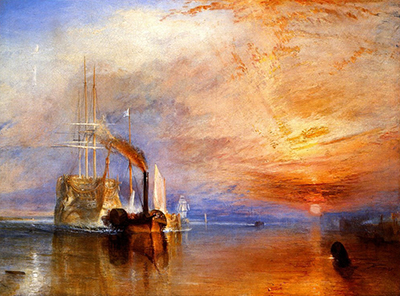
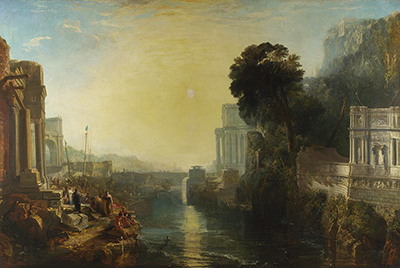
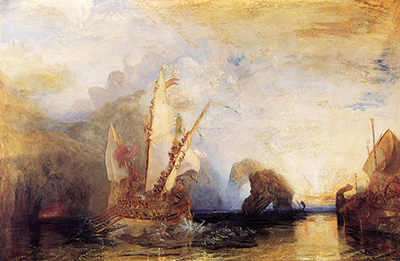
That complexity matters because it changes how Turner can be understood. The bequest preserved finished pictures such as Dido Building Carthage, Ulysses Deriding Polyphemus, The Fighting Temeraire and many late works, but it also preserved the surrounding evidence of a mind constantly testing light, weather, architecture, sea, travel and memory. Tate gives the scale as roughly three hundred oils, about thirty thousand watercolours and sketches, and some three hundred sketchbooks.[2] The National Gallery gives the same broad scale and stresses that the bequest remains central to the Gallery's Turner history, even though most of the material is now held by Tate.[1]
At a Glance
- Resolution1856
- Legal contextContested will and court settlement
- National giftArtistic works awarded to the nation
- Oil paintingsRoughly 300
- Works on paperAbout 30,000 watercolours and sketches
- SketchbooksSome 300
- First institutional homeNational Gallery
- Major transferBulk moved to Tate in 1910
- Claude pairingDido Building Carthage and Sun Rising through Vapour
- Lasting importanceFinished art and an exceptional record of process
Contents
- A Gift That Became a National Problem
- Turner's Intention and the Claude Pairing
- The Court Case and the 1856 Settlement
- National Gallery, Tate and the Turner Collection
- Why the Sketchbooks Matter
- A Bequest That Changed Turner Scholarship
- The Bequest as Turner's Second Career
- Finished Pictures and Studio Remains
- The Will as Self-Interpretation
- Display, Storage and Changing Meanings
Turner's Intention and the Claude Pairing
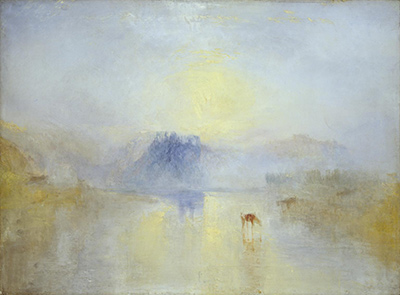
Turner's wish to be seen beside Claude Lorrain was not a quaint vanity. Claude represented an Old Master standard for ideal landscape, and Turner wanted his own modern landscape painting measured against that authority. The National Gallery records that Turner wanted Dido Building Carthage and Sun Rising through Vapour displayed with two Claude paintings, one built around Isaac and Rebecca and the other around the Queen of Sheba's departure.[1] This pairing declared that landscape could carry historical, poetic and intellectual ambition at the highest level.
The condition also clarifies the seriousness of Turner's self-positioning. He was not content to be remembered as a gifted painter of effects or a virtuoso of storms. The bequest says that Turner wanted landscape to enter the same conversation as history painting and the revered traditions of European art. His demand was competitive, but it was also historical: he made his own career legible through the artists against whom he had measured himself.
The Court Case and the 1856 Settlement
After Turner's death, relatives contested the will. The National Gallery describes the challenge as delaying the gift and records the 1856 decree that awarded the artistic works to the nation while the remainder of the estate went to relatives.[1] That settlement broadened the national holding beyond the simple idea of a group of finished pictures. It brought the studio contents, and with them the huge archive of working material, into public ownership.
The legal history explains why the bequest can appear slightly paradoxical. Turner had strong intentions, but the national collection as it exists was also shaped by litigation, institutional negotiation and later display decisions. The bequest is therefore both an artistic act and a legal outcome. It is Turner's most consequential posthumous gesture, but it was not executed exactly as a private collector might arrange a cabinet.
National Gallery, Tate and the Turner Collection
The National Gallery first received and displayed key Turner paintings. Over time, the practical problem of housing such a large body of British art became unavoidable. The National Gallery records that the bulk of the bequest was transferred to Tate in 1910, after Tate had opened as an annexe of the National Gallery in 1897.[1] Tate now holds the great majority of the bequest, while a small group of Turner paintings remains at the National Gallery to show his work in broader European context.[2]
This division is not a split in Turner's meaning. It is part of how the bequest continues to function. At the National Gallery, Turner can still be seen beside European painting and the Claude tradition that mattered so much to him. At Tate Britain, the scale of the Turner holdings makes it possible to study the sweep of his practice: sketchbook journeys, watercolour experiments, unfinished oils, exhibition pictures and late works whose studio status is often essential to their interpretation.[3]
Why the Sketchbooks Matter
The bequest's greatest gift may be the survival of process. Tate's catalogue of Turner's sketchbooks, drawings and watercolours builds its account from the works on paper that came largely through the bequest.[3] These are not secondary scraps around the masterpieces. They are records of looking, travelling, remembering and reworking. They show Turner moving from place to place, returning to subjects across decades, converting observed motifs into exhibition pictures and developing watercolour as a flexible laboratory for light.
Because the bequest preserved so much unfinished and exploratory work, it also resists an overly smooth account of Turner's career. The archive reveals false starts, repeated subjects, different media and shifting intentions. It makes the late works less mysterious, not by explaining them away, but by placing them in a long record of experiment. A small colour beginning, a rapid coastal note or a sketchbook leaf can illuminate a finished canvas without needing to be treated as a miniature masterpiece.
A Bequest That Changed Turner Scholarship
The Turner Bequest did not merely add objects to national museums. It created the conditions for modern Turner scholarship. Catalogues by A. J. Finberg, Martin Butlin and Evelyn Joll, Tate curators, conservators and later researchers all depend on the survival of this large body of material.[4] Without the bequest, Turner would still be a major painter, but he would be a different kind of historical figure: more dependent on exhibited pictures and early criticism, less accessible through studio evidence.
The bequest also complicates the idea of completion. Some works entered the national collection as finished exhibition pictures. Others were studies, beginnings, fragments, sketchbook leaves or paintings left in uncertain states. That mixture is not a weakness. It is one reason Turner remains unusually available to close technical and historical study. The bequest lets viewers see the polished public ambition and the private labour beside one another.
The Bequest as Turner's Second Career
Turner's career did not stop cleanly in 1851. The bequest gave his work a second career inside national institutions, catalogues, exhibitions and public debate. It shaped the way he was presented as a British master, as Claude's rival, as a painter of light, as a traveller, as a technician and as a precursor to later modern interests in colour and atmosphere. Some of those labels are useful; some are too simple. The bequest is the evidence that allows them to be tested.
The most important point is that the Turner Bequest is not only a story of generosity. It is a structure of interpretation. It preserved Turner's ambition for landscape, his attachment to Claude, his studio habits, his restless travel records and the enormous range of works that could not be reduced to a few famous canvases. To understand the bequest is to understand why Turner can be studied as both a public exhibition painter and an artist whose private working archive remains one of the richest survivals in European art.
Finished Pictures and Studio Remains
The bequest is sometimes discussed as if it were simply a collection of Turner's best pictures. That is only part of the matter. The legal settlement brought into public ownership a mixed body of finished, unfinished and exploratory works. The National Gallery catalogue history records the inherited mass in more differentiated terms, including finished pictures, unfinished pictures and thousands of drawings and sketches in colour and pencil.[1] Such distinctions matter because Turner's bequest did not preserve a tidy retrospective selected by a later curator. It preserved the crowded remains of a lifetime's work.
Finished exhibition pictures have an obvious public status. They were made to face critics, collectors and Academy audiences. Studio remains are more ambiguous. Some unfinished works may have been abandoned; some may have been waiting for further use; some were experiments, colour beginnings or records of effects that Turner valued without resolving them into saleable objects. The bequest therefore asks viewers to think about several kinds of artistic intention. A painting can be complete as an exhibition object, unfinished as a studio object, or complete enough as a record of pictorial inquiry.
This is especially important for late Turner. Paintings and colour studies left in the studio can look startlingly open, and later viewers have often wanted to treat them as prophetic modern works. The bequest allows that excitement, but it also restrains it. These works were not made in a museum of modernism. They belonged to a nineteenth-century studio, and their unfinished or exploratory state needs to be understood through Turner's working habits, materials and ambitions.
The Will as Self-Interpretation
Turner's will was not only a legal document; it was a form of self-interpretation. By naming Dido Building Carthage and Sun Rising through Vapour for display beside Claude, Turner directed viewers toward a particular history of landscape. He was not merely donating pictures. He was instructing posterity about the comparison he cared about most. The National Gallery's Turner and Claude material makes clear that he wanted his association with Claude to endure after death.[1]
This desire complicates the idea of Turner as a purely instinctive painter of natural effects. He was intensely self-aware about art history. He knew that Claude's name carried authority, and he understood that the newly formed National Gallery could become a theatre of reputation. His condition tried to secure a permanent visual argument: that a modern British painter could stand beside the Old Master whose ideal landscapes had helped define the genre.
The legal contest over the will did not erase that intention, but it changed the scale of the outcome. What began with carefully specified paintings became a national inheritance of far greater breadth. The bequest that scholars now study is both the fulfilment of Turner's self-fashioning and the product of a settlement that released many more works into public care.
Display, Storage and Changing Meanings
The bequest also raises the practical question of display. No institution could permanently show every Turner sketchbook leaf, colour beginning, unfinished oil and finished picture. The meaning of the bequest has therefore shifted through hangings, transfers, catalogues, conservation campaigns and research projects. The move of most Turner material to Tate after the creation of a national collection of British art changed how the works could be seen together.[2]
At the National Gallery, the Claude pairing and the European painting context remain crucial. At Tate, the depth of Turner's studio archive allows another kind of understanding: sequences, versions, sketchbook journeys, experiments in paper and pigment, and relationships between finished and unfinished works. Neither context cancels the other. Together they show how difficult it is to fit Turner into one institutional story.
The bequest also gave later cataloguers a vast ordering problem. Works had to be identified, dated, grouped, mounted, stored, conserved and interpreted. Earlier catalogues established essential frameworks, but later scholarship has continued to revise titles, dates and relationships. The bequest is therefore not a settled heap of evidence. It is an archive that keeps being reorganised as questions change.
Conservation and Material Knowledge
The survival of the bequest has made technical study unusually important. Turner's works on paper include a wide range of supports, pigments and experimental procedures. His oils include finished paintings, altered works and unfinished canvases whose surfaces can reveal process. Tate's research into sketchbooks, drawings and watercolours has helped turn the bequest from a famous inheritance into an active field of material study.[3]
This matters for public interpretation. Claims about Turner's light, late style or supposed abstraction need to be tested against materials. A colour effect may depend on paper tone, thin wash, opaque pigment, scraping, oil texture or a changed ground. The bequest preserves enough related material to make those questions answerable in ways that would be impossible if only the exhibition pictures had survived.
Material evidence also humanises Turner. It shows repetition, correction and experiment. It makes the famous works feel less miraculous and more strenuous without reducing their power. The bequest lets viewers see that Turner's brilliance was not a trick of temperament. It was labour sustained across decades.
The Bequest and Public Turner
The Turner Bequest helped make Turner a public artist in a stronger sense than he had been during life. He had already been famous, controversial and commercially successful. After 1856, however, his work became embedded in national collections, public debates and later educational systems. The bequest allowed generations of viewers to encounter Turner not only as a name from Royal Academy history, but as a massive body of work distributed through museums, catalogues and reproductions.
That public status has always carried risks. A large national holding can simplify an artist into a national symbol. Turner has sometimes been made to stand for British weather, British genius, British independence or a generalised modern eye. The bequest supplies the evidence to resist those simplifications. It shows an artist deeply engaged with Europe, classical art, maritime culture, industrial change, print publication, patronage and the market.
The bequest's importance, then, lies in both scale and resistance. It is large enough to support big claims about Turner, and varied enough to challenge those claims when they become too easy. It is the foundation on which Turner scholarship stands, but it also keeps scholarship unsettled. There is always another sketchbook, another study, another technical question, another relation between a finished picture and the material around it.
The Bequest and the Problem of Late Turner
Late Turner is almost impossible to discuss responsibly without the bequest. Many of the works that shaped modern fascination with Turner's apparent looseness, brightness and atmospheric daring survived because they remained with him. The bequest therefore preserved not only celebrated public paintings, but also material whose status was more uncertain. Some works can be read as unfinished, some as experiments, some as private studies, and some as finished enough for Turner's own purposes even if they did not pass through ordinary exhibition routes.
This uncertainty has been productive. It has allowed scholars, curators and viewers to ask how finish worked in Turner's studio. A highly resolved Academy picture and a luminous colour beginning may both be central to understanding him, but they should not be interpreted in the same way. The bequest keeps those differences visible. It prevents late Turner from becoming either a myth of pure prophecy or a story of decline. The material itself is too varied for either simplification.
The bequest also allows sequences to be studied. A late effect can be placed beside earlier drawings, travel notes, watercolours, related oils and other works from the same subject family. That comparative depth is one reason Turner scholarship can be unusually precise even when the works themselves seem elusive.
Public Ownership and Private Evidence
There is a striking contradiction at the heart of the bequest: it made public a body of evidence that had been profoundly private. Sketchbooks, unfinished canvases and studio studies were not all made for public inspection. Yet their public survival changed the nature of Turner's reputation. Viewers could now see process, not only performance.
This is not a simple invasion of privacy. Turner himself wanted a national legacy, and the settlement made that legacy larger than the narrow terms of the Claude pairing. But the bequest does mean that modern Turner is partly built from material whose original audience may have been uncertain or very limited. That fact should encourage caution. A private study may reveal a method without making a public statement. An unfinished oil may show a direction without proving a final intention.
The value of the bequest is precisely that it holds these tensions together. It gives the public access to private evidence while asking interpretation to remain disciplined. Turner becomes more knowable, but never fully tidied.
The Bequest as a Continuing Responsibility
The Turner Bequest is not only an inheritance from the past. It is an ongoing responsibility for the institutions that care for it. Conservation, cataloguing, display, digitisation and scholarship all affect how the bequest is understood. Tate's long project around sketchbooks, drawings and watercolours shows that the archive is still being made legible for modern audiences.[3]
That continuing work matters because Turner's materials are vulnerable. Works on paper are sensitive to light and handling. Pigments, supports and old mounts require conservation knowledge. Sketchbooks must be preserved as objects while also being studied as sequences. The bequest is therefore not simply stored; it is actively cared for and interpreted.
The best public understanding of Turner depends on that care. Without it, the bequest would be a famous mass of works. With it, the bequest becomes a living research structure: a way to see the artist's ambition, labour, technical experiment and self-fashioning in rare depth.
Why the Bequest Still Shapes New Turner Writing
Every serious modern account of Turner returns to the bequest because it holds together the artist's public and private selves. It gives the biographer evidence of labour, the curator evidence of sequence, the conservator evidence of materials, and the viewer evidence that Turner's famous effects were developed through repeated experiment. No single finished painting could do that work.
The bequest also protects Turner from a narrow canon. Famous pictures remain essential, but the archive keeps drawing attention back to drawings, colour studies, sketchbooks and works that sit outside the usual list of masterpieces. That wider field is why Turner can still be freshly studied. The bequest does not close his career into a monument. It keeps it open as an active body of evidence.
It also keeps Turner's contradictions visible. He was public and secretive, commercial and possessive, academic and experimental, historically ambitious and materially restless. The bequest preserves those tensions rather than smoothing them away.
That is why the bequest remains a subject in itself, not just a source of objects.
Discussion
How does the Turner Bequest change what can be known about an artist beyond finished exhibition pictures?
Reader Insights
What does the Claude pairing reveal about Turner's view of his own place in art history?
How do sketchbooks and unfinished works alter the story told by famous paintings?
What does public ownership require from museums, cataloguers and conservators?
Join the Conversation
Share a close observation or a source-based question for other readers.
References
- National Gallery, "The Turner Bequest," https://www.nationalgallery.org.uk/about-us/history/the-turner-bequest
- Tate, "Gifts and bequests," https://www.tate.org.uk/about-us/collection/gifts-and-bequests
- Tate Research Publication, *J.M.W. Turner: Sketchbooks, Drawings and Watercolours*, https://www.tate.org.uk/art/research-publications/jmw-turner
- Tate project, *J.M.W. Turner: Sketchbooks, Drawings, Watercolours*, https://www.tate.org.uk/about-us/projects/jmw-turner-sketchbooks-drawings-watercolours