 View the object record
at Tate
Tate, Turner Bequest 1856. Public-domain object image via Wikimedia Commons and Google Arts & Culture.
 by Tom Gurney
Tom Gurney BSc (Hons) is an art history expert with over 20 years experience
Published on June 19, 2020 / Updated on August 29, 2026
Email: tomgurney1@gmail.com / Phone: +44 7429 011000
J. M. W. Turner is often imagined as a painter whose deepest language was beyond words. Light, weather and colour seem to communicate before explanation, while his most radical surfaces resist easy narrative. Yet literature accompanied his art from youth to old age. He quoted Milton in an Academy catalogue, filled private books with attempts at verse, painted Homeric and Virgilian subjects, borrowed and altered Byron, visited Walter Scott, illustrated luxurious editions of Samuel Rogers and repeatedly attributed exhibition lines to an elusive work called Fallacies of Hope.
This activity was not decoration applied to essentially wordless landscapes. Text helped Turner claim intellectual status for landscape, direct spectators, organise history and reach readers through print. It also gave him something to resist. A protagonist could become nearly invisible, a famous passage could migrate to another place and a poem could generate an image that refused literal illustration. Turner treated reading as an active art of selection, condensation and change.
His own writing complicates the picture. Hundreds of poetic lines survive, but they are fragmentary and uneven. Contemporaries mocked the spelling, syntax and ambition of a painter who wanted to be taken seriously as a poet. No continuous document titled Fallacies of Hope was found after his death, despite decades of exhibition attributions. The absence has produced two equally weak conclusions: that a completed epic must have vanished, or that Turner had no real literary project at all. Surviving papers support neither extreme.[1][2]
Turner's literary life is best understood as movement among forms. A line enters a catalogue, a journey becomes a vignette, colour becomes monochrome engraving, and ancient epic becomes modern landscape. Words do not unlock the paintings as if they were codes. They establish histories and expectations that the image can fulfil, reorient or frustrate. That creative friction made literature one of the engines of Turner's visual imagination.
Reading a Painter
Turner's limited formal schooling long encouraged a caricature of natural genius untouched by books. His handwriting can be difficult, his spelling inconsistent and his verse grammatically strained. Early biographers converted those features into a total judgement of education. The visual artist seemed eloquent only when holding a brush, an instinctive opposite to the cultivated writer.[3][38]
The evidence gives a more complex account. Turner owned and used books, copied poetic lines, attempted extended writing, pursued mythological subjects and produced designs for major literary editions. His Academy work required knowledge of scripture, classical history, modern poetry and artistic theory. Patrons such as Walter Fawkes and Samuel Rogers, along with Academy colleagues and collectors, placed him in social environments where literature was discussed and valued.
Reading need not resemble university scholarship to be serious. Turner could encounter Homer, Virgil and Ovid in translation, commentary, dictionaries, pictures and conversation. A well-known line might reach him through an anthology or exhibition culture rather than a complete edition. He sometimes remembered words approximately and changed them to his own purpose. Such use is neither proof of ignorance nor evidence of philological exactness.
Andrew Wilton proposed that dyslexia may help explain Turner's written difficulties while preserving the intelligence of his thought. The suggestion productively challenged ridicule, but it cannot become a retrospective clinical certainty. What survives demonstrates a mind working rapidly across image and language, often without the written control expected from a professional author.[1]
Turner was therefore both more literary and less polished than the opposing myths allow. He read with visual urgency, finding structures, images and moral tensions he could carry into paint. His literary significance lies not in proving that he secretly wrote great poetry. It lies in understanding how sustained engagement with words enlarged what landscape could mean.
The Academy and the Authority of Words
The Royal Academy trained artists within a hierarchy that valued history, learning and generalised principles. Landscape could be admired for skill or beauty while remaining theoretically below narratives drawn from scripture, antiquity and literature. A painter who joined scenery to epic or poetry could argue that the genre addressed human action, morality and national culture rather than merely recording pleasant views.[5]
The annual exhibition catalogue was central to that argument. Visitors moved through crowded rooms carrying a numbered guide. A title identified a work, while an appended quotation could name a character, establish an atmosphere or lend the authority of a celebrated writer. Reading and looking occurred together. The catalogue made a verbal frame even when the physical frame carried no inscription.
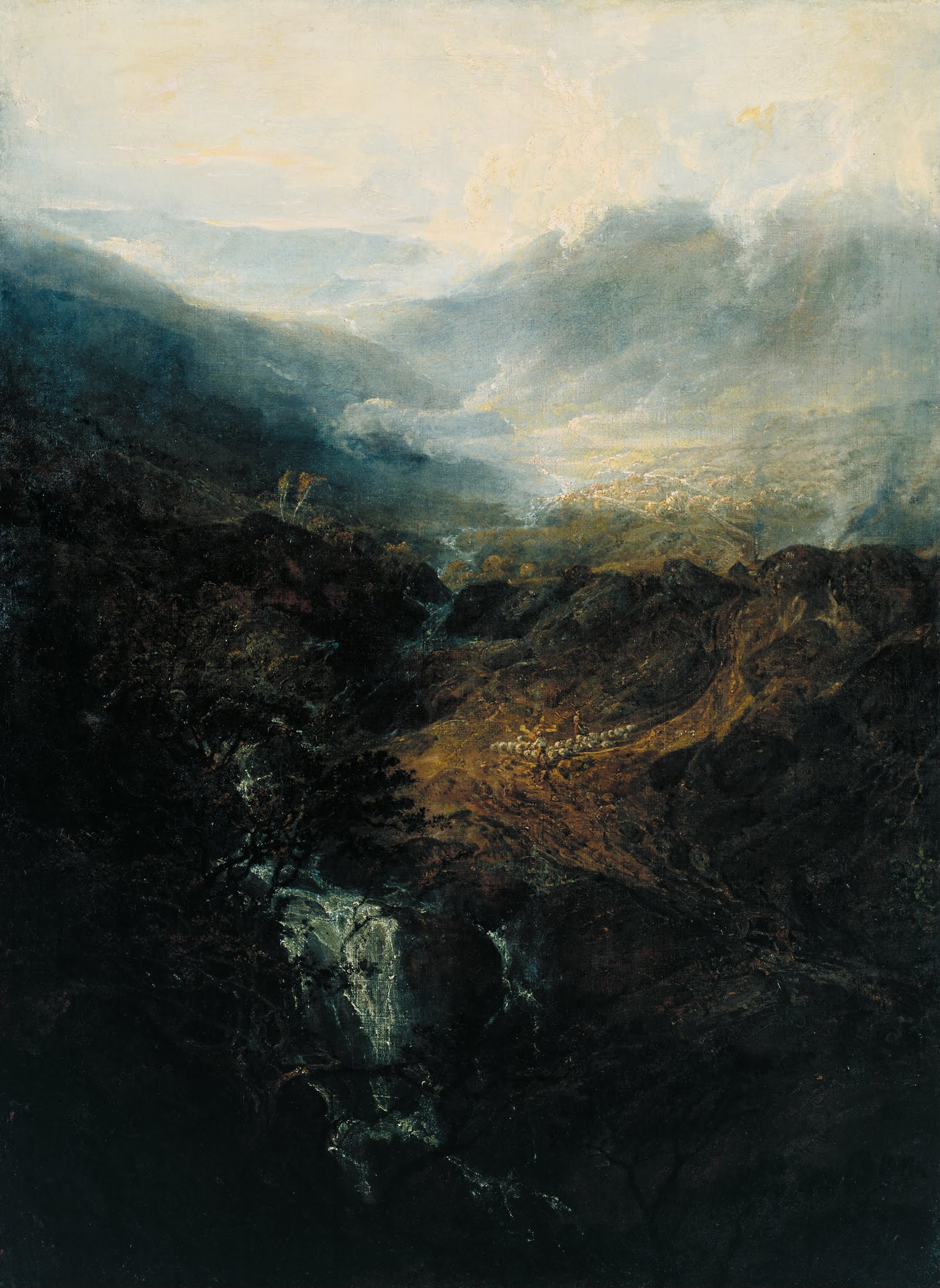
Turner used this opportunity early. In 1798 he exhibited Morning amongst the Coniston Fells with lines from Milton's Paradise Lost. Ruskin later treated this as the first of Turner's Academy mottoes. Mist, rising vapour and mountain dawn acquired an epic register through words associated with creation and elemental movement.[4]
Quotation was common among artists and became increasingly elaborate during the nineteenth century. It might indicate that a picture illustrated a literary episode, but it could instead deepen mood or suggest moral comparison. Later Academy practice confirms how writers from Shakespeare and Milton to Byron and Tennyson supplied a poetic aura for works that were not literal narrative scenes.[5]
Turner made the device unusually personal. He quoted named writers, altered their language, wrote prose explanations and eventually cited his own Fallacies of Hope. The authoritative name beneath a title could become unstable. Spectators had to decide whether text clarified what they saw or increased its mystery. In Turner's hands, the catalogue was not an instruction label but another field of composition.
Contents
- Reading a Painter
- The Academy and the Authority of Words
- The Verse Book
- An Eighteenth-Century Inheritance
- Homer and the Scale of Epic
- Virgil, Foundation and Exile
- Ovid and Transformation
- Scripture and Milton
- Shakespeare on the Academy Wall
- Byron and the Modern Traveller
The Verse Book
The object known as Turner's Verse Book contains writing associated chiefly with the years from about 1804 to 1812. It belongs to a period of rapid artistic expansion: Turner opened his own gallery, developed ambitious oils, worked on Liber Studiorum, travelled and became Professor of Perspective. Poetry was not an elderly eccentricity added after pictorial fame. It accompanied the construction of his mature identity.[1]
The writing includes fragments, descriptive passages, rhymes and attempts at longer structures. Turner tested how natural appearance might be verbalised and how art could be discussed in elevated form. Some lines remain difficult to transcribe because handwriting, cancellation and uncertain sequence resist smooth reading. A modern edited transcription is therefore an act of scholarship, not transparent access to a finished poem.
Wilton's study situates this material among Pope, Thomson, classical poets, eighteenth-century aesthetics and contemporary writing. Turner absorbed forms of descriptive and didactic verse in which landscape could reveal natural order, sensation and moral truth. His attempts often imitate the cadence and vocabulary of admired authors without mastering their verbal precision.
That limitation matters. To call every fragment a successful poem would patronise Turner by lowering literary standards. Yet private experimentation should not be judged as though the artist had submitted a polished volume for publication. The book records labour: searching for rhyme, revising phrasing and trying to make language carry the effects that paint could hold differently.
Its greatest value is historical. It demonstrates that Turner's later exhibition verses emerged from sustained practice. Fallacies of Hope did not suddenly appear as a joke in 1812. By then he had spent years exploring poetry as a companion to painting. Whether or not a unified work ever existed, the desire to make one had real foundations.
*Poetry as a Way of Thinking*
Turner's verse often circles the same forces that drive his images: sun, storm, sea, ruin, labour, fame, decline and deceptive expectation. The recurrence does not mean one medium simply translates the other. Poetry allowed causal and moral statements that a landscape could leave suspended. Painting supplied sensory intensity that Turner's syntax struggled to achieve.
Writing also offered a language for artistic theory. Around 1811 Turner entered verses on art into the endpapers of his copy of The Artist's Assistant. Painters, taste, imitation and worth became poetic subjects. Such work belongs beside his perspective lectures and old-master studies as an attempt to define what artists know and how judgement operates.[1]
Eighteenth-century didactic poetry made this combination plausible. A poem could describe natural phenomena while instructing readers in sensation, ethics or taste. Landscape was not empty scenery; it could stage the relation between human hope and larger processes. Turner adapted that model to a visual career in which weather repeatedly tests ambition.
The gap between his abilities becomes productive. Because Turner could not make verse behave as effortlessly as watercolour, writing reveals effort and intention with unusual directness. A clumsy line may name hope, blood or historical downfall more explicitly than a painting. It should not dictate interpretation, but it records associations present in the artist's thought.
The poems therefore deserve neither canonical elevation nor embarrassed dismissal. They belong to a workshop extending beyond brushes and pigments. Turner thought through borrowed language, half-finished lines and remembered rhythms. Literature was one of the materials from which he built pictorial meaning.
This activity also complicates the familiar claim that Turner was secretive. He guarded sketchbooks and unfinished experiments, yet selected verbal fragments for the most public art event in London. Private writing could become exhibition apparatus without the whole composition being disclosed. Turner controlled the threshold: enough language appeared to establish a theme, while its broader context remained in his possession or imagination.
Poetry may have helped him bridge solitary perception and collective culture. A weather effect seen on tour belonged first to one observer. Once associated with Thomson, Milton or Turner's own elevated diction, it entered a vocabulary that educated spectators could share. The words did not prove the truth of the observation. They gave private sensation a recognised social form.
An Eighteenth-Century Inheritance
Turner's literary imagination was formed substantially by eighteenth-century poetry. Alexander Pope offered formal control, classical reference and the idea that art could generalise nature. James Thomson's The Seasons made changing weather, rural labour and the annual cycle vehicles of sensation and moral reflection. Mark Akenside, John Langhorne and others joined landscape to philosophical inquiry.[1]
Thomson was especially useful to a British landscape painter. The Seasons moves among frost, harvest, storm, hunting, sunrise and social observation. Turner attached lines from Winter to Frosty Morning in 1813, connecting a directly observed Yorkshire road with a national poetic tradition. The quotation enlarged mood without turning the painting into a scene with fixed characters.[4]
Pope's disciplined couplets and cultural authority offered another standard. Turner copied, adapted and answered admired verse, sometimes revealing how far his own writing fell short of its finish. The point was not solely emulation. Familiar poetic language gave spectators a bridge between landscape and established intellectual culture.
Hope was also an inherited subject. Thomas Campbell's The Pleasures of Hope, published in 1799, presented hope through historical, political and emotional registers. Jerrold Ziff connected Turner's opposing phrase to Campbell and to language in Langhorne, though no single derivation resolves every use. Fallacies of Hope sounds personal because Turner repeated it, but its conceptual field was already public.[2]
This inheritance prevents a narrowly Romantic reading. Turner engaged Byron and Scott, yet his habits of citation, moral landscape and elevated diction were grounded in the previous century. Romantic novelty grew from an older culture of descriptive poetry. His work makes the transition visible: ordered language encounters revolutionary war, industrial change and increasingly unstable weather.
The inherited poets also gave him models of sequence. The Seasons unfolds cyclically; epic moves from trial towards consequence; poems of hope compare present suffering with imagined futures. Painting normally presents one field at once, but Turner could imply before and after through weather, ruin and title. A clearing storm remembers danger; a sunset makes prosperity temporary; a departing vessel carries an unseen destination. Literary time taught landscape how to exceed the instant.
This did not require spectators to identify every allusion. Familiar poetic culture worked at several levels. A reader might recognise a precise stanza, remember only a general mood or simply register that the catalogue conferred seriousness. Turner's art accommodates unequal knowledge. Detailed reading enriches the historical structure without becoming an entrance examination for visual experience.
Homer and the Scale of Epic
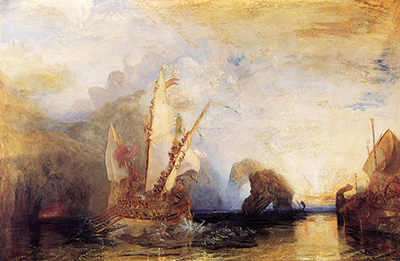
Homer gave Turner a world of voyage, danger, cunning and the uncertain relation between human heroes and elemental power. Ulysses deriding Polyphemus was exhibited in 1829 with a title identifying the Odyssey. The hero escapes the blinded Cyclops but endangers his crew by boasting. Turner makes the sea, light and towering figure of Polyphemus overwhelm any conventional heroic portrait.[33]
The choice demonstrates how epic can elevate landscape while landscape revises epic. Ulysses is present, yet difficult to locate. A viewer who approaches through the title searches the crowded vessel for the named protagonist. The delay is meaningful. Human confidence seems small within a radiant and threatening world, and the Cyclops merges with cloud and mountain.
Turner did not need to illustrate every stage of Homer's narrative. The painting condenses departure, taunt, danger and prophecy into one visual field. Words supply sequence that the image holds simultaneously. Light can be dawn, revelation and exposure; the sea is passage and possible punishment.
Robert Wood's eighteenth-century Essay on the Original Genius of Homer later supplied the epigraph printed at the front of the 1839 Academy catalogue. It argued that poet and painter awaken attention and return spectators to life with renewed curiosity. The quotation belonged to the institution rather than one Turner picture, but it names a principle central to his literary art.[9]
Homer therefore offered more than subject matter. Epic scale gave Turner a way to measure human ambition against natural and historical forces. The visual response remains intelligible without reading Greek or reconstructing every verse, while literary knowledge reveals why triumph in the painting already contains error.
Virgil, Foundation and Exile
Virgil's Aeneid sustained Turner across decades. Dido, Aeneas, Carthage, Cumae and the Golden Bough provided stories of foundation, departure, descent and imperial destiny. These subjects aligned with Claudean landscape and history painting, yet Turner repeatedly shifted emphasis from dramatic encounter to environment.[34]
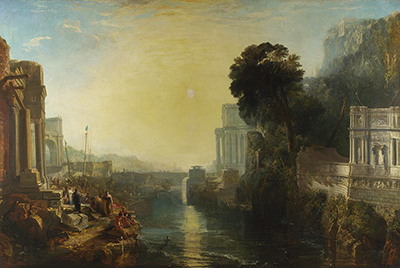
In Dido building Carthage, architecture, labour, shipping and sunlight dominate. The queen appears within the city she is founding, but no single gesture controls the work. Virgilian narrative becomes an urban process, and viewers who know Carthage's future destruction see rise and fall together. The painting's declared subject supplies historical time beyond the visible instant.
The Avernus story offered another structure. Virgil's sixth book sends Aeneas to the underworld under the Sibyl's guidance after he secures the golden branch. Turner returned to Cumaean terrain and prophetic figures in several works. In The Golden Bough, however, he removed Aeneas and allowed women, water, foliage and luminous distance to displace a conventional heroic centre.
Virgil could also enter through translation. Turner knew classical stories in an English literary culture where Dryden, Pitt and other translators shaped phrasing and emphasis. A quoted English line is evidence of mediation, not failure to engage the ancient text. Painting added another translation, changing temporal narrative into spatial relation.
Foundation and exile link Virgil to Turner's modern concerns. Empires build, flourish and decline; travellers leave homes; promised futures carry violence. The Aeneid allowed landscape to contain those contradictions. Turner did not merely clothe British scenes in classical prestige. He used epic history to make radiance morally unstable.
Ovid and Transformation
Ovid's Metamorphoses offered a different literary logic. Gods, humans, animals and elements change form; desire becomes landscape; punishment survives as natural feature. For an artist preoccupied with atmosphere and unstable boundaries, metamorphosis was both narrative subject and pictorial method.[35]
Apollo and the Cumaean Sibyl exemplify the complexity. Ovid recounts her request for as many years of life as grains of sand while she fails to ask for lasting youth. Turner places tiny figures within the Bay of Baiae, where ruins, water and warm distance make time physically expansive. The landscape does not simply decorate the bargain. It becomes the medium through which longevity, decay and surviving voice can be imagined.
Other Ovidian subjects include Glaucus and Scylla, Bacchus and Ariadne, Mercury and Argus, and episodes of divine pursuit. Turner could draw upon Titian, Claude and later painters alongside the text. Visual precedents already interpreted Ovid, so a formal quotation from an old master may be part of the literary response rather than an alternative to it.
Ovid also encourages ambiguity. A body can merge with cloud or water; narrative identity may remain uncertain at first sight. Such transformations resemble Turner's material handling, in which one colour field can become light, mist and distance. This does not make every blurred form Ovidian. It explains why metamorphosis provided a particularly productive imaginative grammar.
The stories allowed Turner to explore desire and consequence without making figures visually dominant. Place remembers what happened through altered nature. Literature supplies before and after; painting gives the unstable threshold between them.
Translation further complicates attribution. Turner may have read an English Ovid, encountered a story in a mythological handbook and studied paintings already shaped by earlier translations. Variations in names or episode could come from any point in that chain. The search for one decisive volume can therefore promise more certainty than the evidence supports.
What remains secure is his repeated attraction to change. Ovidian narrative legitimised a world in which stable identity gives way under pressure. Turner's water, cloud and light make that pressure visible without needing to turn paint itself into a literal metaphor for metamorphosis. Text and technique meet through a shared problem rather than a one-to-one code.
Scripture and Milton
Biblical subject matter appears from Turner's early career through the 1843 deluge pair. Plagues, Moses, Pilate, flood and apocalypse joined history painting to elemental landscape. Scripture carried exceptional authority, but it reached artists through sermons, translations, illustrated Bibles, old-master painting and English epic as well as direct reading.
Milton's Paradise Lost was especially important because it made creation, rebellion and cosmic darkness part of the national poetic tradition. Turner's 1798 Coniston motto associated a British mountain morning with Miltonic vapour and awakening light. The quotation raised topography towards epic without requiring the work to depict Eden literally.[4]
In 1835 seven designs after Turner appeared in Macrone's edition of Milton. Book illustration demanded more specific relation among episode, type and adjacent text than an Academy motto, but even here Turner's strength lay in landscape and atmosphere. The published designs belong to a collaborative volume rather than a private sequence conceived without editorial constraint.[26][38]
The 1843 pair Shade and Darkness - the Evening of the Deluge and Light and Colour - the Morning after the Deluge brings several verbal authorities together. Genesis provides destruction and renewal; Goethe's colour theory shapes the titles; Turner's own lines invoke hope and the ark. Circular movement and opposing colour make theory and scripture sensorial rather than merely explanatory.[31][32]
It would be a mistake to decide that one text is the exclusive key. Biblical narrative, Miltonic sublimity, colour theory and exhibition verse overlap. Turner valued the density. The words establish multiple scales - cosmic history, optical effect and moral hope - while paint refuses to separate them cleanly.
Shakespeare on the Academy Wall
Shakespeare gave Turner recognised characters and a testing ground for figure painting. In 1830 he exhibited Jessica with a line from The Merchant of Venice. Shylock's daughter appears at a window amid a broad yellow-gold field. The title and quotation identify her, while colour connects the work to a play obsessed with money, value, possession and desire.[6]
Most critics did not reward that ambition. The same quoted words became material for jokes about the figure and the overwhelming yellow. Because Gilbert Stuart Newton exhibited another Jessica nearby, reviewers could contrast Turner's indistinct, chromatically excessive heroine with a more conventional literary picture. Words that were meant to guide spectators intensified the charge that Turner had betrayed Shakespeare.
The episode reveals the risk of literary authority. Naming a canonical character creates expectations about body, expression, costume and narrative clarity. Turner supplied a field of colour in which character seems less stable than desire and value. Viewers could see radical interpretation or inadequate figure drawing, and many chose the latter.
Juliet and her Nurse in 1836 pursued another transfer. Turner set the Shakespearean pair high above a nocturnal Venetian festival, not in a literal reconstruction of Verona. Architecture, boats, lamps and crowds make the female figures almost subordinate to a city of performance and secrecy.[36]
Shakespeare therefore did not turn Turner into a theatrical illustrator. The plays provided names around which place and colour could reorganise drama. His failures and successes arise from that choice. Literature makes the human stakes legible, but the landscape painter refuses to let human anatomy possess the whole scene.
Byron and the Modern Traveller
Lord Byron gave nineteenth-century landscape a voice of travel, ruin, war, liberty and self-conscious historical feeling. Childe Harold's Pilgrimage moved through Europe while reflecting upon empire and personal disillusion. Turner found in it passages that could make observed places carry the accumulated weight of cultural memory.[21]
For The Field of Waterloo, Turner used Byron's lines about the aftermath rather than a triumphant military anthem. Women search among bodies after battle, and literary testimony directs attention towards suffering. At Rome and Venice, Turner borrowed other stanzas to frame ruins, sunset and divided time. The poet's traveller becomes a companion to the painter's touring eye.
Turner did not preserve wording with editorial fidelity. Modern Rome - Campo Vaccino adapts language whose immediate setting in Byron is Venetian. Approach to Venice changes a line and combines Byron with Samuel Rogers. Such relocation is deliberate artistic use. It makes memory and geography interfere, though modern discussion must identify the alteration rather than quote Turner as if he copied accurately.
The two men should not be made close friends without evidence. Turner illustrated Byron extensively in publishing ventures of 1832-34, after the poet's death in 1824. Some designs draw upon Turner's own travel; others depend on information or imagery supplied by artists who knew places he had not visited. The printed series created a posthumous collaboration through publishers and engravers.[21][22]
Byron mattered because his poems made looking historically self-aware. A sunset is never only meteorology when the viewer knows empires have occupied the shore. Turner translated that awareness into light, ruin and modern movement. The literary traveller did not replace direct observation; he changed what observation could remember.
Walter Scott and the Historical Landscape
Turner's professional association with Walter Scott began in 1818. Provincial Antiquities and Picturesque Scenery of Scotland brought text and images together around buildings, landscapes and national history. Issued in parts between 1819 and 1826, it involved several artists and engravers. The enterprise proved commercially disappointing and ended before fulfilling all its ambitions.[16]
The project nevertheless established a durable relation. Scott's poetry and prose had made Scottish places internationally legible through story. Turner could depict an abbey, castle or coast as observed terrain and as the setting of remembered conflict. Antiquarian evidence, picturesque composition and literary association reinforced one another without becoming identical.
In 1831 Turner travelled through Scotland gathering material for new editions of Scott's works and stayed at Abbotsford. The visit joined commission to personal encounter. Scott's failing health and death in 1832 gave later designs an elegiac pressure. Chiefswood Cottage includes an empty chair and writing furniture that make absence part of the sunny retreat.[10][12]
The 1833-36 poetical and prose editions eventually involved sixty-four steel engravings after Turner. Subjects range from intimate domestic places to ruins, rivers and immense Highland terrain. Dryburgh Abbey serves a textual function as a frontispiece while also organising the Tweed, woodland and distant country into an independent landscape meditation.[17][18][19]
Scott could prompt modern as well as medieval history. Staffa, Fingal's Cave carried lines from The Lord of the Isles, yet the visible steamer, geological formation and dangerous sea belong to contemporary tourism and scientific attention. Turner did not enter a sealed romance. He showed literary memory being reached by modern travel.
Samuel Rogers and the Illustrated Book
Samuel Rogers united several roles important to Turner: poet, collector, patron and social host. His Italy offered a cultured journey through places Turner had already studied directly. The richly illustrated edition of 1830 brought designs by Turner and Thomas Stothard into close relation with Rogers's text through the work of leading engravers.[13]
Turner's vignettes do not behave like rectangular plates inserted at a distance from reading. Their edges dissolve into the surrounding paper. A moonlit villa, harbour, bridge or mountain can emerge from white space and return to it. The form suits memory and travel, allowing a place to appear as poetic concentration rather than documentary inventory.[15]
The 1834 Poems extended the collaboration. Thirty-three designs after Turner appeared among illustrations involving Stothard, Flaxman and earlier artists. The volume combined poetry, notes, typography and images in a luxury object. Turner's authorship remained visible, but it existed within a carefully designed collective production.[14][25]
Rogers's writing sometimes supplied explicit episode and sometimes a mood or destination. Turner responded by condensing geography. A tiny image might contain a strong moon, a few architectural silhouettes and one moving boat, enough to open a much larger imagined world. The design neither repeats the poem nor floats free from it.
The books greatly expanded Turner's audience. Readers who could not purchase a watercolour or visit his gallery encountered his inventions bound with popular literature. Reproduction translated colour into black and white, but it also placed Turner's landscapes in domestic hands and within the repeated rhythm of reading.
That rhythm differs from gallery viewing. A bound volume controls sequence through turning leaves. An image may be anticipated by a heading, encountered beside a passage and revisited after later lines have changed its meaning. Readers can pause, compare and return in private. Turner's vignette becomes part of memory because it recurs within the physical act of handling a book.
Scale creates intimacy. The reader brings a small engraving close, seeing fine lines that would disappear across an exhibition room. Vast mountain, storm or harbour is compressed to hand-held dimensions without losing imagined extent. Turner's ability to suggest enormous space inside a few inches made him unusually suited to this culture of luxurious miniature illustration.
The original watercolour and published volume consequently address different publics. A collector might value the unique design for colour and touch; thousands of readers knew only the engraved translation. Later museums reunite these states and can tempt viewers to treat the watercolour as the final product. Historically, its destination was another object, where paper, ink, typography and poetry completed the commission.
Thomas Campbell and the Colours of Hope
Turner designed twenty published vignettes for the 1837 edition of Thomas Campbell's Poetical Works. The subjects include distant coasts, battles, historical figures, mountains, romance and scenes from The Pleasures of Hope. The group reveals how much narrative and geography Turner could compress into miniature form.[11]
The National Galleries of Scotland preserves the only set of these literary vignette watercolours kept together. Their colours are startling because the final engravings were monochrome. Ultramarine, red and luminous reserve communicate tonal hierarchy, atmosphere and material effect to the engraver. Colour functions partly as instruction and partly as an independent richness within the original designs.
Campbell's title has an unavoidable relation to Turner's Fallacies of Hope. Ziff identified the poem as part of the verbal field from which Turner's phrase may have developed. Yet an inversion does not establish one moment of borrowing. Turner encountered hope as a broad eighteenth-century theme, and his use changed across decades.[2]
The commission brought that conceptual opposition into productive proximity. Campbell's hope can survive political and historical suffering; Turner's recurrent hope is often tested or exposed as delusive. His images do not simply contradict the poems. They give hope terrain, weather and distance through which it must travel.
These vignettes also demonstrate professional discipline. Turner responded to selected passages, scale, publisher and engraving process while preserving his visual identity. Literary commission was not submission to words. It was a constrained form of invention in which readers, poet, painter and printmaker met.
The Vignette Decade
Between 1830 and 1839 Turner produced around 150 vignette illustrations for authors including Rogers, Scott, Byron and Campbell. The estimate places literary design near the centre of his 1830s practice. These were also years of major Academy paintings, European travel and increasingly controversial colour. Small book images and large public canvases developed together rather than occupying separate careers.[10]
The commissions demanded organisation. Publishers selected texts and formats; Turner gathered or adapted visual information; watercolours went to engravers; proofs returned for correction; plates entered books whose typography and schedules imposed further limits. A delay or misunderstanding could involve several businesses. The apparently effortless image was the end of a chain of negotiated labour.
The range is striking. Scottish abbeys and glens sit beside Mediterranean ports, Alpine valleys, battles, domestic retreats and imaginary structures. Turner could answer a specific location with topographical knowledge, but he could also build a poetic geography from secondary visual material. Authorship lay in the relation he created among forms, light and narrative emphasis, not always in first-hand witness.[22]
Literary design changed circulation. An Academy painting was visible for a season and perhaps afterwards in a private gallery. An illustrated volume travelled, was reread, given, resold and sometimes dismantled for its prints. Around 820 engravings after Turner appeared during his lifetime across all types of project, making reproduction one of the principal means by which his art became known.[24]
The decade also sharpened his skill at condensation. A reader turning from text to a tiny landscape received only seconds of immediate attention. Turner learned to establish atmosphere through a few decisive masses and a luminous interval. That economy did not reduce ambition. It made a miniature capable of suggesting distances and histories far beyond its physical size.
Book production also altered the calendar of artistic labour. Academy paintings faced an annual deadline and one intense period of public exposure. Illustrated projects unfolded across instalments, tours, proof stages and reissues. Turner could return to a plate after an engraver had translated it, discovering losses or new possibilities. This slower circulation made revision visible as a chain rather than a single act of finishing.
Publishers reused successful material. Plates could appear in later editions, portfolios or altered arrangements, separating an image from the exact textual position first intended. A literary design therefore accumulated afterlives while Turner was still working. Readers might encounter the same view under a new binding or without the surrounding poem. The mobility increased fame and weakened the idea that illustration possessed only one permanent context.
The Freedom of the Edge
Vignettes derive much of their effect from the absence of a hard rectangular border. Forms fade towards blank paper, which can act as sky, glare, mist or simply the untouched field around type. Turner understood that an edge need not stop an image. It could become a transition between seeing and reading.[13][15]
This openness changes composition. A conventional framed view establishes a window with four firm limits. A vignette must decide where a tower, cloud or bank becomes sufficient and where it should dissolve. Dark accents anchor the centre; lighter washes lead outward. The eye completes what the support leaves unstated.
White is therefore active. In a watercolour design it may be reserved paper, opaque bodycolour or a mixture of both. In engraving it becomes unprinted light. When the image sits among lines of text, that light is materially continuous with the reader's field. A moonlit river can seem to arise from the same sheet as the poem rather than occupy a separate inserted world.
Turner used brilliant colour even though final publication was monochrome. Hue helped distinguish tonal roles and communicate the desired force of light. A saturated blue might become darkness of a certain transparency; red could mark warmth or a focal accent. The watercolour was both instruction for another medium and a complete object with qualities the book could not preserve.[11]
Miniature scale also affects narrative. One or two figures may identify action, but weather and setting often carry emotion. A distant abbey implies time; a boat under moonlight implies departure; a mountain opening gives travel a destination. The vignette's freedom lies in incompleteness. It meets a text without needing to restate all that the reader already knows.
Engravers as Interpreters
Turner's published illustrations were collaborative works. Edward Goodall, William Miller, Robert Wallis, Henry Le Keux, John Pye, William Finden and other specialists translated watercolour into etched and engraved lines. Steel plates could hold fine detail and support substantial print runs, making them well suited to the expanding illustrated book market.[13][18]
Translation posed hard problems. Watercolour creates atmosphere through transparent stain, soft overlap and coloured contrast. Engraving works through incised line, dot, hatch and the white of paper. An engraver had to decide how a blue haze differed from a grey wall when both became black ink. Too much detail could kill luminosity; too little could make a place unreadable.
Touched proofs reveal Turner's involvement. He could ask for a distance to be lightened, a foreground strengthened, a rainbow widened or a silhouette corrected. Such intervention makes the proof an intermediate state rather than a failed copy. The image evolves through dialogue between the painter's intention and the engraver's technical judgement.[26]
Credit should consequently remain distributed. Turner originated the design and supervised many translations, but he did not cut every line. Publishers arranged finance and audience; authors supplied verbal structures; printers and binders made the physical volume. A book with his vignettes is a designed ensemble, not a folder of solitary Turner images accidentally accompanied by words.
Collaboration could also generate friction. Fees, deadlines, ownership of drawings and expectations about proof quality affected relationships. Yet Turner returned repeatedly to the process because engraving offered exceptional reach. His art entered libraries and parlours through the skill of interpreters whose names are often printed beneath the image but omitted from later retelling.
The proof stage makes Turner's visual intelligence unusually legible. A request to lighten a distance is not a cosmetic preference; it restores recession and protects the hierarchy of attention. Strengthening a dark foreground may make reserved paper seem brighter without changing the light itself. Widening a rainbow changes both meteorological form and compositional span. Corrections show him reasoning through another person's marks.
Engravers also made decisions Turner could accept. Their expertise in line and plate wear belonged to a craft he respected even when he supervised closely. The final print is neither a diminished painting nor an autonomous reinvention. It is a negotiated object whose success depends upon preserving relations across incompatible materials.
Travel Through Text
Literary commissions could send Turner into the landscape. The 1831 Scottish journey was planned around subjects for Scott's writings. At Abbotsford, ruins and Border country were no longer generic picturesque material; they belonged to an author's personal and imaginative geography. Turner then travelled beyond the house to sites where text, history and direct observation overlapped.[12][20]
Norham demonstrates the depth of that layering. Turner first visited the border castle in 1797, returned in 1801 and saw it again in 1831 while connected with Scott at Abbotsford. Scott's Marmion had made the fortress a poetic threshold, but Turner's attachment also grew through repeated light and viewpoint. Literature entered a place he already knew and altered what return could mean.[23]
Rogers's Italy worked differently. Turner had toured Italy in 1819-20 and again reached Rome in 1828. His illustrations could draw upon stored sketches and memories while following a poet's itinerary. The reader encounters a double journey: Rogers's verbal progress and Turner's reconstructed visual experience. Neither is a neutral guidebook.
Byron's Mediterranean world exposed the limits of first-hand travel. Turner had not visited every location required by the publishing programme. The Malta design, for example, is identified as after an unknown artist. He could transform another person's visual information into a composition, but that dependence must remain visible in the history of the work.[22]
Text therefore changes the meaning of travel. A commission selects destinations, a poem supplies associations and publication anticipates distant readers. Turner's observed geography was always partial, yet the combination of field study, memory and mediated knowledge made it imaginatively extensive. Accuracy mattered, but so did the ability to make a place answer the expectations of literature.
Literary tourism was itself a modern industry. Scott and Byron helped travellers approach ruins, lakes and coasts with scenes already in mind. Guidebooks, transport and prints converted poetic locations into destinations. Turner's designs participated in that economy while often exposing weather, distance and modern conveyance that complicated nostalgic expectation.
At Staffa, the steamer makes this tension explicit. Readers arrive imaginatively through Scott, while actual visitors approach through commercial maritime technology. At Abbotsford, the author's home becomes both lived environment and memorial object. Turner's landscapes show literature changing place in the world, not only place changing literature in the studio.
Titles, Quotations and Looking
Turner's Academy titles grew capable of carrying extraordinary verbal weight. A title might name location and weather, identify historical action, include technical detail, quote a poet or cite Fallacies of Hope. The words reached spectators through the catalogue before, during and after looking. They could turn visual uncertainty into active search.
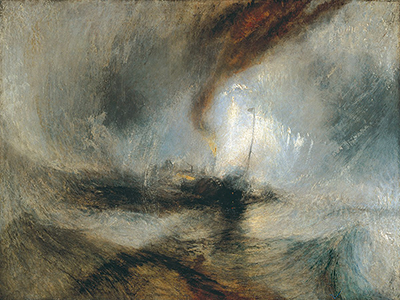
In Ulysses, the name makes viewers hunt for a hero who is not visually dominant. In Jessica, it imposes expectations that the figure struggles to satisfy. In Snow Storm - Steam-Boat off a Harbour's Mouth, the long title asserts a first-person experience and describes navigation by lead. Language does not simply label objects; it negotiates credibility.[8]
Quotation can establish temporal depth. Byron's lines at Waterloo ask spectators to see aftermath rather than national victory. Scott's words at Staffa join sea approach to historical romance. Thomson makes frost part of a poetic season. The quoted writer lends authority while Turner's arrangement determines how much of that authority survives unchanged.
Alteration is central. Turner modified Byron, shortened contexts and moved language between locations. Modern readers may be tempted to repair the wording silently. That would erase the artist's act. A changed line can reorient time of day, sharpen a rhyme or make a passage fit another place. Inaccuracy may be creative, mnemonic or strategic; its function must be considered case by case.
Words also expose their own limits. A catalogue can identify a ship, heroine or myth, but it cannot make a painted form optically clear. Turner used that tension. The viewer reads certainty and sees instability. Meaning begins in the gap between them.
Titles could also protect audacity. A turbulent surface that risked seeming incoherent acquired narrative legitimacy through a storm, deluge or ancient conflict. Conversely, an excessively elaborate title could provoke suspicion that language was compensating for unreadable paint. Critics repeatedly tested whether Turner's words and forms honoured each other.
The catalogue thus became part of reception rather than a neutral record. Reviewers quoted it, parodied it and used it to compare intention with execution. Words carried a painting into newspapers after the exhibition, sometimes more reproducibly than the image itself. Turner's verbal choices helped determine what later generations remembered about first display.
From Illustration to Transformation
“Illustration” covers several different relationships. A book vignette may be commissioned for a specified passage and placed beside it. An Academy painting may use a title from epic while restructuring the narrative. Another work may attach a quotation only to create atmosphere. Treating all three as literal depiction hides Turner's inventiveness.
His strongest responses transform emphasis. Dido building Carthage converts a queen's history into city, labour and sunlight. Ulysses shrinks heroic self-assertion within dangerous sea and sky. The Golden Bough removes Aeneas from the expected descent story. The literary narrative remains available, but landscape takes over work conventionally assigned to the figure.[33][34]
Transformation can also be geographical. Byron's Venetian sky contributes to Modern Rome. Rogers and altered Byron share Approach to Venice, making one arrival carry several acts of memory. A quotation does not pin a picture to the place where its original speaker stood. Turner treats words as portable, much as he carried sketches between journeys and studio.[21]
Visual traditions mediate the process. Ovid may arrive through Titian, Virgil through Claude, scripture through old-master painting and Milton. The resulting work answers a network rather than one isolated volume. Identifying a literary antecedent is the beginning of interpretation, not the end.
This freedom has boundaries. Turner could misjudge a figure or produce obscurity that critics reasonably found frustrating. Not every ambiguity is profound. Yet the repeated redistribution of narrative authority is too consistent to dismiss as accident. He made landscape think by allowing place, weather and light to perform actions that words had assigned to heroes.
Writing His Own Verse
Turner did not limit himself to borrowing. Hundreds of lines survive among his papers, though many are incomplete, difficult to date and challenging to transcribe. Subjects include art, nature, history, myth, travel and human expectation. The quantity establishes persistence even where literary quality remains uneven.[1]
Writing offered control over exhibition meaning. A quotation from Milton or Byron brings an independent author's prestige and context. A line attributed to Turner can be fitted to the painting and can claim that painter and poet are one imaginative authority. Fallacies of Hope gave private authorship the appearance of a larger continuing work.
His verse is strongest when concentrated around visual pressure. Storm, sunset, sea and blood can be joined through direct verbal association. Elsewhere elevated diction, inversion and strained metre make reading difficult. Turner had absorbed the sound of eighteenth-century verse without consistently controlling its grammar.
Contemporaries knew he cared. Their mockery often depends upon the seriousness of his claim: a celebrated painter appeared to demand literary recognition that readers did not believe he had earned. The imbalance between visual mastery and verbal awkwardness became part of his public character.
Yet words need not compete with paintings on equal terms. Their historical role is different. They record themes, establish catalogue encounters and reveal how Turner framed his own art. A weak poem can still be decisive evidence, provided it is not praised merely because a great painter wrote it.
The Problem of Fallacies of Hope
The phrase Fallacies of Hope entered Turner's public career in the 1812 Academy catalogue. Eleven lines accompanying Snow Storm: Hannibal and his Army Crossing the Alps were attributed to “M.S. P. Fallacies of Hope.” The title implied that spectators were reading an extract from a larger unpublished poem.[2][27]
Turner repeated the attribution over decades. Some exhibits supplied lines, others referred to the work without printing any. The formula became familiar enough to attract parody. It also offered flexibility: historical defeat, marine disaster, exile, empire and delusive beauty could all belong under one capacious title.
What Actually Survives
No continuous text bearing that title was found after Turner died. Jerrold Ziff concluded that Fallacies of Hope probably never existed as a particular unified body of poetry. That finding does not erase the securely printed catalogue verses or the many poetic fragments among Turner's papers. It separates evidence of writing from the claim of a completed epic.[2]
Several possibilities remain. The phrase may have named a projected work that never achieved unity. Turner may have used it as an umbrella for independent passages. It may have been a strategic fiction that made each new extract seem part of an accumulating philosophy. These explanations can overlap, and no surviving declaration settles the question.
The uncertainty may itself have suited Turner. A named but inaccessible poem gave him literary authority without submitting the whole to judgement. It also made painting the primary surviving embodiment of ideas that language promised but withheld. Spectators received a fragment and had to imagine the absent whole.
The initials “M.S. P.” strengthened that effect by presenting bibliographical form without access. They suggested a handwritten poem existing somewhere beyond the catalogue. Repetition across years made the fiction of continuity increasingly plausible, even when no reader could consult an original. Turner borrowed the apparatus of citation and turned absence into authority.
This strategy parallels his visual withholding. Tiny protagonists, dissolved boundaries and incomplete narrative cues require spectators to construct relations. Fallacies of Hope does verbally what many paintings do optically: it gives enough structure to direct inquiry but denies complete possession. The analogy does not prove deliberate deception. It explains why an unfinished or imaginary whole could remain useful for so long.
Modern discussion should resist romance. There is no need to invent a lost masterpiece consumed, hidden or destroyed. Nor should the repeated claim be dismissed as empty deception. Fallacies of Hope was real as a public attribution, recurrent concept and group of associated verses even if it was not real as one completed book.
Hope Under Pressure
Hope gave Turner a flexible moral structure because it points towards the future while remaining vulnerable to fact. In Hannibal, the general looks towards anticipated conquest as storm and avalanche threaten his army. Military confidence occupies one moment; viewers know the eventual course of empire. The landscape tests prediction.[27]
The Decline of the Carthaginian Empire makes the test political. Turner described Carthaginians surrendering arms and children in hope of peace while the sun spreads a portent over the western sea. Hope is not foolish because peace lacks value. It becomes fallacious because an enemy exploits the desire for it.[4]
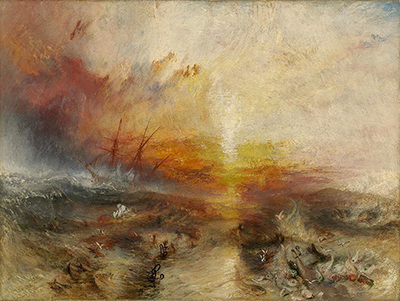
In Slave Ship, the catalogue lines move from approaching typhoon to the order that dead and dying captives be thrown overboard, then ask where hope's market is. Weather, insurance and human sale become inseparable. The word “market” turns philosophical abstraction towards a commercial system that prices lives.[7][28]
These examples do not create one doctrine. Turner did not attach the phrase to every disaster, and some works cited under it are lyrical or enigmatic rather than openly tragic. Hope can inspire action, sustain the traveller or make beauty possible. Its danger lies in concealment: what must be ignored to preserve a desired future?
Sunset often carries the pressure because it promises beauty while marking an end. Yet not every Turner sunset illustrates the concept. The recurrent association becomes meaningful only when title, verse, history or pictorial structure supports it. Otherwise “hope” risks becoming a universal explanation too broad to explain anything.
Late Painted Poems
Turner's late exhibition practice intensified the interaction among title, verse and colour. Slave Ship in 1840 joined an unusually forceful poetic extract to a modern history of slavery and insurance. The words identify human violence that the turbulent surface can be difficult to parse at first sight. Reading does not soften the painting; it makes its colour more ethically charged.[7][28]
In 1842 Peace - Burial at Sea and War: The Exile and the Rock Limpet formed a pair around death and historical memory. Turner attached his own lines. Peace commemorates David Wilkie through cool darkness and the shipboard funeral; War confines Napoleon beneath a hot sunset, whose colour Ruskin read in relation to blood.[29][30]
The pair shows how verbal contrast and chromatic contrast cooperate. Peace is not bright resolution, and war is not active battle. Blackness contains honour and grief; red contains isolation after power. The poems guide association while paint overturns conventional colour symbolism.
The 1843 deluge canvases are even denser. Their titles name Goethe's colour theory and Genesis, while appended verse invokes hope. Circular compositions make creation and destruction difficult to separate. The morning after catastrophe is luminous but not simply reassuring; the evening before it contains both darkness and gathering force.[31][32]
Later Venetian exhibits sometimes cited Fallacies of Hope without giving spectators actual lines. By then the attribution could operate as a signature of mystery. Critics saw pretension and evasion; admirers could see a continuing meditation. The missing words make late colour seem accompanied by an absent poem, but the paintings still have to carry the encounter themselves.
Prestige, Publicity and Commerce
Literary association served artistic ambition. Epic and canonical poetry helped landscape claim status within the Academy. A title invoking Homer, Shakespeare or Byron announced learning and invited critics to judge more than topographical fidelity. Turner's own poetic attribution claimed an even bolder unity of arts.
It also served publicity. Long titles and unusual quotations attracted notice in a crowded exhibition. Critics who mocked Jessica or Fallacies of Hope still repeated the words, extending Turner's presence through the press. Obscurity could be commercially risky, but recognisable eccentricity was part of reputation.
Illustrated books joined prestige to a different market. Rogers's elegant volumes, Scott's collected works and editions of Byron and Campbell placed Turner beside famous authors. Buyers acquired literature, typography and images as one designed object. Subsequent portfolios and impressions allowed the engravings to circulate beyond their first bindings.[14][25]
These motives do not make the engagement cynical. Turner could care deeply about a poem and understand that its name sold books. Publishers could value his artistry and his market power. Nineteenth-century cultural production depended upon such combinations. The painter's literary life was intellectual, social and economic at once.
The strongest evidence of sincerity is labour. Turner travelled, produced scores of designs, corrected proofs and returned to texts across decades. Public attention may explain why literature was useful; it does not explain away the sensitivity with which he could turn a few lines into a new visual world.
Literary networks also brought access. Rogers's breakfasts connected artists, writers, politicians and collectors; Scott joined publishing power to historical scholarship and celebrity. A commission could lead to travel, introductions and new patrons. Turner was not merely borrowing prestige from authors. He was participating in a cultural economy where conversation, ownership and reproduction helped works acquire meaning.
The exchange moved both ways. Turner's images changed how readers imagined poems and places. An edition illustrated by him gave an author renewed visual identity and commercial distinction. Painter and writer did not contribute equal media to one fixed message; each altered the reception of the other.
Ridicule and Misreading
Turner's literary ambition gave critics an exposed target. Inconsistent spelling and strained verse seemed especially comic beside his enormous visual reputation. Reviewers could imply that obscure paintings resulted from confused writing, making verbal difficulty a diagnosis of artistic decline.[38]
The 1830 response to Jessica shows criticism using literature as a weapon. Shakespeare's quotation was repeated to mock the mustard-yellow field and the heroine's appearance. Comparison with Newton's more conventional treatment allowed reviewers to claim that Turner had libelled the playwright. The attack policed both figure painting and acceptable interpretation.[6]
Late works drew broader parody. Punch played upon Fallacies of Hope, and Venetian titles could seem like private jokes imposed upon the public. Thornbury later concluded that Turner felt and painted poetry but could not write it. The judgement preserves an important distinction while hardening it into humiliation.[38]
The Art-Union even feared that poor verses might have exerted a harmful influence on the painter's mind. Such reactions reveal assumptions about disciplinary boundaries. A painter might quote a recognised poet, but claiming poetic authorship invited scrutiny from readers who denied him that status.
Not all criticism was unfair. Turner's writing can be difficult for reasons beyond hostile prejudice, and some catalogue combinations genuinely frustrate. The proper correction is not to pronounce every line brilliant. It is to ask what the words did historically: how they shaped looking, attracted satire and exposed the risks of an artist refusing to remain within one medium.
Ruskin Reads Turner
John Ruskin took Turner's literary and mythological seriousness more fully than most early critics. He read titles, catalogue quotations, classical narratives and scripture as integral to the works. This attention helped rescue Turner from the claim that late colour represented only technical eccentricity or failing sight.[4]
Ruskin did not pretend the verse was great poetry. Discussing the Fallacies lines, he acknowledged that they were not poetically brilliant while arguing that they disproved extreme claims of illiteracy. Their value lay partly in intention. A line could show that Turner meant a sky as stormy or associated sunset red with blood.
His reading of War is exemplary. Turner's verse supports an association among Napoleon, sunset and a sea of blood. Ruskin uses verbal evidence to anchor moral interpretation of colour. The argument is persuasive because text and image converge, but it remains criticism rather than a transcript of every thought Turner held.[30]
Ruskin also brought his own symbolic systems. He could develop elaborate readings of myth and natural form that exceed what Turner documented. Respect for his insight requires preserving that distinction. A critic may reveal possibilities the painter made available without proving a single authorised meaning.
The larger achievement was methodological. Ruskin refused to choose between optical truth and literary thought. Clouds, waves and geology mattered in exact physical terms, while myth and poetry organised moral imagination. That union remains essential to reading Turner without reducing him either to illustrator or abstract colourist.
Literature and Turner's Legacy
Twentieth-century admiration often privileged works that seemed to anticipate abstraction. Unfinished colour studies and dissolved late surfaces could be detached from titles, exhibition contexts and narrative. Literature then appeared as an embarrassment: old-fashioned wording attached to paintings whose modernity supposedly lay in escaping representation.
Restoring texts changes that account. Slave Ship becomes inseparable from abolitionist debate and Turner's market language. The deluge pair joins colour theory to Genesis. Venetian radiance carries Byron, Rogers, tourism and historical decline. Literary context makes formal experiment more, not less, radical because colour is shown doing intellectual work.
The opposite danger is over-decoding. A myth, poem or quotation does not turn every pigment into a fixed symbol. Turner frequently changed his materials of reading, and visual ambiguity remains active. The title may tell us who or where, but it cannot exhaust how the painting moves between recognition and sensation.
Book illustrations add another legacy. They demonstrate that Turner addressed readers as well as gallery spectators and that monochrome reproduction was central to his public reach. Their collaborative authorship challenges the image of a solitary visionary. Publishers, engravers, poets and printers helped carry his landscape language through nineteenth-century culture.[24][37]
They also preserve an alternative account of late Turner. The same artist who could make an Academy canvas appear almost unbounded was capable of minute architectural precision, calibrated tonal instruction and close editorial response. Radical colour did not arise from inability to describe. It coexisted with disciplined service to print and text.
That coexistence weakens linear histories in which Turner steadily abandoned narrative for pure sensation. Literary engagement intensified during the very decades most associated with optical liberation. His modernity lies partly in holding several systems together: mass reproduction and unique watercolour, old epic and steam travel, canonical quotation and private verbal invention.
Turner's own verse occupies a humbler but necessary place. It records effort, ambition and recurrent ideas without requiring admission to the poetic canon. Fallacies of Hope remains compelling precisely because the promised whole is absent. It names a horizon against which separate pictures and lines can be tested.
Literature gave Turner more than stories to paint. It gave him ways to organise time, attach landscape to history, travel through places, argue for status and reach a mass audience. He answered words by altering them. The resulting art is neither illustration alone nor poetry made visible. It is a continuing negotiation in which language points, paint transforms and neither has the final word.
Discussion
How did Turner use literature as a source, a public frame and a material to transform rather than merely illustrate?
Reader Insights
Where does a title or borrowed line clarify a painting, and where does it deliberately leave interpretation open?
How do vignettes, engravers and letterpress complicate the idea of Turner as a solitary author?
What historical value can uneven surviving poetry retain without being inflated into a lost masterpiece?
Join the Conversation
Share a close observation or a source-based question for other readers.
References
- Andrew Wilton, *Painting and Poetry: Turner's Verse Book and His Work of 1804-1812*, Tate Gallery, 1990, https://books.google.com/books/about/Painting_and_Poetry.html?id=eQRGAQAAIAAJ
- Jerrold Ziff, “John Langhorne and Turner's 'Fallacies of Hope',” *Journal of the Warburg and Courtauld Institutes* 27, 1964, https://doi.org/10.2307/750532
- National Gallery, Judy Egerton, Turner catalogue biography, https://www.nationalgallery.org.uk/paintings/catalogues/egerton-2000/joseph-mallord-william-turner
- John Ruskin, *The Turner Collection at the National Gallery*, Library Edition vol. 13, https://www.lancaster.ac.uk/media/lancaster-university/content-assets/documents/ruskin/13Turner.pdf
- Royal Academy Summer Exhibition Chronicle, “1853: Literary Quotations in the Summer Exhibition Catalogue,” https://chronicle250.com/1853
- Royal Academy Summer Exhibition Chronicle, David Solkin, “1830: Turner in Trouble; Or, The Jousting Jessicas,” https://chronicle250.com/1830
- Royal Academy Summer Exhibition Chronicle, Amy Concannon, “1840: Turner 'out-Turnered',” https://chronicle250.com/1840
- Royal Academy Summer Exhibition Chronicle, Martin Postle, “1842: Snowstorm and Sanctuary,” https://chronicle250.com/1842
- Royal Academy Summer Exhibition Chronicle, Cora Gilroy-Ware, “1839: Henry Howard and J.M.W. Turner,” https://chronicle250.com/1839
- National Galleries of Scotland, Joseph Mallord William Turner feature, https://www.nationalgalleries.org/art-and-artists/features/joseph-mallord-william-turner
- National Galleries of Scotland, Thomas Campbell Vignettes collection, https://www.nationalgalleries.org/art-and-artists/collections/thomas-campbell-vignettes
- National Galleries of Scotland, Turner, *Chiefswood Cottage, Abbotsford*, D NG 859, https://www.nationalgalleries.org/art-and-artists/19215
- Metropolitan Museum of Art, Samuel Rogers, *Italy, A Poem*, 1830, 1991.1037, https://www.metmuseum.org/art/collection/search/356367
- British Museum, Samuel Rogers, *Poems*, 1834, 1856,0510.1221, https://www.britishmuseum.org/collection/object/P_1856-0510-1221
- British Museum, Turner and Goodall, *A Villa on the Night of a Festa di Ballo*, 1849,0512.739, https://www.britishmuseum.org/collection/object/P_1849-0512-739
- Metropolitan Museum of Art, Scott, *Provincial Antiquities and Picturesque Scenery of Scotland*, 1826, 51.648.4, https://www.metmuseum.org/art/collection/search/356871
- Metropolitan Museum of Art, *Scott's Prose Works. And Poems*, 27.87.5, https://www.metmuseum.org/art/collection/search/376384
- Morgan Library, *Sixty-four engravings illustrating the poetical and prose works of Sir Walter Scott*, PML 146530, https://www.themorgan.org/printed-books/349728
- British Museum, Turner and Miller, *Dryburgh Abbey*, 1849,0512.705, https://www.britishmuseum.org/collection/object/P_1849-0512-705
- Turner's House, *Miniature Lands of Myth and Memory*, 2019 exhibition record, https://turnershouse.org/blog-post/first-exhibition-opens-at-turners-house-miniature-lands-of-myth-and-memory/
- David Blayney Brown, *Turner and Byron*, Tate Gallery, 1992, https://books.google.com/books/about/Turner_and_Byron.html?id=vJhPAAAAMAAJ
- British Museum, Turner after another artist, *Malta*, Byron illustration, 1849,0512.727, https://www.britishmuseum.org/collection/object/P_1849-0512-727
- National Galleries of Scotland, *Norham Castle, Sunrise* exhibition record, https://www.nationalgalleries.org/exhibition/norham-castle-sunrise
- Manchester University, *J.M.W. Turner's Prints*, https://jmwturnersprints.manchester.ac.uk/
- British Museum, Turner and Rogers *Poems* print portfolio, 1849,0721.2159-2178, https://www.britishmuseum.org/collection/object/P_1849-0721-2159-2178
- Rawlinson, *The Engraved Work of J. M. W. Turner, R.A.*, vol. 2, Getty Research Institute scan, https://upload.wikimedia.org/wikipedia/commons/4/40/The_engraved_work_of_J._M._W._Turner%2C_R.A._%28IA_gri_33125001464789%29.pdf
- Tate, Turner, *Snow Storm: Hannibal and his Army Crossing the Alps*, N00490, https://www.tate.org.uk/art/artworks/turner-snow-storm-hannibal-and-his-army-crossing-the-alps-n00490
- Museum of Fine Arts Boston, Turner, *Slave Ship*, 99.22, https://collections.mfa.org/objects/31102
- Tate, Turner, *Peace - Burial at Sea*, N00528, https://www.tate.org.uk/art/artworks/turner-peace-burial-at-sea-n00528
- Tate, Turner, *War: The Exile and the Rock Limpet*, N00529, https://www.tate.org.uk/art/artworks/turner-war-the-exile-and-the-rock-limpet-n00529
- National Gallery of Art, Turner, *Light and Colour (Goethe's Theory)*, 1986.6.1, https://www.nga.gov/artworks/115947-light-and-colour-goethes-theory-morning-after-deluge-moses-writing-book-genesis
- Tate, Turner, *Shade and Darkness - the Evening of the Deluge*, N00531, https://www.tate.org.uk/art/artworks/turner-shade-and-darkness-the-evening-of-the-deluge-n00531
- National Gallery, Turner, *Ulysses deriding Polyphemus*, NG508, https://www.nationalgallery.org.uk/paintings/joseph-mallord-william-turner-ulysses-deriding-polyphemus-homers-odyssey
- National Gallery, Turner, *Dido building Carthage*, NG498, https://www.nationalgallery.org.uk/paintings/joseph-mallord-william-turner-dido-building-carthage
- Tate, Turner, *The Bay of Baiae, with Apollo and the Sibyl*, N00505, https://www.tate.org.uk/art/artworks/turner-the-bay-of-baiae-with-apollo-and-the-sibyl-n00505
- Tate, Turner, *Juliet and her Nurse*, N00519, https://www.tate.org.uk/art/artworks/turner-juliet-and-her-nurse-n00519
- James Hamilton, ed., *The Turner Collection from the British Museum*, 2002, https://www.britishmuseum.org/sites/default/files/2019-10/Turner_collection_book.pdf
- G. Walter Thornbury, *The Life of J. M. W. Turner, R.A.*, 1862, https://upload.wikimedia.org/wikipedia/commons/6/63/The_life_of_J._M._W._Turner%2C_R.A.%3B_founded_on_letters_and_papers_furnished_by_his_friends_and_fellow_academicians_%28IA_gri_33125004491185%29.pdf