 by Tom Gurney
Tom Gurney BSc (Hons) is an art history expert with over 20 years experience
Published on June 19, 2020 / Updated on August 29, 2026
Email: tomgurney1@gmail.com / Phone: +44 7429 011000
Introduction
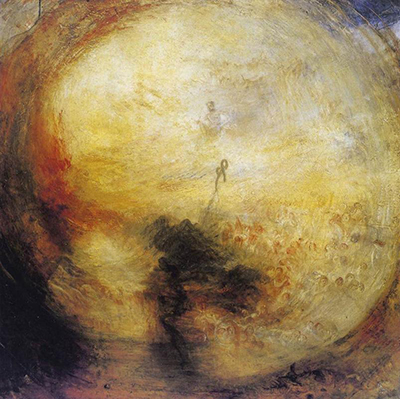
The complete exhibited wording joins three clauses: Light and Colour (Goethe's Theory), the Morning after the Deluge, and Moses Writing the Book of Genesis. The work seems at first to offer almost nothing but radiance. A great pearl-white and yellow field expands across the square canvas. Orange, red and brown gather around its perimeter, with smaller passages of blue and green interrupting the warmth. Only after the eye adjusts do the painting's actors begin to emerge. A tiny bluish figure hovers above the centre. Below him stands a dark upright form wound by a serpent. Faint heads, bodies and animal-like shapes surface through the luminous haze, then lose their identities again.
Turner's unusually long title is essential. Its first clause names colour and Goethe's theory; its second places the scene on the morning after the biblical Flood; its third identifies the minute figure as Moses writing Genesis. These are not three alternative explanations. Turner makes them coexist. The returning sun produces colour, the ruined world reflects its dead, and the future author of the event appears inside the event he will record.
The painting is an oil on canvas measuring 78.7 by 78.7 centimetres. Turner exhibited it at the Royal Academy in 1843, where it carried catalogue number 385. Accepted for the nation under Turner's 1856 Bequest, it is now Tate N00532.[1][2] Its intended companion is Shade and Darkness - the Evening of the Deluge, N00531. Tate identifies the pair as a warm and cool opposition related to the emotional associations in Goethe's Theory of Colours.[3]
Morning does not bring simple reassurance. Turner's accompanying verse calls the colour-bearing bubbles hopeful, then compares them to a summer insect that rises, expands and dies.[4] The reddish forms caught in their iridescence are those lost in the Flood. Light reveals, but what it reveals is mortality. In this work, creation and destruction are not sequential opposites. Each is carried within the other.
At a Glance
- ArtistJoseph Mallord William Turner
- Full exhibited titleLight and Colour (Goethe's Theory) - the Morning after the Deluge - Moses Writing the Book of Genesis
- ExhibitedRoyal Academy, 1843
- Catalogue number385
- MediumOil paint on canvas
- Dimensions78.7 × 78.7 cm
- CollectionTate
- AccessionN00532
- ProvenanceTurner Bequest, accepted 1856
- PendantShade and Darkness, Tate N00531
Joseph Mallord William Turner was sixty-eight when he exhibited Light and Colour in 1843. The work belongs to the final decade of his career, a period in which he repeatedly used compact square canvases, circular movement, elaborate literary titles and increasingly conspicuous surfaces. The canvas is physically square, although an 1843 reviewer described it and its companion as octagon-shaped. Its imagery is dominated by a broad circular field contained within that stable outer geometry.[15][20]
The central figure is extremely small relative to the light around him. Moses appears as a blue-grey mark just above the middle, his head and upper body only partly separated from the surrounding atmosphere. Beneath him, a dark line rises and bends. Tate identifies this as the brazen serpent raised on a pole during the Israelites' wilderness journey, an instrument of healing described in Numbers.[3][6] A darker triangular zone below may evoke Ararat, while Turner's own verse states that the ark rests there. The vessel itself is not securely bounded as a separate object.
Across the right and lower parts of the circle, reddish touches repeatedly approach human or animal form. Some become faces, open mouths or inclined heads; others resemble fragments caught inside vapour. The verse calls them the earth's lost forms returned in prismatic guise.[4] They are therefore memories or reflections of lives destroyed by the Deluge rather than a crowd of straightforward survivors.
The colour field is warm but not uniform. White occupies much of the upper centre, yellow thickens towards the surrounding ring, and orange-red bends along the left and bottom edges. A cool blue wedge appears at upper right; green-blue and dark earth colours press into the lower left. The circle is neither sealed nor symmetrical. Colour enters it, contaminates it and continually changes its apparent depth.
Even the scale is unstable. The pale form can feel like a sun occupying a sky, a bubble floating before the eye, an enormous eye looking back, or a complete atmosphere wrapped around Moses. None of these possibilities accounts for every detail. Turner's strength lies in making one painted structure carry celestial, microscopic, physiological and symbolic meanings without settling into a single diagram.
Contents
- Introduction
- At a Glance
- What the Eye Finds
- The Morning After the Flood
- Moses Out of Time
- The Brazen Serpent
- Prismatic Forms and Ephemeral Hope
- A Pendant of Morning and Evening
- Goethe's Plus Colours
- Moses Harris and the Painter's Circle
What the Eye Finds
From a distance, the work is almost heraldic: a luminous disc set within a square, edged by warm colour and marked at its centre. Closer inspection reverses that clarity. The disc has no clean boundary. Pale paint feathers outward into brown, grey and red, while darker strokes cross its apparent surface. What seemed geometrically simple becomes meteorological and material.
Moses is placed where a conventional composition might establish its principal incident, but he does not command it. The yellow field is so large and the figure so slight that the viewer may overlook him even after reading the title. His body appears suspended rather than securely standing. A cool tone separates him from the warmth, yet that distinction is fragile. He is both the named protagonist and a vulnerable mark inside a much greater optical event.
The serpent and pole are easier to recognise once Tate's identification is known. The upright dark accent rises just below Moses and curves near its top. It anchors the otherwise diffuse centre, but it also introduces unease. A snake ordinarily signifies danger, temptation or death; here its image becomes a means of preserving life. Turner places that reversal at the focal point of a world simultaneously recovering from destruction and displaying the dead within light.[3][6]
The lower central mass is more uncertain. Dark paint forms an inclined, mountain-like shape, with irregular horizontal and vertical accents embedded in it. The title establishes the morning after the Flood, and Turner's lines state that the ark stands firm on Ararat.[4] It is reasonable to associate this zone with mountain and vessel, but the forms are too compressed to separate one confidently from the other. Turner gives the fact of landfall without constructing a legible panorama.
The most disquieting discoveries occur around the luminous ring. Faint reddish-brown strokes become profiles and staring heads, especially towards the right. Some seem to press against the circular atmosphere from within. Others dissolve when attention shifts. Linda Shires observes that Turner's Deluge forms change identity according to viewing position, making perception an active contribution rather than a passive reception.[9] Here the process turns recollection into an unstable visual act: the lost can be seen, but not recovered.
Colour does not merely surround these signs. It makes and unmakes them. A red stroke supplies the edge of a cheek, then extends as vapour. A dark touch reads as an eye before joining a broader shadow. Pale scumbling veils one figure and releases another. The experience resembles looking for images in cloud, except that the title and verse make the search morally charged. Each possible body belongs to a catastrophe whose aftermath is being transformed into beauty.
The Morning After the Flood
Genesis describes the Flood as both destruction and a second beginning. After the waters have covered the earth, the ark comes to rest on the mountains of Ararat. The water gradually recedes; Noah sends out birds; the occupants leave the vessel; and Noah offers sacrifice. God establishes a covenant with Noah, his descendants and every living creature, promising that a flood will not again destroy all life. The rainbow becomes the sign of that covenant.[5]
Turner selects no single episode from this sequence. There is no clearly staged disembarkation, no orderly procession of animals and no monumental Noah receiving divine speech. Instead, he joins several aftermaths. Ararat has emerged. The returning sun draws moisture upward. Colour appears through refracted light. The dead return as reflections. Moses, who belongs far in the future, records what has happened. The whole painting behaves like a memory formed at the moment the world begins again.
The absence of a conventional rainbow is important. Turner fills the circular field with prismatic transitions rather than placing a discrete coloured arc in the sky. The covenantal sign seems dispersed across vapour and reflection. Red, yellow, blue and green do not form a stable band; they migrate through the bubble-like atmosphere. The rainbow's promise is present as a principle of colour, yet the work refuses to let that promise become visually uncomplicated.[9]
Noah's survival is equally indirect. The ark is named in the verse, not isolated in the oil. The patriarch himself is absent or unrecognisable. Turner concentrates on the conditions through which renewed life can be perceived: light, water, vapour, colour and written history. The morning is thus less a celebration of one family's rescue than an inquiry into how a devastated world becomes visible and meaningful again.
This choice changes the emotional register. Traditional Flood imagery often divides its action between the safe vessel and bodies struggling outside it. Turner's evening companion still carries traces of that contrast. The morning work begins after the physical contest has ended, but it refuses to leave its victims behind. Their forms are suspended throughout the glowing air. Survival and recollection occupy the same field.
The painting also recalls the first creation. Genesis begins when light is called into darkness and distinctions are established between day and night, water and land. The postdiluvian world undergoes a related separation as water retreats and dry ground returns.[5] Turner adds a third genesis: colour appears between light, darkness and the perceiving eye. Moses writes a book whose name means beginning while the image enacts several beginnings at once.
Moses Out of Time
Moses did not witness Noah's Flood within biblical chronology. Genesis places many generations between the two patriarchs, while Moses's life and the exodus from Egypt belong to the later books of the Pentateuch. The brazen serpent belongs later still, during the Israelites' wilderness journey in Numbers. Turner therefore introduces not one chronological displacement but several.
An 1843 critic seized on this apparent problem. The Times, preserved through a later scholarly transcription, mocked the anachronism of making Moses present after the Deluge.[17] That response assumes a history painting should reconstruct one coherent instant. Turner's title does something more difficult. It places an event beside the act through which that event enters sacred history.
Moses was traditionally regarded as the author of Genesis and the other first five books of the Bible. Turner's title works within that attribution. It should not be turned into a modern claim that one historical individual directly composed the received text in its present form. What matters for the painting is the cultural authority of Moses as lawgiver, prophet and writer of origins. He gives catastrophe a place in a continuing account.
Nicholas Mirzoeff describes the temporal construction as a kind of future perfect: Moses will have written Genesis.[14] The figure is simultaneously later than the Flood and visually inside its aftermath. The event already contains its future remembrance. History is shown not as a transparent view into the past but as an act of inscription performed from another time.
This helps explain Moses's strange scale. He does not dominate the landscape like a conventional author commanding his material. He is nearly absorbed by the vision he records. The light that permits writing also threatens to erase the writer. His cool body and dark implement are small interruptions inside a field of colour that exceeds human control.
Writing, looking and painting become analogous without becoming identical. Moses converts revelation into words; Turner converts scripture and colour theory into oil; viewers reconstruct both from fugitive signs. The tiny central action gives intellectual order to the work, but it never fixes all its meanings. Record and uncertainty begin together.
The Brazen Serpent
The central serpent introduces another biblical cycle of punishment and preservation. In Numbers 21, Israelites travelling through the wilderness complain against God and Moses. Venomous snakes enter the camp and many people die. After the people repent, Moses is instructed to make a serpent and raise it on a pole. Those who have been bitten can look at the image and live.[6]
The sign is paradoxical. A likeness of the agent of death becomes an instrument of healing. It does not remove the snakes or undo the bites; it changes the result of looking. That structure is particularly suited to Turner's painting. The canvas contains images of the drowned within the brilliance of renewal. What killed becomes what must be contemplated, and vision becomes the condition through which destruction may lead towards life.
Christian interpretation added a further temporal dimension. In the Gospel of John, the lifting of the serpent is compared with the future lifting of the Son of Man.[6] The motif consequently became a traditional prefiguration of the Crucifixion and salvation. Princeton University Art Museum notes that this association made the brazen serpent an appropriate subject beside Calvary in Christian altarpieces.[7]
Turner's central sign can therefore join several rescues. The ark preserves life through water; the brazen serpent preserves Israelites from venom; the Christian type points towards redemption through the Cross. Each depends on an image raised into visibility. Yet the faint drowned forms around the circle prevent these meanings from cancelling historical suffering. Salvation has a centre, but loss remains distributed everywhere.
The serpent should not be confused with the snake of Eden, although the proximity of Genesis makes that association understandable. Tate's identification is specific: this is the wilderness brazen serpent.[3] Nor is it simply a symbol of the Flood, as the Spectator guessed in 1843.[15] Its exact narrative origin strengthens the painting's deliberate anachronism and expands the morning after Noah into a much longer sacred history.
The pole also resembles a pen or brush. That visual echo cannot prove that Turner intended a private equation, but it fits the work's concentration on making signs. Moses raises, writes and records; Turner draws a dark line through light. The smallest material accent carries law, medicine, prophecy and artistic action.
Prismatic Forms and Ephemeral Hope
Turner attached five lines to the painting in the Royal Academy catalogue. They begin with the ark firm on Ararat and the sun returning after the Flood. Heat draws humid bubbles from the earth. Those bubbles compete with light by reflecting lost forms in prismatic colours. They are called heralds of hope, but they last only as long as a summer fly that rises, expands and dies.[4]
The words guide close looking. The vast circle can be understood as a magnified bubble or an atmosphere filled with many bubbles. Its colour arises through moisture and reflection rather than from solid local objects. The faint heads around its rim correspond to the lost forms. Turner's painted ambiguity is therefore anchored in a precise poetic conceit: dead life appears momentarily on an iridescent surface.
Goethe discussed colours visible through turbid media, prismatic boundaries and iridescent effects. His approach repeatedly joined physical observation to the activity of the eye.[8][23] Turner does not reproduce an experiment as a classroom illustration. He enlarges optical transience until it becomes the environment of a biblical history.
The phrase "emulous of light" is especially rich. To emulate can mean to rival, imitate or strive to equal. The bubbles imitate the sun's brilliance, while Turner's pigments imitate luminous colour. Neither possesses light itself. Paint reflects illumination from its surface, just as the humid bubbles reflect the dead within the poem. The work quietly acknowledges that art's radiance is made from material colour.
Hope is equally unstable. The verse first gives the prismatic forms a hopeful function, then extinguishes them in its final movement. A summer fly rises and expands, but its life is brief. The brightness of the canvas can consequently be experienced as both generous and cruel. It grants another appearance to the lost while confirming that the appearance cannot last.
Turner credited the lines to Fallacies of Hope, M.S., an attribution he appended to verses beside many exhibited works. No continuous poem with that title was found among his papers. Jerrold Ziff argued that it probably never existed as one completed work, although Turner certainly wrote poetry and repeatedly used the phrase.[18] The attribution should therefore be understood as part of Turner's public poetic persona, not a surviving epic from which the lines can be restored to a larger context.
The phrase nevertheless provides a powerful frame. Hope is not declared false in every form; it is shown to be vulnerable to projection, duration and desire. The ark has survived, morning has come and a new covenant follows. Yet the dead remain dead, their returning images are temporary, and colour itself changes with conditions. Renewal matters because it is not the same as erasure.
A Pendant of Morning and Evening
Light and Colour was designed beside Shade and Darkness - the Evening of the Deluge. Tate characterises the companions through opposed warm and cool colours and the contrasting emotional associations described by Goethe.[3] Their titles establish the same polarity in time: evening before or during catastrophe stands against morning after it.
The evening canvas, N00531, is organised around a pale region threatened by blue-grey and brown-black cloud. Birds arc across the sky, while animals, human traces, water and an ark-like structure crowd the dark lower zone. Turner's accompanying lines describe an ignored lunar warning, birds fleeing and beasts wading towards the ark.[4] The morning canvas opens that compressed darkness into a broad yellow-white field.
Placed together, the works create movement from cool to warm, contraction to expansion and endangered bodies to reflected memory. The first asks whether warning can be recognised before destruction. The second asks what light can preserve after destruction has occurred. Their subjects are sequential, but their emotional meanings do not divide cleanly into despair and hope.
Mortality inhabits both. In the evening work, animals and people approach extinction as the Flood closes around them. In the morning work, their lost forms return only as transient reflections. Conversely, preservation exists on both sides. The ark remains a possible refuge before the water overwhelms the scene, then stands on Ararat after the storm. Turner makes the pair cyclical rather than simply oppositional.
The format strengthens their relation. Both supports are near-square, and contemporary criticism perceived them as octagonal.[15] Both organise weather and figures through circular movement. The evening turns around a pressured light; the morning expands into a near-total luminous sphere. Their similarity forces colour and temporal difference to carry much of the narrative change.
Gerald Finley calls the paired historical landscapes among Turner's most complex and radical late visionary pictures, joining optics, religion, history and natural process.[12][13] That range explains why either work becomes poorer when isolated. Goethe's polarity needs two terms; the Flood needs before and after; memory needs loss. The companion paintings form one argument about seeing across time.
Goethe's Plus Colours
Charles Lock Eastlake's English translation of Goethe's Theory of Colours appeared in 1840. Turner owned a copy and annotated it extensively. He is the only British artist known to have engaged with that edition so directly while also producing paintings that name Goethe in their conception.[9] The date makes the 1843 pair an immediate, public response to a recently available text.
Goethe's theory differed fundamentally from Newton's physical account of white light and the spectrum. He concentrated on colour as a phenomenon arising at boundaries, through light and darkness, turbid media and physiological effects within the observer. His method combined repeatable experiments with descriptions of how colours act upon sensation and emotion.[8][23] It should be understood historically, not treated as current optical science.
In a famous table, Goethe placed colours and qualities on plus and minus sides. The plus side joined yellow with action, light, brightness, force, warmth, proximity and repulsion. The minus side joined blue with negation, shadow, darkness, weakness, coldness, distance and attraction.[8] Red could arise through the intensification of either yellow or blue, complicating the opposition rather than merely sitting between them.
Light and Colour clearly engages the plus register. Yellow dominates, red-orange intensifies around the outer arc, and the returning sun names the work's time. Goethe described yellow as the colour nearest to light and associated its clear state with warmth, animation and gentle pleasure. As yellow deepened towards red, its energy and emotional force increased.[8]
Turner uses that vocabulary but denies it a simple triumph. Brown and red stain the yellow; blue enters at upper right and lower left; dark forms gather beneath Moses; the warm light carries the dead. Linda Shires emphasises that the mixtures do not convey pure optimism. The bubble is fragile, hues shift, and the verse turns hope into an ephemeral phenomenon.[9]
Turner was also a critical reader. His notes include moments of agreement, jokes, disbelief and objection. When Goethe proposed blue and yellow as fundamental primaries, Turner responded with incredulity. Elsewhere he challenged claims about shadows, sculpture, music and the separation of colour from mathematical optics.[9] The title's parenthetical reference does not announce discipleship.
That independence matters. Turner had been studying light, darkness, painter's primaries and colour contrast long before 1840. He knew writings by British theorists including George Field and had discussed contemporary optics with David Brewster.[9] Goethe supplied a provocative language for an existing practice. The Deluge pair tests that language against oil paint, biblical history and the labour of perception.
Moses Harris and the Painter's Circle
Another Moses stands behind Turner's colour thinking. Moses Harris was an eighteenth-century engraver, naturalist and colour theorist. His Natural System of Colours, published in 1766 and later reissued, organised red, yellow and blue as painter's primaries within a circular system. The Library of Congress copy preserves Harris's account of how three principal colours and their mixtures could generate hundreds of material hues.[11]
Turner adapted Harris's circle in diagrams associated with his own Royal Academy teaching. John Gage explains that he did not preserve Harris's complete arrangement of complementaries. Instead, he took the central motif of three primary triangles and changed its purpose. Yellow represented light; blue and red represented shade; their relations described day, night and gradations between light and dark. Mixed materially, the three led towards black.[10]
This was a painter's problem rather than Goethe's account of physiological colour. Harris classified mixtures of pigments. Goethe investigated phenomena at light-dark boundaries and in the eye. Turner knew that colours made from material paint did not behave exactly like coloured light, even if his terminology could not express the later scientific distinction with modern precision.[10]
The 1843 painting holds these systems in productive tension. Its great circle recalls colour diagrams, but the circle is made from pigment and describes an optical atmosphere. Yellow occupies the dominant field, red and blue enter around it, and dark mixture gathers at the lower centre. A theoretical arrangement has become sun, bubble, eye, mountain and sacred vision.
Lawrence Gowing proposed an additional play on names: Moses writing the beginning of Genesis may allude to Moses Harris at the beginning of a British tradition of systematic colour.[4] The idea is ingenious, especially because Turner placed both a writer called Moses and a colour circle at the work's centre. It remains a scholarly interpretation rather than documented intention.
There is a further suggestive detail. Harris was also an entomologist, while Turner's verse compares prismatic hope to a summer fly.[4][11] That correspondence may strengthen the wordplay, but it cannot prove it. Turner could have selected the insect simply for its brief life and aerial movement. The responsible conclusion is that the image permits the association without requiring it.
What is certain is more important than the pun. Turner transformed inherited theory. He did not choose between British pigment practice and Goethean perception. He used both to construct a work in which material colour imitates light, reflected bodies appear through vapour, and a circular order repeatedly threatens to dissolve.
Sun, Bubble, Eye and Vortex
The painting's central form has generated several readings because it behaves like several things. Turner's verse names the returning sun, so a solar interpretation has firm textual support.[4] Yet the same lines describe humid bubbles reflecting prismatic forms, and the oil resembles an immense translucent sphere. Shires also connects its circular structure with the human eye and the retinal field in which afterimages unfold.[9]
These meanings reinforce rather than exclude one another. A sun produces the conditions for evaporation. A bubble refracts and reflects light. An eye receives changing colour and carries temporary afterimages. A colour circle orders relationships among hues. Turner compresses the source, medium, observer and diagram of colour into one shape.
The circle is not static. Warm bands turn around its edge, darker marks sweep across its lower half, and the reddish lost forms establish a loose rotational chain. The eye travels repeatedly through Moses and the serpent, outward into the spectral crowd, then back through the brightest field. The work behaves like a vortex without describing one literal whirlpool.
Rotation also links natural cycles to sacred chronology. Evening leads to morning; water rises and recedes; vapour leaves the wet earth; light produces colour that fades; mortality gives way to memory and another generation. Finley's scholarship places the pair at the meeting of religious history, Goethean polarity and cyclical nature.[12][13] The composition makes that meeting visible as continuous movement.
The square support controls the rotation. Its equal sides prevent the horizontal sweep associated with conventional landscape, while its corners keep the circular field under pressure. The Spectator called the works octagon-shaped, evidence that their 1843 appearance mediated between square and circle.[15] The canvas itself is not octagonal. Physical object, historical presentation and painted organisation must remain distinct.
It is tempting to call the result abstract because light and colour dominate over recognisable bodies. That label conceals as much as it reveals. The work is saturated with scripture, poetry, colour theory and historical argument. Nancy Rose Marshall cautions that viewing late Turner chiefly as a precursor to modern abstraction can suppress his complex literary Romanticism and his concern with physical and spiritual forces.[20]
Turner's radical achievement is not the elimination of subject. It is the relocation of subject into perception. Moses, serpent, ark, Ararat and drowned forms remain present, but none can be separated from the atmosphere through which it appears. The viewer does not look past colour to find the narrative. Colour is the narrative's medium and condition.
Paint as Luminous Matter
The surface shifts between veiling and assertion. Pale paint is brushed and scumbled across warmer layers so that yellow, cream and white seem to hover at different depths. Along the left and lower arcs, orange-red strokes gather more densely. Cooler colour enters in smaller wedges rather than forming a continuous shadow. Dark touches around the centre become legible signs because they interrupt this broad luminosity.
Scumbling allows Turner to represent light without smoothing away the act of painting. A lighter, relatively opaque layer passes irregularly across another colour, catching texture while leaving openings. The broken result can resemble vapour, glare or a partially transparent film. In Light and Colour, it helps the field appear both radiant and materially encrusted.
Directional marks sustain the circle. Some sweep around its rim; others pull inward towards Moses. The lost forms are made with economical touches rather than completed contours. A curved stroke may establish forehead, eye and cheek, while adjacent haze supplies the rest. The body is produced through participation by the observer, then withdrawn when those marks are read differently.
General conservation research into Turner's practice describes pale absorbent grounds, modified oil media, glazing, scumbling, scraping and rubbing among his available methods.[19] These findings help explain the range from thin stained colour to denser opaque light in his late oils. They do not establish a specific recipe for N00532.
Without a published object-level technical examination, individual pigments should not be assigned as fact. Turner's known enthusiasm for new yellows is relevant to his career, and Gage notes that yellow materials were especially numerous among the colours left in his studio.[10] Even so, visible hue cannot by itself identify a chemical compound or reconstruct a precise layer sequence.
What can be said securely is that material and idea are inseparable. The paint does not disappear into an illusion of sunlight. Its dragging, accumulation and interruptions remain evident. Turner's "emulous" surface competes with light precisely by acknowledging that it is coloured matter. The painting's optical argument is embodied in oil.
The Royal Academy and Its Critics
During the Royal Academy's 1843 summer display, held from 8 May until 29 July, visitors confronted 1,530 exhibits contributed by 789 artists. Elsewhere in London, the Fine Arts Commission showed full-scale cartoons proposed for the new Houses of Parliament. The simultaneous events sharpened arguments about whether Britain could sustain a serious national school of history painting.[16]
Turner's pair entered that debate from the territory of landscape. The works addressed a major biblical subject, invoked a leading European writer on colour and carried original verse, yet they rejected the large, anatomically explicit figure arrangements expected of historical art. Their scale was compact, their protagonists minute and their narrative dependent upon atmosphere.
The Spectator recorded the shock of that choice. It assigned the morning work its correct Academy number, 385, and called it an inexplicable mystery. The critic tentatively found Moses in the clouds but mistook the central serpent as a symbol of the Deluge. Although the pair was dismissed as two octagonal daubs, the same review recognised them as deliberate chromatic harmonies of warm and cool colour.[15]
That contradiction is valuable evidence. The reviewer perceived the formal system while rejecting the difficulty of its iconography. Colour was intelligible as an illustration of Goethe; Moses and the serpent were not. The response shows that Turner's obscurity was neither complete nor accidental. Viewers could identify the experiment even as its sacred chronology resisted them.
Other press reactions concentrated on the anachronism and apparent formlessness. A later teaching compilation preserves the Times ridiculing Moses after the Flood, the Morning Chronicle imagining atoms thrown together, and Blackwood's inventing comic identities for the indistinct forms. The Athenaeum was more receptive, recognising a poetic idea within the prismatic confusion despite regretting Turner's excesses.[17]
These critics should not be caricatured as merely unable to see. Turner had broken familiar agreements among title, visible action and historical time. The long title multiplies rather than resolves meanings. The verse introduces dead forms that remain visually uncertain. The serpent points to Numbers and Christian typology inside a Genesis aftermath. Difficulty is real because the intellectual construction is real.
The 1843 context also complicates later claims that Turner accidentally anticipated non-representational painting. He knowingly exhibited the work as history, poetry and colour argument in the principal public forum of British art. Its radical surface served those ambitions. The canvas proposed that landscape could carry sacred and national seriousness not by imitating figure painting, but by making light itself an agent of history.
Theft, Recovery and Return
The two Deluge paintings remained together in another, very different history. In 1994 Tate lent them to Goethe and the Visual Arts at the Schirn Kunsthalle in Frankfurt. They were stolen on 28 July with Caspar David Friedrich's Nebelschwaden. The exhibition had reunited them because of their Goethean subject; the theft removed the pair together.[21][22]
Tate received an insurance settlement and later reacquired legal title so that recovery efforts could continue. Official records released in 2005 document payments associated with buying back title and securing the paintings' return.[21] The legal and financial history was unusually complex, but the institution ultimately retained both the works and the greater part of the insurance settlement.
German recovery efforts secured Shade and Darkness during July 2000, but the result remained confidential while its companion was still missing. Light and Colour was recovered in December 2002 and returned to Britain within days. Reports stated that both paintings were without their original frames but in good condition.[22]
The pair returned to public display at Tate Britain on 8 January 2003.[22] That reunion restored more than two individual objects. Their meanings depend upon comparison between evening and morning, cool and warm, warning and aftermath. Years in which only one had been recovered but remained undisclosed demonstrated the practical force of their companionship.
The episode should not become an allegory for the Flood or the lost forms. It belongs to the paintings' later object history, not to Turner's original conception. Its significance lies in custody, national ownership and restored access to one of his most intellectually integrated pairs.
Why Light and Colour Matters
Light and Colour matters because its beauty is never allowed to become innocent. Turner offers one of the warmest and most radiant fields in British painting, then fills it with the dead of a universal catastrophe. The returning sun makes those forms visible, but only as unstable reflections. Hope appears, expands and passes away.
The work also makes anachronism into historical thought. Moses occupies the aftermath of an event he will later record. His wilderness serpent introduces another scene of punishment and healing. Christian typology carries that sign towards the Crucifixion. Flood, authorship, law and redemption are held together without pretending they occurred at one ordinary moment.
Colour provides the structure for this expanded time. Goethe's plus and minus polarity helps organise warm morning against cool evening.[8] Turner's annotated response prevents the paintings from becoming obedient illustrations.[9] His earlier adaptation of Moses Harris supplies a painter's circle in which yellow, red and blue generate material relations between light and dark.[10][11] The oil combines these sources while remaining irreducible to either.
Its formal decisions are equally exact. A square support contains a circular atmosphere. Moses is reduced so that light becomes physically dominant. A dark serpent anchors the centre. Warm arcs create rotation. Spectral touches form and dissolve around the rim. Scumbled paint represents vapour while remaining visibly paint. Every difficulty contributes to the subject of perception after loss.
The painting therefore asks more than what happened after the Flood. It asks how catastrophe is remembered, how signs can preserve life, how colour enters consciousness and how art competes with illumination. Writing does not master the past; looking does not restore the dead; warm colour does not abolish darkness. Yet each creates a form in which loss can be encountered.
Turner's morning is a beginning shadowed by what preceded it. The ark has reached Ararat, but drowned faces remain in the air. Moses writes, but his own figure nearly disappears. The serpent heals, but it retains the shape of death. The sun returns, but its prismatic promise is brief. Holding these contradictions together is the source of the painting's continuing force.
Discussion
How does Turner's returning light create hope while preserving the Flood's mortality?
Reader Insights
How do Moses, Noah and the brazen serpent coexist across different biblical moments?
Where do Goethean perception and Harris-derived pigment thinking remain distinct?
Which readings of the circle—sun, bubble, eye, colour wheel—can coexist?
Join the Conversation
Share a close observation or a source-based question for other readers.
References
- Tate, *Light and Colour (Goethe's Theory) - the Morning after the Deluge - Moses Writing the Book of Genesis*, N00532. https://www.tate.org.uk/art/artworks/turner-light-and-colour-goethes-theory-the-morning-after-the-deluge-moses-writing-the-book-n00532
- ACMI, Tate loan record for *Light and Colour (Goethe's Theory) - the Morning after the Deluge - Moses Writing the Book of Genesis*. https://www.acmi.net.au/works/120218--light-and-colour-goethes-theory-the-morning-after-the-deluge-moses-writing-the-book-of-genesis/
- Tate, collection text for *Light and Colour (Goethe's Theory)*. https://shop.tate.org.uk/jmw-turner-light-and-colour-goethes-theory/turner1401.html
- Lawrence Gowing, *Turner: Imagination and Reality*, Museum of Modern Art, 1966, catalogue no. 29. https://assets.moma.org/documents/moma_catalogue_2572_300062313.pdf
- *The Bible*, Genesis 8-9, NIV text via Bible Gateway. https://www.biblegateway.com/passage/?search=Genesis%208-9&version=NIV
- *The Bible*, Numbers 21:4-9 and John 3:14-17, NIV text via Bible Gateway. https://www.biblegateway.com/passage/?search=Numbers+21%3A4-9%2CJohn+3%3A14-17&version=NIV
- Princeton University Art Museum, *The Brazen Serpent* by Maarten van Heemskerck. https://artmuseum.princeton.edu/art/stories-perspectives/brazen-serpent-maarten-van-heemskerck
- Johann Wolfgang von Goethe, *Theory of Colours*, translated by Charles Lock Eastlake, John Murray, 1840. https://www.gutenberg.org/cache/epub/50572/pg50572-images.html
- Linda M. Shires, "Color Theory - Charles Lock Eastlake's 1840 Translation of Johann Wolfgang von Goethe's Zur Farbenlehre," BRANCH. https://branchcollective.org/?ps_articles=linda-m-shires-color-theory-charles-lock-eastlakes-1840-translation-of-johann-wolfgang-von-goethes-zur-farbenlehre-theory-of-colours
- John Gage, "Emulous of Light: Turner's Colour Revisited," Turner Medal Lecture, The Colour Group, 2009. https://www.colour.org.uk/wp-content/uploads/2017/10/John-Gage-Turner-Medal-Lecture-2009-Emulous-of-Light-CGweb.pdf
- Moses Harris, *The Natural System of Colours*, 1766, Lessing J. Rosenwald Collection, Library of Congress. https://www.loc.gov/item/50048542/
- Gerald Finley, *Angel in the Sun: Turner's Vision of History*, chapter 12, "The dark'ening Deluge," McGill-Queen's University Press, 1999, pp. 200-208. https://www.jstor.org/stable/j.ctt80v2x
- Gerald Finley, "The Deluge Pictures: Reflections on Goethe, J. M. W. Turner and Early Nineteenth-Century Science," *Zeitschrift fur Kunstgeschichte*, vol. 60, no. 4, 1997, pp. 530-548. https://www.scribd.com/document/407164626/reflecoes-sopbre-goethe-e-turner
- Nicholas Mirzoeff, "On Visuality," *Journal of Visual Culture*, vol. 5, no. 1, 2006, pp. 53-79. https://www.ces.uc.pt/ficheiros2/files/MirzoeffNicholas_On%20VIsuality_2006.pdf
- "Fine Arts: Royal Academy Exhibition," *The Spectator*, 13 May 1843, pp. 19-20. https://archive.spectator.co.uk/article/13th-may-1843/19/fine-arts
- Catherine Roach, "1843: The Royal Academy and the Westminster Cartoon Exhibition," in *The Royal Academy of Arts Summer Exhibition: A Chronicle, 1769-2018*, Paul Mellon Centre, 2018. https://chronicle250.com/1843
- *Impressionism, Post-Impressionism and Fauvism* teaching notes, September 2016, pp. 9-10. https://www.shafe.co.uk/wp-content/uploads/02-Impressionism-Post-Impressionism-and-Fauvism.pdf
- Jerrold Ziff, "John Langhorne and Turner's 'Fallacies of Hope'," *Journal of the Warburg and Courtauld Institutes*, vol. 27, 1964, p. 340. https://doi.org/10.2307/750532
- Joyce H. Townsend, "Painting Techniques and Materials of Turner and Other British Artists 1775-1875," in *Historical Painting Techniques, Materials, and Studio Practice*, Getty Conservation Institute, 1995. https://www.getty.edu/publications/resources/virtuallibrary/0892363223.pdf
- Nancy Rose Marshall, review of *J.M.W. Turner*, CAA Reviews, 2008. https://www.caareviews.org/reviews/1210
- Tate, "Consent Order enables Tate to put documents relating to stolen Turners in public domain," 16 December 2005. https://www.tate.org.uk/press/press-releases/consent-order-enables-tate-put-documents-relating-stolen-turners-public-domain
- Louise Jury, "Back from the underworld: Tate's £24m Turner prize," *The Independent*, 20 December 2002. https://www.the-independent.com/news/uk/home-news/back-from-the-underworld-tate-s-aps24m-turner-prize-136920.html
- Friedrich Steinle and Hakim Al-Hafiz, "Exploratory Experimentation: Goethe, Land, and Color Theory," *Physics Today*, vol. 55, no. 7, 2002. https://physicstoday.aip.org/features/exploratory-experimentation-goethe-land-and-color-theory