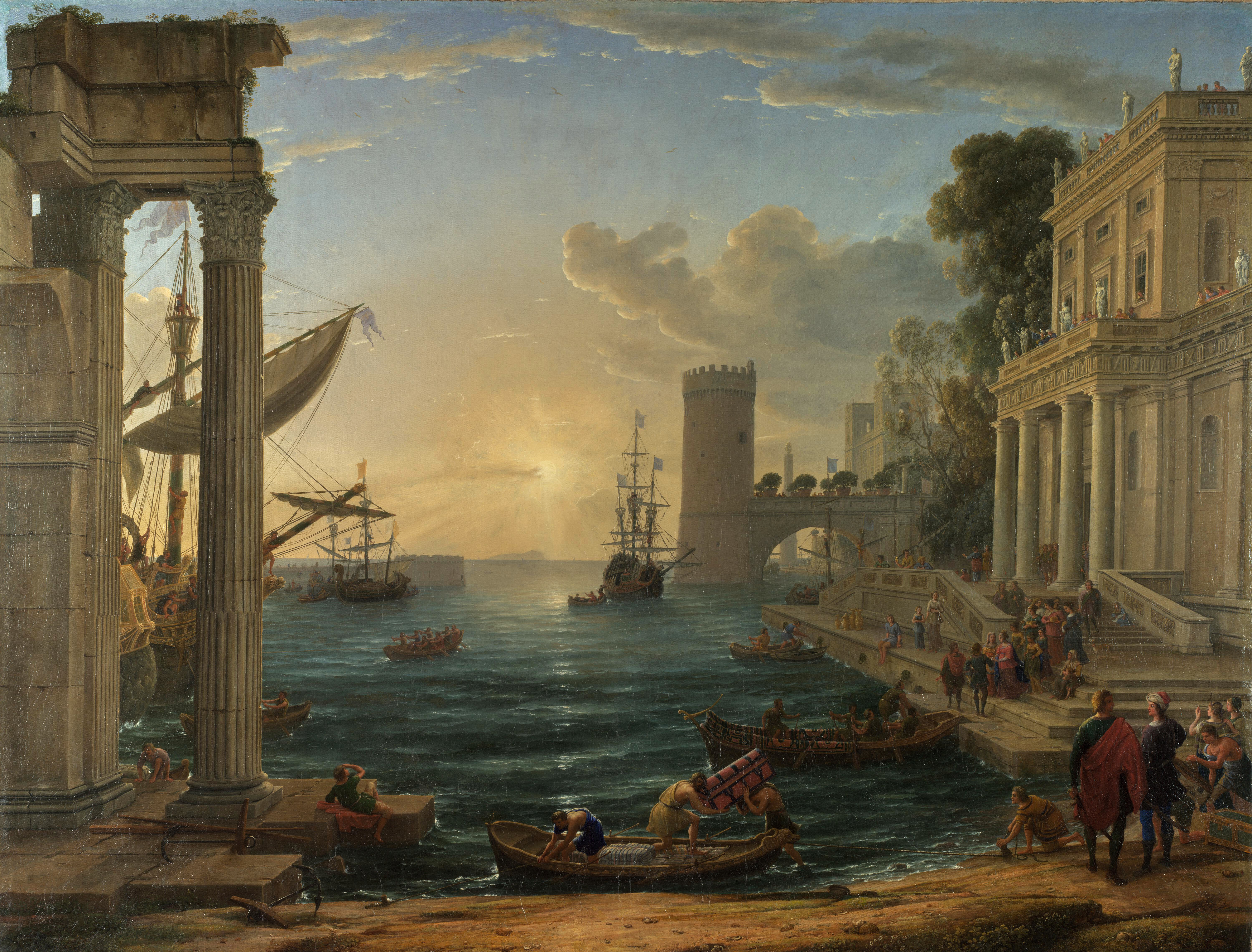
 View the object record
at the National Gallery
The National Gallery, London. Public-domain object image via Wikimedia Commons.
 by Tom Gurney
Tom Gurney BSc (Hons) is an art history expert with over 20 years experience
Published on June 19, 2020 / Updated on August 29, 2026
Email: tomgurney1@gmail.com / Phone: +44 7429 011000
Two Painters Who Never Met
J. M. W. Turner and Claude Lorrain are often spoken of as rivals, although Claude died in 1682, ninety-three years before Turner was born. Their contest did not occur between two living artists. Turner constructed it through looking, copying, adapting, exhibiting and collecting. Critics intensified it, and the National Gallery eventually made it physical by hanging paintings from the two careers together. Few artistic relationships have been pursued across time with such determination.
Claude gave Turner more than a recognisable kind of golden landscape. He offered a model for making light organise an entire world. A harbour could recede between architecture and ships towards the sun. A river could connect foreground pasture with distant mountain and sky. Small figures from the Bible or classical poetry could lend historical consequence to an environment whose real protagonist was land, water and atmosphere. Landscape could therefore carry the dignity associated with history painting without becoming a mere setting.[1][3]
Turner absorbed those possibilities and repeatedly changed their terms. He used Claudean order for an English castle, a Tamar valley, ancient Carthage, a French fishing port, a yacht regatta and coal labour on the Tyne. He turned calm radiance into smoke, moonlight or blinding pressure. Sometimes he paid homage; sometimes he advertised difference. In every case, “Claudean” describes a relation that Turner activated rather than a style he passively inherited.
The culmination came in his will. Turner required two of his own paintings to be placed at the same height beside two Claudes in the National Gallery. He was not leaving comparison to future taste. He made adjacency a condition of the gift, effectively designing a four-work argument that would continue after his death.[12][29]
That gesture can look like vanity, reverence or both. It is better understood as the endpoint of a lifelong inquiry. Turner learned from Claude when the older painter's works were mostly accessible through prints and private collections. He tested the lesson in public exhibitions, carried it to Italy, converted it into modern subjects and finally asked the nation to judge the results. The relationship is not a footnote to Turner's light. It is one of the structures through which he defined what landscape painting could become.
The Metropolitan Museum has described Turner as positioning himself as heir to classical landscape, especially Claude, while remaining an artist of tradition and modernity.[31] That duality prevents a false choice. His interest in steam, industry or unstable atmosphere did not require him to forget old masters; his classical ambition did not oblige him to avoid the present. Claude supplied a durable framework precisely because Turner could carry it into subjects the seventeenth-century painter had never encountered.
Ian Warrell's dedicated study of the two careers emphasises this persistence: Turner pays homage while trying to move beyond his chosen master.[32] “Influence” alone sounds passive and one-directional. The surviving evidence instead records acts of selection. Turner copied one Claude, invoked the title of another body of work, chose particular paintings for public comparison and altered that choice in his will. He managed the relationship across media and decades.
This history also asks viewers to look comparatively without searching only for matches. A tree in Turner need not correspond to a tree in Claude. More revealing questions concern function. Does foreground shadow invite entry or resist it? Does the sun resolve depth or flatten it? Are figures securely held by an ordered environment, or do labour and weather destabilise the order? Comparison becomes useful when it exposes decisions rather than assembling a catalogue of similar motifs.
Who Claude Lorrain Was
Claude Gellée was born in the Duchy of Lorraine in 1604 or 1605 and is known by the region attached to his name. He was not Italian by birth, though Rome became the centre of his career. After early movements through Germany, Italy and his native region, he settled in Rome around 1628. Work with the architectural and landscape painter Agostino Tassi, study of northern artists active in Italy and knowledge of the balanced landscapes developed by Annibale Carracci and Domenichino all contributed to his practice.[3]
Claude drew outdoors in and around Rome. Valleys, trees, coastlines, ruins, clouds and changing illumination supplied observed material. Paintings were then composed in the studio rather than copied from one location. Buildings seen in different places could be joined; a familiar hill could lead to an invented harbour; biblical or mythological figures could inhabit a Roman prospect transformed into an ideal world. His art depends on observation and reconstruction together.
This distinction matters for Turner. Claude was not an enemy of nature who replaced looking with formulas, whatever some later criticism implied. His compositions made a reasoned whole from studies gathered over time. Light links the parts: a low sun brightens water, separates planes, softens distant forms and makes foreground shadow feel inhabited rather than empty. Trees and architecture often rise along the sides while an opening draws the eye towards a radiant centre.
Narrative occupies a deliberately measured role. In The Arrival of Aeneas at Pallanteum, the Trojan hero offers peace from the prow of a ship, yet river, hills, architecture and air make the event part of a much larger historical landscape. Claude hints at the future Rome that will grow from the humble settlement. The people are small, but the relation between their action and the land is immense.[5]
Claude's reputation rested partly on this ability to make landscape learned, poetic and socially prestigious. Princes, cardinals and international collectors commissioned subjects from Virgil, Ovid and scripture. Ancient narrative gave titles and associations; composed nature gave emotional scale. Turner would inherit both parts while refusing to keep their balance stable.
Contents
- Two Painters Who Never Met
- Who Claude Lorrain Was
- Claude in British Collections
- Prints before Original Paintings
- The Altieri Claudes Arrive in 1799
- Learning by Copying
- Angerstein and the Bouillon Pair
- Learning Claude's Structure
- Early Turner before Italy
- Sun Rising through Vapour
Claude in British Collections
By Turner's youth, Claude was deeply embedded in British culture. Aristocrats returning from the Grand Tour had bought his paintings throughout the eighteenth century. Their country houses turned Italianate landscape into a marker of taste, travel and wealth. To admire Claude was to participate in a culture that valued Rome, classical literature and the authority of continental old masters.[3]
This British ownership had an important consequence. A young London artist did not have to reach Rome before encountering Claude, but access was unequal. Major canvases hung in private houses, and entry depended on patrons, introductions or professional standing. Turner acquired such access through artists, collectors and commissions. Looking at old masters was therefore also an experience of social networks.
Claude's prices magnified his authority. When John Julius Angerstein bought the two Bouillon pendants in 1803, he paid 8,000 guineas. William Beckford's Altieri pair entered Britain in 1799 under similarly spectacular circumstances, and their value rose still further when sold in 1808. These sums announced that landscape could command the market prestige of the most celebrated European painting.[4][16]
For Turner, the lesson was not simply that Claude was beautiful. Claude demonstrated what society was prepared to honour. A British landscape painter trying to elevate his genre had to address that reputation. He could imitate it, reject it or show that he could transform it. Turner chose the most difficult option: sustained, visible engagement.
British collections also changed over Turner's lifetime. Pictures once available only through invitation entered exhibitions and eventually the National Gallery. Angerstein's collection formed the core of the new institution in 1824. Turner consequently experienced Claude first as private privilege and later as public national property. His will responds to both conditions, using a state gallery to perpetuate a comparison first formed in collectors' rooms.[29][30]
Collecting shaped what counted as an old master. Claude had made paintings for patrons in Rome, but British purchase, country-house display and reproductive publication created the version of his reputation Turner inherited. Certain large works became canonical because they were available to prominent collectors and writers. Other aspects of Claude's practice, especially the breadth of his drawings, were less publicly familiar. Turner's “Claude” was therefore both a historical artist and a British cultural construction.
That construction was tied to land, finance and empire. Wealth capable of purchasing expensive continental pictures came from varied sources, including commerce and estates entangled with Britain's expanding power. The paintings' transfer into national ownership did not erase those histories. Turner's own rise from a barber's household into elite collections made him acutely aware that artistic authority moved through money, access and display.
The market could also turn comparison into value. A modern British landscape seen as worthy of Claude might command higher critical and financial status. Yet direct imitation risked appearing derivative. Turner had to make resemblance legible enough to claim lineage while preserving enough difference to claim invention. The resulting tension is aesthetic and professional at once.
Prints before Original Paintings
Reproductive print culture widened access long before the National Gallery opened. Claude had kept a book of drawings now known as the Liber Veritatis, or Book of Truth. The sheets record roughly two hundred painted compositions, often preserving information about patrons on their reverse. The book may have helped distinguish authentic works from copies or pastiches, although its purpose cannot be reduced to a modern copyright register.[3][7]
Richard Earlom translated these drawings into a major printed edition published by John Boydell from 1777. Etching described contours while mezzotint recreated broad tonal fields, allowing readers to compare composition, light and shadow across the series. The publication identified patrons and known owners, turning Claude's private working record into a monument of British connoisseurship.[8]
An artist could study those prints repeatedly. Unlike a visit to a country-house collection, a book allowed return, comparison and close analysis. It revealed how framing masses varied, how a river or harbour opened, where foreground darkness met luminous distance and how figures controlled scale. Monochrome removed colour but made tonal architecture unusually legible.
Turner's precise debt to any individual Earlom plate must not be assumed. He encountered Claude through original canvases, other prints, copies and discussion as well. Yet the printed Liber Veritatis formed part of the visual culture in which his ambitions developed. It demonstrated that a landscape painter's inventions could be organised, reproduced and studied as a coherent body.
The book also posed a professional challenge. Claude's recorded compositions appeared complete, authoritative and retrospectively ordered. How could a living artist answer not just one famous painting but a canon arranged in sequence? Turner's eventual Liber Studiorum addressed that question by changing a record of past achievements into a public programme for landscape still being invented.
The Altieri Claudes Arrive in 1799
The most important early encounter came when two monumental Claudes reached Britain from Rome in 1799. The Father of Psyche sacrificing at the Temple of Apollo and The Arrival of Aeneas at Pallanteum had belonged to the Altieri family. Artists and dealers Robert Fagan and Charles Grignion arranged their removal during political instability, and the pair was purchased for William Beckford. The National Trust records the exceptional history through which they entered his collection.[4][5]
Beckford showed the works at his London house to Turner, Thomas Girtin, John Constable and others. Turner was twenty-four. He had already exhibited at the Royal Academy and developed considerable skill in watercolour, but these huge Italian landscapes presented a different measure of ambition. Classical narratives, Roman terrain, architectural memory and immense atmospheric unity were joined on the scale of history painting.
A reported response says that Turner found the experience both pleasurable and painful because the works appeared beyond imitation.[4] The anecdote should be handled as evidence of reception rather than a stenographic record of his words. Accounts of artists overwhelmed by masterpieces can acquire dramatic polish in retelling. What matters is that Turner's subsequent work confirms serious attention.
The pair itself offered more than one formula. The Psyche scene places ritual and temple architecture within a broad landscape. The late Aeneas picture makes river journey and future Roman foundation central. Both connect human destiny with terrain, but their spatial rhythms and light differ. Turner could study Claude as a flexible composer rather than the maker of one repeated sunset.
The arrival also joined artistic authority to contemporary power. Pictures removed during European upheaval came to a fantastically wealthy British collector, with naval protection remembered in their provenance. Claude's imagined antiquity entered a modern economy of war, dealing and elite competition. Turner would later place ancient and modern systems of power inside the very landscape form these canvases exemplified.
Learning by Copying
Turner's response survives in a watercolour copy of Claude's Aeneas composition, made around 1799 in the Studies for Pictures sketchbook. The sheet is small, about 21.5 by 13.8 centimetres, and cannot reproduce the physical command of the enormous canvas. Its value lies in analysis. Turner compressed the arrangement so he could understand how masses, river and distance worked together.[6][35]
Copying an old master did not mean surrendering originality. Academic training treated close study as a means of acquiring decisions unavailable through rule alone. By remaking Claude's design, Turner had to identify its load-bearing relations: the direction of the river, the balance of architecture and trees, the placement of light, and the interval between foreground incident and distant promise.
The copy is especially revealing because it predates Turner's first Italian journey by twenty years. His knowledge of classical landscape was mediated through a painting already transformed by travel, ownership and display in Britain. Italy existed pictorially before he encountered it geographically. When he later reached Rome, he brought a long visual memory rather than an empty eye.
Close study could also produce dissatisfaction. A copy teaches what the model accomplishes and what it excludes. Claude's equilibrium depends upon subordinating local disturbance to the whole. Turner increasingly wanted weather, labour and historical change to remain active. His mature art often preserves Claude's spacious structure while refusing the tranquillity that structure once guaranteed.
The Studies for Pictures sheet therefore marks neither submission nor instant emancipation. It is evidence of apprenticeship to a chosen ancestor. Turner would continue to copy and adapt old masters throughout his career, but Claude occupied a unique position because the borrowed language became a field in which Turner repeatedly tested his own identity.
Scale changes what copying can reveal. Compressing a canvas more than two metres wide into a small book forces hierarchy. Minor figures and architectural ornaments cannot all survive. Turner had to decide which dark, opening or directional line made Claude's totality recognisable. The copy is consequently an argument about essentials, even if it began as private study.
Colour introduces another transformation. A small watercolour on blue paper cannot reproduce the layered oil surface of a seventeenth-century canvas. Wash, reserve and support create different luminosity. Turner translated Claude materially while copying him compositionally. The exercise joined analysis with adaptation from its first stroke.
Such work helps explain why Turner's later responses seldom resemble academic replicas. He learned how a composition behaves, then rebuilt the behaviour in another location or medium. The lesson could lie dormant and reappear in a Welsh watercolour, an etched design or a great oil. Copying generated a portable understanding rather than a store of motifs to be repeated mechanically.
Angerstein and the Bouillon Pair
Another decisive pair arrived in Angerstein's collection in 1803. Claude had painted Seaport with the Embarkation of the Queen of Sheba and Landscape with the Marriage of Isaac and Rebekah in 1648 for the duc de Bouillon. One looks across a grand harbour alive with departure; the other opens across a river landscape towards dancing figures, cattle, bridge and distant architecture.[15][16]
Turner later referred to them simply as the “Sea Port” and the “Mill.” The second shorthand can confuse two related versions. The London painting carries an inscription identifying Isaac and Rebecca, while a closely related canvas in Rome is conventionally called The Mill. Turner used the familiar nickname without writing a modern catalogue distinction into his will.[7][16]
The seaport offered an especially powerful grammar. Architectural facades and ships rise on either side. Water opens towards the horizon, and sunlight enters that opening as both illumination and spatial destination. Foreground figures enact the Queen's departure, but the whole port seems to participate through stairs, rigging, reflections and distant vessels. Movement occurs within order.
Its pendant broadens the comparison. Dancing and pastoral life occupy a fertile landscape; trees and shadow establish shelter; river and distant settlement carry the eye outward. Turner did not choose two identical Claude harbours as his final standard. He chose a maritime departure and a pastoral-biblical landscape, requiring his own pair to answer Claude's range as well as his radiance.
Angerstein's purchase linked Claude with Turner's living professional world. The collector supported contemporary British art and owned early work by Turner. After Angerstein's death, the government purchased thirty-eight paintings to found the National Gallery in 1824.[30] The Bouillon pair thus changed from private benchmarks into components of a national collection. Turner could eventually direct his bequest towards named works in a public institution because this transfer had occurred.
Learning Claude's Structure
A Claudean composition is often described through a list: framing trees, classical buildings, water, small figures and low sun. The list is useful only if the relations among those elements remain visible. Trees and architecture create unequal vertical weights. Darker foregrounds establish a threshold. Receding bands soften in tone. Water or valley makes continuity, while light unifies forms that might otherwise disperse.
Turner learned to treat structure as an instrument rather than a recipe. A central opening can promise calm distance, but it can also expose the viewer to glare. Side masses can frame harmony or crowd the escape. Reflections can stabilise a vertical axis or break it into moving fragments. The same spatial grammar supports different emotional and historical claims.
Claude's figures taught another lesson. Their small scale does not necessarily make narrative insignificant. Instead, human action gains meaning through relation to a larger order. A departure becomes part of sea and sky; a marriage becomes part of fertility and settlement; Aeneas's arrival belongs to the future history of Rome embedded in terrain. Turner would similarly let landscape perform narrative, though he often made that surrounding order less secure.
Light was the deepest lesson because it acts materially and intellectually at once. It distinguishes near from far, makes atmosphere measurable and gives time of day. It can suggest providence, prosperity, memory or danger without becoming a simple symbol. Turner admired Claude's ability to make illumination feel pervasive rather than applied to separate objects.[2]
Yet Turner did not inherit an untouched seventeenth-century method. He saw Claude through aged surfaces, frames, hanging arrangements, prints and British criticism. What he learned was already historical. His response consequently included the problem of reputation: how could a modern painter use a revered structure without producing belated pastiche?
Early Turner before Italy
The answer began in British and European subjects. Turner's large watercolour of Caernarvon Castle around 1800 places a Welsh fortress, estuary and foreground figures within a broad luminous recession linked by modern scholarship to the spirit of Claude. The arrangement elevates a toured British place without pretending that North Wales is the Roman Campagna.[35]
In 1804 Turner painted a variation upon the Beaumont landscape of Narcissus and Echo. The project shows him engaging not only a Claudean manner but a particular picture available through a British patron. Myth, reflective water, trees and distance became material for reassessment. Such work demonstrates that access to collections could directly generate composition.
The 1803 Festival upon the Opening of the Vintage at Mâcon takes another path. Turner had travelled in France and observed the region, yet he organised festivity and harvest with classical pastoral breadth. A contemporary event could gain poetic order without being displaced into antiquity. This capacity would become central to the later French ports and English industrial scenes.
These adaptations resist a neat sequence from imitation to independence. Turner could be topographically exact in one work and idealising in another. He could respond to Claude while also learning from Richard Wilson, Nicolas Poussin, Aelbert Cuyp, Dutch marine painters and his contemporaries. No one ancestry explains his early development.
Claude nevertheless gave Turner a particularly ambitious scale of comparison. The relationship connected private study with public strategy. A young artist who had copied architecture and worked in watercolour could imagine landscape as a field equal to the largest literary and historical claims. Long before Italy, Turner was already testing whether British places and modern events could inhabit that field.
Sun Rising through Vapour
Sun Rising through Vapour, painted before 1807, is essential because Turner eventually chose it to stand beside Claude. The picture presents a calm sea beneath pale early light. Fishing people clean and sell their catch in the foreground, while larger ships become ghostly within mist. The sun is prominent but not violently hot; its illumination spreads through moisture and makes distance uncertain.[11]
The picture draws upon more than Claude. Its working foreground and low marine horizon connect with Dutch traditions, and the activity is contemporary rather than biblical. Turner does not flank the sea with a monumental classical city. Nevertheless, the organisation of light across water and the ambition to make atmosphere govern a large canvas place it within the sustained Claude dialogue.
The fishermen are crucial. Claude's ideal ports commonly contain figures loading, embarking, tending animals or conversing, but their activity submits to harmonious order. Turner's foreground labour has greater material insistence. Fish, boats, bodies and shore make the vapour's beauty inseparable from an economy. The sun elevates work without making it unreal.
Turner valued the painting across decades. Sir John Leicester bought it, but Turner repurchased it when Leicester's collection was sold in 1827. Friends congratulated him, and he refused the work to later buyers despite a reputed high offer. The history suggests that he regarded it not merely as an early success but as a work necessary to his final public self-definition.[12]
Its eventual place in the will complicates any linear story of progress. Turner did not choose only a late, high-coloured canvas to prove that he had surpassed Claude. He chose a painting made before his Italian travels. Sun Rising through Vapour allowed him to claim that his answer had deep roots: modern marine labour, northern atmosphere and luminous unity were already joined at the beginning of his mature oil practice.
Liber Veritatis and Liber Studiorum
Around 1807 Turner began issuing Liber Studiorum, a title that openly answers Claude's Liber Veritatis. Latin lends the projects an immediate family resemblance, but their purposes differ. Claude's book records completed paintings, while Turner's series presents designs for publication as a cumulative argument about what landscape can contain.[7][9]
The contrast is temporal. Claude looks back across commissions and secures their identity. Turner projects forward through a living enterprise. A subscriber receiving successive parts encounters a practice still unfolding. The publication does not merely preserve reputation; it seeks to make one.
Turner planned one hundred plates and issued seventy-one during his lifetime, chiefly between 1807 and 1819. The subjects were associated with categories including marine, mountainous, pastoral, architectural, historical and elevated or epic pastoral. Initials on impressions guide classification, although the boundaries are deliberately porous. A ruin may be architectural and elegiac; a coast can be marine and historical.[9]
Claude's name thus becomes the point of departure for a wider field. Turner does not limit his response to tranquil Italianate scenes. Storm, shipwreck, mountain, abbey, river and imagined history occupy the same undertaking. The arrangement says that the modern landscape painter requires several modes, not one inherited ideal.
The title also reveals confidence. Turner could have published a neutral collection of views. By invoking the most famous landscape record book, he invited comparison across the whole series. The gesture is competitive, yet not dismissive. Claude's authority gives Turner's claim its force. Answering a lesser model would not have elevated the genre.
Print as Landscape Theory
Liber Studiorum contains no extended treatise explaining Turner's system. Its theory is visual and comparative. Viewers move from image to image, noticing how tonal structure changes with category. A marine plate may depend on an exposed horizon; an architectural subject can use ruins as weight; a pastoral design turns shadow into shelter; a mountain composition converts recession into ascent.
The print process makes tone unusually important. Turner often established the etched framework, while collaborators developed mezzotint fields under varying degrees of his direction. The British Museum record for The Felucca identifies the combination of etching and mezzotint and the involvement of Henry Dawe.[10] Authorship remains Turner's, but production depended on skilled translation.
That collaboration parallels the older Earlom project while changing the direction of labour. Earlom interpreted Claude's record drawings for Boydell decades after the paintings. Turner's engravers worked with a living artist who could revise, supervise and sometimes intervene directly. The prints were not memorial reproductions of a closed career.
Monochrome also tested the Claudean lesson. Claude's fame rested heavily on coloured light, yet Earlom's edition showed that his compositions survived tonal translation. Turner likewise had to make illumination convincing without hue. Etched contours, velvety darks and reserved paper create atmosphere through value. The exercise strengthened a structural understanding of light rather than treating radiance as yellow paint.
The undertaking ended short of its projected hundred plates, but incompletion does not erase its argument. Seventy-one published designs offered substantial evidence of range. Turner had transformed Claude's private book of truth into a public school of studies, using reproducible landscape to teach viewers how many kinds of seriousness the genre could sustain.
The Royal Academy in 1815
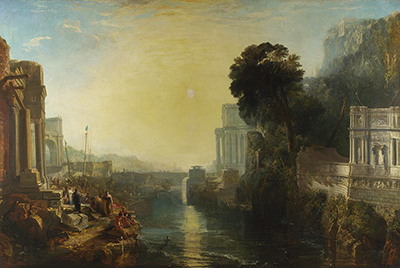
The most explicit early public challenge came at the Royal Academy exhibition of 1815. Turner showed Dido building Carthage and Crossing the Brook, two large oils whose differences are as important as their shared ambition. One imagines the foundation of an ancient empire; the other draws upon the Tamar Valley and the movement of ordinary travellers.[13][14]
Turner was forty and long established within the Academy. He did not need to prove basic competence. The exhibition allowed him to stage a broader claim: landscape could command the scale, literature and public authority traditionally associated with history painting, and it could do so through both classical invention and British terrain.
Claude formed the standard against which that claim became legible. Viewers familiar with old-master collections and prints could recognise an ideal-port structure in Dido. They could also understand the expansive recession, framing vegetation and luminous order of Crossing the Brook as belonging to a classical landscape tradition. Turner placed recognition under pressure by changing subject and surface.
The two canvases should not be called pendants without documentary proof, yet their joint exhibition creates a meaningful comparison. Dido is broad and horizontal, crowded with construction and maritime promise. Crossing the Brook is vertical, built through steep descent, water, trees and distant valley. Turner's Claudean ambition does not produce one format.
The year itself intensified historical interpretation. Europe had endured prolonged war and would see Napoleon defeated at Waterloo. Turner did not make either canvas a direct report of that conflict. Nevertheless, imperial foundation, national terrain and the public status of British art carried contemporary resonance. Claude's inherited calm became a language through which a modern British painter could think about power, place and historical consequence.
Royal Academy hanging encouraged immediate comparison among unlike works. Paintings competed for visibility across crowded walls, and reputations were made through relation to neighbours as much as isolation. Turner's large canvases had to function at a distance, announce their tonal organisation quickly and then reward closer inspection. Claudean breadth offered public force, while surface density differentiated the modern painter once a spectator approached.
The institutional setting also changed the meaning of historical emulation. The Academy trained artists through casts, life drawing and established principles, yet contemporary exhibitors were expected to produce novelty. Turner used an accepted old-master model to claim that landscape belonged within the Academy's highest ambitions. At the same time, he demonstrated that respect for precedent could support different British subjects.
The paired year became a declaration of range. Turner was not asking to be known only as “the English Claude,” a phrase that might praise and confine him. By making one canvas crowded, ancient and maritime and the other quiet, regional and vertical, he showed that the relationship generated alternatives. Claude was a standard to think with, not a branded appearance to repeat.
Dido and the Ideal Seaport
The National Gallery identifies Dido building Carthage as Turner's first painting specifically intended to match Claude, particularly his seaports.[13] Water opens towards a bright centre. Architecture rises on both sides, shipping activates the harbour and numerous figures fill the foreground. Dido appears within a city being made rather than posing as an isolated heroine.
Turner adopts Claude's broad grammar but refuses his usual degree of repose. Masonry, tomb, scaffolding, vessels, merchandise and people crowd the field. Surfaces are textured and the architecture feels under construction. Claude's ports often appear as perfected worlds in which present action belongs to enduring order; Turner's Carthage is caught in the unstable energy of becoming.
The Virgilian subject sharpens that instability. Dido is founder and future victim. Aeneas's presence links Carthage to Rome, the power that will eventually destroy it. Brightness does not simply celebrate prosperity. Viewers who know the Aeneid can see loss already embedded in foundation. Turner uses the ideal landscape's capacity to hold different times at once.
This is one reason “imitation” is insufficient. The visual reference is meant to be recognised, but recognition opens difference. Turner thickens incident, increases historical pressure and makes the city visibly laborious. He wants the picture to stand in Claude's company while retaining a modern concern with construction, empire and change.
The later bequest confirms the strategic importance of the canvas. Turner never displaced Dido from the intended quartet, even when he changed its companion. It represented the direct ancient-harbour challenge. Whatever else entered or left his final arrangement, this painting remained the work through which he asked posterity to compare his historical landscape with Claude's.[12][29]
Crossing the Brook and British Ground
Crossing the Brook offers a quieter but equally consequential test. Tate records the oil as exhibited in 1815 and now holds it as N00497.[14] A woman and child cross water in the lower landscape while the Tamar Valley extends beyond them. Trees, slopes, reflection and distant settlement make a British view carry monumental pictorial weight.
The figures are not heroes from epic. Their action is ordinary and local. Yet small scale does not mean insignificance. Like human groups in Claude, they measure the land and give movement a temporal direction. The crossing turns foreground water from ornament into lived terrain.
Turner composes the valley through depth rather than identifying every feature equally. Darker vegetation frames the descent; water catches light; cultivated and inhabited distance opens beyond. Claudean structure helps a regional subject become expansive without converting Devon and Cornwall into imaginary Italy.
The canvas therefore challenges a hierarchy within landscape itself. If Dido gains status from Virgil and antiquity, Crossing the Brook must establish seriousness through place, atmosphere and everyday passage. Its size insists that British terrain can bear sustained attention without a classical title. Turner uses an inherited form to enlarge what counts as a worthy subject.
Seen together, the 1815 paintings articulate a double inheritance. Turner can enter Claude's ancient seaport and make it denser, or he can carry the lesson of luminous order into local geography. The second movement is not weaker. It demonstrates that learning from an old master need not trap a modern artist inside the old master's preferred world.
Italy Changes the Dialogue
Turner first travelled to Italy in 1819, reaching places whose artistic presence he had known for decades through collections, literature and prints. Rome, Naples, Venice and Florence supplied direct experience of architecture, terrain and light. The journey transformed his resources, but it did not begin his engagement with Claude.
That chronology is essential. Turner arrived with expectations formed by the Altieri and Bouillon pictures, Earlom's prints, British patrons and his own classical experiments. Actual Italy could confirm, complicate or contradict an imagined one. The experience was a comparison between accumulated pictures and present conditions, not a pristine discovery of Mediterranean light.
In Florence Turner studied Claude's Seaport with the Villa Medici, now at the Uffizi. The painting combines identifiable Roman architecture, the lighthouse of Genoa, shipping and intense sunset within an invented harbour. Turner made a copy, learning how central radiance could control crowded water and architecture.[18][19]
The Italian tours also revealed Claude's selectivity. Rome was noisy, inhabited and historically layered, not the permanently balanced world of a classical canvas. Turner could draw ruins, streets, ceremonies, mountains and weather in rapid succession. Studio paintings later combined those encounters with old-master organisation, sometimes preserving ideal order and sometimes exposing its fragility.
When Turner returned in 1828, he was no longer testing whether he could paint Italy. He was exhibiting to an international audience in Rome and confronting Claude on the ground where the older artist's reputation had formed. Regulus would turn that encounter into one of the most aggressive uses of inherited light in nineteenth-century painting.
Direct travel sharpened the difference between meteorological encounter and pictorial memory. Light changes by minute, season and position; a canvas fixes a designed effect. Turner filled books with rapid evidence, but his major oils remained studio constructions. In this respect he and Claude share a method more than the mythology of spontaneous transcription allows: both gathered from the world and reorganised what they had gathered.
Italy also enlarged Turner's architectural vocabulary. Roman ruins, Renaissance buildings, coastal settlements and volcanic terrain could be studied in relation rather than as engraved fragments. Claude's invented combinations became newly intelligible as transformations of real material. Turner could see where an old master had compressed distance, joined separate structures or made Campagna light serve a narrative.
The journey did not produce a uniformly warmer or more ideal style. Turner continued to paint northern storm, English coast and modern technology. Italy became one memory among others, though exceptionally powerful. Its value lay in expanding his comparative range: an observed French harbour could be given Mediterranean amplitude, while an ancient Italian subject could be made unstable by specifically Turnerian weather and colour.
Claude and Turner's Ancient Worlds
Turner's classical paintings range far beyond direct quotations from Claude. Carthage, Baiae, Ulysses, Regulus, the Cumaean Sibyl and Ovidian subjects involve different texts, locations and pictorial problems. Claude supplied a major precedent for letting landscape carry ancient narrative, but Virgil, Homer, Ovid, English translations, theatre and Turner's travel all shaped the results.[26][27][28]
In The Bay of Baiae, observed terrain near Naples becomes the setting for Apollo and the Sibyl. Ruins, water and warm distance hold prophecy and decay together. Claude had repeatedly joined small mythic figures to idealised Italian landscape, yet Turner's experience of Baiae and concern with time make the ancient world physically eroded rather than perfectly available.[27]
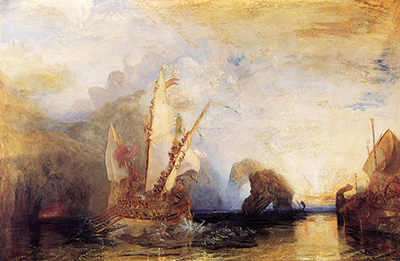
Ulysses deriding Polyphemus uses a ship, sunrise and mountainous giant to convert Homeric escape into a marine spectacle. The vessel pushes into brightness, but smoke, crowded rigging and the Cyclops's fading form disturb calm recession. The sun promises movement while the hero's taunt prolongs danger.[26]
The Golden Bough turns the Sibyl's gesture, water, grove and pale architectural distance into an atmosphere of ritual and mortality. Narrative remains difficult to locate, as it often does in late Claude, but Turner's paint makes ambiguity active rather than placid. The landscape seems to remember several myths and moments at once.[28]
These works show why “Claudean” must remain precise. It can describe composed recession, small narrative figures, classical memory and atmospheric unity. It cannot explain every source or intention. Turner used Claude as one authority within a larger historical imagination, and the originality of the pictures lies partly in how those authorities collide.
Carthage and Historical Time
Turner returned to Carthage repeatedly, making the civilisation's rise and fall a long meditation rather than a formal series. Dido presents foundation in 1815; The Decline of the Carthaginian Empire, exhibited in 1817, answers with sunset, departure and anticipated defeat. The pair makes Claudean light historical.[13][17]
Sunrise and sunset are not simple labels for progress and collapse. In Dido, brilliant beginnings contain future tragedy. In Decline, beauty persists while political power fails. Turner uses the cycle of light to expose the mismatch between human confidence and historical duration. Empires imagine permanence; atmosphere changes around them.
Claude's landscapes often fold ancient action into a harmoniously ordered world. Turner asks what happens when order itself belongs to time. Architecture can be built, occupied, damaged and remembered. Harbours enable trade and conquest. Figures embark because states demand movement. The landscape does not merely witness history; it organises the conditions through which power expands and recedes.
The relationship also carried contemporary implications. Britain emerged from the Napoleonic Wars as a global maritime power. Carthage and Rome offered historical distance through which victory, commerce and empire could be contemplated without illustrating one current event. Turner did not supply a single coded political lesson, but his public understood that ancient rivalry could speak to modern states.
Turner's first will in 1829 selected Dido and Decline to stand with Claude. That initial choice would have made imperial rise and fall the British painter's complete response. His later substitution of Sun Rising through Vapour changed the argument, but the abandoned arrangement reveals how centrally historical time had once figured in his planned comparison.[12]
The Ideal Port Becomes Modern
Claude's seaports were associated with antiquity, scripture and elite patronage, but their structure could organise contemporary life. Turner recognised that the central waterway, flanking masses and radiant distance were not bound to one century. They could give coherence to present-day vessels, crowds, trade and travel.
The Frick Collection's Harbor of Dieppe provides the clearest example. Turner visited the French port in 1821 and 1824, then constructed the enormous canvas in London. Two arms of buildings, boats, quays and people reach from the sides around open water. The sun and its reflection create a luminous axis, unmistakably recalling Claude's harbour grammar.[20][21]
What occupies that grammar is radically current. Around two hundred figures conduct ordinary business. Fishing, loading, waiting, carrying and household movement replace royal embarkation. The French subtitle, Changement de Domicile, draws attention to relocation without identifying one definitive story. Grand form contains small modern uncertainties.
Turner also changes the balance of substance and atmosphere. The sky occupies more than half the canvas, and reflected light makes solid form less stable towards the centre. Claude's radiance often confirms order; at Dieppe it competes with the density of lived activity. The city is both monumental and dissolving.
This translation matters because it prevents the Claude relationship from becoming a retreat from modernity. Turner did not use an old-master structure only when painting Aeneas or Dido. He could place a contemporary cross-Channel port inside it and grant everyday labour the scale of historical painting. Inherited composition became a means of recognising the present as consequential.
Cowes, Le Havre and Maritime Spectacle
The 1827 Cowes campaign extended the transformation into fashionable sport. Turner stayed with John and Mary-Anne Nash at East Cowes Castle during the second Royal Yacht Club regatta. Rapid drawings and oil studies fed two large paintings commissioned by Nash. Harbour, yachts, spectators, workboats and property became a moving social system.[24]
Claude's influence here is not a point-for-point quotation from one canvas. It lies in the capacity to coordinate many vessels, frame water through shore and architecture, and let atmosphere unify incident. Turner alters that capacity through speed. Sails tack, wakes cross and boats converge. The stable ideal harbour becomes a field of relative motion.
Nash's residence appears in the long titles, linking patron and estate to spectacle. Yet the commissioned paintings do not behave as obedient property portraits. Water and wind compete with ownership. The castle can recede while crews, crowded boats and shifting light dominate the experience. Turner expands a patron's commemoration into an argument about coordinated action under unstable conditions.
Le Havre: Sunset in the Port, made around 1832, reduces another modern French harbour to warm atmosphere, vessels and low light.[25] The work belongs to a broad sequence rather than a single Claude citation. Its importance lies in continuity: ports remained places where Turner could test how much information light might absorb without losing geography altogether.
The National Gallery's 2012 exhibition joined East Cowes and Le Havre with more overt classical works to make that continuity visible.[2] The comparison reveals a mobile inheritance. Claude's ordered water does not dictate subject. Turner carries it among regatta, resort, naval presence and working port, changing the pressure of each composition according to contemporary life.
Keelmen and the Inversion of Light
In Keelmen Heaving in Coals by Moonlight of 1835, Turner turns Claudean luminosity inside out. The setting is the Tyne, where workers transfer coal from shallow keels to larger vessels. Moonlight opens the water and sky, while torches and industrial fire burn among dark ships at the right. Cool and warm illumination compete across smoke.[22][23]
The composition still depends on a radiant passage over water. Dark vessels flank distance, masts create vertical rhythm and reflections connect sky with the foreground. Yet the sun of an ideal southern port has become a northern moon veiled by coal atmosphere. Human figures do not embark on a biblical journey; they shovel fuel for the industrial economy.
Turner avoids a simple opposition between natural beauty and ugly industry. Moonlight, firelight and smoke make one atmospheric field. Labour is difficult to separate from spectacle because the visual brilliance is produced partly by the work's own conditions. Coal generates flame and haze while moving through bodies and boats towards machines elsewhere.
The canvas was commissioned by the Manchester textile manufacturer Henry McConnel as a companion to a Venetian picture he already owned. A smoky English night consequently answered a bright southern trading city.[23] The pairing adds another level to Turner's method: Claudean maritime light can compare not only old and new, but leisure and labour, south and north, consumption and energy.
The 2012 Claude exhibition used Keelmen to demonstrate that old-master inheritance could help Turner paint the industrial landscape.[6] This is one of the relationship's most important outcomes. Turner did not become modern by discarding Claude. He became modern partly by discovering that Claude's structures could survive reversal, contamination and a wholly different economy.
Regulus and Light as Assault
Regulus makes the transformation violent. Turner first exhibited it in Rome in 1828 and extensively reworked it before showing it at the British Institution in 1837. The painting invokes the Roman commander traditionally said to have been tortured through forced exposure to the sun. Turner almost removes the hero and gives his ordeal to the viewer through concentrated glare.[19]
Claude's Seaport with the Villa Medici is the most specific formal model. Turner had copied it in Florence during the 1819-20 journey and could see it again in 1828. Architecture and shipping frame a central burst of light over water. In Claude, radiance joins the port; in Turner, it overwhelms distinctions and makes looking strenuous.[18][19]
The relation depends upon memory of calm. If viewers did not sense the inherited equilibrium, the disturbance would lose part of its force. Turner keeps enough of the ideal port to make its collapse visible. Masts, buildings and crowded foregrounds remain, but the centre no longer offers effortless release into distance. It acts against the eye.
Contemporary responses recognised the challenge. Roman observers debated the paintings' resemblance to Claude and the freedom of Turner's execution. London critics in 1837 complained of dazzling excess or advised seeing the work from across the gallery. Their bodies became part of the picture's reception, moving closer or farther in response to light.
Technical study shows that Turner's later intervention was extensive and connected to an earlier tear and repair. Thick yellow repainting and other revisions intensified the effect before the 1837 display.[19] The famous account of Turner transforming the canvas during exhibition preparations captures his public performance but cannot replace the material chronology. Rivalry with Claude was enacted through layered labour, damage and revision, not one miraculous flourish.
Venice and the Late Continuity
Turner's later Venice works can seem far removed from Claude because architecture and water often dissolve into colour. Yet the older painter's lesson remains: light is not an addition to form but the relation through which forms become a world. Turner extends that principle until solidity itself looks provisional.
Venice was especially suited to the extension. Buildings rise directly from a reflective lagoon; haze can join sky and water; boats punctuate scale; maritime history makes present beauty inseparable from former power. Turner did not need to invent a classical seaport because the city already carried historical depth and theatrical light.
His 1840s watercolours frequently use a few architectural accents to hold broad washes. Distance may be nearly weightless, while reflections blur the border between object and atmosphere. Claude normally guides the eye through carefully articulated planes. Turner lets those planes interpenetrate, preserving recession while reducing the structures that declare it.
This is development rather than a final escape from influence. The National Gallery included late Venetian watercolours in Turner Inspired precisely to show that Claude's importance did not end with Dido or the first Italian visit.[2] A relationship can persist when resemblance becomes less obvious, because the underlying question—how light organises perception—remains active.
Venice also complicates the usual contrast between Claudean antiquity and Turner's modernity. The city is historical, commercial, inhabited and increasingly consumed through tourism. Turner's images can be luminous recollections, marketable works for collectors and meditations on decline at the same time. The old master's composed atmosphere becomes one resource for holding those temporal layers together.
What Artistic Rivalry Means Here
Turner and Claude did not compete for patrons, wall space or reviews while both were alive. “Rivalry” names a deliberate relation across history. Turner chose an ancestor whose authority was secure enough to make challenge meaningful. Collectors, critics and institutions then converted his choices into comparisons that shaped both reputations.
Admiration and aggression coexist. Copying the Aeneas composition acknowledges dependence. Naming Liber Studiorum after Claude's book claims succession. Exhibiting Dido invites measurement. Recasting a seaport as industrial night shows difference. The will turns all these gestures into a permanent request for judgement.
The relation is not a sporting contest with a final score. Turner sometimes approaches Claude's calm, sometimes reverses it and sometimes fails by the standards of sympathetic critics. Claude remains an independent artist whose landscapes cannot be reduced to raw material for British achievement. His observed drawings, patronage, narrative intelligence and tonal invention deserve attention in their own historical setting.[3][7]
Nor does shared sunlight prove direct influence. Turner studied many painters and nature itself. A low horizon or framing tree can arise through broad convention. The strongest comparisons possess documentary or institutional grounding: a surviving copy, access to a named collection, a title answering another book, criticism that identified the relation, or the explicit bequest.
Used carefully, rivalry describes Turner's method of historical self-education. He did not wait for later scholars to assign him a lineage. He studied, selected and staged one. The process allowed landscape painting to speak simultaneously about artistic memory and new experience, showing that innovation can emerge through sustained argument with inherited form.
Ruskin Rewrites the Contest
John Ruskin became Turner's most powerful nineteenth-century advocate, and Claude became one of the standards he attacked. When Modern Painters began in the 1840s, Claude was still widely regarded as the supreme landscape painter. To establish Turner's range and truth, Ruskin had to challenge the old hierarchy.[33]
Ruskin did not deny all merit to Claude. He acknowledged grace, aerial skill, beautiful skies and formal refinement. His objection concerned what he considered submission to pictorial convention. Claude's nature appeared selected and arranged according to inherited ideas, whereas Turner, in Ruskin's argument, attended humbly to complexity, change and difficult fact.
This opposition was rhetorically effective but historically partial. Claude had drawn from nature and built studio compositions from close observation. Turner also selected, combined and invented. Ruskin turned differences of method and range into a moral division between convention and truth because he was writing advocacy, not a neutral comparative catalogue.
He later described Turner as challenging and defeating Claude, Van de Velde, Salvator Rosa and Cuyp in their own fields before extending landscape into subjects they had not attempted.[34] The account helped make Turner the foundation of modern landscape. It also made old masters into stages of his progress.
Ruskin's response to Regulus exposes the argument's tension. He condemned the painting as a destructive return to conspicuous competition with Claude. Turner was permitted to surpass the old master through fidelity to nature, but not always to advertise the contest through optical excess. The critic who elevated Turner above Claude could recoil from the very rivalry that Turner had chosen.[19][33]
The Will as a Curated Argument
Turner signed his first will on 29 September 1829, one day after his father's funeral. It selected Dido building Carthage and The Decline of the Carthaginian Empire for placement beside Claude's “Sea Port” and “Mill.” The arrangement would have opposed sunrise and sunset, foundation and collapse, across two Turner canvases while answering Claude's maritime and pastoral pendants.[12]
On 10 June 1831 Turner signed a second will. Dido remained, but Sun Rising through Vapour replaced Decline. The instruction now required the National Gallery to accept and place the works as directed within twelve months. Turner wanted them on the same line and at the same height, continuing together perpetually.[12]
He left no explanation for the substitution. National Gallery scholarship proposes possibilities: two Carthage paintings may have looked too much like direct emulation, while a historical harbour and a modern marine could answer Claude's own contrast more broadly. Turner may also have trusted the early seascape's sky to stand comparison. These remain informed conjectures, not recovered intention.
The final quartet is structurally subtle. Dido addresses Claude through ancient city, architecture and central light. Sun Rising addresses him through modern fishermen, mist and open sea. The Turners differ from each other in subject and mood, as the Claudes do. Turner claims not one victory but range.
He also chose works from before his late fame. Both Turner canvases were made well before the will and before his most radical 1840s handling. The argument is not that his final style made Claude obsolete. It is that the foundations of his mature achievement deserved placement within the European old-master tradition.
From Instruction to Institutional Memory
Turner died in December 1851, and relatives contested his will. His executors urged the National Gallery to claim the two specified pictures, which reached Trafalgar Square in 1852. A Court of Chancery decree settled litigation in 1856 and awarded the artistic works to the nation, while other parts of the estate went elsewhere.[29]
Display did not proceed as one uninterrupted fulfilment. Space shortages divided the bequest among Trafalgar Square, Marlborough House and South Kensington. Following a House of Lords inquiry, the finished pictures returned to the National Gallery in 1861. The two Turners and two Claudes were shown together among French paintings, making Turner's desired comparison visible within nineteenth-century national taxonomy.[29]
The institutional landscape changed again when much of the Turner Bequest moved to Tate in 1910. Between the wars and after 1945, the quartet was not consistently maintained. In 1954 the National Gallery argued that Turner's equality with Claude had become sufficiently accepted that the moral need for adjacency had diminished. The reasoning demonstrates how completely the comparison had entered reputation: success appeared to make the original proof unnecessary.
A 1968 settlement between the National Gallery and Tate clarified the division of British paintings, while public attention revived the hanging question. The quartet was reunited, and the National Gallery records that the works have remained alongside one another since. Later displays and the 2012 exhibition have renewed the comparison for different generations.[1][29][36]
The arrangement is therefore both Turner's creation and an institutional history of interpretation. It has survived litigation, transfers, shortages, war and changing museum principles. Claude's works are no longer only models Turner studied; they are neighbours he selected. His final act of rivalry was curatorial: he designed how future spectators would look back and forth.
That looking remains more productive than deciding who won. Claude shows how observation, ideal construction and luminous order made landscape intellectually prestigious. Turner demonstrates how such order could be copied, expanded, disturbed and redirected towards modern experience. Their adjacency preserves inheritance as a visible argument rather than a story in which one artist simply replaces another.
Modern exhibitions have added another layer by temporarily reuniting works scattered among institutions. The 2012 National Gallery exhibition brought copies, books, paintings, watercolours and archival evidence into one sequence.[1][6] It allowed spectators to reconstruct encounters that Turner experienced across private houses, travel and decades. The museum did not merely illustrate a settled thesis; its comparisons renewed questions about where resemblance ends and transformation begins.
The quartet remains the most concise form of the argument, but it is not the whole relationship. Liber Studiorum, Dieppe, Cowes, Keelmen, Regulus and Venice demonstrate consequences that four canvases cannot contain. Turner's will selected a public emblem, not a complete survey. Its force comes from directing viewers outward into the longer history of study and change.
Claude's position also benefits from resisting the role of defeated predecessor. Looked at independently, his paintings recover their own tensions: observed nature joined to ideal design, tiny narratives carrying dynastic claims, Roman landscapes made for international patrons and record drawings guarding a dispersed career. Turner saw enough complexity there to return for more than fifty years. The duration of his attention is the strongest evidence of respect.
Their dialogue matters beyond biography because it demonstrates how a genre acquires authority. Claude showed that landscape could organise history, poetry and perception into a commanding whole. Turner inherited that achievement without treating it as closed. By placing British ground, modern work and unstable sight inside structures shaped by Claude, he made tradition answer conditions it had not anticipated. The result is neither continuity nor rebellion alone. It is a sustained practice of learning through transformation, in which the old model remains visible enough for the new claim to be tested.
Discussion
How did Turner turn Claude's inherited structures of light, landscape and reputation into a modern public argument?
Reader Insights
What changes when Claude is understood through paintings, prints, copies and British collections rather than imitation alone?
Where does Turner preserve Claudean order, and where does he disturb it through labour, weather, glare or history?
How did the will transform comparison into a lasting institutional arrangement?
Join the Conversation
Share a close observation or a source-based question for other readers.
References
- National Gallery, *Turner Inspired: In the Light of Claude*, 2012 exhibition record, https://www.nationalgallery.org.uk/exhibitions/past/turner-inspired-in-the-light-of-claude
- National Gallery, “Turner Inspired: In the Light of Claude,” 2012 press release, https://www.nationalgallery.org.uk/about-us/press-and-media/press-releases-archive/turner-inspired-in-the-light-of-claude
- National Gallery, Claude artist record, https://www.nationalgallery.org.uk/artists/claude
- National Trust, Claude, *The Father of Psyche sacrificing at the Temple of Apollo*, NT 515656, https://www.nationaltrustcollections.org.uk/object/515656
- National Trust, Claude, *The Arrival of Aeneas at Pallanteum*, NT 515654, https://www.nationaltrustcollections.org.uk/object/515654
- National Gallery, *Annual Review 2011-12*, “Turner Inspired,” https://www.nationalgallery.org.uk/media/16070/annual-review_2011-12.pdf
- British Museum, Claude, *Liber Veritatis* record drawing 113, 1957,1214.119, https://www.britishmuseum.org/collection/object/P_1957-1214-119
- British Museum, Earlom and Boydell, *Liber Veritatis*, 1777, 1857,0613.984, https://www.britishmuseum.org/collection/object/P_1857-0613-984
- National Museums Liverpool, *Liber Studiorum* overview, https://www.liverpoolmuseums.org.uk/artifact/liber-studiorum
- British Museum, Turner, *The Felucca*, 1913,0712.18, https://www.britishmuseum.org/collection/object/P_1913-0712-18
- National Gallery, Turner, *Sun Rising through Vapour*, NG479, https://www.nationalgallery.org.uk/paintings/joseph-mallord-william-turner-sun-rising-through-vapour
- Judy Egerton, National Gallery catalogue, *Sun Rising through Vapour*, https://www.nationalgallery.org.uk/paintings/catalogues/egerton-2000/sun-rising-through-vapour
- National Gallery, Turner, *Dido building Carthage*, NG498, https://www.nationalgallery.org.uk/paintings/joseph-mallord-william-turner-dido-building-carthage
- Tate, Turner, *Crossing the Brook*, N00497, https://www.tate.org.uk/art/artworks/turner-crossing-the-brook-n00497
- National Gallery, Claude, *Seaport with the Embarkation of the Queen of Sheba*, NG14, https://www.nationalgallery.org.uk/paintings/claude-seaport-with-the-embarkation-of-the-queen-of-sheba
- National Gallery, Claude, *Landscape with the Marriage of Isaac and Rebekah*, NG12, https://www.nationalgallery.org.uk/paintings/claude-the-mill
- Tate, Turner, *The Decline of the Carthaginian Empire*, N00499, https://www.tate.org.uk/art/artworks/turner-the-decline-of-the-carthaginian-empire-n00499
- Gallerie degli Uffizi, Claude, *Seaport with the Villa Medici*, https://www.uffizi.it/opere/salvator-rosa-marina-porto
- CATS Proceedings III, *Turner's Regulus: A Tale of Violence, Abuse and Accident*, https://pure.kb.dk/ws/portalfiles/portal/10104814/CATS_proceedings_III.pdf
- Frick Collection, *Turner's Modern and Ancient Ports: Passages Through Time*, https://www.frick.org/press/turner%E2%80%99s_modern_ancient_ports_passages_through_time
- Frick Collection, *The Harbor of Dieppe: Changement de Domicile*, https://www.frick.org/exhibitions/turner/59
- National Gallery of Art, *Keelmen Heaving in Coals by Moonlight*, 1942.9.86, https://www.nga.gov/artworks/1225-keelmen-heaving-coals-moonlight
- National Gallery of Art, “Sublime Light,” https://www.nga.gov/stories/articles/sublime-light-jmw-turner-keelmen
- Victoria and Albert Museum, *East Cowes Castle, the Regatta Starting for Their Moorings*, https://collections.vam.ac.uk/item/O8272/east-cowes-castle-oil-painting-turner-joseph-mallord/
- Tate, Turner, *Le Havre: Sunset in the Port*, D24647, https://www.tate.org.uk/art/artworks/turner-le-havre-sunset-in-the-port-d24647
- National Gallery, Turner, *Ulysses deriding Polyphemus*, NG508, https://www.nationalgallery.org.uk/paintings/joseph-mallord-william-turner-ulysses-deriding-polyphemus-homers-odyssey
- Tate, Turner, *The Bay of Baiae, with Apollo and the Sibyl*, N00505, https://www.tate.org.uk/art/artworks/turner-the-bay-of-baiae-with-apollo-and-the-sibyl-n00505
- Tate, Turner, *The Golden Bough*, N05523, https://www.tate.org.uk/art/artworks/turner-the-golden-bough-n05523
- National Gallery, “The Turner Bequest,” https://www.nationalgallery.org.uk/about-us/history/the-turner-bequest
- National Gallery, “John Julius Angerstein,” https://www.nationalgallery.org.uk/about-us/history/collectors-and-benefactors/john-julius-angerstein
- Metropolitan Museum of Art, *J. M. W. Turner*, 2008 exhibition overview, https://www.metmuseum.org/exhibitions/listings/2008/j-m-w-turner
- Ian Warrell, *Turner Inspired: In the Light of Claude*, National Gallery and Yale, https://yalebooks.co.uk/book/9781857095371/turner-inspired/
- Lancaster University, “Ruskin on Claude,” https://www.lancaster.ac.uk/fass/ruskin/empi/notes/jclaud03.htm
- Lancaster University, Ruskin, “Turner and His Works,” https://www.lancaster.ac.uk/fass/ruskin/eSoV/texts/vol12/vol12p127.html
- Paul Mellon Centre, Thomas Girtin catalogue, *Narcissus: A Landscape Adapted from a Composition by Claude Lorrain*, https://www.thomasgirtin.com/collection/catalogue/narcissus-a-landscape-adapted-from-a-composition-by-claude-lorrain
- National Gallery, “The Nation's Gallery, open and ready when you are,” 2020, https://www.nationalgallery.org.uk/about-us/press-and-media/press-releases-archive/the-nation-s-gallery-open-and-ready-when-you-are