 by Tom Gurney
Tom Gurney BSc (Hons) is an art history expert with over 20 years experience
Published on June 19, 2020 / Updated on August 29, 2026
Email: tomgurney1@gmail.com / Phone: +44 7429 011000
A Late Subject with a Long History Behind It
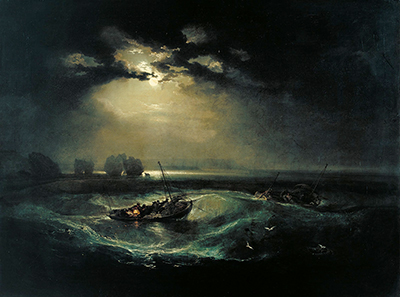
J. M. W. Turner did not turn to whales because the sea was new to him. When two paintings titled Whalers appeared at the Royal Academy in 1845, he had been exhibiting marine subjects for almost half a century. His first oil shown there, Fishermen at Sea in 1796, had already joined nocturnal light, working boats and dangerous water. Ships under sail, wrecks, harbours, storms, fishing crews and coastal trade remained central to his art through every later change of manner. What was new in 1845 was the scale and concentration of his attention to one maritime industry. At seventy, Turner made the pursuit of sperm whales the subject of four large exhibition canvases across two successive summers.[1]
The group is small enough to seem self-contained, yet it opens onto an unusually wide history. Whaling joined distant oceans to London capital, scientific description to commercial killing, heroic adventure to repetitive labour, and artificial illumination to the bodies of animals rarely seen by British audiences. It also suited Turner's recurrent concern with enterprises that become tests of human confidence. A crew could cross the globe, lower boats, fasten to a whale and transform its carcass into valuable cargo. It could also be smashed, drowned, frozen in or lost. Technical organisation never abolished exposure to weather, distance and animal force.
Turner's four oils do not deliver a simple verdict on that enterprise. They neither advertise whaling as uncomplicated national prowess nor declare a modern campaign against it. The hunters are courageous and vulnerable, but they are also agents of extreme violence. The whale is wounded and doomed, but its tremendous movement can reverse the apparent hierarchy between men and prey. Processing produces useful substances and profit, while reducing a living body to head matter, strips of blubber, smoke and casks. Turner holds those conditions together instead of resolving them into moral comfort.
The paintings are equally important to the history of looking. Contemporary observers struggled to identify whales, boats and ships within Turner's broken colour. Some ridiculed what they saw as shapelessness; others found that apparently arbitrary marks cohered at a distance into an overwhelming impression. Whaling therefore gave Turner both an extraordinary modern subject and a means of testing what painting could ask from a spectator. The pictures make recognition uncertain because the world they present is itself unstable: spray obscures bodies, glare erases edges, boats pitch, ice shifts and the ocean refuses a fixed surface.
Seen together, the quartet is not merely an eccentric episode near the end of Turner's life. It is a concentrated meditation on marine labour, global extraction, animal agency, imperial ambition and the fragile authority of human vision.
The Four Paintings and Their Two Exhibition Years
The first pair appeared at the Royal Academy in 1845 under the identical title Whalers. One, now at Tate, shows several boats converging on a sperm whale whose dark back and spout break the surface. A square-rigged vessel waits beyond the hunt. The other, now at the Metropolitan Museum of Art, catches the encounter after power has shifted: a wounded whale has struck a boat, men and wreckage are in the water, and the parent ship emerges through a tumult of spray and pale sky.[3][4] Their common format, closely related palette and complementary action make them a pair, but not duplicate treatments. The Tate canvas builds expectation around approach; the Met work converts pursuit into catastrophe.
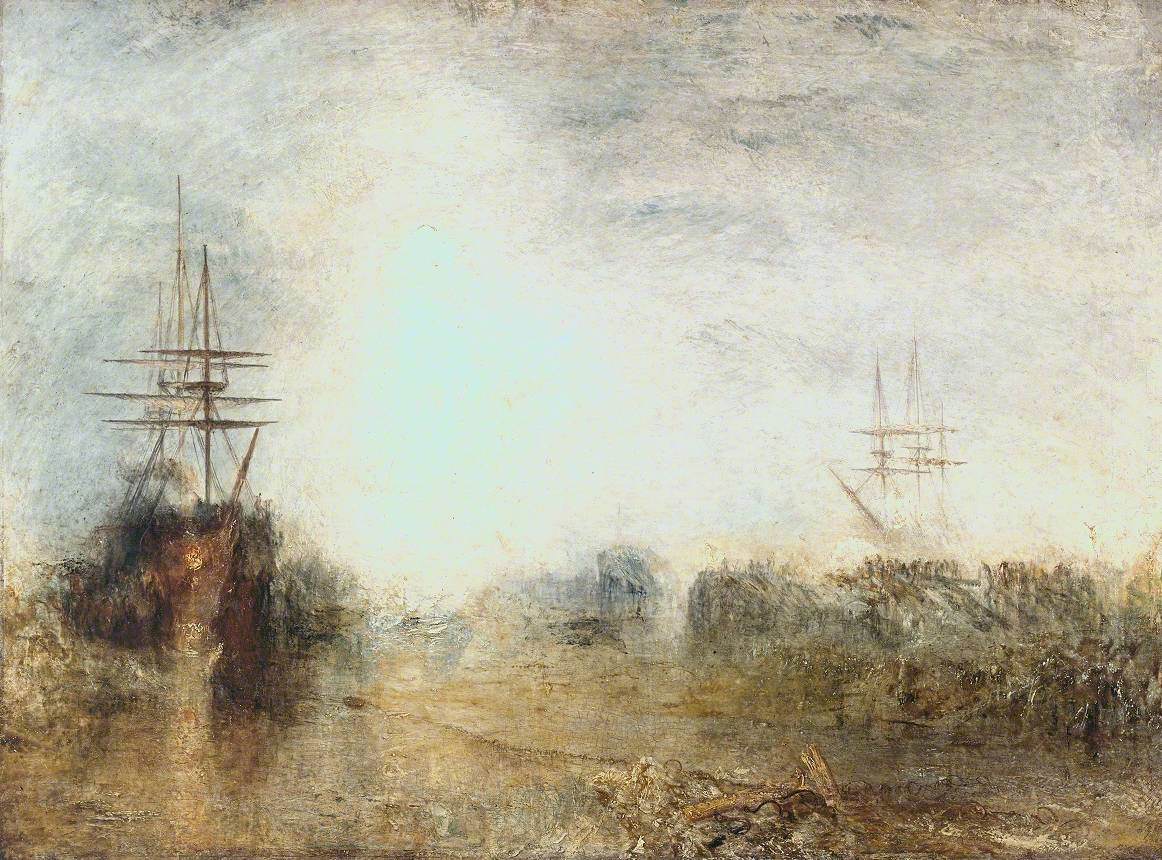
Turner expanded the subject at the 1846 Academy exhibition. 'Hurrah! for the Whaler Erebus! Another Fish!' shows the aftermath of a successful catch. Boats cluster at one side while a larger ship and the partly processed whale occupy the other. Its companion, Whalers (Boiling Blubber) Entangled in Flaw Ice, Endeavouring to Extricate Themselves, brings fire, smoke, ships and floating ice into uneasy balance.[5][6] These later works retain the broad proportions and low fields of maritime action found in the earlier pair, but their atmosphere changes. The glaring whites and violent motion of 1845 give way to richer yellow, blue and green, quieter water and the threatening stillness of polar entrapment.
It is tempting to turn all four into consecutive frames: locate the whale, attack it, cut it in, render the blubber. That sequence clarifies the material process, yet it should not erase the division between years. The 1845 captions direct attention to Thomas Beale's account of sperm whaling in the North Pacific. The 1846 works invoke polar exploration and onboard manufacture. Their geographies do not align neatly, and the final canvas may combine practices and imagery associated with different regions. Turner built a thematic progression rather than a documentary record of one ship's voyage.
Nor does surviving evidence establish that the quartet was commissioned as a settled cycle. The dimensions, pairings and repeated subject support the idea of a sustained project. A prospective buyer connected with sperm-whale products clearly mattered. But no contract fixes four pictures in advance, and Turner's decision to return to whaling in 1846 may have developed from the response to the first pair as much as from an original plan.
A Useful Order, Not a Literal Voyage
The strongest reading therefore keeps two ideas in view. The canvases collectively move from encounter with a living whale towards the industrial conversion of dead animals. At the same time, each pair has its own visual logic: attack and reversal in 1845; extraction and environmental peril in 1846. Their unity is real, but imaginative rather than reportorial.
Contents
- A Late Subject with a Long History Behind It
- The Four Paintings and Their Two Exhibition Years
- Before the Quartet: Sea, Fish and the Whale on Shore
- Elhanan Bicknell: Collector, Refiner and Intended Buyer
- London, the Southern Fishery and a Global Industry
- From Living Whale to Light, Lubricant and Luxury
- Thomas Beale and the Authority of Witness
- Beale's Pacific Hunts Transformed in Paint
- Pictures within Pictures: Linton, Huggins and Marine Convention
- Drawings: Inventing a Hunt Never Seen
Before the Quartet: Sea, Fish and the Whale on Shore
Turner's preparation for the whaling pictures consisted less in direct knowledge of whales than in decades of attention to maritime conditions. From early views of fishermen and naval vessels to late storms in which steamships almost disappear, he repeatedly considered what happens when a fragile craft enters a field governed by weather and water. Marine painting also allowed him to shift between labour and spectacle. A fishing boat could be an instrument of livelihood, a measure of scale, a national emblem and a vulnerable patch of colour within the same composition.
Whaling intensified each possibility. It was fishing enlarged to an oceanic and industrial extreme: longer voyages, heavier capital, more distant grounds, larger prey and a more elaborate chain of processing. The whale carried biblical and mythical associations, yet the hunt was also contemporary work. That collision between leviathan and commodity made the subject unusually compatible with Turner's habit of finding large historical meanings in present-day activity.
There was one significant pictorial rehearsal. Around 1837 Turner made The Whale on Shore for an illustrated edition of Walter Scott's The Pirate. The design was ultimately replaced, and it never acquired the public prominence of the later oils. Even so, it shows that a stranded whale and the people gathered around it had entered his imagination before Elhanan Bicknell became the likely commercial stimulus for the Academy canvases.[1] A beached animal offered a different relation from an ocean hunt. Human figures could inspect a huge body immobilised on land; the terrifying agency of the swimming whale was suspended. In the 1845 works, that agency returns with force.
Turner's own seafaring experience should be described precisely. He crossed channels, travelled along coasts, sketched from boats and cultivated the identity of a sailor-painter. He was also a devoted angler. None of that placed him in a whaleboat in the Pacific or beside a tryworks in polar ice. The authority of the quartet came from synthesis: familiar observation of waves, rigging, coastal weather and shipboard scale combined with printed testimony and images of an industry beyond his experience.
That distance matters. Turner was not reporting an expedition after seeing it. He was constructing how whaling might be imagined in metropolitan exhibition culture. The resulting pictures are not weakened by their indirectness; rather, they reveal how nineteenth-century Britons encountered distant extraction through books, prints, commodities, news and art. Their unstable imagery belongs to a subject already mediated before paint touched canvas.
Elhanan Bicknell: Collector, Refiner and Intended Buyer
The most immediate reason for Turner's concentrated choice of subject was probably Elhanan Bicknell. A prosperous partner in a business that refined spermaceti, Bicknell had substantial interests in the Pacific sperm-whale fishery. He was also an energetic collector of modern British painting. He began acquiring Turner's work in 1838, and in 1844 bought eight of his oils, six in a single day. That remarkable purchasing burst made him an obvious audience for new canvases joining marine drama to the industry from which his wealth had developed.[1]
Turner's short note of 31 January 1845 is the decisive document. He invited Bicknell to Queen Anne Street at the earliest opportunity, announcing “a whale or two on the canvas.” Playful though the wording is, its commercial purpose is plain. Turner wanted a proven buyer to see works in progress. What it does not prove is equally important: there is no surviving commission, agreed price or instruction from Bicknell specifying the subject. Turner was courting a patron, not necessarily fulfilling an order.
Bicknell's business may have assisted the project in practical ways. He subscribed for four copies of Beale's Natural History of the Sperm Whale, Turner's principal written authority. His firm owned a painting by the marine specialist William Huggins showing its whaling ships with an active hunt in the foreground. Both book and picture could have been made available to Turner, although no document records a loan. Bicknell thus stood at the crossing of information, imagery and market opportunity.
He apparently acquired the Met Whalers in 1845, but the transaction did not end calmly. In September, John James Ruskin reported that Bicknell had found what he believed to be watercolour in the work and rubbed some away with a handkerchief. Turner was furious and eventually took the canvas back to alter it. Whether Bicknell received it again is uncertain. The incident exposes conflicting assumptions about finish and durability: a buyer expected a stable oil painting, while Turner's mixed and experimental handling could look alarmingly vulnerable.[1][3]
The commercial connection complicates any heroic story of solitary inspiration. Turner made daring art while attending sharply to potential sales. Yet Bicknell's role does not reduce the quartet to private flattery. Three canvases remained unsold in Turner's possession. The project exceeded the needs of one collector because it transformed the patron's trade into a broad inquiry about labour, violence, light and risk. Bicknell helped make whaling available as a subject; Turner made its meanings unmanageable.
London, the Southern Fishery and a Global Industry
The whaling Turner imagined took place far from Britain, but its financial and material centre could be close to his London life. The British Southern Whale Fishery began in 1775 and remained heavily associated with the capital during its roughly eighty-five-year history. Vessels and investments radiated from London into the Atlantic, Indian, Pacific and Southern Oceans. Their voyages joined shipowners, insurers, refiners, chandlers and merchants at home to sailors working across enormous distances.[13]
This was not one uniform fishery. Northern voyages sought bowhead and right whales in Arctic waters, while southern and Pacific fleets increasingly pursued sperm whales. Different species produced different balances of oil, baleen and head matter, and regional practices changed with climate, distance and the need to preserve cargo. Turner's Beale-derived paintings concern sperm whaling; his polar imagery then crosses categories that historical operations usually kept more distinct.
By the 1840s British whaling had declined from earlier peaks. Foreign competition, especially from the United States, combined with changing prices, depleted hunting grounds and the high costs of long voyages. Decline did not make the industry culturally invisible. On the contrary, scarcity and distance could heighten its romance. Accounts of crews entering little-known oceans, encountering immense animals and returning with valuable cargo retained the character of adventure even when investors faced diminishing returns.
Bicknell's investments belonged to this transoceanic system. The British Southern Whale Fishery database records the vessels, owners and changing shares through which risk was distributed. Bicknell was among the owners of the Samuel Enderby, a ship built at West Cowes in 1834 and named for a family deeply identified with southern whaling.[14] Such ownership turns the apparent distance between a Herne Hill collection and Pacific slaughter into a continuous economic chain.
The same voyages also carried naturalists, specimens, navigational knowledge and imperial ambitions. Whaling ships entered waters not governed by Britain, relied on island and coastal communities, and helped map resources for later commerce. To nineteenth-century viewers, the whale hunt could signify courage and national reach. From a wider perspective, it was a mobile extractive frontier. Turner's pictures contain both energies: ships and crews embody formidable organisation, while sea, ice and animal bodies reveal the violence and limits built into that organisation.
From Living Whale to Light, Lubricant and Luxury
The sperm whale was valuable because its body could be separated into substances with different commercial uses. Ordinary body fat yielded sperm oil. The animal's immense head contained spermaceti, a waxy material that could be refined into bright-burning candles and high-quality oil. Whale oils lubricated machinery and illuminated domestic, civic and industrial interiors; other whale products entered soap, manufactured goods and decorative objects. Baleen from other species served flexible products before modern plastics.[12]
That chain of use is essential to the quartet. Turner does not show a generic battle between humanity and wilderness. His hunters pursue a body already understood as future material. Harpoon and lance begin a sequence that continues through cutting, boiling, casking, refining, selling and burning. The radiant centres of the 1846 canvases can therefore be read against an economy in which whale matter became light. The relation is interpretively powerful even though Turner left no statement naming it as an allegory.
Whaling demanded specialised coordination. Lookouts first located a spout. Small boats were lowered from the parent ship and rowed or sailed towards the animal. A harpoon attached whale and boat, after which crews endured the dangerous rush sometimes called a “Nantucket sleigh ride.” Lances caused lethal wounds once exhaustion brought the whale close. The dead animal was fastened beside the ship, where men cut the blubber in long strips and processed the head. On southern voyages, tryworks rendered the blubber into oil at sea, allowing a vessel to remain out for years.[12]
Every stage carried danger. Lines could entangle or sever limbs; a whale could overturn a boat; cutting tools worked on slick surfaces; open furnaces burned aboard timber ships; ice or weather could prevent escape. The industry converted animal fat into controlled illumination through a process repeatedly exposed to uncontrolled force.
Turner's sequence makes that conversion visible without the clarity of a technical illustration. In 1845 the whale is still an active body, first approached and then violently returning force. In 1846 the body is harder to distinguish because it is being disassembled. By the final canvas, smoke and flame signify rendering while the whale itself has nearly vanished. The disappearance is material rather than merely pictorial: a living subject has become process, atmosphere and prospective cargo.
Thomas Beale and the Authority of Witness
Turner relied most openly on Thomas Beale's The Natural History of the Sperm Whale, published in its expanded form in 1839. Beale had served as a surgeon aboard a South Sea whaleship. He combined anatomical observation, discussion of behaviour, criticism of inherited misconceptions, practical description and a voyage narrative. The book claimed empirical authority in a field filled with fabulous stories and inaccurate images.[7]
For Turner, Beale solved an obvious problem. The painter knew the sea but not deep-ocean whaling. By attaching short references to Beale in the Royal Academy catalogue, he could anchor imaginative pictures in the testimony of a participant. The citation functioned almost like a guarantee: viewers unable to judge the zoology or procedures could recognise that the artist had consulted a recent specialist account.
The relationship was not one of obedience. Turner extracted scenes, phrases and motifs, then recomposed them. Beale wrote sequential narrative; Turner compressed time. The author identified species, tools and actions; the painter allowed bodies to merge with water and light. A textual source promising precision became the basis of paintings famous for uncertainty.
That tension also appears within Beale's own undertaking. His whale is an animal to be described scientifically, a powerful agent whose behaviour challenges observation, and a commercial resource pursued for profit. Beale could admire its anatomy and intelligence while narrating its agonising death as the normal business of a voyage. Turner inherited this unstable combination. His canvases do not simply borrow incidents; they intensify the collision between knowledge and possession.
Bicknell may have supplied the volume, since he subscribed for four copies. Turner could also have obtained it independently. What matters is the public declaration of dependence. Artists often quoted poetry or history beneath exhibited titles, and Turner used literary extracts throughout his career. Here, however, the authority was neither canonical verse nor ancient legend. It was contemporary natural history written from within an industry. That choice made the modern whale hunt worthy of ambitious painting while acknowledging how much the artist's ocean had been assembled from another man's witness.
Beale's Pacific Hunts Transformed in Paint
The catalogue note attached to Tate's 1845 Whalers directed viewers to Beale's account at p. 163. The episode takes place in the North Pacific off Japan, then a highly productive ground for sperm whaling. Beale begins with dazzling sunlight and solemn stillness before attention gathers around a whale. Its hump projects above the surface, the spout rises from its head, boats gain upon it and harpooners stand ready. Turner selected the visual potential of calm becoming collective pursuit.[1][7]
The canvas preserves several elements without becoming a literal record. The animal is partly submerged, a dark and uncertain mass beneath spout and foam. Boats approach from different directions, their small crews registered through concentrated touches. The ship beyond establishes the larger system supporting the hunt. Yet the pale field of atmosphere and the circular pressure of movement matter more than exact nautical description. Turner makes anticipation legible through relations of scale and direction.
The Met picture cites p. 175 and turns to a more catastrophic incident. On 18 June 1832, after a whale had been harpooned and lanced, it rose rapidly and struck a boat with its head. Men and equipment were thrown into the air, the craft broke apart, and the whale circled as sailors clung to oars and wreckage. Sharks appeared, one crewman could not swim, and rescue depended on the arrival of another boat.[7]
Turner concentrated this reversal into a field of broken forms. The whale's damaged head and open jaw occupy the darker left side, while boats, men, blood, spray and wreckage become difficult to separate. The parent ship remains present but remote from immediate danger. Human organisation has not vanished; it has failed at the decisive point of contact.
Read as a pair, the works alter the moral and physical balance of Beale's hunt. The first positions the animal as quarry surrounded by purposeful men. The second shows those men dispersed by the body they have wounded. Neither outcome is triumphant. Beale's whale ultimately dies, so the apparent reversal does not become liberation. Turner instead exposes how mastery can be both effective and precarious: the industry kills the animal, but cannot prevent its last movements from becoming catastrophic.
Pictures within Pictures: Linton, Huggins and Marine Convention
Beale's prose was accompanied by images that offered Turner more immediate compositional material. William James Linton's frontispiece, Boats Attacking Whales, includes a spouting animal flinging a boat and sailors upward. A related image near Beale's account of the shattered craft brings the violent contact closer. The book also reproduces an image derived from William Huggins's widely circulated South Sea Whale Fishery, with whaleboats struggling around their quarry.[1][7]
Huggins had worked at sea before becoming a specialist marine painter. His whaling scenes emphasised recognisable ships, species and procedures for patrons who often knew the trade. A painting by him owned by Bicknell's firm portrayed its vessels with a hunt in the foreground. Turner may have studied it directly. Similarities make the possibility persuasive, although documentary proof of a viewing has not survived.
This visual inheritance clarifies what Turner changed. Earlier whaling images commonly spread separate incidents across a broad, legible ocean: parent ships, lowered boats, spouts, pursued animals and distant hazards could all be read. They advertised the reach of a fleet or preserved the identity of named vessels. Turner drew the spectator into atmospheric instability instead. Ship, whale and boats retain narrative roles but lose firm contours. The subject is no longer mastered by description.
The difference should not be reduced to factual Huggins versus expressive Turner. Huggins's experience and patrons generated their own sophisticated conventions, while Turner's apparent freedom depended on those conventions being recognisable enough to disrupt. He could dissolve a whale boat because viewers had seen how one was normally represented. He could turn a whaling ship into pale scaffolding because printed marine culture supplied the expected form.
The quartet consequently belongs both within and against the established genre. It borrows the genre's motifs and commercial setting, but exchanges its assurance for perceptual pressure. The result is a modern kind of history painting in which no ancient hero is required. Tiny working sailors, a wounded animal and a distant vessel carry questions of courage, suffering and ambition once reserved for myth.
Drawings: Inventing a Hunt Never Seen
Turner's surviving drawings confirm that the whaling project developed through variation rather than eyewitness transcription. Eight sheets in the Whalers sketchbook, probably carried on Kentish coastal journeys across 1844-45, have been associated with the oils. They contain ships, clustered boats, horizons and broad effects of weather. Their settings may originate in familiar coastal observation, but their incidents are rearranged towards an imagined deep-ocean hunt.[20][21]
In Vessel at Sea, chalk and watercolour establish a ship against mobile atmosphere with economical means. Whalers at Sea moves a dark form, perhaps a whale, towards a boat and distant vessel. The medium allows Turner to think in pressure and colour before resolving identity: a wash can be cloud, spray or disturbed water, while a stroke may become boat, body or rigging only through relation to its neighbours.
Other sheets connect more strongly with 1846. Sea Piece, with Figures in Foreground places activity at the lower edge beneath a luminous horizon. On the following leaf, black and red chalk locate boats and ship closer to their arrangement in 'Hurrah! for the Whaler Erebus!' White chalk marks the central light that would become more commanding than the minuscule labour around it.[22][23]
Two especially forceful watercolours dwell on animal resistance. Tate's A Harpooned Whale spreads crimson around the dark body and raised tail. Turner inscribed a phrase usually read, with caution, as an intention to use the idea. The Fitzwilliam's The Whaler sets the whale's bulk against tiny red figures and includes the words “He breaks away.”[24][25] Language and image do not describe something observed; they prompt action within the painter's imagination.
Some of these works probably followed the completion or exhibition of the first oils. The Ambleteuse and Wimereux material dates from a French journey around the opening of the 1845 Academy, and related Channel studies may be later that summer. Calling every sheet preparatory would impose a false linear order. Turner continued to test the subject after presenting it publicly. Oil paintings generated further watercolours, which in turn kept whales active in his thinking before the 1846 pair.
Looking at Violence without Resolving It
Whaling could be represented as disciplined labour, spectacular adventure or national commerce. Turner preserves aspects of all three while refusing to make the kill visually comfortable. The 1845 paintings insist on the close bodily encounter between a crew and an animal far larger than its boats. Red marks imply wounds and danger without separating human blood from whale blood or reflected colour. Spray and glare make suffering hard to inspect, but they do not make it absent.
The Met canvas is particularly resistant to a heroic hierarchy. The whale has been harpooned and lanced. Its violent movement destroys a craft, yet that resistance occurs within mortal injury. Sailors in the water are genuine victims of the immediate reversal, while remaining participants in the hunt that produced it. Sympathy moves uneasily between species.
This double exposure is one reason the sublime is useful, provided the term is not allowed to beautify slaughter. Eighteenth- and nineteenth-century theories associated sublimity with vastness, obscurity, terror and the breakdown of secure comprehension. Turner's whale cannot be grasped as a clean outline; its scale is understood through the boats it overwhelms. The sea becomes a force rather than a setting. Vision is partial because danger, motion and atmosphere prevent mastery.
At the same time, the pictures remain commodities shown for sale within an elite institution. Their excitement depended partly on giving metropolitan viewers controlled access to distant peril. A spectator could experience confusion and fear while standing safely before canvas. That distance is ethically significant. Turner makes violence affectively intense, but the exhibition also converts it into cultural value.
The strongest reading does not force a verdict that the evidence cannot carry. Turner did not leave a declaration condemning whaling, and his cultivation of Bicknell argues against treating the pictures as straightforward protest. Nor are they simple celebrations. Their formal instability makes confidence difficult to sustain. Hunters, whale, weather and machinery enter one field in which effective exploitation and failed control are visible together.
The Royal Academy in 1845: Whales between Venice and Ancona
Turner showed six works at the 1845 Royal Academy exhibition: four Venetian subjects and the two Whalers. He was seventy and serving as interim president, with long experience of how placement shaped comparison. The whale pictures did not appear in isolation. Clarkson Stanfield's The Mole at Ancona with Trajan's Arch hung between them, creating an unusually pointed contrast between two distinguished marine painters.[8]
Stanfield's picture was widely praised for lucid construction, cool colour, firm drawing and descriptive finish. Turner offered pale turbulence, uncertain forms and chromatic intensity. The juxtaposition encouraged critics to define one artist through the other. Stanfield seemed to paint optical effects as clearly observed facts; Turner appeared to provide materials from which the viewer's eye had to construct an effect.
That labour divided opinion. Several writers complained that Turner's sea was an undifferentiated mass of white spray, that forms could not be found and that expressive colour had replaced truth. Yet resistance frequently turned into reluctant admiration. The Literary Gazette called the Met work visionary and unreal while praising its prismatic harmony. The Times valued the force of a moment. The Spectator found peril and excitement within light, cloud and surge. Even critics who rejected the method conceded its power.[1]
The satirical response was more economical. Punch compared Turner's effects to lobster salad and joked that the same painted confusion could receive almost any title.[10] The joke depended on a genuine problem: if named objects emerged only slowly, what prevented the title from doing all the representational work?
William Makepeace Thackeray supplied the most perceptive answer. Writing in Fraser's Magazine, he described Turner's apparently random purple, yellow and vermilion marks becoming whale, harpoon boats and sailing ship as he looked. He placed the artist between absurdity and sublimity, able to mesmerise an initially sceptical eye.[11] Recognition was therefore not absent but delayed. Turner's handling turned spectatorship into an event, making viewers reenact the difficulty of finding stable forms in the hunt.
1846: From Pursuit to Processing
When Turner returned to whaling the next year, he shifted attention from attack to the work that followed a kill. 'Hurrah! for the Whaler Erebus! Another Fish!' contains boats, anchors, chains, buoys and a large vessel. Beside the ship, the carcass has entered the cutting-in process. Its head has been separated and suspended; blubber is removed as the body is turned against the hull. The forms are difficult to isolate, but the painting's business is extraction rather than pursuit.[5]
Beale is cited again, though without a precise location in the volume. His description of cutting-in explains the activity, and episodes in which crews race towards whales or cheer a cargo-completing catch may inform the title. No one passage accounts for the whole scene. Turner fused operational knowledge with the celebratory cry and with a radiant composition dominated by the sun.
The final oil advances towards rendering. Orange fire and dark smoke beside the vessels indicate tryworks, the brick furnace where pieces of blubber were boiled. This was punishing labour: cutting spades were dangerously sharp, decks became slick, the smell was pervasive, and flame operated aboard a wooden ship surrounded by oil. The extracted liquid would eventually be cooled and stored in casks.[6][12]
Turner sets this manufactured fire against pale natural light and cold sea ice. The opposition belongs to his wider imagery of modern industry, where furnaces, steam and artificial illumination meet sun, moon or weather. Here it acquires a material specificity. Whale fat feeds the fire that releases more whale oil, while ice threatens the ship carrying both apparatus and future commodity.
The transition across the quartet is profound. In the first works, the whale's body is an active dark presence, however hard to decipher. In the third it hangs against the ship as matter under division. In the fourth it survives primarily through smoke, flame and title. The industrial achievement consists in making the animal disappear into useful substance. Turner makes that disappearance visually magnificent and morally unsettled.
The 1846 exhibition tested whether audiences had learned how to look at this kind of Turner. The previous summer's jokes returned almost immediately. The Almanack of the Month recycled the lobster-salad comparison and printed a caricature of Turner working with a mop beside a bucket marked yellow. Ridicule now attached not only to indistinct form but to a public image of the artist as someone who substituted extravagant colour and crude tools for disciplined labour. His handling had become recognisable enough to function as a comic brand.[1][9]
More sympathetic observers answered by treating 'Hurrah! for the Whaler Erebus!' as evidence that the jokes had reached their limit. The Times argued that the magnificent light should restrain viewers inclined to dismiss every late Turner as a jest. Its critic looked directly into the represented sun and admired the delicate indications of high cloud around the blaze. The praise is revealing because it does not depend on being able to inventory every chain, boat or strip of blubber. Atmospheric coherence supplied the standard by which descriptive uncertainty could be forgiven.
The response to Whalers (Boiling Blubber) Entangled in Flaw Ice was similarly divided. The Athenaeum reported that a spectator could at least make tangible forms from its almost chaotic colour. Sea-green ice, flickering sunlight, smoke and tall vessels offered enough structure to support the title. The Literary Gazette went further: grant Turner's manner, it argued, and dark ships, pink whales, yellow masses and thick touches could collectively produce an extraordinary magic. The concession “grant the style” identified the central issue. Viewers were being asked to accept a pictorial system with rules different from smooth finish and local colour.[1]
Those reviews also show that processing was difficult to recognise without words. A whale hunt had familiar dramatic cues: raised harpoons, boats and a spout. Cutting-in and trying-out were specialised operations, and Turner's small scale made their tools obscure. His unusually extended titles and the Beale citation supplied knowledge that the image alone withheld. Word and paint therefore collaborated. The title did not merely label a transparent scene; it taught spectators what kinds of forms they were trying to find.
The critical dispute was not a secondary afterthought to the paintings. It completed their public operation. Whaling crossed distance by turning an unfamiliar animal and remote labour into printed account, commodity and spectacle. Turner's manner made that crossing difficult enough to become visible. Audiences confronted both the attraction of a radiant maritime image and their dependence on verbal authority to identify its violence. The 1846 pair thus carried the industrial sequence into spectatorship: as crews process a whale into usable matter, viewers process colour into a meaningful event.
HMS Erebus and the Pull of Polar Exploration
The word Erebus on Turner's 1846 title and painted banner does not identify a known commercial whaler. It points instead towards HMS Erebus, a Royal Navy bomb vessel converted for exploration. Together with HMS Terror, it had sailed under James Clark Ross to Antarctica between 1839 and 1843, charting coasts, investigating terrestrial magnetism and collecting natural-history material.[1][26]
Several connections could have brought the expedition close to Turner. Both he and Ross belonged to the Athenaeum Club. Joseph Dalton Hooker, the assistant surgeon and naturalist aboard Erebus, was a nephew of Turner's friend Dawson Turner. The artist owned a portion of the published zoology of the voyage. Whales appeared within the expedition's scientific field even though the naval vessel was not engaged in commercial whaling.
The ships acquired another identity almost immediately. On 19 May 1845, shortly after Turner's first Whalers went on view, Erebus and Terror departed under Sir John Franklin in search of the Northwest Passage. The undertaking attracted intense attention because it combined national ambition, scientific purpose and advanced technology. Its fatal outcome was not yet understood when Turner exhibited the 1846 paintings.
Which voyage did he mean? The completed Antarctic expedition offered known polar imagery and natural history. Franklin's new Arctic mission supplied urgent public currency. The answer may be both. The title could draw on the established fame of the ships rather than refer to one exact event. Turner's association of Erebus with a whale catch is imaginative, not a record of naval whaling.
The ambiguity matters because later knowledge changes how the jubilant word “Hurrah” sounds. Franklin's expedition would become a national tragedy in which all 129 men died. Turner could not have known that fate in 1846, and the picture should not be treated as prophecy. Nevertheless, its companion already converts celebration into entrapment. Success and disaster form a pattern within Turner's art before history supplies this particular disaster.
Flaw Ice and an Unstable Geography
“Flaw ice” refers to floating ice detached from a larger body, capable of shifting around vessels. Turner's long title presents ships caught within it but still trying to free themselves. The action is less explosive than the smashed boat of 1845, yet danger may be greater. Ice constrains the whole industrial system: parent ships, furnaces, crews and cargo can all be immobilised at once.
The geographical evidence is deliberately difficult. Onboard boiling of blubber was characteristic of southern whaling. In the Arctic, crews generally stored blubber for processing after returning home. That practical distinction makes an Antarctic setting likely. Ross's Erebus voyage supplies a southern-polar association, and Hooker's published summary described vessels becoming entangled in and extricated from pack ice.[1]
Other cues pull north. Franklin's departure made Erebus newly synonymous with Arctic exploration. Paintings and reports of vessels trapped in northern ice were already common. John Ward of Hull had exhibited a related Erebus and Terror rescue subject at the Academy in 1840. Turner may also have consulted Frederick Debell Bennett's account of southern whaling, which described the infernal spectacle of tryworks at night.
Trying to assign one latitude can therefore distort the painting. Turner combined procedures, words and visual conventions from a broad polar imagination. The mixture is not mere carelessness. Metropolitan knowledge of remote seas was itself assembled from expedition reports, trade accounts, prints and news. His canvas reproduces that mediated geography while using it to heighten conflict between fire and ice.
The ice also transforms the meaning of industry. In the open Pacific, boats pursue a mobile animal. Here, the vessels have become the trapped bodies. A furnace designed to convert nature into transportable value burns within an environment that prevents transport. Human work continues, but the larger field has ceased to cooperate. The final scene closes the quartet without closure: the men are endeavouring to escape, and Turner withholds the result.
Whale, Commodity and the Material of Paint
One of the most suggestive facts about Turner and whaling lies outside the quartet's documented technical history. Conservation science has identified spermaceti wax in the media of some Turner paintings. He experimented with oils, resins, waxes and prepared mixtures to vary flow, translucency, texture and drying. In at least one analysed work, spermaceti and beeswax formed part of a complex paint structure.[29]
This finding has encouraged the memorable claim that Turner painted whales with whale. It must be handled with restraint. No evidence locked to the four whaling canvases demonstrates that their layers contain spermaceti. A material identified elsewhere in his practice cannot be transferred to these objects by thematic attraction. The quartet may have been made with similar mixtures, but possibility is not analysis.
The broader historical relation remains significant. Turner worked in a culture where animal substances permeated artistic manufacture. Oils, waxes, glues, brushes and supports carried material histories that exhibition audiences rarely saw. Spermaceti entered both commercial illumination and some painters' experiments. The boundary between represented world and artistic medium was more porous than modern categories of “art” and “industry” suggest.
This context deepens the 1846 emphasis on processing. Cutting and boiling turn a body into substances whose origin can disappear in use. A candle presents steady light, not the violence of the hunt. A modified paint medium presents colour and handling, not a whale's head. Turner's pictures reverse that disappearance by reconnecting luminous effects to labour at sea, even if their own precise ingredients remain unknown.
Material caution also applies to surface interpretation. The Met canvas has undergone treatment, and the nineteenth-century handkerchief dispute complicates its history. Visible abrasion cannot simply be assigned to Bicknell's gesture. Nor can digital inspection identify pigments or binding media. Turner's technique contributes to meaning, but claims about chemistry require samples and conservation records rather than metaphor.
Hull, the Northern Fishery and Other Ways of Seeing Whaling
Turner's quartet was exceptional in style, but whaling imagery had an established British centre in Hull. The port supported a northern fleet and a community of marine painters whose clients included shipowners and captains. Artists such as John Ward recorded named vessels, catches, ice and local maritime identity with a descriptive precision quite different from Turner's late manner.[17]
The contrast reveals different functions. A ship portrait could commemorate ownership, successful voyages or civic commerce. Accurate rig and hull mattered because patrons recognised the vessel. Turner's ships are less individualised; they operate as parts of a larger drama of labour and perception. Yet his art did not supersede Hull painting. The local tradition preserves industrial and social information that his atmospheric canvases obscure.
Hull collections also contain scrimshaw: objects carved or incised by whalers from sperm-whale teeth, jawbone, baleen and other animal material. They depict ships, hunts, women, houses and remembered scenes. Scrimshaw gives artistic form to the commodity transformation itself. The support is not canvas representing a whale but part of the killed animal carrying an image made within whaling culture.[18]
These objects complicate distinctions between fine art, occupational craft and evidence. An Academy oil entered elite criticism and collecting; a carved tooth circulated as souvenir, gift or sailor's work. Both aestheticised the hunt, though from different positions. Both can also disclose what they suppress: pain, unequal labour, Indigenous presence and ecological cost.
The 2017 exhibition Turner and the Whale, created through collaboration between Hull Maritime Museum and the University of York, placed Turner's work within this broader material culture. It brought together three original Turner works, a full-scale reproduction of the Met painting, Hull marine paintings and whaling artefacts.[16][19] The display did not recreate the Met's four-original reunion. Its achievement was different: it shifted attention from the isolated genius of a late painter towards networks of animals, workers, objects, ports and scholarship.
Empire, Exploration and the People Left Outside the Frame
British whaling entered oceans inhabited, travelled and understood by many peoples long before metropolitan ships arrived. Crews depended on ports, provisions, local navigation, trade and knowledge across the Pacific and polar regions. Yet British images often represented distant waters as empty spaces awaiting national courage. Ice, whale and ship filled the frame while Indigenous communities disappeared.
That absence is especially consequential in Arctic imagery. Inuit knowledge proved essential to survival and movement in northern environments, but expedition culture frequently cast the region as a blank field for British discovery. Hull School scenes of whaling and rescue could reinforce possession by showing British vessels as the principal actors within apparently unoccupied ice.[17] Turner's 1846 paintings share the visual absence even though their atmosphere destabilises triumph.
Whaling and exploration were not identical enterprises, but they overlapped. Commercial vessels gathered geographic and natural-historical information. Naval expeditions mapped possible trade passages and collected specimens. Both converted movement through remote environments into knowledge valued at the imperial centre. The Erebus reference allows those activities to converge within Turner's quartet.
The paintings do not provide enough evidence to label Turner an anti-imperial critic. His interest in national history, exploration and maritime power was complex, and he could invest modern enterprise with grandeur. What they do show is the insecurity of imperial confidence. Vessels remain tiny under sky, whale and ice; command can turn rapidly into catastrophe. Natural forces do not recognise the political meanings attached to a flag.
A responsible modern interpretation can restore suppressed histories without pretending Turner consciously encoded them. Asking who is absent changes what the pictures disclose. The empty-looking ocean becomes a constructed metropolitan vision. The commodity becomes the endpoint of encounters extending beyond the sailors Turner depicts. The quartet then belongs to an imperial culture not because it carries a simple message of empire, but because its animals, goods, ships and imagined geographies were made possible by that culture.
Environmental History and Animal Studies
Modern knowledge of cetaceans changes the conditions under which Turner's pictures are viewed. Industrial whaling severely reduced many populations and altered marine ecosystems. Museum research now joins historical logbooks, specimens and commercial records to biological questions, revealing how the extraction of whales shaped scientific collections as well as ocean life.[15]
The four paintings were made before modern conservation movements and before current ecological science. It would be anachronistic to present Turner as forecasting population biology or climate change. Yet the works offer substantial material for environmental history because they show the cultural imagination surrounding extraction: the distant animal made visible, the hunt presented as adventure, the carcass converted into energy, and the whole enterprise threatened by the environment it seeks to master.
Animal studies asks a related but distinct question: can the whale appear as more than symbol or resource? Turner's 1845 reversal gives the wounded animal force and presence. Its body disrupts boats and pictorial order. That agency does not recover the whale's experience, and the painting still arrives through a human hunt, human text and human market. It does, however, prevent complete reduction to passive prey.
Later curators and scholars have used the quartet to discuss suffering, interspecies violence and the ethics of looking. The York and Hull collaboration deliberately connected the pictures to scrimshaw, Arctic histories and contemporary debates. Some contributions used newer theoretical vocabularies associated with critical animal studies and vegan criticism.[16] Those approaches belong to the continuing reception of Turner, not to a hidden declaration by the artist.
Jason Edwards's study Turner and the Whale, developed alongside the Hull project, demonstrates how much interpretive ground lies beyond identifying sources and vessels. It considers the whale as animal, raw material, image and critical problem, and asks what forms of attention become possible when art history takes species difference seriously.[28] Such an approach does not require the claim that Turner secretly held twenty-first-century views. It examines what the paintings do to bodies: which are rendered visible, which are fragmented, which attract sympathy and which become supports for human meaning.
The distinction is crucial because environmental interpretation can otherwise become self-congratulation. A present-day observer may condemn nineteenth-century whaling while enjoying the very splendour through which Turner made it culturally compelling. The canvases do not permit an easy position outside that contradiction. Their surfaces transform blood, smoke, oil and danger into chromatic pleasure. Ethical looking begins by acknowledging that aesthetic power rather than pretending moral awareness cancels it.
Historical ecology also expands the timescale of the represented event. A hunt appears momentary, but its conditions include years of voyage, accumulated catches, market demand and pressure on breeding populations. Its consequences continue through refined products, museum specimens, commercial archives and altered seas. Turner's compressed action can now be understood within that longer duration, even though he did not possess the data by which modern researchers reconstruct it.
This longer view returns importance to ordinary labour. Famous discussions of Turner and Melville can elevate whaling into metaphysical conflict, leaving the crews as symbols. Material and environmental history restore rowing, cutting, boiling, cleaning and casking, as well as the unequal distribution of risk and profit. The tiny marks in Turner's foregrounds represent people whose work connected animal death at sea to metropolitan light. Their near disappearance is formally powerful, but historical interpretation can refuse to let scale make labour incidental.
Finally, the whale itself remains partly beyond every framework. Beale's observations, Turner's imagined forms and present-day biology each produce knowledge, yet none gives unmediated access to the animal's experience. The quartet's obscurity can sustain that limit. It does not make the whale unknowable in a mystical sense; it reminds viewers that scientific description, commercial use and aesthetic response are human relations to a life that exceeds them.
The distinction between intention and availability is productive. Turner need not share current concepts for his work to reveal structures that concern us now. Indeed, the quartet's refusal to resolve bravery, profit, beauty and pain makes it unusually open to environmental reconsideration. Its dazzling light cannot be separated from extracted oil; its magnificent sea cannot be separated from commercial penetration; its whale cannot be separated from the wounds that make its power visible.
Turner and Melville: A Connection with Firm Limits
Turner's whaling paintings inevitably invite comparison with Herman Melville's Moby-Dick, published in 1851 only months before the painter's death. Both works elevate dirty, dangerous labour into an ambitious meditation on knowledge, pride, nature and catastrophe. Both use whiteness, obscurity, unstable seas and the immense whale to test the limits of description. The chronological and documentary relationship, however, is narrower than the imaginative affinity.[1]
Melville obtained Beale's Natural History of the Sperm Whale in 1850 while developing his novel. In his copy he dated his use of the book and wrote that Turner's pictures of whalers had been suggested by it.[27] The note proves that he knew of the paintings and understood their principal written source. It does not prove that he had stood before the oils.
Melville visited London in 1849 and encountered people connected with Turner, including Samuel Rogers and Charles Robert Leslie. He saw British collections and could have learned about the controversial whale pictures through conversation, prints, Ruskin or criticism. No surviving journal entry places him in Turner's Queen Anne Street gallery, where three of the oils remained. The location of the Met work at that moment is uncertain.
The mysterious painting in the Spouter-Inn early in Moby-Dick has often supplied the strongest case for influence. Ishmael confronts a dark, nearly indecipherable marine image whose masses gradually resolve into ship and attacking whale. The experience resembles Thackeray's 1845 description of looking at Turner. It also resembles Turner's late seascapes more generally. Resemblance is not a documentary chain, and several visual or written sources may have contributed.
Melville certainly admired Turner later. During an 1857 visit he responded to the paintings, eventually wrote about The Fighting Temeraire and collected Turner reproductions, including Brandard's engraving after 'Hurrah! for the Whaler Erebus!'[30] Later admiration cannot establish what he saw before 1851. The intellectually honest conclusion is more interesting than a forced discovery: Turner and Melville shared Beale and a Romantic problem of representing the nearly unrepresentable, while the exact path between their works remains unresolved.
Reunion, Redisplay and Changing Questions
Three whaling canvases remained with Turner and passed to the nation through the Turner Bequest. The Met Whalers travelled through the market and entered the New York museum in 1896. Separation encouraged uneven familiarity. British audiences could see three works together, while the catastrophic 1845 scene became an American museum object with its own provenance and conservation history.[2][3]
The Metropolitan Museum's 2016 exhibition brought all four originals together for the first time. Their common dimensions and shifting pair structures could then be assessed through direct comparison rather than reproduction. The display clarified the alternating movement between apparent success and danger, and between animal encounter and industrial processing. It also returned the Met canvas to a context from which its independent fame had partly detached it.[2]
The accompanying study by Alison Hokanson reconstructed the role of Bicknell, Beale, printed imagery, sketchbooks, criticism, polar exploration and Melville. Its central achievement was not to force a single key upon the group, but to show how the pictures accumulated meaning through connected fields.[1] The quartet could be at once a sales venture, a late marine experiment, an industrial narrative and a meditation on failed mastery.
Hull's 2017 exhibition asked another set of questions. By placing Turner beside local whaling paintings, scrimshaw and contemporary scholarship, it foregrounded animal material, labour, Arctic imagination and regional memory. The substitution of a full-scale reproduction for the Met original also made the history of separation visible rather than pretending that every reunion was the same.[19]
Redisplay matters because no artwork's interpretation remains fixed. Nineteenth-century critics asked whether Turner's marks counted as truthful painting. Twentieth-century scholars often concentrated on late style and literary connection. More recent exhibitions add commodity history, ecology, empire and animal ethics. Each emphasis uncovers evidence while risking overstatement. The quartet rewards the change precisely because it never supplied an easy account of what whaling meant.
What Turner's Whaling Project Finally Holds Together
Turner's engagement with whaling lasted only a concentrated part of his long career, but it drew together concerns developed over decades. The sea provided a field in which light, weather and motion could exceed firm drawing. Maritime labour supplied vulnerable human figures and contemporary purpose. Whaling enlarged those terms through the scale of the animal, the distance of the voyage and the violence of extraction.
The project also joined different kinds of authority. Beale offered the authority of participation and natural history. Huggins and printed whaling images supplied established visual conventions. Bicknell brought commercial knowledge, artistic patronage and the hope of a sale. Polar expeditions carried scientific and national prestige. Turner absorbed each element without submitting to any one of them.
Across the paintings, mastery remains provisional. Boats converge with discipline, then splinter. A successful catch becomes a suspended carcass. Fire turns blubber into oil, then ice threatens the whole operation. Human ingenuity is real; so are animal suffering and environmental resistance. This is not a tale in which nature simply defeats civilisation, because the whale is killed and the industry often succeeds. It is a tale in which success cannot be separated from cost or danger.
Turner's manner makes that argument through perception. He does not offer the whale as a stable emblem placed against a stable sea. Forms emerge and recede within spray, glare, smoke and colour. Viewers must work to identify the very process by which bodies are being found, pursued and made useful. The difficulty of seeing becomes inseparable from the difficulty of judging.
That openness explains why the quartet continues to support new interpretation. It can be studied through nineteenth-century commerce, marine painting, exhibition culture, polar exploration, material science, literary history or environmental ethics. None exhausts the works. Together they show an artist transforming a specialist modern industry into a profound inquiry about what humans do when they convert the living world into knowledge, spectacle and value.
Their continuing force also depends on Turner's refusal to separate beauty from implication. Sunlight does not absolve the hunt, and violence does not cancel the beauty of light. A ship can signify coordinated skill while remaining an instrument of extraction; an animal can inspire terror while suffering mortal injury. Each apparent conclusion encounters its opposite. That pressure gives the paintings unusual historical reach. They preserve the confidence of an age that sent vessels across the globe, but also the fear that distance, weather and living nature could expose the limits of command. To study Turner and whaling is therefore to study neither a maritime curiosity nor a moral lesson fixed in advance. It is to confront a group of works in which seeing, using and valuing the nonhuman world become inseparable problems.
Discussion
How do Turner's whaling pictures hold labour, animal force, extraction and failed human mastery together without resolving them?
Reader Insights
What changes when the four canvases are viewed as two exhibition-year pairs rather than one literal voyage?
How does artificial light alter the meaning of paintings tied to whale oil and spermaceti?
Where does the whale resist human control without escaping the violence of extraction?
Join the Conversation
Share a close observation or a source-based question for other readers.
References
- Alison Hokanson, *Turner's Whaling Pictures*, *Metropolitan Museum of Art Bulletin* 73, no. 4, 2016, https://www.metmuseum.org/met-publications/turners-whaling-pictures
- Metropolitan Museum of Art, “Turner's Whaling Pictures,” exhibition, 10 May-7 August 2016, https://www.metmuseum.org/exhibitions/listings/2016/turner-whaling-pictures
- Metropolitan Museum of Art, “Whalers,” object 96.29, https://www.metmuseum.org/art/collection/search/437854
- Tate, “Whalers,” N00545, https://www.tate.org.uk/art/artworks/turner-whalers-n00545
- Tate, “'Hurrah! for the Whaler Erebus! Another Fish!',” N00546, https://www.tate.org.uk/art/artworks/turner-hurrah-for-the-whaler-erebus-another-fish-n00546
- Tate, “Whalers (Boiling Blubber) Entangled in Flaw Ice, Endeavouring to Extricate Themselves,” N00547, https://www.tate.org.uk/art/artworks/turner-whalers-boiling-blubber-entangled-in-flaw-ice-endeavouring-to-extricate-themselves-n00547
- Thomas Beale, *The Natural History of the Sperm Whale*, London, 1839, Biodiversity Heritage Library, https://www.biodiversitylibrary.org/item/192636
- Royal Academy Chronicle, “1845,” https://chronicle250.com/1845
- Royal Academy Chronicle, “1846,” https://chronicle250.com/1846
- *Punch*, vol. 8, 31 May 1845, p. 233, Heidelberg digitisation, https://digi.ub.uni-heidelberg.de/diglit/punch1845/0229
- W. M. Thackeray, “Picture Gossip,” *Fraser's Magazine* 31, June 1845, pp. 720-21, Internet Archive, https://archive.org/details/frasersmagazine31fras
- New Bedford Whaling Museum, “Whales and Hunting,” https://www.whalingmuseum.org/research/research-resources/whaling-history/whales-and-hunting/
- British Southern Whale Fishery, “History of the British Southern Whale Fishery,” https://www.britishwhaling.org/history-of-the-british-southern-whale-fishery.html
- British Southern Whale Fishery, “Ships,” https://www.britishwhaling.org/ships.html
- Natural History Museum, “Cetacean (Re)Sources,” https://www.nhm.ac.uk/our-science/research/projects/cetacean-resources.html
- York Art History Collaborations, “Turner and the Whale: Turner,” https://yahcs.york.ac.uk/research/exhibitions/turner-and-the-whale/turner/
- York Art History Collaborations, “Paintings from the Hull School,” https://yahcs.york.ac.uk/research/exhibitions/turner-and-the-whale/paintings/
- York Art History Collaborations, “Scrimshaw and Carvings,” https://yahcs.york.ac.uk/research/exhibitions/turner-and-the-whale/scrimshaw-and-carvings/
- University of York, “Turner whaling exhibition,” 2017, https://www.york.ac.uk/news-and-events/news/2017/events/turner-whaling-exhibition/
- Tate, “Vessel at Sea,” D35248, https://www.tate.org.uk/art/artworks/turner-vessel-at-sea-d35248
- Tate, “Whalers at Sea,” D35251, https://www.tate.org.uk/art/artworks/turner-whalers-at-sea-d35251
- Tate, “Sea Piece, with Figures in Foreground,” D35252, https://www.tate.org.uk/art/artworks/turner-sea-piece-with-figures-in-foreground-d35252
- Tate, “Whalers,” D35253, https://www.tate.org.uk/art/artworks/turner-whalers-d35253
- Tate, “A Harpooned Whale,” D35391, https://www.tate.org.uk/art/artworks/turner-a-harpooned-whale-d35391
- Fitzwilliam Museum, “The Whaler,” P.D.116-1950, https://data.fitzmuseum.cam.ac.uk/id/object/202416
- Royal Museums Greenwich, “HMS Erebus and Terror,” collection and research records, https://www.rmg.co.uk/stories/topics/hms-erebus-terror
- Harvard Library, “Did Melville read it?”, Thomas Beale volume from Melville's library, https://takenote.library.harvard.edu/45-did-melville-read-it
- Jason Edwards, *Turner and the Whale*, 2017, preview, https://api.pageplace.de/preview/DT0400.9781784422875_A31461396/preview-9781784422875_A31461396.pdf
- Joyce H. Townsend, “The Materials and Techniques of J. M. W. Turner,” in *Historical Painting Techniques, Materials, and Studio Practice*, Getty Conservation Institute, 1995, https://www.getty.edu/publications/resources/virtuallibrary/0892363223.pdf
- Robert Brandard after Turner, “Whalers,” in *The Turner Gallery*, 1859-61, historical volume, https://upload.wikimedia.org/wikipedia/commons/d/de/The_Turner_Gallery%3B_a_series_of_one_hundred_and_twenty_engravings_from_the_works_of_the_late_J.M.W._Turner%2C_R.A.%3B_%28IA_gri_33125008236784%29.pdf