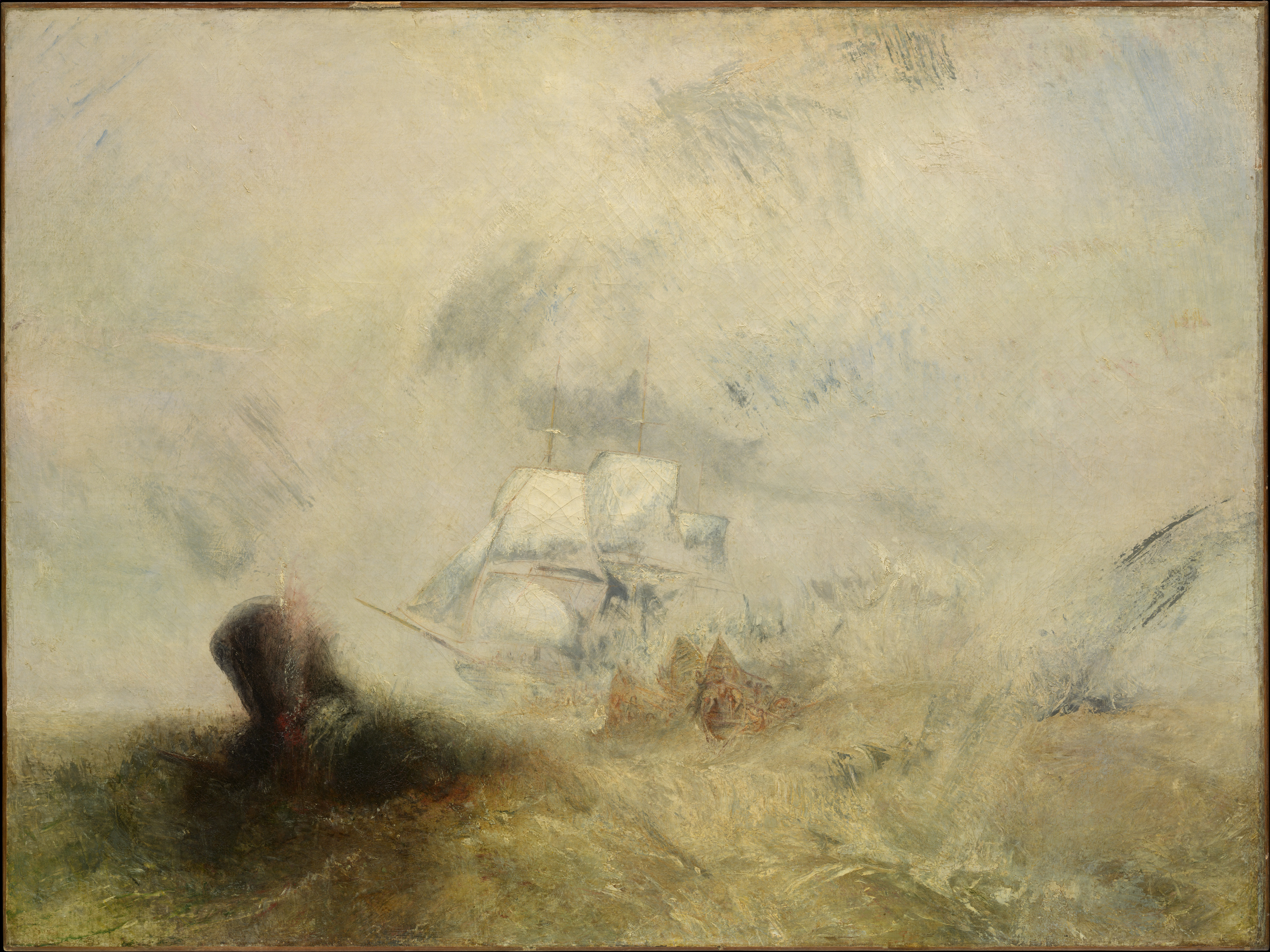
 View the public-domain object record
at The Met
Metropolitan Museum of Art, object 96.29. Public domain.
 by Tom Gurney
Tom Gurney BSc (Hons) is an art history expert with over 20 years experience
Published on June 19, 2020 / Updated on August 29, 2026
Email: tomgurney1@gmail.com / Phone: +44 7429 011000
Whalers at the Metropolitan Museum of Art
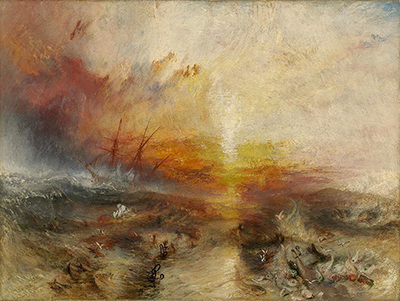
J. M. W. Turner's Whalers is an oil painting of about 1845 in the Metropolitan Museum of Art, New York. It measures 36 1/8 by 48 1/4 inches, or 91.8 by 122.6 centimetres, and entered the museum in 1896 through the Catharine Lorillard Wolfe Collection, Wolfe Fund. The Met's object number is 96.29.[1] These facts identify a particular canvas, which matters more than usual because Turner exhibited two different paintings under the title Whalers at the Royal Academy in 1845. The other belongs to Tate. The Met picture is the one in which a wounded sperm whale has smashed a pursuing boat and thrown whalers into the sea.
The catastrophe is not immediately easy to read. A dark form rises at the lower left, pale sails hover behind it, and scattered orange-red marks break across an expanse of cream, grey, blue and white. Looking longer turns the dark mass into the whale's head and open jaw. Broken boats begin to cohere around it. The pale geometry becomes a whaling ship. Minute heads appear in the water. What looked like an atmospheric field becomes an event in which animal, men, timber, spray and paint seem to have entered the same violent circulation.
That delayed recognition is central to the work rather than a defect that must be cleared away before interpretation can begin. Turner made the difficulty of seeing part of the danger represented. His whalers have tried to attach, exhaust and kill an immense animal in an environment that will not hold still. The viewer also has to assemble unstable signs while colour and brushwork continually threaten to scatter them. William Makepeace Thackeray described much the same experience in 1845: apparent smears and zigzags gradually disclosed a whale, boats and a ship.[2][12]
Turner was seventy when the picture appeared. It belonged to a burst of late invention rather than a withdrawal from public ambition. In the Royal Academy exhibition he placed the unfamiliar subject of pelagic whaling beside four Venetian paintings. The two marine worlds shared glare, haze and a resistance to hard outlines, but whaling brought bodily violence and commercial extraction to the foreground. The Met canvas asks how paint can make a viewer feel an event whose forms are nearly overwhelmed by its force.
How to Begin Looking
The broadest division is between a luminous upper field and a darker, crowded band along the bottom. Yet no stable horizon cleanly separates sky from sea. Vapour, spray and pale paint cross the interval, while the ship rises through both. The canvas therefore refuses the dependable geometry of a distant marine view. Its space is built out of pressures: the whale's dark weight at left, the ship's pale verticals behind, the agitated knot of boats near the centre and the long strokes that sweep towards the right edge.
A Path Through the Apparent Confusion
Begin with the whale's head at lower left. Its rounded forehead is almost black against the surrounding light. A long lower jaw appears to open towards the centre, edged by warmer colour. Follow that direction and the congested orange-brown marks become wrecked or overturning whaleboats. Small upright strokes suggest men trying to remain with their craft, while isolated dark touches to the left read as heads in the water. Behind them, the larger ship's white sails provide the clearest constructed forms in the picture. From the ship, look right across the surface, where broad slanting marks make the sea feel driven and unstable.
This path does not convert every touch into an object. Some marks can carry several possibilities at once: blood, clothing, splintered wood, reflected light or exposed ground. Turner's late manner depends on that mobility. A red accent may help a figure appear without enclosing it. A patch of white can be sail, foam, glare and the means by which adjacent darkness gains weight. The picture remains readable because relationships persist even where outlines do not.
The frame also matters. The action is pushed close to the lower and side edges, so the viewer seems to arrive in the middle of an event rather than contemplate it from a secure shore. The whale is cut by the leftward compression of the composition; the moving water continues beyond the right edge. Above, the enormous pale sky gives the catastrophe room but not calm. It bears dragged and broken passages that echo the turbulence below. The eye repeatedly rises for relief and finds the disturbance continuing in another register.
Digital reproduction can exaggerate either opacity or brightness, and the painting's appearance changes with scale and light. It is therefore safer to describe visible relations than to assign a fixed identity to every stroke. The Met's public-domain image makes the overall design accessible, while Alison Hokanson's detailed museum study supplies the strongest account of the series, its documents and its sources.[1][2]
Contents
- Whalers at the Metropolitan Museum of Art
- How to Begin Looking
- The Wounded Sperm Whale
- Broken Boats and Men in the Water
- Sea, Sky and the Work of Paint
- Two Paintings with One Title in 1845
- From a Pair to Four Whaling Pictures
- A Marine Subject at the End of a Marine Career
- Elhanan Bicknell and the Hope of a Sale
- Whale Oil, Spermaceti and Global Commerce
The Wounded Sperm Whale
The whale is the canvas's darkest and most bodily presence. Its huge forehead rises abruptly, and its open jaw turns the lower-left corner into an image of pain, breath and counterforce. The animal is not seen whole. Its length has to be inferred through disturbance, from the dense head towards the churned water and sweeping movement farther right. Fragmentation increases its scale: the body exceeds the clear descriptive signs available to contain it.
Turner identified the quarry through the literary source attached to the exhibition entry. Thomas Beale's Natural History of the Sperm Whale described a hunt off Japan in which a harpooned and lanced whale resurfaced with speed, struck a boat with the front of its head and threw crew and equipment into the air. It then circled the men as they clung to wreckage. The Met picture selects the instant when the expected relation between hunter and prey has reversed.[4][5]
The reversal does not make the whale an untouched emblem of nature. It has already been gravely wounded. Warm red-brown touches around the head and boats can be read with Beale's account of blood in the water, while pale spray cascades over and around the form. The creature's remaining power is inseparable from its suffering. Its blow, movement and exposed jaw register a body fighting within a process designed to turn it into saleable material.
This is the only one of Turner's four large whaling oils in which the animal becomes so substantial a visible form. In Tate's first 1845 Whalers, little more than a dark hump and spout disclose the pursued whale. The two paintings of 1846 disperse attention among ships, men, towing, fire and ice. Here the animal's head supplies a physical anchor, but Turner refuses the detached natural-history profile that would make identification easy. The whale is encountered through an emergency.
Beale stressed the sperm whale's enormous head, toothed lower jaw and capacity for force. He also tried to correct European images made from distorted stranded specimens, drawing authority from experience at sea.[4] Turner could use that knowledge without becoming a zoological illustrator. The painting's animal is plausible enough to drive the event, but its truth lies equally in scale, darkness and the way its body reorganises the entire surface.
The distinction guards against two opposite reductions. The whale is not merely a black shape in a near-abstract composition; its species, injuries and action matter. Nor is it a diagram whose anatomy can be read apart from atmosphere. Turner makes knowledge arrive through danger. The most recognisable feature, the head, is also the instrument that has destroyed the boat and broken the hunters' control.
Broken Boats and Men in the Water
The whaleboats occupy the painting's most congested passage. They were small open craft, carried by a much larger mother ship and lowered when a whale was sighted. Their speed and manoeuvrability brought crews close enough to throw a harpoon, but proximity also made them acutely vulnerable. In the Met canvas, slender hulls and upright fragments seem to fold into one another. One boat has been shattered or overturned; another appears in danger of following it. Men cling to gunwales, oars and pieces of wreckage.[2][13]
Turner makes the figures difficult to count. That imprecision should be preserved, because a firm inventory would give documentary certainty to marks designed to remain mobile. The strongest reading identifies several heads at far left, more bodies gathered around the central boats and a few urgent upright gestures. Their smallness is not equivalent to insignificance. Each touch marks a human life exposed to drowning, injury, sharks and the continuing movement of the whale.
Beale's cited episode gives the painted confusion a sequence. On 18 June 1832, in calm weather off Japan, a crew wounded a whale, which submerged and then struck their boat from below or in front. The craft broke apart. One sailor could not swim, so companions struggled to support him. Men remained among oars and debris while the whale circled and sharks approached; another boat eventually rescued them after about three quarters of an hour.[4] Turner did not reproduce every detail, but the text explains why swimmers, wreckage and intact boats occupy the same danger zone.
The parent ship in the background intensifies their exposure. It is large enough to carry boats, casks, provisions and the eventual cargo, yet it cannot offer immediate shelter. Its sails seem both present and remote through the spray. The distance between ship and men expresses the operational structure of pelagic whaling: the industrial voyage depended on tiny craft leaving the relative security of the vessel to confront an animal vastly larger than themselves.
Heroism and culpability remain entangled. The sailors' courage and skill were real, and their danger is not comic because the hunt has gone wrong. At the same time, they entered the water to kill. The whale is not an aggressor arriving from outside the action; its violence follows harpoon and lance. Turner holds both facts together. Sympathy can move between injured men and injured animal without making their positions morally identical.
Sea, Sky and the Work of Paint
The sea does not behave as a neutral stage. Around the whale, short dark touches and broken light create a revolving congestion. Across the centre, cream and grey strokes meet warmer fragments from the boats. At right, longer diagonal sweeps imply larger swells and carry the action outwards. These changing kinds of mark prevent the water from becoming a repeated decorative pattern. The surface appears to move at several speeds.
Turner's whites are equally varied. Some define the ship's sails; some veil forms; some strike across darker passages as foam or spray; others open the immense atmosphere above. Contemporary reviewers often complained that the paintings were masses of white spray, yet even hostile descriptions recognised that colour and handling produced a powerful total effect.[2] Whiteness makes visibility unstable, but it also gives the dark whale an extraordinary density.
The sky contains faint blue-grey arcs, rubbed passages and warmer illumination. There may be the suggestion of clearing light, but no single meteorological label can account for the whole. Beale's incident occurred on a bright calm day, while Turner transformed it into a turbulent pictorial environment. That change demonstrates why the catalogue citation should not be mistaken for an instruction to match text and image detail by detail.
Brushwork connects unlike substances. Similar dragged marks can become cloud, spray or wave according to their place and relation. Dark dabs can be sea until a nearby warm accent and vertical gesture cause a figure to emerge. This continuity does not erase the narrative; it makes narrative precarious. Men, boats and whale belong to one field of force because the same paint can cross the boundaries that usually keep them optically separate.
The handling also involves time. A crisp descriptive picture may permit rapid naming followed by slower appreciation of detail. Whalers reverses that order. The first view can be an almost undifferentiated atmospheric shock. Sustained looking brings objects into focus, but they can dissolve again when attention shifts. Thackeray's review caught this oscillation between apparent absurdity and sublime effect. Turner did not simply paint a split second. He structured the viewer's repeated loss and recovery of the event.[12]
Calling the painting unfinished would therefore miss the sophistication of its organisation. Turner knew how to finish in conventional descriptive terms and chose a different threshold. Nor does resemblance to later abstraction make the work independent of subject. The radical surface and the whaling disaster strengthen one another. A hunt that has escaped control is represented by a picture whose forms repeatedly escape stable possession.
Two Paintings with One Title in 1845
The 1845 Royal Academy catalogue listed two works as Whalers. Turner's supplementary captions distinguished them by directing readers to different passages in Beale. Tate N00545 cited p. 163; the Met painting cited p. 175.[2][6][10] Modern readers can easily merge the two because title, date, scale, palette and subject are close. Their narratives, however, are consecutive rather than interchangeable.
Tate's canvas shows the attack. Boats approach a whale whose dark hump rises at the far right. A man in the foremost boat appears poised to strike, and other crews close in. Pinkish spray suggests that the animal is already wounded. The picture's energy gathers around anticipation: the hunters remain in their craft, the harpoon or lance is about to descend, and danger has not yet destroyed their formation.[6]
The Met picture shows reversal. The whale is more visible, the boats less secure and the men dispersed. Its source passage describes the catastrophe after harpooning and lancing. Seen as a pair, the canvases move from coordinated pursuit to broken order. The same pale, unstable atmosphere that gives the first hunt exhilaration becomes the medium of calamity in the second.
Their Royal Academy placement sharpened the relationship. Clarkson Stanfield's marine painting hung between them. Critics used Stanfield's lucid, carefully finished description as a foil for Turner's rougher and more ambiguous effects.[2] The physical arrangement therefore offered not only a narrative pair but an argument about marine painting: exact optical statement in the middle, atmospheric and imaginative reconstruction on either side.
The duplicate title may have encouraged viewers to treat the pictures as variations rather than a fixed illustrated sequence. Turner supplied no numbering and no comprehensive series title. Beale's citations did part of the differentiating work. They gave each canvas a textual address while leaving the paintings free to combine multiple visual and imaginative sources.
The distinction remains important in reproductions and catalogues. The label The Whale Ship has sometimes helped separate the Met canvas from Tate's Whalers, but it is not the Met's current title. The clearest practice is to retain Whalers, name the collection and describe the action. Museum, accession number and source caption do more reliable identifying work than an unqualified title alone.[1][22]
From a Pair to Four Whaling Pictures
Turner returned to the subject at the Royal Academy in 1846. 'Hurrah! for the Whaler Erebus! Another Fish!' and Whalers (Boiling Blubber) Entangled in Flaw Ice, Endeavouring to Extricate Themselves are now Tate N00546 and N00547.[7][8] Together with the 1845 pair, they form a quartet of large late oils, although no surviving contract proves that a patron commissioned them as a complete cycle.
The third picture changes the emotional register. Boats and men appear to celebrate another catch, and a strong central light opens behind the activity. Its title borrows the name Erebus, familiar from James Clark Ross's Antarctic expedition, but Turner used it for a whaling context rather than documenting the naval exploration vessel as a commercial whaler. The scene extends the hunt from attack towards triumph and possession.[2][7]
The fourth painting makes industry visible. A ship at left appears amid orange fire and dark smoke as blubber is boiled in onboard tryworks. At right, another vessel and men struggle with broken or “flaw” ice. The long catalogue title joins processing and environmental danger. Killing a whale did not end the labour; the carcass had to be cut, rendered and stored, while ship and crew remained exposed to ice, fire and weather.[8][13]
Read across all four, the sequence never becomes a simple rise from danger to success. The first chase leads to the Met catastrophe. The 1846 celebration leads to a picture in which productive work and entrapment coexist. Every apparent conquest contains another threat. Boats can be smashed; ships can be crushed; fire needed for processing can turn a wooden vessel into a floating industrial hazard.
Formal relationships hold the quartet together. Low bands of activity sit beneath immense skies. Ships rise from haze rather than occupying a firm horizon. White, grey, yellow and warmer accents organise atmosphere as much as objects. Human labour is compressed into gestures that become legible only through attention. Yet each canvas redistributes dark and light to suit a different phase of the whaling enterprise.
The four paintings were separated after Turner's lifetime. Three entered the Turner Bequest and are now at Tate; the Met canvas passed through private collections. The Metropolitan Museum's 2016 exhibition was the first to reunite the quartet.[3] That event allowed the New York picture to be seen not only as an isolated late seascape but as the catastrophic turn in Turner's most concentrated investigation of whaling.
A Marine Subject at the End of a Marine Career
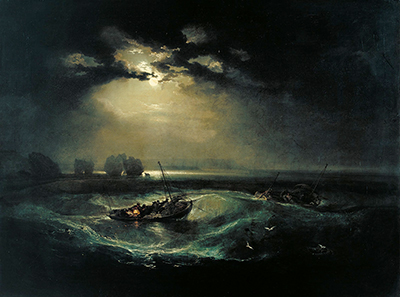
Whaling was new to Turner's large public oils, but the sea was foundational. His first exhibited oil, Fishermen at Sea, appeared at the Royal Academy in 1796. Moonlight, working boats, rock, danger and national maritime identity were already joined in a painting that announced technical ambition. Across the next five decades he painted shipwrecks, ports, naval history, storms, steam vessels, fishing, trade and the changing relations of sail and industrial power.[2]
The whaling pictures therefore concentrate established interests in an unfamiliar arena. Turner knew British and continental coasts through extensive travel, but he had not voyaged to the Pacific sperm-whaling grounds. Deep ocean had to be assembled from reading, images, conversations and his own marine repertoire. The gap between lived coastal experience and imagined pelagic event is not a weakness concealed by the painting. It explains its method of synthesis.
There was a smaller precedent. Around 1837 Turner designed The Whale on Shore, a watercolour illustrating an episode in Walter Scott's The Pirate. Islanders attempt to secure and kill a stranded whale, which raises its tail and overturns a boat. The design was intended for an illustrated publication but was replaced by another artist's image.[2] It established that Turner had already considered the whale as a body whose resistance could overturn human action.
The 1845 oils raised that problem to exhibition scale. No shore contains the encounter. The mother ship is visible, but land, harbour and spectators have disappeared. This removal matters in a career rich in recognisable topography. The location “off Japan” comes from Beale rather than from a painted landmark. Sea and sky become an almost total environment in which scale must be judged through fragile boats and glimpsed rigging.
Late career does not mean that Turner abandoned history painting's ambitions. Whaling could carry epic conflict without an ancient hero. The participants were working sailors, a commercial animal and a modern ship, but their encounter tested courage, suffering and the limits of mastery. Turner had long sought to raise landscape and marine art beyond decorative view-making. The quartet makes a contemporary industry bear the weight of tragedy and the sublime.
Nor should the paintings be treated as accidental anticipations of Impressionism or abstraction. Later art helps explain why their surfaces now feel familiar, but Turner worked within Royal Academy exhibition, British marine tradition, Romantic ideas of nature and a precise economy of patronage and print culture. His innovation is strongest when those historical conditions remain present.
Elhanan Bicknell and the Hope of a Sale
Elhanan Bicknell provides the most direct bridge between Turner's studio and the whaling economy. A prosperous partner in a London firm that refined spermaceti, Bicknell had substantial interests in Pacific sperm-whale fishing. He was also a serious collector of modern British art. He began acquiring Turner in 1838 and bought eight of the artist's oils in 1844, six on a single day.[2]
On 31 January 1845 Turner wrote asking him to visit the Queen Anne Street studio because he had “a whale or two on the canvas.”[9] The phrase is strong evidence that Turner wished to interest this particular buyer while the 1845 pair was in progress. Subject and prospective patron fitted with unusual neatness. Bicknell also subscribed for four copies of Beale's book, and his firm owned a William Huggins painting of whaling ships and an active hunt.[2]
The evidence does not establish a commission. No contract, agreed price or instruction for a four-picture set survives. A later writer stated that Turner painted the works for Bicknell, but retrospective testimony cannot supply the missing transaction. The safest conclusion is more interesting than a false certainty: Turner probably chose and developed the subject with Bicknell's interests and purchasing power very much in mind, while retaining control of the paintings.
Bicknell seems to have acquired the Met canvas in 1845, although its path was troubled. In September, John James Ruskin wrote to his son that Bicknell had found watercolour in the painting and rubbed some with a handkerchief. Turner, according to the report, reacted angrily and eventually took the work back to alter it.[2] The incident records a collision among experimental handling, expectations of finish and ownership. It does not permit a technical diagnosis from a second-hand letter, but it shows that the surface itself became part of a patronal dispute.
Whether the altered picture returned to Bicknell is unclear. Turner and the collector continued to meet, and Bicknell bought other works, so the disagreement did not end the relationship. Yet an 1848 visitor to Turner's gallery saw two pale whaling pictures, and the Met canvas's whereabouts before 1851 cannot be reconstructed with confidence. Even the apparently simple statement that Bicknell “owned” it requires a date and qualification.
This uncertainty changes the series. Rather than a straightforward commission delivered to a whale-oil magnate, the quartet emerged from a negotiation among artistic initiative, targeted selling, collector knowledge and resistance to a difficult surface. Turner made commercial art about commerce, but neither subject nor buyer entirely controlled the result.
Whale Oil, Spermaceti and Global Commerce
The pale atmosphere of Whalers was connected to a material economy of light. Sperm whales were pursued for body oil and for spermaceti, a waxy substance found in the head. Refined sperm oil burned clearly and served as a valuable lubricant; spermaceti could make high-quality candles. Soap and other manufactured products extended the uses of the carcass.[13] Bicknell's wealth tied the canvas in a London exhibition to voyages, killing, refining and consumption across oceans.
The British Southern Whale Fishery began operating from London in 1775 and remained heavily centred on the capital for roughly eighty-five years. Its ships travelled to distant grounds in the Atlantic, Indian, Pacific and Southern oceans.[14] A painting sourced to an incident off Japan therefore belonged to a recognisable British commercial geography, even though Turner had not visited the place.
Whaling voyages lasted years. Ships had to carry boats, tools, casks, provisions and crews capable of hunting and processing animals far from home. The enterprise brought sailors into new waters while connecting trade with imperial movement, natural-history collection and the transfer of specimens and knowledge. Modern research into cetacean collections emphasises how whaling and science were embedded in wider networks of British expansion.[15]
By the mid-1840s Britain's position in sperm whaling had weakened under competition and changing policy, while American ports had become dominant. Decline did not remove the industry's imaginative power. Reports, voyages, museum specimens, prints and products kept whales present in metropolitan life. The subject could appear simultaneously modern, endangered as a British business and vast enough for epic treatment.
It is easy to let the romance of the open ocean conceal the commodity chain. Turner's four paintings resist that concealment when read together. The Met work shows the violence of capture; the last Tate canvas shows blubber being boiled. Between those moments, an animal becomes oil, wax, light and profit. The process created livelihoods and useful goods, but it depended on systematic killing.
The context should not turn the Met painting into an illustrated economic thesis. No candle appears, and the precise destination of the hunted whale is not painted. Yet the intended Bicknell audience and the quartet's processing scene make extraction inseparable from interpretation. Turner selected a subject in which light, his supreme pictorial means, had a literal commercial relation to the whale's body.
How a Nineteenth-Century Whale Hunt Worked
When a lookout sighted whales, crews lowered open boats from the parent ship and rowed towards the animals. A harpoon was primarily a fastening instrument. Its barbed head pierced blubber and attached the whale by rope to the boat. The wounded animal might dive, thrash or flee, towing the crew at speed. Once exhaustion made a close approach possible, sailors used lances in an attempt to kill it.[13]
The procedure explains the 1845 pair. Tate's canvas belongs to approach and attack: boats remain organised around the partly visible whale, and a poised man prepares another strike. The Met canvas belongs to the unpredictable interval after attachment and wounding. A whale still capable of rapid movement can overturn the small craft connected to it. Harpoon, rope and coordinated crew do not guarantee mastery.
Boat design balanced contradictory demands. The craft needed to be light, swift and manoeuvrable, but it also had to carry a crew and dangerous coils of line into collision range. In Beale's account the whale's head shattered the boat, reducing a specialised hunting instrument to wreckage. Turner makes this fragility visible through thin, discontinuous hulls against the immense sea.
If a whale was killed and did not sink, it was brought alongside the ship. Crews cut away blubber in large sections and reduced it for rendering. By the middle of the nineteenth century many pelagic whaleships carried tryworks: iron pots over a brick furnace in which blubber was boiled to extract oil. The product cooled and entered casks in the hold.[13] Turner's fourth whaling picture represents this fiery processing while another vessel struggles in ice.
Technical language can distance the violence it describes. “Fastening,” “cutting in” and “trying out” were working terms, but each names an act performed on an animal. Turner was drawn to the gestures, danger, smoke and light of labour; he also placed the wounded whale's head where it cannot be reduced to raw material without resistance.
The painting does not establish every item of equipment. Indistinct rods might be oars, lances, harpoons or fragments, and the relation of individual boats is difficult to settle. General whaling practice explains why such forms belong in the scene, but interpretation should stop before converting mobile marks into an inventory. Turner's accuracy operates through the credible structure of crisis rather than exhaustive description.
Beale's Book and the Disaster off Japan
Thomas Beale published the expanded edition of The Natural History of the Sperm Whale in 1839. He had served as a surgeon aboard a South Sea whaler and combined observations of anatomy and behaviour with commercial information and an account of a voyage in which he had participated.[4][5] He presented the book as a remedy for error, especially the distortions produced by naturalists who had not observed sperm whales in their ocean environment.
Turner named the source publicly. The Royal Academy entry for the Met canvas told visitors to see Beale's voyage at p. 175. That direction distinguished it from the companion's p. 163 and gave an apparently fantastic picture the authority of eyewitness narrative. Viewers confounded by the paint could consult a printed event.
The cited hunt began on 18 June 1832 in bright, calm conditions off Japan. Whalers attacked a sperm whale with harpoon and lance. After going below, the animal rose rapidly and hit a boat with the front of its head, throwing men and contents upwards and breaking the hull. As the crew struggled among oars and wreckage, the whale moved around them. Blood drew sharks. One man could not swim, and others exhausted themselves supporting him until rescue came from another boat.[4]
Turner concentrated the narrative. Whale, damaged craft, swimmers and approaching boats share one compressed foreground, while the mother ship appears through spray behind. He also transformed the weather. Beale's calm brightness becomes an all-enveloping disturbance. The discrepancy does not show careless reading. It reveals the difference between a cited source and a literal illustration.
Beale's text offered several kinds of authority at once. Medical training supported anatomical observation; voyage experience supported the hunt; commercial chapters explained products and practice. Yet his categories are historically situated. The whale repeatedly appears as “fish,” prey, monetary value and object of knowledge. Turner could borrow the event while making the animal's suffering and counterforce more visually insistent than a commercial narrative might require.
The reference also belongs to Turner's larger habit of attaching literary or historical sources to exhibition pictures. Such citations could stabilise subject while leaving visual invention free. Here the source is neither classical poetry nor scripture but a recent technical and experiential book. Modern industry enters the Royal Academy with its own textual authority.
Printed Images, Paintings and Maritime Knowledge
Beale's words were accompanied by images. William James Linton's frontispiece, Boats Attacking Whales, includes a spouting animal throwing a boat and sailors into the air. A related illustration near the cited episode isolates the catastrophe more closely. The volume also reproduced a design based on William Huggins's widely circulated South Sea Whale Fishery.[2][4]
These pictures offered Turner solutions to a problem he could not solve from direct ocean observation: how a sperm whale's head, boat and men might relate at the instant of impact. Similarity does not prove that he copied one plate mechanically. The oil combines motifs, changes scale and weather, and subordinates outline to atmospheric movement. Prints supplied usable knowledge; painting rebuilt it.
Huggins provided a more personal connection. Bicknell's firm owned his portrait of whaling ships, with a hunt in the foreground. Turner may have seen it through the prospective patron.[2] Huggins had maritime experience and was known for specialised ship and whaling subjects. His descriptive approach offered concrete vessels and procedures that Turner could absorb without imitating its finish.
Turner's acquaintances also included people with relevant maritime or scientific knowledge. The American sea captain Elisha Ely Morgan, the inventor and Arctic traveller George Manby, and the comparative anatomist Richard Owen could all have spoken about ships, harpoons or whales.[2] The possibility broadens the artist's information network, but no surviving conversation can be assigned to a particular painted detail.
Whales were occasionally seen or displayed in Britain. A finback was killed and exhibited at Deptford in October 1842, near Wapping, where Turner owned property. That proximity is suggestive but does not establish attendance. No conclusive evidence proves that he saw a living or dead whale.[2] The claim that he painted from first-hand zoological study would therefore exceed the record.
The absence of direct sight did not mean ignorance. Nineteenth-century visual culture allowed remote events to be assembled through plates, books, paintings, specimens, conversation and memory. Turner's method was unusually visible because he refused to smooth those inputs into a neutral documentary style. The canvas feels imagined, but its imagination worked on a dense body of recent information.
The Whalers Sketchbook
Several small sheets show Turner thinking through the subject at speed. The sketchbook called Whalers, probably used during visits to the Kent coast in 1844 and 1845, contains leaves associated with the oils. They mix black chalk, graphite and watercolour in images of ships, boats, sea, fire and whale-like forms.[16][17][25]
Vessel at Sea, Tate D35248, reduces a ship and its setting to broad relations. Whalers at Sea, D35251, scatters brief notations across washes and dark chalk, making atmosphere and action develop together.[16][17] These are not miniature cartoons to be enlarged square by square. They test how little information is needed for a marine situation to cohere.
In A Harpooned Whale, Tate D35391, a huge smooth grey body rises above dark water. Red strokes flare around it, capable of signifying wounds, boats, action and light. The small sheet has an index-card intensity: an enormous conflict compressed into a few materials. An inscription has been read as a note about possible use, but its wording is uncertain and should not be converted into a firm statement of intention.[18]
The Fitzwilliam Museum's related The Whaler carries the words “He breaks away.”[19] That fragment has the force of a narrative cue. Turner could use writing not to explain a completed composition but to trigger motion in an emerging image. The phrase also captures the central reversal of the Met painting: the whale breaks the formation meant to hold it.
Most scholars do not treat these sheets as records of a whale seen from life. They are exercises of the mind's eye, informed by print and experience of the sea. Their restricted colours and unresolved forms show Turner moving between memory and invention. Red can be blood without ceasing to be sunset; black can be ship, animal or storm until adjacent marks decide it.
Chronology remains difficult. Some sheets associated with Ambleteuse or Wimereux may have followed the 1845 exhibition rather than prepared it. The sketchbook evidence therefore supports a field of experimentation, not a single neat sequence from observation to sketch to oil. Turner could revisit motifs after public display and feed them into the 1846 pair. The quartet grew through recurrence.
Violence, the Sublime and an Unresolved Moral Position
The sublime is useful here only if it retains conflict. Turner's painting confronts the viewer with magnitude, danger and difficulty of comprehension. The whale exceeds the boats; sea and sky exceed them all; the event exceeds quick recognition. Yet awe cannot be separated from an injured body and endangered workers. The painting's power comes from a crisis, not from atmospheric beauty alone.
Whaling literature often presented the hunt as courage, enterprise and mastery. Beale admired sailors' endurance while recording wounds, wrecks and death. Commercial language converted a whale into expected barrels and monetary return. Turner draws on that world but makes mastery visibly fail. The animal remains capable of smashing the instrument of its destruction.
That reversal can encourage an ecological reading, but historical precision matters. The canvas does not contain a written condemnation of whaling, and no document establishes Turner as an opponent of the industry. He was courting a buyer enriched by whale oil. The subsequent pair includes a cry of celebration and the productive boiling of blubber. A simple anti-whaling message would ignore those facts.
Celebration is not the whole story either. The Met painting gives unusual weight to the whale's pain. Its gaping jaw, dark head and blood-touched spray prevent it from becoming an anonymous obstacle. The human figures are vulnerable but minute, while the animal's body governs the composition. The last canvas makes industrial fire both magnificent and infernal and traps another ship in ice. Conquest is repeatedly compromised.
The ethical force lies in sustained contradiction. Whalers require skill and accept extraordinary risk; they also wound and kill. The whale suffers and retaliates; it is neither sentimentalised as gentle nor demonised as monstrous. Light makes the scene beautiful while deriving historical resonance from the very substance for which sperm whales were hunted. Painting, commodity and violence cannot be cleanly separated.
Jason Edwards's study of Turner and the whale shows why the subject expands beyond a single iconographic solution. Whales moved through nineteenth-century art as animals, commodities, specimens, metaphors and bodies whose scale challenged representation.[23] In Turner's quartet, those meanings remain materially connected. The dark head at lower left is at once a living creature, an injured opponent, an object of scientific description and the source of valuable substances. Its capacity to occupy all these categories without settling into one makes the painting ethically difficult. Formal uncertainty is not an escape from history; it is the means by which incompatible claims on the whale remain visible together.
Modern viewers know the devastating later history of industrial whaling. That knowledge rightly sharpens attention to the animal, but it should not be projected backwards as Turner's declared programme. The work can support moral reflection because it refuses easy mastery, not because it supplies a twenty-first-century verdict in advance.
The Royal Academy in 1845
Turner occupied an eminent and exposed position when he exhibited Whalers. At seventy, he was serving as interim president of the Royal Academy and participated in the hanging committee. He showed six works: four Venetian subjects and the two new whale paintings.[2][10] The display put a radical modern marine subject before the institution in which he had built his career.
The two Whalers were separated by Clarkson Stanfield's picture of Ancona. Stanfield represented a more lucid and carefully finished kind of marine painting. Reviewers repeatedly compared the artists. Turner seemed rough, smudged and extravagant; Stanfield precise, cool and optically convincing. The juxtaposition made style impossible to separate from subject.
Turner's catalogue captions intervened in that contest. A viewer unable to identify the apparent chaos could read “Beale's Voyage” and find a recent authoritative account. The references asserted that the extraordinary event was not fantasy, even though the paintings transformed it. Title and citation worked as a documentary frame around deliberately unstable surfaces.
The four Venetian pictures complicated accusations that Turner could no longer describe. Venice and whaling shared his late palette of pale light and broken forms, which invited satirists to say that any title might fit the same effect. Yet the two groups demanded different kinds of attention. Architecture, water and historical memory structured Venice; wounded animal, splintering boats and commercial risk structured Whalers.
Turner was absent from London for part of May and may have missed some immediate responses. The debate nonetheless joined a long argument around his later work: whether freedom of handling sacrificed truth, or whether conventional finish was inadequate to transient light and violent motion. The whaling pair made that question unusually urgent because failure to see could mean failure to grasp the represented danger.
The exhibition was not a quiet late-career coda. It staged a contest among marine traditions, new global subject matter and Turner's institutional authority. The paintings' mixed reception confirms that viewers did not simply dismiss them. Even critics who objected to the means often recognised an effect they could not explain by ordinary standards.
Critics Between Lobster Salad and Magic
The 1845 reviews are unusually valuable because they record the paintings before later modernist admiration made their freedom seem inevitable. Many critics complained that forms were vague, colours excessive and surfaces insufficiently finished. White spray appeared to swallow the motif. Some saw slapdash execution where Turner claimed a perilous whale hunt.[2]
Yet resistance often turned into reluctant praise. The Literary Gazette called the Met Whalers a vision or unreality, then admired the harmony and prismatic brilliance of its colour. The Times valued the fearless embodiment of a moment's effect. The Spectator found light, spray and clouds capable of conveying the peril and excitement of whale fishing even when the description remained vague.[2]
Such responses show that “effect” was not a dismissive word alone. Critics were trying to explain how a canvas could violate accepted standards of drawing and finish while producing a persuasive overall experience. One comparison proposed that Stanfield painted observed effects themselves, whereas Turner supplied materials from which the viewer's eye produced them. That distinction closely describes the active looking Whalers still demands.
Satire made the objections memorable. Punch compared the Met picture's singular effect to lobster salad and joked that Turner's titles were interchangeable.[11] The humour depends on the gap between catalogue specificity and apparent optical confusion. It also reveals how strongly Turner's late palette had become a public signature.
Thackeray offered the most perceptive comic defence. Writing under the persona Michael Angelo Titmarsh, he described Turner as oscillating between absurd and sublime. With time, vermilion marks became boats of harpooners, a purple smear became a whale and scattered lines became a fully sailed ship.[12] His exaggeration preserves the sequence of perception: bafflement, continued attention, recognition and astonishment.
John Ruskin did not rescue these particular works. Although Turner's most influential defender, he considered the late whaling subjects unworthy.[2] That judgement prevents a simple division between conservative enemies and enlightened admirers. The paintings disturbed standards even within Turner's supportive circle.
The reviews matter because they confirm that delayed legibility is historical, not invented by damaged reproduction or modern taste. Viewers in 1845 had to decide whether the forms cohered. Their disagreement is built into the painting's afterlife. Whalers continues to ask where vision ends and projection begins, while giving enough evidence for whale, wreck and ship to return.
Ownership, Sale and Arrival in New York
The painting's first ownership remains less settled than its museum record. Bicknell apparently took it in 1845, Turner took it back after the dispute over its surface, and no document securely shows a return to the collector. The canvas may have remained with Turner or passed through the print publisher and dealer Joseph Hogarth. Certainty resumes at the 1851 Christie's sale, where Hogarth sold it.[2]
Later owners placed Whalers within important British art networks. Frederick R. Leyland became known as a collector of Old Masters and a patron of Dante Gabriel Rossetti and James McNeill Whistler. Thomas Woolner was a sculptor connected with the Pre-Raphaelite circle. Sir Francis Seymour Haden combined careers as surgeon, etcher and collector and had a complicated association with Whistler.[2]
Haden sold the painting to the Metropolitan Museum in 1896. It entered as the museum's second Turner oil, following Saltash with the Water Ferry, Cornwall in 1889, and was among the early Turner paintings placed in an American public collection.[2][24] Its acquisition moved a once-baffling Royal Academy exhibit into a permanent transatlantic institutional setting.
Reproductive prints also shaped recognition. Robert Brandard engraved a version for the later Turner Gallery, translating the mobile colour into line and tonal structure. Such images could spread Turner's subject in Britain and America but could not reproduce the original surface's unstable relation among impasto, veil, colour and ground. The painting's reputation travelled in forms that often made it more legible than the oil.[2]
The 2016 Met exhibition restored another context by bringing the three Tate companions to New York. For the first time, all four whaling oils could be examined together.[3] The reunion made changes of narrative, geography, light and labour visible across the group. It also returned the Met canvas to the sequence from which collecting history had separated it.
Provenance is therefore part of interpretation, not a list appended after the image. The uncertain Bicknell episode raises questions about finish and control. Later private ownership connected Turner to Victorian collecting. The Met acquisition helped establish him publicly in the United States. The reunion allowed a fragmented series to become a quartet again, if only temporarily.
Whalers and Moby-Dick: Evidence and Temptation
Turner's quartet now seems to invite comparison with Herman Melville's Moby-Dick, published in 1851, months before Turner's death. Both works transform whaling from specialised labour into an encounter with knowledge, violence, scale and the limits of representation. The chronology and a remarkable surviving annotation justify the comparison, but they do not prove direct influence.
Melville obtained a copy of Beale's Natural History of the Sperm Whale while developing his novel. He dated it 10 July 1850 and wrote that Turner's pictures of whalers had been suggested by the book.[2][20] The note establishes three things: Melville knew of the paintings, knew their relation to Beale and considered that relation worth recording. It does not say where he learned it or whether he had seen the oils.
Melville had visited London in 1849 and was deeply interested in visual art. It is tempting to imagine him entering Turner's Queen Anne Street gallery, where several whaling canvases remained, but no document records such a visit. The Met picture's whereabouts were themselves uncertain. Prints, reviews, Ruskin's writing and conversations offered other possible routes to knowledge.[2]
Chapter 3 of Moby-Dick describes a smoke-darkened marine painting in the Spouter-Inn. Ishmael has to revisit and question it before indistinct masses resolve into a storm, ship and attacking whale.[21] The pattern resembles the experience Thackeray described before Turner's Whalers: apparently meaningless marks slowly become a marine catastrophe. The affinity is strong enough to discuss and too uncertain to call a source.
Melville's later admiration is better documented. He responded to Turner during an 1857 visit to London, wrote a poem connected with The Fighting Temeraire, acquired books and collected engravings, including one after a whaling picture.[2] These facts establish a durable interest after Moby-Dick, but later evidence cannot automatically be moved back into 1850.
The direction of influence also has a firm limit. Turner exhibited his paintings in 1845 and 1846. Moby-Dick appeared in 1851. The novel could not have inspired the oils. Whether the paintings shaped the novel remains open. Shared Romantic ideas, the same Beale source and a broader marine culture can explain parallels without a direct encounter.
The uncertainty is productive. Turner and Melville both make the whale difficult to comprehend, resist clean separation of fact and imagination, and force readers or viewers to labour through obscurity. Their works can illuminate one another without being collapsed into an origin story. The strongest connection is not a sensational claim that one masterpiece caused another. It is a documented recognition by Melville that Turner had already transformed Beale's whaling knowledge into art.
Why Whalers Still Matters
Whalers is one of Turner's most demanding late paintings because its subject cannot be detached from the means of seeing it. A sperm whale has been hunted, wounded and made to fight through boats and men. Turner makes that catastrophe emerge from pale atmosphere, dark mass and scattered colour slowly enough that recognition feels uncertain and consequential.
The painting belongs to several histories at once. It is the second movement of an 1845 Royal Academy pair, the catastrophic centre of a four-picture whaling sequence, a late culmination of Turner's marine career and an object entangled with Elhanan Bicknell's whale-oil fortune. It draws authority from Thomas Beale while departing from his calm weather and printed illustrations. It carries the global commodity chain of oil and spermaceti into an institutional exhibition while refusing to make extraction look secure.
Its ethical position remains unsettled. Turner did not declare against whaling, and he hoped to sell to a man invested in the trade. Yet the whale's pain, power and visual weight prevent a simple celebration of human enterprise. The hunters are courageous and vulnerable; they are also agents of the injury that endangers them. Beauty does not resolve the contradiction. It makes the encounter harder to dismiss.
The critical arguments of 1845 still provide a useful guide. Some viewers saw only confusion; others discovered harmony, force and magic once they allowed the eye to participate. Thackeray's marks becoming whale, boats and ship describe a painting that unfolds in time. The image is not vague because Turner lacked a subject. It is difficult because subject, atmosphere and action have been made inseparable.
The painting's modern reunion with its Tate companions and its cautious connection to Melville extend that difficulty rather than settle it. Sequence clarifies the industry; Moby-Dick sharpens the problem of interpreting an obscure whale image. Neither context replaces the Met canvas itself. Its lasting achievement is to keep returning the viewer to a wounded dark form at the edge of a brilliant field, where mastery has failed and looking must begin again. The longer one looks, the less the pale expanse resembles emptiness: it becomes the pressure through which ship, animal and men struggle to remain visible. That struggle is the painting's enduring subject.
Discussion
How does Turner's unstable paint surface change the ethics and legibility of the whale hunt?
Reader Insights
Which forms emerge first from the pale storm of sea, sky and spray?
How does the wounded whale overturn the hierarchy of the hunt?
Where does Beale's documented catastrophe end and Turner's invention begin?
Join the Conversation
Share a close observation or a source-based question for other readers.
References
- Metropolitan Museum of Art, “Whalers,” object 96.29, https://www.metmuseum.org/art/collection/search/437854
- Alison Hokanson, *Turner's Whaling Pictures*, *Metropolitan Museum of Art Bulletin* 73, no. 4, 2016, https://www.metmuseum.org/met-publications/turners-whaling-pictures
- Metropolitan Museum of Art, “Turner's Whaling Pictures,” exhibition, 10 May-7 August 2016, https://www.metmuseum.org/exhibitions/listings/2016/turner-whaling-pictures
- Thomas Beale, *The Natural History of the Sperm Whale*, London, 1839, Biodiversity Heritage Library, https://www.biodiversitylibrary.org/item/192636
- Wellcome Collection, Beale's *Natural History of the Sperm Whale*, 1839 digitisation, https://wellcomecollection.org/works/r9yqq4dt
- Tate, “Whalers,” N00545, https://www.tate.org.uk/art/artworks/turner-whalers-n00545
- Tate, “'Hurrah! for the Whaler Erebus! Another Fish!',” N00546, https://www.tate.org.uk/art/artworks/turner-hurrah-for-the-whaler-erebus-another-fish-n00546
- Tate, “Whalers (Boiling Blubber) Entangled in Flaw Ice, Endeavouring to Extricate Themselves,” N00547, https://www.tate.org.uk/art/artworks/turner-whalers-boiling-blubber-entangled-in-flaw-ice-endeavouring-to-extricate-themselves-n00547
- John Gage, ed., *Collected Correspondence of J.M.W. Turner*, Clarendon Press, 1979, https://books.google.com/books/about/Collected_Correspondence_of_J_M_W_Turner.html?id=BZLqAAAAMAAJ
- Royal Academy Chronicle, “1845,” https://chronicle250.com/1845
- *Punch*, vol. 8, 31 May 1845, p. 233, https://digi.ub.uni-heidelberg.de/diglit/punch1845/0229
- W. M. Thackeray, “Picture Gossip,” *Fraser's Magazine* 31, June 1845, pp. 720-21, https://archive.org/details/frasersmagazine31fras
- New Bedford Whaling Museum, “Whales and Hunting,” https://www.whalingmuseum.org/research/research-resources/whaling-history/whales-and-hunting/
- British Southern Whale Fishery, “History of the British Southern Whale Fishery,” https://www.britishwhaling.org/history-of-the-british-southern-whale-fishery.html
- Natural History Museum, “Cetacean (Re)Sources,” https://www.nhm.ac.uk/our-science/research/projects/cetacean-resources.html
- Tate, “Vessel at Sea,” D35248, https://www.tate.org.uk/art/artworks/turner-vessel-at-sea-d35248
- Tate, “Whalers at Sea,” D35251, https://www.tate.org.uk/art/artworks/turner-whalers-at-sea-d35251
- Tate, “A Harpooned Whale,” D35391, https://www.tate.org.uk/art/artworks/turner-a-harpooned-whale-d35391
- Fitzwilliam Museum, “The Whaler,” 1845, https://data.fitzmuseum.cam.ac.uk/id/object/202416
- Harvard Library, “Did Melville read it?”, Thomas Beale volume from Melville's library, https://takenote.library.harvard.edu/45-did-melville-read-it
- Herman Melville, *Moby-Dick; or, The Whale*, 1851, Project Gutenberg, https://www.gutenberg.org/ebooks/2701
- National Gallery of Art, *J. M. W. Turner* exhibition object list, 2007, https://www.nga.gov/content/dam/ngaweb/press/exh/2832/2832-list.pdf
- Jason Edwards, *Turner and the Whale*, 2017, https://api.pageplace.de/preview/DT0400.9781784422875_A31461396/preview-9781784422875_A31461396.pdf
- Metropolitan Museum of Art, *British Paintings in The Metropolitan Museum of Art, 1575-1875*, 2009, https://www.metmuseum.org/met-publications/british-paintings-in-the-metropolitan-museum-of-art-1575-1875
- Ian Warrell, *Turner's Sketchbooks*, Tate Publishing, 2014, https://books.google.com/books/about/Turner_s_Sketchbooks.html?id=7dYnngEACAAJ