 by Tom Gurney
Tom Gurney BSc (Hons) is an art history expert with over 20 years experience
Published on June 19, 2020 / Updated on August 29, 2026
Email: tomgurney1@gmail.com / Phone: +44 7429 011000
Overview
The sea was one of J. M. W. Turner's lifelong subjects. It gave him weather, commerce, travel, naval history, danger, light, distance and moral pressure. It also gave him a way to test what painting could do when the visible world was unstable. Water reflects, hides, carries, destroys and connects. Ships are machines, homes, weapons, businesses, memorials and vulnerable bodies. Turner understood that the sea could hold all of these meanings at once.
The maritime side of Turner should not be reduced to storm drama. Christine Riding and Richard Johns's Turner & the Sea, recorded by Royal Museums Greenwich, presents the full extent of Turner's engagement with the sea in an age of global naval warfare, rapid technological change and increased travel. [1] That frame is important because Turner did not paint the sea as a timeless romantic backdrop. He painted it as a historical environment.
The National Gallery's artist record helps explain why the subject mattered so much to him. It describes Turner as an artist known for brilliant colour in landscapes and seascapes, and notes his early debt to Dutch marine painting and Italianate landscape traditions. [2] Turner entered a field with powerful precedents, then changed what marine painting could contain. He could paint moonlight over fishermen, naval memory, steam power, cross-Channel discomfort, coastal weather, shipwreck, fire seen from the Thames, slavery at sea and late storms where the viewer's own certainty seems to break apart.
A responsible account needs to hold those strands apart. Naval war is not the same as shipwreck. Shipwreck is not the same as slavery. Steam is not the same as sail. Travel is not the same as commerce. The sea links them, but it does not make them morally equal. Turner's greatness lies partly in recognising that the same element could sustain national pride, imperial trade, everyday labour, modern transport and scenes of disaster.
His sea paintings also ask viewers to be careful with anecdotes. Turner is surrounded by stories about storms, speed and personal daring. Some may contain truth; others are too useful as myths. The paintings themselves are stronger evidence when supported by catalogues and institutional records. They show a career-long effort to make maritime experience visible without pretending that the sea is only beautiful.
At a Glance
- Career spanEarly marine ambition through late storm subjects
- Main frameworkTurner & the Sea by Christine Riding and Richard Johns [1]
- TraditionsDutch marine painting, Vernet and classical landscape
- Naval historyWar, commemoration and national memory
- ShipwreckRisk, rescue and human vulnerability
- SlaveryMaritime violence must remain historically specific
- Modern changeSteam, industry and new transport
- Working methodTravel, sketchbooks, observation and studio transformation
- Print cultureEngraving expanded maritime audiences
- Key cautionDo not treat storm anecdotes as evidence without reliable support
Contents
- Overview
- Marine Painting Before Turner
- Early Marine Ambition
- Naval War and National Memory
- Shipwreck, Risk and Human Vulnerability
- Slavery, Violence and the Sea
- Steam, Technology and Modern Water
- Rivers, Fire and Public Drama
- Travel, Sketching and Maritime Observation
- Print Culture and Maritime Audiences
Marine Painting Before Turner
Turner did not invent marine painting. He inherited a tradition in which ships, harbours, naval battles and coastal views already carried prestige. Royal Museums Greenwich records that Turner & the Sea examines his response to earlier marine art, including the tradition represented by Willem van de Velde the Younger and Claude-Joseph Vernet. [1] That context matters because Turner learned from artists who made the sea a serious pictorial subject before him.
Dutch marine painting gave Turner models for ships, wind, rigging, water and naval order. The Van de Velde tradition treated maritime subjects with technical seriousness. A vessel had structure. A wave had direction. A sky could determine the whole mood of a picture. Such painting required knowledge as well as atmosphere. Turner absorbed that discipline even when his later work became freer.
Vernet offered another kind of precedent: harbour, weather, disaster and narrative arranged with dramatic control. In Vernet's world, the sea could be theatre as well as topography. Turner could use this inheritance while pushing it toward more extreme colour, light and uncertainty. He did not merely imitate earlier marine painters. He competed with them.
The National Gallery notes Turner's early inspiration from seventeenth-century Dutch artists such as Willem van de Velde, along with Claude and Richard Wilson. [2] That mixture helps explain the breadth of his sea art. Marine exactness, classical light and British landscape ambition all entered his practice. A Turner seascape may carry the memory of Dutch ships, Claudean radiance and modern British experience in the same composition.
This inheritance also explains why Turner's sea art is rarely just about water. The sea becomes a field in which artistic traditions meet current events. A naval subject can look back to Dutch precedent while addressing British national history. A harbour can evoke Claude while showing modern movement. A storm can draw on earlier disaster painting while unsettling the viewer through colour and surface.
Turner's achievement was to make the tradition less stable from within. Earlier marine painting often depended on recognisable ship types, readable weather and balanced composition. Turner could supply those things when he wanted to, but he also tested how much pressure a marine picture could bear before certainty gave way. Masts dissolve into rain, sails lose sharpness in mist, waves become nearly indistinguishable from cloud, and light can overwhelm the objects it reveals. He did not reject marine tradition; he made it answer to more unstable experience.
This is why the sea became such a useful subject for his whole career. It allowed continuity with established art and confrontation with modern change. A painter could honour naval memory, study Dutch precedent, evoke Claudean light, describe coastal travel, respond to steam power and address slavery or war without leaving the maritime field. The subject was broad enough to hold both inheritance and disruption.
Early Marine Ambition
Turner's early marine subjects helped establish his public seriousness. He began as a watercolourist and draughtsman, but marine painting in oil allowed him to enter a prestigious field of public exhibition. The sea gave him a subject large enough to test composition, light and drama. It also let him show that British landscape could compete with history painting in ambition.
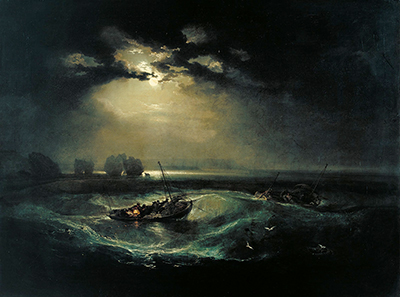
Early works such as Fishermen at Sea matter because they show Turner using marine subject matter before the famous later storms. The picture belongs to a world of night, labour, vulnerability and controlled light. It should not be treated merely as a prelude to later drama. It shows that Turner was already interested in how small human activity appears within vast natural conditions.
The early sea also connects to travel and drawing. Coasts, harbours and rivers supplied Turner with subjects that were both local and international. A harbour could be a place of labour, trade, national defence or picturesque observation. A small boat could provide scale against moonlight or storm. A headland could organise distance. Marine practice trained him to think in moving relationships: vessel, water, sky, land and weather.
Turner's early ambition was therefore not only technical. It was social and professional. A convincing marine picture could show knowledge of ships and weather, but it could also show command of tradition. It placed Turner within a competitive field and allowed him to enlarge landscape painting's claims. Marine art helped him argue that natural conditions and modern life were worthy of the highest painterly attention.
The early marine works also trained his handling of artificial and natural light. Moonlight, lanterns, dawn, lightning and reflected fire all create different relationships between water and vessel. The sea is never merely blue or grey; it is a surface that receives light from above, below, beside and within the scene. Turner learned how to make those reflections carry emotion. A small gleam on water can make a boat feel exposed. A band of light can open distance. A dark mass of sea can make human effort seem fragile.
Early marine ambition also helped Turner develop scale. A ship can be large in life and small within a picture. A person can become a tiny mark against water. A cliff or storm cloud can dwarf both vessel and viewer. This play of scale gave Turner a way to move between description and the Sublime. He could show what a boat is and also show how little control it has when weather, darkness or distance takes over.
Naval War and National Memory
Britain's maritime culture in Turner's lifetime was inseparable from war. The French Revolutionary and Napoleonic Wars made the sea a military arena and a national image. Ships were not only vehicles; they were symbols of state power, victory, sacrifice and imperial reach. Turner returned to naval subjects because they allowed landscape, history and public memory to meet.
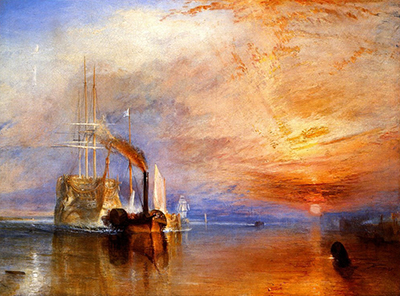
Royal Museums Greenwich notes that Turner & the Sea foregrounds works including The Battle of Trafalgar and The Fighting Temeraire. [1] These examples show two different kinds of naval image. Trafalgar belongs to battle and national triumph. The Fighting Temeraire belongs to memory, obsolescence and the afterlife of war. Together they show Turner's ability to make ships carry time.
The National Gallery's account of The Fighting Temeraire is especially useful because it separates fact from poetic reconstruction. The painting shows the old warship on its final journey to be broken up, but the Gallery notes that Turner likely did not witness the towing and imaginatively recreated the scene using contemporary reports. [3] This is crucial. The painting is not simple reportage. It is a memorial image shaped by artistic choice.
That distinction helps the sea article as a whole. Turner often used maritime fact as the beginning of imagination, not as its limit. He could alter a ship, a light direction or a visual emphasis to make historical meaning more forceful. In The Fighting Temeraire, the transition from sail to steam becomes visible through the contrast between ghostly warship and dark tug. The sea is calm, but the historical change is not.
Naval subjects also require moral caution. War at sea can be made heroic, but it also involves death, wreckage and political violence. Turner's later treatment of military and maritime subjects often complicates easy celebration. He could acknowledge national memory while allowing loss and obsolescence to enter the image. The sea becomes a place where triumph is never completely secure.
This complication is one reason Turner's naval subjects still feel alive. They do not simply illustrate patriotic certainty. Ships carry histories that outlast the event. A vessel may move from battle to storage, from national pride to timber value, from active service to memory. The sea helps make that passage visible because it is itself a medium of transition. It carries the ship away from one historical identity and toward another.
Naval memory also depends on public viewing. Battles are seen, reported, commemorated, engraved and retold. Turner worked within that chain. He knew that a ship could become a public emblem and that a painting could reshape how viewers remembered it. His maritime art therefore belongs to both event history and image history. It asks how a nation pictures its own sea power after the moment of battle has passed.
Shipwreck, Risk and Human Vulnerability
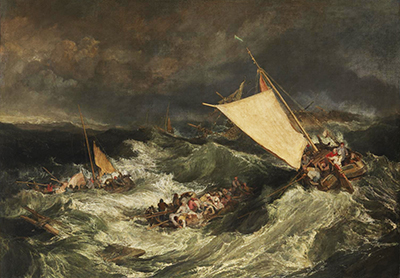
Shipwreck is one of the most powerful themes in Turner's sea art, but it must be handled without romanticising disaster. Wrecked ships and drowning figures are not decorative signs of sublimity. They represent danger, labour, fear and bodily exposure. Turner understood the attraction of the storm image, yet his best maritime works make the viewer feel instability rather than simply admire it.
The shipwreck subject had a long history before Turner, and it appealed to eighteenth- and nineteenth-century ideas of the Sublime. A storm at sea could overwhelm the viewer's sense of scale and control. Turner made that tradition more urgent by dissolving clear boundaries. In many maritime pictures, sea and sky press against each other until the viewer has to search for ships, bodies or shore.
This searching is part of the meaning. A shipwreck painting is not only an image of a broken vessel. It is an image of failed orientation. The viewer may not know where safety lies, how far the shore is, or whether human action can matter. Turner often turns the sea into a field of competing forces: wind, wave, darkness, light, wreckage and human effort.
The danger is that such works can become exciting at the expense of suffering. Turner sometimes courts visual splendour even when the subject is violent. Modern readers have to keep both facts in view. The beauty of colour and weather does not cancel the human cost. A wave can be magnificent and lethal. A burning sky can be visually stunning and morally disturbing.
Shipwreck also connects to commerce and empire. Vessels carried goods, people, weapons and capital. A wreck could mean economic loss, personal tragedy or public news. Turner painted in a culture where maritime risk was part of everyday national life. His sea art is powerful because it does not isolate the storm from that larger world of travel, trade and violence.
The shipwreck theme also let Turner test the border between narrative and atmosphere. A conventional disaster scene might make the sequence clear: vessel endangered, figures struggling, rescue attempted, outcome implied. Turner often makes that clarity harder. The viewer may sense danger before every detail can be identified. That delay creates tension. It makes looking part of the crisis.
At the same time, Turner did not need to abandon narrative entirely. Wreckage, sails, figures, shoreline, signals and light can all direct interpretation. His most powerful maritime disasters often balance recognisable incident with visual force. The viewer understands that something human is at stake, but the sea and weather prevent calm inspection. This balance separates serious shipwreck painting from simple sensationalism.
Slavery, Violence and the Sea
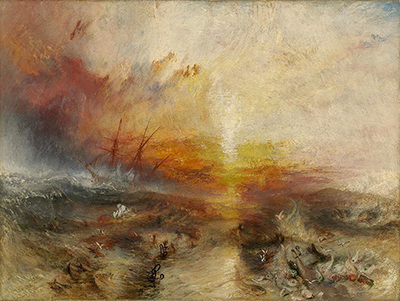
No account of Turner and the sea is adequate if it treats maritime violence only as weather. Slave Ship forces a different reckoning. MFA Boston presents the 1840 painting as a central work in Turner's Modern World and describes it as an indictment of the transatlantic slave trade. [4] The sea here is not only elemental. It is part of a human system of terror.
The painting should not be reduced to a storm picture. Its horror depends on the relation between human cruelty and natural violence. The sea receives bodies that have been treated as financial calculation. Weather amplifies the disaster, but it does not cause the crime. The subject belongs to slavery, insurance, murder, abolitionist politics and the moral limits of drama.
MFA Boston connects the painting to the infamous 1781 Zong incident, in which the crew of a slave ship forced 133 captives overboard so insurance money could be claimed for people counted as lost at sea. [4] That history must be named plainly. It should not be softened into general tragedy. Turner used marine painting to address one of the most violent realities of Atlantic commerce.
The painting also raises a difficult issue about beauty. Turner gives the sea and sky extraordinary colour, yet the subject is atrocity. That tension is not a reason to look away from the image's visual power. It is a reason to ask what that power does. Does beauty expose violence, intensify it, risk aestheticising it, or force the viewer into discomfort? The answer may not be simple, and the painting remains troubling because it refuses an easy separation between drama and indictment.
Detailed treatment of Slave Ship belongs to its own article, but within a broader sea account it proves that Turner's maritime imagination was not only about national pride or natural force. The sea could reveal the brutality of commerce and empire. It could make visible what political and economic systems tried to hide.
It also forces a different vocabulary for the sea itself. In many marine pictures, water may be described as dangerous, sublime, beautiful or powerful. In Slave Ship, those words are insufficient unless joined to accountability. The violence is not only environmental. The sea becomes the place where a crime is enacted and concealed. It is both setting and witness.
That distinction matters for all of Turner's maritime art. Viewers should not treat suffering at sea as an aesthetic category detached from history. Wreck, war, forced movement and enslavement involve different forms of harm. Turner sometimes brings them into proximity through storm and colour, but interpretation has to separate them again so that human responsibility does not disappear into weather.
Steam, Technology and Modern Water
Turner's sea and river subjects also track technological change. Steam power altered the experience of water, distance and speed. Ships no longer depended only on wind and tide. Rivers became corridors of industrial movement. Harbours and coastlines were increasingly shaped by modern transport and commerce.
The National Gallery's account of The Fighting Temeraire makes this transition visible: a veteran sailing warship is towed by a paddle-wheel steam tug on its final journey. [3] The painting's power comes partly from the contrast between old and new forms of maritime motion. Sail appears as memory; steam appears as present force. Turner does not make that contrast simple. The tug can seem harsh, necessary, energetic and mournful at once.
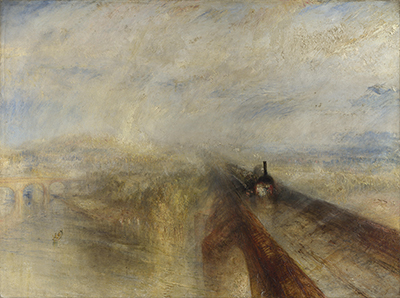
The same modern pressure appears in Rain, Steam, and Speed, although it is a railway picture rather than a sea painting. The National Gallery describes the train crossing Maidenhead Railway Bridge through rain and notes Turner's interest in industry, technology and new forms of transport. [5] The relevance to maritime art is conceptual: Turner treated water, weather, speed and machinery as connected modern experiences.
Steam also changes the meaning of weather. Under sail, wind is a governing force. Under steam, machinery seems to challenge natural conditions, but never escapes them. A steamship in a storm is both modern and vulnerable. Smoke, spray and rain can merge visually, making technology part of atmosphere rather than a clean opposite to nature.
This is why Turner's maritime modernity is not simply pro-technology or anti-technology. He painted new machines because they had become part of the visible world. He also saw that machinery did not remove uncertainty. Steam tugs, trains and boats move through mist, darkness, weather and human history. Modern transport extends power, but it does not abolish risk.
Steam also introduced new visual materials. Smoke could thicken the sky, darken a vessel, obscure a horizon or echo storm cloud. Iron, fire, paddle movement and exhaust changed the look of water transport. Turner used those features pictorially. He did not isolate technology from atmosphere; he made modern machines enter the same unstable field as wind, rain and light.
This has consequences for how his sea art should be read. The arrival of steam does not simply end the age of sail. In Turner's work, sail and steam often overlap. Old vessels, new engines, remembered battles, commercial shipping and weather share the same water. The result is not a clean historical before-and-after, but a visual world in which different kinds of power coexist uneasily.
Rivers, Fire and Public Drama
Turner's maritime imagination includes rivers as well as open sea. The Thames was a working river, a transport artery, a stage for public events and a place where fire, smoke, water and crowd attention could meet. River subjects allowed Turner to paint modern drama without leaving the language of water.
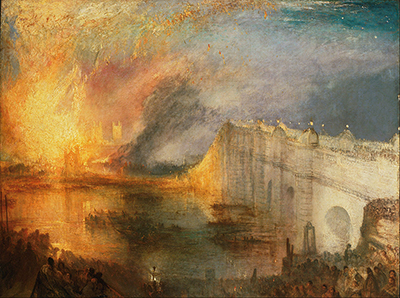
The burning of Parliament in 1834 is a key example. UK Parliament records that the fire began after wooden tally sticks from an obsolete accounting system were burned in underfloor stoves in the House of Lords; smoke and heat were noticed on 16 October before the disaster unfolded. [6] Turner was among the artists who represented the event, and the Thames vantage made the disaster both civic and maritime.
Fire seen across water creates a particular kind of image. Reflections spread the event horizontally; smoke rises into weather; boats and crowds become witnesses; the river separates the viewer from destruction while carrying its light. Turner understood this visual structure. The river is not incidental. It turns public disaster into a moving field of flame, darkness and public viewing.
Such subjects also show that Turner did not limit maritime painting to ships alone. Water could frame a national event, carry news, create distance or intensify drama. The sea and river world in Turner is a world of circulation: people, reports, commodities, armies, refugees, artworks and memories all move through it.
This public dimension matters because Turner was an exhibiting artist. He knew that dramatic events became public images. A fire, a wreck, a naval ship's last journey or a steam train in rain could become a subject for collective looking. Water often gave these events their visual stage.
The Thames was especially important because it joined national institutions to everyday movement. It was not wilderness. It was a working river bordered by government, commerce, industry, housing and crowds. Painting an event from or across the river allowed Turner to show modern Britain as something seen through water, smoke and shared attention. The river made public life atmospheric.
That river perspective also complicates the line between sea and city. Turner could bring maritime seeing into urban subjects. Reflections, boats, bridges, smoke and shifting light connect the city to the larger water world. The same eye that studies a storm at sea can study firelight on the Thames. In both cases, water turns an event into a moving optical field.
Travel, Sketching and Maritime Observation
Turner's sea art depended on travel and works on paper. Tate's research publication on Turner's sketchbooks, drawings and watercolours presents the world's largest collection of his works on paper as giving unique insight into his mind and creative process. [7] For maritime subjects, that means looking at sketches, coastal notes, harbour views, watercolour studies and travel records alongside finished works.
Travel taught Turner that the sea was never one thing. The Channel, the Thames, the North Sea, the Mediterranean, Venetian waters, rivers and harbours all behave differently. Light changes with geography. Boats change with local use. Weather changes with season and coast. The sketchbook allowed Turner to carry these differences back into the studio.
Maritime observation also trained speed. A wave does not pause. A boat shifts. Smoke disperses. Weather closes and opens. Turner needed methods that could seize a relation quickly: a mast against cloud, a sail against dusk, a line of foam, a dark hull, a harbour silhouette, a sun path on water. These observations could later become finished watercolours, oils or designs for reproduction.
Works on paper also prevent a false separation between marine art and the rest of Turner's practice. A sea painting may depend on drawing; a watercolour may carry travel memory; an oil may transform sketchbook material; a print design may spread a maritime subject to a wider audience. The sea moved through Turner's whole working system.
This connection to travel should still be evidence-limited. Not every storm painting records an eyewitness event. Not every sea image can be tied to a precise journey. Turner often transformed memory, reading, reports and earlier art. The maritime sketch is a starting point for interpretation, not automatic proof of a finished work's origin.
Travel also broadened the types of water Turner could compare. Coastal Britain gave him harbours, fishing boats, naval sites and weather-beaten shores. Continental travel brought ports, rivers, canals, alpine lakes and Venice. The sea was part of a wider family of water subjects. Even when the object is not open ocean, Turner often thinks like a maritime artist: light travels across water, movement is unstable, distance is reflective, and human structures appear temporary.
Sketching at the coast also teaches omission. A passing vessel cannot be recorded in every detail. A wave pattern cannot be fixed permanently. Turner learned to preserve what mattered: direction, relation, tone, force, silhouette. This selective practice helps explain the freedom of later works. Their apparent looseness grows from long habits of choosing what is necessary.
Print Culture and Maritime Audiences
Turner worked in a print culture that expanded the audience for maritime subjects. Royal Museums Greenwich notes that Turner & the Sea considers his role within a highly evolved print culture. [1] This matters because many viewers encountered ships, coasts, ports and storms through engraved images rather than through singular oil paintings.
Print culture changed how the sea circulated. A painting in an exhibition room might be seen by a limited audience, but an engraved design could travel through books, series and domestic collections. Maritime subjects were especially suited to this movement because they connected place, travel, commerce and national identity. Turner understood the value of images that could move.
The print process also affected composition. An image intended for reproduction needed structure that could survive translation into line and tone. Ships, masts, waves, cliffs and clouds had to remain legible even when colour was absent or reduced. This discipline sharpened Turner's ability to organise complex maritime scenes around strong contrasts and memorable shapes.
Prints also complicated authorship. A Turner design might pass through engravers, publishers and audiences before reaching its final viewers. The sea image became collaborative and commercial. That does not diminish Turner. It places him in the nineteenth-century visual economy where maritime Britain was imagined not only in galleries, but in illustrated publications and reproduced views.
Maritime print culture also made distant places familiar. Viewers who had never crossed a dangerous channel, seen a foreign port or watched a naval vessel could still consume images of those experiences. Turner worked in a society hungry for such pictures. The sea was not only a physical space; it was an imagined national possession, a field of travel desire and a marketplace for images.
This wider circulation affects interpretation. A marine subject may speak to viewers who know the coast firsthand and to viewers who know it only through art. Turner could satisfy both groups by combining recognisable structures with heightened atmosphere. The image had to be specific enough to persuade and open enough to carry imagination.
Late Storms and Visual Uncertainty
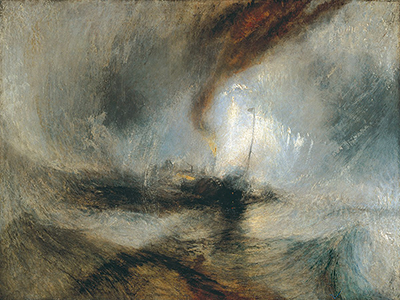
Turner's late storm subjects are among his most famous sea images, but they are often over-described as pure abstraction or personal confession. A better approach begins with what they do visually. They reduce stable boundaries. They make sea, sky, vessel, smoke and light hard to separate. They force the viewer to experience uncertainty.
This uncertainty is not vagueness. It is a maritime condition. In storm, fog, spray or darkness, orientation fails. A horizon disappears. The vessel becomes difficult to locate. Scale becomes unstable. Turner makes that experience into pictorial structure. The viewer does not simply look at a storm; the viewer struggles to see through one.
Late storm pictures also continue earlier concerns rather than abandoning them. They still involve ships, weather, danger, technology, memory and public exhibition. Their freer handling grew from decades of marine practice. Turner could dissolve forms because he knew what forms were being dissolved. The sea gave him permission to test the limits of visibility.
The caution is anecdotal. Stories about Turner being tied to a mast or exposing himself to storms have often shaped popular interpretation. Unless a specific claim is supported by reliable evidence, it should not bear the weight of explanation. The paintings do not need such stories. Their force lies in material, composition and historical context.
Late maritime works also remind us that the sea in Turner is not a single mood. It can be moonlit, commercial, patriotic, murderous, technological, elegiac, industrial, sublime or nearly unreadable. The late storms intensify the problem that had always attracted him: how to paint a world where human systems meet forces they cannot control.
They also intensify the viewer's responsibility. When forms become hard to read, interpretation can become lazy: everything is called mist, abstraction or emotion. Turner deserves better. A late sea picture may be difficult because it is carefully organised around partial visibility. The task is to ask what remains visible, what has been withheld and how uncertainty is made. The sea becomes a discipline for looking.
The late storms are therefore not an escape from history. They still belong to a century of steam, empire, public exhibitions, maritime labour and technological change. Their looseness should be read beside those contexts, not away from them. Turner was not leaving the world behind; he was finding a visual language for a world that felt increasingly unstable.
How to Read Turner’s Sea Art
The first question is what kind of maritime subject is being shown. Is it fishing labour, naval memory, shipwreck, steam transport, slavery, river drama, coastal travel, harbour commerce or a late storm? The answer changes the ethical and historical frame. A ship is never just a ship in Turner. It belongs to a social world.
The second question is how water functions. Does it carry the vessel, threaten it, reflect light, separate viewers from an event, hide bodies, open distance or dissolve form? Turner uses water as active pictorial material. It can organise space and meaning at the same time.
The third question is what kind of evidence supports the scene. Is Turner working from direct observation, sketchbook material, press reports, literary sources, earlier art, public memory or imaginative reconstruction? Sometimes the evidence is clear; sometimes it is mixed. The Fighting Temeraire is a useful reminder that a powerful maritime image can be historically informed without being a literal eyewitness record. [3]
The fourth question is moral. What kind of human experience does the sea carry? National pride, labour, danger, trade and violence can all appear in marine painting. In slavery subjects especially, the sea cannot be treated as neutral scenery. It belongs to a system of human exploitation and death.
Finally, look at visibility itself. Turner often makes the act of seeing unstable. Smoke, rain, spray, sunset, moonlight, glare and mist can make forms hard to fix. This is not a failure of description. It is one of the main subjects. Turner made the sea a place where the visible world keeps changing.
This approach also helps avoid two common mistakes. The first is to treat every sea picture as a mood piece. The second is to treat every ship as a historical document. Turner usually works between those poles. His maritime art is atmospheric and historical, technical and emotional, pictorial and political. The sea gave him a subject large enough to hold that complexity.
Frequently Asked Questions
No. Storms are important, but Turner's maritime art also includes fishermen, harbours, naval memory, steam vessels, rivers, travel, print culture, slavery and public events. Reducing his sea art to storms misses its historical range.
Sometimes Turner worked from observation, but not every maritime image is an eyewitness record. The National Gallery notes that he probably did not witness the towing of the Temeraire and instead recreated it imaginatively from reports. [3]
It should be understood as a maritime work about slavery and violence, not merely as a storm picture. MFA Boston describes it as an indictment of the transatlantic slave trade and connects it to the Zong atrocity. [4]
Discussion
How does Turner make the sea carry both visual drama and historical responsibility?
Reader Insights
What kind of maritime experience is being shown?
How do weather, smoke or light control what can be seen?
Which human systems or events shape the scene?
Join the Conversation
Share a close observation or a question for other readers.
References
- Royal Museums Greenwich, "Turner & the Sea / Christine Riding and Richard Johns." https://www.rmg.co.uk/collections/library/rmgl-152360
- National Gallery, London, "Joseph Mallord William Turner 1775-1851." https://www.nationalgallery.org.uk/artists/joseph-mallord-william-turner
- National Gallery, London, "The Fighting Temeraire." https://www.nationalgallery.org.uk/paintings/joseph-mallord-william-turner-the-fighting-temeraire
- Museum of Fine Arts, Boston, "Turner's Modern World" press release. https://www.mfa.org/press-release/turners-modern-world
- National Gallery, London, "Rain, Steam, and Speed - The Great Western Railway." https://www.nationalgallery.org.uk/paintings/joseph-mallord-william-turner-rain-steam-and-speed-the-great-western-railway
- UK Parliament, "The Great Fire of 1834." https://www.parliament.uk/about/living-heritage/building/palace/architecture/palacestructure/great-fire/
- Tate, "J.M.W. Turner: Sketchbooks, Drawings and Watercolours." https://www.tate.org.uk/art/research-publications/jmw-turner