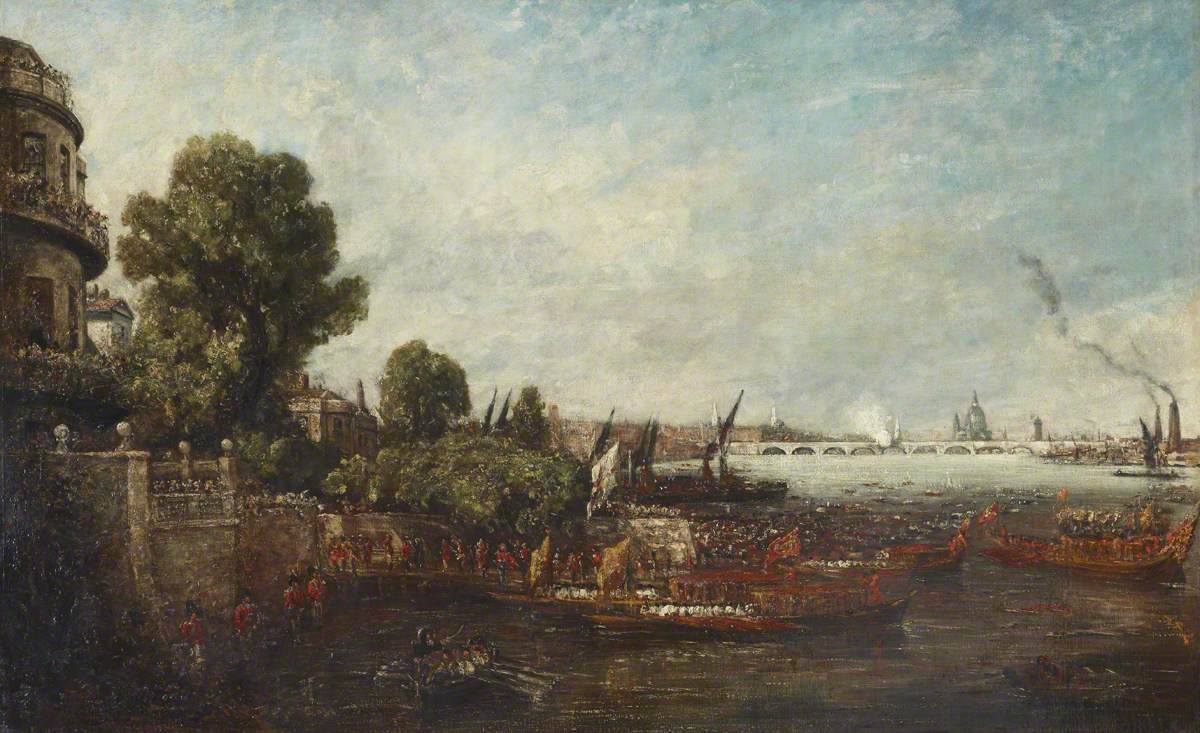
 View the object record
at National Trust Collections
National Trust, Anglesey Abbey. Public-domain object image via Wikimedia Commons.
 by Tom Gurney
Tom Gurney BSc (Hons) is an art history expert with over 20 years experience
Published on June 19, 2020 / Updated on August 29, 2026
Email: tomgurney1@gmail.com / Phone: +44 7429 011000
J. M. W. Turner and John Constable have become the paired names of British landscape painting. They were born only a year apart, trained at the same institution, exhibited before the same crowded public and spent decades confronting related questions. How could paint convey moving weather? What made a familiar place worthy of a great canvas? Could landscape equal history painting in intellectual and emotional force? Their answers were so distinct that posterity has often turned difference into opposition: Turner as traveller and visionary, Constable as resident observer; Turner as fire, Constable as water; one painter of imagination, the other of fact.
None of those contrasts is entirely false, but each becomes misleading when treated as a verdict. Turner observed with extraordinary discipline, while Constable composed, remembered and revised. Constable's rivers belonged to commerce as well as rural affection; Turner's luminous inventions remained anchored in geography, history and material experience. Both studied old masters, manipulated exhibition conditions and worked through the market. Both made sketches that later gained a status they had not necessarily possessed during production. Neither can be understood as simply natural or simply artificial.
Their personal relationship was equally resistant to a neat label. Constable admired some Turner paintings profoundly and disliked others. Turner could be brusque, competitive and supportive. The two men shared dinners, committees, charitable activity and the politics of the Royal Academy. A few vividly remembered encounters have encouraged the idea of a continuous feud, but the surviving record is thinner and more varied. Rivalry existed most securely in professional comparison: pictures hung together, critics measured one artist against the other, and each understood that landscape was being redefined in public.[1][2]
The strongest account therefore begins neither with friendship nor enmity. It begins with two ambitious artists occupying the same cultural field from unequal positions. Their careers reveal how originality can develop through common institutions and inherited traditions without producing a common style. The famous red buoy matters, but so do decades of looking, judging, exhibiting and occasionally recognising greatness in the other man's work.
Near Contemporaries, Unequal Careers
Turner was born in Covent Garden in 1775, Constable at East Bergholt in Suffolk in 1776. The small difference in age has encouraged a symmetrical story, as though two runners began together and pursued alternate lanes. Professionally, they did not. Turner entered the Royal Academy Schools in 1789 and showed a watercolour there in 1790. By the time Constable first exhibited in 1802, Turner had already become an Associate, mounted a substantial body of public work and secured patrons. In that same year Turner was elected a full Royal Academician at twenty-six.[5][7]
Constable entered the Academy Schools as a probationer in 1799. He was therefore beginning formal study when Turner was gaining institutional rank. Constable's Associateship did not arrive until 1819, and he waited another decade for full membership. He was fifty-two when elected in 1829. These dates matter because later visual comparison can conceal the earlier imbalance. Turner had enjoyed years of professional authority, teaching, sales and critical attention while Constable was still seeking acknowledgement from the same body.[2][6]
Their temperaments and timetables also differed. Turner converted youthful skill into a remarkably early career, moving from topographical watercolour into ambitious oils, print ventures and a private gallery. Constable proceeded more slowly, resisting some conventional routes and returning insistently to a limited group of places. His delay was not evidence of lesser ambition. It produced a different kind of pressure: he had to make repeated Suffolk motifs answer the demands of annual public judgement.
To call them contemporaries is thus correct but incomplete. They belonged to the same generation while experiencing it from unequal positions. Turner could appear to Constable as colleague, standard, irritant and institutional elder at once. Constable could appear to Turner as a near-aged artist whose formal recognition came late. Their eventual pairing was made not by equal beginnings but by the gradual convergence of reputations.
Two Family Economies
The settings of their childhoods have often been romanticised into artistic destiny. Turner's father was a barber in busy Covent Garden. The shop exposed the boy's drawings to customers, and his father encouraged, displayed and sold early work. Urban trade was not incidental to Turner's rise. It provided social contact, practical support and an early understanding that images circulated through exchange. The young artist's London was commercial, theatrical and architecturally dense before his travels enlarged it.[5]
Constable grew up amid fields, mills, barges and locks along the River Stour. His father Golding Constable was a prosperous corn merchant who owned watermills and controlled shipping used to move grain. The landscape later associated with rural innocence was therefore a productive network. Water turned machinery, barges carried goods and labour maintained channels, banks and towpaths. Constable's intimate knowledge included economic function as well as trees and clouds.[6][9]
His family initially expected him to participate in the business, and paternal hesitation delayed full commitment to art. Yet family means gave Constable forms of support that Turner's household could not supply in the same way. Later inheritances altered his finances, although marriage, seven children and his wife Maria's illness brought heavy responsibilities. Neither security nor anxiety alone explains his work. The point is that his beloved terrain was also inherited property, employment and memory.
Turner constructed his own commercial system. Watercolour commissions, engraved views, oil sales, patrons, Academy exposure and the private gallery attached to his home allowed him to control access and retain important works. His father's later assistance in the studio made family cooperation part of this mature economy. Turner could be secretive about money and ownership, but he was no detached dreamer. He understood pictures as objects with prices, reproduction rights and strategic futures.
These backgrounds complicate familiar class contrasts. The barber's son became the earlier institutional success; the miller's son struggled longer for artistic rank. Both transformed working environments into cultural capital. When Turner painted ports and Constable painted the Stour, neither left commerce behind. They selected, reordered and dignified worlds in which movement, labour and value were already embedded.
Contents
- Near Contemporaries, Unequal Careers
- Two Family Economies
- Academy Beginnings
- Landscape as High Art
- Old Masters and Originality
- Travel and Familiar Ground
- Drawing from Nature
- Watercolour and Oil
- Skies as Instruments
- Weather, Memory and Composition
Academy Beginnings
The Royal Academy offered both men training, professional identity and the most consequential recurring exhibition in London. Its Schools emphasised drawing from casts and the living model, perspective, anatomy and familiarity with established art. Landscape occupied a lower theoretical rank than history painting, but the annual exhibition created opportunities to challenge that hierarchy in practice. The institution was conservative in some judgements and indispensable to ambitious artists.[7]
Turner's admission at fourteen gave him early access to instruction and networks. His first Academy exhibit, a view of Lambeth Palace, announced architectural and topographical competence. Rapid development followed through watercolours of cathedrals, abbeys, towns and mountains, then oils designed to hold their own among larger works. Election as Academician formalised a position he had already made visible. From 1807 he served as Professor of Perspective, a role that joined artistic reputation to institutional duty.[5]
Constable's relationship with the Academy was more vexed. After first exhibiting in 1802, he wrote that the display showed him where he stood and told him what nobody else could. The sentence captures public comparison as a form of education. Yet repeated disappointment fostered resentment. He could complain bitterly about the pictures, politics and standards around him while continuing to submit work and seek election.[2]
That ambivalence was rational. Academy walls brought criticism, buyers and the judgement of peers. Membership conferred prestige and participation in governance. Constable's large canvases were created in part to command this arena, even when they did not sell. Turner, already secure, could use the same rooms to test increasingly difficult colour, literary titles and historical ambition.
Their rivalry was consequently institutional before it became anecdotal. Every annual arrangement placed works in physical relation. Committee decisions affected visibility. Reviews grouped artists and converted proximity into argument. Turner and Constable did not need to quarrel privately for their paintings to compete. The Academy made comparison one of the conditions under which both careers developed.
Landscape as High Art
British academic theory inherited a hierarchy in which history painting, with elevated human action drawn from scripture, antiquity or literature, stood above landscape. Turner often challenged this order by absorbing history into landscape. Storms, mountains, ports and cities could contain Hannibal, Dido, Ulysses or modern war, while natural forces controlled the spectator's experience. A landscape painter could thus claim the scale and learning of the highest genre without surrendering atmospheric power.[17][18]
Constable pursued a less overtly literary course in his major Stour paintings. Barges, horses, wagons and cottages carry no ancient disguise. Their claim rests upon magnitude, concentration and the seriousness of sustained knowledge. Enlarging an ordinary river scene to roughly six feet across was itself argumentative. The format asked spectators to grant working English terrain the attention normally commanded by grander narratives.[11]
This distinction should not be exaggerated. Turner's historical subjects depend upon observed landscape, and Constable's views contain memory, symbolism and cultural argument. Salisbury Cathedral from the Meadows includes a rainbow, turbulent sky and ecclesiastical meaning that exceed neutral description. Turner's modern scenes can dispense with named heroes and place labour or technology at the centre. Each crossed boundaries when the subject demanded it.[16][20]
Both artists also understood that elevation required formal control. Scale alone could become empty display. Turner organised movement through light, diagonal force, architectural mass and layered incident. Constable rehearsed spatial relations, tonal balance and the rhythm of trees, water, buildings and figures. Their energetic surfaces are underwritten by composition.
The result was a shared enlargement of landscape's possibilities without a shared formula. Turner demonstrated that the genre could encompass history, empire, catastrophe, travel and modern machinery. Constable demonstrated that repeated local knowledge could sustain monumental invention. Their differences widened the field. Later spectators could regard landscape as central to British art partly because these competing models had made narrow classification impossible.
Old Masters and Originality
Neither painter discovered originality by avoiding earlier art. Turner studied Claude Lorrain, Aelbert Cuyp, Richard Wilson, Nicolas Poussin and Dutch marine painters, among many others. He copied compositions, analysed prints and sometimes announced a contest through titles, exhibition pairings or his eventual bequest. Old masters gave him structures to transform and reputations against which to measure modern landscape.[5]
Constable also looked deeply. Claude, Jacob van Ruisdael, Rubens, Gainsborough and Dutch landscape helped him understand recession, weather, movement and emotional tone. His celebrated commitment to nature did not require historical innocence. It meant testing inherited conventions against particular experience. A cloud, tree or cart could be observed afresh while remaining part of a long visual culture.[6][9]
Their attitudes to imitation differed in emphasis. Turner often made emulation conspicuous, inviting viewers to notice how a modern work answered a predecessor. Constable could sound suspicious of artists who travelled in search of borrowed scenery or relied on formula. Yet his own paintings are carefully composed and historically informed. His directness is an achievement, not the absence of mediation.
Cuyp provides a productive meeting point. British collectors admired the Dutch painter's golden river scenes, cattle, boats and expansive skies. Turner responded overtly in Dort, filling a broad river with luminous distance and intricate contemporary activity. Constable recognised what the transformation achieved. His later praise of the picture shows an artist capable of admiring the very mode of ambitious emulation sometimes placed against his own practice.[15]
The comparison exposes a false choice between tradition and truth. Turner used inherited structures to organise observation; Constable used observation to renew inherited structures. Both depended upon selection. A finished landscape cannot contain every visible fact, and no historical model applies itself. Originality lay in deciding which relations mattered, what kind of experience the work would produce and how visibly the past should remain within it.
Travel and Familiar Ground
Turner's mobility became one of his defining professional resources. He travelled throughout England, Wales and Scotland, then repeatedly across continental Europe. Sketchbooks accompanied journeys through France, Switzerland, Italy, Germany, the Low Countries and Venice. Roads, boats, mountain passes and urban approaches generated thousands of observations. Travel supplied topography, weather, human incident and the bodily experience of difficult terrain.[30]
Constable's geography was more concentrated. East Bergholt, Dedham Vale, the Stour, London, Hampstead, Salisbury and Brighton recur, with an important Lake District journey in 1806. He did not build a career upon continental touring. Familiarity allowed him to return under altered conditions and to connect visible places with childhood, family, friendship and loss. Repetition deepened rather than exhausted his subjects.[6]
It is tempting to equate Turner's range with curiosity and Constable's concentration with rootedness. Both terms require qualification. Turner revisited motifs over decades and carried memories back into the studio. His Europe was not a sequence of disposable spectacles. Constable travelled within Britain, studied unfamiliar country and lived between Suffolk memory and metropolitan professional life. His chosen localism was constructed from movement and absence as well as residence.
Their methods generated different kinds of authority. Turner's authority often arises from accumulated encounters: a place is seen on tour, redrawn for publication, reconsidered after another journey and joined to historical reading. Constable's arises from duration: river levels, trees, working routines and skies become legible through repeated acquaintance. One condenses range; the other intensifies recurrence.
Neither guarantees truth. Wide travel can encourage convention, and familiarity can become nostalgia. Both painters had to resist those risks through form. Turner made locations specific even when atmosphere transformed them. Constable revised beloved terrain until affection acquired public structure. Their geographies are best understood as different research practices, each turning partial experience into a deliberately composed world.
Drawing from Nature
Turner's sketchbooks are often treated as proof of direct observation, and rightly so, but they are more varied than a simple visual diary. Rapid pencil outlines record profiles, architecture, boats and routes. Watercolour notes register tonal or chromatic effects. Written words identify colours or events when speed, weather or darkness limited drawing. Some books pursue a commission; others contain exploratory fragments whose later use cannot be traced.[30]
Constable made pencil and watercolour drawings, small oil studies and closely observed records of trees, clouds and terrain. Working in oil outdoors allowed colour and handling to respond quickly to change. A small support could receive wet strokes with unusual freedom because it did not bear the same public burden as an Academy canvas. Such studies later came to seem startlingly modern, although their original functions included practice, information and private experiment.[14]
Both artists therefore separated encounter from completion without making the first stage mechanical. A sketch selects from the beginning. Turner might reduce a complex town to a skyline and directional marks. Constable might isolate a cloud mass or tree trunk. The fragment becomes useful because it identifies a relation worth retaining, not because it stores an exhaustive view.
Their surviving bodies of work distort comparison. Turner's bequest preserved an immense range of material, including unfinished sheets and canvases that he had not publicly released. Constable's family holdings and later museum collections similarly elevated working studies into autonomous objects. Modern admiration can blur the historical difference between what each man exhibited and what remained within the studio.
Directness should consequently be described as a mode of attention, not a guarantee of final appearance. Turner could use a quick observation years later in a highly literary composition. Constable could expand a local motif through several stages and change its weather, figures or emphasis. Nature supplied evidence and resistance. Art began in the decisions by which that evidence was carried forward.
Watercolour and Oil
Turner's early reputation rested substantially upon watercolour. Transparency, reserved paper, layered wash and opaque additions allowed him to create architecture, rain, mountain distance and radiant skies with exceptional range. The medium also suited travel and reproduction. Watercolours could be commissioned, exhibited, sold and translated into engravings, joining private possession to a broad print audience.[30]
Constable's modern fame is more closely tied to oil, especially the small studies and full-size sketches whose broken handling appears immediate. He nevertheless drew and painted in watercolour throughout his career. The difference lies not in exclusive ownership of a medium but in the roles each assigned it. Constable's oil sketch often became a laboratory for relation and touch; Turner's watercolour could function as observation, finished work, publication design or private chromatic experiment.
Oil also meant different things within each practice. Constable's full-size preparatory canvases for the six-footers allowed him to work through composition at the scale of exhibition. Their broad handling is not simply the first spontaneous idea enlarged. They are extended acts of revision. The more finished versions regulate some energy while introducing clarity, detail and tonal order.[11][12]
Turner's oils range from carefully layered early surfaces to paintings visibly altered during exhibition preparation. Glazing, scumbling, scraping, wiping and opaque highlights could coexist. Some late works appear dissolved when seen in reproduction but are controlled through local anchors, directional movement and strategic contrast. His method changed with subject and date rather than obeying one recipe.
The most useful comparison concerns translation. Each artist moved information between media and scales. A pencil line could become architecture; a colour notation could become a sky; an oil study could become a public canvas; a painting could become mezzotint. Every transfer demanded loss and invention. Their art was made not only before nature but between objects.
Skies as Instruments
Constable famously argued that the sky was the chief organ of sentiment in landscape. During the early 1820s at Hampstead, he made concentrated cloud studies, sometimes noting date, hour, wind direction and weather on the reverse. These inscriptions align feeling with empirical attention. Clouds are not vague emblems laid over a view; they have structure, movement and meteorological cause.[6][13]
Turner observed skies no less persistently, although his surviving notes often serve different projects. Sun breaking through rain, mountain vapour, marine storm, moonlight and urban smoke appear across sketchbooks, watercolours and oils. Atmosphere can unite the whole field or make stable forms difficult to see. In a historical subject it may become an agent of fate; in a topographical work it defines a particular hour; in a modern scene it can mingle weather with steam.[16][17]
The period's growing scientific interest in weather forms part of this attention. Luke Howard's cloud classifications supplied a new vocabulary, while instruments, optics and public lectures encouraged close inquiry into natural processes. Constable's annotations seem especially compatible with classification, yet his skies remain emotionally and compositionally charged. Turner's looser records do not indicate indifference to science. Both worked in a culture where observation and imagination were not enemies.
Their skies also solve pictorial problems. A cloud mass can counterweight a tree, accelerate recession, direct light or connect foreground action with distance. Constable sometimes adjusted a sky between sketch and finished work because the total composition required it. Turner could intensify a storm beyond the conditions first recorded because history or narrative demanded greater pressure.
To call Constable meteorological and Turner atmospheric therefore establishes a useful tendency only if the categories remain open. Constable transformed measured conditions into sentiment. Turner made atmosphere through accumulated observation. In both, the sky is active structure: it tells the land how to be seen and the spectator how quickly stability may change.
Weather, Memory and Composition
A weather study captures a transient condition, but a major painting must sustain attention long after that condition has passed. Constable solved the problem through memory, rehearsal and adjustment. He valued fidelity to natural effect while recognising that an exhibition canvas required unity. Clouds seen on one occasion could be joined to terrain known across years, provided the resulting light and movement remained convincing.
Turner worked with a similarly layered temporality. The instant of a storm, sunset or passing shower entered notebooks alongside journey knowledge, historical associations and earlier pictures. In the studio, these strata could be combined. The result is not a photograph of one moment but an argument about how moments become memory. Weather makes that process visible because it is both observed fact and rapidly disappearing form.
Composition controls the transformation. Constable's skies can lean into the direction of land, open a bright interval above water or press darkly against a tower. Turner's vortices, diagonals and luminous centres organise the eye even when individual forms seem unstable. Apparent disorder is often carefully distributed. The spectator experiences change because the painting establishes enough order to make change intelligible.
Personal memory distinguishes their uses without separating them absolutely. Suffolk carried Constable's childhood, courtship and family history. Later Salisbury works absorbed grief after Maria's death and anxiety about the church. Turner's places more often accumulate through travel, patronage, literature and national history, though personal attachment to the Thames, Margate, Petworth or Venice can be intense.
Both reject the idea that landscape is inert scenery. Weather reveals time acting upon place, while memory reveals place acting upon the artist. Their paintings do not simply preserve appearances. They stage the labour by which unstable experience is made durable, and they invite viewers to feel that durability remains provisional.
Working Landscapes
Constable's Stour Valley has become an emblem of pastoral England, yet its waterways, mills and fields were organised for production. Barges moved grain, horses worked towpaths, locks controlled passage and mills converted water power into income. Willy Lott's cottage and Flatford Mill belonged to a functioning commercial environment connected with the Constable family. The apparent ease of The Hay Wain depends upon labour and management.[9]
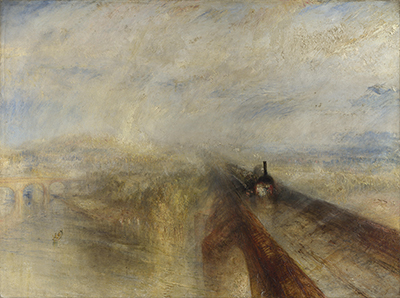
Turner painted working rivers and farms as well as dramatic industry. Fishermen, sailors, porters, keelmen, builders and travellers inhabit his landscapes. Modern transport eventually becomes explicit in steam packets and railways, but older technologies already organise many scenes. Sails, bridges, roads and canals are systems of movement. Human figures may be small while their activity gives the place historical meaning.[16][34]
The artists distribute tension differently. Constable often presents labour through habitual continuity. A cart enters water, a barge passes a lock, cattle graze near managed banks. Industrial transformation is not always visible, although awareness of change may sharpen the desire to monumentalise this terrain. Turner more frequently brings transition into open conflict: sail and steam, ruin and construction, sunlight and smoke occupy the same field.
Neither approach is politically transparent. Rural harmony can conceal poverty and conflict; technological spectacle can register wonder without offering a simple judgement. Viewers should ask what kinds of work are visible, who controls the environment and which disruptions remain outside the frame. The pictures provide evidence without becoming social surveys.
Their shared achievement was to make labour compatible with ambitious landscape. Constable did not need to dress a wagoner as a classical shepherd, and Turner could give a modern vessel the visual force once reserved for heroic action. Everyday work entered art through different scales of attention. In both, landscape became a relation among natural process, human use and the histories viewers bring to what they see.
Constable's Six-Footers
From 1819 Constable developed a sequence of large Stour paintings now known as the six-footers. The White Horse, Stratford Mill, The Hay Wain, View on the Stour near Dedham, The Lock and The Leaping Horse transformed river episodes into imposing public statements. Their size was unusual for ordinary English landscape and essential to the claim they made within Academy rooms.[11]
The method was equally ambitious. Constable prepared full-size oil sketches for most of the sequence. At nearly the dimensions of the intended painting, these studies allowed him to test the distribution of light, masses, figures and directional movement with broad handling. A small study can conceal a structural weakness that becomes obvious when enlarged. Working at full scale forced every relation to survive bodily viewing.[12]
The sketch and finished version should not be ranked simply as free original and compromised copy. Each addresses a different problem. The sketch can preserve active brushwork and unresolved alternatives. The exhibition canvas clarifies incidents, adjusts tone and creates the sustained legibility required by a crowded display. Constable sometimes changed important elements between them. Completion was another invention.
Turner's presence is indirect but relevant. He had already demonstrated that landscape could occupy monumental formats and attract attention through powerful tonal organisation. Constable did not imitate his subjects or surfaces, yet he worked in an arena whose expectations Turner had helped change. To compete at the highest level, a familiar river scene had to assert itself across a room.
The six-footers also complicate the myth of effortless naturalism. They required months of studio labour, repeated studies and strategic exhibition thinking. Their freshness is constructed through revision. Constable's achievement was not to avoid artifice but to make extensive artifice preserve the sensation of lived familiarity. That paradox links him to Turner even as their visible results diverge.
*Turner and Public Scale*
Turner learned early to make a work declare itself within dense displays. Large oils such as Snow Storm: Hannibal and his Army Crossing the Alps use sweeping movement, compressed figures and a powerful atmospheric arc to remain legible at distance, then reveal historical detail near at hand. Architectural and marine subjects similarly establish strong tonal masses before incident emerges.[17]
His public scale was not always physical. A smaller watercolour could reach a wide audience through engraving, while a private gallery concentrated attention under conditions he partly controlled. Publication series extended reputation beyond a single season. Turner understood that scale concerned circulation, repetition and critical memory as much as canvas dimensions.
Constable's great canvases confronted this established versatility. His river scenes have fewer exotic or literary cues, so size intensifies ordinary matter. A tree trunk, wet bank or wagon acquires bodily presence. The broad sky creates room for changing weather. Viewers cannot dismiss the subject as a minor view when it occupies the visual territory of a major statement.
The comparison should not imply that Turner always pursued spectacle while Constable pursued intimacy. Turner's large works often include quiet, exact observations; Constable's can be theatrical in light and weather. Both controlled the sequence of looking. A distant spectator first receives an arrangement of brightness and mass. Closer inspection discovers paint, labour and narrative fragments.
Academy scale also carried risk. A forceful effect might be attacked as exaggeration. Broken handling could look unfinished. A large familiar scene might seem pretentious if critics did not accept its emotional claim. Turner and Constable repeatedly accepted those risks. Their successes helped detach landscape from the assumption that it should remain decorative, modest or subordinate.
Markets and The Hay Wain
Constable exhibited Landscape: Noon at the Royal Academy in 1821. The work later became universally known as The Hay Wain, a title associated with his friend John Fisher rather than the original catalogue. Reviewers noticed its unusual fidelity to rural appearance, but favourable attention did not produce a buyer. The distinction is important: the Academy accepted and displayed the painting; the market did not immediately reward it.[9][10]
Its subsequent French history has sometimes been told as instant triumph following British rejection. The sequence was less direct. In 1824 the Anglo-French dealer John Arrowsmith negotiated for The Hay Wain, View on the Stour near Dedham and a smaller Yarmouth Jetty, paying £250 for the group. Fisher encouraged the transaction partly because foreign approval might alter English opinion. The three works went to the Paris Salon.
French artists and critics responded strongly to Constable's handling, colour and natural effects. Delacroix returned to his own Massacres at Chios and enlivened its surface after studying the British pictures. Charles X awarded Constable a gold medal, chiefly associated with The Hay Wain. Yet the Louvre did not acquire the painting, Arrowsmith's finances were unstable and the work moved through the market before eventually entering the National Gallery in 1886.[10]
Turner's commercial position by 1824 was far stronger at home. Patrons, collectors, print publishers and his own gallery had sustained him for decades. He could retain works, buy some back and negotiate from established fame. International travel enriched his subjects, but his authority did not depend upon one foreign breakthrough. Constable's Paris success, by contrast, gave him prestige without immediately producing the British recognition he desired.
The contrast reveals two paths through the same art economy. Turner cultivated range, publication and controlled display early. Constable invested heavily in a small number of monumental canvases whose sales could be uncertain. Neither path separated artistic decisions from money. The unsold Hay Wain and Turner's retained pictures became national treasures later, but future status should not erase the practical risks under which they were made.
Exhibition success itself was difficult to convert into income. Reviews could establish reputation without naming a purchaser, and a large canvas demanded more space and money from any collector willing to acquire it. Engravings could broaden recognition while introducing costs, delays and negotiations with publishers. Private patrons might provide security but also direct subject, dimensions or delivery. Turner became unusually skilled at moving among these arrangements. Constable's narrower production and slower completion made every major commitment more exposed.
Ownership later changed interpretation. Once The Hay Wain entered a national collection, its earlier failure to sell became part of a reassuring story in which posterity corrected contemporary blindness. That story overlooks the favourable reviews, French enthusiasm and complicated dealer history between 1821 and 1886. Turner's bequest created a different distortion: an enormous retained body can make him seem indifferent to buyers, although sales and commissions had helped finance the independence that allowed retention. Market history explains choices without reducing either artist's achievement to price.
What Constable Thought of Turner
Constable's recorded opinions make any single account of rivalry difficult. He could be dismissive, competitive, amused and deeply admiring, sometimes within a short span of years. At an Academy dinner in 1813 he sat beside Turner and afterwards described him as uncouth but possessing a “wonderfull range of mind.” The judgement mixes social discomfort with intellectual respect.[2]
Specific paintings drew similarly discriminating responses. When Turner exhibited Snow Storm: Hannibal and his Army Crossing the Alps in 1812, Constable found parts scarcely intelligible but considered the whole novel and affecting. He did not have to approve every passage to recognise emotional force. In 1814 he preferred his own ploughing subject to Turner's Dido and Aeneas, despite praise Turner received from other artists.[2][17][18]
These remarks are not inconsistency in a trivial sense. Artists judge individual works, professional circumstances and their own ambitions. Constable might resist Turner's colour or historical machinery in one exhibit while learning from his authority in another. Admiration can be sharpened by rivalry because the admired achievement occupies terrain the observer also wants to command.
Constable later asked rhetorically whether anyone saw a Turner without wishing to possess it. Such praise sits beside jokes at Turner's expense and irritation about publishers, manners or exhibition tactics. It suggests that his private and professional vocabulary allowed several truths at once. Turner could be difficult company, a formidable competitor and a maker of desirable pictures.
Far fewer remarks by Turner about Constable survive. That imbalance should restrain speculation. Silence does not prove contempt, indifference or secret admiration. Turner's votes, visits and institutional conduct can be considered, but motive remains partly unavailable. The relationship is documented most fully through Constable's shifting voice and through situations in which their works were made to speak beside each other.
Dort and Explicit Admiration
Turner exhibited the great 1818 river scene commonly shortened to Dort at the Academy. The enormous painting draws upon Cuyp's luminous Dutch landscapes while filling its calm breadth with contemporary traffic. Boats cross and overlap, passengers gather, goods move and distant Dordrecht rises through warm atmosphere. Tranquillity and abundance coexist.[15]
Years later Constable remembered the work with exceptional precision. He described its singular intricacy and beauty, its canal crowded with boats making thousands of shapes, and called it the most complete work of genius he had seen. The statement is among the strongest surviving tributes from one major British landscape painter to the other.[2][15]
What impressed him was not light alone. “Intricacy” identifies Turner's capacity to organise incident without losing unity. Each vessel contributes shape, direction and scale; luminous atmosphere prevents abundance from becoming inventory. Constable, who struggled intensely with the relation between broad effect and local fact, could recognise the difficulty of that balance.
The old-master dimension may have deepened his response. Both men knew Cuyp's British reputation. Turner did not merely reproduce golden light but placed recent travel and modern river life within that inheritance. Constable's praise therefore acknowledges a successful encounter among observation, tradition and ambition - the very problems his own art addressed differently.
This moment should not be sentimentalised into friendship. It is more valuable as evidence of exact looking. Constable did not admire a general idea of Turner; he identified a particular work's structural achievement. Rivalry here becomes a form of informed recognition. A competitor could supply one of the clearest accounts of why the picture succeeds.
Collegial Life
The art world that Turner and Constable inhabited was small enough to produce regular contact. Academy meetings and dinners, exhibition preparation, collectors, mutual acquaintances and charitable organisations repeatedly brought artists together. Most encounters left no dramatic record. The absence of anecdotes should not be mistaken for absence of professional life.
In 1818 Turner chaired the Artists' General Benevolent Institution when Constable was elected a director. The organisation supported artists and their dependants in hardship, placing both men within practical work beyond personal production. Committee activity required discussion, decisions and a willingness to share responsibility despite differences of rank or temperament.[2]
Turner could appear socially abrupt, especially when interrupted while working. Constable sometimes used these encounters to create comic portraits of his colleague. When canvassing support for Academy election in 1828, he called upon Turner on a Monday afternoon and found him angry at the intrusion. The story reveals Turner's guarded studio habits, but also Constable's confidence that support was worth seeking.
Their circles overlapped through figures such as George Jones, David Roberts, Charles Eastlake and Academy officers. Patrons and exhibitions created further intersections. They would have known not only each other's paintings but the evolving talk around them: prices, reviews, committee decisions and comparisons. Competition operated through this shared information.
“Colleague” is therefore a more secure word than friend or enemy. It accommodates practical cooperation, irritation and respect without demanding emotional intimacy. Their relationship had duration because institutions continually renewed it. The most memorable clashes emerged from that ordinary proximity, not from two isolated careers suddenly colliding.
Election in 1829
Constable's election as a Royal Academician on 10 February 1829 followed years of disappointment. He won by a single vote. The narrow margin has encouraged a satisfying story in which Turner supplied the deciding ballot, but the evidence does not establish that action beyond doubt. Tate scholarship treats it as a possibility, perhaps after Turner's preferred candidate Charles Eastlake fell away, rather than a settled fact.[2]
What happened after the vote is better documented. Turner and George Jones visited Constable to congratulate him. They remained until roughly one in the morning, and Constable recorded that they parted mutually pleased with one another. His wife Maria had died only months earlier, so the achievement arrived amid grief and could not give the shared pleasure he had once imagined.[2][8]
The visit matters regardless of the ballot. Turner could have confined himself to formal acknowledgement, yet he joined a long conversation at Constable's home. Constable chose to record mutual pleasure rather than suspicion. The episode interrupts any narrative in which professional rivalry made warmth impossible.
It also reveals the asymmetry that persisted. Turner had held full membership since 1802. He was welcoming a near contemporary into a rank he had occupied for twenty-seven years. Constable's success made them institutional equals in title while their histories remained radically unequal. That difference may have intensified both satisfaction and competition.
The following exhibitions would test the new relation. Membership brought Constable authority in arrangement and a stronger claim upon critical comparison. The 1829 evening should not be treated as reconciliation before renewed warfare. It shows instead that support and competition could coexist. The same colleagues who parted happily could soon manoeuvre large paintings within a room where position affected reputation.
Rival Print Projects
Turner began Liber Studiorum around 1807 as an ambitious series demonstrating the range of landscape. Seventy-one plates appeared, chiefly before 1819, from a projected one hundred. Etching established key lines while mezzotint developed tonal fields. Categories including marine, mountainous, pastoral, architectural and historical landscape made the sequence an argument for the genre's breadth.[26][27]
Constable turned to mezzotint with David Lucas around 1829. Various Subjects of Landscape, Characteristic of English Scenery appeared in five instalments between 1830 and 1832, later becoming known as English Landscape Scenery. Twenty-two original plates and subsequent additions translated paintings and designs into dramatic monochrome. Constable repeatedly corrected proofs, adjusting light, weather and emphasis through close collaboration.[23][24][25]
The two ventures invite comparison but are not equivalent. Turner's larger undertaking projected an encyclopaedic identity across many modes and locations. Constable's more concentrated sequence retrospectively shaped a career around English scenery and characteristic effect. Turner invoked Claude's Liber Veritatis through title and structure; Constable's collaboration arose from different commercial pressures and a desire to circulate his artistic principles.
A British Museum account preserves a sharp joke. When a publisher proposed terms less favourable than those reportedly granted Turner, Constable called Turner's project “liber stupidorum.” The pun registers irritation about business and perhaps competitive disdain. It should not outweigh his praise for Dort or become a comprehensive verdict on the older series.[23]
Mezzotint itself created deeper common ground. Its worked surface can move from velvety darkness to exposed light, making it especially responsive to storm, moonlight and cloud. Neither artist simply handed finished images to neutral technicians. Collaboration required decisions about what tonal relations defined the original and what a print could newly achieve. Their series made landscape portable while turning reproduction into another arena of invention.
The Royal Academy in 1831
The 1831 exhibition created the most consequential direct comparison before the red buoy. Constable served on the Selection and Hanging Committee, giving him practical authority over placement. His enormous Salisbury Cathedral from the Meadows entered the Great Room alongside Turner's Caligula's Palace and Bridge and Vision of Medea. Three difficult landscapes met at related scale but with sharply different colour, geography and narrative.[2][3][19][20]
Evidence indicates that Constable moved his own canvas into a central position between the two Turners. Later recollection describes Turner's anger at finding one of his works displaced and accusing Constable of having slain him without remorse. Constable appeared to wriggle under the accusation. Yet the memory came through David Roberts, and scholars differ over exactly which Turner had been moved. The broad manoeuvre is persuasive; every theatrical detail is not equally secure.[2][4]
The arrangement made institutional equality visible. Constable, recently elected, placed his ambitious cathedral where it could not be treated as a peripheral English view. Turner's two classical subjects framed it with hot colour, ancient architecture and literary drama. Constable answered through dark weather, Gothic mass, grazing cattle, a cart and a rainbow. The centre became an argument about what elevated landscape might now be.
Turner had six works in the exhibition, Constable two. The Great Room contained only part of a display involving 669 exhibitors and 1,234 works. Crowding, height and adjacency shaped perception. A painting needed both immediate effect and resistance to powerful neighbours. Constable's committee role gave him opportunity, but it also exposed his work to unusually severe comparison.[3]
The episode is often called provocation, yet hanging committees necessarily rearranged works. Constable later admitted that he had “played the devil with others” during exhibition work and deserved punishment when he experienced difficulty himself. His self-awareness suggests tactical boldness rather than innocent accident. Still, there is no need to invent a private plot. Public ambition explains enough.
Committee authority was temporary and collective. Selection determined which submissions entered; arrangement then assigned position across walls already crowded with portraiture, history, genre, architecture and landscape. Academicians had privileges, but no member acted within an empty room or without colleagues. A move that benefited one large canvas could displace another and alter several visual relationships. Constable's decision was therefore personal in effect even if made through ordinary institutional labour.
The annual catalogue and contemporary press extended those relationships beyond the building. Titles supplied literary or geographical cues, while reviews described colours and placements to readers who might never attend. The modern Academy Chronicle reconstructs this environment from catalogues and criticism, reminding us that the famous trio belonged to a vast, temporary arrangement rather than a museum installation designed for permanent comparison.[33] Turner and Constable were competing not only beside each other but for recollection after hundreds of neighbouring works had disappeared from view.
Fire and Water
Critics seized upon the 1831 grouping. The Literary Gazette and other reviewers contrasted Turner and Constable through heat and moisture, producing the durable phrase “fire and water.” Turner seemed all flame, glowing colour and heated vapour; Constable seemed drenched, storm-laden and humid. The language condensed an immediate visual experience into memorable elements.[2][3]
Such criticism could praise and rebuke simultaneously. Turner's colour might appear magnificent or excessive. Constable's rain and broken surface might feel powerfully natural or oppressively wet. Both were increasingly described as originals whose unmistakable styles risked becoming mannerisms. To be recognised at a glance was a triumph and a vulnerability.
The important historical change is that critics placed Constable beside Turner as an equal problem. Turner's eminence had long made him the standard for ambitious landscape. In 1831 Constable's scale, Academy status and commanding placement forced comparison on new terms. Reviews could no longer discuss him only as a patient painter of Suffolk nature. He had become a public antagonist in colour and effect.
Elemental labels nonetheless distort when carried beyond the room. Constable could paint fiery sunsets and Turner could saturate a landscape with rain. Both used cloud, water and illumination across broad emotional ranges. “Fire and water” describes a critical encounter, not permanent ownership of natural forces.
Nor did the hang produce a clear winner. Contemporary responses valued and mocked both men, often within the same notice. The exhibition's significance lies in reciprocal visibility. Each work changed how its neighbours looked. Constable's dark storm made Turner's heat hotter; Turner's classical radiance made Constable's English weather more immediate. Rivalry occurred in the spectator's eye.
Varnishing Day in 1832
The following Academy exhibition generated the story that has come to represent the whole relationship. Turner's maritime painting Helvoetsluys; the City of Utrecht, 64, Going to Sea hung beside Constable's immense The Opening of Waterloo Bridge. The Turner was cool, pale and predominantly grey. Constable's Thames celebration was rich with red, gold and active detail after years of labour.[4][21][22]
Varnishing Days allowed Academicians to adjust works already positioned on the walls. The practice could involve literal varnish, glazing, repainting or finishing touches made in awareness of neighbours. Turner was famous for substantial interventions during this period. Painting in public made artistic process visible and allowed exhibitors to respond tactically to the room.
According to C. R. Leslie's later recollection, Turner watched while Constable heightened his canvas with vermilion and lake. Turner then placed an intense red mark upon his own cool sea and left. Constable remarked that he had “been here and fired a gun.” Turner returned later, glazed the scarlet shape and formed it into a buoy.[4][8]
What Leslie Actually Recorded
The temporal distance matters. Leslie's Autobiographical Recollections appeared in 1860, twenty-eight years after the event and after both painters had died. He had witnessed the Academy preparations and knew Constable closely, so the account is important. It is still remembered narrative rather than a contemporary transcript. His wording distinguishes the first red mark from the later shaping of the buoy.[4]
Popular retellings often add a decisive humiliation. Turner supposedly transformed an indifferent work with one touch and made Constable's labour vanish. Jacqueline Riding has shown that Leslie does not say Constable believed himself destroyed. “Fired a gun” may signal combat, a visual explosion, a joke about a shot in the sea or recognition that Turner had answered concentrated reds with one stronger accent.[4]
The previous year's hang may have sharpened everyone's interpretation. Constable had used committee authority to centre his cathedral between Turners. In 1832, he could reasonably expect some response. Yet revenge cannot be proven from a spot of colour. Turner was also solving a formal problem within his own painting. Tactical intelligence and private amusement can coexist without a complete theory of motive.
What the Red Buoy Changed
The buoy demonstrates a basic colour relation with unusual clarity. A small warm mark becomes intense when surrounded by cool greys. Its isolation concentrates attention more effectively than many scattered touches. Constable's reds were distributed across flags, figures and architectural festivity; Turner's single accent operated as punctuation. Proximity made each system newly visible.[4]
Turner did not create the entire painting in that instant. Helvoetsluys already contained sea, shipping, atmosphere and the historical reference to the Dutch vessel leaving port. The red addition altered hierarchy. It supplied a near focus, animated depth and gave the eye a point from which to measure surrounding coolness. Small size increased rather than reduced its authority.[21]
Constable's Opening of Waterloo Bridge had occupied him for years and survives in more than one version. Its crowded river ceremony, smoke, flags, buildings and brilliant touches celebrate a modern urban event through accumulated incident. The painting is not made weak by requiring many reds. Its dispersed colour corresponds to festivity and scale. Turner's concentration answers a different pictorial need.[22]
The contrast also complicates ideas of labour. Constable's prolonged preparation and Turner's rapid intervention can appear to oppose industry and instinct. In reality, Turner's decision depended upon decades of experience, while Constable's long process included bold improvisation. Speed at the wall was compressed knowledge. Duration in the studio did not exclude freshness.
When the pair was reunited at the Royal Academy in 2019, viewers could test the anecdote against the objects. The buoy attracts attention, but it does not erase the neighbouring canvas. Modern display turns legendary victory back into comparative looking. The enduring lesson is less that Turner defeated Constable than that placement can transform colour into action.[32]
Colour and Surface
Constable's paint can be remarkably physical. Thick touches catch on foliage and water; white flecks break across darker grounds; palette knife and brush create varied resistance. Critics sometimes mocked bright highlights as “Constable's snow,” treating a flexible device as an eccentric signature. At their best, the marks make light seem distributed through matter rather than laid evenly over it.[6][20]
Turner's surfaces vary across his career, but later exhibition works often combine thin glaze, opaque body, scraping and emphatic accents. A bright field may be built from many layers rather than one unmodulated yellow. Forms can emerge through contrast and then dissolve at their edges. Critics who saw only looseness overlooked the technical sequence that made instability controlled.
Both artists were vulnerable to the accusation of finishlessness. Academic finish usually implied coherent modelling, subordinated touch and a surface appropriate to the subject. Constable's broken paint could resemble a study; Turner's late luminosity could make objects seem unresolved. Yet each understood the conventional finish he disturbed. Their innovations derive force from selective refusal, not inability.
Distance changes judgement. Across a room, Constable's flecks merge into weather and foliage; nearby, they insist upon pigment. Turner's atmospheric fields similarly cohere and fragment as a spectator moves. Academy display encouraged this oscillation. A painting had to attract from afar while surviving inspection among peers.
Colour therefore joins method to rivalry. The 1831 and 1832 comparisons were memorable because both men made chromatic relation structural. Red, white, gold, grey and dark cloud do not decorate completed forms. They determine visibility, emotion and sequence. The works compete by reorganising the conditions under which neighbouring colour is seen.
Critical Originals
During their lifetimes, “original” could be praise edged with suspicion. An original artist escaped imitation and enlarged possibility, but eccentricity might harden into self-conscious manner. Turner and Constable received both responses. Their work became instantly recognisable, and that recognisability allowed critics to convert complex paintings into verbal caricatures.[1][2]
Constable's reputation later settled around truth to nature and English rural identity. Familiar reproduction made The Hay Wain seem reassuring, obscuring how radical its scale, handling and unidealised locality once appeared. The painting's absence of visible factories has encouraged nostalgia, yet its river is economically managed and its making belongs to an age of industrial transformation.[9][28]
Turner's afterlife moved toward the visionary and proto-modern. Unfinished works from the bequest, once private, helped twentieth-century viewers imagine a direct path to abstraction. That story can hide his literary learning, topographical precision, narrative titles and engagement with modern politics and technology. Luminous dissolution was one instrument within a representational practice, not a rejection of subject.[34]
Pairing the artists can correct these simplifications if comparison remains reciprocal. Constable becomes more experimental beside Turner, while Turner becomes more observant beside Constable. Their shared old-master learning, market calculation and technical revision emerge. Difference remains, but neither carries only one half of a binary.
Critics in 1831 had already glimpsed this productive equality. To place both among the great originals was not to say they painted alike. It meant that landscape now contained more than one authoritative modern language. Their rivalry strengthened the genre because spectators had to judge between competing kinds of coherence rather than measure every work against a single inherited ideal.
Late Divergence
Constable's final years brought intensified experiment in painting, drawing, print and lecture. Salisbury, Hampstead, Hadleigh and Stonehenge acquired dark weather, broken surfaces and grave emotional pressure. Maria's death in 1828 changed the conditions of family life, but grief should not become a universal key. Religious anxiety, professional ambition, natural study and print translation also shaped the later work.[20][23]
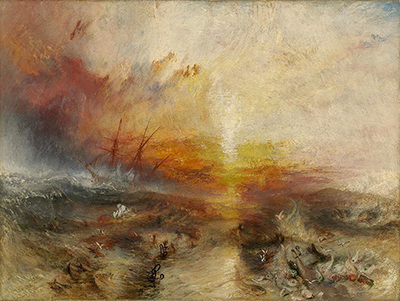
Turner outlived Constable by fourteen years. After 1837 he continued to exhibit historical, Venetian, marine and modern subjects while producing watercolours of Switzerland and other places. Increasing radiance did not detach him from contemporary life. Steam, war, slavery, fishing, travel and ancient narrative remained active concerns. Late style was plural rather than a steady disappearance into light.[16][34]
Their differing lifespans make parallel chronology deceptive. Constable died at sixty; Turner worked into his seventies. What appears to be Turner's further stylistic advance partly reflects additional time and changing historical circumstances. Railways, new pigments, altered exhibition culture and a younger critical generation entered his later career after Constable's had ended.
Yet the final Constables resist an easy conservative role. Salisbury Cathedral from the Meadows places architecture beneath unstable sky and across difficult, heavily worked ground. The mezzotints push familiar motifs through extreme darkness and sudden illumination. His practice was becoming more, not less, concerned with how material handling could carry thought.
The divergence is consequently twofold. Turner widened subject and dissolved boundaries through continued travel, memory and public experiment. Constable compressed feeling into a smaller geography and explored its tonal afterlife through print. Both intensified methods already present. Neither needed to converge with the other for their careers to remain historically linked.
Afterlives and Modern Reunions
Public collections gradually made Turner and Constable national counterparts. The National Gallery holds The Hay Wain and major Turners, while Tate's holdings include the Turner Bequest and an exceptional Constable collection. Museum arrangements, textbooks and exhibitions repeatedly place the two names together, converting a historically uneven relationship into a balanced account of British landscape.[35][36]
Such pairing has benefits. It restores scale and material difference lost in isolated reproduction. Tate reunited the 1831 encounter in 2018, allowing Salisbury Cathedral from the Meadows to stand again with Turner's Caligula's Palace and Bridge and related work. The Royal Academy's 2019 display brought the 1832 pair together, shifting attention from quotation to visual evidence.[20][32]
Tate Britain's Turner & Constable: Rivals & Originals ran from November 2025 to April 2026 and assembled more than 170 works. The exhibition followed their careers in tandem, including early formation, natural studies, Academy ambition and critical afterlives. Its title preserved rivalry while balancing it with originality, acknowledging that direct antagonism is only one part of the relationship.[1][29]
A related focus on sketching from nature further complicated the opposition. Placing working studies together reveals shared urgency, selectivity and responsiveness even when medium and mark differ. Turner does not cease to be imaginative when drawing a precise contour; Constable does not cease to compose when painting rapidly outdoors. The comparison returns both to acts of attention.[30][31]
Modern reunions are interpretations rather than neutral recoveries. Curators choose works, sequence encounters and write themes that the artists never experienced as a whole. Yet these constructions can test inherited myths. Seeing the red buoy beside Constable's crowded Thames does not abolish the anecdote; it makes its exaggerations measurable. Seeing Dort near Constable's studies gives his praise formal substance.
Reunion also changes the audience. Academy spectators in the 1830s brought fresh knowledge of elections, recent reviews, prices and living personalities. Modern viewers approach canonical names whose works have been cleaned, reframed, photographed and repeatedly reproduced. A temporary comparison can recover scale and adjacency, but it cannot reproduce the uncertainty of first reception. Turner and Constable had not yet become inevitable national masters when their canvases first competed.
That gap is useful. It directs attention from fame back to decisions: why Constable enlarged a river crossing, why Turner concentrated warm colour within grey, why both accepted the risk of appearing unfinished. Museums can make reputations look stable. Comparative display is strongest when it restores contingency and allows each work to resist the identity later assigned to its maker.
The deepest reason to consider them together is not to crown one painter. It is to understand how shared problems can produce independent greatness. Turner ranged widely through geography, history, print and atmospheric transformation. Constable made sustained local knowledge monumental and turned weather into structure. They competed for walls, attention and judgement, but each expanded what the other's success meant.
Their relationship contains admiration without intimacy, support without harmony and rivalry without a permanent war. The Academy made them colleagues; criticism made them elements; later museums made them twins. Their own works remain less tidy. Before those works, fire contains water, observation requires imagination, and a small red buoy can sharpen a conversation that began decades before it was painted.
Discussion
How did professional respect, institutional competition and different landscape practices coexist in Turner's relationship with Constable?
Reader Insights
How did unequal starting points and Academy timing shape the comparison between near contemporaries?
Where do their methods of observing, remembering and composing weather meaningfully diverge?
What do the 1831 and 1832 hangs reveal when later anecdotes are kept within their evidential limits?
Join the Conversation
Share a close observation or a source-based question for other readers.
References
- Tate, Amy Concannon, *Turner & Constable: Rivals & Originals*, exhibition record, https://main-tate-3be997.up.railway.app/whats-on/tate-britain/turner-and-constable
- Tate Papers no. 33, David Blayney Brown, “'Fire and Water': Turner and Constable in the Royal Academy, 1831,” 2020, https://dig-305-artwork-alt-text-c8b04f.up.railway.app/research/tate-papers/33/fire-water-turner-constable-royal-academy
- Royal Academy Summer Exhibition Chronicle, David Blayney Brown, “1831: Turner and Constable as 'Fire and Water',” https://chronicle250.com/1831
- Royal Academy Summer Exhibition Chronicle, Jacqueline Riding, “1832: Shot out of the Water?,” https://chronicle250.com/1832
- National Gallery, Judy Egerton, Joseph Mallord William Turner catalogue biography, https://www.nationalgallery.org.uk/paintings/catalogues/egerton-2000/joseph-mallord-william-turner
- Victoria and Albert Museum, “John Constable - an introduction,” https://www.vam.ac.uk/articles/john-constable-an-introduction
- Royal Academy, large-print guide, *Turner, Constable and the Royal Academy*, https://royal-academy-production-asset.s3.amazonaws.com/uploads/556f29b2-1ac9-4c01-8351-fd67716809d4/Collection%20Gallery%20%28Turner%2C%20Constable%20and%20the%20RA%29.pdf
- C. R. Leslie, *Memoirs of the Life of John Constable, R.A.*, 1845 edition, https://upload.wikimedia.org/wikipedia/commons/6/6c/Memoirs_of_the_life_of_John_Constable%2C_R.A_%28IA_memoirsoflifeofj00lesl_0%29.pdf
- National Gallery, John Constable, *The Hay Wain*, NG1207, https://www.nationalgallery.org.uk/paintings/the-hay-wain
- National Gallery catalogue, Judy Egerton, *The Hay Wain*, https://www.nationalgallery.org.uk/paintings/catalogues/egerton-2000/the-hay-wain
- National Gallery of Art, *Constable's Great Landscapes*, https://www.nga.gov/exhibitions/constables-great-landscapes
- National Gallery of Art, *An Eye for Art*, “The Six-Footers,” https://www.nga.gov/sites/default/files/2025-09/an_eye_for_art_opt.pdf
- National Gallery of Art, Constable, *Cloud Study: Stormy Sunset*, 2000.19.1, https://www.nga.gov/artworks/104243-cloud-study-stormy-sunset
- National Gallery of Art, *True to Nature: Open-Air Painting in Europe, 1780-1870*, https://www.nga.gov/exhibitions/true-nature-open-air-painting-europe-1780-1870
- Yale Center for British Art, Turner, *Dort, or Dordrecht: The Dort Packet-Boat from Rotterdam Becalmed*, B1977.14.77, https://britishart.yale.edu/collections/objects/151
- National Gallery, Turner, *Rain, Steam, and Speed - The Great Western Railway*, NG538, https://www.nationalgallery.org.uk/paintings/joseph-mallord-william-turner-rain-steam-and-speed-the-great-western-railway
- Tate, Turner, *Snow Storm: Hannibal and his Army Crossing the Alps*, N00490, https://www.tate.org.uk/art/artworks/turner-snow-storm-hannibal-and-his-army-crossing-the-alps-n00490
- Tate, Turner, *Dido and Aeneas*, N00494, https://www.tate.org.uk/art/artworks/turner-dido-and-aeneas-n00494
- Tate, Turner, *Caligula's Palace and Bridge*, N00512, https://www.tate.org.uk/art/artworks/turner-caligulas-palace-and-bridge-n00512
- Tate Research, Amy Concannon, ed., *Salisbury Cathedral from the Meadows exhibited 1831 by John Constable*, 2017, https://www.tate.org.uk/research/publications/in-focus/salisbury-cathedral-constable
- Tokyo Fuji Art Museum, Turner, *Helvoetsluys; the City of Utrecht, 64, Going to Sea*, https://www.fujibi.or.jp/en/collection/artwork/00428/
- National Trust Collections, Constable, *The Opening of Waterloo Bridge*, NT 515574, https://www.nationaltrustcollections.org.uk/object/515574
- British Museum, David Lucas after Constable, *English Landscape* frontispiece and series history, 1842,1210.61, https://www.britishmuseum.org/collection/object/P_1842-1210-61_1
- British Museum, David Lucas after Constable, *Spring*, 1842,1210.83, https://www.britishmuseum.org/collection/object/P_1842-1210-83_1
- British Museum, David Lucas biographical record, https://www.britishmuseum.org/collection/term/BIOG36357
- National Museums Liverpool, *Liber Studiorum* overview, https://www.liverpoolmuseums.org.uk/artifact/liber-studiorum
- British Museum, Turner, *The Felucca*, 1913,0712.18, https://www.britishmuseum.org/collection/object/P_1913-0712-18
- National Gallery, *Discover Constable and The Hay Wain*, 2024-25 press record, https://www.nationalgallery.org.uk/about-us/press-and-media/press-releases-archive/discover-constable-and-the-hay-wain-2024
- Tate Publishing, Amy Concannon, *Turner and Constable* exhibition book, 2025, https://shop.tate.org.uk/turner-and-constable-hardback-exhibition-book/30341.html
- Tate Publishing, Nicola Moorby, *Turner and Constable: Sketching from Nature*, 2025, https://shop.tate.org.uk/turner-and-constable-sketching-from-nature/14975.html
- Royal Academy, *Turner and Constable: Sketching from Nature*, 2025 exhibition record, https://www.royalacademy.org.uk/exhibition/turner-constable-sketching-from-nature
- Royal Academy, “He has been here and fired a gun,” 2019 display record, https://www.royalacademy.org.uk/exhibition/turner-constable
- Paul Mellon Centre, *The Royal Academy Summer Exhibition: A Chronicle, 1769-2018*, project information, https://www.paul-mellon-centre.ac.uk/archives-and-library/digital-resources/royal-academy-summer-exhibition-chronicle
- Tate Publishing, David Blayney Brown, Amy Concannon and Sam Smiles, *Turner's Modern World*, https://shop.tate.org.uk/turners-modern-world-hardback/24872.html
- National Gallery, Room 41 collection context, https://www.nationalgallery.org.uk/visiting/floorplans/level-2/room-41
- Tate, John Constable artist record, https://www.tate.org.uk/art/artists/john-constable-108