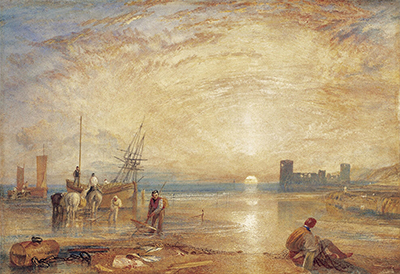
 by Tom Gurney
Tom Gurney BSc (Hons) is an art history expert with over 20 years experience
Published on June 19, 2020 / Updated on August 29, 2026
Email: tomgurney1@gmail.com / Phone: +44 7429 011000
Turner's Book of Landscape Ambition
Liber Studiorum, Latin for "Book of Studies", is one of Turner's most revealing projects. It was a print series through which he argued for the range, seriousness and intellectual reach of landscape. National Museums Liverpool describes the project as intended to consist of 100 prints, with 71 released during Turner's lifetime, issued in fourteen parts from around 1807 until 1819.[1] The series contained no continuous written treatise. Its argument was visual: landscape could be architectural, historical, marine, mountainous, pastoral and more than merely descriptive.
The title deliberately recalls Claude Lorrain's Liber Veritatis, the record of Claude's compositions. Turner was not copying Claude's book. He was answering it. If Claude represented the old authority of ideal landscape, Turner used Liber Studiorum to set out his own modern claim for the genre.
At a Glance
- TitleLatin for Book of Studies
- PublicationIssued from about 1807 to 1819
- Planned scale100 plates
- Issued in Turner's lifetime71 plates in fourteen parts
- Old Master dialogueClaude's Liber Veritatis
- Core techniquesEtching and mezzotint
- Working modelTurner's designs with specialist collaborators
- Landscape modesArchitectural, historical, marine, mountainous and pastoral
- Central claimLandscape can sustain the highest artistic ambition
- Project statusSystematic but unfinished
Contents
- Turner's Book of Landscape Ambition
- Prints as Public Argument
- Categories of Landscape
- Etching, Mezzotint and Collaboration
- Claude, Rivalry and Modern Landscape
- The Unfinished Project
- Landscape Without a Treatise
- Why Liber Studiorum Matters
- The Claude Problem
- Publication as Control
Prints as Public Argument
Turner understood print culture deeply. Engravings after his work circulated his images beyond exhibition rooms and private collections. The Paul Mellon Centre notes the importance of engravings after Turner within the research record of his career.[2] Liber Studiorum belongs to this broader print economy, but it was more controlled and programmatic than ordinary reproduction.
The series let Turner organise landscape into categories and demonstrate versatility. It also made his work available through multiples, allowing collectors to engage with a structured body of images rather than a single painting. The print series became a portable argument for landscape's dignity.
Categories of Landscape
The familiar categories associated with Liber Studiorum include architectural, historical, marine, mountainous and pastoral subjects; Liverpool notes that Turner used initials to identify categories and describes the project as illustrating his argument for landscape's supremacy.[1] The categories were not rigid boxes. They allowed Turner to show that landscape could move across registers: a harbour could be marine and historical; a ruin could be architectural and elegiac; a mountain could be topographical and sublime.
This categorical ambition matters because it reveals Turner as a thinker about his own art. He was not only producing effects. He was mapping a field of practice and showing how landscape could absorb other forms of meaning.
Etching, Mezzotint and Collaboration
Technically, Liber Studiorum joined Turner's design with printmaking collaboration. The British Museum record for The Felucca identifies the work as part of the series and describes the technique as mezzotint and etching, with the image after Turner and associated with Henry Dawe.[3] Many plates involved Turner preparing etched outlines while specialist engravers developed mezzotint tones. The balance between Turner's hand and collaborators' labour varied across the series and must be described with care.
Mezzotint suited Turner's aims because it could produce tonal richness, darkness, glow and atmosphere. It allowed landscape to be organised through light and shadow rather than line alone. In a series concerned with the range of landscape, that tonal flexibility was essential.
Claude, Rivalry and Modern Landscape
The comparison with Claude is central. Claude's Liber Veritatis recorded compositions and helped protect authorship. Turner's Liber Studiorum did something different. It presented a living artist's claim that landscape could occupy multiple poetic and intellectual modes. The title announces rivalry, but the images expand the rivalry into a new system.
This helps explain why Liber Studiorum belongs beside Turner's Royal Academy career and his classical paintings. All three are parts of the same ambition: to make landscape answer the highest expectations of art. The print series did so not by one grand canvas, but by cumulative demonstration.
The Unfinished Project
The projected 100 plates were never completed in Turner's lifetime. Liverpool records that 71 were released, while further related drawings and plates were found after his death.[1] The unfinished state is not incidental. It points to the scale of Turner's ambition and the practical difficulty of sustaining such a demanding publication.
The series also continued to generate impressions, cataloguing and collecting histories after Turner. British Museum records for individual prints preserve later states, donors, references and technical notes.[3] Liber Studiorum therefore has both a Turner-era history and a long afterlife in print scholarship.
Landscape Without a Treatise
One of the most interesting features of Liber Studiorum is that it makes a theoretical claim without extended prose. The viewer learns the argument by comparing images: ruin, sea, mountain, pastoral calm, storm, architecture, figure and light. Turner asks the series to think visually.
This is deeply characteristic of him. He could be verbally obscure, but pictorially exact in ambition. Liber Studiorum lets the prints do the classification, persuasion and rivalry. It is a book of studies, but it is also a book of claims.
Why Liber Studiorum Matters
Liber Studiorum matters because it reveals Turner at the intersection of art theory, print commerce, Old Master rivalry and technical experiment. It shows him organising landscape as a field broad enough to contain history, architecture, sea, mountains and pastoral life. It also shows him using reproduction not as a secondary activity, but as a central instrument of reputation.
For anyone trying to understand Turner beyond a handful of famous oils, Liber Studiorum is essential. It is the place where Turner most clearly says, in visual form, that landscape is not a minor genre. It can be systematic, poetic, historical, atmospheric and intellectually ambitious.
The Claude Problem
The relation to Claude's Liber Veritatis gives Turner's project much of its edge. Claude's book had functioned as a record of compositions and a defence against copying, but it also became a monument to the authority of classical landscape. Turner took that prestige seriously. By naming his own project Liber Studiorum, he placed himself in direct conversation with Claude while changing the purpose of the model.
Turner's book was not a register of paintings already made. It was a publication through which he could demonstrate range. The difference is important. Claude's authority lay partly in the memory of completed compositions. Turner's authority would lie in the active classification and invention of landscape modes. The title announces continuity, but the series performs transformation.
Publication as Control
Print publication allowed Turner to control sequence, category and reputation in a way that ordinary exhibition could not. A painting in an Academy room had to compete with many works around it. A print series could build cumulative meaning from plate to plate. The viewer encountered not one landscape, but an organised field of landscape possibilities.
The planned scale of one hundred plates shows how ambitious the project was. Even the seventy-one issued plates were enough to form a substantial statement. The unfinished state may reflect practical and commercial pressures, but it also leaves the project with a revealing tension: it is both systematic and incomplete, ordered and open-ended.
Categories and Their Flexibility
The categories associated with the series helped Turner argue that landscape had many branches. Marine, mountainous, architectural, historical and pastoral subjects could each claim seriousness. But the categories should not be treated as rigid compartments. One of the series' strengths is that the images often test the edges between them.
A marine subject can carry history; an architectural subject can be atmospheric; a pastoral subject can be elegiac; a mountainous subject can be sublime. Turner used categories to expand landscape, not to imprison it. The initials attached to plates gave viewers a framework while the images themselves demonstrated flexibility.
Tone, Darkness and Mezzotint
Mezzotint was crucial because it allowed a language of tone. Unlike line engraving, mezzotint could create soft gradations, deep darkness and luminous transitions. For Turner, whose art increasingly depended on atmosphere and light, tonal printmaking offered a way to translate painterly effects into reproductive form.
The British Museum's record for The Felucca identifies the combination of etching and mezzotint in an individual plate and preserves the complex authorship around Turner and collaborators.[3] Such records remind us that Liber Studiorum was not simply Turner drawing and printing alone. It was a managed collaboration in which his designs and supervision met specialist print labour.
That collaboration could be tense. Printmakers had to interpret Turner's tonal demands, and Turner was deeply invested in the results. The series therefore belongs to both art and craft, invention and translation.
Landscape as a Complete World
The deepest claim of Liber Studiorum is that landscape can contain the full range of human and natural experience. It can be quiet or violent, architectural or wild, historical or pastoral, local or exotic. Turner did not need landscape to borrow dignity from figures alone. He showed that light, land, water, building and atmosphere could make a complete world.
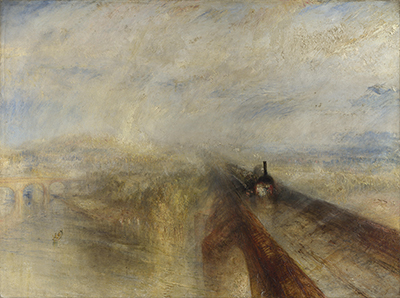
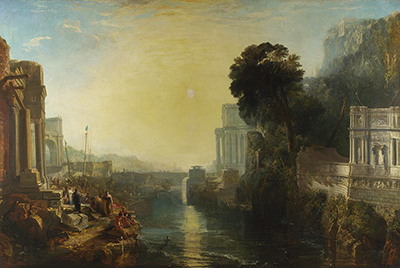
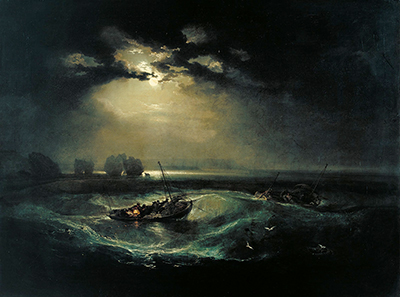
This claim connects Liber Studiorum to Turner's larger career. The same artist who painted Dido Building Carthage, The Shipwreck, Crossing the Brook and Rain, Steam, and Speed also organised landscape through print. The series is a theoretical hinge between works on paper, oils, print commerce and exhibition ambition.
Collecting and Later Study
Because Liber Studiorum is a print series, it has a collecting history different from Turner's unique paintings and drawings. Impressions, states, paper, plate condition and later editions all matter. Museums such as the British Museum preserve individual examples with cataloguing that records technique, references and provenance.[3] This makes the series especially important for print historians as well as Turner specialists.
For viewers, the series offers a slower Turner. It asks for comparison and sequence rather than immediate spectacle. It rewards attention to tonal structure, category, motif and recurrence. In that sense, it is one of the best correctives to the simplified Turner of late colour alone. It shows him as organiser, theorist and print strategist.
A Bridge Between Drawing and Painting
Liber Studiorum also bridges drawing and painting. The plates depend on designs that begin with Turner's command of composition and tonal arrangement, but the final printed result asks those designs to behave like independent works. This is different from a sketchbook note and different from an oil painting. It is a third field in which landscape is translated into reproducible tone.
That translation reveals Turner's priorities. He is interested in masses, light, distance, weather and category. Colour is absent from the prints, but atmosphere is not. Mezzotint allows darkness and glow to do work that colour might do elsewhere. The series therefore shows that Turner's atmospheric intelligence did not depend on colour alone.
Pedagogy Without Classroom Language
The series can also be read as a teaching instrument. It does not lecture in prose, but it shows how landscape may be organised. A collector or young artist moving through the plates would encounter examples of marine, mountainous, pastoral, architectural and historical treatment. The series demonstrates options rather than stating rules.
This silent pedagogy suits Turner. As Professor of Perspective, he held a formal teaching role, but his most compelling teaching may have been visual. Liber Studiorum says: look at how landscape changes when tone, structure and category shift. It teaches by comparison.
Why the Shorter Length Is Honest
Compared with Turner's travels, Italy or the bequest, Liber Studiorum is a narrower subject, and it should not be inflated beyond the available evidence. Its importance is high, but its public treatment can be more concentrated. The essential points are the Claude dialogue, the planned structure, the issued plates, the categories, the collaborative print process and the series' argument for landscape.
That narrower focus does not make it minor. It makes it precise. Liber Studiorum is one of the clearest examples of Turner thinking systematically about his art, and its compactness is part of its strength.
Discussion
How does a print series turn landscape classification into a public argument?
Reader Insights
Where does one image cross the boundaries between landscape modes?
How do etching and mezzotint organise atmosphere without colour?
What changes when the plates are read cumulatively rather than alone?
Join the Conversation
Share a close observation or a source-based question for other readers.
References
- National Museums Liverpool, *The Felucca*, https://www.liverpoolmuseums.org.uk/artifact/felucca
- Paul Mellon Centre, Joseph Mallord William Turner artist guide, https://www.paul-mellon-centre.ac.uk/archives-and-library/artist-subject-guides/joseph-mallord-william-turner
- British Museum, *The Felucca*, Liber Studiorum, museum no. 1913,0712.18, https://www.britishmuseum.org/collection/object/P_1913-0712-18