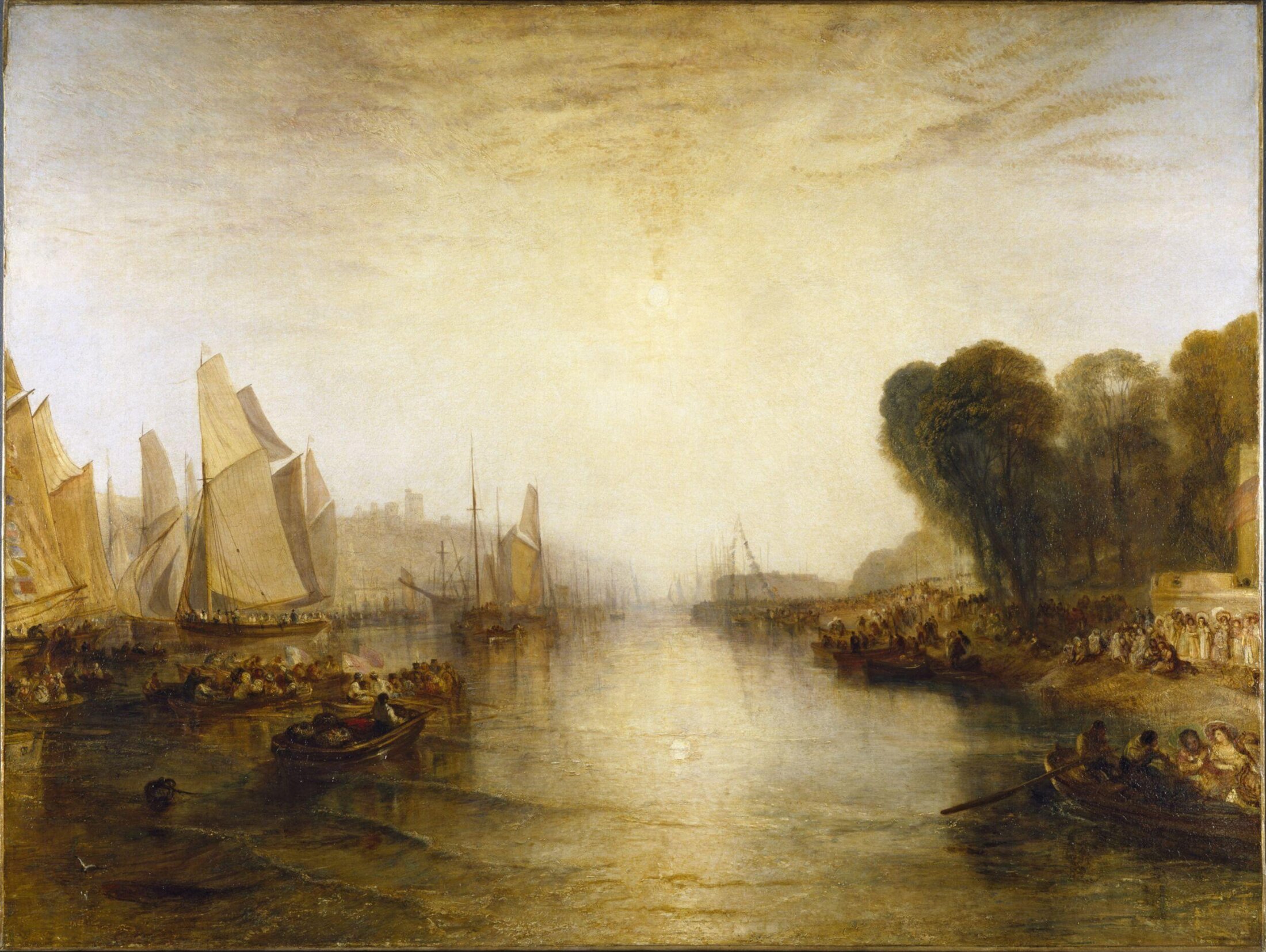
 View the object record
at the V&A
Victoria and Albert Museum. Public-domain object image via Wikimedia Commons.
 by Tom Gurney
Tom Gurney BSc (Hons) is an art history expert with over 20 years experience
Published on June 19, 2020 / Updated on August 29, 2026
Email: tomgurney1@gmail.com / Phone: +44 7429 011000
An Island of Several Turners
J. M. W. Turner's Isle of Wight is not one landscape. It is a moonlit sea beneath the Needles, an inland castle approached through weather, a south-coast garden looking towards the Channel, a naval anchorage at twilight and a field of racing yachts under pressure from wind. Across visits in 1795, 1826 and 1827, the island offered him unusually concentrated contrasts of geography, history and social life.
The first journey belonged to Turner's early career as a travelling draughtsman. At twenty, he recorded named places for patrons and an unrealised engraving project. The later visits came when he was Britain's leading landscape and marine painter. Lady Willoughby Gordon supplied sketches for a painting of her Niton garden, making the 1826 work a documented collaboration between artists. John Nash then welcomed Turner into the large house party at East Cowes Castle in 1827, where the second Royal Yacht Club regatta brought fashionable sport, naval presence, harbour labour and marine observation together.
Those episodes produced works in almost every medium Turner used. Small graphite notations became finished watercolours. An amateur artist's views became an Academy oil. Rapid race drawings led towards large commissioned paintings. Intimate sketches were given to another guest. Oil studies reduced sea and sky to broad fields of colour. Engravers later translated Carisbrooke and Cowes designs for national publication.
The island's compactness matters. A visitor could move from the Medina anchorage in the north to Carisbrooke near Newport, then towards the Undercliff and open southern sea. Yet proximity should not become conflation. Niton's sheltered garden culture was distinct from Cowes yachting. Carisbrooke was inland, not a coastal ruin. East Cowes Castle was Nash's neo-Gothic residence, while Cowes Castle across the river was a Tudor fortification associated with the Yacht Club.
Turner's Isle of Wight art gains depth when those distinctions remain visible. The island was not merely a scenic stop. It became a place where commission, friendship, working observation and experiment overlapped, allowing Turner to move between the most public maritime spectacle and the most reduced study of weather.
The Island between Channel and Solent
The Isle of Wight lies off Hampshire, separated from the mainland by the Solent. Its north coast faces comparatively enclosed and heavily travelled water, while the western Needles and southern cliffs confront the English Channel. The central landscape rises and falls towards valleys, settlements and historic strongholds. This variety supplied Turner with environments that made different demands on drawing.
At the mouth of the River Medina, East and West Cowes face each other across a working harbour. Vessels entering or leaving the Solent could anchor there, and by the 1820s warships, merchant shipping, fishing craft, gigs and private yachts shared the water. Tide, current and wind shaped every movement. The harbour offered a social cross-section even when ownership and leisure were sharply unequal.
South around Niton, the Undercliff created another climate. A long coastal landslip zone sheltered vegetation and encouraged villas and gardens with expansive sea prospects. Terrace, planted ground and distant sail could suggest Mediterranean ease within an English setting. The sea remained present, but viewed from cultivated privacy rather than from a boat or quay.
Carisbrooke Castle occupies higher inland ground near Newport. Its strategic history, gatehouse and layered building fabric offered architecture rather than open marine spectacle. Turner's treatment depended on approach, causeway and changing light rather than surf. Confusing it with a coastal castle removes the specific relation between fortification, town and interior island landscape.
The Needles at the western end formed the most exposed motif. Their chalk stacks marked navigation between Solent and Channel and could become pale or jagged forms beneath moonlight. For Turner, the island could therefore measure the sea from opposite conditions: sheltered harbour, elevated garden, inland history and open-water danger.
Contents
- An Island of Several Turners
- The Island between Channel and Solent
- 1795: A Young Artist Travelling for Work
- Chale Farm and John Landseer's Unfinished Project
- Carisbrooke in the First Sketchbook
- Fishermen at Sea and the Western Horizon
- Carisbrooke from Fortress to Heritage
- Lady Willoughby Gordon as Artist and Patron
- The Orchard at Niton
- 1826: Return, Gosport and the First Cowes Races
1795: A Young Artist Travelling for Work
Turner visited the Isle of Wight in August and September 1795 during a wider southern journey. His sketchbook records Cowes, Carisbrooke, Chale and other subjects. The trip came after several years of architectural study and annual Royal Academy exhibits, but before he had established himself as an oil painter. Travel drawings were a central source of income and reputation.
The book's inner cover includes a list of “Order'd Drawings.” Seven were assigned to John Landseer, an engraver with ambitions for island views. Subjects and sizes were specified, showing that Turner was not gathering impressions without destination. He was fulfilling or soliciting work that could be finished in London.[1][2]
This practical framework shaped observation. A commissioned view required recognisable architecture or terrain, but Turner's records remained economical. Graphite fixed profiles, building relations and potential foregrounds. He could then decide how much weather, incident and colour a patron's finished sheet would support.
The journey also exposed him to marine conditions associated with his first exhibited oil the following year. Cowes harbour, the western coast and the Needles enlarged his existing knowledge of boats and water. Yet it would be too simple to claim every feature in Fishermen at Sea came from one island drawing. Turner's marine imagination combined direct study with earlier art, technical knowledge and studio construction.
The 1795 work is important because it establishes themes that returned three decades later. Carisbrooke was recorded from several distances. Cowes became both castle and anchorage. The island was already connected to publication. When Turner came back in the 1820s, he was not approaching an unknown place but reactivating a professional geography formed in youth.
The journey can also be understood through the physical discipline of a small working book. Turner did not carry the conditions of a studio around the island. He had to decide quickly which outline would secure identity, which angle would make a building intelligible and which note could be deferred until a finished drawing. The result is selective rather than incomplete seeing. A few strokes may preserve the slope beneath a castle more usefully than laborious masonry, because the slope determines how the fortress commands the country.
Such economy was bound to movement. Reaching the island, crossing it and finding lodging consumed time; weather could close a prospect almost as soon as it appeared. The order list offered priorities, but the book also contains evidence gathered beyond a rigid commission. Turner was building a reserve of forms and relations. The reserve mattered when a publisher altered plans, a patron selected another subject or the artist returned to an idea after memory had changed its emphasis.[2][25]
The Isle of Wight therefore entered Turner's career simultaneously as a set of named commissions and as an open store of experience. Those functions are easy to separate in retrospect: one drawing is labelled preparatory, another independent. In practice, the same encounter could serve several futures. A castle profile might satisfy topographical recognition, support an exhibited watercolour and later help an engraver. A harbour notation might remain unused for years yet deepen the credibility of an oil.
The age of the artist makes this adaptability striking. At twenty, Turner already understood that travelling work moved through a chain of decisions. Observation had to survive return to London; a patron's request had to become an image worth exhibiting; colour had to anticipate possible translation into monochrome. The island offered no guarantee that Landseer's venture would succeed. Turner's method ensured that the journey would retain value even when the commercial scheme faltered.
The early visit also warns against reading his island art as a simple chronology of increasing freedom. The 1795 drawings can be exact and compressed, while the 1827 studies can be broad and unresolved. These are choices suited to different purposes, not merely evidence that an older artist had escaped youthful restraint. Turner learned early to keep recognition and invention in productive tension, and the island remained a place where he could vary that balance.
Chale Farm and John Landseer's Unfinished Project
Chale Farm, Isle of Wight is the clearest surviving product of the Landseer commission. Turner made a pencil study inscribed with the farm's name, then developed a signed watercolour close to the “Second size” dimensions listed in the order book. It appeared at the Royal Academy in 1796.[1]
The subject was not an idealised cottage chosen at random. Chale Farm, now called Chale Abbey, incorporated remains of a medieval hall. Architecture, working land and antiquity met within a recognisable property. The commission therefore belonged to the same topographical culture that valued named estates, castles and ruins across Britain.
Landseer intended a reproductive project. Around 1799 he began five unfinished engravings of Isle of Wight subjects, though the selection differed from the original seven ordered drawings. The scheme never became a complete publication. That failure is as informative as later success. Engraved series required sustained capital, coordination, suitable designs and a market; commissioning watercolours did not ensure completion.
For Turner, the order still provided value. Chale Farm became an Academy exhibit and demonstrated that a travel subject could circulate beyond its initial patron. The sketchbook retained material for other works. A failed engraving venture could remain artistically productive.
The episode also reveals how early Turner's career depended on collaborative networks. Landseer identified marketable subjects and planned translation into print. Turner supplied observation and finished design. Engravers would have transformed tone and colour into line. Authorship remained Turner's, but production was never isolated.
Carisbrooke in the First Sketchbook
Turner approached Carisbrooke through a sequence rather than one definitive view. Tate records a distant prospect, a closer landscape-format study and a vertical drawing of the gateway, all dated 1795. Another sheet shows Newport with the castle in the distance. Together they establish relation: fortress seen across country, architectural mass, threshold and nearby town.[2]
The variety mattered when he later developed finished works. A distant castle could act as a historical marker within working landscape. A close gateway could organise human entry. Newport established the castle's place within settlement rather than leaving it alone on a romantic hill.
Historic catalogues once described portions of the early sequence as partly worked in watercolour, while current Tate data identifies graphite. That discrepancy belongs to cataloguing history and should not be transferred to every related object. What remains secure is the architectural information Turner gathered.
Around 1796 he made a watercolour of a sluice and watermill with Carisbrooke far away. The castle no longer monopolises the scene; water management and labour occupy the immediate ground. This arrangement anticipates his lasting ability to connect antiquity with present use.
Turner returned to Carisbrooke material intermittently before and during the 1820s. The finished design eventually made for Picturesque Views in England and Wales drew on this accumulated knowledge rather than recording one encounter. The 1795 gateway studies remained especially important because they secured the physical authority around which later weather and visitors could be invented.
Fishermen at Sea and the Western Horizon
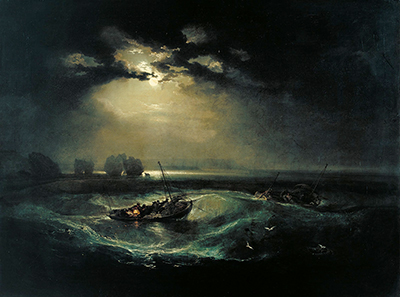
At the Royal Academy in 1796 Turner exhibited Fishermen at Sea, his first oil shown there. Moonlight breaks across waves around small fishing boats, while jagged pale forms in the distance are associated by Tate with the Needles.[3] The picture transformed a regional marine motif into a major declaration of artistic ambition.
Its fishermen belong to work, not sport. A bright lantern suggests practical activity; boats cluster for safety or cooperation; the sea remains threatening despite the moon's illumination. The scene differs fundamentally from the aristocratic yachts Turner later drew at Cowes, even though both depend on wind, water and skilled crews.
The Needles provide geographic plausibility rather than complete explanation. Turner had seen the island in 1795, but no single surviving study determines the oil's composition. He could combine remembered coast with established moonlight traditions and careful studio planning. The painting's authority comes from that synthesis.
Its scale was important. Turner had exhibited watercolours, yet a large marine oil entered a field associated with Dutch masters, British naval art and ambitious public painting. Moonlight allowed him to demonstrate reflected illumination, darkness and the partial visibility of danger. The island's western edge became a test of oil technique and marine imagination.
The motif did not disappear after 1796. Moonlight at Sea (The Needles), made around 1818, returned to western chalk and nocturnal water in watercolour.[4] Even before Turner revisited the island physically, its most exposed landmark remained available as a structure for light, distance and navigation.
Carisbrooke from Fortress to Heritage
The later Carisbrooke watercolour joins three decades of observation. The finished sheet, made around 1828 and now associated with Carisbrooke Castle Museum, shows a rising causeway, mounted visitors, the gatehouse, sunlit stone, dark weather and a rainbow. It was allocated to the museum through the Acceptance in Lieu scheme in 2007.[21][22]
Turner was not illustrating a medieval battle or Charles I's captivity. The visitors are contemporary, and their approach changes the gate from defensive control to historical encounter. Weather makes the architecture dramatic, but the social act is tourism: people enter a monument whose military purpose has declined.
The castle's fabric carries many periods. An early defended settlement preceded Norman development. Isabella de Fortibus shaped the medieval residence and gatehouse. Tudor works responded to invasion fears. Parliament held the castle during the Civil War, and Charles I was imprisoned there in 1647-48.[23] Turner need not narrate each episode for the entrance to possess accumulated weight.
The composition is a synthesis. Early gate drawings supplied architectural knowledge; later island studies refreshed landscape and atmosphere; the sun-rainbow conjunction belongs to pictorial construction. No evidence requires one observed meteorological instant. Turner's accuracy operates through convincing parts assembled into expressive totality.
Charles Westwood engraved the design in 1830 for Picturesque Views in England and Wales. Line made masonry and figures more explicit while translating colour contrast into tonal pattern. The public afterlife connected the inland island monument to a national series, long after Turner's first visit.[24][32]
Lady Willoughby Gordon as Artist and Patron
The 1826 Niton oil's full Academy title states that it was made “from Sketches by a Lady,” acknowledging an unusual origin while withholding a name. MFA Boston identifies the lady as Julia Bennet, Lady Willoughby Gordon, a former pupil of Turner. Other biographical records give her fuller name as Isabella Julia Levina Bennet. She had also learned from Thomas Girtin and David Cox and produced designs for ceramics.[5][6]
Calling her merely an amateur understates the evidence. Social position gave Lady Gordon access to instruction and leisure, but she made visual records capable of supporting a major oil. Turner's title acknowledged dependence while conforming to conventions that protected or obscured elite women's public authorship.
The painting was shown at the Royal Academy in 1826 as no. 297. Turner wrote to John Soane on 8 July that year indicating it already belonged to Lady Gordon.[5] Commission, ownership and source therefore converged. Turner was not appropriating an unknown person's drawing for open sale; he was translating a pupil-patron's view into an exhibited work that returned to her collection.
The relationship complicates the image of Turner as an artist who relied only on his own travel. Translating another person's sketch was familiar within topographical practice. Monro-circle training had involved working from existing outlines, and patrons often supplied subjects. Originality lay in what Turner made from the evidence: scale, colour, atmosphere, arrangement and pictorial coherence.
Lady Gordon's role also links Turner's island work to teaching and sociability. The Niton painting emerged from an artistic relationship extending back years. It reminds us that his professional world included women as pupils, collectors, practitioners and intermediaries even when catalogues made their contributions less visible.
The Orchard at Niton
The Niton painting looks from The Orchard, the Gordons' villa within the Undercliff, towards the Channel. A terrace and designed garden occupy the foreground before the land falls towards the sea. Urns, planting and garden furniture establish cultivated leisure. This is a view from property, not an encounter with open water.[5][7]
The composition invokes Italianate taste. Terraces, sculptural containers and an elevated sea prospect could suggest the Mediterranean landscapes admired by British travellers. Yet the place is specific to the Isle of Wight. The Undercliff's shelter supported vegetation and villa culture, while changing Channel light prevented the garden from becoming a static stage.
Turner's translation likely reorganised Lady Gordon's sketches, though the exact division of invention cannot be reconstructed. The title preserves her observational authority. It does not tell us which tree, urn or cloud came from her hand. Claims about individual contributions should remain modest.
The view belongs to domestic and gendered histories of landscape. Many of Turner's tours emphasise male movement through roads, mountains and ships. Niton begins from a woman's terrace and an inhabited garden. Looking is stationary but not passive; the arrangement of foreground and horizon turns ownership, cultivation and distance into one experience.
The painting remained in the Gordon family through Northcourt and later descendants before sale in 1926. William A. Coolidge eventually acquired it, and his bequest brought it to the MFA in 1993.[5] Its long family history supports the personal importance of a work whose source was Lady Gordon's own looking.
The phrase “from Sketches by a Lady” deserves close attention because it performs several tasks at once. It advertises an unusual origin, acknowledges an artistic debt and preserves the decorum expected of a titled woman. The wording neither names Lady Gordon nor treats her contribution as irrelevant. Academy visitors were invited to know that a woman's drawings lay behind the oil, even if they were not given enough information to identify her. The title thus records participation through the very convention that limits public visibility.
Lady Gordon's training changes how the collaboration should be imagined. A former pupil of Turner who had also studied with Girtin and Cox was not simply forwarding a verbal description. She understood selection, framing and tonal structure. Her sketches could embody decisions about where the terrace ended, how vegetation opened towards the sea and which objects established the character of the garden. Turner's transformation may have been extensive, but it began from another practised act of looking.[5][6]
The work also reverses the usual direction of the picturesque tour. Instead of a male traveller arriving, claiming the best prospect and moving on, a resident woman supplies views formed through familiarity. The Orchard was lived space. Its terrace, planting and furniture belonged to repeated domestic experience, seasonal change and social use. Turner converted that situated knowledge into an oil for exhibition, yet its eventual return to Lady Gordon kept the public work attached to the household from which it arose.
This context sharpens the relationship between foreground and horizon. The distant Channel may promise travel, but the foreground is not an obstruction to be escaped. Cultivation gives the view its structure. Containers, foliage and terrace edges measure recession; they also register the labour and resources required to make a villa landscape. The prospect is pleasurable because nature has been arranged, sheltered and maintained. Turner allows the sea's changing atmosphere to unsettle that order without destroying it.
The commission connects island art with Turner's activity as a teacher. Instruction did not end when a lesson finished. Skills passed to a pupil could return years later as material for the master's work. Lady Gordon's drawings became part of a reciprocal professional relation: Turner had helped train her eye, and her eye supplied a subject he could not have obtained in precisely the same form alone. The painting is therefore collaboration across time as well as across media.
Its ownership history reinforces that reciprocity. Turner informed Soane that the oil belonged to Lady Gordon before the Academy exhibition had run its course.[5] She was not merely the distant inspiration for a picture destined to enrich another collector. The exhibited object publicly enlarged her private prospect and then remained within her family. That movement between garden, sketch, Academy and household is essential to the painting's meaning.
1826: Return, Gosport and the First Cowes Races
The Niton commission coincided with Turner's renewed physical engagement with the island. Drawings in the Gosport and Isle of Wight material indicate attention to the coast and Cowes in 1826. Ian Warrell has argued that Turner spent much of the visit near Niton with Sir James and Lady Gordon.[8]
That summer also saw the first annual cup races organised by the Royal Yacht Club at Cowes. The club had been founded in 1815 and gained royal designation in 1820; it adopted the name Royal Yacht Squadron in 1833.[19] Turner may have witnessed the first season, but the evidence does not justify turning every 1826 sheet into an eyewitness regatta record.
The two centres of interest were socially different. Niton offered private hospitality, garden and southern coast. Cowes presented a crowded anchorage and elite sporting event. The Gosport and Isle of Wight book's movement between mainland naval water and island subjects reflects the broader maritime network rather than one fixed residence.
The painting from Lady Gordon's sketches may have revived Turner's interest strongly enough to encourage return the following year. That causal idea is plausible rather than documented in a statement by the artist. What is clear is that 1826 reopened island questions across medium: commissioned oil, renewed sketching and contemporary yacht culture.
The first regatta also created a subject likely to suit Turner. Racing made wind visible through sail angle, heel and wake. Unlike naval battle, it offered controlled competition without destruction. Unlike harbour calm, it required rapid observation of changing relative positions. In 1827 he would pursue those possibilities intensively.
John Nash's East Cowes Castle
John Nash built East Cowes Castle as his own neo-Gothic residence overlooking the Medina mouth and Solent. Known for Regent Street, the Regent's Park terraces and royal commissions, he created an island retreat suited to hospitality. Turner stayed there with Nash and his wife Mary-Anne in July and August 1827.[8][11]
The house should not be confused with Cowes Castle on the west bank. Nash's building was a modern picturesque residence with towers, passages, planted grounds and broad water views. Cowes Castle had begun as a Tudor defensive work and later became associated with the yacht club. Their visual and historical roles were different even when Turner's drawings brought both into one harbour world.
East Cowes Castle gave Turner multiple vantage points. From terraces and grounds he could look across the Medina. Paths and trees framed the house. Interior passages, rooms and lamps supplied domestic subjects. A boat or anchored warship opened other positions. The residence functioned as observation base, social environment and commission source.
Nash's hospitality also placed Turner inside elite networks shaping the regatta. Guests could watch races, travel by boat, dine and exchange drawings. The painter was a celebrated participant, not an anonymous reporter outside the event. That access influenced what he could see while raising questions about whose spectacle the finished works served.
The castle was demolished in the 1960s. North Lodge, an icehouse and fragments survive, but housing covers much of the ground.[31] Turner's many drawings consequently record a lost building and designed landscape. Their value extends beyond preparation for paintings: they preserve spatial experiences no longer recoverable intact.
A House Party, Not an Isolated Genius
Turner's reputation for secrecy and solitary work can make the East Cowes visit seem anomalous. Two drawings made for fellow guest Harriet Petrie provide direct evidence of sociability. Shipping in Cowes Harbour and The Regatta off East Cowes remained with her descendants until their 2025 sale.[9][10]
The pair contrasts calm and motion. One attends to an anchored man-of-war and reflection; the other compresses the energy of yachts and open water. Turner selected two aspects of the visit as signed gifts, demonstrating an awareness of pairing later developed in Nash's commissioned oils.
Their support is unusually specific. Turner used fragments of Turnbull's Superfine London Board, a reinforced material commonly associated with visiting or playing cards. The choice may reflect resourcefulness within the house party: he used what was available to make finished-looking souvenirs.[9]
Harriet Petrie's ownership restores a named woman to the Cowes story, as Lady Gordon's sketches do at Niton. Neither was simply a passive witness. Petrie's gift drawings preserved evidence through family descent; Gordon's observations initiated a major painting. The island engagement was sustained by social relations as well as solitary looking.
This does not mean Turner became transparent about his methods or motives. He still worked rapidly and protected aspects of his practice. It does show that sociability could generate art. Conversation, hospitality, gift exchange and commission coexisted with intense concentration.
The Royal Yacht Club Regatta of 1827
The 1827 Cowes races were only the second annual season of organised club competition, but they had already become an important aristocratic summer event. Yachting joined wealth, design, seamanship and social display. Royal connection gave the gathering prestige, while the harbour's naval setting linked private sport to national maritime culture.[19][20]
For Turner, a regatta was a moving system rather than one vessel portrait. Boats beat to windward, turned around markers, crossed wakes and altered sail. Spectator craft and anchored ships created obstacles or viewing stations. Shore figures watched positions change too quickly for a single detailed drawing.
Institutional accounts differ slightly in emphasis and count. Sotheby's refers to more than forty rapid race drawings. Newfields describes roughly seventy drawings and eight oil sketches made from shore and aboard a man-of-war.[8][11] The difference need not be forced into one total; both testify to exceptional concentration.
Elite spectacle depended on labour. Owners might receive prizes and social recognition, but crews trimmed sail, handled lines, judged tide and responded to wind. Boatmen transported guests, and harbour workers maintained the surrounding infrastructure. Turner's marks often make individual identity impossible while preserving collective action.
The races also offered a modern marine subject without naval violence. Competition could produce danger, but its aim was speed and skill rather than destruction. Turner could draw upon Dutch marine tradition and his own battle imagery while addressing a distinct culture of recreation and technology.
Watching from Shore and Ship
Turner's changing viewpoint is one reason the Cowes material resists reduction to a single eyewitness panorama. From Nash's grounds, the harbour could be read across trees, architecture and descending land. Near the water, hulls interrupted one another and sails rose beyond spectators. From a boat or larger vessel, the shoreline shifted while the observer moved. Each position disclosed part of the event and concealed another.
Observation afloat was especially demanding. The support moved beneath the hand, boats altered bearing and rigging repeatedly crossed the field of vision. A short graphite line might record inclination rather than contour; a dark accent could fix a hull before it disappeared behind another vessel. What looks summary can therefore be highly specific to force and direction. The drawings preserve the logic of racing even when they do not identify every yacht.[13][29]
Shoreward observation supplied a different order. Spectators could be grouped against parapet or beach, and Cowes Castle gave the gathering an architectural focus. The viewer sees both those watching and what they watch. This double structure turns sport into social theatre. It also lets Turner contrast bodies at relative rest with sails whose angle announces strenuous movement.
Aboard a man-of-war, height and enclosure altered the scene again. Decks, ports and rigging framed glimpses of water; sailors and guests occupied different levels; nearby yachts could pass through narrow openings. Between Decks is valuable in this context because it refuses the unrestricted horizon often expected of marine art. The vessel becomes an interior through which the sea is partially encountered.[30]
These viewpoints carried social meanings. Nash's terrace represented privileged ownership. Club boats and naval decks depended on permission. Shore crowds occupied more mixed ground, although even access to Cowes during the season required travel and expense. Turner moved among these positions as a distinguished guest whose artistic labour granted unusual mobility. His drawings neither erase privilege nor remain fixed within one proprietor's view.
The race itself made time visible. Beating to windward required repeated tacking, so apparent progress could involve alternating directions. A yacht briefly leading from one angle might look enclosed from another. Turner had to remember relation rather than isolated appearance. The accumulated sheets function as a distributed account: no single record is complete, but together they hold recurring masts, sail plans, wakes, markers, shorelines and groups.
That distributed method helps explain why institutional totals vary. One curator may count only rapidly executed race leaves, another a broader Cowes campaign including harbour and oil studies. The difference is not evidence of confusion. It reflects a body of work whose edges are genuinely porous. Turner watched races within a harbour, and the harbour continued before and after the official competition.[8][11][13]
Nor was the regatta visually modern only because yachts were fashionable. It organised a public encounter with applied knowledge. Hull design, sail handling, tide, wind judgement and crew coordination became visible as speed. The cup transformed those skills into elite competition, but the image of modernity rests upon experienced labour. Turner's strongest studies retain both the brilliance of the spectacle and the resistance of the water through which it moved.
Drawing Motion in the Windsor and Cowes Book
The Windsor and Cowes sketchbook contains sixty-eight leaves spanning royal and island subjects. Its Cowes sequence records vessels at anchor and under sail, yachts off the castle, groups watching, harbour activity and the shoreline. Repetition is its method.[13][25]
A race cannot be captured through one stable profile. Turner drew a yacht, then redrew it at another angle or relation to a rival. Masts and hulls may be abbreviated to directional lines. Wake, heel and sail area carry more information about force than ornamental detail. The book works almost as a sequence of changing states.
Some drawings were probably made from shore; others suggest observation aboard a vessel. Between Decks, an oil sketch of 1827, gives a compressed shipboard space opening towards water and rigging.[30] The view reminds us that Turner's body sometimes occupied the marine structures he represented.
The book also contains spectators. Groups around Cowes Castle or the front establish how racing became public performance. Their presence distinguishes a regatta from an isolated encounter at sea. Looking, like sailing, is organised socially.
No leaf should be assigned automatically to one race or exact hour. The sequence may span several days and conditions. Its value lies in accumulated observation from which Turner could later construct coherent paintings. The finished works are not snapshots; they are syntheses of relative movement.
Oil Sketches: Testing Water, Wind and Colour
Turner made an extraordinary group of small oil studies around the 1827 visit. Tate works N01993-N02000 relate to the two regatta compositions, though each explores different arrangements of sails, sky, water and shore. Their handling is broader than the finished paintings and often leaves forms provisional.[13][28]
Oil allowed rapid changes in opacity, drag and colour relation. A sail could be placed as a light wedge, then adjusted. A dark hull could anchor broad water. Cloud and sea could be tested before detailed rigging entered. Such studies convert observation into pictorial problem-solving.
They should not all be labelled outdoor paintings without evidence. Turner may have worked on some directly before the motif, developed others under shelter or altered them later. Small scale and immediacy do not prove a complete plein-air process. What the group establishes is experimentation close to the campaign.
The studies also complicate the distinction between preparation and independent art. Some clarify elements found in the Academy oils; others are compelling because they remain unresolved. Their visible decisions reveal Turner's search more directly than polished finish.
Cowes gave that search a technical urgency. Race movement required speed, but the harbour also invited prolonged attention to reflection and light. Turner could test both extremes within one visit, from converging yachts to nearly empty sea.
The use of oil did more than add colour to information first secured in graphite. Paint could enact the very instability Turner was studying. A loaded brush dragged across a rougher passage leaves broken light; a thin wash lets an earlier tone remain active; an opaque touch can place a sail abruptly against cloud. These are material equivalents for interrupted reflection, shifting haze and the momentary visibility of canvas under wind.[28]
Scale encouraged comparison. On a small support, Turner could alter the balance between a bright sail and a dark mass without committing to the labour of a large exhibition picture. Several variants could test whether the shore should anchor the scene, whether a buoy could control depth or whether open water needed a crossing boat. The group records not one answer but a series of pictorial hypotheses.
This experimental character does not make the sketches careless. Their economy depends on trained understanding of vessels. Turner knew how mast, hull, sail and wake relate, so he could omit much without losing coherence. Where a form dissolves, the dissolution often serves glare, distance or motion. Broad handling and marine knowledge work together rather than oppose one another.
The studies also mediate between the social event and the large commission. A patron might expect recognisable racing and a relation to East Cowes Castle; Turner needed an image that remained powerful beyond identification. Small oils allowed him to test how much incident atmosphere could absorb. The finished canvases retain crowds and yachts, but their weather and water prevent them from becoming inventories of a summer gathering.
Seen beside the gift drawings for Harriet Petrie, the oil group shows how medium altered the memory of the visit. A small signed drawing could serve as a personal token, concise enough to carry away. An oil study remained closer to private investigation. A large canvas entered Academy competition and the patron's collection. Cowes generated all three because Turner could move from sociability to experiment and public statement without treating them as separate worlds.
Study of Sea and Sky, Isle of Wight
Tate's Study of Sea and Sky, Isle of Wight is among the most reduced works associated with 1827. It is an oil on canvas, not a watercolour, measuring 32.1 by 50.2 centimetres.[16] Sea occupies a low band beneath a much larger atmosphere, with incident subordinated to colour and horizon.
The institutional title connects it to the island, but not to an exact point or race. It should not be forced into a direct preparation for one yacht painting. The study asks a broader question: how little description is needed for sea, weather and distance to become convincing?
Its importance within the regional group lies in contrast. Nearby sketchbook leaves contain named architecture, masts, crowds and hulls. Here, the island's maritime environment is almost stripped of social event. Turner moved from abundance to reduction without abandoning observation.
That reduction can look prophetic of later abstraction, but historical terms matter. Horizon, weather and tonal recession remain legible. Turner was not rejecting nature; he was concentrating on relations that detailed narrative could obscure. The painting belongs to marine study and colour experiment rather than a twentieth-century programme.
The Isle of Wight campaign therefore contributed not only subjects but permissions. A regatta justified repeated looking at sea under rapidly changing conditions. From that work could emerge an image in which the event recedes and atmosphere becomes nearly sufficient in itself.
Nash's Two Regatta Commissions
Nash commissioned two large oils that Turner exhibited at the Royal Academy in 1828. The picture commonly shortened to Beating to Windward is now at Newfields. Its companion, Starting for Their Moorings, is in the Victoria and Albert Museum. Their full contemporary titles identify East Cowes Castle as Nash's seat.[11][12]
The pair divides the experience. Beating to Windward gives greater emphasis to racing yachts, open water and the pressure of wind. Its companion brings harbour congestion, quayside life and heavily laden boats into relation with the event. Nash's house and social world remain part of the titles, joining patron, property and spectacle.
Turner constructed each from many studies. A small drawing for Harriet Petrie anticipates aspects of the racing composition in reverse, while oil sketches test buoys, sails and light. No one study contains the finished answer. Composition emerged through selection and recombination.
Newfields notes Turner's dialogue with seventeenth-century Dutch seascapes.[11] Those traditions supplied complex fleets, low horizons and atmospheric order. Turner applied them to a contemporary sporting event, using freer handling and unstable movement to exceed simple homage.
The paintings also expose the politics of commission. Nash paid to commemorate a fashionable event visible from his estate. Turner delivered more than a property portrait, but the works still celebrate access available to wealth. Their crowded labour and powerful water prevent complete ease, while their Academy scale converts private hospitality into public prestige.
The long titles deserve emphasis. “East Cowes Castle, the Seat of J. Nash, Esq.” establishes ownership before identifying the stage of the regatta. Nash's residence and the race are grammatically joined. Yet Turner's compositions do not simply place a house at the centre and arrange obedient boats around it. The castle can recede within weather, foliage or distance while waterborne action claims attention. The patron's name frames an image whose forces exceed proprietorial control.
Pairing allowed Turner to represent different temporal phases. Beating to windward concerns effort during competition: sails strain, courses diverge and progress must be won against air and water. Starting for moorings shifts towards departure, return or reorganisation, where racing overlaps with harbour traffic and spectators. The two canvases refuse a single climactic instant. Together they suggest an event made from preparation, contest and dispersal.[11][12]
Their Academy exhibition in 1828 carried a private Cowes summer into metropolitan public culture. Viewers did not need to have attended the regatta to recognise a marine spectacle, but those acquainted with Nash or the club could read social particulars. Turner served both constituencies. Specific title and contemporary dress anchored the occasion, while the scale and compositional ambition invited comparison with established marine painting.
Dutch precedent offered more than a prestigious style. Seventeenth-century fleet scenes had developed ways to coordinate numerous vessels, changing weather and low horizons without losing hierarchy. Turner drew on those solutions while substituting the unsettled energy of a sporting fleet. The historical dialogue let a new leisure culture claim the seriousness of an older maritime tradition, even as Turner's handling made the modern scene less orderly than polite commemoration might demand.[11]
The two works are therefore neither neutral records nor simple celebrations. They depended on Nash's hospitality and money, and they enhanced his cultural standing. At the same time, their water, wind and compressed human activity insist that ownership cannot command nature. Turner's response to patronage was expansive: he satisfied the commemorative premise while making the regatta a larger argument about coordinated effort under unstable conditions.
West Cowes: Repose after Racing
Around the same campaign Turner developed the finished watercolour West Cowes, Isle of Wight for Picturesque Views in England and Wales. It looks from the Medina mouth towards West Cowes under late twilight. Naval and civilian vessels lie at anchor while a gig crosses the foreground. The scene is not a regatta.[8]
That distinction matters because it reveals Turner's range. The race drawings make water legible through speed and collision of direction. West Cowes organises stillness through horizontal reflection, pale residual light and latent force. Anchored ships do not become inert; rigging, oars and broad swell imply readiness.
John Ruskin later described the watercolour through the phrase “power in repose.” He observed that widely separated reflection marks suggested a large underlying swell beneath a polished surface.[27] His account records sustained nineteenth-century looking rather than Turner's own explanation.
Robert William Wallis engraved the design in 1830. The plate retained moon, remaining sunset, warships, town and officer's boat while translating colour into line.[17][18] Reproduction made Cowes part of a wider national topography and encouraged viewers to recognise naval calm alongside fashionable racing.
The private watercolour should remain separate from MFA Houston's View of a Seaport: East Cowes, Isle of Wight, an 1828 drawing in ink, wash and white chalk on blue paper.[15] Shared geography does not make identical object or purpose.
Cowes as Harbour, Resort and Working Water
By the 1820s Cowes was becoming famous for yachting, but its harbour life exceeded the club. Naval vessels anchored in the Solent, merchant craft moved through, ferries and gigs crossed local water, and fishing continued. Shore businesses served hulls, sails, crews, passengers and visitors.
Turner's drawings register this mixture through scale and type. A man-of-war might dominate vertically while a rowing boat supplies immediate movement. Yachts share water with workboats. Crowds gather for sport beside people whose livelihoods depend on the harbour irrespective of the race. The 1827 watercolour now called Shipping similarly layers large vessels, smaller craft and active water without reducing the harbour to one event.[14]
The distinction between East and West Cowes added spatial complexity. Looking west from the Medina mouth did not mean standing within West Cowes. Nash's East Cowes estate provided elevated and shoreward prospects across the channel, while boats opened lower views. Turner repeatedly altered position.
Military and recreational cultures also overlapped. The Royal Yacht Club's prestige depended partly on naval association, and many members possessed service connections. Yacht design borrowed and tested maritime expertise. The sport presented seamanship as elite competition while relying on professional crews.
A regional interpretation should therefore resist turning Cowes into a festival poster. Turner found colour, movement and sociability there, but he also found hierarchy and work. The beauty of sail under wind emerged from disciplined human effort within one of Britain's most active maritime corridors.
Interior and Exterior at East Cowes Castle
Turner did not confine his attention to the water. The East Cowes group includes studies of Nash's towers, plantation roads, vaulted passages, courts, rooms, trees and lamps. Finberg's historical inventory records pen, ink and white chalk on blue paper across many of these sheets.[26]
Interior studies once associated with Petworth have more recently been connected cautiously with East Cowes Castle. Music Party and another great-house interior suggest sociable rooms dissolved by light. Identification remains interpretive where architecture is not exact, so the regional argument should avoid certainty unsupported by catalogue evidence.
The possibility is nonetheless important. At Cowes, Turner moved between exterior spectacle and domestic gathering. Guests who watched races also occupied music rooms, terraces and passages. Light entering a drawing room could become as unstable as glare over water.
Nash's neo-Gothic architecture encouraged theatrical transitions. A vaulted way framed distant tower; plantation opened towards harbour; a lamp punctured darkness. The house was designed as a sequence of picturesque experiences rather than a neutral box beside the sea.
Its demolition gives the drawings documentary value, but they are not measured architectural surveys. Turner selected and distorted in pursuit of effect. Together with estate plans and other artists' views, they help reconstruct how a lost residence mediated between private life and the Solent.
Publication: From Landseer to Heath and Wallis
Turner's island work entered print culture twice under very different conditions. John Landseer's 1790s commission began with ordered drawings but did not achieve a finished island series. Three decades later, Charles Heath's Picturesque Views in England and Wales successfully published both Carisbrooke and Cowes designs.[24][32]
The contrast measures Turner's changing position. In 1795 he was a young supplier working for an engraver's prospective venture. By the late 1820s, his finished watercolours were central assets in a prestigious national undertaking involving leading reproductive specialists. His name helped sell the project.
Westwood's Carisbrooke plate strengthened architectural edges, mounted visitors and rainbow through monochrome line. Wallis's Cowes plate had to convey twilight, moon and water without hue. Each engraver interpreted rather than mechanically copied.
Publication also linked island differences. A buyer could encounter inland castle and naval anchorage within the same national sequence. Place became portable, collected in parts and viewed far from weather or tide. The island's geography was reorganised through the logic of a book.
Turner remained attentive to proofs and reproductive quality. The engravings could never preserve every colour relation, but they expanded audience dramatically. A project first imagined in youth reached fruition through another publisher and another generation of technical collaboration.
The time separating drawing and publication altered what the island meant. Landseer's proposed series belonged to Turner's first independent decade, when named local views could establish reliability. England and Wales belonged to a mature career in which collectors expected exceptional finished watercolours and engravers competed to reproduce their effects. Carisbrooke and Cowes entered the later undertaking with the authority of Turner's reputation already attached.
Reproductive difficulty was part of that authority. A rainbow crossing dark rain, moonlight fading into afterglow and broken reflections on swell resist linear translation. Westwood and Wallis had to invent systems of hatch, stipple and reserved light that produced tonal equivalents rather than copies of pigment. Their plates are interpretations governed by printing, paper and the need for repeatable impressions.[17][18][32]
That translation could clarify objects while changing atmosphere. Rigging that remains submerged in a watercolour may become firmer in engraving. Architecture can gain sharper contours; soft colour intervals become contrasts of ink density. Readers encountered a Turner designed partly through another hand. The result was collaborative without making the engraver an invisible machine.
The national series also changed scale conceptually. Chale, Carisbrooke and Cowes were localities with distinct histories, but publication placed selected island subjects among views from across England and Wales. The sequence encouraged comparison between castles, ports, towns and rural landscapes. The Isle of Wight became one component of a broader visual account of the nation, accessible to people who might never cross the Solent.
Turner's long island engagement can consequently be measured by two unrealised and realised economies. In the 1790s, an engraver's order prompted valuable work but failed to achieve its intended set. Around 1830, publisher, artist and specialist engravers sustained a complex enterprise that circulated island designs widely. The difference reflects Turner's status, but also the developed market and technical network supporting his art.
Publication did not end the life of the unique watercolours. They remained prized objects whose colour, scale and surfaces differed from the plates. Print created another audience rather than replacing the collector's experience. Turner's Isle of Wight was therefore doubled: singular sheets passed through private hands while reproducible versions entered albums and libraries. That double existence helped make a regional encounter part of durable public memory.
Island Sociability and Artistic Exchange
The Isle of Wight repeatedly connected Turner with other makers. John Landseer commissioned and planned engravings. Lady Gordon supplied sketches and had received instruction from Turner, Girtin and Cox. John Nash offered architecture, hospitality and commissions. Harriet Petrie received drawings. Wallis and Westwood translated watercolours into prints.
This network does not weaken Turner's authorship. It explains the conditions through which subjects became available and moved between private and public forms. The solitary act of drawing was embedded in correspondence, teaching, travel, conversation, collecting and payment.
Women hold especially important positions. Lady Gordon's title remained anonymous in 1826, but modern records restore her name and practice. Petrie's family preserved works that document the house party. Mary-Anne Nash's role in hospitality is less visible in object catalogues but formed part of the social environment.
The island's status as a place of retreat encouraged exchange. Villas and estates gathered guests; regatta season concentrated visitors; boats made viewing collective. Turner could participate socially while maintaining the intense observational habits evident in dozens of drawings.
The result is a more accurate portrait of artistic production. Turner was capable of privacy, suspicion and abruptness, but he was not creatively self-sufficient. Isle of Wight works arose through relationships that influenced subject, format, ownership and survival.
The surviving objects show different kinds of exchange. Payment underwrote commissioned watercolours and oils. Teaching created knowledge that could circulate back to Turner. Hospitality supplied time, access and a community of viewers. A gift drawing converted rapid observation into personal remembrance. Engraving carried one artist's colour design through another maker's labour. These exchanges cannot be reduced to patron and employee.
They also affected preservation. Lady Gordon's descendants retained the Niton oil because it represented family, home and her artistic participation. Harriet Petrie's descendants kept two drawings attached to the story of a house party. Museum acquisitions later separated works geographically while cataloguing helped recover the relationships among them.[5][9][10] Provenance here is not an appendix to interpretation; it explains why particular evidence survived.
Mary-Anne Nash belongs in this account even though the major paintings bear her husband's name. A large country-house gathering depended on hosting, domestic organisation and social introductions, work conventionally obscured by the title of an estate. Turner's access to guests, rooms and excursions arose within that managed environment. To recognise it is not to invent a commission by her, but to distinguish hospitality from the single act of payment.
The island gatherings also crossed artistic forms. Nash's architecture structured views; Turner's drawings interpreted it. Yacht design and professional seamanship produced the motion he recorded. Lady Gordon's garden and sketches organised the Niton prospect. Each finished image sits at the end of several kinds of making, some celebrated as art and others classified as craft, labour or domestic management.
Turner retained decisive control over composition, but control is different from isolation. He chose what to combine, omit and intensify because relationships had given him particular material. The Isle of Wight is especially revealing on this point: its best-known works cannot be adequately explained without the engraver who ordered, the woman artist who supplied views, the architect who hosted, the guest who preserved gifts and the crews who made racing visible.
Three Visits, Three Forms of Patronage
The 1795, 1826 and 1827 visits correspond to different professional structures. Landseer's order treated Turner as a talented young topographer whose drawings might feed an engraving venture. Lady Gordon's commission treated him as established master, former teacher and interpreter of her own observations. Nash's hospitality led to major oils commemorating a fashionable event and property.
Each patronage form shaped medium. Chale Farm became a modest watercolour suitable for reproduction and Academy display. Niton became an oil whose terrace view could hang in a family collection. Cowes generated monumental marine paintings, intimate gifts, rapid notebooks and independent studies.
The differences also reveal Turner's agency. He did not give every patron the same formula. He adjusted scale and emphasis to the relationship while pursuing his own concerns with weather and light. Commission could generate experiment rather than suppress it.
Failure and success coexist. Landseer's series remained unfinished, but its drawings entered Turner's career. Nash's oils gained public exhibition, yet one later travelled through collections far from the house. Lady Gordon's painting remained within her descendants for a century. Patronage shaped afterlife unpredictably.
Across all three visits, the island functioned as professional opportunity grounded in actual relationships. Turner was never simply a tourist collecting private impressions. His looking carried anticipated audiences from the beginning.
The Isle of Wight as a Laboratory of Contrasts
Calling the island a laboratory is a modern interpretation, not Turner's phrase. It is useful because concentrated differences allowed him to test related pictorial questions under changing conditions. What makes water visible: moon, wake, reflection or a low horizon? What makes history present: fortress, visitor or weather? What makes distance desirable: open sea or a framed garden prospect?
The answers coexist rather than replace one another. A detailed yacht drawing and a nearly empty sea-sky oil belong to the same summer. A crowded harbour picture and a quiet anchorage form complementary possibilities. Inland Carisbrooke and coastal Cowes enter the same print project without becoming equivalent.
Social contrast is equally strong. Fishermen work under moonlight; yacht owners compete for cups; crews manage both kinds of vessel. Lady Gordon looks from private land; harbour labourers occupy public water. Nash's house party enjoys privileged access while Turner's publications distribute images more widely.
Material variety follows. Graphite records speed. Watercolour builds atmospheric topography. Oil can be a small experiment or a large Academy statement. Engraving converts unique colour into reproducible line. The island work is unusually effective for studying how Turner chose among these forms.
The strongest regional account keeps the tensions open. It does not turn every image into progress towards abstraction, every patron into constraint or every boat into a national symbol. Turner responded to particular subjects while discovering relations that exceeded them.
Why the Island Matters in Turner's Career
The Isle of Wight appears at two decisive moments. In 1795 it helped a young watercolourist prepare his first exhibited marine oil and fulfil early commissions. In 1826-27 it gave a mature artist fresh material for collaboration, public spectacle and formal experiment. Few regions connect those stages so clearly.
Its art also revises familiar categories. Marine painting includes work and leisure, warship and yacht, motion and repose. Landscape includes designed garden and lost modern house as well as cliff or castle. Topography can arise from another artist's sketch. Social life can produce rigorous observation rather than distract from it.
The island's later material history adds another layer. East Cowes Castle has gone. Carisbrooke was restored and became a museum. Cowes racing grew into an international tradition. Private watercolours entered American collections. Family gift drawings surfaced after nearly two centuries. The places and objects did not share one fate.
Turner's achievement was to preserve particular moments without making them closed records. A regatta remains recognisably modern to 1827 yet becomes a study of wind and organised movement. Niton belongs to Lady Gordon's home yet explores how cultivation frames distance. A sea-sky canvas emerges from Cowes observation yet nearly escapes narrative.
Across three visits, Turner found an island capable of holding the breadth of his practice. Its coasts, castle, gardens, harbour and houses gave him more than views. They gave him structures through which patronage, friendship, labour, history and atmosphere could become visible together.
Discussion
How did the Isle of Wight let Turner connect moonlit labour, inland history, garden culture, sociability and regatta spectacle?
Reader Insights
What changes when Niton, Carisbrooke and Cowes are kept as distinct island environments?
How do Lady Gordon, John Nash and Harriet Petrie complicate the myth of an isolated artist?
How does Turner move between fishermen, harbour labour, naval presence and elite yacht racing?
Join the Conversation
Share a close observation or a source-based question for other readers.
References
- Christie's, *Chale Farm, Isle of Wight*, https://www.christies.com/en/lot/lot-298993
- Tate collection open data, *Isle of Wight* sketchbook and D00431-D00433, D00452, D00667, https://github.com/tategallery/collection
- Tate, *Fishermen at Sea*, T01585, https://www.tate.org.uk/art/artworks/turner-fishermen-at-sea-t01585
- Tate, *Moonlight at Sea (The Needles)*, D08176, https://www.tate.org.uk/art/artworks/turner-moonlight-at-sea-the-needles-d08176
- Museum of Fine Arts Boston, *View from the Terrace of a Villa at Niton, Isle of Wight, from Sketches by a Lady*, 1993.46, https://mfaboston6.emuseum.com/objects/35491/view-from-the-terrace-of-a-villa-at-niton-isle-of-wight-from-sketches-by-a-lady
- Hampshire Field Club, “A Royal Upstairs Downstairs on the Isle of Wight,” https://www.hantsfieldclub.org.uk/publications/hampshirestudies/digital/2010s/Vol_69/9.Powney%26Mitchell.pdf
- Isle of Wight Gardens Trust, Niton and East Cowes Castle research, https://iowgardenstrust.co.uk/Autumn%202017%20book%20copy%20for%20website.pdf
- Sotheby's, *West Cowes, Isle of Wight*, 4 July 2018, lot 201, https://www.sothebys.com/en/auctions/ecatalogue/2018/old-master-british-works-on-paper-l18040/lot.201.html
- Christie's, *Shipping in Cowes Harbour*, 2025, https://www.christies.com/lot/lot-6562584
- Christie's, *The Regatta off East Cowes*, 2025, https://www.christies.com/en/lot/lot-6562585
- Newfields, *East Cowes Castle, the Regatta Beating to Windward*, 71.32, https://collections.discovernewfields.org/artwork/54889/
- Victoria and Albert Museum, *East Cowes Castle, the Regatta Starting for Their Moorings*, https://collections.vam.ac.uk/item/O8272/east-cowes-castle-oil-painting-turner-joseph-mallord/
- Tate open data, *Windsor and Cowes* sketchbook D20593-D20730 and oil sketches N01993-N02001, https://github.com/tategallery/collection
- National Gallery of Ireland, *Shipping*, 1827, https://onlinecollection.nationalgallery.ie/objects/12065/shipping
- Museum of Fine Arts Houston, *View of a Seaport: East Cowes, Isle of Wight*, 2002.455, https://emuseum.mfah.org/objects/56571/view-of-a-seaport-east-cowes-isle-of-wight
- Tate, *Study of Sea and Sky, Isle of Wight*, N02001, https://www.tate.org.uk/art/artworks/turner-study-of-sea-and-sky-isle-of-wight-n02001
- British Museum, Wallis after Turner, *Cowes, Isle of Wight*, 1850,0112.17, https://www.britishmuseum.org/collection/object/P_1850-0112-17
- Tate, Wallis after Turner, *Cowes, Isle of Wight*, T04556, https://www.tate.org.uk/art/artworks/turner-cowes-isle-of-wight-engraved-by-robert-wallis-t04556
- Royal Museums Greenwich, *Making Waves: A History of the Royal Yacht Squadron 1815-2015*, https://www.rmg.co.uk/collections/library/rmgl-154173
- Royal Museums Greenwich, Cowes and 1826 yacht records, https://www.rmg.co.uk/collections/objects/rmgc-object-150832
- Arts Council England, Acceptance in Lieu report 2007-08, Carisbrooke watercolour, https://www.artscouncil.org.uk/sites/default/files/download-file/Cultural_Gifts_Scheme_and_Acceptance_in_Lieu_report_200708.pdf
- Carisbrooke Castle Museum, *Highlights*, https://www.carisbrookecastlemuseum.org.uk/wp-content/uploads/Highlights.pdf
- English Heritage, “History of Carisbrooke Castle,” https://www.english-heritage.org.uk/visit/places/carisbrooke-castle/history/
- British Museum, *Picturesque Views in England and Wales* series record, https://www.britishmuseum.org/collection/object/P_1850-0112-15
- A. J. Finberg, *A Complete Inventory of the Drawings of the Turner Bequest*, vol. 1, https://upload.wikimedia.org/wikipedia/commons/b/bf/A_complete_inventory_of_the_drawings_of_the_Turner_bequest_-_with_which_are_included_the_twenty-three_drawings_bequeathed_by_Mr._Henry_Vaughan_%28IA_completeinventor01nati_0%29.pdf
- A. J. Finberg, *A Complete Inventory of the Drawings of the Turner Bequest*, vol. 2, https://upload.wikimedia.org/wikipedia/commons/e/ed/A_complete_inventory_of_the_drawings_of_the_Turner_bequest_-_with_which_are_included_the_twenty-three_drawings_bequeathed_by_Mr._Henry_Vaughan_%28IA_completeinventor02nati_0%29.pdf
- John Ruskin, *Modern Painters*, discussion of *Cowes, Isle of Wight*, historical edition, https://www.lancaster.ac.uk/fass/ruskin/empi/notes/gsturnerz01.htm
- Joyce H. Townsend and Ian Warrell, *How Turner Painted*, Tate, https://www.tate.org.uk/research/publications/how-turner-painted
- Ian Warrell, *Turner's Sketchbooks*, Tate Publishing, https://books.google.com/books/about/Turner_s_Sketchbooks.html?id=7dYnngEACAAJ
- Tate, *Between Decks*, N01996, https://www.tate.org.uk/art/artworks/turner-between-decks-n01996
- Isle of Wight Gardens Trust, “Repton on the Isle of Wight,” East Cowes Castle survival and landscape, https://iowgardenstrust.co.uk/V2%20Repton%20on%20the%20IoW%20final%20for%20website.pdf
- Rawlinson, *The Engraved Work of J. M. W. Turner*, historical catalogue, https://upload.wikimedia.org/wikipedia/commons/4/40/The_engraved_work_of_J._M._W._Turner%2C_R.A._%28IA_gri_33125001464789%29.pdf