 by Tom Gurney
Tom Gurney BSc (Hons) is an art history expert with over 20 years experience
Published on June 19, 2020 / Updated on August 29, 2026
Email: tomgurney1@gmail.com / Phone: +44 7429 011000
Overview
J. M. W. Turner's technique is often described through dramatic language: light, storm, speed, fire, mist and dissolving form. Those words are useful only if they are tied to the practical things Turner actually used. His art was made from paper, canvas, prepared grounds, pigments, brushes, washes, scraping, layering, oil paint, watercolour, sketchbook marks, studio revision and the physical behaviour of materials over time. Technique was not a romantic mystery outside history. It was the daily labour through which Turner converted looking into pictures.
Joyce H. Townsend's How Turner Painted: Materials & Techniques is the central modern guide to this subject. Thames & Hudson describes it as a detailed examination of Turner's painting techniques, including modified paint media, innovative watercolour methods, composition process, colour reproductions and X-ray photography. [1] That framing matters because it treats technique as evidence. It asks how works were made, how materials were handled and what technical study can show that ordinary looking may miss.
Turner worked across media. The National Gallery's summary places watercolour, oil and engraving within the same career, with Royal Academy watercolour exhibits beginning in 1790 and oil exhibits following in 1796. [2] This range is essential. A watercolour, an oil painting, a sketchbook leaf, a print design and an unfinished studio canvas do not behave in the same way. They can share subjects and habits of seeing, but their materials create different possibilities.
Technical discussion also needs conservation awareness. A Turner work today is not simply the object as it appeared when it left his hands. Paper can fade, discolour or cockle. Pigments can alter. Varnish can yellow. Canvas can be lined, cleaned or stretched. Paint surfaces can crack, sink, blanch or abrade. Some changes are part of ordinary ageing; others relate to treatment history, environment or display. Conservation does not remove the romance of Turner. It makes the romance more truthful by showing what survives, what has changed and what cannot be safely inferred.
The safest way to read Turner's technique is therefore comparative. Look at oils beside watercolours, finished works beside studies, public exhibition pictures beside sketchbook notations, and visible surfaces beside technical evidence. Turner was experimental, but experiment does not mean chaos. His strongest effects depend on choices about support, sequence, absorption, opacity, transparency, touch, drying and revision. Those choices made his art look free.
At a Glance
- MediaOil, watercolour, drawing, sketchbooks and print designs
- Technical backboneHow Turner Painted by Joyce H. Townsend [1]
- WatercolourTransparent wash, bodycolour, reserved light and scratching-out
- Oil paintGrounds, glazes, opacity, texture and revision
- SupportsPaper, canvas and prepared surfaces
- ColourTraditional pigments alongside newer nineteenth-century colours
- EvidenceVisible surfaces, technical imaging and conservation study
- ConditionAgeing, environment and treatment can affect present appearance
- Key cautionDo not treat late abstraction as a technical fact
- Looking methodSeparate observation, inference and object-specific evidence
Contents
- Overview
- Materials Before Myth
- Watercolour as a Working Intelligence
- Oil Paint and Exhibition Effects
- Sketchbooks, Drawing and First Marks
- Colour, Pigments and Experiment
- Supports, Grounds and Surfaces
- Conservation and the Present Appearance of Turner
- Examples Without Overreading
- How to Look Technically at Turner
Materials Before Myth
Turner became famous for visual effects that seem almost immaterial, but every effect begins with material conditions. A luminous sky depends on a surface that can hold or reflect light. A storm depends on the density and movement of pigment. A distant building may depend on the thinness of a wash or the dragging of a loaded brush. A blazing sun may be paint, reserved paper, exposed ground, opaque highlight or a cleaned opening within surrounding tone.
This is why technical vocabulary helps. A support is the physical base: paper, canvas, panel or another material. A ground is a preparatory layer that affects colour, absorbency and texture. A wash is diluted colour spread broadly, usually associated with watercolour but conceptually useful when thinking about thinly handled paint. Bodycolour is opaque water-based paint used to cover or heighten. Glazing is a transparent or semi-transparent layer over dry paint. Impasto is thicker paint that catches light physically. Scratching-out removes or disturbs colour to recover a light or create a mark.
These terms should not become a checklist imposed on every work. They are tools for asking better questions. Does a light area come from untouched paper, added white, removed colour or thin paint over a pale base? Does a dark passage look built in layers or placed in a single loaded stroke? Does a surface describe form through line, tone, colour temperature or texture? Turner used all of these possibilities at different moments.
Technical evidence also prevents a common exaggeration: the idea that Turner achieved late freedom by simply abandoning discipline. His freer surfaces depend on training. Early topographical drawing, watercolour practice, Royal Academy exhibition, print culture and long travel habits gave him the means to simplify without losing structure. A late colour field can look spontaneous because Turner understood what little had to remain visible for the image to work.
Materials can also set limits. Some pigments are more stable than others. Some papers respond differently to wetting, scraping and abrasion. Some oil paint mixtures dry unevenly or age in ways that change surface relationships. A technical account should not turn these facts into moral judgement. It should not claim that Turner disregarded permanence unless evidence supports the claim. It should say something more careful: his effects sometimes depended on materials and methods whose later condition requires close conservation study.
This evidence-led approach has a history of its own. Townsend's earlier Turner's Painting Techniques helped establish a technical literature around the artist before the later, broader synthesis in How Turner Painted. [7] Reading the two titles together is useful because it shows that technical understanding is cumulative. Conservation science, catalogue work, imaging and close visual study refine one another over time. Turner technique is not a fixed set of anecdotes; it is a field of evidence that can be corrected and expanded.
It also matters because Turner is unusually vulnerable to myth. Stories about speed, secrecy and drama can be seductive, but they often blur the distinction between observed fact and later admiration. A better account begins from the object. What kind of support is present? What sequence of marks can be seen? What does technical study suggest? Which claims are secure, which are probable and which are only attractive guesses? This discipline makes Turner more interesting because it shows how complex the making actually was.
Watercolour as a Working Intelligence
Watercolour was central to Turner from the beginning. The Wallace Collection's Townsend account explains that in Turner's youth watercolour had a lower status than oil, being associated with developing ideas, travel records or military planning, and that Turner helped raise its artistic ambition. [3] This background matters because Turner's watercolour technique was not a secondary version of oil painting. It had its own speed, transparency, paper logic and market.
Watercolour rewards control of timing. A wet sheet lets colour spread softly. A drier sheet catches harder edges. A transparent wash can use the brightness of the paper beneath it. Opaque colour can sit on top. Turner could move among these effects, sometimes using a pale preparation, sometimes reserving light, sometimes applying stronger notes late in the process. The drama of a finished watercolour often comes from such small decisions.
The Wallace account gives practical examples of traditional and experimental methods: making use of paper colour for lights, working on light grey or blue paper, using opaque colour, removing paint to reveal paper, and creating lights through clean water, sponge or sharp tools. [3] These details help readers see Turner as a maker rather than as a vague magician of atmosphere. A highlight might be achieved by what is not painted, what is removed or what is added.
Scratching-out deserves special attention because it shows the physical nature of watercolour. A fine line of light in foam, rigging, stone or foliage may not be drawn with white pigment. It may be produced by disturbing the surface. That act changes the relation between image and support. The paper is not passive; it becomes part of the mark. The same is true when Turner lets coloured paper contribute to the image rather than covering it fully.
Watercolour also suited travel and memory. A sheet could record a place rapidly, preserve a weather effect or develop a more finished design. Tate's works-on-paper publication describes the world's largest collection of Turner's sketchbooks, drawings and watercolours as giving unique insight into his mind and creative process. [4] That collection shows how watercolour belongs to the whole career, from early topographical discipline to later colour experiments.
The medium should still be separated from sketchbook notation. A pencil sketch, a lightly tinted notebook leaf, an unfinished colour study and a finished watercolour are related but not identical. Each carries a different level of intention and finish. Turner could use a small sheet to test colour, a larger one to create a marketable view, and a notebook to store a quick observation. Technical reading begins by identifying which kind of object is in front of us.
Watercolour also changes the viewer's sense of time. Because the medium can be fast, it can make a work feel immediate. Yet speed does not remove planning. A broad wash may need the surface to be at just the right dampness. A reserved light has to be protected before surrounding colour is laid. A scraped highlight requires both pressure and judgement. Turner could make these decisions quickly because he had practised them for years. The freshness of the result depends on stored skill.
The medium also connects private practice and public ambition. A travel note might be made for later use; a finished watercolour might be intended for sale, exhibition, a patron or reproduction. The same technical vocabulary can appear in both contexts, but the level of finish differs. In a working note, a colour patch may be enough. In a finished watercolour, the relation between passage, detail and whole design becomes more deliberate. Turner was able to move between these levels without treating watercolour as merely preparatory.
Oil Paint and Exhibition Effects
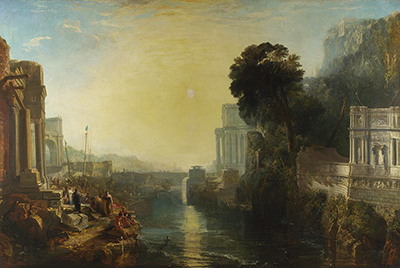
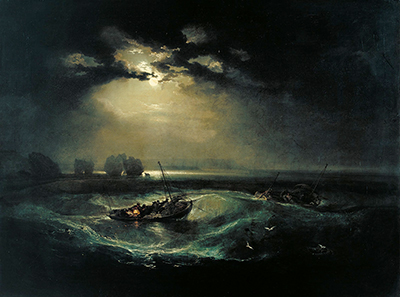
Turner's oil technique developed under different pressures. Oil painting offered scale, density, revision and public exhibition authority. It allowed Turner to build surfaces through layers, alter compositions, intensify contrasts and compete with the old masters in a medium associated with high ambition. His first exhibited oils belong to a Royal Academy culture in which pictures had to hold their own among many works and many viewers.
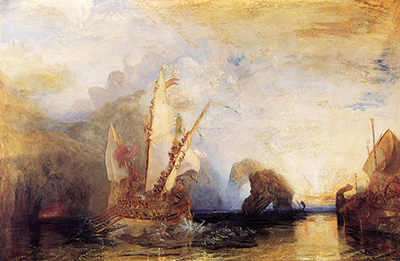
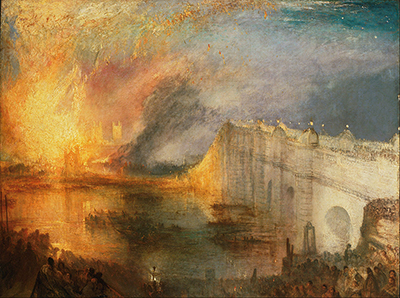
Oil also gave Turner a different kind of light. In watercolour, light often comes through or from the paper. In oil, light may come from a pale ground, from opaque paint, from transparent glazes, from scumbled layers or from the physical catching of light on paint ridges. A sunset, mist or flame in oil can therefore be both optical and material. It looks like light because paint has been arranged to behave that way.
The National Gallery's phrase "painter of light" is familiar, but it becomes more useful when tied to process. [2] Turner did not paint light as a single substance. He made light through contrasts of warm and cool, thick and thin, transparent and opaque, sharp and blurred, reserved and overpainted. A bright centre works because surrounding tones are managed. A misty passage works because edges are softened or broken. A burst of colour works because neighbouring paint prepares the eye for it.
Technical study can also reveal revision. Townsend's book is described as using X-ray photography, which is important because technical imaging can show hidden structures, changes of mind or buried paint that ordinary viewing cannot see. [1] This does not mean every Turner oil contains dramatic secrets. It means the visible surface is only one level of evidence. Underlayers, drawing, altered forms and later treatments may all affect interpretation.
Turner's oil surfaces vary widely. Early marine and landscape works often show strong compositional organisation and inherited pictorial discipline. Later works may use looser handling, reduced forms and more open atmospheric fields. The difference should not be simplified into early control versus late freedom. Even a late work depends on decisions about where structure remains, where form dissolves and how colour carries space. The freer the surface appears, the more important those remaining anchors become.
Oil technique also raises conservation questions. Thick paint, thinly bound passages, glazes, varnish, surface dirt, cracking and cleaning history can all affect how a Turner painting is seen. A dark area may have sunk or become more opaque. A light passage may have been altered by varnish or abrasion. A technical account should never assume that a reproduction tells the whole story. Scale, surface and condition matter.
The physical scale of oils also matters. A large Royal Academy picture was not handled like a small colour study. It had to carry across a room, survive comparison with other ambitious works and hold a complex composition together at a distance. Turner could use broad tonal masses for public impact and smaller incidents for close looking. Technique therefore includes viewing conditions. Paint handling that seems loose nearby may resolve into atmosphere or movement from farther away.
Turner also used oil paint to negotiate between inherited landscape structure and modern visual instability. Classical or marine compositions often require strong architecture: horizon, recession, vessel, harbour, cloud mass or framing light. Yet Turner could destabilise those structures through smoke, rain, glare or wave movement. The technical achievement lies in balancing legibility and dissolution. If everything dissolves, the image loses its subject. If everything remains fixed, the weather has no force.
Sketchbooks, Drawing and First Marks
Drawing sits beneath much of Turner's technique, even when the final work looks dominated by colour. Sketchbooks allowed him to collect structures: a river bend, a roofline, a harbour edge, a mountain profile, a bridge, a boat, a sequence of clouds. These marks could be quick, but they were not casual in their function. They gave later work something to remember.
Tate's Turner works-on-paper project gives the scale of the material: about 37,500 accessioned sketchbooks, drawings and watercolours entered national ownership through the Turner Bequest in 1856. [5] That scale matters for technique because it shows how much of Turner's practice happened before or beside finished exhibition works. Technique includes preparation, notation and comparison, not just final handling.
A sketchbook mark can be technical evidence, but it must be read carefully. A line may record a contour rather than a finished composition. A rapid wash may note weather rather than establish a display work. A written colour note may preserve information that the drawing does not show visually. A blank area may be an unfinished gap, a reserved light or simply unused space. Context matters.
The physical form of the notebook matters too. Size, binding, paper type and sequence influence what could be drawn. A small book used while travelling encourages compression. A larger sheet invites a different kind of study. A bound sequence may show movement through a place, while a loose sheet may have a different working history. Technique is inseparable from such practical constraints.
Drawing also remained important when Turner painted directly. To paint without detailed line is not the same as lacking structure. Turner often understood the architecture of a scene well enough to suggest it through tone and colour. A few marks can carry perspective if the artist knows what must be kept. This economy is one of Turner's great technical achievements.
First marks can also show how Turner placed information. A sketch may preserve the angle of a bridge but ignore surrounding detail. Another may keep the profile of hills but leave architecture vague. A colour note may record evening warmth while giving little topographical description. These decisions are technical because they determine what later work can use. Selection begins at the moment of notation.
This is why sketchbooks should not be treated only as personal records. They are working instruments. Their value lies partly in repetition: the same kind of problem appears again and again, each time under different circumstances. Rivers, coastlines, towers, clouds and boats recur because they are useful visual problems. Turner was not collecting scenery passively. He was collecting structures, conditions and effects that could be recombined.
Colour, Pigments and Experiment
Turner's colour has often attracted the strongest praise and the weakest explanation. Colour in his work is not only brightness. It is structure, temperature, distance, weather, symbolism, timing and surface. A blue can push a mountain back. A yellow can make mist glow. A red can intensify danger or focus attention. A grey can hold air. A white can be foam, cloud, paper, glare, smoke or exposed ground depending on the object.
The Wallace account notes Turner's use of newly invented coloured pigments in watercolours and later references newly invented artists' colours that he often used in later life. [3] This supports a careful claim: Turner was alert to the expanding material possibilities of his time. It does not prove that every strong colour in his art was new, nor that novelty alone explains his effects. Pigment choice works with method, support and composition.
Colour also behaves differently in watercolour and oil. In transparent watercolour, the paper can provide luminosity through the paint. In opaque passages, colour can cover, heighten or correct. In oil, colour may sit in thick strokes, thin films or layered glazes. A Turner effect may depend on the contrast between these behaviours. Technical looking asks not only what colour is present, but how it has been made to act.
Colour can also change. Some pigments fade; some darken; some become less distinct as surrounding materials alter. This is where conservation language matters. The colour relationships seen today may not perfectly match their first state. That does not make the works unknowable. It means responsible interpretation keeps condition in mind, especially when discussing delicate works on paper or complex late oils.
Turner's colour experiments should not be described as "late abstraction" as if that were a technical fact. Some late works reduce description and give colour extraordinary independence, but they remain historical objects made within nineteenth-century practice. They may look forward to later art, but their technique belongs to Turner, his materials, his training and his time.
Colour also helps explain why Turner can look different across collections and media. An oil painting with varnish, a delicate watercolour under controlled light and a sketchbook study reproduced digitally may all seem to belong to different artists if technique is ignored. The differences are often material rather than stylistic alone. Support, medium, scale and condition change how colour reaches the viewer.
A technical account should therefore avoid ordering Turner's media too simply. Oil is not automatically more complete than watercolour, and a sketch is not automatically less intelligent than a finished work. Each medium asks what kind of colour action is possible. Watercolour can make white paper become light. Oil can make dense pigment become atmosphere. Drawing can make a few strokes become distance. Turner used these different powers rather than forcing all media to behave alike.
Supports, Grounds and Surfaces
A support is never neutral. Paper absorbs, resists, stains, wrinkles, cockles, tears, fades and reflects. Canvas flexes, receives ground, responds to stretching and holds paint texture. The surface Turner chose helped determine the kind of image he could make. A watercolour on blue paper starts from a different optical condition than one on white paper. An oil on a prepared canvas starts from a different working problem than a pencil sketch in a notebook.
Grounds and preparations are especially important in oil painting. A pale ground can make thin paint glow. A darker preparation can give shadows weight. A smooth surface can support delicate transitions, while a more textured one catches brushwork. Turner could exploit these differences to create air, distance and light. The finished image may seem atmospheric, but that atmosphere is partly the result of how paint meets surface.
Paper colour plays a related role in watercolour. The Wallace account explains that Turner could use off-white, buff, light grey or blue papers, and that the colour of the paper itself could contribute to lights or other details. [3] This is a technical point with interpretive consequences. What looks like added colour may sometimes be the support doing visual work. What looks like empty space may be active brightness.
Surface also affects reproduction. Photographs flatten texture, scale and sheen. A screen image may exaggerate colour or hide subtle abrasion. A printed reproduction may compress tonal differences. This is especially important for Turner because small changes of edge, translucency and surface can carry meaning. Conservation-aware looking treats reproductions as useful access tools, not substitutes for the object.
Supports also connect to handling and survival. Works on paper are vulnerable to light, humidity and mounting history. Oils may carry restoration histories that affect varnish, surface gloss or structural support. A technical article should not turn these concerns into alarm. It should help readers understand why museums control display conditions and why some Turner works may be shown selectively.
The support also affects how viewers should describe finish. A barely worked sheet may be complete for its purpose if its purpose was to hold a colour relation or travel memory. A heavily worked oil may still be unfinished if Turner left the larger pictorial statement unresolved. Finish is not simply the amount of labour visible on the surface. It depends on function, format and intended status. Conservation and catalogue study help keep those distinctions clear.
This is also why dimensions matter. Scale changes technique. A small oil study can be carried by a few decisive relations of tone and edge, while a large exhibition canvas has to sustain attention across a broader field. A sketchbook leaf, a cabinet watercolour and a major oil do not ask paint or paper to solve the same problem. Turner moved among these formats with unusual freedom, and technical looking should keep that freedom visible.
Conservation and the Present Appearance of Turner
Conservation is not only repair. It is study, documentation, preventive care and ethical decision-making. For Turner, conservation has special importance because his art often depends on delicate relationships: thin wash against reserved paper, pale tone against subtle ground, loose paint against exposed preparation, or a fragile colour balance across a large atmospheric field. Small changes can matter.
A conservation view asks what can be known from the object itself. Is the support original? Has the work been trimmed, mounted, lined, cleaned or varnished? Are there losses, retouching, fading or surface changes? Does technical imaging show a change beneath the surface? Does the material evidence support or challenge a traditional story about the work? These questions do not replace art history. They strengthen it.
The Tate works-on-paper publication and project context are important because the Turner Bequest is not just a famous collection; it is a technical archive of process. Tate's project overview frames the work as a full re-examination and updating of A. J. Finberg's Turner Bequest inventory. [6] Revision matters because technical, material and catalogue evidence can refine how individual objects are understood.
Conservation also guards against overconfident language. A viewer may be tempted to say that Turner deliberately made a painting look unfinished, that he intended a colour to fade, or that he abandoned permanence for effect. Sometimes scholarship can support a precise claim about method or intention. Often it cannot. The better formulation is evidence-limited: this surface suggests rapid handling; this material has changed; this work may be unfinished; this passage shows revision; this colour relationship may be affected by condition.
The present appearance of Turner is therefore a collaboration between original making, ageing, care and interpretation. Museums do not simply reveal Turner; they preserve and study the conditions through which Turner can still be seen. That is why technical scholarship matters for the general viewer. It explains why two works by the same artist may look dramatically different, why some works on paper are sensitive to light, and why conservation conclusions are usually careful rather than theatrical.
Conservation also changes how we talk about uncertainty. It is acceptable for a responsible account to say that a work may have altered, that a passage appears to have been revised, or that an effect depends on a material feature visible today. It is less responsible to turn every uncertainty into a dramatic story. Turner does not need that treatment. His technique is already rich enough when described plainly.
This plainness is especially important for damaged or changed works. Condition is not a flaw in art history; it is part of the evidence. A faded watercolour can still show handling, composition and intention, but its colour should be discussed with awareness. An oil with a changed surface can still carry Turner's design, but its present appearance may require conservation context. Technical looking accepts that works have lives after the studio.
Examples Without Overreading
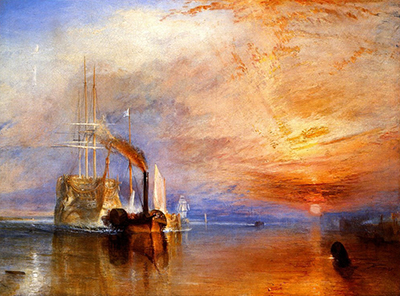
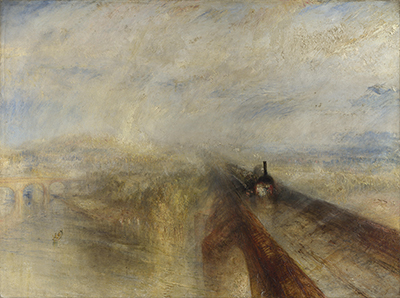
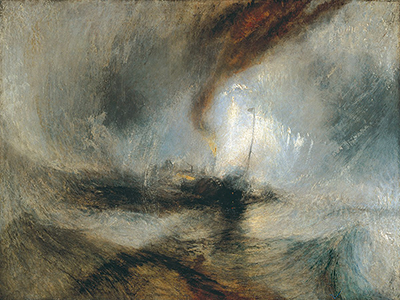
Famous works help explain technique, but they should not be reduced to technical demonstrations. The Fighting Temeraire can introduce the relation between oil paint, sunset colour, marine subject and symbolic contrast, but its full meaning belongs to its own historical setting. Rain, Steam, and Speed can introduce modern technology, rain, smoke and speed, but it should not be treated only as a paint-handling exercise. Snow Storm - Steam-Boat off a Harbour's Mouth can introduce circular movement and atmospheric uncertainty, but its technical effects should not be turned into unsupported anecdote.
The same caution applies to Norham Castle, Sunrise. It is tempting to use such a work as proof that Turner became abstract. A more careful technical reading says that the image reduces architecture and landscape into a luminous field while retaining enough structure for recognition. That is a stronger account because it describes what the painting does without forcing it into a later category.
Watercolour examples need similar care. A Swiss colour study, a Venice sheet, a topographical view and a sketchbook wash may all show Turner's control of paper and pigment, but they may have different purposes. Some are finished works; some are studies; some are notes; some are connected to print or travel. Their technique cannot be judged from appearance alone.
Venice is especially useful because it brings together architecture, reflection, water, atmosphere and memory. Turner could make buildings seem both solid and unstable, using light to dissolve edges without losing the identity of place. The technical means may include thin colour, reserved brightness, soft transitions, opaque accents and compositional compression. But each Venice work must be read on its own evidence.
The best use of examples is therefore modest. They can show how Turner's materials work, but they should not carry more than they can prove. A single object cannot stand for the whole career. A reproduction cannot prove every technical detail. A famous title should not silence the material evidence of the particular work.
The same rule applies to biography. Turner's secrecy about working, his intense labour and his public reputation can help explain why technique became surrounded by legend, but they do not replace material evidence. A story about temperament cannot prove how a passage was painted. A technical feature may support a claim about speed or revision, but it should be allowed to speak as evidence first.
How to Look Technically at Turner
Begin with the medium. Is the work oil, watercolour, pencil, ink, bodycolour, a print-related design or a mixed working object? The answer changes what kinds of marks are likely and what kinds of condition issues may matter. A watercolour light may depend on paper; an oil light may depend on ground, paint body or varnish; a sketchbook mark may be a record rather than a finished effect.
Next, look for sequence. Where might the first broad tones be? Where are later accents? Are hard edges placed over soft ones? Are lights reserved, added or recovered? Does the image seem built from drawing outward, or from tone and colour inward? These questions can be asked without pretending to be a conservator.
Then ask what the support is doing. Is the paper colour visible? Does canvas texture catch light? Does the surface seem smooth, rough, abraded or layered? Does the image rely on thinness or density? Turner often makes support and image work together. A technical viewer notices that relationship.
After that, separate observation from inference. It is fair to say that a passage looks thinly washed, heavily worked, scratched, opaque, transparent or revised if the evidence is visible. It is less safe to leap from appearance to intention. Turner may have wanted an effect; ageing may have altered it; later care may have changed the surface. Technical looking stays alert to those differences.
Finally, keep the whole career in view. Turner's technique was not one trick. It was a long, changing repertoire shaped by training, travel, exhibition, print culture, watercolour practice, oil painting, patrons, materials and later conservation. His achievement lies not in escaping materials, but in making materials seem like weather, memory, speed and light.
This way of looking also improves ordinary viewing. Instead of asking only whether a Turner work is beautiful, dramatic or modern, ask how the effect is made. Where does light come from? Which parts are firm, and which are open? What does the support contribute? How much does colour carry, and how much does line carry? What might have changed over time? These questions do not reduce the work to craft. They make the poetry of the image more precise.
Frequently Asked Questions
Turner used oil paint, watercolour, pencil, paper, canvas, sketchbooks and materials connected with print and design work. The exact materials vary by object. Technical sources such as Townsend's How Turner Painted and Tate's works-on-paper research are essential because Turner's methods changed across media and across his career. [1][4]
They show his command of transparent wash, paper colour, opaque colour, reserved lights, scratching-out, wet and dry handling, and rapid observation. The Wallace Collection's Townsend account explains how Turner used both traditional and experimental watercolour methods. [3]
Turner used traditional materials and also took advantage of newer colours available in his lifetime. The safest claim is that he was alert to expanding material possibilities, especially in watercolour, rather than that novelty alone explains his effects. [3]
Conservation can provide strong material evidence through close examination, technical imaging and treatment history, but it does not solve every question. It can reveal supports, layers, changes and condition issues; interpretation still needs caution.
Some late works reduce detail and give colour and light extraordinary independence, but "abstract" is a later category and should not be treated as a technical fact. A better approach is to describe how the object handles form, colour, support, atmosphere and recognition.
Discussion
Which material choice most changes the way you see a Turner work?
Reader Insights
How does the support or medium contribute to light and atmosphere?
What can be observed directly, and what remains an inference?
How might ageing or conservation affect the work's present appearance?
Join the Conversation
Share a close observation or a question for other readers.
References
- Thames & Hudson, Joyce H. Townsend with Tony Smibert, *How Turner Painted*. https://www.thamesandhudsonusa.com/books/how-turner-painted-softcover
- National Gallery, London, "Joseph Mallord William Turner 1775-1851." https://www.nationalgallery.org.uk/artists/joseph-mallord-william-turner
- Wallace Collection, Joyce Townsend, "Turner's Watercolour Materials and Techniques." https://www.wallacecollection.org/explore/explore-in-depth/turner/turners-watercolors/turners-watercolour-materials-and-techniques/
- Tate, "J.M.W. Turner: Sketchbooks, Drawings and Watercolours." https://www.tate.org.uk/art/research-publications/jmw-turner
- Tate, "J.M.W. Turner: Sketchbooks, Drawings, Watercolours," project record. https://www.tate.org.uk/about-us/projects/jmw-turner-sketchbooks-drawings-watercolours
- Tate, "Project Overview," *J.M.W. Turner: Sketchbooks, Drawings and Watercolours*. https://www.tate.org.uk/art/research-publications/jmw-turner/project-overview-r1109225
- Joyce H. Townsend, *Turner's Painting Techniques*. London: Tate Gallery, 1993.