 by Tom Gurney
Tom Gurney BSc (Hons) is an art history expert with over 20 years experience
Published on June 19, 2020 / Updated on August 29, 2026
Email: tomgurney1@gmail.com / Phone: +44 7429 011000
Introduction
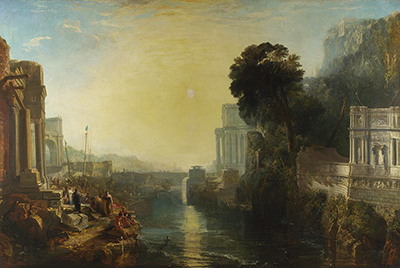
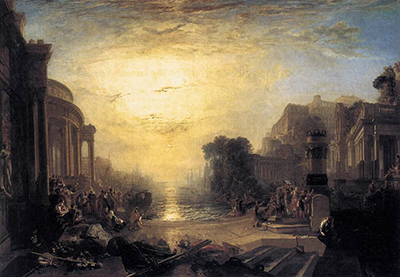
J. M. W. Turner's The Decline of the Carthaginian Empire presents catastrophe before the city has fallen. Carthage still rises in terraces of columns, porticoes and towers. Boats cross its harbour, crowds fill the quays, and a low sun turns water and stone to gold. Yet the people gathered in the foreground are not celebrating the city's splendour. They are giving Rome the weapons with which they might defend themselves and the children whose detention will guarantee their obedience. The painting's beauty is inseparable from this act of surrender.
Turner exhibited the enormous oil at the Royal Academy in 1817. It measures 170.2 by 238.8 centimetres and is now Tate N00499, having entered the national collection through the Turner Bequest in 1856.[1][2][3] Its scale belongs to public history painting, but Turner makes landscape, architecture and light carry much of the drama. The principal historical actors are not enlarged at the centre. They are distributed among families, discarded objects, ships and ceremonial buildings, while the sun becomes the most commanding presence.
The precise moment matters. This is not the Roman sack of Carthage in 146 BCE. Turner looks back to the opening crisis of the Third Punic War in 149 BCE, when Rome demanded hostages and arms from a rival desperate to avoid renewed conflict. Only after Carthage complied did the Roman commanders reveal a further demand: the inhabitants must abandon the coastal city and settle inland. Carthage then resisted, and the ensuing siege ended three years later in destruction.[5]
Turner's own Royal Academy description makes the coercion explicit. Rome, he wrote, selected terms that would either drive Carthage into war or destroy it through compliance. The anxious Carthaginians yielded even their children and weapons.[4] This is decline as a failure of political hope. The city remains materially magnificent, but its power to determine its future is being removed object by object and person by person.
Above the scene, the western sky supplies a second history. Pale gold around the descending sun is overtaken by a blood-red and brown storm band. In Turner's accompanying verse, deceptive hope leads leaders and mothers to surrender what they value, while the setting sun spreads a gathering signal of disaster.[4] Light does not soften the event. It gives imperial splendour the radiance of something already passing away.
At a Glance
- ArtistJoseph Mallord William Turner
- TitleThe Decline of the Carthaginian Empire
- ExhibitedRoyal Academy, 1817
- Catalogue number195
- MediumOil paint on canvas
- Dimensions170.2 × 238.8 cm
- CollectionTate
- AccessionN00499
- ProvenanceTurner Bequest, accepted 1856
- Principal companionDido building Carthage, National Gallery NG498
Turner was forty-two when he showed The Decline of the Carthaginian Empire. By then he was a Royal Academician and the Academy's Professor of Perspective. He had long demonstrated that landscape could rival the intellectual ambition of history painting, and this work joins those claims on an exceptionally large scale. Its architecture requires disciplined recession; its historical subject invokes the fate of nations; its harbour opens the city to commerce and invasion; and its changing sky turns time into a visible force.
The main waterway begins near the lower centre and narrows towards a bright horizon. This central opening divides two different architectural worlds. At the left, a dark monumental facade advances close to the spectator, followed by a pale circular colonnade nearer the water. At the right, stairs, balconies, trees, porticoes and layered civic buildings climb the slope. The asymmetry prevents the city from feeling like a balanced stage set. One side presses forward as shadow, while the other recedes through increasingly complex light.
The sun hangs just left of the central axis, low enough for its reflection to spread across the channel. It is neither the clear disc of a calm evening nor an incidental source of illumination. Red-brown vapour stretches horizontally above it, cutting across the upper sky like an atmospheric bar. Cooler blue survives towards the upper right, but the broad warm band appears to be gathering rather than dispersing.
Human action is concentrated along the lower edge and both quays. Women, men and children form small clusters rather than one legible procession. Some kneel, embrace or gesture; others carry or lay down objects. On the right, figures gather near broad steps and a tall dark monument or ceremonial structure. On the left, family groups occupy the edge of a shadowed architectural mass. Farther away, people become minute signs of harbour activity.
Across the foreground lies a disturbed inventory of civic and private life. Long staffs or shafts, weapons, textiles, shields and instrument-like forms overlap with flowers, foliage and other offerings. Tate records preparatory studies for a leaf, lily, tambourine, flute and staff associated with the painting.[17] These records confirm Turner's close attention to small relinquished things, although the finished forms should not all be given certain names.
The contrast of scale is fundamental. Carthage looks durable because its masonry is immense, yet its fate turns on the small bodies and objects below. Turner asks the eye to move between an imperial city and individual costs. Decline is not only a grand cycle measured in centuries. It is a mother separated from a child, a weapon surrendered, a promise trusted and a protective boundary crossed.
Contents
- Introduction
- At a Glance
- A City Before Ruin
- Hostages, Arms and the Third Punic War
- Turner's Catalogue and Verse
- Dido and the Shape of Imperial Time
- Turner and Claude's Seaports
- Architecture, Harbour and Human Cost
- Sunset, Storm and Painted Atmosphere
- Carthage after Waterloo
A City Before Ruin
Many images of fallen empires begin with ruins. Broken columns, empty arches and overgrown masonry make historical decline immediately readable. Turner chooses a harder moment. His Carthage is intact. Its waterfront remains crowded, its boats still move, and its architecture appears richer than the visible buildings of most contemporary cities. Knowledge of coming destruction has to work against what the eyes presently see.
This choice transforms suspense into historical irony. Viewers know that Roman forces will eventually breach, burn and depopulate Carthage, but the painting withholds that conclusion. The people within the scene do not yet know every consequence of compliance. They act under the belief that surrender may preserve peace. The audience therefore sees two times at once: the hopeful present of negotiation and the future catastrophe that makes the present decision unbearable.
The city is not an archaeological reconstruction of the North African capital. Turner had not travelled to Carthage, and he did not attempt to rebuild its Punic streets from excavated evidence. Instead, he imagined an ideal classical seaport through architectural study, old-master precedent and the visual language of European history painting. Colonnades, domes, terraces and stairs establish civilisation as a monumental order rather than documenting one excavated location.
That imaginative method is not a weakness in the historical argument. The city has to represent more than one ancient settlement. It becomes an image of maritime power itself: built around water, enlarged by commerce, ornamented by wealth and exposed through the same harbour that made it prosperous. Ships link Carthage to the world, but they also provide Rome with the means to remove hostages and return with armies.
The harbour's recession towards the sun makes this vulnerability beautiful. Water opens a passage through the city, carrying the eye outward while also inviting an imagined fleet inward. The brightest zone is therefore both escape and threat. Turner does not close Carthage behind walls. He makes its identity depend upon circulation across a medium no city can possess or control completely.
Architecture supplies another kind of tension. The dark building at the left seems heavy enough to survive centuries, while the pale structures on the right multiply into haze. Near and far, solid and atmospheric, defensible and exposed coexist. Turner's city is already passing from matter into memory even though no wall has visibly collapsed.
The crowded lower edge resists the architecture's promise of order. Figures overlap, gestures point in different directions, and surrendered possessions interrupt movement. Civic grandeur cannot organise private grief. The more imposing the city becomes, the less adequate its magnificence seems as protection for those assembled below.
Hostages, Arms and the Third Punic War
Carthage and Rome had already fought two Punic Wars before the crisis Turner selected. The first established Roman power at sea and cost Carthage Sicily. The second brought Hannibal across the Alps and into Italy, but ended with Roman victory and severe restrictions on Carthaginian military independence. During the following decades Carthage recovered commercially while remaining constrained by the peace settlement.
Conflict with neighbouring Numidia created the immediate opening for the Third Punic War. Carthage fought without Roman permission, allowing Rome to treat the action as a breach of the earlier treaty. According to Polybius, the Roman decision for war had effectively been made before Carthaginian envoys reached the capital and offered unconditional surrender.[5] The negotiation that followed was consequently unequal from its beginning.
The Senate first required three hundred young hostages, selected from leading families. They were to be delivered at Lilybaeum in Sicily. Polybius describes an outpouring of grief when the demand became known: families lamented, mothers clung to their children, and the departure generated fear that Rome intended more than it had disclosed.[5] Turner's foreground draws its emotional force from this collision between public submission and parental attachment.
When Roman forces reached North Africa, another demand followed. Carthage had to surrender its weapons and military equipment. Polybius gives enormous quantities: two hundred thousand sets of armour and two thousand catapults.[5] Whether every figure is numerically exact is less important for Turner's purpose than the sequence. Compliance did not secure peace. Each concession exposed the city to another.
Only after the arms had been delivered did the consuls announce the decisive term. The inhabitants could retain their laws and possessions, but they had to leave Carthage, destroy or abandon the coastal city, and settle at least ten miles from the sea. For a maritime community whose wealth, identity and security depended upon the harbour, this was not preservation. It was civic extinction presented as mercy.
Carthage refused the final command. The city prepared defences with extraordinary urgency, converting houses and public buildings into workshops and improvising new weapons after surrendering the old ones. The siege lasted from 149 until 146 BCE. Roman forces under Scipio Aemilianus ultimately captured the city, killing or enslaving much of the population and demolishing Carthage as an independent power.
Turner's title compresses this sequence into decline rather than final fall. Hostages and weapons occupy the threshold at which peace becomes impossible because one party is exploiting the other's hope. Rome's strategy is not shown as a straightforward contest of equal military powers. It is a calculated removal of the rival's capacity to resist before revealing the full objective.
This is why the children are best described historically as hostages. The Metropolitan Museum of Art has interpreted the scene as families bidding farewell to sons carried away by a Roman fleet and used the language of slavery.[6] That reading conveys the painting's pathos, but Polybius identifies the initial group of three hundred as guarantees of obedience. Turner allows the departing young people to embody several terrors at once: separation, captivity, political leverage and an unknown future.
Turner's Catalogue and Verse
The Royal Academy catalogue did more than name the painting. Under number 195, Turner supplied a prose explanation that identifies Rome's intention and Carthage's mistake. Rome was determined to eliminate its rival and imposed conditions designed either to provoke resistance or to ruin Carthage through acceptance. The Carthaginians, weakened and anxious for peace, yielded their arms and children.[4]
This wording prevents a neutral diplomatic interpretation. Turner calls Rome the city's hated rival and describes its terms as a trap. He also calls the Carthaginians enervated, a word suggesting that prosperity, fear or long political pressure has weakened their power of decision. The decline is therefore external and internal. Roman bad faith meets Carthaginian inability to recognise when further compliance becomes fatal.
The attached six-line verse moves from policy to emotion and atmosphere. Hope offers a deceptive smile. The security associated with leaders and the pride invested in children pass into the conqueror's grasp. Over the western water, a blood-coloured sun enters gathering haze and spreads a storm warning before it sets.[4] Turner converts the catalogue's explanation into a compact sequence of trust, surrender and omen.
The sun is both natural event and historical sign. Sunset can conventionally represent decline because a day ends as an empire ends. Turner complicates that familiar analogy by making the light unusually splendid. Carthage does not fade into grey. Its last security is surrendered under one of the most magnificent skies he had yet painted. Beauty intensifies the loss because it reveals the scale of what is imperilled.
The verse also directs attention to mothers rather than abstract statecraft. Maternal pride is not ornamental sentiment placed beside political history. Children are instruments within Rome's strategy, and parental attachment is the human bond the strategy exploits. The crowd below the architecture gives this pressure visible form through embraces, separations and gestures whose exact identities remain uncertain.
Beneath the catalogue verse appeared the credit Fallacies of Hope, M.S. Turner attached this supposed literary origin to numerous exhibited works, yet no continuous poem bearing the name was found among his surviving papers. Jerrold Ziff concluded that a single completed work probably never existed, even though Turner undoubtedly wrote poetry and repeatedly invoked the title.[18] The six lines belong securely to the 1817 display, but they cannot be restored to a known epic.
The phrase nevertheless fits this subject with unusual precision. Carthage's hope is not foolish because peace is worthless. It is fallacious because Rome manipulates the desire for peace while withholding its full demands. The painting makes hope dangerous when it becomes detached from power, evidence and the adversary's demonstrated intent.
Dido and the Shape of Imperial Time
Two years before Decline, Turner exhibited Dido building Carthage, or The Rise of the Carthaginian Empire. The National Gallery dates the oil to 1815 and identifies its subject through Virgil's Aeneid.[7] Queen Dido appears within a bright harbour city under construction, visiting the tomb of her dead husband Sychaeus while the Trojan Aeneas probably stands nearby.
The works are natural companions, but they are not documented as a commissioned pair with a single original destination. Their relationship is conceptual and visual. Dido gives Carthage a legendary foundation; Decline gives the empire a political threshold before destruction. Taken together, they expand history beyond the isolated instant available to one canvas.
Time of day makes the relation immediate. The 1815 city is associated with early light, building activity and imperial beginning. The 1817 city faces a setting sun and gathering storm. Sunrise and sunset turn the cycle of one day into a measure for centuries of growth and collapse. Yet Turner avoids a perfectly symmetrical rise-and-fall formula.
In Dido, the founding city already contains loss. Sychaeus is dead, Dido's future love for Aeneas will end in abandonment, and Virgil's Roman audience knows that Carthage will become Rome's enemy. Foundation is shadowed by stories yet to unfold. In Decline, the city still possesses beauty, population and civic form. Collapse has begun politically, but material splendour survives. Each canvas carries the opposite phase within it.
The protagonists also change. Dido can be identified by her blue dress and diadem, giving foundation a commanding royal figure. Decline disperses responsibility and suffering across a crowd. No single Carthaginian ruler controls the foreground. Empire's beginning can be personified as decisive command; its ending becomes collective, confused and painfully domestic.
The National Gallery notes that Turner painted ten major works concerned with Carthaginian subjects and that the rise and fall of empire occupied him throughout his career.[7] The number should not be treated as proof of one formally planned cycle. It reveals recurrence. Carthage supplied Turner with a historical field broad enough to include Dido and Aeneas, Hannibal, Regulus, maritime power, family tragedy, imperial rivalry and terminal decline.
Through that recurrence, the ancient city becomes more than a setting. It is a structure for thinking about time. Turner can approach it at foundation, military ascent, negotiation, defeat or remembered ruin. No single work exhausts the theme because the historical problem is not simply that empires fall. It is that acts of creation and victory already produce the conditions through which later viewers will understand their disappearance.
Turner and Claude's Seaports
Claude Lorrain supplied the most important old-master precedent for Turner's Carthaginian harbour. Claude's Seaport with the Embarkation of the Queen of Sheba, painted in 1648, arranges monumental classical buildings on both sides of a waterway that recedes towards a low sun. Stairs, ships, sailors and passengers fill the harbour while warm morning light gives the invented architecture an ideal unity.[8]
Turner knew the painting after John Julius Angerstein acquired it in 1803. It later entered the National Gallery with Angerstein's founding collection. Claude's companion Landscape with the Marriage of Isaac and Rebekah, commonly called The Mill, joined pastoral festivity, water, trees and architecture in an equally celebrated ideal landscape.[9] Together the two pictures represented a standard against which ambitious landscape painting could be judged.
The Claudean structure is clear in Decline. Buildings frame an opening rather than closing the view. Water draws the eye into depth. Numerous small figures connect elevated history with everyday harbour labour. Architecture is invented to embody antiquity rather than copied as topography. Above all, sunlight organises space, colour and emotional expectation.
Turner does not merely imitate that grammar. Claude's Queen of Sheba departs within a lucid, balanced morning. Turner's Carthaginians surrender within a congested evening. The low sun in Claude provides harmony and revelation; in Decline it also carries the warning of extinction. A compositional language associated with ideal order becomes the setting for political bad faith.
The foreground demonstrates the transformation. Claude distributes figures in measured groups across broad architectural platforms. Turner presses people and objects towards the lower edge, where bodies overlap with staffs, instruments, weapons and offerings. The historical action feels difficult to disentangle because coercion has disturbed ordinary relationships among families, possessions and civic space.
Turner's buildings are also less serenely balanced. The left facade is dark and abrupt, while the right city rises through a more open, luminous sequence. A heavy red-brown sky band interrupts the smooth recession one might expect from an ideal seaport. The old-master order remains visible, but pressure accumulates inside it.
This is emulation in the strongest sense: study joined to competition and difference. Turner wanted viewers to recognise Claude, then to discover what a modern British painter could make the inherited form carry. History is no longer a dignified incident protected by ideal nature. Atmosphere itself becomes historical, and the harbour's splendour cannot be separated from violence taking place within it.
Architecture, Harbour and Human Cost
The painting's perspective is not a neutral display of professional skill. It establishes a hierarchy and then unsettles it. Architectural lines direct attention towards the distant sun, suggesting an orderly city governed by rational space. Foreground figures refuse that order through irregular grouping, opposing gestures and objects laid across the expected paths of movement.
On the left, the nearest masonry is so dark that it acts almost as a curtain. Its mass pushes the human groups towards the water and distinguishes their lighter clothes and bodies from deep shadow. Beyond it, the circular colonnaded structure opens a ring of pale columns to the sky. Monumentality changes from enclosure to permeability within a short distance.
The right side is more elaborate. Broad steps descend towards the water, crowded by figures who turn towards one another and towards a tall dark vertical monument. Porticoes and terraces continue uphill, interspersed with trees. These levels imply a city whose ceremonial, commercial and domestic life has accumulated over generations.
The central monument may suggest civic ritual, sacrifice or commemoration, but its exact function is not securely identified. It acts visually as a dark counterweight to the sun. One vertical form rises from the human crowd; the other luminous form descends through the sky. Between them, the painting holds political action and natural time in tense relation.
Ships and masts appear farther along the channel. Their smallness gives depth, yet their presence is narratively important. Rome's power reaches Carthage across water, and the hostages will be removed by sea. The harbour is the source of Carthaginian prosperity and the open path through which Roman demands become physical possession.
Turner avoids one obvious centre of grief. The viewer must search among families and infer which gestures signify farewell. This dispersal makes the surrender collective. Every cluster may contain another separation; every object may belong to defence, ritual, music or household life. Uncertainty broadens rather than weakens the human cost.
The preparatory studies make the foreground's apparent disorder more deliberate. Tate records a leaf, tambourine, flute and staff among motifs studied for the oil, as well as a related lily.[17] Music, ceremony, plant life and armament have been considered separately before being compressed into the final accumulation. Turner constructs abundance at the instant abundance becomes useless as protection.
Flowers and instruments complicate a purely military reading. Carthage is not represented only by weapons that Rome fears. It is a culture of celebration, worship, domestic attachment and cultivated beauty. When these objects lie together under the feet of the crowd, surrender appears as the disorganisation of a whole civic world.
Sunset, Storm and Painted Atmosphere
The sun in Decline is relatively small, but nearly every major spatial movement depends upon it. The waterway narrows towards its vicinity. Reflected brightness opens the centre between darker quays. Architecture on both sides is measured by degrees of illumination, and the upper sky's red-brown band acquires force because it crosses the sun's pale atmosphere.
Sunset gives the title an immediately legible metaphor. An empire approaches night just as the sun approaches the horizon. Turner's verse confirms that relation by making the western light a storm signal.[4] Yet the image does not behave like a simple emblem in which a red sun equals decline. Atmospheric transitions remain sensuous and physically convincing enough to be experienced before they are interpreted.
The pale central zone is built through broad veils of cream, gold and cool grey. Darker architecture is not filled with uniform black or brown; light enters edges, windows and receding planes. Small opaque accents pick out clothing, stone and objects near the front. The surface shifts between expansive atmosphere and concentrated signs.
General conservation scholarship on Turner's practice describes his use of absorbent grounds, modified oil media, glazes, scumbles, rubbing and opaque touches across different periods.[19] Such evidence helps explain the range of density visible in his oils, but it does not establish a chemical recipe for this particular canvas. No pigment should be named from colour appearance alone.
What matters visually is the relation between material weight and optical dissolution. The nearest architecture and foreground debris feel heavy. The distant city thins into air. Figures occupy the middle condition: some are articulated through costume and gesture, while others become touches of colour barely distinct from their surroundings. Human identity weakens with distance before the city itself disappears.
The red-brown band across the sky prevents the sunset from becoming restful. It resembles vapour gathering into weather, but it also echoes the verse's blood-coloured sun. Turner lets natural observation and poetic metaphor share the same paint. The cloud need not be an impossible supernatural sign to carry historical foreboding.
There is no visible battle. Atmospheric violence stands in for military force not yet released. The storm remains at the horizon just as the siege remains in the future. Both have become inevitable through actions taking place below, but neither has reached its final intensity. Turner makes imminence more disturbing than spectacle.
Carthage after Waterloo
Turner exhibited Decline less than two years after the allied victory over Napoleon at Waterloo. Britain emerged from the long wars with enhanced naval power, global reach and national confidence. An ancient struggle between two maritime empires could not appear politically empty in that setting, even though the painting contains no explicit modern event.
Rome and Carthage had supplied European writers with flexible analogies throughout the revolutionary and Napoleonic period. Depending upon speaker and moment, Britain or France could be cast as commercial Carthage, conquering Rome, threatened republic or decadent empire. Tate's scholarship on Turner's modern historical world stresses that these comparisons changed rather than forming one stable code.[16]
The painting should therefore not be solved by assigning Britain to one city and France to the other. A simple equation would reduce its historical structure. Rome is victorious but morally compromised by concealed demands. Carthage is wealthy and magnificent but politically weakened. Both positions could disturb a British audience accustomed to celebrating victory as evidence of national virtue.
Modern scholarship has consequently read Turner's Carthage as an oblique meditation on British imperial power. Leo Costello places the artist's historical subjects within a period when collective identity and empire were being made, challenged and transformed.[14] A scholarly review of his study emphasises Carthage as a possible anticipation of Britain's own imperial fate and Turner's repeated attention to time acting upon human ambition.[15]
This interpretation is persuasive because the canvas directs warning towards the victor as well as sympathy towards the defeated. Rome succeeds through strategic coercion, not transparent justice. Carthage's decline shows the vulnerability of commercial and maritime greatness. For a Britain confident after war, the ancient story could suggest that triumph does not end historical change.
The warning is not delivered through ugliness. Turner makes Carthage enviably beautiful. Its wealth, buildings and harbour display the achievements that imperial power can produce. Precisely because viewers may desire this splendour, sunset becomes a warning against assuming that possession, victory or cultural magnificence can suspend time.
Nor is Carthage innocent. Turner's catalogue calls its people weakened, and the larger Punic history includes conquest, rivalry and violence on every side. The work does not replace Roman triumphalism with a pure victim narrative. It asks how empires become unable to distinguish survival from surrender and how conquerors make ruin appear like a voluntary choice.
History thus approaches the present indirectly. Turner does not paint Parliament, Waterloo or the British fleet. He uses an ancient harbour to create critical distance, allowing viewers to admire, judge and then recognise themselves within patterns that no modern nation can claim to have escaped.
Carthage Across Turner's Career
Carthage offered Turner an exceptional combination of literature, history, sea power and tragic time. Through Dido, the city belonged to Virgil and the origin story of Rome's destined greatness. Through Hannibal, it represented the most formidable military challenge Rome had faced. Through Regulus, it entered Roman traditions of patriotic endurance. Through the Third Punic War, it became the exemplary destroyed rival.
Turner approached these episodes over decades rather than exhausting them in one phase. Snow Storm: Hannibal and his Army Crossing the Alps, exhibited in 1812, subordinates military ambition to weather. Dido building Carthage turns foundation into radiant harbour architecture in 1815. Decline answers with surrender in 1817. Later works return to Dido, Aeneas and Regulus through very different visual languages.
The National Gallery's count of ten major Carthaginian paintings indicates sustained preoccupation.[7] It also warns against treating Decline as a self-contained moral illustration. Turner repeatedly re-entered the same history because its meanings changed with episode, date, companion work and visual form.
The sea connects many of these images. Carthage's identity is maritime, and movement across water carries founders, armies, captives, commerce and abandonment. In Turner, the sea is never only a setting beneath ships. It is the medium through which political power expands and the unstable element that prevents control from becoming permanent.
Light provides another continuity. The storm over Hannibal, the rising brilliance around Dido, the setting sun of Decline and the overwhelming glare of Regulus give natural phenomena historical agency. Individual heroes may be present, but atmospheric scale tests their claims. Empire appears powerful within human measures and temporary within larger cycles.
The Carthage subjects also let Turner revisit Claude without repeating one formula. An ideal seaport can represent foundation, surrender or narrative uncertainty. Old-master emulation becomes a long argument about what landscape can do: preserve the past, compete with history painting, address modern politics and expose the fragility of power.
Decline occupies a decisive place in that argument because it makes the city itself the protagonist. Dido is no longer commanding its construction; Hannibal is absent; Roman generals are not visibly celebrated. Architecture, crowd, harbour and sunset together embody an imperial condition. History has become environmental.
Preparation and Deliberate Detail
The work's breadth can make its small details seem spontaneous, but surviving drawings show selective preparation. Tate's record connecting a leaf, tambourine, flute and staff to Decline indicates that Turner isolated foreground motifs before embedding them in the crowded oil.[17] A related study of a lily strengthens the association between plant forms and the final accumulation.
These objects matter because they expand surrender beyond armour. A flute and tambourine evoke music, ceremony and social pleasure. A lily may carry associations of purity, mourning or fragile beauty without needing one fixed symbolic definition. Staffs can belong to authority, travel, procession or weaponry. When such forms overlap, the city seems to lay down cultural identity along with military defence.
Turner's perspective training shapes the opposite end of the scale. As Professor of Perspective, he understood how repeated columns, stepped planes, diminishing figures and the width of water could construct deep space. The harbour's recession is rigorous enough to hold extraordinary architectural invention together.
Discipline and excess are not opposites here. Perspective gives Turner a stable framework within which crowds, debris and atmosphere can become increasingly complex. The city is convincing not because every building corresponds to ancient evidence, but because relationships of scale and distance make the invented whole navigable to the eye.
The painting also depends upon calculated delay. From across a gallery, visitors first receive architecture and sunset. Approaching the canvas reveals the families and surrendered objects. Historical meaning therefore unfolds through movement. Grandeur arrives before coercion, echoing the way Carthage's hope conceals the final Roman objective.
Preparatory study does not eliminate ambiguity. Knowing that Turner drew a tambourine cannot securely identify every circular foreground mark. Nor does a lily study turn all pale flowers into one symbol. The evidence instead demonstrates that apparent confusion was made from considered components. Turner wanted the lower edge to reward searching without resolving into a labelled inventory.
This method joins the painting's ethics to its form. The ancient narrative concerns terms whose implications emerge too late. The viewing experience likewise begins with a luminous city and only gradually discloses surrender. Slow recognition is not an obstacle placed between spectator and meaning. It is how the meaning is made.
The Royal Academy in 1817
The forty-ninth Royal Academy summer display opened on 5 May 1817 and continued until 28 June. It contained 1,077 works by 525 artists and received 74,137 visitors.[11] Turner contributed only The Decline of the Carthaginian Empire, giving the canvas unusual responsibility as his entire Academy statement that year.
The exhibition was not organised around Turner. Thomas Stothard's ceiling designs, John Flaxman's and Antonio Canova's sculpture, George Henry Harlow's The Trial of Queen Katherine and Francis Chantrey's The Sleeping Children drew substantial attention. Contemporary discussion also focused on colour, including the work of Turner and James Ward.[11]
Within that crowded environment, Decline asserted landscape's claim to the highest ambitions of art. Its subject involved ancient history and national destiny; its architecture displayed learned design; its verse joined painting to poetry; and its scale demanded comparison with major figure compositions. Turner did not ask that landscape be admitted by becoming less itself. Harbour, city and atmosphere carried the historical argument.
Initial criticism could be highly favourable. A notice in the Annals of the Fine Arts, preserved in later catalogue scholarship, declared that although Turner had sent only one work, it was a lion. The critic praised its mind and poetic conception and suggested that in the higher qualities of art it could stand even against Claude.[12] The comparison was precisely the one Turner had invited.
Another contemporary response admired the architectural learning, Grecian orders, geometry and perspective of the city, treating the work as a serious historical vision.[12] Such praise shows that its classicism did not initially appear merely derivative. Viewers could understand architectural discipline as evidence that a British landscape painter had entered an elevated European tradition.
The reception also reveals how colour and structure supported one another. Turner's sunset might have seemed excessive if separated from the legibility of the classical harbour. Conversely, the architecture might have appeared academic without the sky's emotional pressure. The painting's success depended upon joining learned form to a chromatic event that made the ancient subject urgent.
Public exhibition shaped this union. The immense canvas had to work among more than a thousand objects and crowds of visitors. Its low sun provided an immediate visual signal across distance; its small figures and scattered possessions rewarded a closer encounter. Turner designed both impact and prolonged scrutiny.
The favourable notices should not be treated as unanimous judgment, but they correct the assumption that Turner's historical landscapes were valued only after modern taste embraced atmospheric freedom. In 1817, his learned composition, poetic framing and dialogue with Claude could be recognised as contemporary strengths.
Ruskin and a Reversal of Taste
Forty years later, John Ruskin responded very differently. In his 1857 notes on the Turner collection, he called Decline one of the deepest humiliations Turner's art had suffered. He judged it a strained transitional work built from academic outlines and coloured brown, with foreground details made for display rather than from genuine conviction.[13]
Ruskin's hostility is striking because he was Turner's greatest nineteenth-century advocate. He had defended the painter's truth to nature and helped make weather, geology, sea and luminous colour central to Turner's reputation. His rejection of Decline was not simple resistance to the artist. It reflected a hierarchy within Turner's own career.
By 1857, Ruskin knew the later paintings and watercolours through which Turner seemed to escape conventional classicism. Against those achievements, the architectural learning admired in 1817 could appear borrowed. Claudean order looked less like ambitious emulation and more like dependence upon a foreign model. The careful foreground looked less like historical richness and more like theatrical effort.
The disagreement reveals two ideas of greatness. The early critics valued Turner's command of the elevated forms through which landscape could rival history painting. Ruskin valued the moments when Turner seemed most responsive to natural truth and most unmistakably himself. One group saw disciplined entry into tradition; the other saw tradition obstructing authentic development.
Neither response exhausts the painting. Ruskin was perceptive about its transitional tension. The architecture can feel more fixed than the atmosphere, and some foreground motifs strain against distance. Yet calling these tensions failures overlooks how well they serve a city whose material order and political security are separating before the viewer.
Modern attention can also reverse Ruskin too easily by praising every dissolution as a forecast of abstraction. Decline remains deeply invested in narrative, perspective, architecture, verse and ancient history. Its achievement lies not in escaping those structures but in making them unstable from within.
The reception history is valuable because it keeps the work open. In 1817 it could look like the successful elevation of British landscape beside Claude. In 1857 it could look like an embarrassing stage before Turner's mature liberation. Today it can be understood as a difficult hinge where old-master ambition, modern imperial unease and atmospheric experiment act upon one another.
The Will, the Bequest and the Painting's Afterlife
Turner's desire to be measured against Claude continued long after the 1817 exhibition. On 29 September 1829, the day after his father's funeral, he signed his first will. It specified that Dido building Carthage and The Decline of the Carthaginian Empire should hang in the National Gallery beside Claude's Seaport and The Mill, aligned at the same height and retained there in perpetuity.[10]
That original selection would have made rise and decline the Turner half of a four-picture statement. The two Carthage canvases would answer Claude through related classical harbours while also answering one another across historical time. Turner's claim to succession would have been unmistakably concentrated.
He changed the arrangement in his second will, signed on 10 June 1831. Dido remained, but Sun Rising through Vapour replaced Decline.[10] The new choice contrasted a mythic ancient harbour with a modern marine subject and placed two different kinds of Turner beside two different Claudes.
Turner did not record his reason. The National Gallery catalogue suggests possibilities: he may have wanted the Turner pictures to differ in mood and subject as the Claudes did, or he may have worried that two ancient seaports made his emulation too close.[10] These are informed conjectures, not facts about his intention.
The change does not diminish the earlier importance of Decline. Turner had selected it for the most controlled statement of his intended artistic afterlife, then reconsidered the balance of that statement. The revision shows active self-criticism and an acute awareness that museum display could shape interpretation across generations.
Under the final arrangement, Dido building Carthage and Sun Rising through Vapour entered the National Gallery and were installed with Claude's two paintings. Decline nevertheless belonged to the much larger Turner Bequest accepted for the nation after legal dispute in 1856.[20] It is now held by Tate, where N00499 remains part of the national Turner collection.[1][2]
The painting's reach expanded through reproduction more slowly than its fame might suggest. Scholarship on later Carthage imagery notes that an engraving after it did not appear until 1859.[21] For decades, the work's audience depended heavily upon exhibition and access to the national collection rather than widespread printed circulation.
Its modern importance rests on more than canonical ownership. Decline preserves a moment Turner understood with exceptional clarity: a civilisation can be most vulnerable while it still looks complete. Columns remain upright, the harbour glows, boats continue to move and families still hope. Ruin has begun because the power to resist it is being surrendered under terms designed to make every concession inadequate.
Claude's luminous order remains present, but Turner has made that order historically dangerous. The sun reveals architectural beauty while announcing its end. The harbour displays commercial greatness while opening a path for coercion. The crowd gives scale to the city while exposing the private costs hidden inside imperial history.
That is why The Decline of the Carthaginian Empire remains more than an illustration of an ancient episode. It is a painting about the seductions of peace without security, the ethics of victory, the instability of maritime power and the historical knowledge contained in sunset. Turner gives Carthage no visible flames. He makes the intact city itself the image of loss.
Discussion
Why does Turner present Carthage at its most beautiful precisely when surrender makes its destruction likely?
Reader Insights
Which details make this a political crisis before physical ruin?
How can the painting warn Britain without assigning a fixed modern equivalent to Rome or Carthage?
How does Turner transform an ideal seaport into a scene of coercion?
Join the Conversation
Share a close observation or a source-based question for other readers.
References
- Tate, *The Decline of the Carthaginian Empire*, N00499. https://www.tate.org.uk/art/artworks/turner-the-decline-of-the-carthaginian-empire-n00499
- National Gallery of Art, Washington, *J.M.W. Turner* exhibition image checklist, 2007, catalogue no. 41. https://www.nga.gov/content/dam/ngaweb/press/exh/2832/2832-list.pdf
- Wikimedia Commons, Tate-linked object metadata and public-domain image for *The Decline of the Carthaginian Empire*. https://commons.wikimedia.org/wiki/File:Joseph_Mallord_William_Turner_-_The_Decline_of_the_Carthaginian_Empire_-_WGA23169.jpg
- Royal Academy of Arts, *Exhibition of the Royal Academy, 1817*, catalogue no. 195. https://upload.wikimedia.org/wikipedia/commons/2/21/Royal_Academy_of_Arts%2C_Summer_Exhibition_Catalogue%2C_Vol_49%2C_1817_%28IA_RASECVOL491817%29.pdf
- Polybius, *Histories*, Book 36, Perseus Digital Library. https://www.perseus.tufts.edu/hopper/text?doc=Perseus%3Atext%3A1999.01.0234%3Abook%3D36
- Metropolitan Museum of Art, *The Decline of the Carthaginian Empire*, image record for *J.M.W. Turner*, 2008. https://www.metmuseum.org/exhibitions/listings/2008/j-m-w-turner/photo-gallery
- National Gallery, London, *Dido building Carthage, or The Rise of the Carthaginian Empire*. https://www.nationalgallery.org.uk/paintings/joseph-mallord-william-turner-dido-building-carthage
- National Gallery, London, Claude, *Seaport with the Embarkation of the Queen of Sheba*. https://www.nationalgallery.org.uk/paintings/claude-seaport-with-the-embarkation-of-the-queen-of-sheba
- National Gallery, London, Claude, *Landscape with the Marriage of Isaac and Rebekah (The Mill)*. https://www.nationalgallery.org.uk/paintings/claude-the-mill
- Judy Egerton, National Gallery catalogue entry for *Sun Rising through Vapour*, 2000. https://www.nationalgallery.org.uk/paintings/catalogues/egerton-2000/sun-rising-through-vapour
- Paul Mellon Centre and Royal Academy of Arts, "1817: Two Schools of Sculpture," *The Royal Academy Summer Exhibition: A Chronicle, 1769-2018*. https://chronicle250.com/1817
- David Blayney Brown catalogue material reproduced by Philip Periman, *The Decline of the Carthaginian Empire*. https://www.performan.org/works/turner-1775-1851/165-the-decline-of-the-carthaginian-empire-rome-being-determined-on-the-overthrow-of-her-hated-rival/
- John Ruskin, *Notes on the Turner Gallery at Marlborough House, 1856-7*, no. 499, Lancaster University edition. https://www.lancaster.ac.uk/media/lancaster-university/content-assets/documents/ruskin/13Turner.pdf
- Leo Costello, *J.M.W. Turner and the Subject of History*, Routledge, 2012. https://www.routledge.com/JMW-Turner-and-the-Subject-of-History/Costello/p/book/9780754669227
- Brian Lukacher, review of Leo Costello, *J.M.W. Turner and the Subject of History*, CAA Reviews, 2013. https://www.caareviews.org/reviews/2055
- Tate Britain, *Turner's Modern World*, exhibition guide. https://www.tate.org.uk/whats-on/tate-britain/turners-modern-world
- Tate, *Three Sketches of Chertsey Bridge and Thames Scenery; a Leaf; a Tambourine, Flute and Staff for 'The Decline of the Carthaginian Empire'*, D10425. https://www.tate.org.uk/art/artworks/turner-three-sketches-of-chertsey-bridge-and-thames-scenery-a-leaf-a-tambourine-flute-and-d10425
- Jerrold Ziff, "John Langhorne and Turner's 'Fallacies of Hope'," *Journal of the Warburg and Courtauld Institutes*, vol. 27, 1964, p. 340. https://doi.org/10.2307/750532
- Joyce H. Townsend, "Painting Techniques and Materials of Turner and Other British Artists 1775-1875," in *Historical Painting Techniques, Materials, and Studio Practice*, Getty Conservation Institute, 1995. https://www.getty.edu/publications/resources/virtuallibrary/0892363223.pdf
- Tate, Turner Bequest research framework. https://www.tate.org.uk/art/research-publications/jmw-turner
- Adrienne L. Childs, "New Discovery: Robert S. Duncanson's *Ruins of Carthage* (1845)," *Panorama*. https://journalpanorama.org/article/ruins-of-carthage/