 by Tom Gurney
Tom Gurney BSc (Hons) is an art history expert with over 20 years experience
Published on June 19, 2020 / Updated on August 29, 2026
Email: tomgurney1@gmail.com / Phone: +44 7429 011000
Introduction
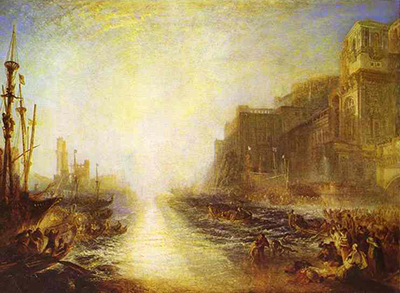
The hero of Regulus is almost impossible to find. Turner gives the centre of the painting not to a Roman general, a decisive gesture or a clearly staged act of torture, but to a blaze. Pale light advances through the sky, pours down the harbour and spreads across the water until architecture, shipping and human activity seem exposed to an optical force greater than the story that supposedly contains it. The title promises a person. The picture answers with the physical ordeal of looking.
This reversal is deliberate. One small figure on the steps at the right has been identified as Regulus, yet the identification does not resolve the action. The setting has been called Rome and Carthage. Later prints gave different embarkation titles. A barrel at the left recalls the most gruesome form of the legend, while the sun evokes another torture said to have been inflicted on the captive. Turner disperses these clues across a working port instead of arranging them into a conventional historical climax. The spectator must search, compare and infer while repeatedly being pulled back toward the brightness.
Tate preserves the painting as N00519 under the simple title Regulus.[1] It is an oil on canvas measuring 89.5 by 123.8 centimetres, first exhibited in Rome in 1828, extensively altered and exhibited again at the British Institution in 1837. It entered the national collection through the Turner Bequest in 1856.[2][3] Those two exhibition dates are more than catalogue milestones. They identify two materially different moments in the work's life. Turner conceived the harbour in Italy, but the dazzling form known today also emerged from damage, repair and a remarkable campaign of repainting in London.
The painting is therefore about more than a legendary act of blinding. Its subject, composition and physical history all turn on disturbed vision. A Roman moral example became a doubtful historical tradition; an ancient harbour became a collage of places and times; a blue Italian sky became a yellow-white glare; and a canvas already wounded by accident was later attacked with a knife. Regulus does not simply represent violence. Violence entered its fabric and altered how its light reaches us.
At a Glance
- ArtistJoseph Mallord William Turner
- TitleRegulus
- First exhibitedRome, 1828
- Reworked and exhibitedBritish Institution, 1837
- MediumOil paint on canvas
- Dimensions89.5 × 123.8 cm
- CollectionTate
- AccessionN00519
- ProvenanceTurner Bequest, accepted 1856
- Principal formal modelClaude Lorrain, Seaport with the Villa Medici
Joseph Mallord William Turner painted Regulus during his second stay in Rome in 1828. He was fifty-three, internationally experienced and long established as a Royal Academician. The work belongs to his standard three-by-four-foot format, although its exact metric dimensions are 89.5 by 123.8 centimetres. A National Gallery of Art checklist rounds those measurements to 91 by 124 centimetres.[4] The Frick Collection records the more exact dimensions and distinguishes the original Roman display from the reworked London exhibit of 1837.[2]
The canvas presents an imagined ancient port. Dense masts and hulls rise at the left. Monumental buildings, steps and terraces mass along the right. Boats cross a broad channel while crowds gather on both shores. In the lower foreground, figures bathe, labour, gesture, embark or wait. The centre is comparatively empty of solid objects. It is occupied by sunlight and its reflection, a vertical passage that joins sky and sea while pushing the human action toward the edges.
The painting's apparent subject is Marcus Atilius Regulus, a Roman commander captured during the First Punic War. The famous tale says that his Carthaginian captors allowed him to travel to Rome under oath, expecting him to argue for peace or an exchange of prisoners. Instead, he advised resistance and voluntarily returned to captivity, where he endured elaborate tortures. That narrative made him an exemplar of courage and fidelity for centuries. Modern classical scholarship, however, considers much of it a later invention.[7]
Turner did not illustrate the tale as though it were uncomplicated fact. His one-word title leaves the moment open, and the principal surviving visual cues can point to different episodes. The uncertainty is part of the achievement. History painting normally makes an exemplary action legible through bodies. Here the body of the exemplar almost disappears, while harbour, atmosphere and luminous paint carry the moral and emotional burden.
Contents
- Introduction
- At a Glance
- Regulus Between History and Legend
- The Story Turner Inherited
- Where Is Regulus?
- Harbour, Crowd and Composition
- Looking Into the Sun
- Claude Recast
- Rome in 1828
- Journey, Accident and Concealment
Regulus Between History and Legend
The historical core begins in the First Punic War, Rome and Carthage's long struggle for power in the western Mediterranean. Polybius describes Regulus remaining in North Africa with a Roman force during the winter of 256-255 BCE after a successful naval campaign and initial advances on land.[8] The Roman commander expected further victory, but the balance changed when the Carthaginians reorganised their army under the Spartan Xanthippus. Regulus was defeated and captured in 255 BCE.
The later story moves several years beyond that capture. Regulus is sent to Rome to negotiate an agreement, bound by an oath to return if the mission fails. Once there, he places Roman interests above his own survival, opposes concessions and then goes back to Carthage. Cicero uses the episode repeatedly as proof that moral obligation outweighs apparent advantage. In De Officiis, Regulus becomes the citizen who preserves an oath even to an enemy and accepts torture rather than compromise his conception of duty.[9]
That exemplary force mattered more to many ancient and later readers than documentary probability. Horace also made Regulus a model of severe Roman virtue. Turner knew this moral tradition well. In verses written in 1811, he praised the captive's stubborn self-command, his refusal to let wife, children or personal safety weaken love of country.[11] The painting of 1828 was not a sudden choice of an exotic name. Regulus had occupied Turner's imagination for at least seventeen years.
Yet the distinction between moral legend and recoverable event is essential. The Oxford Classical Dictionary accepts Regulus's commands, African successes, defeat and capture, but judges the embassy to Rome and brutal death at Carthage almost certainly invented. It notes that Polybius, the strongest surviving narrative for the war, apparently did not know the later tale.[7] One possible reason for its development was to excuse or answer Roman cruelty toward Carthaginian prisoners after Regulus died in captivity.
This does not make Turner's subject meaningless. It changes the kind of truth at stake. The painting concerns a story through which Rome imagined fidelity, sacrifice and enemy cruelty, not a securely documented execution. Turner was working with cultural memory. By making the narrative difficult to locate, he may even preserve something of that instability. The harbour is persuasive as poetic history without pretending to be an archaeological report.
The uncertainty also darkens the moral example. Regulus has traditionally been admired because he sacrifices himself to an idea of public duty. But the tale depends upon cycles of war, captivity, retaliatory cruelty and imperial self-justification. Turner's light can be understood as honour made visible, yet it is also an instrument of punishment. The same sun that seems to ennoble the hero threatens to erase him. Moral radiance and physical violence become inseparable.
The Story Turner Inherited
The most likely immediate narrative source was Oliver Goldsmith's The Roman History, first published in 1769 and owned by Turner. Goldsmith gave the legend the vivid sequence that later interpretation has found scattered through the painting. The Carthaginians remove the prisoner's eyelids, expose his face to the burning sun and finally confine him in a barrel fitted with inward-pointing nails.[10] This version transforms civic virtue into an assault upon sight and flesh.
Turner had once contemplated the moment of return to Rome. His 1811 verses concentrate on self-denial and patriotic resolve: Regulus will not enter ordinary domestic life because captivity and oath still bind him.[11] The eventual oil moves away from that emotionally legible encounter. There is no prominent reunion with wife and children, no senate debating policy and no central farewell. The decision that made Regulus exemplary has already dispersed into consequences.
The sun is the most powerful of those consequences. Goldsmith's account makes forced exposure to sunlight one stage in a larger torture. Turner converts it into the governing condition of the picture. Rather than showing captors physically holding the victim's head, he directs the beam outward. Anyone who searches the harbour for Regulus must face the light associated with his punishment. Narrative information becomes visual behaviour.
The barrel offers a different kind of clue. At the left, close to congested boats and figures, men handle a large cylindrical object. One nearby person appears to raise an arm toward the face. Daniel Wilson, who engraved the work under Turner's supervision, later connected this motif to the fatal barrel.[5][6] The identification is plausible because it matches Goldsmith, but the object still belongs naturally to the labour of a harbour. Turner makes an instrument of legendary torture almost indistinguishable from cargo.
That double function is important. Ordinary port life continues around the implications of violence. People bathe, crowd the shore, handle ropes, board boats and wait on steps. The supposed barrel does not stop commerce. The supposed hero barely interrupts the architecture. History is not isolated from everyday life in a grand theatrical zone; it is embedded in work, transit and spectatorship.
The painting may therefore be understood as a composite rather than a snapshot. Embarkation, return, torture and memory coexist without obeying a single clock. One episode is represented by the sun, another by the barrel, another perhaps by the tiny traveller on the steps. Turner turns temporal sequence into spatial distribution. The eye crosses the harbour as a reader crosses the legend, assembling parts that never become one perfectly continuous scene.[6]
Where Is Regulus?
The most persistent question is also the simplest: which figure is Regulus? A small white presence descends or stands near the great stairway at the right, surrounded by architecture and crowds. The Frick identifies the hero there, reduced to a few pale strokes.[2] Wilson's later account likewise located him among the right-hand figures. Yet the scale is so slight, and the surrounding action so active, that recognition depends more on transmitted interpretation than on an unmistakable attribute.
The left foreground offers a rival possibility. A person near the open barrel appears to shield his eyes. That gesture responds directly to the solar glare and the blinding story. Is this Regulus approaching one torture while anticipating another? Is it a Carthaginian labourer or witness? The painting does not supply enough anatomical or narrative precision to compel a verdict.
Titles have not solved the problem. Turner used Regulus. Wilson's 1838 engraving was called Ancient Carthage - The Embarcation of Regulus, a wording probably accepted by Turner during their close work together.[5][15] Nineteenth-century National Gallery records also used Regulus Leaving Rome. Samuel Bradshaw's smaller print of 1859-61 was titled Regulus Leaving Carthage.[5][6] Each title makes a voyage central, but the proposed direction changes.
The harbour itself cannot arbitrate. Its architecture evokes antiquity and the Mediterranean, but it is not a topographically exact Rome or Carthage. Renaissance forms, imagined palaces, fortifications, towers and shipping combine into a poetic port. The setting can hold the legend because it does not belong completely to one coast.
John Gage proposed the most influential alternative: perhaps Regulus is absent because the spectator occupies his position. On this reading, the painting gives not a distant view of the torture but the field forced before the victim's unprotected eyes. The blazing centre is then subjective as well as atmospheric. We do not find Regulus because we see as Regulus.[6]
The proposal brilliantly accounts for the discomfort of looking, but it should not close the work. The tiny right-hand figure, the barrel and the embarkation tradition continue to operate. Turner may have wanted several relations to the hero at once: identify him at the margin, reconstruct his story from objects and undergo an analogue of his visual ordeal. Regulus works less like a puzzle with one hidden answer than a structure designed to keep perception unsettled.
Harbour, Crowd and Composition
At first glance, the composition follows a stable harbour formula. Land and architecture frame a central reach of water. Shipping creates vertical accents against the sky. Foreground groups supply scale and incident. Distance opens toward the luminous horizon. The Frick exhibition on Turner's ancient and modern ports identifies this shared arrangement across works concerned with Dieppe, Cologne, Brest, Rome and Carthage.[13]
In Regulus, however, stability begins to fail at the centre. The left edge is a dark lattice of masts, sails, spars and rigging. Hulls overlap so closely that individual vessels are hard to separate. The right is an enormous architectural bank, its lower arcades crowded and its upper walls rising toward a projecting palace. These two dense regions do not meet. Between them lies a vertical stream of near-white sky and water.
That interval is both passage and obstruction. Boats can travel through the harbour, and the eye can follow the reflective channel into distance. Yet the very brightness that promises depth cancels detail. Horizon, sun and reflection merge. Instead of a clear opening through space, Turner creates a luminous barrier. The farther the eye tries to go, the less it can distinguish.
Human activity forms a rough arc around this vacancy. On the lower right, figures recline, kneel, bend, raise arms and gather around cloth, baskets or goods. Beyond them, boats press toward the quay. Across the left shore, darker bodies cluster among nets, timber and vessels. The middle water carries low craft, including a long boat whose rowers or passengers stand against the light. No single action dominates. The port is collectively alive.
The crowds complicate the supposed heroism. Traditional history painting distinguishes its protagonist through scale, lighting, pose and emotional response. Turner grants Regulus none of those privileges securely. The general is absorbed into a population. Mothers, children, bathers, sailors and porters command more immediate attention than the celebrated Roman. Landscape and social life displace individual greatness.[6]
Architecture undergoes a similar pressure. At the right, ledges and staircases remain legible, but the central facades seem abraded by brightness. Fine lines of windows and masonry dissolve into vertical brown-grey masses. On the left, the harbour structures are even less substantial. Towers rise like afterimages. The city seems both monumental and perishable.
Colour holds these discontinuous parts together. Browns and reds bind the two crowded shores. Blue remains at the upper corners and in the broken water. Pale yellow expands from the centre, catches facades, threads among boats and touches clothing. The sun's influence is not confined to a circular disc. It spreads across every material, making light the agent that joins opposing banks and competing incidents.
Looking Into the Sun
The solar centre is difficult to describe because Turner suppresses the boundaries that would make it an ordinary object. There is no neatly enclosed yellow circle hanging above a horizon. Instead, a pale region widens through thin cloud and seems to descend into its own reflection. Sky and water answer each other so completely that the harbour appears split by a single radiant column.
This is where the legend becomes immediate. A painted sun cannot physically blind, but contrast, scale and loss of detail can imitate the involuntary response to glare. The eye turns away from the brightest centre to seek relief in masts, architecture and foreground bodies. It then returns because the composition directs every major line inward. Looking becomes a rhythm of attraction and retreat.
Contemporary viewers noticed the effect. A critic in 1837 wrote that Turner's sun dazzled the eyes. Another complained that the landscape had been sacrificed to glare and suggested retreating as far across the gallery as possible, where the work resolved into a burst of sunlight.[5][6] These responses register more than conservative dislike. They show that spectators experienced distance and bodily adjustment as part of the painting.
The Frick interprets this demand as Turner's most audacious narrative device: while searching for the nearly invisible general, viewers undergo a controlled equivalent of his ordeal.[2] The subject is not described through expression on Regulus's face. It is transferred into the conditions under which everyone else sees.
There is also a moral reversal in this light. Sunlight conventionally discloses truth, orders space and animates a harbour. Here it obscures. Too much illumination removes rather than supplies information. The centre contains the greatest brightness and the least definition. To see nothing but light is another way of being unable to see.[6]
Turner exploits that paradox without making the effect merely destructive. The harbour remains beautiful. Warm colour, flickering water, distant air and active life offer sensuous pleasure. The viewer is drawn toward precisely what the legend defines as torture. Beauty and coercion are fused. The painting does not let admiration stand outside the fate it evokes.
The light also weakens certainty about time. It may suggest sunrise, late afternoon or a radiance outside normal weather. Shadows are not organised with the consistency of a single observed hour. The centre behaves less like a meteorological record than an actor. It produces the scene, judges it and threatens to consume it.
Claude Recast
Turner's harbour rests upon a long engagement with Claude Lorrain. The most specific model is Claude's Seaport with the Villa Medici, painted in 1637 and held by the Uffizi. The Uffizi describes the work's harbour space as organised by dazzling sunset effects, the same broad visual premise Turner inherited.[12] Turner studied and copied the painting during his first Italian journey in 1819-20 and had another opportunity to see it while travelling through Florence in 1828.[5]
The relationship is structural rather than imitative in every detail. Claude balances architecture and shipping around a central sunlit opening. Recognisable Roman buildings and the great lighthouse of Genoa contribute an ideal Mediterranean world. Small figures conduct trade, embark or converse within a landscape whose order seems both natural and civilised. Light gives variety a harmonious unity.
Turner preserves the flanking masses, central water, busy shore and radiant distance, but changes their emotional temperature. A critic in 1837 called Regulus the converse of Claude: where Claude offered repose, serenity and mellow Italian illumination, Turner supplied glare, agitation and unease.[6] The comparison is exact. The inherited form remains visible while its promise of balance is placed under pressure.
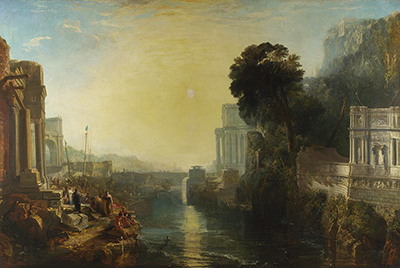
This was not Turner's first argument with Claude. His Carthaginian pictures had long treated the seventeenth-century master as a rival and ancestor. Dido Building Carthage used a luminous port to imagine imperial beginnings. The Decline of the Carthaginian Empire made sunset register political decay. Regulus condenses that grand tradition into a smaller canvas and turns radiance against the eye.
The result is not a rejection of Claude. Turner needed the older painter's calm grammar in order to make disturbance legible. Masts, palaces, water and distant light establish expectations of ideal landscape. The blinding centre then violates the ease those components normally create. Admiration becomes contest.
The Claude reference also answers the choice to paint a doubtful Roman legend as landscape. Benjamin West and other history painters had represented Regulus through farewell, family and heroic gesture. Turner relocates exemplary action into atmosphere. The landscape does not merely surround the story; it performs sacrifice, danger and memory through light. This raised the status of landscape while making the boundary between genres uncertain.[6]
Rome in 1828
Turner arrived in Rome in October 1828 intending to paint oils, a marked change from his first Italian stay, when he had concentrated on pencil and watercolour. He worked in rooms near the Spanish Steps and moved within an international artistic community that included the younger Charles Lock Eastlake. Technical research identifies Regulus as one of a group made on locally sourced supports with features distinct from Turner's usual London canvases.[5]
The support has a coarse, open plain weave, roughly nine threads per centimetre in both directions. It was originally fixed to a roughly cut softwood stretcher with long fine sprigs rather than conventional tacks. Its ground consisted of two layers based on lead white and chalk, with a small amount of yellow-brown ochre in the upper layer. These material facts anchor the painting in Roman practice while showing that Turner could specify an absorbent preparation suited to his preferences.[5]
He worked rapidly. The conservation study suggests that Regulus was probably the first of the Roman exhibition pictures and may have been substantially completed by early November, in less than a month. In mid-December, Turner displayed it with Vision of Medea and View of Orvieto at Palazzo Trulli in the Via del Quirinale. The display lasted only a short period but drew roughly a thousand visitors.[5]
The response was divided and sometimes hostile. International artists accustomed to different standards objected to the freedom of Turner's application and the apparent defects of his figures. Eastlake reported that many concentrated on those weaknesses and on the resemblance to Claude. He nevertheless praised Regulus as an exceptional demonstration of Turner's special power, admiring the gradation and architecture as more intensely Italian than Italy itself.[5]
That clash reveals what Turner had attempted. Rome was the city in which Claude's reputation had formed and where the remains of antiquity supplied academic art with authority. Turner arrived as a British landscape painter and presented a Roman subject through conspicuous colour, rapid handling and a brazen adaptation of Claude. Regulus announced that historical landscape could be renewed through modern pictorial force rather than respectful imitation.
The first version differed significantly from the one now visible. Examination at the outer edges indicates a brighter blue sky made with natural ultramarine and pale chrome yellow. A sample also contains a natural-resin varnish applied over paint that was still scarcely dry, apparently before the Roman display.[5] The original effect was vivid, but its centre may not yet have possessed the overwhelming yellow-white intensity associated with Regulus today.
The Roman exhibition therefore survives only partly within the present canvas. Right-hand architecture and protected edge colour retain important evidence, while later work transformed much of the sky. The painting should be dated 1828 and 1837 not because Turner casually returned to an old idea, but because two distinct public statements occupy the same fabric.
Journey, Accident and Concealment
Turner left the Roman paintings behind to travel home. They were sent by the slower sea passage, apparently insured for 500 guineas, and did not reach London until 20 July 1829. That delay put them beyond the Royal Academy season Turner had hoped to meet. His correspondence expressed relief that his own canvases had arrived safely, but later physical evidence complicates his report.[5]
At some point after the Roman exhibition and before the 1837 display, Regulus suffered a large tear in the upper-left sky. The damage follows a reverse-question-mark shape and required a forceful collision with a hard object. It may have occurred during transport, unpacking or movement in Turner's crowded London gallery. No surviving document identifies the incident, so the precise cause remains unknown.
Raking light suggests that the torn canvas was stitched. It was then probably lined with a glue-paste adhesive under heat and pressure, a common British repair. Turner disguised the damage by repainting almost one quarter of the picture, chiefly across the sky.[5] This was not a minor patch. A structural wound prompted a broad reimagining of the atmosphere.
The sequence matters because it overturns a familiar story about sudden inspiration. Turner did not wait until the British Institution opened in 1837 and then conjure the entire blinding effect in a few hours. Cracks within the thick yellow region show that substantial repainting had aged before the thinner final additions were laid across it. The mended tear and its first reintegration belong to an earlier campaign.[5]
Repair also altered meaning. To conceal an irregular break in the sky, Turner expanded pale, thick colour around it. The sun lies immediately below the damaged zone. The need to unify surface and image encouraged light to spread. Conservation specialists consequently caution that it is impossible to decide how much of the present dazzle belonged to the first conception and how much grew from the effort to hide the tear.[5]
This uncertainty does not diminish the achievement. Turner transformed constraint into pictorial logic. Instead of merely matching the surrounding blue, he made the repair participate in the legend. A wounded sky became the vehicle of blinding illumination. Accident entered invention.
The canvas then remained out of London exhibitions for years. View of Orvieto appeared at the Royal Academy in 1830 and Vision of Medea in 1831, both with further work. Regulus waited until 1837. One practical possibility is that its damage delayed public reuse. Another is that Turner rediscovered its potential while reassessing unsold Roman canvases in the mid-1830s. Either way, the nine-year interval allowed the first painted object and the later exhibition object to separate materially and conceptually.
The British Institution in 1837
Turner sent Regulus to the British Institution rather than the Royal Academy. The distinction matters. The British Institution was founded by aristocratic connoisseurs partly to encourage British artists through study of old masters. Turner had a complicated relationship with its prescriptive ideals, but the setting made his revision of Claude especially pointed.[5]
Artists received varnishing days before the public opening, allowing them to adjust works after seeing their hanging position, light and neighbours. Turner was famous for using these sessions energetically, and historical museum scholarship places the 1837 revision of Regulus within that established exhibition practice.[17] Witnesses saw him work upon the picture in the Institution's gallery. Charles West Cope recorded the scene in a small oil on card, now in the National Portrait Gallery, which identifies Turner standing before the painting at the British Institution.[14] Thomas Fearnley produced another view, showing the artist elevated on a bench before the luminous canvas.[5]
John Gilbert, not yet twenty, also watched. Decades later he remembered Turner driving pale paint across a predominantly red and yellow surface with large brushes, producing the effect of sunlight absorbing objects into haze. He described a large amount of flake white, radiating ruled lines and a raised solar boss.[5] The recollection has become one of the most repeated anecdotes about Turner's working method.
Technical evidence supports its broad outline while checking its dramatic details. The canvas does contain thin, medium-rich 1837 revisions that lighten and unify the sky. Turner strengthened reflections, masts and edge incidents at the same time. Yet the surface does not preserve convincing ruled rays or enough texture for the once-prominent white disc Gilbert recalled. His memory was recorded forty-five years after the event and may have been affected by later prints or retellings.[5]
The surviving paint makes the intervention more interesting than the legend of instant creation. Turner worked on an already complete, exhibited, damaged, lined and heavily repaired canvas. He was not generating form from a bare beginning. He was tuning an image whose earlier history constrained every choice. Public performance and slow material accumulation met on the exhibition wall.
The revisions intensified the central radiance. Pale scumbling reduced the dominance of red and yellow without erasing their warmth. Glaze-like strokes passed over older cracks. New accents brought boats and architecture into relation with the altered sky. Turner could change the total balance through limited but strategically placed additions.
This process explains why Regulus is both exceptionally coherent and materially troubled. The light seems to pass through everything because layers from several campaigns cross former boundaries. It is an atmosphere built by correction. Turner's command lay not in pretending that the canvas had no history, but in making its history converge upon one effect.
What the Surface Reveals
The 2012 examination combined stereomicroscopy up to one hundred times magnification, raking light, ultraviolet imaging, X-radiography, paint cross-sections and elemental analysis. Together these methods separated stages that ordinary viewing merges.[5] The painting now carries Roman paint, an early varnish, tear repair, extensive wax-modified repainting, 1837 additions, nineteenth-century restoration and later retouching.
The original sky visible at protected edges contains natural ultramarine and pale chrome yellow. Over it lies natural-resin varnish applied when the first paint was only partly dry. Around the repaired tear, Turner used thick yellowish paint in a wax-and-oil formulation. Near the sun, that impasto reaches approximately two to three millimetres, unusually substantial even within his work of the 1830s. Palette-knife application helped bridge and disguise the disrupted surface.[5]
The 1837 layer is thinner and brighter. It includes chrome yellow and red lake in a medium-rich mixture whose ultraviolet behaviour and fine cracking are consistent with megilp. Turner used related material above the sun, near the upper edge, across reflections and to reinforce masts and lateral features. In the water he combined the mixture with cobalt blue to articulate waves.[5]
These findings sharpen visual analysis. The blue corners are not merely cool complements added around a finished golden design; they retain the earlier Roman sky. The yellow centre is not one continuous application; it includes a substantial repair campaign beneath a more fluid exhibition adjustment. The apparent unity of sunlight is constructed from differing materials, dates and purposes.
The evidence also explains present irregularities. Wax-modified paint, rapid-drying medium, old varnish, glue-paste lining, repeated restoration and environmental change have produced cracks, cupping and varied gloss. Some contours are softer than they once were. Reproduction can flatten these features into a uniform golden mist, but the physical object is ridged, fractured and locally dense.
Most importantly, conservation prevents romantic exaggeration. Turner's varnishing-day speed was real, and fellow artists saw him transform the balance of the work. But the deepest material change had begun earlier when he concealed the tear. The painting's brilliance arose from several acts of looking, judging and revising. It is a record of persistence rather than a miracle performed in one morning.
Critics, Ruskin and Optical Defiance
The 1837 reviews understood Regulus primarily through its light. One praised the sun's ability to dazzle and rejected the objection that British viewers might consider such brilliance excessive. Another found the repetition of solar display wearying, believed landscape and subject had been sacrificed to glare, and recommended viewing from the greatest available distance.[5] The opposition was not between seeing and failing to see. Both responses recognised the intended optical pressure; they disagreed about whether it served painting.
Turner had reasons to embrace the dispute. Critics had already complained that his luminous ports, including Harbor of Dieppe and Cologne, were blinding or unnaturally bright. The Frick sees Regulus as a defiant answer. By choosing a hero tortured through sunlight, Turner made the charge of excessive luminosity part of the subject.[2][13] If the picture hurt the eye, that discomfort could no longer be separated from narrative appropriateness.
The strategy also mocked expectations of history painting. A reviewer could complain that the scene had little to do with Regulus, but that complaint exposed the work's premise. Turner had refused to make the hero the easiest object to see. The light was not a decorative effect imposed upon a weak narrative. It was the means by which narrative reached the spectator.
John Ruskin's reaction was especially contradictory. In the first volume of Modern Painters, he celebrated Turner's unique ability to send dazzling intensity through colour and mocked those who expected representations of the sun to remain subdued and manageable. That defence seems made for Regulus. Yet Ruskin strongly disliked the painting.[6]
He called it an artistic error and later condemned it as a disgraceful relapse into rivalry with Claude. His technical objection was that Turner confused the radiation of sunlight with its reflection. In Ruskin's account, truth deserted the artist when ambition to compete with an old master overrode direct natural feeling. He even proposed segregating such works as examples of Turner's failure.[6]
The contradiction is illuminating. Ruskin valued intense light when he believed it arose from truthful encounter with nature. In Regulus, he saw artifice: a literary subject, a Claudian port and an effect manipulated beyond optical coherence. Modern viewers may disagree with his judgment, but it identifies the picture's risk. Turner made sunlight do several incompatible things at once. It radiates through sky, reflects on water, obscures depth, represents torture and asserts painterly rivalry.
Rather than weakness, that excess can be understood as the work's organising intelligence. The sun is not required to behave like one observed phenomenon because it carries several times and meanings. It belongs to Rome in 1828, to the repaired London canvas, to Regulus's legendary agony and to the British Institution wall. Its impossible concentration is historical as well as visual.
Ruskin's hostility should not be linked causally to later violence against the painting. His rhetoric of disgrace and confinement belongs to critical history; it does not prove that another viewer acted under his influence. What it does demonstrate is the unusual aggression with which Regulus could be discussed. Long before its canvas was physically attacked, spectators described its light as an assault.
Engraving, Bequest and Attack
Turner continued to value Regulus after its failure to sell in 1837. He allowed the young Daniel Wilson to engrave it and supervised the translation of its colour into line. The resulting print, published in 1838, clarified figures, adjusted proportions and extended the left side with additional masts. Its title, Ancient Carthage - The Embarcation of Regulus, became an important witness to the narrative without settling every ambiguity.[5][15]
Engraving demanded decisions the painting could evade. Indistinct bodies had to become lines; tonal transitions had to replace colour; foreground actions needed greater legibility. Wilson's version suggests more sharply fanned rays and clearer clouds, but it cannot be treated as a mechanically exact record. Turner used the proofing process to alter details, and the print was designed as an independent translation.[5]
After Turner's death in 1851, the work entered the national collection in 1856 as part of the Bequest. It was among the first hundred oils prioritised for display and received the number N00519. It moved through Marlborough House, South Kensington and, in 1861, the Turner Room at the National Gallery. Bradshaw's later engraving carried the alternative title Regulus Leaving Carthage, keeping the directional uncertainty alive.[5]
On 16 December 1863, Walter Stephenson attacked the painting with a penknife. The National Gallery archive records a request to the Treasury to prosecute him for damaging what it then called Regulus leaving Rome.[16] Contemporary accounts describe his agitation at the work's misty appearance and his stated dislike of Turner. He was sentenced to six months of hard labour.[5][6]
X-radiography reveals the extent more reliably than sensational summaries. The canvas received four piercing stabs, four lesser marks confined to paint and a cut about one and a quarter inches long. Restorer George Morrill relined the work early in 1864, and Charles Buttery completed further repair before it returned to display in April.[5]
The second lining flattened and softened parts of Turner's wax-rich repainting. It also replaced the earlier lining associated with the large tear. Consequently, the attack changed not only isolated points but the texture of the whole support. The surface now records accidental rupture, artistic concealment, deliberate puncture and institutional restoration.
An unwitnessed impact in 1984 dislodged several paint fragments near the centre; conservators recovered and reattached them. Repeated consolidation and retouching have also been necessary as old layers crack and lift.[5] These interventions do not make Regulus less authentic. They disclose what survival means for a heavily worked oil: the object reaches the present through care as well as through Turner's hand.
Why Regulus Matters
Regulus matters because Turner remade the basic contract of history painting. He did not ask viewers simply to recognise a famous action and admire its hero. He made recognition difficult, placed the exemplary body at the margin and transferred the drama into atmosphere. Light becomes protagonist, punishment, compositional axis and test of spectatorship.
The work also exposes how legends operate. The historical commander can be separated from the invented embassy and torture, yet the doubtful tale shaped Roman ethics, eighteenth-century history, Turner's poetry and nineteenth-century visual culture.[7][9][10][11] Rather than restoring a lost event, the painting shows the power of a narrative repeatedly retold. Its uncertainty is historically honest even when its harbour is fantastical.
Its relation to Claude is equally consequential. Turner adopted the ideal seaport, then changed serenity into strain. The ancient city no longer rests securely beneath harmonious light. Architecture and human labour endure at the edges while the centre erases distinctions. Landscape does the intellectual work once assigned to heroic gesture.
The canvas's material history makes that transformation more profound. A Roman blue sky survives beneath London yellows. A transport or studio accident required a huge repair. Thick paint concealed the wound; thinner revisions unified the exhibition effect; later attacks and linings altered the texture again.[5] The sunlight admired today is not untouched inspiration. It is the visible resolution of difficulty.
That history should change how the painting is viewed. Cracks are not simply age, and haze is not simply style. They belong to a layered object whose present appearance was shaped by choices and injuries over nearly two centuries. The eye encounters a record of concealment at the very point where the subject concerns forced vision.
Turner could not have planned the 1863 assault or later conservation. Yet those events intensified questions already present in 1828 and 1837. What can looking bear? When does light reveal, and when does it destroy distinction? Can violent history be made beautiful without neutralising its violence? Does repair restore an image or create a new one?
No single identification answers these questions. Regulus may be the tiny pale figure on the right, the person shielding his eyes at the left, the absent owner of the barrel, the implied traveller between cities or the position temporarily assigned to the spectator. The work sustains all these possibilities because its true centre is not a body but an ordeal of attention.
The result is among Turner's most intellectually and materially complex paintings. It joins classical legend, maritime life, old-master competition, optical experiment and the contingencies of a damaged canvas. Its sun is magnificent, but magnificence is not reassurance. The brightness withholds what it appears to promise, forcing us to search in the very place where vision begins to fail.
Discussion
Does Turner's glare clarify the legend of Regulus, or make historical and visual certainty impossible?
Reader Insights
Where, if anywhere, do you locate Regulus within the harbour?
How does the central radiance act upon the viewer as well as the scene?
How should damage, repair and repainting affect interpretation?
Join the Conversation
Share a close observation or a source-based question for other readers.
References
- Tate, *Regulus*, N00519. https://www.tate.org.uk/art/artworks/turner-regulus-n00519
- Frick Collection, *Regulus*, in *Turner's Modern and Ancient Ports: Passages through Time*. https://www.frick.org/exhibitions/turner/106
- National Gallery of Australia, archived *Turner* exhibition entry for *Regulus*. https://digital.nga.gov.au/archive/exhibition/turner/default.cfm?irn=230477&bioartistirn=18113&mystartrow=61&realstartrow=61&mnuid=3&galid=0&viewid=2
- National Gallery of Art, *J.M.W. Turner* exhibition image checklist, catalogue no. 96. https://www.nga.gov/content/dam/ngaweb/press/exh/2832/2832-list.pdf
- Joyce H. Townsend, Rebecca Hellen and Ian Warrell, "Turner's Regulus: A Tale of Violence, Abuse and Accident, Illuminated by Technical Study," in *Studying the European Visual Arts 1800-1850*, 2017, pp. 109-123. https://pure.kb.dk/ws/portalfiles/portal/10104814/CATS_proceedings_III.pdf
- Matthew Beaumont, "Reason Dazzled: The All-Seeing and the Unseeing in Turner's Regulus," *British Art Studies*, issue 15, 2020. https://britishartstudies.ac.uk/issues/15/turners-regulus
- Andrew Drummond, "Atilius Regulus, Marcus," *Oxford Classical Dictionary*. https://academic.oup.com/edited-volume/61673/chapter-abstract/548509240
- Polybius, *Histories*, Book 1, Perseus Digital Library. https://www.perseus.tufts.edu/hopper/text?doc=Perseus:text:1999.01.0234:book=1&force=y
- Cicero, *De Officiis*, especially 1.39 and 3.97-111, LacusCurtius. https://penelope.uchicago.edu/Thayer/E/Roman/Texts/Cicero/de_Officiis/3C*.html
- Oliver Goldsmith, *The Roman History, from the Foundation of the City of Rome to the Destruction of the Western Empire*, first published 1769; digitised edition. https://openlibrary.org/books/OL24997814M/Goldsmith%27s_Roman_history_for_the_use_of_schools
- J. M. W. Turner, 1811 verses on Regulus, Tate-sourced transcription, Bibliotheca Augustana. https://www.tha.de/~harsch/anglica/Chronology/19thC/Turner/tur_po09.html
- Gallerie degli Uffizi, collection text discussing Claude Lorrain's *Seaport with the Villa Medici*. https://www.uffizi.it/opere/salvator-rosa-marina-porto
- Frick Collection, *Turner's Modern and Ancient Ports: Passages through Time*. https://www.frick.org/exhibitions/turner
- National Portrait Gallery, Charles West Cope, *J.M.W. Turner*, NPG 2943. https://www.npg.org.uk/collections/search/portrait/mw06425/JMW-Turner
- British Museum, collection record trail for Daniel Wilson after J. M. W. Turner, *Ancient Carthage, The Embarkation of Regulus*, 1838. https://www.britishmuseum.org/collection/term/BIOG141480
- National Gallery Archive, letter to the Secretary, H.M. Treasury, 21 December 1863, NG6/3/157. https://www.nationalgallery.org.uk/research/research-centre/archive/record/NG6/3/157
- Martin Butlin, "A newly-discovered masterpiece by J. M. W. Turner," National Gallery of Victoria. https://www.ngv.vic.gov.au/essay/a-newly-discovered-masterpiece-by-j-m-w-turner/