 by Tom Gurney
Tom Gurney BSc (Hons) is an art history expert with over 20 years experience
Published on June 19, 2020 / Updated on August 29, 2026
Email: tomgurney1@gmail.com / Phone: +44 7429 011000
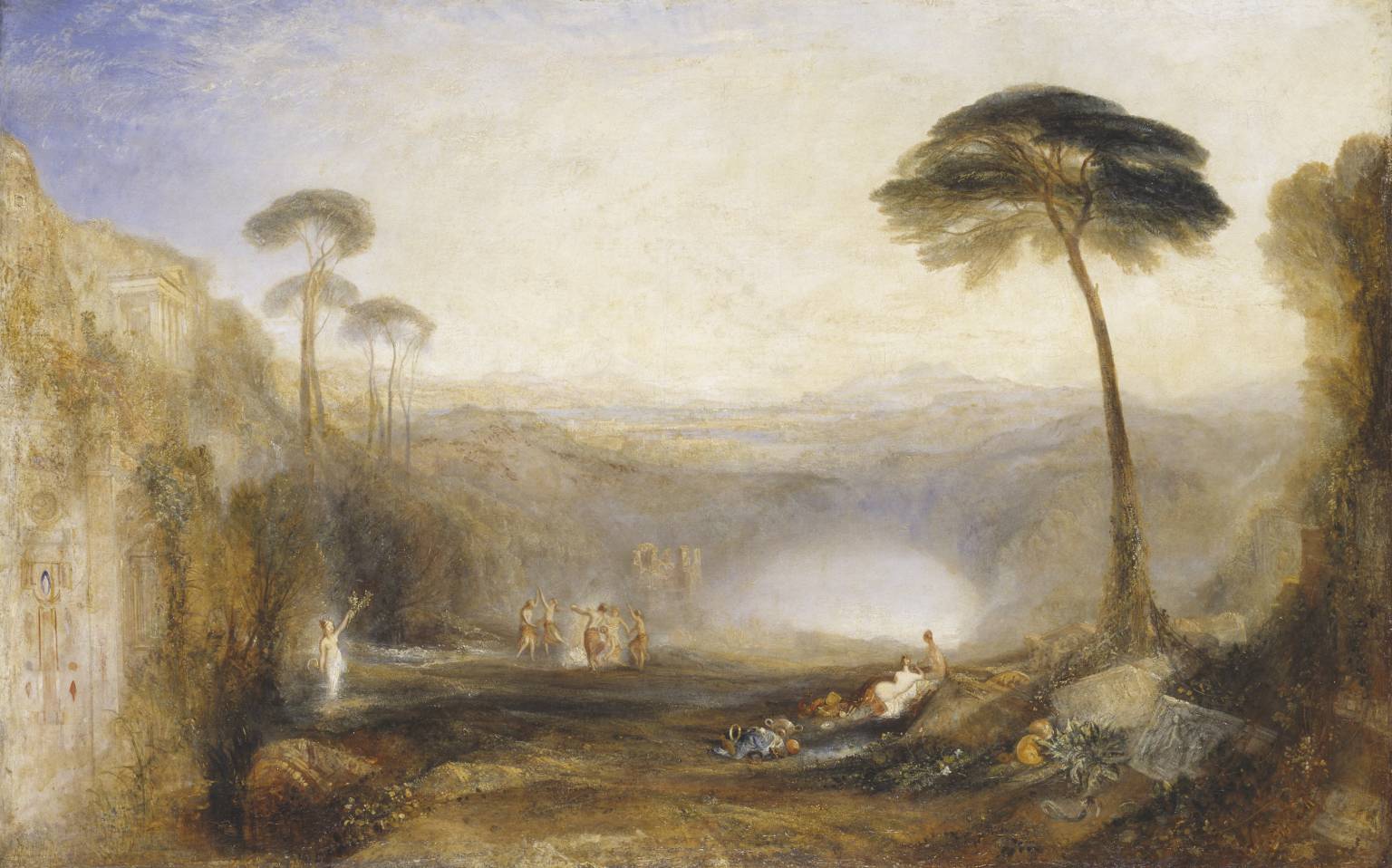
The Golden Bough is one of J. M. W. Turner's most spacious and seductive classical landscapes. Exhibited at the Royal Academy in 1834, it turns a decisive episode from Virgil's Aeneid into a world of pale air, dark pines, ruined architecture, dancing bodies and half-hidden signs of death. The legendary branch is present, but it is small. The hero who should cut it is missing. Landscape carries more of the drama than action does.
Turner painted the work in oil on canvas. It measures 104.1 by 163.8 centimetres and is now Tate N00371. The current title is The Golden Bough, although its first audience encountered the fuller catalogue wording The Fates and the golden bough. Robert Vernon acquired the painting and presented it to the nation in 1847.[1][2]
The subject comes from Book VI of the Aeneid. Aeneas must obtain a sacred branch before the Sibyl can guide him into the Underworld to meet his dead father. Virgil makes the episode a test of destiny. The bough will come away only if Fate permits the journey; strength alone is useless. Turner radically rearranged this story. Aeneas does not appear, while the Sibyl displays the branch at the edge of Lake Avernus.[5][6]
That alteration gives the painting its peculiar character. It is both exact enough to reward mythological knowledge and open enough to resist a single narrative reading. A snake, tomb-like forms, sleeping figures and broken stone suggest mortality. Flowers, dance, water and overwhelming light suggest vitality. Turner sets passage to the dead inside a place that seems almost impossibly desirable.
The painting later gave James George Frazer the title and opening image for his vast anthropological study The Golden Bough. Yet Frazer wrote more than half a century afterward and shifted attention from Avernus to Lake Nemi. His fame can obscure Turner's own Virgilian subject. To understand the canvas, the sequence must run in the other direction: first through Virgil, translation, the 1834 exhibition and Turner's long engagement with Italy, then onward to Ruskin, Vernon, reproductive prints and Frazer.[22][23]
A Landscape at the Threshold
The first impression is not of a branch or a hero but of light. A great pale opening occupies the centre of the canvas, spreading from sky into lake and distant terrain. Cream, silver, warm yellow and cool blue-grey seem to circulate through one continuous atmosphere. Darker vegetation encloses that brightness at either side, making the middle distance appear at once remote and penetrable.[3]
A tall stone pine rises on the right. Its trunk cuts upward through the luminous field before the broad canopy turns into a dark roof. Smaller umbrella pines answer it from the left. These trees do more than identify an Italian climate. They regulate sight, creating apertures through which the eye travels toward water, hills and a sky whose brightness has almost dissolved their boundaries.
Ruins appear within both margins. At the left, architecture and broken masonry form a rough gateway around the Sibyl. Beyond the dancing group, another structure interrupts the haze. Turner offers enough classical vocabulary to establish antiquity, but not enough archaeological precision to identify one excavated monument. The setting belongs to historical imagination rather than measured reconstruction.
Human figures occupy a surprisingly small proportion of the surface. The Sibyl stands near the left edge of the lake. A central group dances around a dark and pale focus. Reclining and sleeping forms spread through the right foreground. Their scale forces the viewer to search, and their gestures remain less stable than the large architecture of trees and light.
The composition is organised as a threshold. The dark foreground seems close enough to touch, while the lake draws vision toward an uncertain beyond. The title tells us that the way leads to the dead, but the canvas presents no obvious mouth of hell. Instead, transition is embedded in changes of illumination, depth and bodily state.
Turner thereby avoids the conventional contrast between a beautiful upper world and a black infernal opening. Avernus itself glows. Danger survives in the snake, funerary associations, broken forms and the ritual need for the bough, yet it inhabits the same environment as dance and abundant growth. The threshold is alluring because it does not advertise its cost.
This structure also slows narrative time. Virgil's action moves from command to discovery, burial, sacrifice and descent. Turner suspends the instant after cutting, then surrounds it with activities that do not advance the plot. The Sibyl raises the branch, dancers circle, figures rest, haze expands. Preparation becomes a whole state of being rather than a brief episode before adventure.[8]
What the Eye Can Find
The Sibyl is easy to miss. She stands at the left margin of the water, pale against darker vegetation and architecture. Tate identifies her with a sickle and the newly cut bough.[1] In reproduction, the exact separation between hand, blade, branch and surrounding marks is difficult. Her identity depends on title, tradition and informed looking as much as on conspicuous attributes.
This small scale is purposeful. Turner could have enlarged the figure or staged an encounter between Sibyl and Aeneas. Instead, he makes discovery depend on attention. The instrument and branch are decisive within the myth, but physically modest within the world. Human destiny is shown as an event inside landscape, not as a force that dominates it.
Near the centre, several figures dance around what appears to be a fire or dark ceremonial focus. Their linked rhythm contrasts with the Sibyl's more isolated gesture. Tate calls them the Fates, following the exhibited title.[1] Eric Shanes proposes a more complicated identity for the group, and the painting's material history makes certainty harder still.[7]
On the right, partly draped bodies recline among plants, vessels and fragments. Some seem asleep; others sit or lean. Their indolence has often encouraged allegorical readings, but no secure key assigns a name to every person. Their strongest function is spatial and emotional. They make the foreground inhabited, vulnerable and slow.
A snake curls among the lower-right vegetation. It is visible enough to reward close inspection but not prominent enough to control the first impression. Ruskin later seized on precisely this relation: the fearful thing lies among exceptionally lovely growth.[11] Mortality is not outside pleasure; it is folded into it.
Broken blocks and architectural remnants occupy the lower left, while flowers and thorny forms animate the opposite corner. A vessel and a lyre-like object have been identified among the scattered forms. Each may extend associations with sacrifice, music, sleep, burial or abandoned festivity, though the aged paint does not permit every mark to bear an exact symbolic label.
The lake opens beyond these near incidents. Historical descriptions place the Bay of Baiae and Vesuvius in the far distance, but Turner's geography is freely reorganised. The pale mountain and shore matter less as a topographical diagram than as an atmospheric horizon. Avernus is recognisable through narrative context, not through one mechanically exact profile.
Direct inspection therefore demands two disciplines at once. The eye should linger over small forms, because Turner has made them meaningful. It should also resist over-definition, because a digital image and an aged surface cannot secure every iconographic claim. The painting rewards recognition while continually exposing the limits of recognition.
Contents
- A Landscape at the Threshold
- What the Eye Can Find
- Virgil's Golden Branch
- Turner's Rearranged Myth
- The Royal Academy Title
- Avernus Made Luminous
- Thirty-Six Years of Aeneas and the Sibyl
- Hoare, Wilson and an Italy before Italy
- Claude and the Historical Sun
- Italy Remembered after 1819
Virgil's Golden Branch
Book VI of the Aeneid begins with arrival at Cumae. Aeneas has escaped Troy and crossed the Mediterranean, but the future of his mission remains uncertain. He seeks the Cumaean Sibyl so that he can enter the world below and speak with Anchises, the father whose death has left grief and unfinished instruction behind.[5]
The Sibyl warns that descent is easy while return is difficult. Before Aeneas can attempt it, he must find a branch whose leaves and supple stem are golden. It is concealed within a dense grove and consecrated to Proserpine. The dead cannot be approached without this offering.
The test is spiritual and historical rather than athletic. If destiny summons Aeneas, the branch will yield willingly. If Fate opposes him, neither physical force nor steel will tear it away. The object therefore confirms a calling. Possession means that a private desire to see his father accords with a larger divine order.[6]
Another obligation intervenes. One of Aeneas's companions, Misenus, lies dead and unburied. The living hero cannot pass ceremonially into the Underworld while neglecting the corpse within his own community. Funeral duty, purification and sacrifice must accompany the search for hidden knowledge.
Venus sends two doves to guide her son. They fly ahead and settle in the tree where the golden light appears within dark foliage. Virgil compares the branch to mistletoe, a plant that remains green on a host tree and bears a growth unlike the wood around it. The wonder depends on contrast: brightness and otherness inside obscurity.
Aeneas takes the branch to the Sibyl. After rites at the entrance, the pair descends among monsters, unburied souls, judges and the divided regions of the dead. At Proserpine's threshold, Aeneas fixes the offering in place. The bough is thus a passport, ritual gift and visible confirmation that the journey has been allowed.
The meeting with Anchises expands the episode beyond bereavement. The father reveals souls waiting for future life and names the Roman line to come. Aeneas sees his mission as part of history. He must leave private attachment behind, continue to Italy and accept the burden of founding a political future he will not personally enjoy.
Turner's subject carries all these meanings in compressed form. The branch implies death, descent, filial love, ritual duty and historical destiny before the journey begins. Yet the canvas withholds the hero and the dark road. It paints authorization rather than fulfilment.
Turner's Rearranged Myth
The most important narrative fact in The Golden Bough is an absence. Virgil gives Aeneas the task of finding and breaking the branch. Turner shows the Sibyl holding it and removes Aeneas altogether. This is not a minor deviation hidden at the edge; it changes the dramatic centre of the episode.[7]
The Sibyl becomes discoverer, bearer and interpreter. Her raised gesture can be read as presentation, proclamation or invitation. Because she also knows the path through death, the branch appears less like a trophy won by heroic effort and more like knowledge entrusted by a guide.
Removing Aeneas also prevents the scene from becoming a portrait of masculine resolve. There is no armoured traveller stepping toward destiny, no exchange between prophetess and warrior, and no clear sequence of command followed by obedience. Instead, many female figures occupy the landscape: the Sibyl, dancers, reclining bodies and perhaps the Fates or Vestals.
Shanes places this change within Turner's long engagement with the Aeneas legend. The story repeatedly allowed him to consider love and duty, divine obstruction, historical mission and the difficulty of reading signs.[7] In the 1834 canvas, those questions cease to depend on the hero's visible body. Fate occupies the entire environment.
The rearrangement is also spatial. Virgil hides the bough in a dark grove. Turner brings it to the lake edge, where open atmosphere surrounds the Sibyl. The discovery has already happened; the picture contemplates what possession means. Its brightness can suggest revelation, but the surrounding signs make that revelation morally complicated.
The branch itself remains small. A viewer who knows the title looks for it, yet the whole landscape seems more golden than the object. Pale light spreads over water and sky, while dark foliage catches warmer accents. The attribute has become an atmospheric principle without disappearing as a specific ritual thing.
That diffusion is not a vague replacement for narrative. Turner retains enough exactness to establish Avernus, Sibyl, bough, fate and mortality. He then redistributes their force. A tree can embody duration, a snake can interrupt delight, sleeping bodies can approach the stillness of death, and a bright lake can become an entrance without a cavern.
The result occupies an interval between illustration and invention. Virgil supplies the intellectual structure, but no line of the poem describes this precise gathering. Turner constructs a parallel poetic episode in which destiny has become visible as landscape.
The Royal Academy Title
When the painting appeared in 1834, its catalogue entry read The Fates and the golden bough. It was number 75 in the Royal Academy exhibition, not number 184 or another figure sometimes encountered in later chronological lists. Beneath the title appeared only the notation `M.S., "Fallacies of Hope."`[4]
The fuller wording matters. Modern familiarity with The Golden Bough directs attention toward branch, Virgil and Frazer. Turner's first title gives equal or greater initial weight to the Fates. It asks the audience to connect the central figure group with destiny before identifying the small Sibyl at the side.
In classical tradition, the Fates govern the span and termination of mortal life. Their presence would suit a branch obtainable only when Fate allows it. They would also deepen the relation between Aeneas's personal journey and Rome's predetermined future.
The catalogue's abbreviated literary attribution creates a different problem. Turner attached the phrase “Fallacies of Hope” to a number of exhibition entries, encouraging later writers to imagine a coherent private poem. William Lionel Wyllie reported that Turner submitted lines for The Golden Bough but that the Academy suppressed them.[12] The surviving primary entry does not reveal those lines.
It is therefore unsafe to quote verses assigned retrospectively to the painting as though visitors read them in 1834. The only certain printed clue is the title of the supposed source. That clue still matters. “Fallacies of Hope” gives the glowing scene an undertone of disappointment and error, but it does not tell us which figure hopes falsely or what exact lesson Turner intended.
The rest of Turner's 1834 contribution widened the context. He also exhibited The Fountain of Indolence, a Venetian view, a Northumberland wrecking scene with a steam vessel offering assistance, and St. Michael's Mount, Cornwall.[4] Classical dream, contemporary travel, maritime emergency and British topography shared the same exhibition identity.
The Fountain of Indolence is especially suggestive because its reclining and leisurely bodies invite comparison with the foreground of The Golden Bough. Yet similarity does not make the canvases a formally documented pair. Each has its own literary field and compositional argument.
The first title thus supplies evidence and uncertainty together. It secures the importance of Fate but cannot determine the present identity of every dancer. It invokes a lost or unpublished poetic frame but does not authorize invented quotation. The exhibition record narrows interpretation precisely by showing what remains unknown.
Avernus Made Luminous
Lake Avernus lies in the volcanic terrain near Cumae, west of Naples. Ancient writers associated its enclosed waters, dark woods and geological strangeness with access to the dead. Virgil made it the landscape through which Aeneas approaches the Underworld.
Turner does not paint a narrow black crater. The water opens horizontally, and its distant edge merges with haze. The central sky is among the lightest parts of the canvas. Rather than illustrating horror through darkness, he creates a place whose beauty could draw the traveller forward.
Ruskin later understood this transformation. He described the soft, alluring descents of Turner's Avernus and treated loveliness as essential to the work's power.[11] A conventional infernal mouth would warn the viewer immediately. Turner's lake requires slower moral vision because the peril inhabits splendour.
The setting remains enclosed despite its openness. Pines and woods create dark lateral walls, while the foreground is crowded with bodies, plants and stone. The eye can travel into the distance, but it cannot occupy a neutral position outside the scene. The spectator stands among the signs that must be interpreted.
Wyllie observed that Turner altered the circular shape of the real lake and added temple architecture and a pine.[12] The comment helps define the difference between topography and invention. Turner knew that Avernus was a particular place, but he enlarged and reorganised it to hold several times and myths at once.
The far distance has been described as the Bay of Baiae with Vesuvius. Such identification is consistent with the regional imagination surrounding the work, though the pale forms do not demand one cartographic reading. Turner often fused observed features into a landscape whose historical truth depended on relation and atmosphere rather than exact alignment.
The lake's brightness also changes the meaning of descent. Aeneas does not fall from daylight into darkness within the pictured moment. The possibility of the dead presses upward into the living world. Tombs, snake and branch coexist with sunlit air. The boundary is porous before anyone crosses it.
Avernus is therefore more than scenery behind a classical episode. It becomes the painting's central agent. Its light attracts, its depth withholds, and its ancient associations give every resting body a faint funerary echo. Turner makes a geographical threshold behave like a state of consciousness.
Thirty-Six Years of Aeneas and the Sibyl
Turner did not arrive at this arrangement suddenly. He had painted Aeneas and the Cumaean Sibyl since the late 1790s, long before his own first journey to Italy. The 1834 canvas is best understood as a mature transformation of a subject he had repeatedly tested.[7]
The earliest major version, Aeneas and the Sibyl, Lake Avernus, dates from about 1798 and is now Tate N00463.[9] It belongs to Turner's ambitious early pursuit of elevated historical landscape. Aeneas and his guide are more conventionally legible participants, while the scenery carries the authority of an Italy then known through art, literature and another traveller's drawing.
Around 1814-15 Turner painted Lake Avernus: Aeneas and the Cumaean Sibyl, now at the Yale Center for British Art. It was made for Sir Richard Colt Hoare, who supplied sketches of the region because Turner had not yet visited Italy.[10] The work gives the story a larger, more assured classical setting.
In both earlier paintings, Aeneas remains part of the encounter. The figures establish a traveller-and-guide relationship. Architecture and lake frame their movement, and the narrative can be read as a moment on the road toward descent.
By 1834, Turner had enlarged the canvas and extended its foreground theatre. Figures became smaller relative to the environment. The hero disappeared, while the Sibyl, branch, dancers and prone bodies generated a more diffuse structure. Shanes argues that this sequence reveals purposeful iconographic revision rather than repetition.[7]
The three oils also record Turner's changing access to Italy. The first two depend substantially on mediated sources and collection context. The last follows his 1819 travels and years of sustained engagement with Italian light, art and memory. Direct experience did not replace inherited models; it enabled him to recombine them more freely.
Continuity survives in lake, prophetic guide, architecture and the idea of passage. Change appears in emphasis. The early Turner proves that he can construct an Italian historical landscape. The mature Turner asks how little explicit action such a landscape needs before destiny can still be felt.
This long development guards against reading The Golden Bough only through Frazer's later fame. Turner had been working with Aeneas, Sibyl and Avernus for roughly thirty-six years before the anthropologist borrowed the title. The canvas culminates an artistic sequence rooted in Virgil and British landscape collecting.
Hoare, Wilson and an Italy before Italy
Sir Richard Colt Hoare occupies an important position in this history. An antiquarian and traveller associated with Stourhead, he possessed first-hand drawings of Italian scenery and commissioned Turner. His visual material allowed the younger artist to imagine Avernus before crossing the Alps himself.[10][14]
This dependence was not concealment. Eighteenth- and early nineteenth-century landscape practice routinely joined travel sketches, prints, poetry, collections and memory. Turner's achievement lay in transforming supplied information into pictorial structures that could stand beside established masters.
Stourhead offered a particularly charged environment for such work. Its collection and designed grounds connected classical literature to British acts of viewing and movement. Richard Wilson's Lake Nemi provided an admired model of Italian landscape, composed through breadth, tonal unity and historical association.
Shanes suggests that Turner's early Avernus paintings were conceived in relation to Wilson's Lake Nemi at Stourhead.[7] The argument explains their scale and patronage without reducing them to copies. Avernus and Nemi are different places, and Turner varied figure, architecture and light.
Wilson's example showed how an Italian view could be both particular and ideal. Topography did not need to lose identity when reorganised into a stable classical composition. Turner learned from that balance, then made it increasingly unstable. In The Golden Bough, radiant atmosphere begins to overwhelm measured recession.
Hoare's supplied views also make the 1819 journey easier to assess. Turner did not encounter Italy as an empty field. He arrived with decades of imagined geography already formed through Wilson, Claude, Virgil and patrons' records. Actual travel tested an interior archive rather than beginning one.
The distinction between Avernus and Nemi becomes especially important later. Wilson's Nemi could inform the collecting context of an Avernus canvas, but it did not change Virgil's setting. Frazer would eventually transfer the title and image toward Nemi for another reason. These are separate acts of association across a century.
Turner's pre-travel Italian work demonstrates that authenticity in classical landscape cannot be reduced to presence on the spot. Hoare supplied observations; Wilson supplied a British artistic lineage; Virgil supplied narrative. Turner supplied the organisation that made those materials cohere.
Claude and the Historical Sun
Claude Lorrain was a central authority for Turner's classical landscape. His compositions often place small biblical or mythological figures within broad harbours, pastoral plains and luminous distances. Human history becomes legible through the environment that surrounds it.
Shanes identifies an increasingly Claudean order across Turner's Aeneas paintings.[7] Dark trees and architecture frame an opening, a foreground stage holds the figures, and light draws the eye toward distance. This arrangement gives landscape dignity equal to narrative.
The Golden Bough uses that grammar but pushes it toward instability. The right pine is darker and more isolated than a polite framing device. The centre is so luminous that exact forms dissolve. Figure groups do not assemble into one lucid action; they scatter attention across the foreground and middle ground.
Claude's frequent treatment of the Aeneid made him more than a formal model. His landscapes could imply the rise and fall of cities, departure, sacrifice and the long reach of empire. Turner inherited a way to make sunlight historical.
The brightness in The Golden Bough can therefore carry time. Aeneas's future Rome is not represented through a labelled building or procession. It is potential within the vast opening beyond the Sibyl. At the same time, ruins in the foreground remind a nineteenth-century audience that every empire anticipated by myth eventually becomes broken stone.
Turner had measured himself against Claude throughout his career. That rivalry should not be reduced to imitation or competitive anecdote. It involved a sustained question: how could modern painting renew an ideal landscape language whose very authority belonged to the past?
His answer here is to preserve compositional memory while changing perception. Claudean recession remains, but haze weakens stable intervals. Classical figures remain, but their identities become difficult. Ruins still signify antiquity, yet they merge with vegetation and bodily rest.
The result is historically double. A viewer recognises the cultivated order associated with old-master landscape, then experiences an atmosphere that seems to exceed that order. Turner makes tradition visible at the moment it begins to dissolve into light.
No single Claude painting needs to be named as a copied source. The relation works at the level of pictorial language and historical ambition. Turner enters an inherited structure and opens it until destiny feels less like a staged anecdote than a property of air.
Italy Remembered after 1819
Turner's first Italian journey in 1819 transformed the resources available to him. He travelled as far as Naples and observed the volcanic coast, the Bay of Baiae, distant Vesuvius, classical remains and the changing transparency of southern atmosphere.[13]
The journey did not produce The Golden Bough immediately. Fifteen years separate travel from exhibition, and the myth had occupied him much earlier. That interval matters. The canvas is not a fresh report from an itinerary but a construction made after recollection had merged with study and older pictorial models.
Drawings around Naples supplied forms, relations and light effects. Turner could now compare the imagined Avernus of Hoare and Wilson with the region's actual spatial conditions. Yet no single surviving sheet should be forced into the role of complete blueprint for the 1834 composition.
His 1823 Bay of Baiae, with Apollo and the Sibyl shows how rapidly Italian experience entered an elaborate poetic landscape. Its subject belongs to another episode in the Sibyl's mythology: Apollo grants extended life after she fails to request enduring youth. Ruskin later treated The Golden Bough as a sequel.[11]
Baiae and Avernus were close enough geographically and imaginatively for Turner to let their associations overlap. Both offered water, volcanic history, ruins and the Sibyl. One story concerns desire and the burden of longevity; the other concerns guided descent and duty to the dead.
The mature landscape contains signs of observation without becoming a view painting. Umbrella pines, lake, pale mountain, warm stone and humid recession establish Italy. Their arrangement is governed by poetry. Turner uses local plausibility to make invention persuasive.
Memory also changes colour. Immediate travel drawing often records discrete facts quickly. In the oil, distinctions between sky, water and distance are softened into a sustained luminous field. The passage of time permits observed light to become an organising idea rather than one weather report.
By 1834, Italy had become both place and artistic territory for Turner. It represented antiquity, Claude, modern travel, personal recollection and the pressure of historical decline. The Golden Bough gathers those layers without ranking one as the only authentic source.
Its Italy is therefore experienced and invented at once. That combination explains why the scene can feel geographically convincing while resisting exact reconstruction. Turner remembers enough to depart responsibly from what he saw.
Sibyl, Fates or Vestals
The Sibyl's identity is the most secure among the painted figures. She belongs to Virgil's episode, stands near Avernus and carries the branch. The central dancers are much less settled, despite the authority of the Royal Academy title.
Tate identifies the dancing women as the Fates.[1] That reading is direct and historically grounded. Turner's original wording joined them to the bough, and Fate determines whether the branch will yield to Aeneas. Their circular movement could suggest the continuous ordering of life and death.
Shanes offers a more complicated reconstruction. He distinguishes a group associated with the Fates from the women dancing around a central fire and proposes that the latter may be Vestals.[7] He connects them to an engraved illustration in an early edition of Dryden's Aeneid.
If they are Vestals, the fire would invoke Vesta's sacred flame and the continuity of Rome. This would connect Avernus to the political vision Aeneas receives from Anchises. The women would represent not only present ritual but the future city latent within the hero's mission.
The proposal is intellectually powerful because it explains the fire, number and dancing formation. It is not conclusive. Attributes are difficult to read, the figure group may have changed after exhibition, and Tate retains the Fates identification. A responsible account preserves this disagreement.
The alternatives need not produce entirely opposed meanings. Fate governs Aeneas's passage, while Rome is the historical destiny revealed below. Whether the central group names cosmic allotment or civic continuity, it extends the branch beyond private adventure.
The absence of Aeneas makes these women more important. Female prophetic, ritual and mythic agencies occupy the canvas. The Sibyl mediates worlds; Fates govern necessity; Vestals, if present, preserve communal flame. The heroic traveller is conceptually surrounded even though he is physically omitted.
Turner also prevents iconography from becoming a frozen diagram. Dance is movement, not a row of labelled attributes. The figures animate the transition between dark foreground and pale distance. Their uncertain identity makes the viewer experience interpretation as an active process.
That uncertainty is historically meaningful rather than a defect. It arises from Turner's small-scale handling, altered narrative, changing physical figure group and the gap between title and present surface. The painting asks for informed hypotheses, then refuses the comfort of final identification.
Bodies, Snake and Broken Ground
The foreground is materially dense. Against the luminous lake, its earth, plants, fragments and bodies seem close and heavy. Turner places mortality not in the remote Underworld but beneath the viewer's immediate gaze.
Several partly draped figures recline at the right. Their poses evoke sleep, exhaustion, pleasure or death without settling on one state. Sleep has ancient associations with death, but these bodies are not corpses by default. Their ambiguity makes the threshold between living stillness and final stillness perceptible.
Objects lie around them. A vessel may suggest libation or ordinary use; a lyre-like form may invoke music; broken stone may be ruin, tomb or discarded architecture. Turner creates a field of possible ritual meaning while withholding a strict inventory.
The snake is more exact. Tate associates it with death and mystery, and Ruskin made it central to his later response.[1][11] Its curved body is small against the landscape yet close enough to occupy the spectator's zone. The threat is intimate rather than spectacular.
Plants intensify the relation. Flowers and pale growth imply fertility, while thorny or coarse forms complicate easy pastoral pleasure. Ruskin was struck by the placement of fear among the fairest leafage. Beauty becomes ethically demanding because it can conceal what destroys.
Shanes identifies foxes, sarcophagi, tombs and other emblems in the composition.[7] Such readings can reveal Turner's density, but aged paint and small forms require restraint. The broader pattern is secure even where an individual creature or stone remains uncertain: signs of life and death occupy the same ground.
Broken architecture adds historical mortality. Classical culture survives as fragment around a story that anticipates Rome. The viewer knows the future city promised to Aeneas will itself become ruins. Turner's nineteenth-century antiquity contains fulfilment and aftermath simultaneously.
The dancers counter the prone bodies. Circular energy in the middle ground rises against horizontal rest in front. The Sibyl's lifted arm supplies another vertical action. Turner composes bodily states as a progression from weight through rhythm toward prophetic gesture.
None of this requires a complete allegorical code. The painting's force comes from association across forms. Branch, snake, flowers, sleep, fire, water and ruined stone all touch the cycle of passage. Their relations are clearer than their individual translations.
Light as Subject and Argument
The central light is the largest event in the painting. It does not fall as a single beam from a visible sun. Instead, pale colour expands through cloud, sky, lake and distant land, making the divisions among them uncertain.
This continuity changes scale. Small figures and buildings appear suspended within an atmosphere larger than any narrative act. The Sibyl can authorize descent, but she cannot command the light. Fate appears as an environmental condition rather than a human decision.
Dark framing makes the radiance possible. The right pine, wooded left edge and weighted foreground absorb light, creating a tonal enclosure around the centre. Without them, the pale field would lose intensity and distance. Turner uses darkness to generate vision rather than simply to symbolize death.
Warm and cool notes coexist inside the brightness. Cream and gold suggest heat, while silver and blue-grey retain moisture. The lake can seem reflective, misted and luminous at once. Atmospheric uncertainty supports the mythic threshold because no hard line identifies where ordinary geography ends.
Opaque accents interrupt thinner veils. Pale architecture, bodies and flashes on water momentarily assert form, then dissolve into surrounding colour. Dark touches define tree trunks, heads, vegetation and fragments. The eye alternates between grasping objects and losing them.
The golden quality of the whole creates a striking relation to the branch. The sacred object no longer owns its colour exclusively. It is as if its exceptional radiance has entered the landscape, or the landscape has prepared the viewer to discover it. Turner turns an attribute into a chromatic atmosphere.
Yet gold does not make the scene triumphal. The light can be read as revelation, late afternoon, memory or an almost unearthly suspension. The title's invocation of the Fates and the “Fallacies of Hope” notation prevent a simple equation between brightness and happy outcome.
The broad haze also slows historical time. Ruins, ancient myth, Turner's Italian recollection and the viewer's present seem to coexist. Distance does not lead toward one dated event. It opens a field in which the past remains visible but unreachable.
Turner's light therefore performs intellectual work. It makes death attractive, disperses the branch through colour, diminishes the hero, activates classical memory and tests the reliability of hope. Atmosphere is not decoration around the subject; it is the medium through which the subject becomes complex.
Paint, Surface and Revision
Turner's method joins broad atmospheric construction to minute incident. Thinly spread colour allows light ground and neighbouring tones to participate in haze. More opaque pale paint brings forward figures, architecture and water. Darker passages provide the weight against which those delicate transitions remain visible.[3]
The great pine is built as a structural mass. Trunk and canopy retain enough solidity to measure the dissolving centre. Smaller branches and leaf clusters break its edge, allowing light to penetrate without destroying the tree's function as a frame.
Across the lake and sky, boundaries are softened. Brushwork and veiling create continuity, while touches of warmer colour keep the pale field from becoming empty. The distance is not blank canvas; it is densely calibrated light.
Human figures require a different scale of handling. Small strokes of flesh colour, white, red, blue and dark brown establish bodies and gestures. Their relative indefinition is not evidence that Turner forgot the subject. It lets movement and atmosphere compete with anatomical legibility.
Foreground textures vary more sharply. Broken masonry, weeds, earth, cloth and objects are differentiated through short marks and tonal contrast. Even here, forms remain partially merged. The viewer must assemble a world from paint whose local identities are never entirely fixed.
The aged surface adds caution. Cracking and altered varnish can change colour relations, while photography may flatten impasto or exaggerate contrast. A visual account should describe the present object without assuming that every brown or pale interruption looked identical in 1834.
No detailed pigment analysis is needed to understand the central strategy. Turner works between transparency and opacity, continuity and accent, broad field and tiny sign. Those material oppositions correspond to the myth's relation between visible landscape and hidden destiny.
Revision was also literal. Evidence associated with a cut-out figure group suggests that Turner used paper on the completed painting and later replaced it with painted forms. The foreground was not the untouched product of one continuous session.
The pasted-paper intervention
A later account from Robert Vernon's family says that a foreground figure began to peel two or three years after the painting had been acquired. Turner reportedly recognised it as paper cut from a life-school study, took the canvas away and painted the group directly onto the surface.[15]
John Gage connected a surviving cut-out group with the Fates, while later Tate catalogue discussion records both the proposal and uncertainty. The paper figures and the current painted bodies are not necessarily identical in pose or symbolic attributes.
The episode reveals a pragmatic, experimental Turner. He could test a group by physically attaching another drawing to an exhibition canvas, then revise it when the material failed. Collage-like intervention and traditional oil painting briefly belonged to the same finished object.
The story survives through later testimony rather than a complete contemporary conservation record, so its details should not be embellished. What matters is the credible evidence of alteration. The present foreground is a revised solution, and that revision helps explain why the 1834 title cannot automatically label every surviving dancer.
Apollo, the Sibyl and the Bay of Baiae
The Bay of Baiae, with Apollo and the Sibyl, exhibited in 1823, provides the nearest major mythological counterpart. Ruskin regarded The Golden Bough as its sequel and read the recurring Sibyl and snake across both works.[11]
The earlier subject comes from the Sibyl's relationship with Apollo. Granted as many years of life as grains of sand she held, she failed to ask for perpetual youth. Longevity became a punishment of bodily decline. The story concerns desire fulfilled in the wrong form.
In the Avernus episode, the same prophetic figure has another role. She understands the laws governing access to the dead and instructs Aeneas in duty. She is no longer the recipient of a dangerous gift but the possessor of necessary knowledge.
Turner's return to the Sibyl therefore creates continuity without repetition. Baiae and Avernus belong to the same Italian region, and both paintings place female prophecy within luxurious landscape. Their narratives examine different relations among hope, time and mortality.
The snake strengthens Ruskin's connection. In each work, danger appears within beauty rather than attacking from outside. The creature can recall mortality, temptation or the persistence of fear. It does not require one fixed doctrinal meaning to link the canvases.
The relationship also illuminates the cryptic “Fallacies of Hope” attribution. Apollo's promise fulfils the Sibyl's wish literally while exposing its failure. Aeneas's bough promises authorized descent but not escape from historical sacrifice. Hope is not simply false; it can be partial, misdirected or costly.
Turner had visited the Bay of Naples before making either exhibited canvas, though the Aeneas subject itself stretched back earlier. By linking distinct myths to neighbouring landscapes, he made southern Italy an archive of recurring human errors and obligations.
Ruskin's sequel claim remains interpretation, not proof that Turner formally designed a pair. The canvases differ in date, ownership and exact subject. Their dialogue is strongest at the level of place, Sibyl, beauty, serpent and mortal limit.
Together they show why classical myth remained useful to Turner. It allowed landscape to hold actions separated by centuries and stories. A bay, lake or pine could remember more than one fate at once.
Robert Vernon and a National Picture
Robert Vernon acquired The Golden Bough during the years when he was building one of the most important collections of modern British art. The painting was already his by the time its material figure-group problem was remembered, and nineteenth-century accounts describe it as a prized work.
Vernon's collecting mattered because he bought living or recent British artists at a moment when national institutions gave them limited space. Purchases from exhibitions, studios and dealers helped establish both reputations and a historical account of British painting.[18]
On 22 December 1847, Vernon transferred his collection to the nation by deed. The National Gallery archive records works numbered NG301 through NG457.[17] The Golden Bough retained the number that later became Tate accession N00371.
The gift was not the Turner Bequest. Turner was still alive, and his own enormous bequest entered national custody after his death. Keeping the two histories separate clarifies why this major canvas had a public status before the contents of Turner's studio were resolved.
Space was an immediate problem. The National Gallery's history records that Vernon pictures moved through private and public locations, including Vernon's house, Marlborough House and South Kensington, as institutions struggled to accommodate modern British art.[16]
A catalogue of the Vernon collection calls the work Lake Avernus, the Sybil, and the Golden Bough. It praises the richness of colour, misty distance and mythological figures, ranking the painting among the collection's gems.[19] The changing title guided readers toward setting and Sibyl rather than the Fates.
National ownership altered the painting's audience. A work formed through elite classical culture and private collecting became part of a public account of British achievement. Its difficult figures could now be studied beside other modern British canvases and, eventually, the Turner Bequest.
The movement between buildings also shaped reception. Display conditions, neighbouring works and catalogue wording changed what viewers first noticed. The canvas acquired institutional histories layered over its Virgilian and Italian ones.
Vernon's gift is therefore more than a line of provenance. It explains the painting's early public visibility, its reproductive programme and its place in debates over whether modern British art deserved national representation. The luminous Avernus became a national picture through private generosity.
Engraving the Golden Atmosphere
The Vernon collection generated an ambitious reproductive programme. Thomas Abiel Prior engraved The Golden Bough: Lake Avernus in 1851, translating Turner's colour into steel-engraved line and tone. National Galleries Scotland preserves an impression and records the print's dimensions and publication history.[20]
James Tibbits Willmore made another substantial version in 1856. The Metropolitan Museum's impression combines etching and engraving on chine collé, a delicate paper mounted onto a stronger sheet.[21] The technique offered fine tonal gradation suited to Turner's haze.
Neither print is a neutral substitute for the oil. Engravers had to decide where pale atmosphere ended and objects began, how strongly to define the Sibyl and dancers, and how to separate vegetation from shadow. Translation inevitably reorganised legibility.
Monochrome could make some narrative details easier to locate while losing the painting's central relation between golden warmth and silvery distance. It could also harden ruins and trees that remain suspended in colour on the canvas.
The prints expanded access far beyond one London display. They entered albums, domestic interiors and international collections. Viewers could encounter Turner's Avernus through reproductive craft before or without standing before the original.
Title variation continued in this process. Prior's wording foregrounded Lake Avernus; Vernon literature named the Sibyl; the Royal Academy had named the Fates. Each version supplied a verbal path through an image whose essential forms were difficult at small scale.
Reproduction also carried the painting across the Atlantic. A Willmore impression associated with Herman Melville belongs to the wider history of American engagement with Turner. Such ownership demonstrates reach without proving that every later literary golden branch descends directly from the canvas.
The engravings preserve historical states of interpretation as much as pictorial form. Their labels, selected emphases and tonal decisions show what Victorian mediators thought needed clarification. They belong to the work's public life rather than standing outside it.
Turner was deeply involved with engraved translation throughout his career. Although these later plates served Vernon's collection rather than one of Turner's own serial projects, they extended a familiar principle: an image could change medium and audience while retaining an identifiable imaginative structure.
The challenge was acute here. To engrave The Golden Bough was to make marks for an atmosphere whose power depends partly on the disappearance of marks. Prior and Willmore turned that paradox into circulation.
Ruskin Finds Terror in Beauty
John Ruskin's response remains one of the most influential readings of The Golden Bough. He knew Turner's classical landscapes intimately and refused to treat their loveliness as superficial decoration.
Ruskin identified the place as Lake Avernus and the figure as the Sibyl carrying the branch that would guide Aeneas to the shades.[11] His account restores narrative while concentrating on the moral effect of landscape.
The snake fascinated him. Turner placed it among rich leafage rather than isolating it as a theatrical monster. Ruskin understood this as a fundamental truth about danger: terror can inhabit the most beautiful ground and become more disturbing because attraction lowers resistance.
He also linked the canvas to The Bay of Baiae, with Apollo and the Sibyl. The recurring snake, prophetic woman and Italian luxuriance allowed him to trace mortality across distinct myths. Beauty repeatedly contains the sign of its own limit.
For Ruskin, Turner's Avernus was compelling because its descent was soft and alluring. The entrance to death did not need sulphur, black caverns or grotesque demons. A gentle slope and luminous air could make the moral danger more exact.
This reading opposes a simple account of the sublime as violent shock. The Golden Bough does not overwhelm through storm, avalanche or shipwreck. It unsettles through pleasure sustained long enough for death to become visible within it.
Ruskin's interpretation also helps explain the resting bodies. Even without naming them, their ease can seem precarious beside snake, tomb-like fragments and prophetic ritual. Indolence is not condemned by one obvious gesture; it becomes vulnerable through context.
His criticism should still be historically bounded. Ruskin wrote through his own religious and moral framework, often turning Turner's forms into arguments about truth, temptation and judgment. He did not provide a transcript of the artist's unspoken thoughts.
That distance is part of the painting's reception. Ruskin demonstrates how a work built from Virgil and classical landscape could become urgent within Victorian debates about perception and morality. He looked closely enough to make small signs matter.
The lasting strength of his reading lies in its refusal to choose between beauty and fear. Turner does not hide one beneath the other as a puzzle with a reveal. He makes them simultaneous. Ruskin recognised that simultaneity as the canvas's central pressure.
Frazer Moves the Bough to Nemi
James George Frazer published The Golden Bough in 1890, fifty-six years after Turner's Royal Academy exhibition. The title created one of the most famous afterlives any Turner painting received, but it also encouraged a lasting geographical confusion.
Frazer opens by invoking Turner's golden dream of landscape. He then asks the reader to imagine another lake: Nemi, south-east of Rome, known as Diana's Mirror. There a priest-king held office under threat from a challenger who could kill and replace him.[22]
The anthropological inquiry concerns ritual kingship, magic, religion, sacrifice, seasonal renewal and succession across many cultures. Its legendary branch comes through ancient commentary on the Nemi rite, particularly the tradition associated with Servius. Virgil's Avernus remains part of the title's literary resonance, but it is not Frazer's principal setting.
Thomas Ossa-Richardson traces the transformations among Virgil, Servius, Turner and Frazer.[23] The chain shows that “the golden bough” was never one stable symbol transferred unchanged. Each author selected a different relation among branch, sanctuary, death and authority.
Mary Beard places Frazer's popularity and later criticism within the history of classical anthropology.[24] His sweeping comparisons were enormously influential but have been challenged for method, evidence and evolutionary assumptions. Those controversies belong to Frazer's work, not to Turner's original programme.
The chronological boundary is essential. Turner could not have painted Frazerian anthropology in 1834. Frazer could borrow the canvas as an imaginative threshold because it already held branch, death, ritual, antiquity and seductive landscape.
Modern discussion has stressed that the painting evokes Avernus while Frazer's opening relocates its atmosphere to Nemi.[25] The two lakes are joined by reception, not identity. Even Frazer's personal encounter with Nemi came after the first edition.
The transfer nevertheless reveals the painting's generative power. Turner's image offered more than an illustration to cite. Its luminous uncertainty gave Frazer a visual model for approaching hidden structures beneath beautiful surfaces.
Frazer's fame then changed how audiences returned to Turner. The shorter title began to evoke comparative religion before Virgil, while the original Royal Academy emphasis on the Fates receded. Reception reordered the work's verbal frame.
Seen accurately, this afterlife enriches rather than replaces the canvas. Virgil explains Turner's subject; Turner helps explain Frazer's chosen image; later scholarship explains the distance between them. The bough remains golden because every transfer changes what it illuminates.
What The Golden Bough Achieves
The Golden Bough succeeds by refusing to make its central subject visually dominant. The branch is small, the Sibyl stands at an edge, and Aeneas is absent. A myth about qualification for descent becomes an immense meditation on landscape, destiny and historical memory.
Turner's first audience had useful clues. The Royal Academy title named the Fates, while the reference to the “Fallacies of Hope” darkened the glowing view. Yet those words did not resolve the canvas. They directed attention toward powers that remained difficult to locate.
Virgil supplies the strongest foundation. The bough will yield only when Fate permits; Aeneas must honour the dead before seeking them; Anchises will transform filial grief into future duty. Turner condenses this sequence into the moment when permission has become visible.
His departures are as meaningful as his fidelity. By giving the branch to the Sibyl, he shifts authority from heroic force to prophetic knowledge. By removing Aeneas, he prevents destiny from belonging to one body. By filling the scene with women, dancers and sleepers, he multiplies the agencies around passage.
Avernus is transformed from a dark verbal threshold into an alluring field of light. Death remains present in snake, possible tombs, broken architecture and bodily stillness. It is not defeated by beauty. It becomes harder to dismiss because beauty contains it.
The painting also sums up a long artistic education. Hoare's drawings and Stourhead supplied an Italy before travel. Wilson offered a British model; Claude offered a historical language of light; the 1819 journey supplied observation; decades of Aeneas paintings supplied revision.[7][10]
Material history complicates iconography. The pasted-paper story means that the figure group may have changed after exhibition. Fates and proposed Vestals therefore remain competing interpretations rather than labels that can be forced onto every surviving body.
Vernon's gift made the canvas part of national culture. Engravers carried it to wider audiences. Ruskin discovered terror within its leafage. Frazer transported its title and atmosphere to Nemi, creating a later intellectual monument that now shadows the original.[16][20][22]
None of these histories exhausts what the surface does. Dark pine and pale haze continue to regulate sight. Small coloured figures appear and disappear. The lake opens toward a distance that seems accessible until the myth reminds us what entry requires.
The bough is not merely an object hidden in the painting. It is a principle of selection. The viewer searches, tests signs and discovers that knowledge does not arrive through force. Turner makes looking itself resemble Aeneas's qualification: the way forward appears only when attention learns how much remains uncertain.
Discussion
How does Turner make an Underworld threshold luminous without removing the danger embedded in Virgil's story?
Reader Insights
What changes when Aeneas disappears and the Sibyl carries the freshly cut bough?
How should the Royal Academy title's Fates be weighed against the later Vestal interpretation?
Where does beauty reveal mortality rather than concealing it?
Join the Conversation
Share a close observation or a source-based question for other readers.
References
- Tate, “The Golden Bough,” N00371, https://www.tate.org.uk/art/artworks/turner-the-golden-bough-n00371
- Tate API, N00371 structured object record, https://www.tate.org.uk/api/v2/pages/44691/
- Wikimedia Commons, public-domain image of *The Golden Bough*, https://commons.wikimedia.org/wiki/File:Golden_bough.jpg
- Royal Academy Chronicle, 1834 exhibition catalogue and transcription, https://ra-exhibition-pmc.dlc.services/1834
- Virgil, *Aeneid*, book VI, translated by Theodore C. Williams, Perseus Digital Library, https://www.perseus.tufts.edu/hopper/text?doc=Perseus%3Atext%3A1999.02.0054%3Abook%3D6
- Virgil, *Aeneid* VI.124 onward, Perseus Digital Library, https://www.perseus.tufts.edu/hopper/text?doc=Perseus%3Atext%3A1999.02.0054%3Abook%3D6%3Acard%3D124
- Eric Shanes, “Love and Duty: J. M. W. Turner and the Aeneas Legend,” https://opencourses.ionio.gr/modules/document/file.php/DHI148/Turner%20Aeneas.pdf
- Virgil, *The Works of Virgil*, Christopher Pitt translation, volume III, https://play.google.com/store/books/details/Virgil_The_Works?id=-U6GjHxpcdUC
- Tate, “Aeneas and the Sibyl, Lake Avernus,” about 1798, N00463, https://shop.tate.org.uk/jmw-turner-aeneas-and-the-sibyl-lake-avernus/turner1508.html
- Yale Center for British Art, “Lake Avernus: Aeneas and the Cumaean Sibyl,” https://artsandculture.google.com/asset/lake-avernus-aeneas-and-the-cumaean-sibyl-joseph-mallord-william-turner-1775%E2%80%931851-british/xAHphu7xPwntIQ
- John Ruskin, *Turner*, selected writings on Turner and the Sibyl pictures, https://the-ruskin.co.uk/wp-content/uploads/2025/07/13Turner.pdf
- William Lionel Wyllie, *J. M. W. Turner*, https://pettersson-fanpage.de/Turner1/J.M.W.%20Turner%20-%20Wyllie,%20William%20Lionel,%201851-1931.pdf
- Tate, “Vesuvius and the Sorrentine Peninsula from the Via Posillipo,” 1819, https://shop.tate.org.uk/jmw-turner-vesuvius-and-the-sorrentine-peninsula-from-via-posillipo/turner2501.html
- Sotheby's, Turner, *Lake Avernus: Aeneas and the Cumaean Sibyl*, https://www.sothebys.com/en/auctions/ecatalogue/2010/old-master-and-british-paintings-evening-sale-l10033/lot.57.html
- Matthew Imms and Tate catalogue text on Turner's cut-out figure group, https://spenceralley.blogspot.com/2017/11/english-bodies-in-art.html
- National Gallery, “Collection history,” https://www.nationalgallery.org.uk/about-us/history/collection-history?viewPage=2
- National Gallery Archive, Robert Vernon deed of gift, NG5/70/1, https://www.nationalgallery.org.uk/research/research-centre/archive/record/NG5/70/1
- National Gallery, “Robert Vernon,” https://www.nationalgallery.org.uk/people/robert-vernon
- Samuel Carter Hall, *The Vernon Gallery*, https://upload.wikimedia.org/wikipedia/commons/6/62/Getty_Research_Institute_%28IA_catalogueofverno00hall%29.pdf
- National Galleries of Scotland, Thomas Abiel Prior after Turner, “The Golden Bough: Lake Avernus,” P9850, https://www.nationalgalleries.org/art-and-artists/22053/golden-bough-lake-avernus-illustration-turner-gallery-1859-1875-rawlinson-no-731
- Metropolitan Museum of Art, James Tibbits Willmore after Turner, “The Golden Bough,” X.782, https://www.metmuseum.org/art/collection/search/359724
- James George Frazer, *The Golden Bough*, 1922 abridged edition, Project Gutenberg, https://www.gutenberg.org/cache/epub/3623/pg3623-images.html
- Thomas Ossa-Richardson, “From Servius to Frazer: The Golden Bough and its Transformations,” https://www.jstor.org/stable/25691242
- Mary Beard, “Frazer, Leach, and Virgil: The Popularity (and Unpopularity) of The Golden Bough,” https://www.cambridge.org/core/journals/comparative-studies-in-society-and-history/article/abs/frazer-leach-and-virgil-the-popularity-and-unpopularity-of-the-golden-bough/EC23C6832BB63742E6B0A2B389820ABA
- *Engramma*, “The Golden Bough, Turner and Frazer,” https://www.engramma.it/eOS/index.php?id_articolo=5190