 by Tom Gurney
Tom Gurney BSc (Hons) is an art history expert with over 20 years experience
Published on June 19, 2020 / Updated on August 29, 2026
Email: tomgurney1@gmail.com / Phone: +44 7429 011000
Introduction
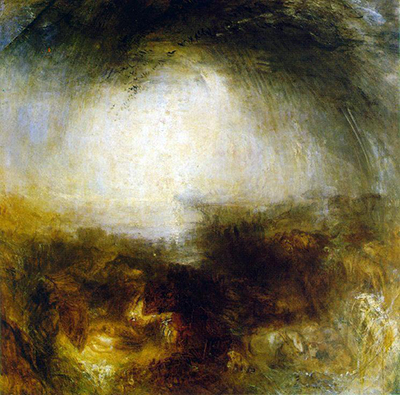
The first thing visible in Shade and Darkness - the Evening of the Deluge is not Noah, the ark or the Flood. It is a pressure of light enclosed by darkness. A broad pallor opens near the centre of the canvas, while blue-grey shadow gathers at the upper left and a heavier brown-black sweep advances across the top and right. Small birds curve through this unstable sky. Below, animals, people, water and timber are crowded into a darkened zone where one form repeatedly dissolves into another. Turner makes recognition arrive slowly, as if seeing itself were struggling against the catastrophe.
This difficulty is the painting's method rather than a failure of description. The title supplies a time, an event and a moral atmosphere: evening before or during the biblical Deluge, when warning has gone unheeded and the old world is about to disappear. Turner's lines in the 1843 Royal Academy catalogue add a moon, disturbed birds, beasts wading towards the ark and a giant structure beginning to float.[4] Once those clues are known, the lower confusion starts to disclose life in motion. Yet no single figure becomes dominant. The work asks viewers to search among endangered creatures while the storm's circular force keeps drawing attention away from them.
Tate preserves the oil as N00531 under the title Turner used when he exhibited it in 1843.[1] Its canvas measures 78.7 by 78.1 centimetres, almost a square, and entered the national collection through the Turner Bequest in 1856.[2] It was conceived as the companion to Light and Colour (Goethe's Theory) - the Morning after the Deluge - Moses Writing the Book of Genesis, N00532. Tate describes the pair as an opposition of cool and warm colour and of the emotional associations discussed in Goethe's Theory of Colours.[3]
The result is biblical history painting joined to an experiment in perception. The Flood is not merely represented by dark clouds and rising water. It occurs in the act of looking: outlines disappear, categories become uncertain and a crowded world approaches visual extinction. At the same time, Turner's birds, beasts and flashes of human presence resist complete erasure. The painting is dark, but not empty; obscure, but never indifferent to the lives entering its shadow.
At a Glance
- ArtistJoseph Mallord William Turner
- TitleShade and Darkness - the Evening of the Deluge
- ExhibitedRoyal Academy, 1843
- Catalogue number363
- MediumOil paint on canvas
- Dimensions78.7 × 78.1 cm
- CollectionTate
- AccessionN00531
- ProvenanceTurner Bequest, accepted 1856
- PendantLight and Colour, Tate N00532
Joseph Mallord William Turner exhibited Shade and Darkness at the Royal Academy in London in 1843, when he was sixty-eight. The catalogue assigned it number 363. Its companion, Light and Colour, appeared as number 385.[5] Both were oils on near-square canvases and both carried lines credited to Turner's supposed unpublished poem Fallacies of Hope. They belong to the artist's final decade, when he repeatedly tested circular and octagonal fields, compressed literary subjects and increasingly conspicuous paint handling.[19][20]
The evening canvas is organised around a pale central expanse rather than a sharply bounded moon. An arc of birds enters from the left and climbs into the darkness above. Cloud appears to fold around the light, creating a loose rotational movement. Across the bottom, dark earth colours, slate blue, dirty white and small accents of warmer paint suggest inundated ground or water filled with bodies, animals and debris. A large, roughly horizontal structure occupies the lower middle distance and can be associated with the ark described in Turner's verse.
The exact scene is deliberately compressed. Genesis describes animals entering the ark before the rain, the waters rising after Noah's family is enclosed, and the vessel lifting only when the Flood increases.[14] Turner brings warning, migration and flotation together. His evening is therefore not a documentary instant. It is a threshold assembled from several stages of the story, with safety and destruction present at once.
The work has sometimes been reproduced or discussed beside another Turner oil called The Evening of the Deluge, now in the National Gallery of Art in Washington. That is a separate painting, about 76 centimetres square, with a distinct provenance and the accession number 1960.6.40.[15] Its clearer central disc, arcing birds and animal forms make it a valuable comparison, but it is neither Tate N00531 nor the companion to Light and Colour.
Contents
- Introduction
- At a Glance
- Warning and Vulnerable Life
- Genesis, Verse and the Fallacies of Hope
- Returning to the Deluge
- Two Paintings, One Argument
- Goethe's Theory of Colours
- Turner as a Critical Reader
- Square, Octagon and Vortex
- Paint as Weather and Evidence
Warning and Vulnerable Life
Turner's central brightness initially appears open and almost calm. It is surrounded, however, by evidence of closing space. The blue region at upper left is hemmed in by descending grey. Across the top, dark cloud thickens towards the right, then bends downwards. The movement can be followed through streaks and broad changes of tone rather than through one clean contour. Light is not simply shining through a hole in cloud; it seems to be pressed, stained and narrowed by atmosphere.
The flock gives that pressure direction. Individual birds are no more than dark notches or quick bent strokes, but together they form a mobile chain. They rise from left of centre, curve upwards and vanish towards the upper middle. Turner's verse says that birds have left their nocturnal shelters screaming.[4] Their flight is therefore not the decorative passage often used to animate a landscape. It is a biological alarm. Creatures recognise danger that disobedient humanity has ignored.
The moon is more linguistic than diagrammatic. Turner's catalogue lines begin with a lunar sign of woe, yet the oil does not isolate a crisp silver circle. The warning has spread through the whole pale field. That distinction matters because a definite moon would act as an object within a sky; Turner's dispersed light acts upon the sky and upon every uncertain form below. It becomes an atmospheric condition.
Looking closely does not make all ambiguity disappear. It produces alternating moments of discovery and loss. A shape may read as the flank of an animal, then as foam or clouded water. A pale vertical mark may become a person for an instant before returning to paint. Such instability echoes the subject. The Flood destroys separations between land and water, shelter and exposure, familiar habitat and universal danger. Turner gives that dissolution a visual equivalent without removing every narrative clue.
The title's first two nouns also resist easy distinction. Shade can mean shelter from light, a cast shadow, a gradation of tone or even a ghost. Darkness can suggest the absence of illumination, physical obscurity or moral blindness. Turner places them side by side instead of allowing one to explain the other. Their overlap turns the painting into an inquiry: what remains visible when warning, colour and form are all passing into dark?
The lower third rewards patient attention. On the right, pale bodies with lowered heads and bent legs suggest large animals pressing forward. Some forms resemble horses or cattle; others remain less certain. Nearer the middle, black and brown masses gather beneath the ark-like horizontal form. On the left, angular timber, white flashes and congested bodies create a more agitated passage. No orderly procession advances two by two. The movement is crowded, frightened and hard to separate from the water around it.
Turner's animals are not incidental emblems. Genesis makes their preservation part of the covenantal structure of the Flood: representatives of living kinds enter with Noah so that life can continue after destruction.[14] The painting, however, concentrates on the danger before preservation is assured. Bodies wade rather than rest inside the vessel. Birds abandon shelter. The dark mass of the ark seems only partly accessible. Turner places creaturely vulnerability in the foreground of a story often reduced to a neat image of paired animals and a boat.
Human beings are even harder to isolate. Brief pale and reddish strokes near the lower centre may indicate figures directing, struggling or moving among the animals. Their scale is small and their actions are unresolved. Noah does not stand apart as a monumental patriarch receiving the procession. The absence of an obvious hero makes the scene collective. All terrestrial life is exposed to the same changing environment.
The ark itself is not a cleanly drawn ship. A long dark-edged shape crosses the middle of the lower zone, with a squarer raised mass near its centre. It may be the "giant framework" of Turner's verse, newly afloat, but cloud, hill, building and vessel remain entangled.[4] The uncertainty prevents the ark from becoming a reassuring destination. Its structural presence can be inferred without its security being visually guaranteed.
This compression also creates an ethical tension. Viewers know that the biblical vessel preserves a chosen remnant, yet most living things outside it will die. The eye searches for individual creatures because their forms are difficult to retain. Turner's obscurity is consequently not just spectacular atmosphere. It makes the scale of loss felt through repeated acts of attempted recognition.
Genesis, Verse and the Fallacies of Hope
The Flood narrative occupies Genesis 6 to 9. Human violence and corruption provoke divine judgment; Noah is instructed to construct an ark and preserve his household with animal life. The creatures enter, the rain begins, the deep opens and the waters increase until the ark floats. Life outside the vessel perishes. After the waters retreat, Noah leaves the ark, offers sacrifice and receives the covenant marked by the rainbow.[14]
Turner does not reproduce this sequence literally. His own verse gathers the unheeded moon, sleeping disobedience, closing water, floating framework, screaming birds and wading beasts into five accelerating lines.[4] In the biblical order, the animals have already entered when the rain begins, and the vessel rises only after the Flood is underway. The oil similarly fuses approach and catastrophe. This is less an error than a deliberate condensation of moral and natural crisis.
Evening is crucial to that condensation. It carries ordinary associations of closure, diminishing visibility and approaching sleep. Turner's disobedient humanity sleeps through a warning, converting evening rest into fatal inattention. Darkness is therefore both meteorological and ethical, but the painting does not distribute guilt simply. Animals suffer within a judgment directed at human corruption. Their alarm and movement make them responsive witnesses to a disaster they did not cause.
The companion begins after the Flood. Its full title introduces morning, Moses and the writing of Genesis, placing recollection and authorship after catastrophe. This is knowingly anachronistic: Moses belongs far later than Noah within biblical chronology. Nicholas Mirzoeff argues that this temporal instability matters, because Turner makes the event and its future record coexist.[12] The evening painting performs a related compression in the opposite direction. Warning, destruction and possible rescue are simultaneous.
Turner's Flood should therefore be read as sacred history transformed through poetic structure, not as an archaeological reconstruction or a claim about geology. The image takes the biblical narrative's moral scale and tests how painting can hold it. Rising water becomes the loss of stable ground; divine warning becomes dispersed light; universal peril becomes a field in which every body is difficult to keep in view.
The Royal Academy catalogue did more than name the work. Turner appended lines in which the moon issues an ignored sign, disobedience sleeps, the darkening Flood closes around the world, the ark begins to float, birds flee their shelters and beasts wade towards safety.[4] The passage supplies actions that the oil withholds from immediate recognition. Text and image depend upon each other without saying exactly the same thing.
Turner credited the lines to Fallacies of Hope, M.S., as he did with verses attached to many exhibited works. He began using that attribution in 1812 and continued almost to the end of his exhibiting career. No complete handwritten work bearing the title was found after his death. Jerrold Ziff concluded that Fallacies of Hope probably never existed as one continuous body of poetry, although Turner certainly wrote verse and repeatedly used the phrase.[16]
That uncertainty suits Shade and Darkness. Hope is present in the ark, the preservation of animals and the known continuation of the biblical story, but it is neither easy nor secure. The moon warns, yet nobody heeds it. The birds respond, but their flight offers no guaranteed refuge. The beasts move towards the vessel only as water rises. Each possible sign of rescue is accompanied by evidence that rescue may come too late.
The verse also changes the relation between obscurity and intention. An 1843 critic needed the title's clue before discerning beasts going towards the ark.[5] Turner's words acknowledge that the scene might not be read unaided, then convert that delay into part of the subject. The viewer resembles the sleepers in the poem, slow to recognise signs already present.
It would be misleading, however, to treat the lines as a code that solves the painting. They do not identify every form, fix the position of Noah or explain the precise relationship between ark and floodwater. Instead they establish a field of expectation. Birds, beasts and framework become visible because language directs attention, while the paint continues to resist certainty. Turner makes poetry an active companion to looking rather than a caption that closes interpretation.
Returning to the Deluge
Turner had painted The Deluge nearly four decades earlier. The large oil, exhibited in 1805, measures approximately 142.9 by 235.6 centimetres and presents desperate human suffering within a broad historical landscape.[13] It belongs to the ambitious phase in which Turner used biblical and poetic subjects to claim the elevated territory traditionally reserved for figure painters.
The early work makes bodies and actions comparatively legible. Figures struggle in water; groups cling together; physical rescue and abandonment can be followed across an expansive horizontal stage. Its severity was associated with the seventeenth-century example of Nicolas Poussin and with the sublime language of Milton. The work treats the Flood as an immense event occurring to recognisable human bodies in a constructed world.
In 1843 Turner returned to the same catastrophe but altered every basic condition. The canvas became intimate and near-square. The horizon lost stability. Human figures diminished. Animals and birds carried more of the narrative. Colour polarity and atmospheric rotation replaced the earlier distribution of figure groups across a panorama. The subject moved from the spectacle of inundation towards the difficulty of perceiving a world as it disappears.
This was not abandonment of history painting. Tate's account explicitly describes the pair as a return to the historical sublime mastered in Turner's earliest exhibition pictures.[3] What changed was the means by which history became present. Instead of depending upon clearly modelled bodies and a sequence of gestures, Turner allowed light, shade, colour and paint movement to bear intellectual weight.
The long interval also prevents a simplistic story of late dissolution. Turner had been interested in Deluge imagery, mortality and elemental force throughout his career. His final-decade treatment is radical because it renews an old concern through a different visual language. The early and late canvases show continuity of ambition alongside transformation of form.
Two Paintings, One Argument
Shade and Darkness was designed to be encountered with Light and Colour. The titles divide evening from morning, coolness from warmth, darkening disaster from postdiluvian illumination. Tate connects this contrast directly to the emotional associations in Goethe's Theory of Colours.[3] Yet the pair is more unsettled than a diagram of despair followed by hope.
The companion is dominated by yellow, orange and red. A circular radiance encloses Moses writing Genesis, while bubbles or spectral forms evoke reflection, evaporation and prismatic colour. Turner's accompanying verse speaks of the returning sun drawing humid forms from the earth, but its promised signs are ephemeral: they rise, expand and die.[4] Morning brings visibility and record, yet its beauty remains transient.
The evening picture is correspondingly more than pure negation. Blue-grey and brown-black passages surround a pale centre rather than extinguishing it. Birds retain coordinated movement. Animals press towards shelter. The ark is difficult but not absent. Cool colour and darkness create anxiety, distance and contraction, while small warm notes continue within the lower turmoil.
Gerald Finley treats the pair as exceptionally complex historical landscapes in which religious narrative, colour theory and natural process are inseparable.[10][11] That complexity discourages a mechanical reading in which one canvas equals evil and the other equals redemption. The Flood destroys and preserves; morning renews and exposes mortality; darkness conceals while making light perceptible.
The pairing also changes the experience of each square. Seen alone, Shade and Darkness may seem to pull everything into a closing vortex. Beside its companion, that contraction becomes one phase in a larger cycle of dark and light, evening and morning, submersion and re-emergence. Turner creates meaning through opposition but refuses to let either pole remain pure.
Goethe's Theory of Colours
Goethe published Zur Farbenlehre in 1810. Charles Lock Eastlake's English translation, Theory of Colours, appeared in London in 1840, only three years before Turner's pair.[7] Eastlake acknowledged that Goethe's physical account of the spectrum opposed Newton and had met strong resistance, but he also argued that the book's observations and experiments deserved attention, especially for painting.
Goethe approached colour through experienced phenomena: afterimages, coloured shadows, turbid media, contrast and the effects of hues upon the observer. In one experiment, a pencil's shadow cast by candlelight at twilight appears blue because declining daylight illuminates it against a warm-tinted field. He proposed that colour is itself a degree of darkness and develops through relations among light, obscurity, medium and eye.[7]
His famous polarity table places yellow against blue. On the plus side he lists action, light, brightness, force, warmth, proximity and repulsion. On the minus side he lists negation, shadow, darkness, weakness, coldness, distance and attraction.[7] These are not simply pigment recipes. They connect optical appearance to spatial and emotional tendencies.
The Turner pair clearly engages this division. The morning canvas mobilises yellow-red warmth and expansion; the evening canvas leans towards blue, shadow, distance and contraction. The emotional effect is embodied rather than labelled. Warm colour seems to advance and envelop. Coolness recedes, while dark cloud draws the eye into an anxious circuit.
Goethe's work should not be described as modern physical optics or as a scientific victory over Newton. A history-of-science account distinguishes his exploratory experiments and symmetric colour circle from Newton's theory-oriented analysis of spectral light.[9] Goethe's value for artists lay particularly in perception, complementarity and affect. Turner could use those resources without accepting the whole argument or trying to settle a scientific controversy in oils.
Turner as a Critical Reader
Turner owned Eastlake's translation and annotated it extensively. Linda Shires identifies him as the British artist who engaged most directly with the edition, but stresses that his response included approval, suspicion, jokes and outright disagreement.[8] He had already studied colour through other writers and through decades of practice; Goethe did not suddenly teach an inexperienced painter how hues behave.
Some marginal comments are sharply practical. When Goethe describes the division of shadows around a raised hand, Turner objects that the stated effect would seem to produce two people from one. Faced with an argument about primary colours, he challenges the proposed emphasis on blue and yellow. He also recognises that separating colour from mathematical optics leaves a central question unresolved.[8]
Most relevant to the evening painting is his complaint that Goethe offered nothing adequate about shadow or shade considered pictorially or optically. Mirzoeff uses this note to argue that Turner treated darkness as an active force held in tension with light rather than as mere absence.[12] The title Shade and Darkness can therefore sound like an intervention in the theory, not only a selection from its minus column.
The canvas supports that reading. Darkness does not sit inertly around a completed light effect. It curves, descends, stains and redirects. Blue-grey shadow at the left is qualitatively different from the brown-black upper mass. The pale centre depends upon those differences, while the dark lower field generates intermittent colour and form. The relation is productive and unstable.
Turner's critical engagement also helps explain why the pendant is not a classroom demonstration. He applies Goethe's polarities, then complicates them with biblical time, mortality and moral warning. Theory becomes material for invention. The work asks what shade does in painting, how darkness acts upon colour and how an observer responds when illumination reveals too little or too late.
Square, Octagon and Vortex
The support is a near-square rectangle, not an octagon. Its exact measurements are 787 by 781 millimetres.[2] Yet the Spectator called both Deluge works "octagon-shaped" when reviewing them in 1843.[5] That contemporary perception has been connected with Turner's late experiments in framing square canvases through octagonal openings or presenting their imagery as an eight-sided field.[20]
An octagonal field mediates between square and circle. The square anchors an object to vertical and horizontal edges; the implied circle encourages rotation; the cut corners ease the transition between them. In Shade and Darkness, broad curving movement operates within a stable outer support. Cloud bends around the pale centre, the flock follows an arc and lower forms turn inward from both sides.
The word vortex is useful only if it remains connected to what Turner painted. This is not a diagram of fluid mechanics or a formless spiral. Its rotation is assembled from weather, flight, water, animals and brush direction. The eye circles because represented forces and painted marks repeatedly reinforce one another.
The format also alters historical scale. Turner's 1805 Deluge spreads disaster across a wide panorama.[13] The late square removes escape into lateral distance. Its crowded lower world is pressed beneath the encircling sky. A viewer cannot survey catastrophe from one end to the other but is held near the centre of its atmospheric action.
Late Turner has often been claimed as a precursor of abstraction, yet scholarship warns against allowing that modern category to erase literary subject, physical light and transformative natural force.[19] Here narrative is not discarded; it is made conditional upon sustained attention. Birds, beasts and ark matter precisely because they emerge from a structure that first appears almost self-sufficient as colour and movement.
Paint as Weather and Evidence
Turner's surface moves between thinness and density. In the central field, pale paint has been brushed, dragged and scumbled so that warmer and cooler layers remain partly visible through it. Across the upper darkness, directional strokes accumulate into cloud without smoothing away the movement of application. In the lower zone, abrupt lights strike animal flanks, water and figures, then break before contours can close.
Scumbling is especially important. A lighter, relatively opaque paint passed irregularly over a darker or differently coloured layer catches raised texture and leaves small openings. The result can suggest vapour, spray or light dispersed through atmosphere. Turner uses this broken coverage to make illumination feel material without turning it into a solid object.
General conservation research on his oils describes a preference for pale, absorbent grounds, frequent use of modified oil media, and a working vocabulary that could include transparent glazing, opaque body colour, scraping, rubbing and rapid later adjustment.[18] His long experience in watercolour also encouraged him to think through reserves, layered washes and the recovery of light. These broad findings help explain the visual range of Shade and Darkness.
They do not justify assigning a precise pigment recipe to this individual canvas. Without a published object-level technical study, it would be unsafe to name each blue, yellow or resinous medium as fact. What can be described securely is the visible organisation of the paint: cool and warm greys interact; pale layers partly veil darker ones; brush movement strengthens the circular composition; local touches make bodies appear and disappear.
The surface therefore performs two tasks. It represents unstable weather, and it records Turner's decisions. A bird exists as a bent stroke that remains visibly a stroke. An animal is modelled just enough to become a body while its edges merge with adjacent paint. The work does not ask viewers to forget its material construction. Recognition occurs through that construction.
The Royal Academy in 1843
The Royal Academy exhibition opened on 8 May 1843 and closed on 29 July. It contained 1,530 works by 789 artists.[6] London already offered many competing displays, and that summer the Fine Arts Commission also mounted a major exhibition of life-size cartoons for the decoration of the new Houses of Parliament.
The competition at Westminster intensified debate about national history painting. Artists were offered prizes and the prospect of public commissions for subjects from British history and literature. Catherine Roach notes that the Academy had long been criticised for failing to foster the highest genre, while the new contest appeared to give historical art a dedicated civic arena.[6]
Turner's Deluge pair entered this climate as historical paintings that barely resembled the large, figure-led designs promoted nearby. Their biblical subject was elevated and intellectually serious, but the canvases were relatively compact. Bodies were subordinated to atmosphere. Goethe's recent colour theory stood beside Genesis and Turner's own verse. The works asserted that landscape could address history through optical and emotional experience rather than through monumental anatomy alone.
Turner also exhibited large architecture, Venetian views and other luminous landscapes that year. The Spectator praised him as more splendid and intelligible than usual, admiring the sunlight, colour and atmosphere of his Venice paintings.[5] Against those recognisable successes, the Deluge pair seemed deliberately difficult. They preserved his reputation for eccentricity even while demonstrating exceptional control of chromatic contrast.
The Academy setting matters because the works were made for public comparison. Their numbers separated them in the catalogue and perhaps on the walls, but titles, format and colour demanded that they be remembered together. They were not private experiments accidentally exposed. Turner placed a demanding visual argument inside the most prominent annual arena for British art.
Critics Confront the Pair
The Spectator review of 13 May offers unusually direct evidence of first encounter. With help from the title, the critic could just discern animals travelling towards the ark in Shade and Darkness. The companion seemed even harder to decode. Both were called riddles and mocked as octagonal daubs, yet the reviewer also identified them as "chromatic harmonies" organised around cool and warm colour.[5]
That combination of ridicule and recognition is revealing. The critic understood the pairing's formal premise but rejected the price it demanded from narrative clarity. In conventional history painting, the title confirms an action already legible through bodies. Here the title had to teach the reviewer where to begin looking. What Turner treated as active participation could be experienced as exclusion.
Other responses were harsher. A later scholarly compilation records the Times dismissing the evening canvas as a ridiculous daub, the Morning Chronicle comparing the pair to atoms thrown together, and Blackwood's Edinburgh Magazine inventing grotesque comic stories for the indistinct animals and figures. The Athenaeum, though regretting Turner's excess, admitted that a poetic idea within the prismatic chaos could arrest attention and excite imagination.[22]
The mockery often depends upon forced identification. Critics stare into unstable marks, assign them absurd literal meanings and then blame the painter for the result. Their jokes inadvertently describe the work's central operation: the mind cannot resist trying to turn paint into bodies, even when certainty is impossible.
Reception should not be rewritten as simple philistinism confronted by a modern genius. The pair genuinely challenged established contracts between title, subject and representation. Its verse was obscure, its chronology compressed and its figures difficult. The important point is that negative criticism preserves the intensity of the encounter. Viewers recognised a chromatic system, felt the resistance of the imagery and argued about whether visual difficulty could carry sublime meaning.
The Other Evening of the Deluge
The National Gallery of Art in Washington owns a separate Turner canvas titled The Evening of the Deluge, dated about 1843. It measures 76 by 76 centimetres and entered the collection through the Timken bequest in 1960.[15] Earlier owners and sale catalogues used such titles as Animals Going into the Ark - Circle, The Deluge and The Eve of the Deluge.
Its composition shares key concerns with Tate's work. A pale yellow disc occupies the sky. Birds sweep around it in a long curve. An arched brown structure sits below, surrounded by loosely indicated vegetation, water, figures or animals. The Washington museum's visual description cautiously identifies possible outlines of a bear, crocodile and giraffe among the lower forms.[15]
The differences are equally instructive. The central disc is much clearer than the dispersed moonlight in N00531. The palette is warmer overall, with butter yellow, green, rust and wine red. The ark-like structure is more immediately grasped, and the animals can feel like spectral suggestions within a less crowded field. Tate's evening canvas is cooler, denser and more oppressive, with a heavier upper darkness and a lower world packed close to the edge.
The Washington provenance begins with the Reverend T. J. Judkin and passes through British, French and American owners before the Timken collection.[15] Tate N00531 remained with Turner and entered the national collection through his Bequest. These histories, dimensions and accessions rule out the common mistake of treating the two images as alternative photographs or titles for one object.
Their relationship is best kept open. The Washington painting proves that Turner explored the evening Deluge through more than one square canvas around 1843. It may clarify motifs, but it should not be called a preparatory study or discarded version without firmer evidence. Comparison reveals a painter testing how little definition birds, ark and animals require before a Flood narrative becomes visible.
Theft, Recovery and Return
In 1994 the two Tate Deluge paintings travelled to Frankfurt for Goethe and the Visual Arts at the Schirn Kunsthalle. On 28 July, thieves stole both Turners and Caspar David Friedrich's Nebelschwaden.[21] The pair's Goethe connection had brought them together for the exhibition; their physical pairing then continued through a major episode of loss.
The Tate received an insurance settlement and later paid to reacquire legal title to the works, allowing the institution to pursue their return. Official documents released in 2005 record payments of eight million pounds for title and 3.5 million pounds for recovery, alongside the much greater cultural and financial value restored to the national collection.[17]
Shade and Darkness was recovered in Germany in July 2000. The news remained confidential because negotiations concerning its companion were still active. Light and Colour returned in December 2002, allowing both recoveries to be announced. The paintings were reported to be out of their original frames but otherwise undamaged, and they returned to public display at Tate Britain in January 2003.[21]
This history does not explain Turner's original image and should not be used as a metaphor that overwhelms it. It does, however, demonstrate the practical importance of the pendant relationship. For years, the two canvases were absent together; one was then held from public view while efforts continued to recover the other. Their eventual return restored an argument that depends upon paired looking.
The episode also altered the works' institutional history without changing their identity. They remained part of the Turner Bequest, held for the nation, even while physically missing and legally entangled. Recovery returned not only two valuable objects but a central experiment in British Romantic painting: evening and morning, darkness and light, warning and unstable renewal.
Why Shade and Darkness Matters
Shade and Darkness matters because Turner made historical landscape operate through delayed vision. The biblical event is present, but it is distributed across moonlight, birds, animals, human traces, water and the uncertain ark. No commanding protagonist organises the scene. The viewer must build meaning from signs that the surrounding atmosphere is already eroding.
The painting also gives colour theory moral and temporal depth. Goethe's polarities offered Turner a language of yellow and blue, warmth and coldness, proximity and distance, light and shadow.[7] Turner used that structure while questioning its adequacy. Darkness became active; shade acquired optical and ghostly force; cool and warm ceased to be simple labels and entered a cycle of destruction and renewal.
Its difficulty is therefore exacting rather than vague. The near-square support confines the field. Curving cloud and birds establish rotation. Scumbled pale paint generates dispersed illumination. Darker strokes press down from above. Small lower accents repeatedly begin the recognition of bodies. Every major formal choice contributes to the experience of a warning perceived under pressure.
The work is equally important within Turner's career. It returns to a subject he had treated monumentally in 1805, but replaces panoramic staging with a concentrated late language.[13] It joins biblical poetry, contemporary theory, old concerns with the sublime and material experiment. The radical appearance of 1843 grew from continuity as much as rupture.
Most of all, the painting asks what it means to see a catastrophe before it is too late. Turner's sleeping disobedience ignores the moon, while birds and beasts respond. Modern viewers arrive knowing the title and outcome, yet still take time to discern the signs. That delay places them uncomfortably close to the moral condition the image describes.
The darkness never becomes total. Pale atmosphere remains open at the centre; the flock retains its arc; animals continue towards the vessel. But light does not guarantee understanding, and survival is not evenly distributed. Turner holds warning, beauty, fear and hope in one unstable field. The painting endures because none of those forces cancels the others.
Discussion
How does delayed recognition turn the Deluge's warning into an experience of looking?
Reader Insights
Which birds, animals or ark-like forms become legible first?
How do cool darkness and pale moonlight resist a simple despair-and-hope binary?
How do square support, implied octagon and vortex movement work together?
Join the Conversation
Share a close observation or a source-based question for other readers.
References
- Tate, *Shade and Darkness - the Evening of the Deluge*, N00531. https://www.tate.org.uk/art/artworks/turner-shade-and-darkness-the-evening-of-the-deluge-n00531
- ACMI, Tate loan record for *Shade and Darkness - the Evening of the Deluge*. https://www.acmi.net.au/works/120219--shade-and-darkness-the-evening-of-the-deluge/
- Tate, collection text for *Shade and Darkness - the Evening of the Deluge*. https://shop.tate.org.uk/jmw-turner-shade-and-darkness---the-evening-of-the-deluge/turner1402.html
- Lawrence Gowing, *Turner: Imagination and Reality*, Museum of Modern Art, 1966, catalogue nos. 28-29. https://assets.moma.org/documents/moma_catalogue_2572_300062313.pdf
- "Fine Arts: Royal Academy Exhibition," *The Spectator*, 13 May 1843, pp. 19-20. https://archive.spectator.co.uk/article/13th-may-1843/19/fine-arts
- Catherine Roach, "1843: The Royal Academy and the Westminster Cartoon Exhibition," in *The Royal Academy of Arts Summer Exhibition: A Chronicle, 1769-2018*, Paul Mellon Centre, 2018. https://chronicle250.com/1843
- Johann Wolfgang von Goethe, *Theory of Colours*, translated by Charles Lock Eastlake, John Murray, 1840. https://www.gutenberg.org/cache/epub/50572/pg50572-images.html
- Linda M. Shires, "Color Theory - Charles Lock Eastlake's 1840 Translation of Johann Wolfgang von Goethe's Zur Farbenlehre," BRANCH. https://branchcollective.org/?ps_articles=linda-m-shires-color-theory-charles-lock-eastlakes-1840-translation-of-johann-wolfgang-von-goethes-zur-farbenlehre-theory-of-colours
- Friedrich Steinle and Hakim Al-Hafiz, "Exploratory Experimentation: Goethe, Land, and Color Theory," *Physics Today*, vol. 55, no. 7, 2002. https://physicstoday.aip.org/features/exploratory-experimentation-goethe-land-and-color-theory
- Gerald Finley, *Angel in the Sun: Turner's Vision of History*, chapter 12, "The dark'ening Deluge," McGill-Queen's University Press, 1999, pp. 200-208. https://www.jstor.org/stable/j.ctt80v2x
- Gerald Finley, "Pigment into Light: Turner, and Goethe's Theory of Colours," *European Romantic Review*, vol. 2, no. 1, 1991, pp. 39-60. https://openbibart.fr/vibad/index.php?action=getRecordDetail&idt=oba_0415684&lang=en
- Nicholas Mirzoeff, "On Visuality," *Journal of Visual Culture*, vol. 5, no. 1, 2006, pp. 53-79. https://www.ces.uc.pt/ficheiros2/files/MirzoeffNicholas_On%20VIsuality_2006.pdf
- ACMI, Tate loan record for J. M. W. Turner, *The Deluge*, 1805. https://www.acmi.net.au/works/120195--the-deluge/
- *The Bible*, Genesis 7-9, NIV text via Bible Gateway. https://www.biblegateway.com/passage/?search=Genesis7-9&version=NIV
- National Gallery of Art, Washington, J. M. W. Turner, *The Evening of the Deluge*, 1960.6.40. https://www.nga.gov/artworks/46064-evening-deluge
- Jerrold Ziff, "John Langhorne and Turner's 'Fallacies of Hope'," *Journal of the Warburg and Courtauld Institutes*, vol. 27, 1964, p. 340. https://doi.org/10.2307/750532
- Tate, "Consent Order enables Tate to put documents relating to stolen Turners in public domain," 16 December 2005. https://www.tate.org.uk/press/press-releases/consent-order-enables-tate-put-documents-relating-stolen-turners-public-domain
- Joyce H. Townsend, "Painting Techniques and Materials of Turner and Other British Artists 1775-1875," in *Historical Painting Techniques, Materials, and Studio Practice*, Getty Conservation Institute, 1995. https://www.getty.edu/publications/resources/virtuallibrary/0892363223.pdf
- Nancy Rose Marshall, review of *J.M.W. Turner*, CAA Reviews, 2008. https://www.caareviews.org/reviews/1210
- David Blayney Brown, Amy Concannon, Sam Smiles and others, *Late Turner: Painting Set Free*, Tate Publishing, 2014. https://shop.tate.org.uk/late-turner-painting-set-free-/15144.html
- Louise Jury, "Back from the underworld: Tate's £24m Turner prize," *The Independent*, 20 December 2002. https://www.the-independent.com/news/uk/home-news/back-from-the-underworld-tate-s-aps24m-turner-prize-136920.html
- *Impressionism, Post-Impressionism and Fauvism* teaching notes, September 2016, pp. 9-10. https://www.shafe.co.uk/wp-content/uploads/02-Impressionism-Post-Impressionism-and-Fauvism.pdf