 by Tom Gurney
Tom Gurney BSc (Hons) is an art history expert with over 20 years experience
Published on June 19, 2020 / Updated on August 29, 2026
Email: tomgurney1@gmail.com / Phone: +44 7429 011000
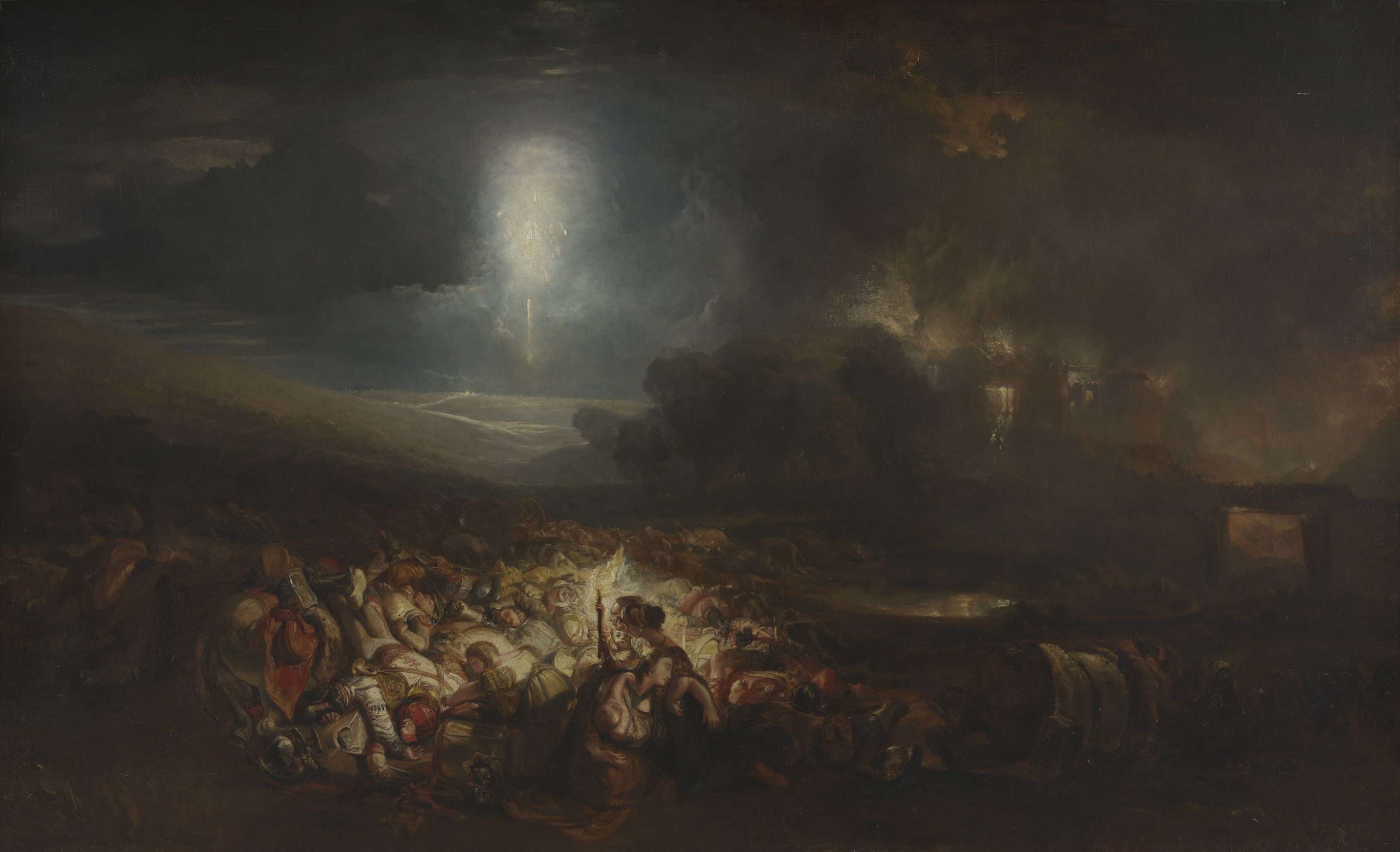
J. M. W. Turner's The Field of Waterloo is a victory picture from which victory has almost disappeared. There is no mounted commander, no decisive charge and no orderly review of surviving troops. The Battle of Waterloo had ended Napoleon's return to power and entered British public culture as a national triumph. Turner chose the ground after combat, when distinctions between victor and defeated had collapsed into a heap of human and animal bodies.
The painting was exhibited at the Royal Academy in 1818, three years after the battle and one year after Turner visited Waterloo. It is an oil on canvas measuring 147.3 by 238.8 centimetres, now Tate N00500. Its unusual breadth gives it the physical authority of a major history painting, but the people who occupy that scale are the dead, wounded and bereaved rather than the generals who directed them.[1][2]
A flare or rocket hangs high in a dark sky. Hougoumont burns in the distance. In the foreground, women and children search by torchlight among soldiers and horses. These three human-made lights do not clarify everything they touch. They reveal fragments: a face, a red coat, tartan, pale cloth, a limb, a weapon, the head of a horse. Illumination makes knowledge possible while showing how incomplete it must remain.[3][22]
Turner had not witnessed the battle or its immediate aftermath. He travelled to the field on 16 August 1817, studied its terrain, consulted a guidebook, filled sketchbook leaves and examined military dress. He then combined observation with testimony, print culture, Lord Byron's poetry and artistic invention. The resulting canvas is historically informed without pretending to be an eyewitness report.[6][8][10]
Its argument is anti-triumphal rather than simply documentary. Bodies of different armies are “in one red burial blent,” as the stanza from Childe Harold's Pilgrimage printed beneath Turner's Royal Academy entry declared.[4][5] National history is not denied, but it is made answerable to physical consequence. The political importance of Waterloo remains outside the frame; within it, victory is measured against the people, animals, buildings and earth consumed to obtain it.
The Morning After Victory
The Battle of Waterloo was fought on Sunday 18 June 1815. By nightfall Napoleon's army had broken, Wellington's Anglo-Allied force still held the ridge of Mont-Saint-Jean, and Prussian intervention had helped turn French retreat into defeat. News travelled rapidly. In Britain, the battle became the culminating event of more than two decades of revolutionary and Napoleonic war.[11]
Public commemoration converted that result into names, objects and ceremonies. Dispatches were read aloud; medals and prints circulated; captured possessions became relics; Waterloo entered street names and consumer culture. The Royal Collection preserves the density of this commemorative world, in which material objects associated with Napoleon and the campaign could turn recent violence into dynastic and national memory.[18]
Turner's painting begins where that conversion becomes difficult. A battlefield after dark cannot easily be arranged as a public lesson in command. Orders have ceased to structure the scene. Uniforms remain, yet bodies cross one another so densely that nationality and rank can no longer produce a stable hierarchy. A horse and rider do not enact disciplined movement; both have fallen into the same material field.
The date matters because Turner's subject is not timeless catastrophe. The burning farm, military clothing and chosen title locate a particular event. His work depends upon the viewer recognising Waterloo as a victory and then experiencing the gulf between the word and the scene. Historical specificity sharpens, rather than restricts, its moral force.
The temporal setting is less exact. The aerial flare, burning Hougoumont and searching group suggest night during or soon after combat, but Turner does not fix one documented minute. Hougoumont began burning amid the fighting, while the search for missing men evokes the hours after it. Different phases are brought together to make an intelligible aftermath.
That compression resists a familiar narrative progression from danger to resolution. The battle may be over politically, but the human event has not ended. Wounds, identification, mourning, burial and memory are still beginning. Turner asks what history looks like before its disorder has been removed.
A Wide Field Under a Dark Sky
The canvas is nearly two and a half metres across. Its width promises a panoramic view, yet Turner blocks the easy survey associated with military maps and elevated command. The horizon lies low. A massive sky occupies much of the upper surface, while the closest strip is congested with bodies. The eye can travel laterally, but it cannot master the field.[3]
The brightest aerial mark appears left of centre. A white flare hangs above a pale vertical fall of light, joining sky and ground without making either fully legible. It is an artificial signal, not a benign moon and not the forked lightning visible in Turner's related watercolour. Its cold radiance creates a temporary corridor through darkness.
At centre-right, orange and red announce the burning buildings of Hougoumont. Smoke and night interrupt the architecture. Pale fragments suggest walls, roofs or reflected surfaces, but the farm is not offered as a neat landmark. It appears as matter being consumed, another casualty within the field.
The foreground torch supplies a smaller, warmer light. It belongs to the search group rather than to armies at a distance. Its function is immediate and bodily: someone holds illumination close enough to distinguish among the fallen. The circle it creates is narrow, emphasizing everything beyond its reach.
A receding light strip or road links foreground and distance. Wooded forms close portions of the middle ground, and small lights flicker near the right edge. These do not resolve into an inventory of named places. Turner uses topography as a framework while withholding the comprehensive clarity of a battlefield diagram.
The painting therefore moves between immense and intimate scales. Sky and fire suggest forces larger than any single person. At the lower edge, a child's face or a hand requires close attention. The breadth that might have celebrated armies instead gives space to repeated acts of looking, recognition and failure to recognise.
Turner also frustrates a smooth left-to-right reading. The flare pulls vision upward, the fire diverts it toward the right, and the foreground group forces it down again. Instead of following an army's advance, the eye circulates among separate emergencies. No visual course through the composition produces closure.
The skyline offers only intermittent orientation. Darkness consumes the intervals between wooded masses and pale structures, so distance feels both extensive and obstructed. That visual uncertainty is not the same as geographical carelessness. Turner has designed a field in which every available landmark has been altered by smoke, fire and night.
Contents
- The Morning After Victory
- A Wide Field Under a Dark Sky
- The Heap in the Foreground
- Women Searching Among the Fallen
- Three Human-Made Lights
- The Battle Behind the Image
- Hougoumont in Flames
- The Long Work of the Aftermath
- Turner's Journey to Waterloo
- A Guidebook in His Pocket
The Heap in the Foreground
The lower band is difficult to parse because Turner made entanglement its organising fact. Soldiers lie across, beside and partly beneath one another. Legs cross torsos; faces emerge beside packs and cloth; horses interrupt the human anatomy. What first appears to be one dark mass gradually discloses many bodies without becoming an orderly set of individuals.[3][19]
Colour offers partial clues. Red coats and areas of tartan point toward British and Scottish troops. Pale and dark uniforms, military caps and equipment suggest men from the French and other forces. These details show that Turner researched military appearance, but they do not justify assigning every fragment to a regiment. The Anglo-Allied army itself included troops of several nations, making any simple division between red British and dark French inadequate.[11]
No commander anchors the composition. Epaulettes, flags and weapons cannot establish a lasting chain of rank among compressed bodies. The refusal is significant within history painting, where the exemplary death of a named officer often converts collective violence into an intelligible sacrifice. Turner gives no single death that can stand for all the others.
Horses deepen the collapse of categories. A head, neck and limbs can be picked out among the lower-left and central forms, but the animal bodies are not scenic accessories. They occupy the same physical pile as the soldiers. Byron's line joins rider and horse before joining friend and foe; Turner turns that grammar into matter.[5]
Some figures may still be alive. Bent postures, open faces and the activity of the searchers make the boundary between corpse and wounded person uncertain. Such uncertainty was a practical horror after battle, when exhaustion, darkness and massive casualties could delay aid. The viewer cannot assume that stillness means death.
The heap also alters perspective. Because it presses against the lower edge, spectators seem to stand on the field rather than above it. There is no clean foreground platform from which to contemplate noble action. Looking becomes uncomfortably close to searching.
The compression denies the decorum often granted to the heroic corpse. No body receives an isolated contour, calm pose and sufficient surrounding space to become a monument. Even potentially expressive faces are interrupted by adjacent forms. Death is collective without becoming anonymous through mere distance.
At the same time, Turner's refusal to finish every contour can protect the victims from spectacle. The canvas conveys injury without converting each wound into an anatomical display. Its darkness is ethically double: it obstructs the viewer, but it also denies effortless consumption of suffering.
The horses deserve equal seriousness. Cavalry and transport made them essential to Napoleonic warfare, while artillery, musketry, exhaustion and collision exposed them to immense injury. Turner does not sentimentalise one noble animal. By weaving equine forms through human remains, he widens the constituency of suffering beyond those who chose, commanded or understood the battle.
That enlargement affects Byron's pairing of rider and horse. The bond created by military use ends in shared vulnerability, but the animal cannot be absorbed into national allegiance as readily as a uniformed soldier. Its body makes the field's violence at once historically specific and resistant to patriotic explanation.
Women Searching Among the Fallen
At the centre foreground, women and children create the painting's principal human drama. One woman appears to collapse or faint; another bends toward or supports her. A child is caught close to the group, and a figure behind them holds the torch. Their forms are small in relation to the canvas but visually concentrated by gesture and light.[1][20]
The group is often described as soldiers' wives searching for husbands or lovers. That reading expresses the emotional situation, but no record identifies each person or confirms one literal incident. Turner may have synthesised reports, conventional figures of mourning and his own invention. It is more accurate to understand them as civilian searchers and bereaved families than as portraits of documented women.
Their presence changes the social field of the picture. A military victory is normally narrated through combatants, rulers and public institutions. Turner introduces those who must discover what war has done after orders and formations cease. The search makes national consequence private without reducing it to one household.
The women are active as well as grieving. They enter dangerous darkness, lift a light, examine bodies and support one another. Even the collapsing figure belongs to a collective process of recognition. This is not simply a passive allegory placed beside masculine action; it is labour created by battle and largely omitted from heroic representation.
The child makes that consequence generational. Nothing in the image allows a secure statement about parentage, but the scale of the small body beside the adults is unmistakable. The future produced by victory includes children brought into direct contact with death.
Gender still operates symbolically. Women had long personified nations, grief and charity in European art. Turner can draw on that tradition while making the group plausible within the aftermath of a real campaign. Their force comes from inhabiting both registers: they are particular enough to search and general enough to expose the familial cost of public history.
Their location at the centre does not grant them conventional dominance. Bodies, darkness and reflected light threaten to absorb them. The precariousness makes their gestures more urgent. Human care is present, but it has no guarantee of finding the person sought or restoring the wounded person discovered.
The grouping also changes the spectator's imagined question. A heroic canvas asks who won, who commanded or who fell nobly. This group asks whom the women can identify and whether anyone can still be helped. Turner replaces an abstract verdict with an encounter whose answer differs for every body.
Three Human-Made Lights
Leo Costello identifies three created fires within the painting: the aerial flare or rocket, the burning of Hougoumont and the torch among the women.[22] Reading them together reveals more than a dramatic night effect. Each represents a different relation between human agency, visibility and destruction.
The flare is a military signal. Fired into the sky, it transforms atmosphere into an instrument and briefly exposes the ground below. Its height gives it apparent authority, yet its light is dispersed and unstable. It cannot restore order to the field it reveals.
Hougoumont's blaze is warfare becoming architectural ruin. Buildings meant to shelter people, animals and stores burn because a fortified farm has become a strategic strongpoint. The fire is both tactical history and a vision of human habitation consumed by organized violence.[13]
The torch is modest and restorative in intention. It does not destroy or command; it helps civilians identify, rescue or mourn. Yet it too is limited. Held close to the bodies, it makes a small circle of care within a darkness produced by forces far larger than its bearer.
Their colours and positions create an oblique triangle. Cold white light descends from the upper left, red-orange fire spreads on the right, and warm torchlight gathers near the lower centre. The structure carries the eye through sky, building and body. The whole battlefield is bound by forms of combustion.
Costello compares Turner's recurring use of fire with traditions in which illumination can mean divine presence, creative power or destruction. In Waterloo, no supernatural flame arrives to redeem the event. Every visible source has been made or released by people. The night is infernal because human action has transformed it.
The three lights also establish limits on interpretation. They reveal enough to distinguish grief from battle spectacle, but none becomes a universal illumination. Turner does not promise that art can make every dead person known. He turns partial visibility into the ethical condition of the work.
The Battle Behind the Image
Napoleon returned from Elba in March 1815 and rapidly regained power in France. Coalition armies gathered in the Netherlands. His strategy sought to divide Wellington's Anglo-Allied army from the Prussians under Gebhard Leberecht von Blucher and defeat them separately before larger forces could assemble.[11]
After engagements at Quatre Bras and Ligny on 16 June, Wellington withdrew to a ridge south of Waterloo. On 18 June, roughly 68,000 Anglo-Allied troops with about 156 guns faced a French army of approximately 72,000 with 246 guns. Around 48,000 Prussians would enter the battle as it developed. Such figures vary among accounts, but they convey the density of force compressed onto the terrain.[11]
Wellington's line occupied the Mont-Saint-Jean ridge. Three forward positions helped protect it: Hougoumont on the western side, La Haye Sainte near the centre and Papelotte toward the east. Mud from heavy rain delayed French movement and complicated artillery. Repeated infantry, cavalry and artillery attacks placed severe pressure on the Allied line.
Prussian forces arrived on Napoleon's flank during the afternoon. Late in the day, the defeat of the Imperial Guard damaged French morale and accelerated retreat. Coalition success ended the Hundred Days and led eventually to Napoleon's exile on Saint Helena.
Casualty totals depend on definitions and surviving records. The National Army Museum gives around 22,000 Allied casualties and nearly 40,000 French soldiers killed, wounded or captured. Waterloo Uncovered uses an estimate of up to 45,000 dead and wounded across the armies. Neither formulation should be converted into false precision.[11][14]
Turner does not illustrate this sequence tactically. The Prussian arrival, cavalry attacks and collapse of the Guard are absent. Yet knowledge of the battle clarifies the radical nature of his choice. He suppresses the moments that made victory legible and represents the shared physical result after strategy has done its work.
Hougoumont in Flames
Hougoumont was a walled chateau-farm in advance of Wellington's right. Its buildings, orchard, garden walls and woods gave defenders a position from which to obstruct French movement. Napoleon intended the assault there to divert Allied resources, but the struggle continued for much of the day and absorbed men in repeated attacks.[11]
British Guards and German troops defended the complex. French soldiers entered the courtyard briefly through the north gate, but the defenders closed it and retained the position. Hougoumont was never captured. Its endurance became one of the battle's celebrated episodes.
Celebration can conceal what defending a farm under bombardment meant. Buildings caught fire, including a barn, and wounded men were trapped in or near the complex. Smoke, flame, splintered timber and masonry made domestic architecture part of the battlefield. Modern investigation continues to recover evidence of intense fighting around the walls.[13][14]
Turner places the blaze in the distance rather than turning the gate struggle into a heroic centre. The farm is recognisable through context and location, but it appears damaged and unstable. Its red fire answers the body pile in the foreground: constructed shelter and living anatomy undergo parallel destruction.
An aquatint after James Rouse shows Hougoumont's burial ground after the battle, with civilians preparing a pyre.[13] It records a broader visual culture of aftermath in which burning extended beyond active combat. Turner need not have copied that image for the association between Hougoumont, flame, bodies and civilian labour to be historically grounded.
The painting cannot establish a precise minute or viewpoint for the burning complex. Its likely spatial relation to Hougoumont is enough. Turner reorganises scale and visibility so that fire can remain a distant historical landmark while the nearest consequence belongs to unnamed people.
The Long Work of the Aftermath
Battle did not end when formations retreated. Thousands of wounded people remained across fields, roads, farms and temporary hospitals. Darkness, exhausted medical personnel, limited transport and the sheer scale of injury made rapid treatment impossible. Some men lay through the night before help arrived.[12][15]
Mont-Saint-Jean became an important field hospital. Waterloo Uncovered estimates that roughly 6,000 wounded passed through it. Musket balls, artillery and edged weapons produced complex injuries. Amputation could prevent some deaths, but shock, blood loss and infection remained formidable dangers in an era before antiseptic surgery.[15]
The distinction between dead and living could be hard to establish in poor light. Clothing and possessions were searched or stripped; identification depended on papers, recognition and uniform details. Burial parties then faced a practical emergency. Pits, fires and other improvised measures treated bodies on a scale that exceeded ordinary funerary custom.
Animals and objects enlarged the task. Dead horses, broken weapons, cartridge materials, leather, cloth, wood and personal effects remained across cultivated land. What had been fields, roads and farmyards became an unstable mixture of organic remains and military debris.[14][23]
Turner's women belong to this prolonged history even if their exact arrangement is invented. They search within the period between combat and commemoration, when loss has not yet been named or ceremonially contained. The torch marks a form of aftercare that is physically immediate and socially unglamorous.
The canvas therefore represents aftermath as action, not emptiness. Searching, recognising, carrying, treating, stripping, burying and remembering follow the charge. By focusing on this labour, Turner extends the duration of war beyond the hours assigned to it in a battle chronology.
Early visual records reinforce the scale of the problem. An image in the National Army Museum shows the field on the following morning, placing scattered casualties and abandoned equipment within open terrain.[12] It belongs to a different representational tradition from Turner's nocturne, but both reject the idea that victory instantly cleared the ground.
Charlotte Anne Eaton, who visited Waterloo in the period after the battle, described damaged vegetation, relics and the way guides attached stories to particular locations.[17] Her account demonstrates how swiftly material evidence and narrated memory became inseparable. Visitors did not encounter untouched facts; they encountered a landscape interpreted for them.
Other early travellers reported human remains still protruding from the earth and stains associated with blood.[16] Such testimony must be read critically, since battlefield tourism rewarded horror and authenticity. Even with that caution, the persistence of bodily traces makes clear that burial did not create an immediate clean break between battle and pastoral land.
Modern archaeology approaches the aftermath through different evidence. Metal objects, building damage, human remains and spatial distributions can test inherited narratives, but excavation cannot recover every wounded person's movement or every civilian search. Turner's invented group occupies precisely that gap between aggregate history and irrecoverable experience.[14]
Contemporary descriptions also dwell on vegetation. Shattered trunks, torn branches, flattened crops and churned mud showed that fighting had passed through a worked rural environment.[17][23] Turner compresses those disturbances into dark woods, scorched architecture and an earth-like body mass rather than cataloguing botanical damage.
The difference between testimony and image should remain visible. Accounts can confirm that the field retained bodies, blood, debris and broken plants; they cannot prove Turner's precise torchlit gathering. His authority rests on responsible synthesis. He builds a scene adequate to documented conditions without falsely claiming that one observer recorded it exactly.
Turner's Journey to Waterloo
Continental travel became easier after peace returned. Turner left London on 10 August 1817, crossed to Ostend and travelled through Bruges, Ghent and Brussels. On Saturday 16 August he reached Waterloo, two years and two months after the battle. He then continued toward the Rhine and the Netherlands.[8][9]
This was not a journey devoted solely to military history. Four sketchbooks trace movement through towns, rivers, architecture and landscape: Itinerary Rhine Tour, Waterloo and Rhine, Rhine and Dort. The same expedition that supplied the battlefield also generated drawings for some of Turner's most luminous later views of the Rhine and Low Countries.[8]
At Waterloo, he explored on horseback and made numerous studies. Sotheby's records seventeen sketchbook leaves related to the field and its surroundings, while separate military studies contributed knowledge of uniforms. He noted positions and attempted calculations concerning the men killed at particular locations.[9]
These actions show serious historical preparation. They do not make Turner an eyewitness to 1815. By August 1817, cultivation, tourism and burial had changed the ground. His drawings record a remembered landscape bearing material traces rather than combat itself.
The delay may have strengthened the painting's concern with memory. Turner encountered a place already overlaid by guidebook narrative, relic hunting, local explanation and national expectation. The field was both real terrain and an emerging cultural object.
His journey after Waterloo also matters. He did not remain within a closed monument to war. The expedition continued along rivers, past fortresses and through landscapes carrying many earlier histories of conflict. The Field of Waterloo arose from travel in which modern battle and scenic experience occupied the same notebook sequence.
The combination challenges a retrospective division between Turner's scenic travel and his engagement with modern history. Waterloo was encountered between urban views and river landscapes, not in a sealed military archive. The tour taught him that beauty, commerce, fortification and remembered violence could occupy one continuous geography.
Sketching on horseback also imposed practical limits. Rapid notation could secure profiles, roads and relative positions, but not a finished night composition crowded with bodies. The journey supplied a spatial and mnemonic framework; the final arrangement required prolonged reconstruction in the studio.[9]
A Guidebook in His Pocket
Turner carried John Booth's edition of John Scott's account and George Campbell's New and Correct Guide to the Field of Waterloo. Research into his tour shows that the guide was in his pocket and that he copied practical information from it.[10] The fact makes his visit unusually recoverable while complicating any idea of solitary discovery.
Campbell helped visitors locate farms, roads, troop positions and prominent episodes. Such guides transformed terrain into a readable narrative. A traveller could stand at a viewpoint, identify where formations had moved and connect an apparently ordinary field with events described in print.
Turner used this apparatus but did not submit to it. His canvas contains no numbered key, labelled ridge or sequence of manoeuvres. The guidebook supplied orientation, while painting dismantled the detached authority of the tour. The spectator is moved from knowing where something happened to confronting what happened to bodies.
The guide itself became part of the journey's vulnerability. Notes indicate that it was lost with Turner's wallet and later recovered or recorded through correspondence.[10] Such mundane evidence places the artist within the practical realities of travel, far from the later myth of effortless visionary invention.
By 1817 Waterloo was already a destination. Visitors sought relics, bought accounts, hired guides and examined damaged buildings. The commercial and commemorative infrastructure around the field emerged almost immediately. Turner arrived as one participant in this culture, though his final image sharply questioned its potential for comfortable possession.[16][18]
Guidebook knowledge remains present as a suppressed foundation. Hougoumont can be recognised, the military dress is researched, and the field has spatial credibility. Yet the painting refuses to let information neutralise grief. It asks what remains after location and chronology have been learned.
Battlefield tourism could make violence available as possession. A relic carried home, a named viewpoint or a guide's anecdote allowed the visitor to claim proximity to an event not personally experienced. Waterloo's rapid conversion into an attraction shows that modern tourism and modern mass warfare developed overlapping economies of evidence.[16][18]
Turner participates in that economy while placing pressure upon it. He gathered facts and views, yet the oil offers no souvenir-like object that can contain the battle. Its bodies exceed the collecting impulse. Even the costumes that invite identification ultimately lead toward mixture rather than mastery.
The journey also complicates the relation between present peace and remembered war. In 1817 coaches, inns, guides and agricultural activity had resumed around the battlefield. Turner could travel because conflict had ended, but his freedom of movement depended upon a political settlement achieved through the violence he reconstructed.
The field's apparent ordinariness was part of its shock. Crops could grow again where people had died in extraordinary numbers. A guide's narration reactivated hidden violence for the visitor, just as title and Byron stanza reactivate the darkness of Turner's painted ground. In both experiences, knowledge changes what an otherwise obscure mark can mean.
The Fitzwilliam Watercolour
A watercolour now in the Fitzwilliam Museum was made around 1817 and gives the clearest surviving companion to Turner's battlefield investigation. It measures 28.8 by 40.5 centimetres, bears a J Whatman 1814 watermark and later belonged to Walter Fawkes. It is not a reduced copy of the 1818 oil.[6][7]
The watercolour opens the field under a storm-filled daytime sky. Forked lightning descends at the left. A road carries the eye into depth, while bodies, abandoned material and an overturned cannon occupy the terrain. Marks on the cannon have been associated with George III and perhaps Napoleon, making political emblems part of damaged equipment.[6]
Buildings in the distance have been identified differently, with Hougoumont and La Haye Sainte among the possibilities. That uncertainty is instructive. Turner was testing how topographical fragments, weather and debris could carry historical memory before he fixed the oil's darker arrangement.
The distinction between the two works must remain firm. Lightning belongs to the watercolour's storm. The high light in the oil is an aerial flare or rocket. To call it lightning would import one design's meteorology into another and erase the later painting's insistence on human-made illumination.[22]
The change from open field to compressed foreground is equally important. The watercolour permits movement along the road and across exposed ground. The oil pushes bodies toward the spectator and encloses distance within darkness. What began as a haunted topographical view became a monumental encounter with casualties and searchers.
Fawkes's ownership places the study within Turner's close relationship with a patron who collected his watercolours and encouraged experimental work. Its later bequest to the Fitzwilliam preserved an independent stage of thought. Viewed beside the oil, it demonstrates development rather than preliminary obedience: Turner reconsidered weather, scale, time, human presence and the very source of light.
The watermark provides a material lower boundary for the sheet, while the circa-1817 dating ties it closely to the journey.[7] Such evidence is more reliable than assuming every Waterloo drawing was executed while Turner stood on the field. Work could continue through recollection and synthesis after travel.
The open road in the watercolour retains something of the visitor's approach. The oil abolishes that comfortable entry by filling the nearest ground. Together the works stage two positions: the traveller arriving to inspect a famous location, and the witness imagined within the consequences that made it famous.
Uniforms, Equipment and Research
Turner's refusal of heroism should not be mistaken for indifference to fact. The Guards and Waterloo-related sketchbooks contain studies of military clothing and equipment. Tartan, caps, coats and accoutrements in the oil allow viewers to detect several participating forces within the foreground mass.[9][19]
The tartan identifies Scottish presence without securely naming every regiment. Red coats evoke British infantry, while French caps and contrasting uniforms register opponents. Because Wellington's army included British, Dutch, Belgian, German and other contingents, nationality cannot be reduced to two colour codes.[11]
Historical detail performs a paradoxical task. It first differentiates bodies, proving that the heap contains men from distinct military organisations. Their physical overlap then defeats the hierarchy those organisations created. Uniform survives as evidence while losing its power to separate the dead.
Equipment works similarly. Packs, weapons and cloth indicate the practical load of campaigning. In battle imagery, a polished weapon can signify courage or command. Here objects have fallen out of use. They lie among limbs as debris, their functions suspended.
Turner's annotations and calculations concerning casualties show an attempt to grasp scale through number.[9] Painting takes a different method. Rather than render thousands of tiny figures, he makes a concentrated pile stand for losses that cannot be pictured individually. Numerical magnitude and bodily proximity become complementary forms of knowledge.
This tension helps explain why the foreground is neither a literal census nor a generic mound. Each discovered cap, coat or face asserts difference, while the whole defeats counting. Turner gives enough particularity to prevent “casualties” from becoming an empty statistic and enough compression to suggest loss beyond enumeration.
The result is neither exact reportage nor vague symbolism. Researched distinctions establish the historical credibility needed for their collapse to matter. Friend and foe can blend only after the canvas has shown that there were real differences to blend.
Byron's One Red Burial
Turner exhibited the painting with stanza 28 from Canto III of Lord Byron's Childe Harold's Pilgrimage. The Royal Academy catalogue printed all nine lines beneath entry 263, giving visitors an unusually extensive verbal frame.[4][5]
Byron compresses the battle into a sequence of times. Noon finds the soldiers vigorous and alive. Evening sees them lively still. Midnight brings the signal, morning the call to arms, and day the encounter. Before night returns, earth has covered those who had stood upon it.
The stanza's temporal acceleration supplies a structure Turner could not represent literally in one image. Flare, fire and aftermath gather several moments into darkness, while the poem carries the audience from ordinary vitality to mass death. Speed makes the transformation more violent.
Its final line is decisive: “Rider and horse,—friend, foe,—in one red burial blent!”[5] Turner translates each paired collapse. Horses and people occupy the same heap. Uniforms indicate opposing armies but do not maintain separation. Red can mean military cloth, fire, blood or the atmosphere of slaughter.
Byron's preceding image of clay deepens the relation between body and ground. The earth is covered with “other clay,” and the soldiers' own clay covers them. Human material returns to soil, a process Turner's dense browns, greys and bodily overlaps make visible.[5][23]
The poem does not merely caption the canvas. It directs interpretation toward shared mortality and supplies a rhythm of before and after. Turner answers with things Byron leaves less developed: women searching, Hougoumont burning, limited light and the physical texture of the field.
Their relation also complicates patriotism. Byron acknowledges the battle's magnitude while refusing a simple hymn to national glory. By choosing this passage rather than lines naming Wellington or condemning Napoleon, Turner foregrounded transformation from life to matter.
The stanza begins with ordinary bodily energy rather than public identity. The men are “full of lusty life”; they dine, move and anticipate. Their reduction to clay is powerful because Byron first restores what retrospective military language can erase: before they were casualties, they inhabited a present that did not feel completed.[5]
Turner's searchers extend that temporal reversal. Their task is to recover an individual from the category of dead or missing. The poem moves many living people rapidly toward one burial; the painting makes survivors move slowly back through that collective mass in pursuit of one known face.
Number 263 at the Royal Academy
The 1818 Royal Academy catalogue listed The Field of Waterloo as number 263. Turner's other exhibited oils included Raby Castle at 129 and the large Dutch marine Dort, or Dordrecht at 166.[4] The range joined British estate landscape, Dutch maritime history and recent European war.
The exact catalogue entry matters because the Byron stanza was part of the first public encounter. Visitors did not have to discover the literary association later. Title and verse directed them toward a battlefield after action and toward bodies whose former allegiances had been mixed by death.
The Royal Academy exhibition was crowded and competitive. Large canvases were hung among hundreds of works, and written reviews helped determine what distant viewers believed they saw. Turner's darkness, compressed anatomy and unconventional focus demanded sustained attention under conditions that did not guarantee it.
The scale asserted the work's claim to serious history painting. Its dimensions exceeded those of an intimate cabinet picture and approached the public ambitions of battle art. Yet the canvas withheld the usual reward of that size. No principal hero offers an emotional or compositional centre.
Turner also retained the painting. It did not pass into a celebratory commission or an officer's collection after the exhibition. Remaining in his possession, it eventually entered the national collection through the Turner Bequest, accepted in 1856.[1]
That ownership history extends the original paradox. A work questioning the human price of a national triumph became part of the nation's Turner inheritance. Public memory acquired not only an image of victory but a resistant account of what the word excludes.
In 1816 the British Institution offered a prize of one thousand guineas for large paintings illustrating recent British successes. The invitation encouraged artists to turn Waterloo and other victories into modern national history. Turner did not submit a canvas to the competition and did not win it.[19][20]
The distinction matters because later summaries sometimes draw his painting too directly into the prize. The 1818 work emerged within the same cultural pressure for elevated contemporary subjects, but it was independently exhibited at the Royal Academy. Its distance from the commission helped Turner reverse expectations attached to battle painting.
A conventional victory image might identify the decisive command, present disciplined troops and organise death around purposeful sacrifice. The spectator would learn why the outcome occurred and whom to honour. Turner supplies battlefield scale while removing that explanatory centre.
Women and children displace generals. A burning farm displaces a triumphal landmark. A flare illuminates a body pile rather than a manoeuvre. The work does not deny courage or strategic importance, but it refuses to let either absorb every consequence.
This refusal differs from a declaration of modern pacifism. Turner's precise political beliefs cannot be deduced from one canvas, and opposition to triumphal representation is not identical to opposition to every war. “Anti-heroic” and “anti-triumphal” describe what the composition demonstrably does without inventing a complete ideology.
The painting's seriousness lies in that measured challenge. It enters the grand genre on its own scale and then asks whether national success can be represented honestly without the bodies on which it rests.
The competition context also reveals that subject selection was never politically neutral. To paint a recent British victory on a monumental canvas was to enter debates about patronage, public honour and the status of modern history. Turner's independent exhibition allowed him to claim importance without accepting a prescribed celebratory solution.
David Wilkie's later Chelsea Pensioners Reading the Waterloo Dispatch offered another influential model of commemoration: civilians and veterans gather around news of victory, making reception itself the subject.[20] Turner's field and Wilkie's social gathering occupy opposite ends of the event. One shows information creating communal celebration; the other returns beneath information to physical loss.
Neither comparison makes Turner indifferent to public culture. On the contrary, Waterloo depends upon an audience saturated with the battle's fame. Its reversal works because spectators arrive expecting a story whose victorious ending they already know.
Painting Darkness and Recognition
The present surface is dominated by deep browns, blacks, smoky greys and interrupted warm light. Age, varnish history and reproduction affect what can now be seen, so the exact original saturation should not be reconstructed through guesswork. The surviving image nevertheless preserves Turner's basic economy of obscurity and revelation.[3]
Forms emerge through local contrast rather than continuous outline. A pale face appears beside dark cloth; red catches torchlight; tartan becomes briefly legible; a white shape turns into a sleeve or limb. Other marks resist identification. The act of viewing repeats the search performed within the image.
Paint binds categories before iconography separates them. Smoke crosses sky and building. Earth-coloured passages move between soil, uniform, flesh and animal body. The same red can belong to fire, coat or blood. Turner uses resemblance among materials to undermine the fantasy that war leaves clean conceptual divisions.
A Field Made from Bodies
Simon Oliver describes an ecology of conflict in which people, horses, weapons, chemicals, vegetation and ground become materially entangled.[23] Turner's foreground anticipates that understanding visually. The field is not a neutral stage bearing casualties. It has been remade by them.
This does not require every dark stroke to represent literal blood or decomposition. The stronger claim concerns composition: bodies occupy the land so completely that figure and ground cease to be independent systems. Byron's clay metaphor becomes a painted condition.[5]
Brushwork also resists the polished finish expected of legible historical narrative. Contours shift, forms overlap and illumination breaks continuity. What critics could dismiss as confusion is central to the subject. Clarity would falsify a night search among thousands of casualties.
Yet Turner avoids total formlessness. The women, flare, burning farm, uniforms and horses can be found. Recognition remains possible in fragments, and that possibility keeps the painting attached to specific human loss. Abstraction is approached through accumulation, not through indifference.
The broad format amplifies this procedure. A spectator cannot attend equally to the flare, fire, women and outer bodies in one fixed glance. Looking requires duration and movement. The canvas turns physical breadth into a sequence of discoveries without arranging those discoveries as a triumphal narrative.
Darkness therefore has structural, historical and emotional functions at once. It describes night, makes the signals visible, obstructs identification and prevents the dead from becoming decorative detail. No single explanation exhausts it, which is why reducing the surface to poor preservation or eccentric style misses the coherence of Turner's decision.
The far-right forms clarify the discipline required of a modern viewer. A warm rectangle and scattered low lights are visible, but their exact identities remain uncertain. Naming them as a wagon, tent or burial fire would make the description sound richer while weakening its evidential basis. Turner permits close looking without promising that every mark has retained a recoverable noun.
An Anti-Heroic History Painting
History painting traditionally occupied the highest rank within academic theory because it combined human action, moral significance and learned invention. Battle painting was one branch of that ambition. Turner's canvas claims the genre through scale, recent public importance, literary accompaniment and complex figure arrangement.
It then redistributes historical agency. Wellington, Napoleon and Blucher are necessary to explain the battle, but none appears. Unnamed soldiers, horses, women and a child carry the visible event. Command belongs to prior chronology; consequence belongs to the image.
The change is not simply democratic celebration of ordinary people. Most foreground soldiers cannot speak, act or be individually known. Their anonymity is the tragedy. Turner exposes how historical narrative depends upon multitudes whose names and experiences disappear beneath the actions of famous leaders.
The women's search offers a counter-form of history. Instead of directing armies across terrain, they move through bodies one by one. Their knowledge is intimate, uncertain and painful. A torch held near the ground opposes the distant perspective from which commanders and later historians survey operations.
Landscape also acquires agency without becoming supernatural judgment. Weather, darkness, mud, vegetation and distance condition what people can do and see. The flare and fire are human interventions into that environment, not signs that nature caused the catastrophe.[23]
Turner's achievement is to preserve the magnitude of public history while denying its usual visual hierarchy. Waterloo remains Waterloo, but the battle is understood from below command and after decision.
Critics Confront the Darkness
Contemporary reception was divided. One hostile description compared the painting to a “drunken hubbub on illumination night,” while another response praised it as a “terrific representation of the effects of war.”[21] The contrast shows how closely judgment depended on whether darkness and confusion were treated as failure or purpose.
Viewers expecting a clear military subject could find the anatomy and incident difficult. The bodies merge, the principal action is dispersed, and the night effect suppresses explanatory detail. Academic standards of finish gave critics a language for objecting to precisely the qualities that now appear integral.
The reference to illumination night was intended as ridicule. Public illuminations marked victories and celebrations with artificial light. Applied to Turner's flare and fires, the phrase inadvertently exposes the painting's reversal: festive brightness has become a means of discovering slaughter.
The more sympathetic description recognised “effects” in both senses. Turner represented visual effects of night, smoke and fire, but also the human effects produced by war. Atmospheric painting and ethical argument are inseparable.
Mixed reception should not be simplified into a heroic story in which Turner alone understood modernity and every critic failed. Objections record genuine difficulty in the work's first conditions of display. The canvas made ambitious demands on spectators and risked obscurity as the cost of refusing easy order.
Nor did the Byron quotation guarantee comprehension. Poetry could establish the mingling of friend and foe, but it could not make every painted figure immediately readable from a crowded exhibition floor. Turner placed literary precision beside visual uncertainty rather than using words to eliminate it.
The hostile and favourable phrases also agree on one feature: turbulent collective effect. Whether understood as drunken confusion or terrible war, the painting resisted calm separation of incidents.[21] Critical disagreement concerned the value of that turbulence more than its presence.
Its later importance does not erase that risk. Rather, critical conflict helps recover how unusual it was to make a monumental Waterloo painting whose central experience was uncertain recognition among the dead.
The Mezzotint and a Darker Circulation
Around 1830 Frederick Christian Lewis and Charles George Lewis worked with Turner on a large mezzotint after The Field of Waterloo. A proof in the British Museum measures approximately 46.4 by 64.6 centimetres. It preserves the dead soldiers and horses, women searching by torchlight, burning building and aerial rocket.[24]
Mezzotint was particularly suited to nocturnal tone. Its worked surface could sustain deep blacks from which highlights emerged, translating the painting's structure of limited illumination into print. At the same time, line and tonal separation could make certain figures more legible than in the oil.
The state appears to have remained unpublished or incompletely issued. It should not be described as a mass-circulation engraving without qualification. The surviving proof instead records Turner's effort to reconsider a major earlier canvas through a collaborative reproductive process.
Scale still mattered. This was not a tiny book vignette. Its broad plate attempted to carry the horizontal sweep and concentrated foreground into monochrome. Red coats, blood and fire could no longer depend on colour, so light, texture and value assumed greater responsibility.
The print also extends the painting's chronology. More than a decade after the Royal Academy display, Turner was still testing how its anti-heroic subject might reach another medium. Reproduction was not merely mechanical copying; it demanded a fresh settlement between legibility and darkness.
Its uncertain publication history fits the image's resistance. Waterloo was culturally ubiquitous, yet this particular vision did not become the easiest printable emblem of the victory. The proof survives as evidence of ambition rather than proof of broad commercial success.
Returning to an Emptier Waterloo
Turner revisited the battlefield in later watercolours prepared for illustrated publications. The Field of Waterloo Seen from Hougoumont, made around 1833, was engraved by Edward Finden for an edition of Byron. The scene looks across the terrain from near the farm rather than reconstructing the oil's night search.[25]
The later image is smaller, lighter and more open. Distance and memory replace the compressed heap. Hougoumont and the field persist as historical coordinates, but the absence of massed bodies makes ordinary landscape carry what happened there.
Another related view, often called The Field of Waterloo: The Picton Tree, presents storm, grazing sheep and charred or broken remnants. Associated with a later publication on Napoleon, it turns the battlefield into a place where pastoral present and violent memory coexist.[9]
These works do not cancel the 1818 canvas. They demonstrate that Turner found no single final form for Waterloo. Topography, aftermath, illustration and recollection each required a different balance between visible trace and historical knowledge.
The sequence also describes how battlefields change. Bodies are removed, vegetation returns, damaged structures are repaired or memorialised, and tourism stabilises viewpoints. What remains visible becomes less commensurate with what occurred. Art must decide whether to restore lost violence or register its absence.
In the oil, memory is forced into the foreground as if the dead cannot yet be cleared. In the later views, emptiness becomes charged because viewers already know what the field once contained. Turner moves from immediate imaginative reconstruction toward the long afterlife of place.
Waterloo, War and Turner's Legacy
Waterloo was not Turner's only sustained confrontation with organised violence. In the 1812 Snow Storm, Hannibal's marching force is reduced beneath an immense storm, while imperial ambition is threatened by nature. The Battle of Trafalgar, painted for the royal commission in the 1820s, compresses different moments and directs attention toward ordinary sailors as well as Nelson. Both works test martial fame against embodied survival.
In 1842 War. The Exile and the Rock Limpet returned to Napoleon as an isolated captive on Saint Helena. The former emperor appears diminished within a blood-red atmosphere, far from the command structures that once shaped Europe. Across these works, military fame repeatedly encounters bodily vulnerability, weather, labour and aftermath.
The Field of Waterloo occupies a distinctive position within that wider concern. Nature is dark and unstable, but the principal lights and fires are human-made. The catastrophe cannot be displaced onto storm alone. Its victims include both armies, horses, civilians and built space.
Turner kept the painting until his death. Through the Turner Bequest it entered the national collection in 1856, carrying its difficult version of Waterloo into public ownership.[1] The bequest did not resolve the image into patriotism. It made national culture responsible for preserving a challenge to national self-congratulation.
The work endures because it does not substitute a general sentiment for historical inquiry. Hougoumont, uniforms, journey, guidebook, Byron and the Royal Academy entry anchor it to evidence. At the same time, invention joins phases of the aftermath and gives women a central role that tactical history rarely records.
This balance explains why a purely formal or purely documentary account remains insufficient. Light, colour and breadth produce the meaning, but they operate upon researched geography and recent political memory. Conversely, a catalogue of accurate details cannot explain why the nearest bodies feel inseparable from smoke and earth.
Turner's invention is strongest where evidence reaches a limit. History can establish the battle, visit, casualties, wounded, burning farm and early tourism. Painting asks how those facts might be experienced together by someone seeking one person amid collective destruction. The answer is imagined, but not arbitrary.
Its environmental reach has become increasingly legible. War transforms cultivated ground, trees, animals, buildings and soil along with human communities.[23] Turner does not use landscape as a beautiful surround for action. He shows a whole material system altered by organised force.
The transformation also runs forward in time. Burial, decomposition, repair and renewed cultivation do not restore a pristine field; they carry battle into later soil and memory. The painting fixes one imagined night while allowing the place's history to remain unfinished.
Its scale ensures that this unfinished history cannot be relegated to a minor episode. Turner gives aftermath the dimensions normally reserved for decisive action. The bereaved do not occupy a subsidiary corner beneath a commander; their uncertain search defines how the entire event is seen.
That decision remains the canvas's most demanding inheritance. A nation can preserve the name of a victory more readily than the confusion of its casualties. The Field of Waterloo uses the prestige of oil painting, literary quotation and public exhibition to hold both forms of memory together, refusing to let the first erase the second.
That breadth helps explain why the painting remains more than an indictment attached to one campaign. It is rigorously about Waterloo, yet it asks a general historical question: what forms of knowledge become possible when a celebrated outcome is viewed through its damaged ground rather than its commanders?
Its final proposition is simple but inexhaustible. Political outcomes require names such as Waterloo, Wellington and Napoleon. Human outcomes begin where those names no longer distinguish the bodies. Under flare, fire and torchlight, Turner makes the field of victory answer to the people who must search it.
Discussion
How does Turner turn a celebrated victory into an encounter with bodies, grief and incomplete knowledge?
Reader Insights
How do the flare, burning Hougoumont and torch divide distant violence from intimate search?
Where does researched military difference remain visible, and where does the heap overwhelm it?
What changes when commanders and decisive action are removed from a major history painting?
Join the Conversation
Share a close observation or a source-based question for other readers.
References
- Tate, “The Field of Waterloo,” N00500, https://www.tate.org.uk/art/artworks/turner-the-field-of-waterloo-n00500
- Tate, current object summary, https://shop.tate.org.uk/jmw-turner-the-field-of-waterloo/turner1516.html
- Wikimedia Commons, public-domain image of *The Field of Waterloo*, https://commons.wikimedia.org/wiki/File:Joseph_Mallord_William_Turner_(1775-1851)_-_The_Field_of_Waterloo_-_NG500_-_Tate.jpg
- Royal Academy of Arts, *Exhibition Catalogue*, 1818, number 263, https://upload.wikimedia.org/wikipedia/commons/a/a6/Royal_Academy_of_Arts%2C_Summer_Exhibition_Catalogue%2C_Vol_50%2C_1818_%28IA_RASECVOL501818%29.pdf
- Lord Byron, *Childe Harold's Pilgrimage*, Canto III, Project Gutenberg, https://www.gutenberg.org/files/5131/5131-h/5131-h
- Fitzwilliam Museum, “The Field of Waterloo,” 1817, 2476, https://fitzmuseum.cam.ac.uk/explore-our-collection/highlights/2476
- Fitzwilliam Museum collections data, object 13920, https://data.fitzmuseum.cam.ac.uk/id/object/13920
- Professor David Hill, “1817 Tour to Belgium, Rhine and the Netherlands,” https://sublimesites.co/2020/07/18/1817-belgium-rhine-and-netherlands/
- Sotheby's, Turner, *Ehrenbreitstein*, Waterloo visit, notebook and Byron evidence, https://www.sothebys.com/en/auctions/ecatalogue/2017/old-masters-evening-sale-l17033/lot.21.html
- RKD study of Turner's Netherlands tours and Campbell's guide, https://rkddb.rkd.nl/rkddb/digital_book/201500003.pdf
- National Army Museum, “Battle of Waterloo,” https://www.nam.ac.uk/explore/battle-waterloo
- National Army Museum, “The Field of Waterloo as it appeared the Morning after,” NAM.1971-02-33-469-1, https://collection.nam.ac.uk/detail.php?acc=1971-02-33-469-1
- National Army Museum, “Hougoumont - burial ground after the battle,” NAM.1971-02-33-546-22, https://collection.nam.ac.uk/detail.php?acc=1971-02-33-546-22
- Waterloo Uncovered, *Project Review*, volume 1, aftermath, casualties and archaeology, https://www.waterloouncovered.com/wp-content/uploads/2020/02/WU-review-vol1-compressed.pdf
- Waterloo Uncovered, “Combat and Combat Surgery on a Napoleonic Battlefield,” https://www.waterloouncovered.com/2020/04/21/cwa-april-2020/
- Cambridge University Library, “An eye-witness of the very spot: Waterloo's tourists,” https://exhibitions.lib.cam.ac.uk/waterloo/case/an-eye-witness-of-the-very-spot-waterloos-tourists/
- Charlotte Anne Eaton, *Waterloo Days*, Project Gutenberg, https://www.gutenberg.org/files/52991/52991-h/52991-h.htm
- Royal Collection Trust, “Napoleon I,” Waterloo memorabilia and national commemoration, https://www.rct.uk/collection/stories/napoleon-i
- Kimbell Art Museum and Tate, *Turner's Modern World* audio transcript, https://kimbellart.org/sites/default/files/2021-10/Turner%20audio%20tour%20script.pdf
- Apollo, “The Taste of Victory: British Artists and Waterloo,” https://apollo-magazine.com/the-taste-of-victory-british-artists-and-waterloo/
- Metropolitan Museum of Art, Turner exhibition account and 1818 reception, https://www.metmuseum.org/exhibitions/listings/2008/j-m-w-turner/photo-gallery
- Leo Costello, “Power, Creativity, and Destruction in Turner's Fires,” https://19.bbk.ac.uk/article/1588/galley/1831/download/
- Simon Oliver, “Ecologies of War and Fields of Conflict,” *European Romantic Review*, https://repository.essex.ac.uk/38470/1/Ecologies%20of%20War%20and%20Fields%20of%20Conflict%20Re-Imagining%20the%20Environment%20of%20the%20Battle%20of%20Waterloo.pdf
- British Museum, Lewis after Turner, *Field of Waterloo*, 1830 mezzotint proof, 1940,0601.16, https://www.britishmuseum.org/collection/object/P_1940-0601-16
- Sotheby's, Turner, *The Field of Waterloo Seen from Hougoumont*, 1833, https://www.sothebys.com/en/buy/auction/2023/master-works-on-paper-from-five-centuries-2/the-field-of-waterloo-seen-from-hougoumont